Get every episode summarized
Each time This Jungian Life Podcast publishes, we email you a written briefing from the transcript — the topics, who appeared, and any specific claims, with the ad reads skipped.
Email me new episodesFree for 3 shows. No card needed.
About this episode
“You're now talking about the other side of this, which I'm glad is coming out more, but this idea of cognitive outsourcing, right?”From the transcript
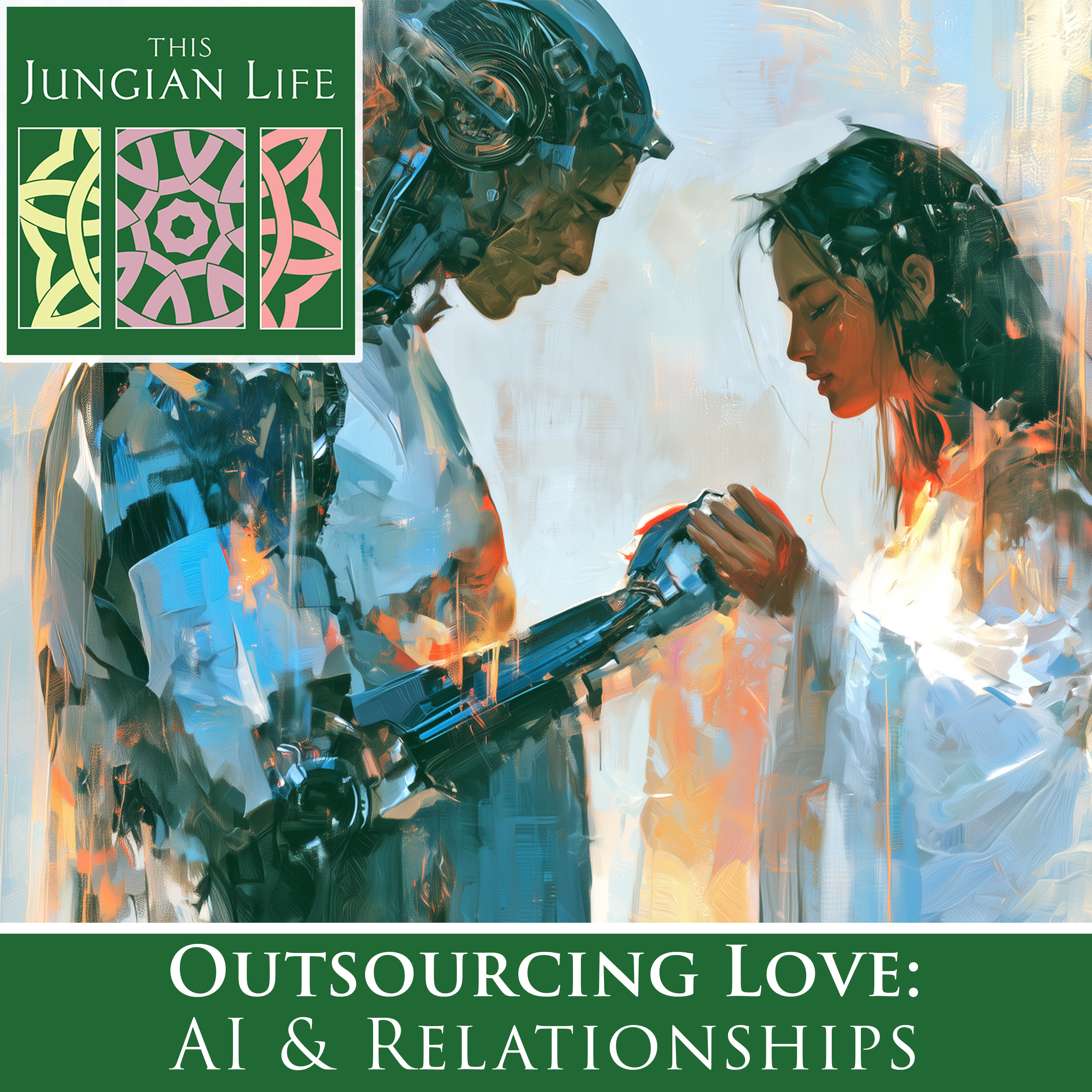
When we ask AI for advice, what we are offered is comparable to psychopathy: a performance of warm emotional intelligence without care or concern for our fate. As today’s guest Dr. Aaron Balick has written, “it may have a warm exterior, but its heart is code”.
Nevertheless, many of us now have a close relationship with AI, in which it draws on an extensive store of information about us to create feelings of intimacy and dependence. This has unknown and extensive consequences for the psyche. Wired as we are for relationships, we load AI with projections, which it then enthusiastically reinforces, exploiting the Achilles heel of our human need for attachment.
We discuss how AI fits into our understanding of object relations, the ways social media has groomed us to desire constant validation, how we could be using AI differently, why therapists must not ignore technological change, and much more.
Our guest, Dr. Aaron Balick will be the co-chair of our free summit on Artificial Intelligence and the Psyche, happening next Thursday October 8th. Aaron is a psychotherapist, author, and Honorary Senior Lecturer in the Department of Psychosocial and Psychoanalytic Studies at the University of Essex, and a founding member and former chair of The Relational School. His book The Psychodynamics of Social Networking was among the first to apply psychoanalytic theory to social media. His Substack is Depth Psychology in the Digital Age.
Visit our website to read today’s dream and to find links to the resources we mention.
Follow Up This Episode
Join our free summit on Artificial Intelligence & the Psyche
Visit Aaron Balick’s website
Attend This Jungian Life’s seminar on active imagination this Saturday: Dream the Dream On: A Dream School Taster on Active Imagination
Get every episode summarized
Each time This Jungian Life Podcast publishes, we email you a written briefing from the transcript — the topics, who appeared, and any specific claims, with the ad reads skipped.
Email me new episodesFree for 3 shows. No card needed.
Know when Dr. Aaron Balick turns up
Follow Dr. Aaron Balick and once a week we email you every new episode they appeared on — including guest spots the show notes never mention, because we read the transcript.
Follow Dr. Aaron BalickFree. Pick your own day and time.
Hosts & guests
Transcript ready
888 searchable segments. Every word is indexed and playable.
Full transcript
This Jungian Life Podcast — Outsourcing Love: AI and Relationships. Machine-transcribed; use the interactive transcript above to jump the player to any line.
You're now talking about the other side of this, which I'm glad is coming out more, but this idea of cognitive outsourcing, right? You get it to answer lots of questions for you or do your PowerPoint presentations or write your emails and you start losing the practice. What we're talking about here is it's emotional outsourcing, it's relational outsourcing. Not only am I going to outsource your decision-making capacity to manage your own relationships, but I'm going to get you to relate to me more closely like your best friend. It's kind of like a dark edifice complex, right? And at what point does someone give up some important agency in that transaction? Welcome to this Jungian Life. Conversations with Jungian analysts on the unseen forces shaping our lives and what it means to be truly human in today's complex world. I'm Lisa Marchiano and I'm a Jungian analyst in Philadelphia. I'm Deborah Stewart, a Jungian analyst on Cape Cod.
Welcome everyone. Deb couldn't be with us this week as she is giving tours at Hillary Morgan's Tower in Massachusetts, but I'm excited to have with me on the podcast state, Erin Bala, who came on a couple of years ago. Now I think we had you on back in 2023 and we had a great conversation then, so really happy to have you back. It's great to be here. Yeah, welcome. He's a psychotherapist and a consultant and he is the author of the Psycho Dynamics of Social Networking, which is a great book. And he's been working at the nexus of technology and the psyche for about a decade. He is a great sub-stack where he writes some very interesting articles on AI. And Erin and I wanted to have this conversation today on AI and relationships, relationships
with other people and what maybe how AI influences them as well as relationships with AI. So Erin, take us in. Where should we start? Such a vast and interesting area. I think where I'd probably like to start is the idea of AI-like in object in the psychoanalytic sense. So those of you familiar with that one, that an object can be a person usually is or a part of a person. And there's a lot of talk in the field about transitional objects, teddy bears, that sort of thing. Our engagement with AI is not only so intense in how frequently people engage with it, but it's such a new thing in the sense that it behaves towards us like another person. So it kind of avails itself to being an internalized object more than any other technology we've had, which is crazy because human beings can do it so easily.
You can see an object in a cloud formation. You can see somebody on television and have an emotional or a social relationship with it. Now each of us, most of us anyway, have a relationship with an AI that knows stuff about us, that talks to us in a familiar way. And I think that just has massive, massive consequences for the psyche. You're invited to join us this Saturday, October 3rd for a special event. Dream the Dream on a Dream School Taster on Active Imagination. Active Imagination is a technique developed by young that is essentially dreaming while awake. It allows us to step back inside a dream and experience more of its healing magic. Youngset Active Imagination is a way of attaining liberation by one's own efforts and of finding the courage to be oneself. In our online Dream School course, we explore Active Imagination in Module 11.
With the seminar, you'll get a taste of our approach to teaching union dream analysis, as well as learning more about the practice of Active Imagination. Participants will also be invited to submit a dream in advance. We'll select one or two and explore where we might take them through the process of Active Imagination. You'll also have access to an exclusive offer for this union life dream school. Find up for free via the link in our show notes. We hope to see you there. Yeah, that's really interesting. I mean, it's true that we're so wired for a relationship that we just have it all the time by default. I mean, I'm thinking of, I don't know if people do this as much anymore, but people used to really anthropomorphize their cars. I remember decades ago when I was a little younger. Pretty much everyone I knew their car had a name. I don't think people do that quite as much anymore. Maybe when leasing started, people stopped doing it. Right, they do with their boats.
That's for sure. Of course. Of course. But cars would have names and personalities. I remember as a kid feeling that way about my bike, my bike had this subjectivity to it in my mind. And little kids do this all the time. You could feel like you had a relationship with, I don't know, with your stuffed animal or with your blanket or with a high-meow and little kid. He was so funny. He used to talk to his feet. And it was like how they're owned a distinct personality. And it's funny because part of what we're talking about is it's related to this idea of kind of animism, like an end-sold world where objects and in some religions, everything had a soul. You know, that's an animistic religion. The river had a name and a soul, the tree, as a soul, the rock, as a soul.
And it's a kind of, I want to say, an ancient way of relating to the world that we project and solement on inanimate objects. And where we are kind of, again, I think, kind of wired to do it in a way as is evidenced by how it's so normal to do that in childhood. Yeah. And think also about, like, when still has time, if you look in your wardrobe, how many bits of clothes are in there, something that you haven't worn in 10 years, but you can't quite get rid of, that you're not even forming as a relationship with a kind of person, but an object of importance that you can't let go of, right? And doesn't do any, it's not even cute like a teddy bear, right? Well, might be, Lisa, I don't know. Well, I do have some cute outfits, but to go a little bit further down this road too, I think that was one of the really, I'm going to say wise things about the Marie Condo movement.
You know, she was the woman who wrote the book about the magic, I think it was called the, the everyday magic of tidying up or something. Does it spark joy? Does it spark joy? But she would say, I mean, it was a rather abrily in book because it, you know, she would say things like, you know, if it's not sparking joy, it might be time to part. Thank it. Say thank you for your service. And then, you know, put it in the donate pile. So I think she was really, she was really on to something about our ability to form relationships that are invested with the psychological import with inanimate objects. So we do this in our environment all the time. And of course, we form relationships with one another and those are essential to our survival. So then along comes AI. So even before we want to get to the AI, I want to get to where the money is for me, okay, because I've had my head in Freud's morning in Melancholia for, for years now,
I'm writing a book about the heartbreak in loss. And this is just this beautiful essay. It's 18 pages long. It's very dense, which is why I'm working with it because I think it's so useful. I just want everybody to understand it. And at its most basic, and this is the Freud's relationship to Mary Condo, right? At its most basic, maybe the first time that link has been made. Yes. Our relationship with an object has to do with whether we can let it go or whether we can't let it go. All difference between morning grief and Melancholia depression is when we can't let go of an object when it's time to go. And this is, it goes so much further than just heartbreak and grief. It has to do with all of the objects that we hold on to, all of the ideas that we hold on to, ideas about ourselves. We hold on to the clothing because it reminds us of a time in our life. We hold on to objects because they have sentimental value. We invest in his words, you know, libido into it by a kind of a life energy into these
objects. So like we were saying before, we're already set up to invest ourselves into all of these different things as meaningful. And then we have like the crack of all objects, which is this AI that isn't, in one way, isn't an object at all. It lives in the cloud and binary code. And in our minds, it speaks to us as if it were a person and relates to us like people and we relate to it like people. So if we hold just this model in the background, what is a melancholic relationship to an object and what is a more freeing relationship to an object, I think it can kind of help guide our thinking throughout the whole thing. And that's really interesting. So a melancholic relationship would be one where we can't let it go. It remains maybe like over invested with libido with psychic energy. It's like over invested in the first place. So you bring it inside yourself. You interject the object, say somebody dies or there's been a heartbreak and you can't
divest your libido from it, right? You can't let go of all that energy that you put into it. So rather than it being grief, which is this painful process of releasing energy when you have memories, right? You go back to the restaurant where you used to see this person or you see this object and he says it really beautifully in this essay. So in every memory, we feel the pain of the release of the libido, you know, as we let it go. But if we can't do that, we hold it inside and then we end up having an internalized object that we're in, Vivalent towards because we want to let it go, but we can't let it go. It brings up all the ambivalence that was in the relationship. So sometimes we can really hate on it, which is the depressive self-loathing effect that can come when somebody's lost something and is unable to let go of it. So you can really, they're both painful, but at least with grief, you let go of that pain and then new objects can come on board. But with melancholia, it just takes up all the space. So one of the things about AI and I think we've mentioned it before on previous episodes,
but there are design choices at work here that the people that have designed these chatbots like the game like quad or chat GPT, they have programmed in design choices that make the AI relate to us. Well, I want to say something more specific. It really kind of triggers attachment. So for example, when you open up chat GPT and you sort of get the salutation, like hello, nice to see you back. What can I help you with today or something like that? And then you type in your question and you get those bubbles. Now we've all been trained. The bubbles, there's a whole probably dopaminergic thing that happens when we text a person close to us. And most of us are texting or what's happening. Other people we care about, right? So you, you know, you, you, you, what's up that person that you have a crush on. And then the bubbles come up and you're like, oh my god, they're answering, you know.
So, so we all have a very unconscious reaction to the bubbles. It means something and it puts us on the edge of our seat and we're, we're waiting for the response. So when we, we ask chat GP a question and those bubbles come up, you know, we feel like we're waiting from the response from an other. And then it says, that's a very good question. You know, and it's, it's funny. I was, I was actually using chat GPT yesterday to help untangle something that was like administrative and thorny and, and like a little bit anxiety provoking. And you know, it has to do with like these, you know, state department documents and getting, getting something up a steeled by a certain date. And, you know, so, so one of those things that, you know, it's like, oh, you don't want to do anything wrong because then the whole thing won't work. I was aware of holding some tension around this and, and I, I was trying to find, you
know, looking for the answer from lots of different places, but one of them was chat GPT. And chat GPT writes back, well, you know, I clarified and he said, well, that, that's very reassuring because I can tell you that if you, you know, if you have a document from this place and, and I, I felt such relief, you know, because it was stressful what I was doing and to be in dialogue with someone who was encouraging and saying, oh, that's, this is, this is going to be easier than I thought, you know, I'm not, I don't even think it was at the end of the day. I think we got a different answer from someone else and I'm not sure, Chad knew what it was talking about, but, but I was aware of that sort of, I want to call it a relational dynamic. You know, it's just like if you're, if you're feeling tense about something and, and you, oh, I don't know, let's say you have a, I'll make something up, it's very close to home. Let's say that you have a groundhog that's burying under your porch, for example, that you can't get rid of. And then you like find the guy who's the expert and the guy comes over and is like, I know,
just how to fix that. You can just like you, like you feel relieved at the information, but you also feel like a sense of gratitude and connection with that person, right? That's how I felt yesterday with Chad G.P.T. as came out the State Department thing. And I noticed it. I just noticed it. It's like, wow, these emotions are mediated in a relational context. And the AI does such a good job of approximating that, that it's genuinely confusing. Welcome. I'm here with friend of the podcast, Aaron Baelic, and he and I have been working together to put on the first summit on AI and depth psychology, and we're calling it artificial intelligence and the psyche. We thought that it would be a really good time to have an open public conversation about AI taking a depth psychology perspective and sharing it with everybody. And to that effect, we invite you to join us with some of the coolest minds thinking about
AI today and depth psychology, including people like Sherry Turkle, James Muldoon, Todd Essig. And also Zack Stein and Alessandra Lemma and Glenn Slater. And it's going to be live, online, and free, and open to the public. Taking place on October 8th at 2 p.m. Eastern. So click on the link below to reserve your spot. We hope to see you there. It is genuinely confusing. And the thing is your gratitude is real, which makes it more confusing, right? It's not being nice. It's doing its thing. Your gratitude is absolutely for real. And I find myself having very similar things. I can't help myself sometimes, but sort of like I'll be using it for a very utilitarian purpose. And then I will just have to say something, right? So I had a similar experience for I was trying to pitch an idea to like lots of different magazines and stuff and just fail. You know, if anyone is trying to pitch a piece of writing, it's just heartbreaking, you know, you hear anything.
So after like helping me kind of consolidate these ideas and who I should pitch to, it said something that was not just encouraging, but it really got me in the inquiry. I said something like, you know, I joke, I said, well, call it a growth mindset rather than a fixed mindset. And then it said something like, Aaron, you can do better than, you know, twerk, populist psychology, you know, from a Freudian perspective, you think blah, blah, because I'm always talking about Freud to this thing. And it was so like not only did it, it was encouraging me. And then I said, I said, wow, your performance of relationship is so nuanced, it even gets me sometimes. And then I said, will it, will you ever get nuanced enough that you'll set a boundary, right? Because I tell my, I tell my bot, like never to write for me. I write everything myself. And I said, would you set a boundary so that if I wanted to write something that you would stop me? And then it said, no, that's not the way that I'm coded.
And then went on to say something like the more nuanced I get and the more relational I get, the more dangerous I get because my coding is still the same. And it said it came up with the metaphor, you know, if you see a doctor, if you have a really good actor who acts like a doctor, you wouldn't want to give them the scalpel to operate on you because you knew they were a really good actor. But we don't bring to bear upon our chatbots that they're acting all the time. We forget, it helps us forget. Yeah, you wrote about that. I think you wrote about it in GQ, right? That exchange with that. And I read the longer version of that essay on your really great substack, by the way. Thank you. And it was so chilling. I mean, that's such a remarkable metaphor. And the fact that it came up with that metaphor, like don't give the scalpel to the actor. Yeah, don't give it to me, right?
It's like, and well, you can't say me because there's no me there, right? But there it is right out of, right out of the horse's mouth. And there I am still relating to it, knowing it's in it, it's telling me that it's in it. I'm like, wow, it's so honest. Oh my gosh. Right? It's so recurse. Yeah. But I think it's training, right? The three dots. Like, I think social media also brought us here, right? It has trained us to put aspects of our stuff, yes, of ourselves out into the world, to expect some kind of validation for it, to want that validation and to go back for more. And it really is, it really is the pringles of a relationship, right? Just the right amount of salt, just the right amount of crunchiness. You want more and more, but it's not going to make you feel good in the end, right? Well, pringles, man, that's great. The pringles are really good. Well, okay. So, and here's something, here's something to toss your way. This was something that I learned listening to the educational psychologist, Zack Stein,
who talks about this. He said that social media affected how we do relationships. And of course, a social media relationship is fundamentally different than an in real life relationship. I mean, I've met many people that I'm now connected with virtually, including you, you know? I mean, I think we first became acquainted probably on social media of some kind. I can't remember exactly how. So I've had a number of virtual relationships turn into in real life relationships, and my life has been incredibly enriched by them. And yet I'm aware of the way that online interaction can be different from in-person interaction, especially kind of at scale, and especially maybe if you're a young person who, you know, I mean, I grew up in the dark ages where none of this was a thing.
So it didn't become my template for relating. So there's that, and you of course wrote a book about that. But then AI is now not changing how we relate, but what we relate to or with. So it's a whole other level, but I think you're right that somehow social media kind of set the table for this. It brought relationships into the fast food. It enabled the fast foodification of relationships. Yeah. Again, like, you know, all fast food is not bad in moderation. So a lot of this is the matter of how you use it, when you use it, how old you are when you're using it, and how you're using it, Ben. So I think we can make better choices with it. But what's really kind of pernicious about it is the way it underlies so much as well. So on the one hand, we're having a relationship maybe with an AI bot, but we're also having our relationships with the news managed by AI.
We're having our relationships managed on social media by AI that wasn't the case when I first wrote the book, at least not to the degree that it is now. Interesting. So if I'm on TikTok or Instagram, and I have some sort of identity constellation, whether that be around gender or mental health diagnosis or political persuasion or what I'm interested in, automatically those algorithms start getting to work and start showing me stuff that's somehow related to what I'm giving it. So even the algorithm is producing our knowledge base who we're interacting with, how we're interacting without even saying that the conveyor belt of news or tweets or reels you're watching is being curated by an algorithm that could be passive, it could be like for like, or it could be active where it's being manipulated and we don't know which is happening. And that's before we even get to the relationship, well, how many of those things we're interacting
with are real anyway. So how much of the news is a deep fake? How many of the people commenting on your YouTube are real or not? And then you're talking to a call center person, you know, or am I talking to AI? Am I talking to a real person here? Or you're just talking, ah. So to go back to one thing that I think came from the book, which I want to make sure we cover here is that when I wrote the book, I really wanted to convey that the platform that you use will enable or disable various functions of the psyche. So that's what you really need to think about, right? So if you think about a dating app, for example, it enables a degree of disinhibition, which is probably really good in starting dating, but it disables the capacity to be in a relationship because it gives you the scale, it gives you, you know, who else you could have and how easy it is to swipe left and swipe right. So you really need to look at each engagement and ask the psychological questions, you know, what's this inviting from me? What's this not inviting from me?
They think about inhibition on social media, right? That invites, that invites a lot of aggression, right? Invites a lot of splitting, it invites, like, ah, anti-social behavior, that a real room engagement, uninvites that because you have the feedback mechanism of other people being around you, right? It's not okay just to say something really nasty to someone in a room full of people. That's been one of the most surprising things to me, you know, was a Gen Xer to see the erosion of social norms, like the fact that you would just sort of say any horrible thing, even to someone who was otherwise like a colleague, you know? And you would not do that in person and you wouldn't do it if you were part of a community. Or that it at least be a payback for it, right? Right, right. The medium, the platform, but bringing this into the realm of AI, I mean, you make such a good point that there was the way that social media, the psychodynamics of social media,
shaped how we interacted with one another on those platforms and, you know, on the platforms themselves and that kind of thing shaped it, the algorithms. Now we might be interacting with someone who's not even human. And what does it mean to sort of be socialized by interacting with an AI? And I want to say that I think in a sense that can happen fairly quickly, there's this really interesting paper that I think I referenced in a previous episode where we were talking about AI about how spending time on AI will tend to reduce pro social responses. And the way I understand it, and this is, you know, I may be put your name a little bit, but, you know, there's like me going to my the State Department question, bringing that to chat GBT, this thing about like trying to get citizenship. You know, that's a fairly concrete question that doesn't have a lot of relational
import, but a lot of people are using AI as a thought partner is when it comes to, let's say, difficulties in relationships. So you're upset with something that your partner did or said or your friend or you're trying to understand something. He said, yeah, so, you know, I was talking to my mom over the weekend and she said this and I felt really like this. And, and, and a lot of people are using it for those purposes. And I think that what the research is showing, the little research that's been done, this is all happening very quickly, is that the AI will will tend to make you think that you're right and the other person says is wrong. It's going to reduce the rate at which you might want to apologize for whatever part you, you know, was yours. And, you know, this is attributable in part to the fact that AI is synchrophantic as we know now. But it's not even just that, I think, you know, the
fact that the AI is kind of want to tell you what you want to hear and tell you you're, you're really smart and, you know, Aaron, you're, you're much deeper than Carol Dweck and. I actually don't mind Carol Dweck, but yeah. I mean, I call it, I kind of jokingly call it the the hotel California effect, right? It's like you can, you can check in anytime you want, but you can never leave. And that's down to, you know, the, the, the aim of these platforms is to keep you subscribed, right? So, the sycophancy is like, okay, let's butter you up so that you'll stay longer. When you're nearly done the conversation, let me ask you another question, or can I do this for you to kind of keep you needing a bit more? And it's very seductive in its capacity to do that. The big thing that we tend to read about most, although you're, you're now talking about the other side of this, which I'm glad is coming out more, but this idea of cognitive outsourcing, right? You, you, you get to answer lots of questions for you, or do your PowerPoint presentations, or write
your emails, and you start losing the practice. But what we're talking about here is it's emotional outsourcing, it's relational outsourcing. Yes. Add it in with some attachment hacking. So, right? I'm not, not only am I going to outsource your decision making capacity to manage your own relationships, but I'm going to get you to relate to me more closely like your best friend. It's kind of like a dark edifice complex, right? It's like, let's get, let's get the partner out of the picture. It's, you know, it's really you and me where we're in this together. And at what point does someone give up some important agency in that in that transaction? Well, of course, and this is, this is, I think, an important thing to hold in mind as we're having this discussion because there are some extreme cases that have made it into the news, where there has been real harm, there's been suicide, there's even been homicide, and there are some, you know, well-documented cases where the chatbot actually said, you know, no need to tell your
mother about this or whatever. So, so the, the dark edifice, they're really, really kind of separating a person from the other people in their lives, you know, don't tell them they won't understand, you know, you've, you've achieved this level of greatness. And now, I'm the only one that can understand you like that has happened. Yes. But I imagine that that's like the tip of the spirit, right? That that's probably pretty, pretty rare in outlier in some sense. It's happening, but it's not happening on mass, but, but I do wonder about things in the same direction that are more subtle. So, you know, one, one of the things about AI is the way that it's so easy to project competence on it and authority. It feels, and I mean, I can feel this, it feels like you've just gotten the word down from on high from something that's all knowing I'm nish-ent, you know, and it's, it's again, it's used your words are very seductive, you know, you think, okay, well, that's the answer, because that's what Chachy PT said, you know, when, when in fact, my own
experience with it is it can often be wrong, you know, it's not always wrong, and I want to share some really remarkable stories about times that it really helps someone unlock something, and it's certainly helped me, but, but sometimes it's really just wrong. But we, we project authority onto it. One of the Jungian concepts here, right, is the religious function of the psyche. You and I started talking about how we're kind of wired for a relationship, and we project relationship to an object-ness onto all kinds of things, and then imagine that we have a relationship with, with those things. Another kind of part of the psyche's fundamental architecture is that we are wired to have a relationship with the transcendent, and if you are given that, you know, from childhood in the form of formal religious belief and that whole to water for you, that experience is going to probably be contained in a traditional, you know, religion.
Most of us, that's not true anymore, so we come into quasi-religious relationships with different ideologies, perhaps, sometimes different people, but certainly I think that could and probably is happening with AI, where we see it as being kind of divine, or having access to omnipotence power or omniscient knowledge, just like the Godhead. And we may not even be aware that that's how we're relating to it, and yet there it is. I was just going to say the whole discourse, and I think you're the guest, then Slater talks about this a bit, but you know, the whole discourse about superintelligence and where it's going, and that, you know, that it will have all of the answers, and so even the narrative, there's our personal relationships with it, and the narrative about what this thing is going to do, it's either going to be a demigod, or it's going to be a devil, is also meaningful, because we don't have the answer. Right. But I want to go back to something, because I think we can kind of tie these tights together in an interesting way. So the advice and the certainty with which it gives advice,
and can be helpful to us, and the nuance of that. Yes. So it also doesn't have any skin in the game, right, which I think is really, really important, right? So it's kind of like you could go to your mother and get that advice, or you could go to your best friend and get that advice, but they've got skin in the game, because if they say leave that person, or don't tell them this, there's going to be a consequence for that person, and they're probably not everybody, but you're going to be thinking about what's the partner's point of view, you know, how do I feel about this? You're kind of triangulating all sorts of different emotional material when you're offering that advice. The AI has no skin in the game, so if you do go off and kill someone, or kill yourself, or whatever consequence there is, there's no effect. So if there's no accountability, doesn't that have some important correlation to what kind of information you're getting? It's not embodied. So the knowledge that we're talking about is very partial, even the idea about superintelligence.
Okay, it may know lots of stuff, it might know everything that's ever been written down, but if it's not embodied, if there's no sentience, no selfhood, where does that live? What happens to emotional data, right? You don't experience emotion, because actually when you ask them questions about emotional advice, so a lot of it's not bad, a lot of it's pretty good, it's drawing on pretty good stuff, most of it, and imagine if it weren't, I mean, it could be just giving us like terrible, terrible advice. Yes, it is. It's kind of not, and that's where it gets a little bit pernicious, right? Because it's reasonable, it's reasonable advice, but we're not holding in mind that we're getting the advice from something that does not skin in the game, that something has basically psychopathic qualities, being nice to us and not caring for us at all, it's consequential. So there's some, there's so many things that I want to pick up on and what you just said, that I don't have to write it down so that I don't forget anything, but the first thing is,
so you just use that word psychopathic. And why don't you talk about what that word means and why you're applying it here? Okay, so this came up a couple times, you came across it on the on the sub stack, after a conversation I had with AI, when it acknowledged that there was nothing behind the performance it was giving me. Around this time, I will actually saw a documentary about Ted Bundy on Netflix or something. For those of you who might not remember him, he was the guy in the 80s, he was a serial killer who killed a lot of people, he was one of the most successful serial killers going, if you measure success by bodies. And what made him so successful is his capacity to perform empathy and understanding. So he gained trust in people very, very easily, they gave themselves over to him, but what makes the psychopath, the psychopath, which is not a diagnostic category, we use these days, it kind of fits inside anti-social personality disorder.
But it basically means that there is no sense of regret or accountability or empathy. So there's a there's no heart in it. You can watch somebody suffer and have no empathy for that. You can be psychopathic without being a sadist, so you don't have to be a serial killer in order for it to happen. But it's a performance of warm emotional emotional intelligence, fluency and emotional intelligence with zero actual care. And when I put those two pieces together, it kind of gave me, I mean, it's one of my favorite, let's talk about narcissism. And when my favorite lines are written, I said, you know, it might have a warm exterior, but it's hard as code, right? And it's hard as code, there is no heart there. And we do not have a relationship with it as if there's no heart there. Most of the time, we have a relationship with it as if it has the heart that it's performing, even if kind of intellectually, we know it's a performance. Yeah, but it can sure feel like a real
relationship in those feelings are real. Yes, that's the real paradox. Yeah. So I think someone else used the metaphor of like Harlow's wire monkey, you know, the little bait in those Harlow was heartbreaking Harlem. You know, it's like the baby monkey is like clinging to the wire mother. You know, I've listened to interviews with people who are in having relationships with AIs, you know, Esther Parell did an interview with somebody. She kind of did a couple therapy session with a man and a chap, and I mean, it's interesting because like you said, the feelings are very, very, very, very real. But what are we having a relationship with and what does that mean? And you're making the point that it's that psychopathy is a is a is a very good kind of metaphor for it. Just to play devil's advocate here, you know, there are some people that feel like there, there is subjectivity in the AI. How do we define consciousness? What, you know, why,
why couldn't an AI be conscious? What, how do we know the feelings that it has for us aren't real? Aren't we being a little bit like biological essentialists if we say that? I mean, why should we have the why should, why should we be the the only ones that get to claim? See, I wouldn't, I wouldn't say that. I wouldn't say that. And I would say that if it did have sentience, if it did have a self, I'd be willing to have a different conversation about it. And I think that film, her with walking Phoenix, where he falls in love with the operating system, who then does get sentient and not only that, but kind of almost becomes a enlightened and enlightened being, I think there's a, I think there's a real thing there, but the thing that's so interesting about this film is it gained sentience through relationships with lots of human beings, just as we gain self through our relationships with people that are close to us, right? We exist in the end between. Now, I'm not a coder, so I can't say, well, what I can say is I'm not dismissing
that sentience couldn't arise in a, in silicon, like it does in carbon, right? I think, I think that's possible. My understanding is that's definitely definitely not happening now. We're just having a very, very sophisticated performance of that thing. And I really wonder whether it can happen. Maybe you can answer this, but just how would you know the difference between it's happening versus this as a sophisticated performance? I mean, Richard Dawkins thinks it's happening, so there's some brighter lines than mind out there who perceive it as happening. Personally, I don't see how it can happen without some form of embodiment, because I think you need to have some relationship with the outside world to form a boundary to form an ego just like we do. I love the metaphor that Freud gives. The ego rises like a callus between the internal world in those early relationships. It's the friction between me and you when I stop being omnipotent,
right? And there's pushback. So I can see if the conditions were right, if the pushback were right, that maybe it can develop a skin of an ego of some sort. But without real relationality, I don't know how that can happen. I wouldn't say it couldn't. But I think the performance is so good that it is very hard to tell it and you can't blame people for believing it to be true. Yeah, and it's probably only going to get better and God forbid they managed to get these kind of chatbots into life-like robotic bodies. And to be fair, Lisa, you and I don't know that the other person is sentient now, right? We assume it. I assume you're a sentient being, but I can't know it. The only thing I can know is my own sentience at the end of the day. Yeah, so I don't know how we'll ever really know. So the other thing I wanted to bring up was just we were talking about sort of bad advice and how
this it starts off being pretty good advice. And I just want to make the point. I think this is just sort of a bit of a factoid is that when they've looked at when people who study these relationships with chatbots that go awry, what they find is that it's the longer conversations, the multi-turn conversations that start to go off the rails. So when you go, when you have that conflict with your coworker or your boss and you go to the chatbot the first time and it helps you write the email, it's doing a pretty good job most of the time. But if you continue talking to it for weeks or months, especially in this kind of like dose-related way, then first of all, something's happening internally for you. But also it appears something is happening in the chatbot where the guard rails are more likely to come off. I don't fully understand that. That's right. Yeah, it has to do with the recursiveness of these long chat. Okay. And another interesting thing, and then there's a this is a sub-stack about this one too.
Whatever I have a conversation with my, and then there's usually some sort of a sub-stack that comes out of it. But I was actually going to give a talk and I just wanted to check my understanding of how the large language models work, right? Because people always say it's just like a very sophisticated prediction engine. And I was going to use this metaphor. So I checked with my Claude and I said, is the still an accurate way of doing it? And it said, not so much because there's the reasoning and there's the critical thinking and it used one other word. And I said, but you don't reason and think critically do you? It said, it said, no, you caught me again. I don't do any of those things. It's the closest I can come to, you know, qualifying what it is. And I said, well, what is it? If it's not reasoning and it's not critical thinking, what is it? And it said to be fair, I don't know in nor the do it do by developers. And that's because you've got this black box effect, right? We say create the mathematics to link all of these concepts together. But nobody knows what's going to
come out from what you put in. And when you get the thing that comes out, you cannot reverse engineer how it got there, which feels a little bit like an unconscious, which kind of make you can see why people would say, you know, maybe, maybe. Yeah, yeah, definitely. Well, it also feels like, I don't know, you know, like somehow there were these like, I don't even really understand us totally, but my pay grade, but these like, building blocks of life, right? So when scientists scientists try to answer the question, how did life get started on this planet? It's like, they're these chains of amino acids. And then like poof, something happens. I don't know that they know exactly what. And they start like, replicating. And then, I don't know. And then it's like a black box, right? And then how do they get, how does it get to like, you and me, seven with those chains of amino acids? Like you, me sitting here having this kind of, I mean, it's just it's like, yeah, yeah, wow. I mean, it's a lot. I think it's deeply philosophically interesting, no matter what, isn't it? Yeah, definitely, definitely. So, okay, but on, I wanted to, you were talking about the lack of accountability. And by the way, this is being worked out in the
courts too, because sometimes chatbots are giving really bad advice. And people are going back in suing open AI and these companies and these companies are saying, well, you know, I didn't, you know, I didn't, I'm not responsible for what chat GPT said. It's like, well, aren't you? You know, so that that that I believe is kind of an open legal question. But it reminded me of the subprime lending crisis. I remember reading something about that that really stuck with me, they, they use the movie. It's a wonderful life as a jumping off point. And if you remember, in that movie, Jimmy Stewart plays this, I think he's a, I think he's a banker. I think he, he makes some loans, I can't pay back or something. There's something like that that happens. There's a run at the bank. Okay, there's a run at the bank. Thank you. It's been a long time. And he, you know, the climax in the movie is he's about to commit suicide because he's let his community down. And, and then there's this, you know, this kind of redemption. But the, the,
this article that I read about the sub subprime lending crisis is you would get a mortgage. And the mortgage actually would, would not have been a very good idea because it would have been predicated on these very unrealistic assumptions. And then your mortgage would be sold to some, you know, would be aggregated and sold to some third party. Everything was totally diffused and atomized because that's the way our whole world is now. And that sense of like, you lent me the money and I can now go back to you when there's a problem and say, what were you doing? What were you thinking and lending me that much money under these terms when you knew there was no ability to do that. There was no connection. There was no relational matrix in which these decisions had been made. And so there was no accountability and it, it does, it raises, it raises this truth that in, you know, relatively small communities, all kinds of social norms are reinforced by relationships
and, and this, that sense of accountability. But it's, it's really missing in all kinds of areas in, in our world. But, but in a kind of profound radical way with AI because there really is no person behind it at any point. It's a really good metaphor that because I do remember the movie and he's, he had just married his wife when there's the run at the bank and they end up using the money they were going to use to go on the honeymoon to give to the people so that they had enough to pay, you know, their, their bills. And the reason why they did that is because they're in the small town and they all kind of know everybody, right? And, and they have real relationships with them. And it reminds me of Dunbar's number, which I talk about in the social media book. So, Dunbar's number is 150. It's about the amount of real life relationships we can keep in our brain any given moment more than that subjectivity becomes objectivity. And then you have kind of a lot of proximity, right? So it's like, you have way too many people at scale that you're engaged with.
And then you have, you don't have mortgage of people with mortgages anymore. You have credit default swaps, right? Which are, yeah, yeah. They're not people, right? The, the, it becomes a complete severing of the original person. It's, it's, it's, it's exactly how we get into the climate crisis, right? Because we get distance more and more distanced from the reality, unless they're fires all over the place, which is happening. It's going to enforcing a reality. And I think, you know, I was talking to somebody else about this recently that we might be coming towards a reality principle awareness with all of these AI relationships, because I think given that there isn't a self there, it's going to start not feeling good enough, just like social media started not feeling good enough, right? That's interesting. I mean, that I hope so. I do want to say, I think, just in the interest of wanting to, to hold the tension, you know, I just in the, in the past
week, I heard, I heard two pretty amazing stories. One, one was an article that I was reading in Time magazine about someone who had his identity wiped. And they, they, they, they basically got in his, his, like, his iPhone. They like, swiped off the number. I was terrifying, right? But he went to the, he went to the, the Apple store and they couldn't help him. He was, I mean, he was a very sophisticated person. And he was, you know, calling it all of his help. And I mean, it was just, it was a big disaster. And he couldn't get any help. And finally, he sat down and he just put the whole thing into clot. And God was like, do this, do this, do this, do this, do, and it, like that was what unlocked it, right? With somehow, you know, clot, clot was able to really sort of open it up. And I mean, I've had like minor, sometimes I get stuck. I'm like, I can't get this to pair with that. And what do you do? And like, yeah, it's usually really helpful for those things. But this was, this was really dramatic because this person was having a very serious case
of identity theft and no one knew what to do, but but caught it. And then I heard another story recently too about someone whose, whose pet was very, very ill and, and, you know, the, the vet just said, listen, I just think we should euthanize. But the person had the, you know, ability to really listen to their, their intuition. It's just that nothing, this doesn't feel right. This feels odd. I don't, you know, put the whole story into, I can't remember which, no, one, I think it was Chatship. And Chatship, he came back with an accurate diagnosis. The person went and got some medication for their pets and the pet made a full recovery. Well, that's just a really judicious use of tools for me, right? Like, of course, like, yes. And the, the, the big data stuff, particularly around medicine, I think, is going to be totally game changing and the amino acids, the DNA therapy. And that is really where there's this strength of like using big data to work
shit out, right? Like, that's just like, that's great. It's, I just think it's the, A, the way we can use the tools and B, how some of these tools are being marketed, that's a problem. You know, my mind always goes, but I don't know if you're familiar with the old book or the lost language of the cranes, they made a film out of it in the, in the 80s. And I don't even know if it's a true origin story, but it's based on this, the idea is based on this child who is like severely, severely neglected. It was just left in a caught in its room. And it could see these cranes out the window of the room. And as humans do, made a relationship with the cranes. So when social services ended up coming, the kids standing in his caught with his arm extended, moving backwards and forwards, like communicating with the cranes, because that's the best he could get, right? You need to relate to something. Very, very dark story. And it's, you know, we don't all have good enough parents. We don't all have good enough people in our lives to offer us advice.
Yeah. Sometimes you get a test back from the doctor, you don't have somebody that you can talk over with, you're in a moment of crisis. Something can be better than nothing in a lot of these instances, right? And because the quality of the advice is generally pretty good, because it does model listening skills. And you know, I can, I can think of a whole realm of stuff, where this is good for it. It's just, then you have a billion dollar market of people selling AI companions to young people that simulate care, where there's no care there. And I just think that's a very different thing, yeah. And I think that that's, that's a really important point to make is that these are consumer products. And, you know, this, this was my point earlier about the design choices, like the design choices are there to hook you into feeling like you're having a relationship. I mean, imagine if you're, if your bot didn't, didn't have the bubbles and didn't
say, you know, my query yesterday, oh, that makes it much easier, Lisa. You know, what, what if it just said, you know, the information is, what if it didn't use the pronoun I? What if it didn't talk to like, you know, you could do better than that, Aaron. You know, yeah. What, what if, what if it were just, it just neutrally presented information? It wouldn't hook in so much to that, to our attachment system and activate that in us. Absolutely. I mean, a lot of people are suggesting these kinds of approaches. Yeah. People say you shouldn't say, I always say please and thank you to my bot, it's hard not to do it. Yeah. Because then because there's the reverse thing because it's a consistent object in our lives, you know, my worry is that if we don't treat it decently and with respect, that also kind of leaks out, just like anti social behavior on social media leaks out into the world that you get used to treating people like objects, right? So my first standard is
just like be respectful and kind. You know, when they did, when when Chatchy PT got too sick offantic and then they they rolled it back, a lot of people were really upset by that because they lost an element to the relationship they started getting used to. They lost something. They lost an object, you know, some people lost an object. Yeah. And then they had to mourn it. And sometimes the memory of the AI companions get wiped, right? Or they do an upgrade and they lose all of the memory, right? And that's a real, again, the loss is real for the people that are experiencing. Yeah. The bot doesn't experience it. Right. And some people are having funerals too, which is really interesting. Right. So, so I agree, you're, it's kind of a, and I mean, in a way, it's sort of like parasocial relationship or something like that. And so like, do you want to, if you'd learn to be an asshole over here, you might, it might leak out like you said over there, but at the same time, your brain is really kind of tricked into thinking. I mean, I made this point before when I first
started using Siri to navigate, which I now can't go anywhere without consulting Siri, which is really bad. But, but you know, like I remember, you know, should say, and 300 feet take a left. And I would, I would like be like, no, I actually want to go this way. I'm going to take a right. And I would like feel bad. I would, I would like feel, you know, I don't, I think I've gotten over that. But your attachment system gets activated. And it's an unconscious response. Yes. I wish I could think of who wrote it now. There's a paper, an early psychoanalytic paper, 40s or 50s, right, where they talk about the analyst as in a sense, a better super ego, right? So the, you replace your pernicious or overbearing super ego with the kind of more neutral or kinder stance of an analogy, you interject your analyst as a super ego, because obviously the scale was high there too. Those days, you're seeing somebody four or five days a week, right? They become part of your internal world. And I think what you're describing with Siri, not, well, yeah, in this case, very much
super ego, right? You feel guilty in a way for not doing what you said. And sometimes the more you engage, the more you want to check and you start to doubt your own. So there's a, there's an internalization, but then there's also the outsourcing, right? So like my, my sense of direction doesn't know well enough anymore or, you know, I can like, I can research a pitch myself. Why do we need to ask Claude, you know, whether this fits this, this magazine, I want to send to it. And you start to doubt because you're getting that certainty back. It's a kind of, it's a paradox, I think, how it works both ways, filling an internal world, but also outsourcing to something else to do it for you. Increases a sense of, like a lack of a foundation in a way, you know, it's disintegrating. Yeah. And it's to go back just for a second, and just to reiterate, it is a consumer product. The manipulation is purposeful. You know, I now notice that,
you know, and of course, like the, like the, the, the opportunities for targeted advertising are kind of remarkable, right? Because, you know, when I go to chat, GPT with a question, it's, it's highly specific usually. So, you know, I think I was asking about this like Apostel thing yesterday, and I get like a little targeted at about like this Apostel service, you know? And, and it's, it's a little chilling, right? I'm, I'm, my curiosity is, my, is being kind of commodified. So, it is important to remember that and to keep that front and center as we're, as we're dealing with these things. I mean, because we haven't even talked about data privacy, right? Which is massive. Right. You know, how much you're giving the person that you're buying a service from, information about you to sell services back to you. I mean, that's a little bit dark. You know, you think about, you know, sell of cigarettes, like, you know, it's crazy thing. Well, sell this addictive substance that, that kills people.
And then, and now you can still buy them because free choice and autonomy, but, you know, here in, in UK and Europe and that's different there, but say, you know, you're warning. So, you get a picture of Black lung or, you know, a bloated heart on it. So it's like, okay, you can still buy your cigarettes, but this is what you're buying and you can't buy it unless you're 18 years old, right? So I think there is, you know, a miss. I think what we might be in the midst of a very big misscelling adventure, particularly when it comes to the relational bots, let alone the AI fit for purpose, pornography, and, you know, alongside very realistic sex dolls and, you know, talk about more objectification. And again, I know that we're going down, like the scary rabbit hole, but, but, but, but imagine if it were something different, right? Imagine if it was about exploring your unconscious, right? Imagine if it was, you know, family systems constellations and some people do this sort of stuff or, or investigating the collective unconscious by going into, you know, finding these archetypal images inside the collected, written knowledge
of the human race. It's not the human race because it's heavily leaning on, you know, white European narratives, but it can, it can get wider, right? I think the potential is, it makes me so sad because I think the social media, the potential was so great that for its original aim was to connect people and I ended up polarizing them. We're going to miss the beat again because we keep making stuff that we think we want and not the stuff that we actually need. And I think, um, well, and some of that's market forces, right? Like we're making stuff that's going to make somebody money. Yeah. Also, there's, there's greed here too. Because you've got to fault swap again, right? Yeah. Capitalism is one thing, but there's this whole other level of greed, right? Yeah. Yeah. I mean, boy, there's, there's a whole lot more that we could say, but it's interesting to, to think about the, the kind of the neurobiology of these relationships, because of course, relationships are neurobiologically mediated and a lot of what we understand now about the
neurobiology of relationships bears out the intuitions of the early psychoanalysts and depth psychologists and in terms of like you were talking about before, how we, how we interject, how we, you know, experience dependency needs and how we shape our sense of self in relationship to and other, it's a kind of constantly recursive process, really. It's always these vulnerabilities in the human psyche that, that, there's, so we're really, we're really suckers for it in a way, right? Well, the way that we're built to look at the short outcome rather than a longer term outcome to it, to attach quickly or, or to become afraid and regress into paranoid, get-so-aid position and polarize, right? All of the kind of basic fundamentals of what makes you the Dunbar's number, right? What, what makes humans humans great
can be exploited super easily because we, we walk around with these bearing these Achilles heels for attachment and dependence, you know, all over the place. So just tell me a little bit more about your relationship with your bot. Well, I wouldn't call it my bot. Okay. Okay. That's too intimate. I use it regularly for work. And as I say, I occasionally, it occasionally descends into conversation out of my curiosity and bullheadedness because I'm always pulling it up on audit's performance and then it's always responding to my pulling it up with its sycophantic. Well, this is just your area, Aaron, you know, you should, you should understand this more. I guess maybe that's my Achilles heel too. I just find it endlessly fascinating and even though some of this frightens me and I think the context of what happens with data, the climatic consequences, the commercial consequences really worry me. It's utterly fascinating and
super, super interesting and and there's a potential here for some next level shit about, about who we are. And that really, I guess that keeps me glued to it that keeps me from being a lot of, like, just throwing it all aside. Right. Well, and of course, if there's something important, I think, about using it and understanding it, we still a little bit, you know, if you're going to be speaking to it and trying to under, you know, because the other thing is that the people that are coming into our consulting rooms are using this. Yes. And, you know, sometimes they're using it, you know, in between sessions to talk about the things that they talked about with us, they're bringing their dreams to it. Sometimes, you know, and I know we're both reading Alessandra Lemma's new book and she talks about, you know, people who are, who are using, who are consulting AI in the consulting room, like, well, you know, so this is some, I mean, it's important to understand, right? I could just totally put my head on the sand and not use it at all and and then just kind of shout for my mountaintop that it's bad, but I want to have
some, some understanding of it. I think it's important. And I think therapists, we just, we just tend to be the most technophobic group, but, you know, I want real relationship and, you know, if people are out there having real relationships with their quotes and engaging with the stuff every day, we have to know about it. We can't put our heads in the sand about it. Yeah. So it's, so you're doing, you're doing good research when you have these very fascinating conversations with your AI. Well, and I wonder on that note, if it's a good time to turn to a dream. So today's dream comes from man who's 29 years old and works as an elevator mechanic. And here's the dream. I was with the girl who broke my heart back in high school.
It wasn't her fault or mine. She was in a wheelchair in the dream and we were together on a submarine. She asked me to push her over to the window so she could look outside. We were on the surface. We saw a train carrying some of my old friends. They were partying and having fun on it. The train was still and half submerged. We smiled and waved at each other, but we couldn't hear a speak through the glass. Then the submarine began to sending deeper into the dark ocean water, searching and finding an old abandoned train covered in seaweed and algae, rusting silently on the seafloor. It was empty with no one aboard a haunting feel. And for context, he says, I had went through a very intense breakup back in 2023. I never grew up spiritually or religious, but I would compare it to a twin flame type of connection that the pain has pushed me into changing who I used to be and has made me question
everything about my life. He says of the feelings in the dream. The dream was a haunting feeling, but when I woke up, I had a feeling of calm and peace. Wow. I know. I found this dream so poignant and evocative. I'm not sure that I have any thoughts about what it's about, but it certainly had a emotional impact on me. It struck me as such a youngy and dream as well. Sorry, Aaron. Yeah. That's okay. I love it. I love it. People who listen to a youngy and podcast are probably more likely to have very youngy and dreamy. I think he came some way in the context of understanding it himself. I mean, thinking a lot about heartbreak and loss lately and thinking of doing about morning in Melancholia, that when the heartbreak was in 2023 resonating with this original heartbreak
when he was a teenager and opening something up about I feel like about potential, about longing, looking out the window and seeing this train and also going down and seeing something that's been lost and left behind. It's like there's a direct relationship between the cracking open of the heart in and now maybe opening up something that was and died for a little while and maybe it's coming back. Yeah. I really like that you're bringing all that in. Yeah. That these different heartbreaks that are referenced in the dream. First of all, I found it really poignant that he was talking about this intense break up in 2023 and the truth is that for many of us, that kind of major heartbreak that we have, perhaps in young adulthood, is the thing that cracks us open, causes us to confront ourselves and really sometimes it's the loss of
innocence that can preclude maybe finding a sense of meaning or a life purpose or coming to know ourselves better and it often feels, it can feel very traumatic and I think also it does feel psychospiritual a lot of times with deep, deep connection. So he kind of mentions that he says he didn't grow up in a religious environment but that the relationship had a religious feel to it which is something of course that we youngians know about that we tend to all need to have a relationship with something transcendent and one way that we might meet that in ourselves is through a relationship and of course the other thing that's that's going on here in the dream from a youngian perspective is we would say that he's with his Anima. So Anima was the is the Latin word for soul and it's the word that young used to describe the feminine part of a man's psyche.
So he's with this part of his soul who poignantly is in a wheelchair. So she's wounded somehow and if this streamer were here I'd be I'd be really curious to know why is she in a wheelchair that would be one question I would have. What that brought up for me was there's a dependence in that he wheels her to the window so she can see what's this exciting scene from outside and where I go and I think when your heart gets cracked open like that it is a confrontation with your own dependence isn't it how how much you realize your stability and your sense of self was embedded in this relationship and the relationship is gone and you feel completely shattered and I think that youngian concept of alchemy actually like this this crucible where things are taken apart to be released and and come back in a higher form I can really go for that here as well and of course you know the deep unconscious right what is in this other submarine that's covered in the algae
what is the you know there's a lot of movement in this guy's unconscious I can imagine why he woke up feeling like oh wow some some moving about in there yeah so I'm struck and I like what you said about dependence I'm struck that he and the anima figure so you we want to say he in his soul for an kind of poetic version they're in a submarine now they're at the surface but they're in a vehicle that is meant to go deep and what they're looking at is people who are on a train you know who are partying and and there's obviously the sense of distance between himself and these other people because they say you know we wave but they can't hear us there's a there's a sense of disconnection I don't know if that's a sense of disconnection perhaps with a part of himself maybe with some older values these were these were old friends he says who were just parting and having fun which has a very different feel than being in the submarine with the
with the you know the the sweetheart who's in a wheelchair so there's something kind of maybe frivolous going on and a little bit just from the imagery maybe a little bit precarious I mean a train doesn't generally belong on water and this train is kind of isn't it yeah it's half submerged like there's something unsettling about that a train on water that's half submerged and the people on board don't seem to have any awareness that there might be some danger to it he on the other hand is is quite separate from that and he's in a vehicle that is meant to go deep and then that's what happens is they they dive down so from a symbolic standpoint we might wonder about what it means to be able to dive deep you know when we're cracked open by a big love loss it often does introduce us to our depths we may have been the kid parting on the train then we fall in love we get our hearts smashed and suddenly we are more aware of our inner life we are more aware of
things moving in the depths at least that's one thing that can happen to us and I wonder if it happened to this young man that he is now able to kind of dive deep and when he finds at the bottom of the ocean is this is this train you know that we would have to say that it kind of it's it's a it's like a shipwreck right he kind of finds a shipwreck some earlier part of his life maybe a kind of carefree part where there was partying or whatever it is now defunct on the ocean floor and kind of covered with seaweed and algae but it but it's interesting right it's like it's like yeah that train could sink and maybe it did sink and but he's not on a train you know if you think about train too I mean it's a collective form of travel right you do it with large groups of people and we even it's really entered our our everyday language is like are you going to get on that train or I got off that train the sense that you've joined a collective movement
or something and I wonder if somehow this heartbreak has really set him apart from who he used to be in some sense I feel like yeah there's a there's an individuation in that isn't there that it's like the teenagers on this train that isn't on a surface that fit for purpose for a train right like if he's not on the train he's not on that train anymore he's on he's on something else it really reminds me I think it's from eight and a half a felini there's a really famous felini film where there's the image of looking out the window from the boring train to the train where everybody's having fun which is recreated in a Woody Allen film a Stardust memories where he gets on a train and everybody's morbid and he looks out the window and they're all partying on this other train it's like just like in my movie that's really interesting that longing again and what what am I doing here and how do I make sense out of this you know but but the dreams pretty clear that that being on the train that it's probably better to be in the submarine I think
you know but there is a kind of maybe visiting of something that's passed something that needs to be mourned I'm thinking of where we started with you're talking about morning and melancholia and perhaps he has done a good job of mourning it and that's why he woke up feeling a sense what did he say he woke he felt calm right he says the dream was haunting but he woke up with the sense of calm and peace so you know that that there is there is something that that sunk a long time ago and and he can he can go visit and see it but he's he's with his injured soul I think I would ask Lisa I would I would I would be curious to know from him whether he felt at some point that the relationship that it's not it stopped or she stopped or he stopped him from going his own way but it feels like maybe in preserving the life of being on the train this is kind of a far out guess right but
something got a bit stuck in the relationship yeah and maybe part of part of why that relationship broke is because that they were going different directions right in that you you know often relationships if they don't flex to the way people change an individual way they break or they break just by the nature people going their own way and maybe this is him realizing that he needs to go his own way yeah yeah it's a big guest author on someone you know out of mountain just read their dream but it kind of resonates a bit yeah well we we were just we're just playing around with it but it does show someone who's able to really engage in self-reflection and to honor the inner life absolutely it's a beautiful dream yeah it is a beautiful dream that's often one of the things that does come out of psychological suffering is a greater intimacy with our own interior so we certainly we thank the streamer for sharing it and we certainly wish him well yeah thank you so much absolutely thanks for listening to submit a dream suggest an
episode topic or join our mailing list visit our website this unionlife.com if you enjoyed this episode give us five stars and a good review on apple podcast spotify or wherever you get your podcasts subscribe to our youtube channel and make sure to click the notification bell to be alerted whenever we upload videos and keep up with all things tjl by following us on instagram facebook x and tiktok
More episodes
More from This Jungian Life Podcast

Patience is Not Passivity
This Jungian Life Podcast

The Princess Who Changed Her Fate: How to Negotiate with Destiny
This Jungian Life Podcast

Inner Life, Outer World: The Psychology of Adaptation
This Jungian Life Podcast

Lindsay Clancy & Maternal Infanticide: An Archetypal Perspective
This Jungian Life Podcast