Get every episode summarized
Each time The Indicator from Planet Money publishes, we email you a written briefing from the transcript — the topics, who appeared, and any specific claims, with the ad reads skipped.
Email me new episodesFree for 3 shows. No card needed.
About this episode
The Indicator from Planet Money is made possible by:
“This is the indicator from planet money. It can feel rare these days to find a hot button political issue that unites Americans across the ideological spectrum. They're big and noisy and they guzzle energy.”From the transcript
Fact checking by Sierra Juarez.
Your Next Listen
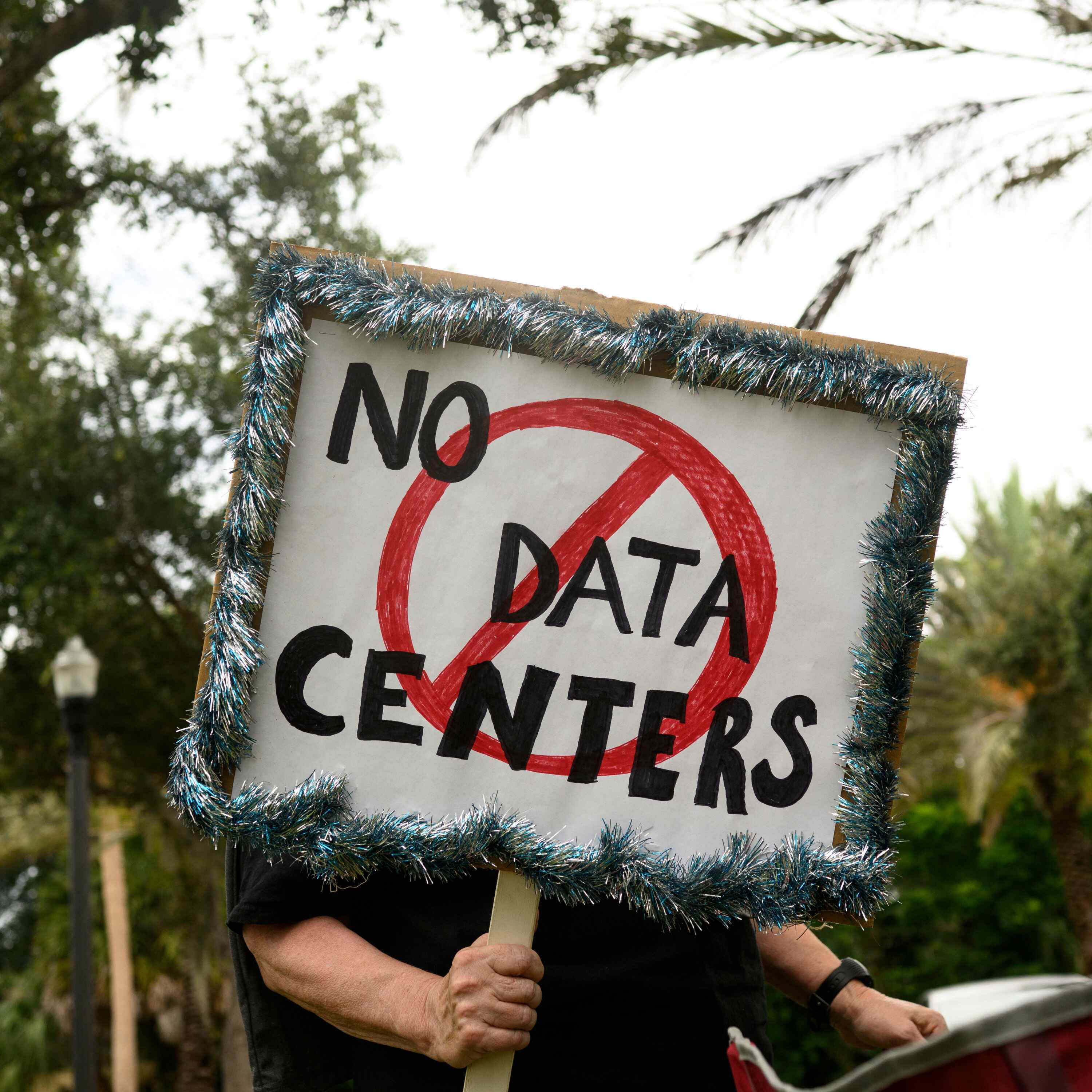
No AI data centers in my backyard!
Over 2,000 episodes in our archive on the NPR App
Connect with The Indicator from Planet Money
The Indicator newsletter — a weekly roundup of news, ideas and staff picks.
Instagram, TikTok and YouTube
Find the Planet Money book
Find the Planet Money game, Sell Me A Sasquatch, and other merch at the NPR Shop!
Support public media by subscribing to NPR+ and enjoy perks for over 25 podcasts like this one. This show’s perks include sponsor-free listening. Learn more at plus.npr.org.
See pcm.adswizz.com for information about our collection and use of personal data for sponsorship and to manage your podcast sponsorship preferences.
NPR Privacy Policy
Get every episode summarized
Each time The Indicator from Planet Money publishes, we email you a written briefing from the transcript — the topics, who appeared, and any specific claims, with the ad reads skipped.
Email me new episodesFree for 3 shows. No card needed.
Hosts & guests

Transcript ready
183 searchable segments. Every word is indexed and playable.
Full transcript
The Indicator from Planet Money — One economist's answer to data center anxiety. Machine-transcribed; use the interactive transcript above to jump the player to any line.
NPR. This is the indicator from planet money. I'm Ricky Mulvey. And I'm Adrian Mah. It can feel rare these days to find a hot button political issue that unites Americans across the ideological spectrum. But AI data centers might be it. AI data centers. They're big and noisy and they guzzle energy. And in some cities around the country, they're putting a strain on local power grids. No wonder in a recent Pew survey, 50% of Americans said they think data centers will be mostly bad for home energy bills. Yeah. And at a time when millions of Americans are seeing rising costs for utilities and a whole lot more, this is just one more thing for them to worry about. But today on the show, our guest argues that this isn't a reason to panic. When we come back, economist Julia Cartray brings us a few examples from history to argue why the current boom in data centers doesn't mean we're doomed to high electricity prices.
Stay tuned for the following announcements and messages from our sponsors. This message comes from superhuman. Superhuman brings together connected tools like Grammarly, Docs, and Mail into one productivity suite. The idea that low-value tasks crowd out meaningful focus. Superhuman meets teams where they already work. It operates proactively alongside writing and email workflows to help clear what is in the way. Superhuman from the makers of Grammarly. Start streamlining your workflows with superhuman today at superhuman.com. This message comes from Bombus. Whether you're outdoors or just lounging around the house, cool weather calls for cozier footwear. Bombus makes the perfect slippers and shoes, built with smooth, premium suede, plush Sherpa, and warm sheepskin sheerling, all with layers of cloud-like cushioning. Perfect for staying in, stepping out, and keeping things cozy all season long. Visit bombas.com slash NPR and use code NPR for 20% off your first purchase.
This episode sponsor is HubSpot, which offers the following message. What if instead of updating your CRM, your CRM updated you? HubSpot's self-updating CRM keeps your customer context current, so you can win more deals. Learn more at HubSpot.com. In 1980, the federal government released a report with a very boring name. The global 2000 report to the president. But the contents of this report was anything but boring. They said, hey, we do not have the capacity or resource abundance to meet the demands of particularly electricity in the future. Julia Cartwright is a senior research fellow at the American Institute for Economic Research. Think tank that advocates for free markets and limited government. So the report says we anticipate that the real price of energy is going to rise about 150%. Now, if you think about the consequences of that, if the price of energy goes up, this means the price of everything is going up because energy is such a valuable input into
any type of production. The reports authors saw oil prices rising, fossil fuels becoming scarce, and a rapidly growing population. In the end, they said consumers will pay the price for this growing scarcity. This conclusion seems so dire. Julia says that the media nicknamed this document, the Doomsday report. But by the turn of the century, Julia says the Doomsday predictions didn't pan out. What actually happens is that the real price of electricity did not increase by 150%. It actually decreased more than 25% in that 25 years. This report not only was it wrong in magnitude, it was wrong in the direction. So what happened? Well, basically, the report assumed that the energy scarcity of the time would continue. It underestimated how human behavior and technology would adjust to high energy prices. Things like fuel efficient cars or new ways of oil and gas drilling that would eventually
lead the US to become the world's largest oil producer. So this is, I think, a very exciting and a very important example to illustrate the power of American ingenuity. Julia wrote this in a recent op-ed for the Washington Post. This ingenuity, she thinks, is being undersold when it comes to the concerns about data centers and energy prices. Just to put a little bit of context here, I read one analysis that electricity usage from data centers will double or triple in the next few years. And half of Americans think data centers will result in higher home energy bills. And the rationale here, classic supply and demand, right? Data centers have huge power requirements. There's limited energy and that is going to put pressure on prices to rise. You say this fear rests on the same broken assumptions as the Doomsday report. What do you mean by that? What I mean by this is that higher prices indicate to entrepreneurs to go into a specific
type of industry. If a price is rising, this signals to somebody with an honor, pernorial bone in their body saying, hey, I can actually solve this problem. And this is what I mean by the price. Exactly. So I'll just give you a little example. Whale oil used to provide oil for lamps all around the nation. How many whales are there in the world? There is a limited number of whales, right? Right. And so what happens, right? That price is going up. That price is going up. Boom. A caracene comes in and makes basically whale oil obsolete. You're saying somebody was like, how whale oil is too expensive? What else can we burn? How about caracene? Exactly. Exactly. And that is the beauty of the price mechanism. Of course, the federal government helped with that by giving caracene attacks advantage compared to some other forms of fuel at the time. Either way, Julius says, look at another example.
Copper wire. Folks were very concerned that the price of copper was going to go so high and we weren't going to be able to build new homes and businesses because the price of copper was prohibitively high. So what happens? Fiber optic comes in and boom, we don't need as much copper anymore. And that is exactly what I anticipate happening in our data center moment. So Julia believes American ingenuity will help us solve our data center dilemma. And on that score, the threat of higher energy prices is already spurring innovation in both the private and public sectors. So let's start with the private sector. Some of the biggest data centers are hundreds of acres. I mean, just absolutely massive, massive, massive buildings. And so these companies are realizing that they're putting strain on the grid. And so they're investing in bringing their own power. To feed some of their needs for electricity, companies like Anthropic, Alphabet, Meta, OpenAI and Amazon, they're investing into building new power plants or restarting old
ones. And then investing in building new nuclear power plants. Although we should say data center can be built in a matter of months, whereas a power plant takes a years. True. And still, that's not the only way companies can bring down costs. The price of compute is going up. Therefore we need to get savvy about how to innovate and bring this down, make things more efficient. And as a result, AI models are getting more efficient fast. Last year, a study from Stanford researchers estimated the cost of running an AI query. And they found that over a two year period, the cost dropped over 280 fold. I mean, don't tell the stock market that we need all the costs we can get. It's not just the hyper scalers innovating to deal with rising electricity prices. Julia says local governments are too. There's also been a big clamoring to try to short up local grid capacity and also local regulation to try to meet the moment of these data centers. That might mean upgrading local energy infrastructure or municipalities changing the way they
deal with data centers. For example, it's long been common for local governments to offer subsidies and tax breaks to companies building these data centers. These subsidies can cost states hundreds of millions of dollars a year in lost revenue. But with the political climate turning against data centers, that's starting to change. Spares are less willing to subsidize these projects. And Julia thinks that's a good thing. If you're not subsidizing them, you're making them pay their own way. That's even more of an incentive for them to figure out an efficient way to do what they're trying to do. So for all these reasons, Julia says the data center boom may cause energy prices to increase in some places in the short run. But in the long run, I have full confidence in the American honor per-nor to meet this moment. Obviously, we love economists on this show. But I think you could accuse a lot of economists of having sort of like terminally long run thinking where they say like, well, the long run everything works out.
But in the short run, there may be a lot of pain for a lot of people. What do you say to that? Well, I say get involved with your local government and remind them that your rights and property are just as important as these flashy new data centers and big companies. Don't panic. Get involved. Exactly. Well, easier said than done. Although one thing that's not scarce right now is anger over data centers. In states like Texas, Virginia, Ohio, Georgia, and a bunch of others, the backlash against data centers has resulted in pauses on things like new construction and subsidies or implemented new environmental rules. Ricky, I feel like economists need to come up with a new supply-demand graph that has a line for anger. It's like the anger session. We've got a new one. Instead of vibe session, we've got anger session. The AI anger curve.
This episode was produced by Cory Bridges with Engineering by Jimmy Keely. It was fact-checked by Sierra Huarez, kicking Canada's our editor in the Indicator's production of NPR. Stay tuned for the following announcements and messages from our sponsors. This message comes from Bombas. Whether you're outdoors or just lounging around the house, cool weather calls for a cozier footwear. Bombas makes the perfect slippers and shoes, built with smooth, premium suede, plush sherpa, and warm sheepskin sheerling, all with layers of cloud-like cushioning. Perfect for staying in, stepping out, and keeping things cozy all season long. Visit bombas.com slash NPR and use code NPR for 20% off your first purchase.
More episodes
More from The Indicator from Planet Money

SNAP strains, youth baseball's class divide, and Meta's bug bounty
The Indicator from Planet Money

The chilling effect of ICE in hospitals
The Indicator from Planet Money

Inside Norway's sovereign wealth fund dilemma to divest from Israel
The Indicator from Planet Money

The proper etiquette of the Venmo nudge
The Indicator from Planet Money