Get every episode summarized
Each time Happy Healthy Caregiver publishes, we email you a written briefing from the transcript — the topics, who appeared, and any specific claims, with the ad reads skipped.
Email me new episodesFree for 3 shows. No card needed.
About this episode
“Helping you tell your story one podcast at a time. Content presented in the following podcast is for information purposes only.”From the transcript
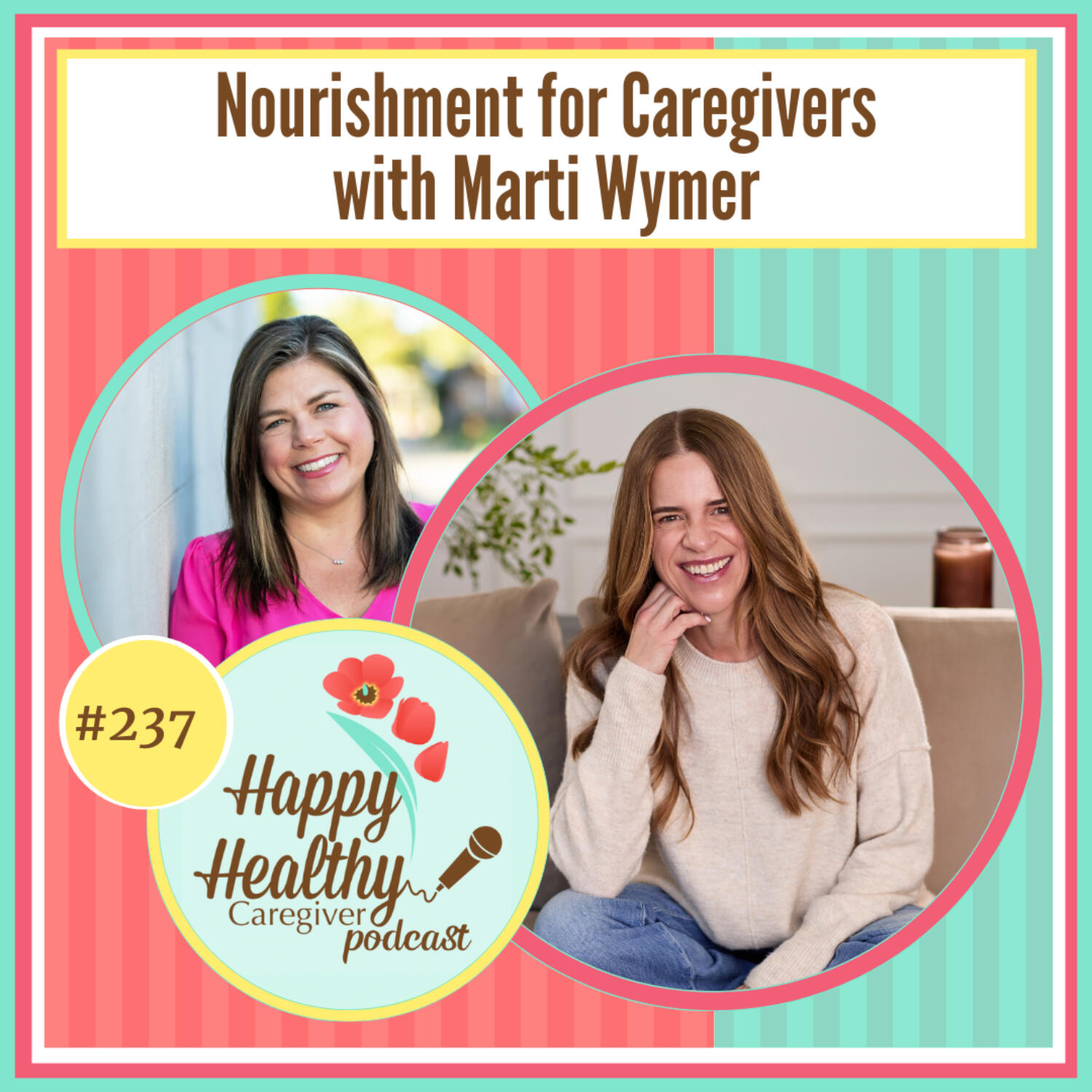
Marti Wymer is a family caregiver, entrepreneur, speaker, and founder of Spoonful of Comfort — a company inspired by her own experience caring for her mother through cancer while raising two young children and navigating the distance that made it all even harder.
In this episode of the Happy Healthy Caregiver podcast, Marti shares what her caregiving journey taught her about grief, emotional support, and showing up for the people we love even from afar. She talks about what it looks like to pour grief into something purposeful.
We talk about why caregiving is so much more than the physical tasks, how little gestures and small acts of showing up can mean everything to someone in a hard season, and why connection itself is one of the most powerful forms of self-care.
We also get into Marti's memorable Shark Tank experience and the resilience lesson that came out of it, and she shares what she is doing right now to fill her own cup — including how learning AI has become an unexpected way to keep her mind sharp and elevated and simplified her skin routine.
Show notes with product and resource links:
Receive the podcast in your email here:
Order a copy of Elizabeth's book Just for You: a Daily Self Care Journal:
For podcast sponsorship opportunities contact Elizabeth:
https://happyhealthycaregiver.com/contact-us/
The Happy Healthy Caregiver podcast is part of the Whole Care Network. Rate and Review the podcast:
Get every episode summarized
Each time Happy Healthy Caregiver publishes, we email you a written briefing from the transcript — the topics, who appeared, and any specific claims, with the ad reads skipped.
Email me new episodesFree for 3 shows. No card needed.
Know when Marti Wymer turns up
Follow Marti Wymer and once a week we email you every new episode they appeared on — including guest spots the show notes never mention, because we read the transcript.
Follow Marti WymerFree. Pick your own day and time.
Hosts & guests
Transcript ready
418 searchable segments. Every word is indexed and playable.
Full transcript
Happy Healthy Caregiver — Nourishment for Caregivers with Marti Wymer. Machine-transcribed; use the interactive transcript above to jump the player to any line.
This is the Whole Care Network. Helping you tell your story one podcast at a time. Content presented in the following podcast is for information purposes only. Views and opinions expressed in this podcast are solely those of the host and guests and may not represent the views and opinions of the Whole Care Network. Always consult with your physician for any medical advice and always consult with your attorney for any legal advice. And thank you for listening to the Whole Care Network. It's just feeling so helpless and wanting to be there and do something and wanting her to know how much I loved and cared for her and how could I comfort her in this particular situation.
I wanted something more meaningful and I thought what do you send someone who's sick, chicken soup. It's what she like many mothers used to make to comfort me. Are you caring for others while working and trying to live your own life? Wondering how to find the time for your own health and happiness? Well, you're in the right place. The Happy Healthy Caregiver Podcast, which is part of the Whole Care Network, is the show where real family caregivers share how to be happy and healthy while caring for others. Hello and welcome. I'm your host Elizabeth Miller. I'm a fellow family caregiver, a care advocate, a professional speaker, author, certified caregiving consultant and certified senior advisor. If this is your first time listening, thank you for being here. This is a show produced by Weekly to help family caregivers integrate self-care and caregiving into their lives. Each episode has an accompanying show notes page. If you'd like more detail about the topics, products and resources we speak about or you want to see any of the related photos, you'll find the show notes by going to the website HappyHealthyCaregiver.com
and underneath the podcast menu, click the image or episode number for today's show. The link for the show notes will also be in your podcast platform's episode description. Now let's get to it. Let's jump into this episode. Welcome. I'm so glad you're here. Before we get into the spotlight conversation with Marty Weimer, I first wanted to just take a few moments to celebrate a fun resource with you. I was reminded to share it because I recently celebrated my 55th birthday and my birthday landed on a Friday, which was amazing the night before I played Masha with my girlfriends. And on my birthday, I took the day off from HappyHealthyCaregiver. I went thrifting with some girlfriends. I did a little needle point. And then my husband and I and another couple went to a candlelight concert down in Decatur, Georgia. This was something that has been on my 20 for 26 list.
We had a yummy dinner beforehand at a tapest restaurant called the Iberian Pig. And when we went to the candlelight concert, you go in. The whole room is lit with candlelight and the theme for that night was Fleetwood Mac Music. The first quartet is only playing Fleetwood Mac Music. It was very calming and beautiful. So would highly recommend that you could potentially check that out. But over my entire birthday month, I treated myself to all the freebies. I have a blog resource that I want to share with you on HappyHealthyCaregiver that rounds up some of the best birthday freebies that you can take advantage of. And I want to share something from your Starbucks coffee, which by the way you have to get on your exact birthday. Most of them give you a week or a month so you can get some freebies from Sephora and Ulta, crumble cookies, smoothie king, Kendra's Scott. I also enjoy my Soma discount during my birthday month. So I want you to pamper yourself during your birthday month.
There's really no reason not to celebrate yourself. I'm going to link to this resource of these birthday freebies so that you can kind of see the whole list. Some of them do require that you sign up to be a member of their app. For instance, you're not going to get your free Chick-fil-A cookie if you're not on the Chick-fil-A app. So you'll want to join a few of those before you can take advantage of the free stuff. I'm going to start with the opposite sponsor, which is newly. I have been renting my clothes from newly if you've seen pictures of what I'm wearing, when I'm speaking, sometimes on the podcast. I have been using it for four years and I'm obsessed. So what newly is is it's a clothing rental company where you pick out the six items that you want to rent. It has totally changed how I get ready for events or everyday activities. So I think it can be a little more creative with the clothing. When I'm tending to buy clothes, I do buy pretty basic colors and things that I can wear over and over again. But with newly, I can try things and see if I like them. And if I fall in love with them, I can buy them the brand names at discount prices. I really want to encourage you if you try it out to read the reviews because they are everything.
So make sure that it's going to work for your body type and your height and so forth. And you can filter the reviews by those things. And then one of the best things is that you just throw it all in the pre-addressed bag, throw it in dirty and send back the items that you decided that you didn't want to keep, which is most cases most of the items for me so that I can just rent six more the next month. Hey, have a code where you can get $30 off of your first month, choose six items. There's no long term commitment. And if you'd like to do so, you go to share.nuly.com forward slash Elizabeth 729. I recently read Frederick Bachman's book called Bear Town. I didn't realize when I was reading it that it's actually the first book in a trilogy. And I also didn't know that it has an original series based on the book. I wasn't sure if I was going to like it since it centers around the sport of hockey, but you don't need to know or care about hockey to really like this book. The novel is really more about small town characters.
And it reminded me a lot of the town that I spent my childhood in, which was in Brockway, Pennsylvania. So Bear Town has this old ice rink on a lake. There's these young teenage boys. They're the town's junior ice hockey team and they're about to compete in the national semifinals. And so all of the hopes and the dreams from this entire town now rest on these shoulders of these young teenage boys under the heavy burden. The semifinal match becomes the catalyst for a violent act that's going to leave a young girl traumatized. So a little bit of a trigger warning there and it's going to put the town in total turmoil accusations are made and these have a ripple effect on the Bear Town families, the schools and the businesses. And you're going to be reading this and you're going to be hoping that the people are going to be doing the right thing and you're going to be disappointed in some of them when they choose not to. I give this book four out of five stars and we found that it to be a really good discussion group for our book club as well. For this episode's favorite thing that I want to spotlight. I want to share with you this little thing called bagu.
This is a bagu standard size tote bag. My daughter gifted me this reusable bag. It comes in this cute little pouch. It's so light. It's so light. It's what I love about it and it folds out into this tote bag and it also, you know, folds back easily and you can put it back into the pouch when you're done. This little pouch I often throw into my purse, my backpack, my luggage. It can turn into a bag that you might need for a day trip or a shopping excursion. Maybe a trip to the farmers market or maybe you just want to use this bag instead of getting the other shopping bags when you're out and about buying the items that you need. They come in a lot of fun prints and colors and they do make a great gift for somebody. There are many knockoffs as well on Amazon, but I can't speak to how they hold up over time. I do know that I have had this bagu bag for many years and still really love and enjoy it. So I'm going to link to Amazon so that you can see all the styles that they have available.
Let's meet our caregiver in this spotlight. Marty Weimer, the family caregiver, an entrepreneur, a speaker and the founder of Spoon Full of Comfort. It's a company inspired by her own experience, caring for her mother through cancer while raising two young children and navigating the distance that made it all even harder. In this episode, Marty shares what her caregiving journey taught her about grief, emotional support and showing up for the people we love even from afar. She talks about what it looks like to pour grief into something purposeful and we talk about why caregiving is so much more than the physical task and how the little gestures and the small acts of showing up can mean everything to somebody who is in a hard season. And why connection itself is one of the most powerful forms of self care. We also get into Marty's memorable Shark Tank experience and the resilience lesson that came out of it. And she shares what she's doing right now to fill her own cup, including how learning AI has become an unexpected way to keep her mind sharp and elevated and simplified her skin routine.
I hope that you enjoy the show. Hello Marty, welcome to the Happy Healthy Caregiver Podcast. Hi there. Thanks so much for having me. Excited to dive into our conversation today. And I certainly have a personal connection with the care packages that we're going to start. We'll talk about it at some point. But before we kind of get into that, we got to set the stage and let everybody know what you're all about in your relationship with caregiving. But we start the show off with little bit of words of wisdom, things that have spoken to me over the years from the Happy Healthy Caregiver jar. I'm a words person way more than a numbers person for sure. Love it. Yes. So today says you hold the power to decide what's acceptable and to refuse what is unacceptable. And when you think about like caregiving and self care and all that, you hold the power to decide what's acceptable and to refuse what's unacceptable. What comes to mind for you there?
Wow. Okay. What when it comes to how you want others to treat you, how you want the boundaries, maybe that you said that you know interesting and this is probably just popping into my head from a conversation I had with actually a coworker yesterday where she's going through some medical stuff right now and didn't really love the answer. She heard from the doctor and I was like pick up the phone, call them back, you know, be more persistent. Contest so that's something that I would share. Yeah. In terms of the health care system gives us a lot of a lot of ways that we can feel like this is not right. So I had something actually just happened to me yesterday where I had scheduled this appointment months ago when I had the referral and then they called me yesterday to cancel. And they were like, oh, your referrals no longer active. I was like, well, it was active when I scheduled the appointment months ago. Now you're calling me the day before and canceling how frustrating is that.
And so I had to kind of go through this regular role of getting a new referral, making another appointment. Luckily, it's not too far out in the future. But yeah, health care has definitely pushing a lot of buttons for me these days. Yes. So I think it's back to, you know, your caregiving story, Marty, and when your mom was diagnosed with cancer, you know, what it? What was caregiving and life looking like for you then? Oh my gosh, you know, my mom at that time. So a lot of people don't know this part of the story. It usually starts with just my mom, but my parents have been together since they were 14 years old. And just about a year and a half before her diagnosis, my dad passed away of a certain heart attack out of nowhere. 56 years old, super young and you know, she was just crushed. And so it's interesting that I consider that time, right? Having, grieving my father, worrying about my mother without my father.
And so thankfully she comes from a huge family. There's 12 of them and she has nine sisters and two. Wow. And yes. And so huge support system there, which is really helpful. And so she was traveling. We lived in Florida at the time and they had a home in Canada. And so she was going back and forth and happened to be in Canada at the time when I got that phone call that she was diagnosed with cancer. And you know, it's just the worst part of being so far away. I had young babies. I had actually just returned from being there. You know, it's hard to get to. And my first instinct is you jump on a plane. I want to be with her. And I just couldn't. And just that feeling of helplessness and wanting to do something to be there for her. But not being able to just compounded that for me. Yeah, you've got a lot of different competing responsibilities that are going on. How old were your kids roughly around this time? Were they were eight months.
And yeah, eight months. Five. Oh, yes. And were you working as well? I was not working at that time. Okay. Well, one less thing to worry about. Yes. But still so much to juggle with two kids, little kids at home and just kind of recovering from the pregnancy yourself. Like that. Yes. That's a lot. What do you, I mean, you mentioned kind of the helplessness of it. But what else do you think are like some of the unique challenges of caregiving from a distance? Caregiving remotely? Gosh. Navigating. You know, who's doing what? Right? With the people on the ground. Like I said, she, I have a lot of very strong women in my life. And all of us, you know, who gets say over what? Who's taking care of what things? When do I get to step in? When is it appropriate? When is it not appropriate? You know, it was also that transition of she was young. Also, she was 57. And so it was the yikes that transition of like the mother daughter relationship, right?
She even though I was 30 years old with my own children, she was still my mother and looked at her that way. And it was a really interesting transition without my dad. Like, I've got to, you know, have a brother and just my personality is to like click in and like, all right, what are we doing here? You know, trying to organize everything and keeping everything in one spot and like the competing of not competing, but just coordinating of all the people that are involved. They all have different opinions. Yeah. Including your mom, right? Like you're a kid. Like you said. And so sometimes it has great impacts on us, but it doesn't necessarily mean that we've got a lot of say and how things are being done and navigating. Do you kind of feel like you eventually settled into your role? Your role from a distance was a project managing aspect of it. Or did you kind of find areas where okay, I'm strong in this. Yeah. And I think some of that was, you know, going through.
I start making phone calls with doctors here in the states and, you know, had made appointments. So she had lung cancer, stage four lung cancer. And then it got come to find out had gone to the brain, gone to her bones. And in my mind, I'm like, you know, you're not moving fast enough there. And like I need to get you here or control it and make the appointments and get you to the best places and the best care. And, you know, and some of that I think was my own like frantic processing through it. And I had everything lined up for her. And then she called and she's like, you know, we all knew how serious it was and how fast it was going to go well. She knew and she's like, I don't want to spend my last days in a hospital in a random city without anybody I know. Like I want to be surrounded with family. And that was the like, we're okay. And so when I kind of had to let go and listen to her in that moment,
and it kind of let me release that like frantic trying to solve it, fix it. You know, thinking thinking foolishly that I could, you know, and then transition to the, okay, now how do I just love you? And, you know, comfort you and care for you. And I switched from that mode into that part. It is like this journey, right? And so much of caregiving is out of our control. Like we want to pull the reins on it. And we realized very quickly and some nice, it's really not up to us. We don't hold the cards. It's so hard. And yet, like I said, sometimes the consequences really roll down to us. And a lot of caregiving, and I think you touched on it. It's not just physical, right? A lot of it lives up here. Yes. For me, that is. Yes, for me. How were you dealing with the emotional part of it, like back at home and what was helping you?
It was helping me. So, you know, my community, my girlfriends checking in, right? And maybe that's part of a coping mechanism for me is, yeah, that I get on the, I'm going to do the lists. And I'm going to get all the things in order, you know, and try to avoid maybe the emotional. But, you know, girlfriends would sometimes, once in a while, just show up with a glass of wine. And let's sit, you know, in the driveway and the kids can do their little toys. And let's just chat about it, you know, and I think they were really helpful for me in that way. They would just show up with, you know, just showing up. It can hopefully give you a space where you feel like you could be vulnerable. You can kind of say the things that were maybe wouldn't, we're saying out loud. And they have a way, right? Of just like scratching the surface. And the next thing you know, you're like ugly crying sometimes. I know all the time. Yeah, I've certainly been there too. Yeah. And, you know, this, this experience was very impactful for you, right?
This caregiving for distance, you mentioned like you feeling helpless. You didn't feel like you had a way to show up. And that really kind of led you down this path, this path of what you do for your business. Talk about that. How did your caregiving experience really inspire what you started and what you're still doing today? Holy. I mean, it literally started from, it's just that gut punch when you get the call, you know, and it just, you know, like I share. It's just feeling so helpless and wanting to be there and do something and wanting her to know how much I loved and cared for her. And how could I comfort her? And so I got online and from a distance, I couldn't do anything local. So I'm going to send something and there were tons of flowers and candy and fruit. And I love all of those things. But in this particular situation, you know, I wanted something more meaningful. And I thought, what do you send someone who's sick? Chicken soup. It's what she like many mothers used to make to comfort me.
And so I couldn't find any. And after I lost her, this idea would literally wake me up at night. Like, why isn't there anybody in this space, you know, and I thought, what better way to honor her than help others in the same, you know, position that we were in. And I'd say the irony is what I started as care packages for the recipient to help them that I later learned, you know, that I think it gave me something too, right? And so I think it gave me a physical way to express my love and care from afar. And so we really recognize and don't ever forget that, you know, there's the two in the journey. And sometimes more, right? There are these other, the person, the recipient, the person who's sick or hardships. And there are many people in their circles that like love and worry and want to help and want to do something. And so people don't know what to do. And so that's, you know, we really thought and hope and found that this was a way to let people do that from afar.
Nice. So that idea evolved into your business, which is a spoonful of comfort. Yeah, which kind of says it all, right? Like you're trying to provide a comfort from a distance. And before you and I were ever introduced, I was a recipient of your product. So my mom was sick or she may have already passed at this point, but we were, you know, making all the arrangements and somebody sent us the family as spoonful of comfort package. We were up in Michigan at the time. And I remember it like I remember like opening it and being like, wow, what a cool, what a cool thing, you know, with the rolls and the cookies. And then I don't know if it had the ladle then. Was that always there? Yes, should have been okay. Okay. That's what I don't, I don't, that's what I don't remember as much. But I did recently get another one. And I was like, wow, the ladle is so cool. Like what a way to kind of just remember that people were thinking about you and trying to give you comfort there.
So I love that, you know, we have that personal connection with your with your care packages. Thank you too. And it had that it moved me all over again. It's been a long, you know, it's been over six years that my mother's six year anniversary of my mom's passing. Certainly, you know, you're getting a lot of castorals and things like that. But super such like you said, did the recipe come from anywhere? Like where did it, how did you, how did you come up with the chicken, the chicken soup recipe that you went to with? The chicken soup recipe. Okay. So the irony. So of course, when I started, I didn't know anything about FDA and regulations and manufacturing and USDA and, you know, kids and dogs at home. I couldn't make it in my kitchen and, you know, a lot of serendipitous things have happened through the years of building this company. But happened to have a good friend. A lot of people don't know. Sarasota, Florida has a big man and a night in Amish community. And a friend is a part of that community and they have this incredible restaurant. And he went to them and these like adorable ladies were like, sure, we look to make the soup for you.
And I would fax my orders in. I'd have to fax them in at night by midnight. And they would make it overnight. And which I love that you pulled out your Mason jar is what you hold your. Yes. Words. Yeah. Because I used to pack it in Mason jars. But I have like an affinity in my daughter's name is Mason. So I have a special affinity to Mason jars. And my husband would like pick them up in the morning. And I would package everything up at the kitchen table. I would put my kids in the minivan and put the packages in the back. Some were local deliveries. Some I'm taken to UPS to drop off and the postal service. And that's how it all started. Yeah. It's a grind, right? Like there's a lot of people don't see behind the entrepreneurial idea of this. And so so the recipe came from Sarasota this place. And then they would ship the soup to you. And you would repackage it and fill the orders. That way. Because I got to say when if people have experienced it, like it's the recent one my son and I enjoyed while I think my husband was traveling.
I was like, great. Mom doesn't have to make dinner tonight. And so the standard for us in here in the Atlanta area is always like the Chick-fil-A chicken soup. You know, we don't feel very good. We go to Chick-fil-A. We go to Chick-fil-A. But he was like, he literally said this is a testament that's better than Chick-fil-A soup. So it's chunky. The noodles, the vegetables. Oh, we're all so very intentional. Yes. Yes. Very intentional about it. You can see the detail and the love and the care that kind of is in it. So I love that it mirrors that intention that you want to put it put behind it. And so I think that's what I think is the most important thing for you, like, you know, in caring for your mom and experience grief, you know, your family members, like what did what did tangible support look like for you? Like what what are you hoping that this accomplishes, you know, when it when it reaches people who are maybe in those moments. So in part of the experience that I hope people experience when they open our packages, if you saw, is how we package it, right?
We are super intentional about it feeling special right down to every single box having its own little quote and its own little pattern. Everything is reusable can be turned inside and out. And so I just, you know, we can't fix anything, but I think those like these little gestures, I think, can just brighten somebody's day a little better, bring a little joy in a moment. And so that's what I hope when people receive the package and experience it that from the minute they open the package, whether they're eating it now or like you say you get a lot, you can put it in the freezer, you can eat it later. You can lead the cookies out because you may have people coming by and you're something there people can pick at. And so, you know, I hope that that's the that it sparks a little moment of joy and happiness on top of the actual nourishment of the food.
Yeah, nourishing them physically, nourishing them emotionally. Yes. And so, I think that's the only way to, I, when I was, you know, research, I didn't talking to you, I didn't realize what I'm a fan of the shark tank shows where I don't think this seems to be my show that I lean on when I go to hotels and it's like I either watching TV like I'm traveling around speaking and I have some time to myself in the hotel room. I can totally just binge on some shark tank. But what was that experience like I'm so curious. That was crazy. That was crazy town experience. And the, you know, like I mentioned before these like San Dippity, we were in the hard early years still when they called in the iron, you know, they reached out to us. Amazing. And I was like, am I getting pranked like yeah, I'm going around Terry, you know what? And basically hung up the phone and like research knows that oh, no, they're actually legit called them back and we had to go through the audition process just like everybody else.
Wow. Very intense. And you know, I would say I went into that process of and like went on to the show and not thinking oh my gosh, we're so awesome. They're going to give us a deal. But I'm like we deal with really emotional occasion. They're going to be so nice. Everything's going to be great. They're going to love it. And when they didn't it like broke my heart. I'm like you just you know called my baby ugly and you don't like it. And it like hurt my feelings more than anything. And I was so nervous that after that I was like, oh my gosh, people aren't going to like us anymore because they don't they're going to think we're bad and it was the opposite. People are amazing. They are so supportive. We would get emails being like they were so mean to you. We love what you do. We're going to order someday. Whatever, whatever. So I mean it like turn ended up turning into this beautiful moment with our customers and people reaching out to support us. It was it was incredible. It was amazing.
It probably fueled you. You were like I'll show them. I'll show them. Yes. Yes. And amazing that people rallied behind you because you know sometimes the people are just looking for the the quick buck and things like that. And that's certainly you know you got to make a living. But it certainly wasn't necessarily what was motivating you initially. So I love that you were kind of this Phoenix that you know has rose from the ashes. I love that of of of shark tanks. So good for you. Good for you. Well, you know, what kind of switchiers and talk about self care a little bit you you have said, you know that caregivers often wait. And I don't know if this was true for you to until you were completely depleted before kind of getting the support. You know, where did you fall in that? Did you even realize like yes, this is happening to this person, but it's also happening to me. Was there a point where you were feeling depleted and needed to ask for more help and support. Yes, I think it hit me when I realized I couldn't fix it. I was like fueled on this mission to to fix it. I'm going to get a getter and when I think when I was hit with the knowledge of we're not fixing this.
I think that's when it was like hardest for me to like, okay, this is different. That's was different. I have to look at this different. But I was still focused just my focus on her. And and I felt so guilty like I might get my kids. I'm from doing that the best am I taking care of her enough and you didn't know when situation really. Yeah, that's what that's what it feels like for sure. Yeah, that's what it felt like. And so I don't think it even can you know occurred to me that I should think about self care in that. Because I'm like I can go where I'm more about my kids and my family and that and my mom and like taking care of her and it didn't even occur to me. I've kind of like compartmentalize it in order to just like function through the days, right? Like the kids still need to be fed. They got me dressed but people got to go places.
You know, and it is the lot like we said, you know, it's not certainly not just a physical thing. There's a big emotional component to it. Well, what did you know, what did self care look like for you then and what does it look like for you now? Like you're busy woman. Now you know, how old are your kids now? They're oh, they're 24 and 20. Okay. So they've watched you do this. They many, many years. You know, the irony is all say actually do. It was I do actually think starting and founding spoonful of comfort was my self care. It like gave me a purpose. So I didn't go down this start, you know, down the start hole. It gave me a purpose and a mission and something to outside of me to get up and and focus on and do every day. So that I would like to rephrase it to that, you know, and I say, you know, it's commonly, you know, poured my grief into it and it really helped me process through it and just even like reading the messages people, you know, people are sending to each other and replies.
They were giving to me, you know, and I'm like, this is like the like the best therapy ironically like the business has been the best therapy through it. I think I could have had. And so I think that was really it sounds weird to say that work is the self care, but it's just so closely tied and just keeps me. It did then and now like just keeps me going get up and go. Yeah, I mean, I totally get it because when I started happy healthy caregiver back in 2015. I had no business starting a business. I was working full time. I was caregiving. But I needed this like outlet, you know, first it was blogging and writing and just like this socks like how can how can I help myself and potentially help other people who are going through it. So I completely get like, you know, pouring it in. I like the way you phrase that way. Pouring it in and that it does does help with processing all of those things and it makes you, you know, kind of get out of your own head and get out of your own bed sometimes like you get get and keep moving. So and it's giving you a connection to these feelings and these these people in that's community, which what a great community right the caregiving community and so forth that never met a caregiver I didn't like.
So I can still say that after many, many years or just they're just special people. Well, is work still your form of self care? Do you have other other avenues and other avenues self care? Yes, I love. I love to hike. I love to entertain. I like to ski in the winter. So those sound more like hobbies, I guess then. Well, that is though. Yeah. Yeah. Like anything for me, I define self care and it's changed over the years, but it's been anything that is going to give me peace of mind so I can sleep at night. It's anything that's going to energize me both physically and emotionally and then just pure joy. And we've got to have like all of those ingredients to feel like we're nourished and we're. You know, functioning in our best of ability and sometimes it depends on the day, right? Like what you need. Yes. On a certain day. So I talk about like, you know, getting together with girlfriends and just talking and you know it's the evening you're sitting outside and put on a fire and just I could chat for hours with my girlfriends.
And then I just leave so filled up, you know, that yes, my favorite form of self care for sure. Yeah, they're energizing you. It's great. I love my my book club girls, my mom's young girls like. Yeah, there's. It's my ones that like to go for the walks and out for breakfast and so yeah, different different things are feeding you in different ways. You also are live with your hobby. And he's also your business partner. Yes. And you've got sounds like you've got some great dogs to yes. Oh my gosh. Crazy great dogs. So they're doggy daycare right now or I would show them to you. Yeah. We have a new Finland. We like we like the giants. He's about 170 pounds. And oh my gosh. And did you sleep with you all? Oh, yes. Yep. There does. Where do you're probably like hanging on the edge of the bed? Yeah. Wake up all twisted and yeah. I know that's going to say like people as I get older. I'm like, I'm going to have back problems because of my dog. Not because of anything else that I do. But.
And then we have a St. Bernard. So we have Billy Ray and Winona. Oh my goodness. Yes. And obsessed with them. Yes. They they have take little piece of our heart. We have two dogs as well. We have a golden doodle, sunny and a old shitsu shadow who I'm a caregiver for a dog. For sure. He's. I have. He's there. Yes. He's a lot right now. So. But we you know, he's he's not in daycare. He can't really go anymore. So we just try to keep him happy when we need him to be quiet. And so so far so good for this episode. Yeah. Yeah. Well, speaking of the joy stuff, we do something in the happy healthy caregiver community. And in my own family too, we call it the 20 for 26 list. And these aren't like 20 resolutions. These are things that are going to infuse more joy. And so we're going to go back to the day into your year. Oh, would there be anything that you, you know, are like, oh, before the years over, I want to do this or try this or make sure that this happens so that when you flip the calendar, you're like, yeah, I lived. I live big this year. Okay.
I'm not going to be that young and I've been too busy to play, but I think it would give me joy. I want to play golf. Yeah. Nine holes is about all I can say that's about all I yeah nine holes that that was. Yeah. But I've been really. I played like once or twice, but I want to play more and make that a part of my routine. I first started learning how to ask in for clubs. My husband was like, oh, you're in fringing on my hobby. And I was like, well, I don't necessarily want to play with you all the time. And but it has been a fun thing that, you know, I don't play near as much as he does. But it's something I think that as we're aging powerfully and more time opens up that it's a fun thing that we can do. I love to ask you some questions from the just for you, daily self care. Okay. This is. Yeah, no wrong answers. This is a journal I wrote years ago because I wanted to journaling was very healing for me writing and instead of caregivers and people looking at a blank page. I felt like a prompted journal that maybe could help them be intentional about putting some of more focus on their own health and happiness was important to me. Like we're so busy taking care of everyone else.
And care. It was written with caregivers in mind, but it's certainly not just for care. So I pulled out a couple questions. Let's see. Okay. So somebody's making a movie, Marty of your life in your in your story was painful of comfort, which celebrity would you would you want to play you in that role? That's a celebrity. You can pick a really hot one too. That would be smart. Yeah. Gosh, I would choose Sandra Bullock. Yes. That's a good one. I think she's like fun and quirky and real and yeah. Yes. Yes. And everyone's going to it's going to be a box office that they're going to want to go see that for sure. So I love that. Is there are there things that you're doing like to do worry about your keeping your mind sharp other activities, mental activities, brain activities that you do that you feel like I'm doing this so I can, you know, just keep my brain going as long as possible. I don't know if it's counter intuitive, but I am really trying to keep up with AI.
Yes. How's that working for you? I do these like master classes. I'm trying to, you know, so I do a lot of reading and but I'm challenging myself to be keeping up at least. Yeah. I'm a not there been little any little things that you've been using AI for that you're like, wow, this is amazing. Like if there've been any of those things in your life, personal life business life that it's helping you saving you time. Oh my gosh. Where do I start? I love it when to use it for a lot of research with that work when I'm, you know, researching products or packages and like it'll even do design stuff I can play with right now and which I love it for that and the other is. Okay, you're going to crack up at this and I hope this doesn't sound skincare. I get very overwhelmed by tell me more right like I, you know, when do you do the vitamin C and Wendy you do the retina and when you do the whatever, whatever's like I get overwhelmed by all those things and what ones to use and when to use them and what order.
That's a great tip actually. I have my 26 year old daughter who's obsessed with skincare or I would also be struggling in this area but she basically just wrote me a list of cheat sheet of like this is what you do in the morning. This way you do it night. This is what you use that do this and then once a week you do this. Yes, that's right. I just literally wrote me out that. Yeah. Yes. I got the stuff and I'm following it. Love it. I'm still looking for the most amazing product to help me as a smiler. This is my, you know, the bags and the wrinkles. I can't see the eyes. Fuzzy video and glasses. That's the cure. But. It's hard to keep up with AI. There's so many different things and then like how to protect ourselves, you know, in some ways to write with something good. There's always the bad things that come along with it while and I think about like older adults and people get and take an advantage of and that's what I am loving it for like travel itineraries and recipes sometimes.
Woo. Like what's that and one time I did a meal prep plan but then I was like, okay, can you do it all now just using the air fryer like make it as easy as possible and it's so good with all of that but certainly helps with a lot of the business stuff. Then I have to do because I'm, you know, there I don't have a big staff. It's a lot of a lot of things with this with me. So that's definitely keeping your mind sharp and then we've got lots to learn there. Okay, let's see one more question. Hey, what do you spend most of your time thinking about? Oh, yikes. Hmm. So I have recent, you know, we've been doing this business for a long time. We recently have become empty nesters and like yikes. Okay, like what do I do with myself? Yeah, for the next however many years. So I would say that I've been thinking about that a lot. Yeah, that's a big chapter is a big chapter and you know, I think when I was being, you know, in your feed and fed about it.
I wasn't like ready for it or I don't know like I didn't know what I didn't know and now it's like you look around and you're like, wait, what do I do with myself without my kids at home? And so figuring that out is yeah, they what I'm thinking about golf is certainly fill it fill a lot of it. I'm sure and can certainly probably fill a lot with work, but that you need to have the kind of the balance on on all of those things too. For sure. Well, what are what are some, are there anything else that you wanted to add to our conversation, any parting words of wisdoms for the family caregivers that are listening? I think everybody says this, but I think something is better than nothing. It does not need to be any big grand gesture or gift, but the check in text for me. It was always, you know, I have this one incredible cousin who never misses an anniversary, you know, from a huge family and not, you know, thinking about you today, like acknowledging they know it's an important day and that those feelings come up.
And so maybe I guess that was two answers, but one is it's it continues on. It's not a what that. I'm not saying that properly, but just checking in and just a little something just acknowledging that you're talking about them, you know what they're going through, you know it's hard and I love, yes, I always love when I get those texts from her. Yeah, thinking about what it means to you and how that could really brighten up somebody's day. I think sometimes we are thinking about them, right, the people and the things that are happening, but we have to take the action. Yes, we love to receive it, but also to give it as well. And so if you're thinking about someone just be like, hey, I'm, you know, no, you're going through a lot right now and thinking of you, like to your point, like a quick text or that's sometimes something funny that makes them laugh. I love it when people send me funny stuff. And I'm like, oh, the day is feeling really heavy and can brighten up your day there. So amazing. Well, how do people stay in touch with you, Marty? Like, where do they go to learn more about spoonful of comfort and connect with you? What kind of links can we add to the show notes there?
Totally, through mostly through the site. Yeah, spoonful comfort dot com and all the social areas. So we would love to connect. Yes, we will link to all of those. If you're not familiar with spoonful of comfort and what Marty had in our husband have created and check it out, it is a wonderful kind of gift to let someone know that they're thinking about them. And so we will certainly link to all of that. Marty, I'd love to have in this conversation learning more about you and spotlighting your, your caregiving story. Thank you for taking action, right? Like you have this idea. It was bugging you and it was irritating you and you're like, gosh, start on them and do something about it. So, and you didn't know how to start the soup business and package it and get it going. And you've learned, you know, learn and really touching a lot of people's lives. So appreciate you coming on and sharing with me today. Thank you. Thank you so much and for being so gracious and making this feel so comfortable because it's good. So thank you very much. I really enjoy chatting with you.
Thank you so much. We'll talk to you soon. We'll talk to you soon. Take care. We are Sue Ryan and Nancy Treester. Together we host the Caregivers Journey Podcast. Our podcast delivers practical tips and candid conversations to help you tackle day-to-day dementia, family caregiving challenges with confidence, patience and peace of mind. We share answers to the questions you don't know to ask and the resources we wish we'd had. Our goal is to help you learn faster and more easily than we did. Listen to our show on demand at the Caregivers Journey.org or on any major podcast platform. Thanks for listening to the Happy Healthy Caregiver Podcast on the whole care network. I hope this episode provided encouragement and practical tips to infuse into your life. You'll find the show notes and all the resources mentioned at HappyHealthyCaregiver.com. I also invite you to check out previous episodes of the podcast that you may have missed.
If you enjoyed the show, be sure to subscribe so you never miss an episode. Ratings and reviews also help others discover the podcast and sharing with a fellow caregiver is a great way to spread support. Stay connected with me between the episodes by following Happy Healthy Caregiver on your favorite social media platforms and subscribe to the weekly newsletter where every week I share something happy, healthy and care related. Just visit HappyHealthyCaregiver.com to join. Until our next episode, I'm Elizabeth Miller with a reminder to take care of you. Are you still here? Well, it's time for the disclaimer. I am not a medical, legal or financial professional and I am not providing medical, financial or legal advice. If you have questions related to these topics, please seek a qualified professional. I have taken care to spotlight family caregivers and experts, but their opinions are theirs alone. This podcast is copyrighted and no part can be reproduced without the written permission of Happy Healthy Caregiver LLC. Thanks again for listening to the Happy Healthy Caregiver podcast on the Whole Care Network.
This is the Whole Care Network. Helping you tell your story one podcast at a time.
More episodes
More from Happy Healthy Caregiver

Sandwich Generation Lessons Learned with Christy Byrne Yates
Happy Healthy Caregiver

Finding Your True Self While Caregiving with Susanna Peace Lovell
Happy Healthy Caregiver

Uncovering Your Roots with Tamara Adams
Happy Healthy Caregiver

Do It Now: Living Fully While Caregiving with Heather Butchen
Happy Healthy Caregiver