Get every episode summarized
Each time Fresh Air publishes, we email you a written briefing from the transcript — the topics, who appeared, and any specific claims, with the ad reads skipped.
Email me new episodesFree for 3 shows. No card needed.
About this episode
Fresh Air is made possible by:
“This message comes from Edward Jones, where they believe Rich means opening yourself to new possibilities. That's why your dedicated financial advisor meets you where you are, helping you move forward with confidence.”From the transcript
See pcm.adswizz.com for information about our collection and use of personal data for sponsorship and to manage your podcast sponsorship preferences.
NPR Privacy Policy
Get every episode summarized
Each time Fresh Air publishes, we email you a written briefing from the transcript — the topics, who appeared, and any specific claims, with the ad reads skipped.
Email me new episodesFree for 3 shows. No card needed.
Hosts & guests


Transcript ready
403 searchable segments. Every word is indexed and playable.
Full transcript
Fresh Air — New drones, deadlier attacks: Dystopian reality in Ukraine. Machine-transcribed; use the interactive transcript above to jump the player to any line.
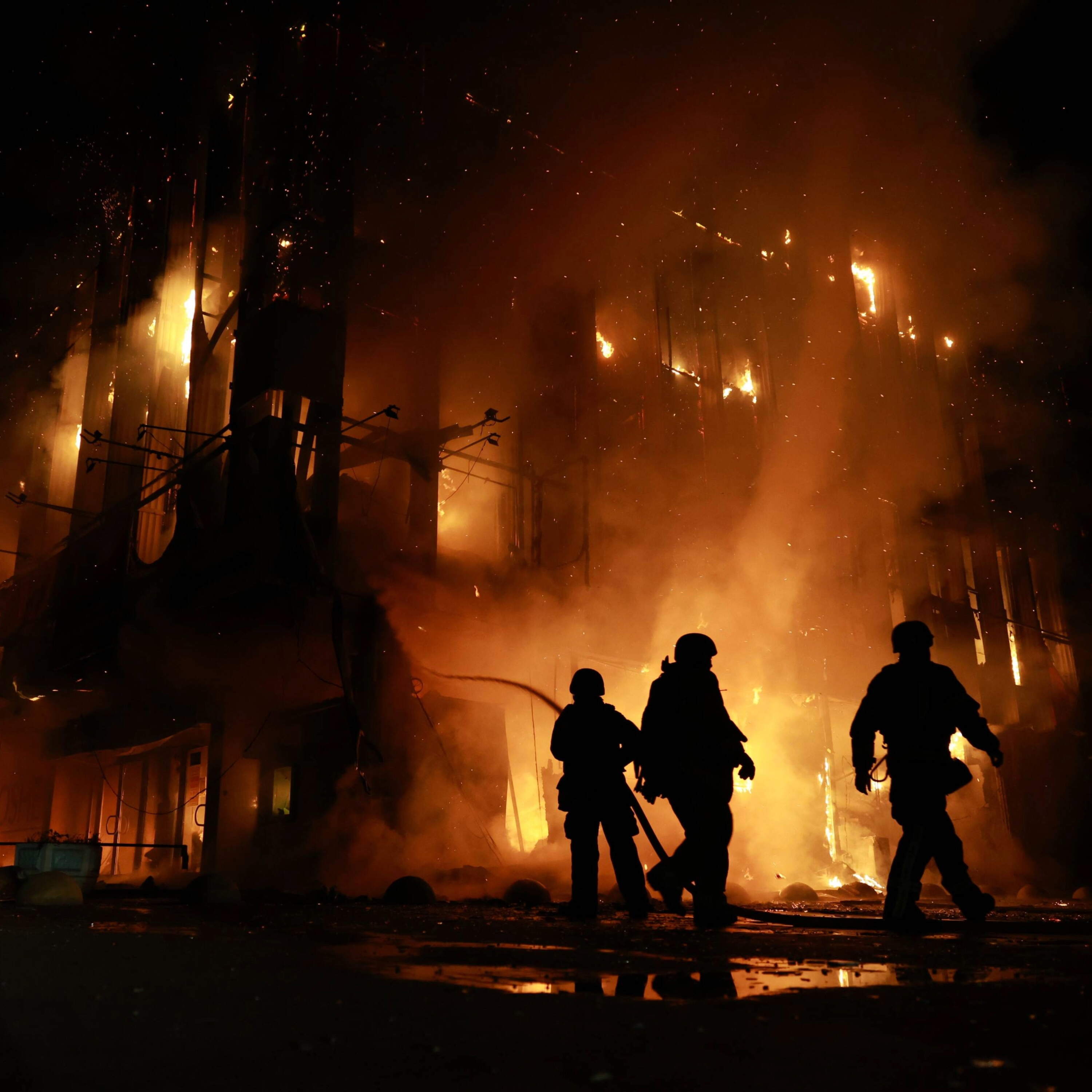
This message comes from Edward Jones, where they believe Rich means opening yourself to new possibilities. That's why your dedicated financial advisor meets you where you are, helping you move forward with confidence. Let's find your Rich, Edward Jones, member SIPC. This is Fresh Air. I'm Dave Davies. Since Russia invaded Ukraine for 1.5 years ago, Ukrainian forces have held their own on the battlefield with support from Western allies. And morale among the country's civilian population has held up, despite punishing air attacks. But our guest, Zannie Minton-Bettos, editor-in-chief of the economist, says the war is changing in ways that bring a new level of terror to Ukrainian citizens and pose serious threats to the country's economy. Minton-Bettos recently returned from a reporting trip with a team of journalists to Ukraine, where she says both sides in the war are developing new weapons and refining tactics with lethal weapons. One example, so-called safari hunting drones, that identify a person or vehicle as a target, then follow them as the target flees in terror.
The drone eventually dives and crashes into the target detonating a deadly explosive charge. We've invited Zannie Minton-Bettos back on the show to talk about Ukraine and catch up on some other important topics, including the war with Iran, trade, tariffs, and the state of US, European and Canadian opposition. Zannie Minton-Bettos is a former economist for the International Monetary Fund, who joined the economist magazine in 1994. She holds degrees from Oxford University and Harvard University, and is a regular commentator on television and radio. We recorded our conversation yesterday. Zannie Minton-Bettos, welcome back to Fresh Air. Thank you so much for having me. You and this team of journalists from the economist recently made an extensive trip to Ukraine. You've been there before. Why did you feel you wanted to make this kind of investment in this subject now? So you're right. I've been there four times since the invasion by Russia, the full-scale invasion. The first, I think, three weeks after the invasion when I went to Kiev and was the first journalist to interview President Zelensky.
The reason I go is because I think this is the most important geopolitical conflict in Europe in the last 70 years. I actually have a kind of personal soft spot for Ukraine. I lived there for a few months, 30 years ago. I find it a fascinating country. I feel that you can only really understand something, particularly a conflict like that if you actually see it close up. I have to say, Dave, this is a very sobering trip. It was probably the most sobering since the very first time I went, which was the first time in 2022. The Russians were still just outside Kiev. The city was virtually empty. We went to see President Zelensky in bunkers in Emory News in his palace, but there were sandbags everywhere. It really felt like a place at war. The subsequent two times, when I went to Kiev, it felt like a normal city. The war felt far away because the city then had very good air defenses. Yes, there were occasional air alerts, but you felt it as though you were in a very safe city.
This time around, I went to Kiev and then I went to visit the brigade headquarters of one of the drone brigades, much closer to the front, in a location that I'm obviously not going to disclose, but much closer to the front. Kiev itself, and this is, I think, really important for people to understand, in the last couple of months, but really the last few weeks, has been under extraordinary bombardment from the Russians. They are basically trying to make life unlivable in a city of several million people. There are two big things that have changed that have given the Russians an advantage. The first is that the Ukrainians have run out of interceptors for ballistic missiles, what are called pack three interceptors produced by the US, which for the past couple of years have really helped them to defend themselves against ballistic missiles. And because these interceptors are extremely short supply, they were used heavily in the Middle East recently in the Iran War. The Ukrainians have essentially hardly got any left, so the Russians are able to bombard the city at night with ballistic missiles.
And the second is that the Russians have made an innovation to their drones. Their kind of workhorse drone is something called the Shahed drone, which was originally made by Iran, that the Russians started producing at scale, and they have essentially attached jet propulsion to those drones, which makes them go much higher and much faster, and thus makes them much harder for the Ukrainians to intercept. The Ukrainians had built defensive drones that could intercept the Shahed with a 95% success rate, but now that they have these jet propulsion attached to them, that interception rate has gone down closer to 40%, and the Russians have enormous quantities of these drones that they are just sending into Ukraine essentially all day and all night now. What does that mean day to day for civilians who are used to air raid sirens? This is not like they're not used to living in a wartime. So I think the difference is that you have, if you're living in Kiev, you have an app on your phone, and I had it on my phone when I was there,
and it goes off every time there is a ballistic missile or a jet Shahed, close within a few, I think, 50 or 100 kilometers, and basically it's going off the whole time. And you are trying to live a normal life, and so you're looking, and you become normalized to this quite quickly, and you look at it and you say, well, is it likely to be in my part of town, looks not too far away, so if it's too close, you might go to a shelter, you might just keep an eye on it, but increasingly it's happening all day, and you're suddenly discovering that the metro isn't working. You're unable to get your kids from school. There's been an attack of supermarkets blown up, and every day people are killed. You paid a visit to the Operations Center of an Elite drone unit in the Ukrainian Army. And share with us what you saw there. So Ukraine has several of these unarmed systems brigades, as they're called, which are units that specialize in drones. And they were set up often by civilians, technologists, sort of separate from the Army structure, but they work with the Army structure.
And they are in the vanguard of what this war is about, particularly at the front lines. And it is very different from what you imagine warfare to be from the movies. A drone-based war is one where the actual front lines, there are no people visible. There is what the Ukrainians call the Killzone, which is now something like 20 to 30 kilometers each way from the contact line, where essentially anything that moves will be shot down, shot at by a drone within seconds or minutes. From both sides? Yes, from both sides. There are hundreds of drones in the air, surveillance drones, drones, attack drones. That means that nothing can really move. So the few people who are there on both sides are, you know, in underground dugouts. They are often supplied by drone or they supplied by unmanned ground vehicles, essentially kind of robots on wheels.
It's a dystopian healthscape. To be clear, I wasn't anywhere near there. I was sort of close to it, but well out of that area. Then these drones are manned and sort of piloted by people in the brigade headquarters of the sort that I went to. They have huge screens, and it's like a cross between a sort of dystopian video game and a startup. There are huge numbers of computer screens. There are people who are plotting where the Russians, assets are, they are sending surveillance drones to go and find them, then they're sending in drones to attack them. And the other side is doing that too. And the area around the frontline is now basically a sort of no man's land where nothing can move. And, you know, the Ukrainians are clearly trying to disrupt Russian supply lines by attacking well beyond the front lines. And then of course, they're also increasingly hitting refineries much further into Russia.
So this is a, on both sides, a drone-based war whose characteristics are very, very fast innovation. And I mentioned in the introduction, these so-called safari drones, where a pilot located somewhere is looking at what the drone sees. They identify a target, might be a person, might be a vehicle, and essentially kind of track them from the air as if they're a safari hunter. And then smash the drone into the target and blow up a charge, right? That's exactly. And that's what happens on the frontline in this kill zone the whole time. What is sort of newer is that the Russians are doing the same thing to attack civilians in frontline towns. And increasingly and alarmingly, they have the capability to reach bigger cities, potentially keir with this kind of drone too. So the notion of safari hunting individuals to kill them is now no longer some sort of dystopian fantasy.
It's something that can happen. There's a dreadful video that I've seen of a man who, and there's this drone buzzing around above him, you know, six or eight feet in the air. And he's dodging around trying to get behind a truck to kind of avoid it. And eventually the drone dives into him and he wasn't killed, but he was seriously injured. But just seeing it just seemed is utterly terrifying. It is. And what was really so bring to me is it was tough enough seeing all of this at this sort of center of this wall. But what I realized is that these are tactics and capabilities that can be used by the Russians elsewhere. And if you remember just a few weeks ago, there was a narrow escape at like zig airport when there was an attack which a drone was attacking a cargo plane at the airport. It was foiled, but it was in Germany. And the German government has said that the Russians were behind it. And I think there was a realization for me. And in one of the conversations I had with the senior people at this drone brigade became clear to me that their view is,
these are the capabilities that the Russians have. Don't think that they're going to be confined just to Ukraine. And I think there is a growing concern amongst European politicians and intelligence services that there will be more of this. We've had alarms raised from the Polish government. We've had alarms raised from Baltic governments. We've had alarms raised across the board that the Russians may well be planning to do more of this. And what became clear to me is that it is technologically totally doable now. The Ukrainians have been effective in sending drones. Behind the lines in Russia and attacking military infrastructure, energy infrastructure. And one of the ways that they have been able to operate is by using these starlink satellite hookups, which are operated by SpaceX, Elon Musk's company. I understand that Musk does not let Ukraine use those for attacks inside Russia. Is that right? Yes, that's right. Starlink is available to the Ukrainians over Ukrainian territory, including the territory that is Ukrainian, but the Russians are occupying.
But it is not available to them over Russia. And what that means is that the Ukrainians lack the ability to go after the launch sites, for example, for ballistic missiles. So there is a huge plea from the Ukrainians to the Americans to basically push SpaceX to allow them to have access to Starlink over Russian territory so that they can go after the launch sites from which these ballistic missiles are raining down on them. Interestingly and alarmingly, something that I hadn't really focused on until I went to Ukraine and sort of really delved into this. The Russians have been and are building their own version of Starlink called Russ Fiat, which is still in its early stages. I think they've put a couple of dozen or so satellites into space, nowhere near as many as Elon Musk has with SpaceX. But nonetheless, this capability is growing and most people think that sometime in the next year or so, the Russians will have some Starlink equivalent, which will mean that they will be very easily able to direct and monitor the space.
And monitor drones going anywhere over Ukrainian territory, which will be another big blow to the Ukrainians. If the Ukrainians haven't had access to the Starlink system in Russian territory, how have they been able to manage these attacks on Russian facilities? I mean, there are other ways of guiding, but they're not as good as Starlink. The Ukrainians are incredibly innovative. And I think the important thing for people to understand is that thus far, Ukraine has sort of been ahead of the Russians in drone innovation. And they've been amazing at building up this drone industry. They've been always in the sort of cat and mouse game somewhat ahead of the Russians. The Russians have been able to scale up. They're a bigger economy. They're good at scaling up their innovations. And what's slightly alarming now is it seems as though the Russians are actually ahead on innovation as well as a bit of an ability to scale. I have no doubt that the Ukrainians will come up with new innovations, both in defensive drones and other areas.
The question that is more uncertain right now is, do they have the financial capability and financial support to scale those innovations? And that's what really matters right now, because the truth is that Ukraine is very, very dependent on financial support. Unfortunately, there's no support coming from the US anymore when the Trump administration came in. Until then, there had been a lot of support from the United States. Now, there is really essentially none. Ukraine is financed by the Europeans. And the question is whether the Europeans will step up the pace of their financial support, such that the Ukrainians have the money to scale up their drone program, which is essential to defend themselves. Yeah, I want to talk more about that in a moment. But I also wanted to just note the level of Russian casualties in this war. It seems that the Ukrainians have been able to inflict terrible punishment on their Russian forces, right? The level of casualties are just extraordinary. I'm something on the order of 40,000 people a month Russians killed and wounded.
This is an unfathomable number of people. But one thing that's important to remember is we've been talking about all of the ways in which Russia is bombarding Ukraine. But Ukraine is essentially holding the frontline and actually making a few gains in certain places. So the sort of overall picture of this war is that the Ukrainians have held off the Russians. The front lines have been basically stable. The Russians at incredible cost, 40,000 people a month. I mean, you can't imagine those numbers. And they are still not able to really make a lot of progress. In some areas, they're gaining a tiny bit of ground in some areas they're losing, but basically the front lines are stable. So what the Russians have decided to do, particularly in recent weeks, knowing that they are not making serious progress at the front line, is to try and break the morale of Ukrainian civilians by completely bombarding the cities. You know, there's a graph that you have in the article that came from your trip. It's a bar graph that shows by year how much money the Western allies have contributed to Ukraine's defense.
And they're color coded, you know, so much for the EU, so much for the United States, so much for other countries. And it was stunning to look. And I think it's in 2025 that the US portion disappears. I'm not sure that much of the United States realizes that US support for Ukraine has vanished completely. Yeah, there is essentially no financial support for Ukraine from the United States. To the extent that there is any weaponry going, it is weaponry that is being bought by the Europeans on behalf of the Ukrainians from the US. When President Trump came in, it became very clear that he did not intend to continue supporting Ukraine, and that has happened completely. I don't think that's that well known. And what is even less well known is the degree to which the Europeans have stepped up and basically are single handedly supporting Ukraine. Now this is because it's also of course, it's our continent. It's in our own interest as Europeans to do that. But I am very clear having just been there that the situation is very, very stark right now. And that I don't think the rest of the world has realized the degree that Russia is attacking civilians.
There's no simpler way, no, no other way of putting it attacking civilians and civilian life. And that in order to be able to survive that and mount a defense, the Ukrainians need faster and more financial support so that they can scale up their defensive capability and so that they can survive. This country has been extraordinarily resilient in the last four and a half years. And yet it looks to me more difficult than it has for a long time in this war without financial support. One of the issues is, is Zelensky still trusted as a leader? I mean, there have been some corruption cases. There are pieces of legislation in the legislature which have not been adopted. What's your sense of Zelensky's leadership and to what extent his credibility is undermining the kind of support, either in the country or among allies? So I think there is growing frustration politically within Ukraine with President Zelensky and his leadership.
I think that's, in some ways, that's kind of normal after four and a half years of war. There is corruption in Ukraine undoubtedly. The anti-corruption unit which has been set up and is funded by the European Union as an important part of the prerequisites that Ukraine has to have to eventually become a member of the European Union. And this organization is effective, is powerful, is unearthing corruption. There is corruption. The highest echelons of government around or at least there are accusations of it in the highest echelons of government. This makes it more difficult. And as you say, the Ukrainian parliament has not passed some elements of some laws that the Europeans would like them to have passed as part of the sort of cleaning up of Ukraine. So that's very frustrating for the Europeans. It's not a perfect political situation. On the other hand, this is a country fighting for its existence. And I'm not sure that this is as much a story of terrible corruption in Ukraine as it is a good news story of the effectiveness of an anti-corruption unit shining a spotlight.
And I see it as a good sign that they're unearthing this and that they are shining the light on corruption where it is. And that's all part and parcel of Ukraine becoming more and more part of Europe, but it should be. But it's very difficult right now. There should have been elections where it not for the war. There would have been elections. And so the president of the country has been president of a long time. In any country, he definitely is not someone who is so focused on institutional reform as he should be. There are huge shortcomings to elements of what president of the landscape does. But I wouldn't conclude from that that you know it's a terribly corrupt place and therefore we shouldn't support it. I think it's remarkable what the Ukrainians are doing given what they're facing. We're going to take another break here. We are speaking with Zannie Minton-Beto. She is editor in chief for the economist. She'll be back to talk more after this short break. I'm Dave Davies and this is for us here.
Stay tuned for the following announcements and messages from our sponsors. This message comes from Edward Jones where they believe rich is about taking care of what gives your life meaning. That's why your financial advisor personalizes your plan to help you preserve your progress and create something that lasts. Let's find your rich Edward Jones member SIPC. This message comes from Squarespace. A beautifully designed Squarespace website is the difference between thinking about photography school and selling your portraits online. It's the difference between giving away cookies for free and running your cookie empire. A beautifully designed Squarespace website is the difference between having a movie reviewing hobby and a movie reviewing career. Squarespace, because no matter what you're into, a website makes it real. Use offer code difference for 50% off select plans, terms and conditions apply. This is Fresh Air. I'm Dave Davies. We're speaking with Zannie Minton-Beto's editor in chief of the economist.
We're discussing trade tariffs, the economic impact of the war in Iran and Russia's war with Ukraine. Minton-Beto's just returned from a reporting trip to Ukraine where she conducted interviews and visited the operations center of an elite drone unit in Ukraine. We're also looking at the state of US relations with our long-time allies, including Europe, Canada and the United Kingdom. We recorded our conversation yesterday. Let's talk about some other things going on in the world. Starting with the conflict in the Middle East, President Trump says the US controls the state of horror moves and plenty of oil is flowing. The reality is somewhat different, right? I think some oil is flowing through the straight-of-all moves under the new arrangements that the US military has put in place. Exactly how much is the matter of some debate, but there is certainly some oil flowing at greater cost. But that doesn't mean that we're back to where we were before the war. I mean, clearly Iran is trying very hard to control the straight.
Clearly, you now have the additional concern of what is happening with the Houthis who are also trying to control another route out of the region. So there is lots of debate about just how much oil is getting out, but what's very clear, Dave, is that there isn't as much as there was before and there certainly isn't refining product coming out as there was before. And that, which is, is much more expensive. Right, and prices remain very high. Do you see any prospect for a resolution of this conflict within the foreseeable future? Both sides say that there is a deal to be done, but that deal is the one on their terms. I think it seems to me unlikely that there is going to be a serious resolution anytime soon. Because Iran is determined to have a resolution much more on its terms, which President Trump is not willing to have. And Iran, the Iranian regime is showing that it has an incredible capacity to endure economic pain.
And I think where we are now is we have a US government that is convinced that the more it can tighten the economic screws on Iran, that at some point the Iranian regime is going to have to cave and come to a deal on US terms. And we have an Iranian regime which of course has several factions within it, of which at least the hard liners are absolutely not determined not to cave and have shown themselves willing to inflict incredible pain on their population. So my sense is that the likely outcome is some version of the status quo for a while. And then either President Trump decides that he is going to go and try and bombard them into submission, or we go back to the agreement that was temporarily reached a few months ago, which is much more advantageous to Iran. Very a while back that the Saudis had asked Trump to bomb the Houthis who are making gains against the Saudi back regime in Yemen, and that Trump thought about doing it, but in the end didn't.
I mean the problem of course is that when you increase hostilities in one place, there's a reaction elsewhere. You know the Iranians can attack American allies. And Trump's kind of in a box here, isn't it? I actually think that that was a very meaningful moment. That decision you're right. It appears that the Saudis asked for help and President Trump decided no. If you stand back from this, we may well find that however this war turns out, it ends up being a turning point in the US relationship with the region. And this was the story we put on our cover last week and looked into in some detail. And let me explain why I think that. You know, what have we learned from this war now? First of all, we've learned that the Gulf countries which relied on US bases for their security have found that actually having US bases doesn't necessarily provide you with security. It can make you a target, right?
It can make you a target. We found that there's been a huge use of US munitions, which is going to have knock on effects for US security all around the world. And we've learned that probably going forward, you know, what US bases remain in the region will have to be moved and probably put underground to be safe because we are now in this new drone based warfare, which changes the calculus. If you add all of that together, it seems to me that it may well be that the sort of medium term impact of this is fewer US forces in different places and thus less of a US footprint in the region. And instead, players from Iran, depending on what happens there, to Turkey, to of course Israel on the other side, are going to be shaping the region with less of an active US involvement than there was. I think we may look back in a couple of decades and see this Iran wars being a turning point.
Not, I mean, I'm not suggesting the US is going to leave completely, but I think the US is going to be less involved than it was. Let's talk about the state of US, Western, Europe, alliances. You know, Trump condemned European countries that declined to support his war against Iran and helped him with the blockade of Iran. He made all those bellicose statements about acquiring Greenland. There have been lots of tensions over tariffs and trade. What's the state of the Western alliances at this point? Well, there's just been a great agreement on Greenland, right, where we've now got a formal agreement to the status quo effectively. Right, kind of it gives the US access to places that are pretty much had access to. We should have access to before exactly. I think the big picture is that, first of all, the Europeans have woken up, not before time, to the need to build up their own defensive capability to spend more on defense. And frankly, President Trump deserves a lot of credit for pushing the Europeans to do that, because for too long, the Europeans have been free-loading off the United States.
At the same time, however, there is a growing sense within Europe, but we're just not sure whether we can rely on the US. And Greenland was one example, but more broadly now, if we were talking earlier about the risk of Russian hybrid attacks or Russian attacks on European countries. These won't be full-on invasions with tanks rolling across the border, but they are already attacks. Now, what does NATO do in that environment? Is this going to get anywhere near an Article 5 collective security moment? And even if it was what would the United States do? And I think in Europe, now there is a growing recognition that we just can't rely on the US. And now, being Europeans, we're spending a huge amount of time talking about this and not doing very much. But there is a sense that there is a new world now, and that new world is one where the Western Alliance that sort of set up by the Americans after the Second World War,
and underwritten by the United States, is now in a different phase. And I'm not quite sure which of the stages of grief we're at, but there's a kind of recognition, and I don't think people haven't really worked out what to do. And so you have Prime Minister Karne of Canada, basically, he's declared it a rupture, and according to the Middle Powers, to work together. Within Europe, there are some Europeans who are still saying, actually, it's absolutely, we can't do anything without the Americans. We must keep this alliance going. Then there are others, the French in particular, who are pushing and always have in a sort of gall-est way for a more European-only approach. We're not yet at the stage of having a coherent, let alone an effective response in Europe. I think there is no doubt that the world what was, to use a very grammatically accurate phrase, has gone. And I'm not in the kind of business of pearl clutching for what was. I think the challenge now for Europeans and for many others around the world is to, in a kind of eyes wide open way, say, OK, this is the United States we have now.
It is a United States that has a different view of alliances than it used to. It's extraordinarily powerful. It's the country leading in the AI revolution that is going to shake warfare and our economies and everything else. What's our relationship with this country and what are we going to do for ourselves? And that's the question. We're beginning to ask ourselves in Europe, unfortunately, we don't have a good answer. All right, let's take another break here. We are speaking with Zannie Minton-Betos. She is editor-in-chief for the economist. We'll talk more after this break. This is Fresh Air. Stay tuned for the following announcements and messages from our sponsors. This message comes from Edward Jones, where they believe Rich is more than caring about the latest and greatest. It's also about taking care of what gives your life meaning. That's why your dedicated financial advisor meets you where you are, with personalized financial strategies that help protect what matters. So you can preserve your progress while creating a path forward. The key to being Rich is knowing what counts. Let's find your Rich together. Edward Jones, member SIPC.
This message comes from Apple Card. Apply for Apple Card and earn daily cash back on back to school purchases. Subject to credit approval. Apple Card is issued by Goldman Sachs Bank USA Salt Lake City Branch, terms and more at Applecard.com. This message comes from Designer Shoe Warehouse. You know that feeling when you find shoes you love at a great price and want to tell everyone about it? Find something to brag about at Designer Shoe Warehouse. Like the latest styles from Brands You Love, the trends everyone's obsessing over and shoes that make you feel like you. Head to a DSW store or DSW.com today for shoes that get you at prices that get your budget. DSW, let us surprise you. This is Fresh Air and my guest today is the economist editor-in-chief, Zanny, Mint and Betos. We're looking at the war in Ukraine and other topics including the conflict in the Middle East and the state of Western alliances. Our interview was recorded yesterday. You know we were talking about how European governments are not quite sure what to make of the United States.
Well there's just been a lot of ruptures over a lot of issues. It seems to me that if you wanted to characterize President Trump's foreign and trade policies in a word, the word wouldn't be erratic. I mean you just never know what's going to happen. Tariffs go up, go down, he gets angry about this, he gets angry about that. And I wonder if European leaders see in him someone who leads with such a personally impulsive style that once he passes from the scene, which will happen in a couple of years, it can return to something like the kinds of set of relationships that existed before. So I'm going to slightly take a seat with your characterization. I think erratic doesn't quite do justice to what's going on. I think there is a kind of mindset behind what this administration does that is a very clear one. It's not as though they're going sort of willy-nilly from one position to another completely orthogonal one.
But importantly, this is an administration that believes in wielding American power for America's own benefit. Doing so in a transactional way, rather than believing in alliances. And doing so without any embarrassment and focusing on that power and the wielding thereof. And to sort of put it somewhat extremely, it is a sort of slight mafia-donna approach. But it is very much rooted in America first. We are going all out to maximize American power, hence the administration's focus on being on the accelerationist side of artificial intelligence. We are going to dominate and we are going to use our ability to dominate, whether it is in economic sanctions, whether it is in acts of war, to achieve our own purposes. And everybody else is either with the program on our terms, but it's all about us.
And if you look at the world through that prism and you think alliances aren't very important and you think international rules aren't very important. And you, the United States, kind of bully your way around because you are the most powerful country, then the relationships with the rest of the world kind of make sense. You're right. There is a coherent set of goals here. But there's also a way in which the strategy and tactics themselves can vary widely. I mean, the tariffs can be really high and then go back really low. I think that's because President Trump uses tariffs as his own personal sort of stick with which to beat people and countries to show kind of displeasure. So tariffs, if you are a country that pursues a policy he doesn't like, tariffs if he thinks it's an unfair trading arrangement. Tariffs if he's just generally displeased with what the country is doing. What can to pretend there's a kind of economic logic to it, there isn't. And you're right, it sort of changes his mind every five minutes as to which countries he wants to wield them against and for what.
It's not a coherent economic policy toolkit. It's not even terribly effective actually. And of course, ultimately the people who suffer are American consumers. It's also a very, very difficult position for others to work out a coherent policy response to. If you're a European country or if you're any America's trading partners and you're not quite sure when there's a tariff threat, is it real? Is it going to last? Is it going to change? What does it mean? It's like a massive tax on global commerce the entire time. Are Europeans looking towards the midterm elections to alter the course of American foreign policy at all, do you think? I think everyone around the world is transfixed by American politics, particularly right now. I think there is. There is an expectation, hope, that something will change after the midterms. The Europeans can look at the polling as well as anybody else.
And you know that I think according to our own forecast, we, as you know, have a midterm forecast model which gives, I think it's like a 93% chance now that the. How is it going to go to the Democrats and it's something like a 60% chance that the Senate does? I read that. It was surprised by that. Yeah, there's a hope that that will happen. I have to say my own expectation is that even if that happens, I don't expect an enormous change in American foreign policy. In fact, if anything, I worry that President Trump will focus more on foreign policy if the Democrats are in charge in Congress. There's a way of distracting attention. And there's an awful lot that the president can do, as you know, without Congress in the foreign policy arena. You know, Canada is an interesting case. I mean, you mentioned this. Mark Carney made that speech in Davos about middle powers having to seek an independent path and not rely on the alliances they have. In the past, I mean, he's also said recently that he speaks frequently with President Trump and that they get along personally. I mean, what do you make of him?
His course. And he's also I talked about joining the EU as what an associate member or something. I don't even know if that's a thing. I actually think Mark Carney has done a really extraordinary job at managing a situation that is very, very difficult as Canadian Prime Minister. I've known Prime Minister Kanye for a while. He used to be a, you know, when he was governor of the Bank of England before that, he was a central banker in Canada. And I used to write about economics. So I've known him for a long time. And I am struck by how well this technocratic former central banker has become a very effective politician. And his as far as I can see, his strategy is one to really try and reshape the Canadian economy to make it more resilient to, you know, cut regulation. To build up its defense to make it a much more effective domestic economy. He also wants to try and build up trading relationships with others, you know, particularly Europe. But it was, you remember he was in China not so long ago. So that over time, the Canadian economy becomes less reliant on the US.
But I think he's also very well aware that at the moment the Canadian economy is incredibly integrated with the US. So there is this difficult balancing act between trying to work with President Trump, negotiate with President Trump. But also politically, he can't cave to whatever, you know, crazy demands the American administration may make. And so I think it's very sensible to be talking a lot to President Trump and to try and have a working relationship. It's also important to stand up when something completely impossible is put on by the American side and to try and do the reforms that make your own economy as strong as possible and to try and build up relationships with others. It's a tough thing to do all of those things. But actually, I think he's been doing pretty well. We need to take a break here. Let me reintroduce you. We are speaking with Zannie Minton-Bettos. She is editor-in-chief for the economist. We'll continue our conversation in just a moment. This is fresh air. Stay tuned for the following announcements and messages from our sponsors.
This week on Sources and Methods Defense Secretary Pete Hegseth delivers a state of the force address. We are no longer the woke department or the weak department. What we're hearing from current and former military leaders about Hegseth's message. If anything, the Pentagon is in disarray. Plus, more of the week's big national security news on Sources and Methods from NPR. This week on Shore Whiff, the internet is obsessed with inflammation. And yeah, it is true. Inflammation is at the heart of nearly every disease in the body. But it's also the body's natural response to danger. So who really needs to be worried about it? Find out on Shore Whiff, the science podcast from NPR. Chris Brown is in the news. Again, and that means that people are publicly relearning and relitigating his history of violence toward women. Many of us are wanting to be protective of black men and boys.
To the point that we're unwilling to hold them accountable for the things that they do to women and girls. Listen to NPR's codes, which podcasts in the NPR app or wherever you get your podcasts. This is Fresh Air. And our guest today is the economist's editor-in-chief, Zannie Minton-Bettos. Our interview was recorded yesterday. There have been right-wing populist parties that have made significant gains in a number of European countries, France, Germany, Italy, of course, Georgian Maloney. I'm just wondering how you think that affects relations with the United States. Does Trump find friendly voices and support there that reinforce his own goals? So I think next year, 2027 is going to be a really pivotal year for Europe. There are elections in a number of European countries, but most importantly in France. And right now, as you know, Marine Le Pen leads the polls. I think there is a very real chance that Marine Le Pen head of the RN, the populist right party, could be the next president of France.
And at the same time, the more extreme right-wing AFD in Germany is not anywhere near power at the federal level, it is certainly the most successful party at the polls and winning at state government level. Europe could see populist right-wing governments in power in one or more countries next year. The question is, what does that mean for the whole European Union project? What does it mean for Europe's own decision-making? What does it mean for Europe's willingness to continue to support Ukraine? And what does it mean for Europe's relationship with the United States? And I think it's an interesting thing to watch here, because on the one hand, you're right, that some of these parties have had very close ties with MAGA, you know, have very strong ties with the Trump administration. But on the other hand, the more bullying the Trump administration is towards Europe, the more difficult it is for a populist nationalist party to be too closely associated.
So if you look, for example, George Emanuele, the Prime Minister of Italy, she was very close to President Trump. But over time, she has had to distance herself because it's just very unpopular domestically. So I think there are two separate questions. Will there be populist nationalist governments in Europe next year? What does it mean for Europe? And then separately, how will those governments behave towards the United States? And I don't think necessarily those two things point in the same direction. And how did those populist parties regard Russia and its territorial ambitions in Ukraine? It's interesting. There's an interesting division between them. George Melloni has been very pro-Ukraine, very clearly with the European mainstream in supporting Ukraine. Interestingly, just in the last couple of weeks, a Marine Le Pen and her party put out a statement, loudly criticizing the Russian hybrid attacks in Europe and saying how unacceptable it was.
The one party that is seen as being very pro-Russian, very determined to end support for Ukraine, is the German Archana Tiva for Deutschland, the German AFD. And that's the party that people are most worried about as being really very close to the Russians. Interesting. Over the summer, the United Kingdom got a new Prime Minister and he burned him. What are some of the challenges he faces? Seven the Prime Minister in the last decade, right? I know, we change our Prime Ministers. We change our clothes nowadays. Prime Minister Burnham is a more natural politician than his predecessor. He's a man comfortable on social media. He's authentic, as they like to say. He's got some serious challenges. We don't have the world's reserve currency, the dollar where a much smaller market. And our debt, guilt yields, that's what British debt is called, guilt yields rising very sharply. And he has a big challenge. He needs to raise some money to make the books balanced.
That almost certainly has to come from cutting, welfare spending, reforming, breaking some promises to pensioners. It's politically tough, but it has to be done. So one question is, will he be bold enough to do that, even though it was something that in their manifesto his party said they wouldn't? He's a Labour Prime Minister, yes. The second is, will he do what is necessary to enable the British economy to grow faster? Again, a very well-known list of things that needs to be done, planning reform to make it easier to build houses, infrastructure reform, improvements in the tax system. The interesting thing about the UK is that if you put a whole bunch of economists and technocrats in a room, they would come up with almost the same list of what needs to be done. It's just politically difficult. What are his relationships like with President Trump and the EU, the European Union? Prime Minister Burnham met President Trump for the first time last week at the UN by all accounts. It was a cordial conversation. He's a very personable guy.
He is very comfortable in his own skin. I think even though he's had some fairly critical things about President Trump in the past, he's a very affable man. I'm sure it would have been a good conversation. Prime Minister Burnham, like every British Prime Minister right now, is having to navigate a path where you keep the US on-site. I mean, we're very proud of the special relationship. We're very proud of having a kind of better relationship with the US than many other Europeans. But at the same time, trying to work with other European countries. Last question. At a speech in the United Nations, President Trump talked about US power and I think said to the victor belongs the spoils. How was that received by Europeans? That goes back to what we were discussing earlier. I do think there's just a very different world view from this administration. It's one about exerting US power. It's about power and power projection. It's about victors and spoils.
That is very different from the alliance-based view that not just Europe but America's other alliances, Asian allies, have long thought the Western world was based on. I think everyone is coming to terms with that, is trying to understand whether this is President Trump specific or whether this is a new American posture. What it means for others. It's trying to make sense that every country I go to, every government official I talk to, wherever. That's the single most important question. Where is the US going? What do they want? What kind of world do they want? What role do they want to play? How do they see this working? Whether we all like it or not, the US is the most important player in the room. We all have to understand what it wants. For those of us who thought that a world based on rules and alliances was not just good for the world but good for the US, this is a big change.
Right. The question is whether there's a real change in the American mentality about it or is it really just this particular President who is pretty unique. I think we won't know the answer to that until after 28. Right. Zannie Minton-Bettos, great to talk to you. Thank you so much for speaking with us. Thank you. Love it. It is talk to you. Zannie Minton-Bettos is editor-in-chief for the economist. We recorded our conversation yesterday. On tomorrow's show, Grammy-winning singer-songwriter Cheryl Crowe, she just released her 12th studio album and is still touring. She says the job feels different now that she's in her 60s. I hope you can join us. To keep up with what's on the show and get highlights of our interviews, follow us on Instagram at NPR Fresh Air. Fresh Air is executive producer Sam Brigger, our technical director as engine. Our technical director and engineer is Audrey Bentham. Our engineer today is Adam Stanisiewski. Our interviews and reviews are produced and edited by Phyllis Myers and Marie Baldenado, Lauren Crenzel, Theresa Madden, Monique Nazareth, Thaia Challener, Susan Yacundi, Anna Balman and Nico Gonzalez-Whistler.
Our digital media producer is Molly Sevy-Nesper, Roberta Shorock directs the show. For Terry Gross, Antonia Mosley, I'm Dave Davies. Stay tuned for the following announcements and messages from our sponsors. This week on the NPR Politics Podcast, a vibe check on election security. With barely a month left until the midterms, we're talking about vote by mail, the possibility of ice at polling stations, and what the Trump administration is doing in the name of preventing fraud, which we know is not a widespread problem. Plus, the latest on how voters are feeling about all of that. Listen now on the NPR Politics Podcast. On NPR's Wildcard Podcast, Willem DeFoe is an open book. I'm a terrible liar. Are an actor supposed to be good at lying? Yeah, maybe I'm a bad actor. Definitely sometimes. Watch or listen to that Wildcard conversation on the NPR app, YouTube or wherever you get your podcasts.
More episodes
More from Fresh Air

Veteran White House reporter April Ryan’s ‘Blacklash’
Fresh Air

How Defense Secretary Pete Hegseth brought the culture wars to the military
Fresh Air

‘Showbiz!’ entertainer Murray Hill became what he didn’t see
Fresh Air

Michael Douglas
Fresh Air