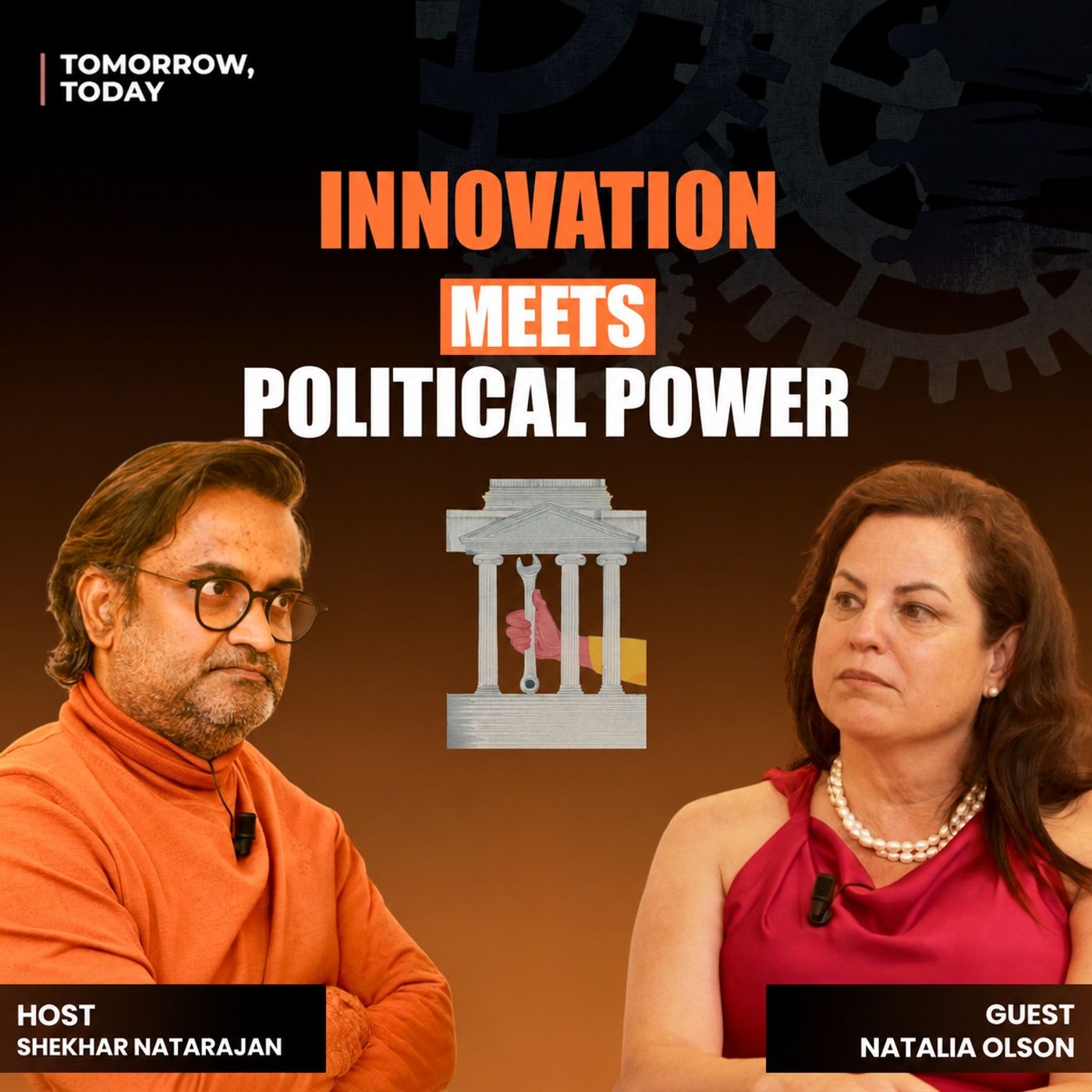
Modernizing Government: Open Data, Innovation & the Future of AI with Natalia Olson | Shekhar Natarajan
Get every episode summarized
Each time Tomorrow, Today publishes, we email you a written briefing from the transcript — the topics, who appeared, and any specific claims, with the ad reads skipped.
Email me new episodesFree for 3 shows. No card needed.
About this episode
“I can create a party made of political agents that can use your job 10 times better. I live in the world of logistics, which is a bunch of irrational people. I don't think that you can run government as a business.”From the transcript
Tomorrow Today with Shekhar Natarajan
What happens when technology moves faster than the systems designed to govern it?
In this episode, Shekhar Natarajan speaks with Natalia Olson, former White House innovation advisor to President Barack Obama and a leading voice in open data, government innovation, collaborative economies, and technology policy.
Natalia takes us through her unconventional journey from growing up across Latin America as the daughter of an architect involved in building U.S. embassies, to working in public service, leading innovation initiatives, advising the Obama administration, and later moving into entrepreneurship and global policy.
Together, Shekhar and Natalia explore:
• How upbringing, culture, and adaptation can shape an entrepreneurial mindset
• What Natalia learned from working inside the Obama administration
• The challenges of modernizing legacy government systems
• Why government cannot simply be run like a business
• How business principles can still improve public-sector efficiency
• The role of open data in creating transparency and empowering communities
• The sharing economy and its potential to improve last-mile efficiency
• Blockchain and new approaches to public transparency
• Differences between U.S. and European approaches to technology regulation
• The rise of sovereign technology infrastructure
• AI regulation and its potential impact on democracy
• Entrepreneurship, failure, resilience, and building a strong support system
• The future of technology, governance, and global collaboration
This episode goes beyond technology.
#NataliaOlson #TomorrowTodayShow #ShekharNatarajan #GovTech #OpenData #Innovation #WhiteHouse #PublicPolicy #SharingEconomy #ArtificialIntelligence #SiliconValley #Blockchain #UrbanPlanning #FutureOfWork #GlobalLeadership #TechPolicy #Sustainability #Entrepreneurship #Democracy #Estonia #Leadership
Subscribe to Tomorrow Today Show by SKN for more transformative global conversations.
Hosted by Simplecast, an AdsWizz company. See pcm.adswizz.com for information about our collection and use of personal data for advertising.
Get every episode summarized
Each time Tomorrow, Today publishes, we email you a written briefing from the transcript — the topics, who appeared, and any specific claims, with the ad reads skipped.
Email me new episodesFree for 3 shows. No card needed.
Know when Natalia Olson turns up
Follow Natalia Olson and once a week we email you every new episode they appeared on — including guest spots the show notes never mention, because we read the transcript.
Follow Natalia OlsonFree. Pick your own day and time.
Hosts & guests
Transcript ready
708 searchable segments. Every word is indexed and playable.
Full transcript
Tomorrow, Today — Modernizing Government: Open Data, Innovation & the Future of AI with Natalia Olson | Shekhar Natarajan. Machine-transcribed; use the interactive transcript above to jump the player to any line.
I can create a party made of political agents that can use your job 10 times better. I live in the world of logistics, which is a bunch of irrational people. I don't think that you can run government as a business. We have an example right now of that doesn't work. It feels like the world has gotten even more polarized and more fragmented. Do you think they can ever do that back together? The Bryan folks from the blockchain community, the Department of Justice started using it.
The Welcome to yet another episode of Tomorrow Today, which is a 50th episode. Natalie Olson, she's a celebrity. What makes this very special is she used to be Obama's innovation advisor and also managing very complex governmental policies and initiatives. Amazing person. As I'm getting to know her, it's been really refreshing to hear some of the thoughts. I want to understand the whole shift of open data and other things that you guys were so instrumental in building and unpack your journey, your personal life along with the professional career and what you're doing now and want to spend the rest of two hours doing that.
That's fun ways to get into the conversation. You're a Latina. You grew up in the United States around the world and you were sharing a little bit of what the family and your dad was building embassies around the world. Tell me, it looks like government and representation of government is like in your blood. How did your early formative years create who you are as a person? Well, I think what's important is the values of your family. I always talk about my parents because my mom's a hunter in America and my father is an Norwegian American. Only in the US you can have a diverse world getting together.
But more than anything, it was the wonderful experience of my parents making us travel around the world, living in different countries, especially in countries that there was a lot of poverty. And my mother made a point that was really understanding the country, understanding that we were very fortunate by having just a home and education. My mother in Mexico City, which is 25 million people, she took us to the biggest landfill. It's a huge amount of trash and people, there's an entire village built out of trash. And she would say, this is how people live and you're so fortunate. And if you don't not work hard enough, you don't understand the value of work. I love working. Then this is what happens. And we're very fortunate. So therefore we have to lend a hand. We always have to help people.
You don't remember at worst what's part of your life. Yeah, yeah. This is really important. Both of my parents are just very giving and and taught us good things. And especially when you have father, medium-mom. In a peace corps. So my father is an architect and he went down to Honduras and he built schools. And my mom was a young lawyer there and they got married and still together. My father comes next week. Shocked the parents. So yeah, and then we went back to the US. Yes, my dad has his own little company. The government was interesting. After the two bombings in Africa or two US embassies there, the US government decided that I was a kid. Decided that we were going to rebuild all of our embassies.
And my father was the only American architect that spoke Spanish well-hack experience in Latum. And so they hired him and so you're going to go and build these embassies across Latin America. So I grew up in Natum in many countries, you know, from Kingston to Jamaica, you know, Ecuador, Venezuela, Mexico, and Honduras. And so that experience I think that gets you to really understand what are the good things in life for you as a kid. And moving around helps you really adapt. You have to adapt really quickly because you have to make every, you know, three years, you have to make new friends, you have to understand the city, understand the different cultures because I tell people that Venezuela and Mexico are very different. They yes, so I always speak Spanish. We're very different histories, different ways of doing things. And that's exciting. And so we really quickly adapt and I think that has made me a stronger
person, I think. And one that takes risks because I think that it's a risk to just pop some morals and show up. So then like, you know, what was what's your background like your education and like how did it actually like prepare you for the role that you're getting into or? Well, you know, I originally wanted to study, it's called, it was a new type of engineering and it was urban systems engineering because I had seen a lot of the poverty and development and under development. I noticed services, amazing, you know, plant that would take garbage and turn it into energy. And I thought that was the best thing in the world back in the late 80s. And I'm like, wow, we need this everywhere. This is something that. And then I switched to economics because I thought from the policy perspective,
I can make more of a difference because I was still moving very slow. And then I went and worked for the State Department and hungry, chapter public and Poland. So I was based in Blue Push. And this was when NATO, when the three ex-seining countries were becoming into the new club, you know, after communism. Very interesting time in centuries to New York. And then I decided, I am going to, you know, education is really important. And that's the only thing my parents have said. And that's the only thing they've given us. They're like, like, any inheritance that you have is education. That will pay for. And you know, but nothing else. So it's important that you take that education and you can transfer that knowledge and apply it. And so I went and worked data masters in. Region and urban planning. So we, regional part is really important because we have to think of the region not just of the city. And then I went and did a double MBA because
I realized we need money to do, to do big plans for the next 50, 100 years. And so I really got into the financial part and to the logistics and transportation and infrastructure. And I, no one else wanted to do in my studio, the transportation part of it. And I thought, this is how you move the world. You know, you move the world. That's why I like someone don't spend the day and so excited. So, so yeah. And so I decided, okay, let's study and apply it. Study and apply it. You always have to be learning. I'll be able to really, and urban planning is wonderful from a theoretical perspective. And it's great plans. But it needs that action driven part of it. So it's important to plan for the next 50, 100 years. But many times, you know, as you know, there are policies and our budgets don't accommodate that. And people have to understand that the citizens are at the center.
The citizens should be involved in all this planning. And so I think that what drove me to do the business side of things was citizens are, you know, their tax buyer money is being used for this, but they're not being asked. This is how I bought technology into this conversation because it was all back then in design, figuring out how to build the scenario, the visual part of things. And so I really just, I think, learning and taking every opportunity to learn from other people. And so I pushed a lot of our urban planning students and our real estate finance students to work together. So the first class that I went to and real estate at the warden said, been planner is the enemy of the real estate. And so it was wonderful to have professors and people that believe in you. And they're like, no, you're right. You have to work together. So it's always been that collaborative. And I'm very
pushing. I'm a charming nagger. No, no, no, I think like you're a beautiful person. So boy, like you had a range of experiences when it comes to education, right? Like, you know, urban planning and MBA and then logistics and a regional urban planning finance, you know, bringing all of that together. So why did you not go into strategy consulting or capital like, you know, venture capital planning? Because that's such a traditional route for a warden graduate. Or go to the big four, like the McKinsey and Ben and that's almost big four. It's not exciting. I mean, I just don't like it. No, no. And I was just did it, didn't trigger
something for me. I really wanted to understand and help the financial part of the community. You know, so a lot of my colleagues went to the big companies and that's great experience. It's excellent experience. They do it for two years and you go into another big company and so on. But I thought, okay, I can do more if I build something myself as well. And then you create an opportunity for others to build and you become a role model. I think one thing that my parents always said, you have to be an example and an example because there's so many people that don't have what you have and being a role model and helping people. So when I started my company, my first company out of a lot of the masters, people were like, the same were going to work. I know I will have to have has to work at least. The idea is planted that we can look at
green economy that we can look at technology for good for the greater good. And now this is wow. This was 2005 before we were using blackberries, not even that. And so the first application comes out and it was all in Philadelphia and you know, it was on transportation and logistics and just the fact that buses, the buses were, you know, I want to use public infrastructure. I want to use the bus and the metro highly underutilized because something so simple as as there were so late all the time. And I worked for the Metropolitan Planning Organization, which in the US is where the funding goes through for all transportation dollars. And for the first time, they realized that the whole air quality was not only based on shipping and rail. It was literally based on
access to mobility access to where you would have to get, you know, buses and metros and everything to reduce automobile, you know, commuting and so on. And so we're really using the data in the best way possible to alleviate air quality problems. And so they were starting. So there was good policy that said, okay, region, New Jersey, you know, in Pennsylvania, you can't, you won't get any transportation dollars if you don't create project to minimize and to reduce the bad things in the air quality. So you're not one of those, like, let's kill sustainability person. And what? Like, I used to have like someone who used to work with mean tapsical, you know, like, and like, I could hear like that rumbling, even then, right? This is like 2007 and 2008. And I used to,
because I used to work in Pepsi, like, I lived in Dan Boring, which is Danberry. And then in in Richfield. Yeah. And so a lot of interesting people. And they would say, like, you know, what climate change? It's snowing more. And this was 2007 and 2008. And I'm like, I'm like, I'm like, I'm sitting and listening to them. And I'm like, okay, we're going to have trouble in the future. Because like, you know, like these people who basically think climate change is not real. You know, there are more and more probably out there. Their voices are very silent. You know, there's going to be some sort of renaissance moment, which is going to happen. And then, yes, we did have one. So it was interesting. Well, you believe me. It's so I, I, you know, we mentioned
earlier those people that have an influence in you and can make you pivot or meet as certain crosswords. It's important for us to to to value that. So I, you know, during like the masters, even though I had lots of classes, I worked at a restaurant. Yeah. I was great. Down Chestnut Street, Capitol Grill was perfect. That was a hostess. And I met everyone, all the council people, the mayor, all those people. And I met one that not no one thought that would become mayor. And then he saw how hard I worked. And then I was actually presenting to him my studio on the waterfront plan. That when he won, Michael Mudder, he said, I want the planning commission and zoning commission to be the strongest one. And then he saw Mayor Daly in Chicago with his green roof. And so Michael was like, we're going to do that. And then he put, he nominated this according to Philly, people,
I was a foreigner. I'm like, I have a home here. I went to school. But so I was on the, I was on the zoning, I was a vice chair of the zoning commission. So we had to we do the zoning code. We hadn't been done since Ken and Bacon. That's Ken and Bacon. And Bacon. Well, Ken and Bacon's dad. Yes. Already famous planner that changed a lot. The way Philadelphia is designed. So so those people gave me the ability. And this is a, this is a volunteer job. This is not like they're paying you. And the other people were like really upset that this woman is on the very powerful commissioner out of the blue. And I had just graduated a couple years before. And I said, everything has to be green. But it's when you put the horse before the car. But we didn't have
the infrastructure. Well, I said, I'm not going to prove anything that is not up to lead standard. Developers were so pissed off. And I had this gentleman come up to me and said, my granddaughter won't get into my Cadillac because of you. And she thinks that I'm killing polar bears. And I was like, well, in 10 years, your granddaughter is going to be able to vote. And that's what really made me be more resilient on that because if the children and the young kids are really looking to this and will make a stand of not getting to grandpa's Cadillac. And then he had to go buy a Prius. So that and it's itself creates an economic shift. Yeah. And so, you know, that gave me hope of really moving the needle on that. And so that really helped me understand better the, I mean, I had come from Hungary. And I could get we could get three countries to talk to each other. But we couldn't get New Jersey in Pennsylvania to share water data. Yeah, I know. Like that's crazy.
Right. Like, so see, this is why I live in the world of logistics, which is a bunch of irrational people. Right. I always wondered. And like, that was my, you know, if you go back and play the history of all the things that I read, it was always around last mile optimization. The last mile for Coke and Pepsi entered the store. It's a DSD model, like direct store delivery. The last mile for Walt Disney company, particularly, like, you know, if you strip away all the entertainment business and other things is a theme park. So basically, Magic Band experience was connecting the last mile experience back to. So that's my one of my inventions. Yes. And then Walmart was basically unlocking the grocery delivery model. And at that time, what happened was like, we were putting tritem trucks on the road to actually make grocery deliveries, which is a web and model, which is not going to work. And the company went defunct.
Like, exactly. And we were trying to replicate that whole silly thing again all over. And we were wondering why we were not making money. I said, it's not going to make money. We were going to put like five deliveries, send it in the same neighborhood like five times. And you think you're going to make money. Like, that's not going to happen. Like, why don't you put it in the trunk of a car? They said, I was like crazy. They literally thought. This guy is out of like, you know, some banana republic. And he's going to like sink like Walmart's like stock. But like, we put so weird and we got it done. Like, you know, I got the the delivery of the done and then we got the lift deal done and then finally went back to Uber and we got the Uber deal done and then we launched it and then it became a instant success. And now like, we don't even process like, you know, when a car comes into the worse to your door, like, it's just like natural to you. But the parcel delivery world, Natalie, like, you know, when I think about it, right? Like, you have a FedEx, a UPS, a USPS,
an Amazon on track, right? All these guys show up at the door. And they're all delivering while the most efficient last mile in your house is the water and the gas, which is by one supplier, though there are many distributors. Exactly. Right? So we don't we don't think about consolidation and sharing of the assets and data. Because the marginal utility cost of the same of a second package delivered to the same door is only 50 cents. Right? So in a geography, if I'm delivering packages, like, why am I not like basically almost thinking like redistricting, like, you know, like one last mile provider, just like you would have one, you know, water provider. And that would be so much more efficient. Right? And so that was my hypothesis of how I got into what I did with American easel and then like, you know, I came out and tried to do the same thing out. But what I found is why these logistics guys, they love control. Yes. It's like control, because it's all,
I think it's all military. I think it's because they've always done it. So in a way, and it's also because, so for me, when, because I love infrastructure, I would literally get into this room full of like 15 men that were just that they were happy when I brought them cigars from Honduras. That's a type of guy. I have the only thing you're missing here is like some whiskey. And I'm going, I have to get you guys to understand that if we create a pathway, a biking pathway that we cross over Conrail rail, that this is something good for both sides. But they just were so adamant. It took so long and taxpayer money to pass things, so simple things like that. The logistics, I think environment has been controlled. And if you look at shipping, it's controlled by like
what 12 companies around the world. So if you look at that, that hierarchy, like you said, it's very controlling. And not until very recently because of policy, Europe, for example, it passed a law that all shipping has to report on the climate footprint. And part of this and others for them to get licenses and many other things. So it takes policy and law to move them to move the needle and move them on things like that. But they have a very stubborn and it's very defensive. If you think about it, a lot of that, innovation does, it is more in military and defense thinking. Because a lot of innovation came out of that, right, in mobility and all that. And that's where you have to slowly, you cannot change people
completely at one time. It has to be, you have to nurture that, you have to show them, little by little. Because if not, they're just going to get resistant to it. But if you give a little bit by and show them how it is in their best interests, then yes, while it takes time, it takes a lot of time. But it's the same sort of like a people who use the postal as the last mine provider as a consolidated. Exactly. Robert, were the post office to be the the consolidator, right? So the consolidation model works and they thought and they found out that's the most efficient thing to do. And unless I'm until you could do doorstop matching, which kind of changes the volume allocation. But the thing that baffles me about logistics is that like close networks, closed pipes, no data sharing, no information sharing. And almost like
thinking that like, you know, words resources are mine, I need to control. You know, that thing like really like gets me like all the earth up. Well, remember when for the big cargo, you know, the containers used to come full and leave empty. Yeah. What are you doing? Yeah. And what we've always done it that way. Like what on earth? Yeah. So that was my favorite one of my favorite. It was, you know, the New York, uh, uh, the port was closing down. So it was moving down to New Jersey. And so, Pennsylvania, so the deeper, the deeper, uh, the make our ports are deeper. Um, and our ships just get getting bigger and, and, and we can't get through. Uh, this was, hilarious to me. Uh, but yeah, it's, it's, um, I think that one point that I think is very important is for people to, they forget where and how and, and the, the journey that that particular
item goes through in order to get to your home. And people complain it's only a couple days late. Yeah. Now, I want to remind people that believe me, this, you're so amazing and lucky, uh, that the, for me, the impact is, I think, the future. This is going to be huge. Uh, people are going to start, and they've already started, I mean, years ago, we tried to do something on, um, you know, a cure code on all the food and the hands and where it was coming from and so on. The DS one and, yeah. And, uh, so people understand the, the amazing climate impact that it takes to get that one product to you. Uh, and, and all the work, I don't know, just takes us. The last mile has been always a part of our, you know, urban idea of, of, of access, right? Yeah. Uh, and the last mile, I think it was developed in, in a lot of small countries, because it was easier. Uh, and, and almost like, you know, all these developing nations have
actually leapfrogged exactly, uh, like the, the thinking and like, you know, we are almost stuck in the stone ages. Like, you know, it feels like, you know, we are in the dialer page, like, when these guys are using cell phones. Yes. Yes. Yes. So it's like, we have our legacy systems, uh, in the US are still really old, uh, and a lot of developing countries around the world. And I've seen it. It's just, I go, when necessity, when, when, when you don't have something, this innovation comes out of this necessity. Yeah. And there's some great ideas that have completely helped us leap frog, um, new things. And so I just feel that we can learn a lot from outside the, I tell you, you know, it's a lot, I just learned a lot here in Spain, just by, you know, people trying to figure out how to move things along, yeah, faster way. So, so I, so I wanted to get to that point, because like, you know, you, you somehow, not somehow, I think like you, you prepared yourself for it. How did you get into about us? Like inner circle and how did that happen?
No, we're, we're a very big team. Well, not big team, actually, we are, you know, the appointees and, um, we go through a process and everything. But the, how it actually was because, uh, in Philadelphia, where did the beginning, I mean, I did campaign for Obama. For Obama. What did you like about Obama that you just, community organizer? He was a community organizer. And, you know, it was, he, you know, came from a very diverse parents, just like my parents. Uh, so that's resonated quite a bit. Yeah, it's, you relate to that. And, and, you know, he's a incredibly smart man. Um, and I was in this, uh, small, uh, meeting thing, we were, it's five of the different agencies, uh, came to speak about what the White House was going to do. And so I stood up and I asked a question and I provided a solution. And so they said, why don't you come and join us?
Until it worked. I'm like, okay. And I didn't know that that was the deal. So literally, that's because I stood up and I said, because people tend to ask questions and criticize. If you're going to ask a question, are we going to criticize? You had to provide a solution. Yeah. Yeah. You know, it just doesn't, you just don't expect, uh, they, you know, because they're new politicians in a way that get all these people became my friends because we were all coming from very diverse backgrounds and a lot of them technology. Um, and so that inspired me to really see that there might be changed because at the same time, we were in a recession, right? The worst recession in the, in the last hundred years. And, um, and I thought, okay, we need to, to look at it in a different way. And I just want to remind folks that this, this particular team was created by, by Congress, uh, it's under the Compete Act. So we have to compete in
order for us to understand what innovation is to really important. Uh, we were in that situation, right? The, the American Reinvestment Act, we had to rebuild. So we went into infrastructure to go and rebuild so we can create jobs as well. And, um, so it was all this rebuilding and, and figuring out how to, and, and a lot of, a few of us that were, you know, in the urban space, urban planning space, um, got together and, and we created the first urban office in the wayhouse. Wow. Yeah. So it is, you know, these ideas, um, reflected that the administration and Barack Obama was really keen on this. The first law and the first, uh, legislation he passed was, uh, an early lead better act, which has had helped women, you know, get to, to that pay, which there was a huge gap. And, um, and so those are the things I think that build, uh, the citizens to really trust government. Uh, very, very tough times. No one, you know, people
criticized, of course, a criticised, or Obama all the time. And he was like after like eight years. And it's amazing. I was like, uh, that Iran deal was pretty well done back then. Yeah, we just went under it and then paid a little bit more. Yeah. No. So, um, so it was, you know, the idea of, of giving back, uh, uh, that, that first phase. And then, uh, you know, several, you know, folks left because our, our, our pointy teams are presidential, uh, administration teams. We lasted the longest. Usually people just stay for a couple of years and several of us stayed for a longer time because it takes time. You can't just do two years. But, you know, people like Arvind Jacob's historic welcome, you know, he has other things to do. Um, and so there's, there's, uh, that responsibility of, okay, I'll stay behind or go ahead and, and I went to work for the SBA.
So I decided, okay, we're going to go ahead and move, we have to move on the SMAs. We really have to, it's, um, the small businesses are the backbone of countries. Yeah. You have to help these businesses. So, so they are from the transportation. And I said, no, the business side. Um, so it was, then because of my languages, I went around speaking about what, you know, the SBA had done. And what we had done is innovate as innovation advisors. And this is how I went around the world talking about what we had done and what didn't work. A lot of stuff don't, it's not work. But that's a fun part of learning, especially when you come into a government that has old legacy systems that they hadn't been updated. Arvind government was still using computers from like 20, 30 years old. And that was a really good reflection of it. You have to build inside the trust and you have to empower the civil employees to really do more. And that's, and so innovation is driven
not only by one person or two people or ten. It's driven internally. You have to empower these people. So, um, very fantastic story. So you, you covered like a breadth of things like, uh, but was there, was there something while you, because you know, I, I remember that time when like Hillary Clinton and like Obama were running neck and neck. Yeah. Um, and like, was there a point when you thought like, you know, Obama is probably not going to be the president or were you always sure that he's going to be the president? Like was like a very good question. Um, I honestly, I wanted to see a woman be a president. And I've been on all the campaigns. I've been on the Hillary campaign. I've been on but the second one was after she was circuitry. And the Kamala campaign. Um, I really, uh, little, I, I thought, wow, we have two amazing leaders. Uh, but I know my country. And I know,
I knew that they weren't ready for a woman president yet. Unfortunately. Uh, but you show that they were going to like, like, like an African-American. Yeah. Yeah. Mel before female. And it will have been, but he's half white, half black. I mean, it's, it's, it's, yeah. It's different in that sense. Um, and but also, you know, Barack was, is, the idea of hope. He's such a great orator. Yeah. It's unbelievable. You know, you get, you still, I still get those bombs when I, yeah, I still do. Because he's so good at that. Um, and it worked out in the sense of brain people that were going through this offer recession. Uh, in, you know, also giving people this idea of that someone like him could become president. You know, and that gives you this idea of like, this could happen. This would make our country better. I think that was the best innovation first. Yes.
Before you became the innovation officer. Yeah. I think it was like, like, for me, it was the most wonderful moment because like, I remember like, you know, I'm, I just literally got married. Um, and, uh, like, you know, me and my wife, uh, she just came into the country, like in 2007, is when you got married. And, uh, basically the election got wrapped up in November. Like, so she came in September and we were just watching glue to the television, like that night. And, like, I literally had like tears in my eyes, like, you know, boy, because it's an immigrant, right? I said, he's a, he's a, he's a son of an immigrant. Yeah. Like, you, we just like, watch this moment and like, you know, it gives you a lot of courage and hope, right? Like in terms of, like, you know, where the world could go. So what was it like to actually work in his administration? It was tough. It was really tough. Um, we, we came with a lot of illusions, right? A lot of hope to do a lot of things. But, uh, but we met a lot of resistance. Yeah. Was it like, what, was it
democratic? You know, at the first, at the beginning, the first two years, both houses, and then it switched, um, you know, to the Republican and Democrat. Like, it's one, both, not both houses, but one was a Republican. The Senate became, yeah. Um, but why was there internal resistance? Like, not internal resistance and within the teams, yeah. It's because you have to remember that these are like 80, 900 people in a different, because it's the, it's the secretaries, the administrators, the advisors, the change, right? Uh, the rest is all civil employees, and there's a few million of them, uh, which actually make things run really well. Uh, so there's always resistance. So you don't believe in like all that, uh, axing and other things that was happening with doge. No. We have a, we compare, if you, this is one of the criticism of Spain is, if you compare, and is it, we have a small government, we do. Uh, here in Spain is like 22%
of people work in the government. Wow. There's a lot of people. And, uh, and the US is like not, to nine and two percent. And so that's still a big number, but not a big number. But, um, you know, the, the, the, is, is there is because we asked for, so in the law, there's, there's, you have to create a strategic plan. Each day, it has to do a strategic plan, right? This was something kind of new. Uh, and so, uh, Pennsylvania gave me a 180, uh, page strategic plan, and Virginia gave me a one page strategic plan. So, uh, the idea of China move things, you have to, you know, first get that, the infrastructure, that's where the infrastructure has to work in order for you to mobilize things, right? Uh, so, yeah, and, and it was silly. There was a lot of racism, uh, us in, in my country, unfortunately, in our country. And, you know, anything that, that we would,
we would take like Republican ideas and, you know, say, okay, this sounds great. Let's do it. And because it was forwarded by a, uh, bottom administration, it was saying no. Not really. Yeah. Uh, well, the biggest, I think the toughest was the, uh, the Affordable Care Act. Yeah. That was still like, yeah. Things like that. But, um, you know, the idea of, uh, renewable, the idea of electric vehicles, uh, the idea of NASA, of, of improving, uh, systems. We know, we went, which is, I can't recommend it enough. So hackers, right? Hacres were thought of evil or or some there, but no, they're wonderful. And so we did all these hackathons. And so, uh, Obama, the team would go to all these states and do these hackathons. And, and then bring, uh, these ideas and challenge them, uh, challenge the different departments and agencies to put out, uh, small
grants to come and fix problems of the health department, of the defense department, of commerce. And these young companies, uh, could solve it in 72 hours, which it would have taken a year, going through the normal way of doing things. So, bringing these, um, kind of helped us push more, but, but it was a little bit out of the context of how to do it in the, because you have to think of other ways that, that, um, allowed us, right? Because if sometimes legislation, what, what it does and policies that have been in place for 30 years, it just slows the process down. So, do you think like, you know, government should be running like a business? I don't think so. I don't think that you can run government as a business. Uh, we have an example right now of, that doesn't work. There's very different ways to run governments. Uh, and you want business acumen. Uh, you want that, that, the knowledge, which is
really important, but you have to have the balance of understanding that it's not a business, uh, you cannot fire people or do things because it is a democratic process. And, and a democratic process means you have to reason that you have to be collaborative, that this is not, you don't, you don't, uh, pass because you're the boss. You just pass whatever you want. Doesn't work that way. Uh, you know, business, yes, it's up to the boss in many ways, but, but a good leader unders, that surrounds themselves with better people than themselves. And then they made that decision. Uh, and so governments are very different. You cannot, and this is, you know, let's say you're all not employees. They're not employees. They are, look, government leaders, yeah, don't serve the people. Yeah. So it's very different. You know, it's like serving your customers in a way, in a way, but not really. Um, so no, I just,
I think that you do have to have good business perspective and it's good to have that as a background, but you cannot run it. No, but would you, would you think about the, the principles of business? Absolutely. Absolutely. Yeah. There's great principles, uh, that, you know, just efficiency. Yeah. Just make it, I'll tell you a story that, um, so our employees, our civil employees would take, but a 30% of their time would be inserting what they did during the day, you know, the numbers and so on. Instead of being able to use the technology in order to just say it and it'll be put in and then you don't have to spend less than 2% and we did that. Uh, and people were so thankful because then they didn't, they could spend, they're doing their job, not doing, you know, inputting all this into antiquated processes systems, right? Um, so yeah, there's, there's ways to do this in a more efficient manner. And that is, is, is more of the business side of things.
Um, you know, so why when I was a regional planner under the Metropolitan, uh, planning organization, billions of dollars were being decided as to where the money was going, uh, based on, um, paper surveys. And so I, I called SurveyMonkey. It was used to be a little company back in Palo Alto, uh, this was 2007. And it just started. It was, it was, I said, look, uh, can we do this? And so on and, but the, the, the, the, let's say the policy people thought it was very strange to do online, uh, surveys by SurveyMonkey. So I call them and I go, can we say like very tiny of a here powered by, oh, yes, of course. Like, yeah, I should have invested in that company, but I have money back then. So I got out of a hundred, so billions of dollars based on 150, you know,
150 responses. And just when the first one, I got 5,500 responses. Just by being able to use the business perspective, we changed the policy and we figure out how to better invest that money. Based on really input, but it took a lot of pushing and, you know, moving in and so you, we need that that expertise, I think, to, to make things efficient, but it's not, but you also have to have to balance the power of, of, of, of the, what the democratic processes are, uh, why election and why you voted, why this is animal, uh, which is, you know, very well structured, I think, our constitution is the longest constitution in the world. It's a working document, but it works. So, uh, World Bank and the development, like, you know, how did that happen for you?
Well, in a lot of the institutions, like the World Bank, IMF, all the development banks are in Washington, DC. Got it. Uh, and they are funded by a minabig part by the US government, uh, a big percentage of it. Uh, in the mountain, you know what the World Bank is supposed to do, is supposed to reduce poverty, but it doesn't do that. So well. And so, uh, now this is an era of, of entrepreneurs, right? We, and so the administration said, no, you have to, programs have to be, you know, related to entrepreneurship because we can't give, giving the fish, we have to teach them how to fish. Uh, so we was, it was very different. And it actually cost a lot of shift and people were upset in the, in those institutions, but they realized that they need to do this. That, you know, you can't keep giving money. You have to empower like, excellent example, right? Africa has been, uh, just, you know, so many countries have,
have gotten through such bad, uh, conflicts and so on and look at Rwanda today because Rwanda now is like, we're going to take these projects, we're going to take the finance and we're going to go ahead and figure out how to commercialize and, and move this through a number entrepreneurial, who would have known when it goes in college, the genocide that happened then and today, what you see today. Uh, so it, it, it does policies at the World Bank needed to shift and, um, and so it became a COVID, right before COVID as well. No one was doing anything because I thought, this, we can't do anything. I mean, yeah, yes, yes, you can do it. You can use that technology. That's how I learned how to do every virtual, you know, visual thing that was possible. To, for us to do more of these virtual calls, and I'm, you know, I shouldn't invest in them that too. I get all these things and then I'm invested in like, well, um, but it was, uh, it was that time,
in period that, that the World Bank needed, uh, more on the entrepreneurial moving capital in a different way, uh, being more aware that, that, um, country wanted not to, to, to, to, wanted to be respected as well. I wanted to, to be part of the conversation. So, um, wow. Yeah. What a, what an amazing experience. So, um, and it was mostly because I was criticizing them. Yes, that's why I'm like, you're not reducing poverty. Wow, wow, else. And your teams could get me getting bigger. And there's thousands of people that are sitting around and going, so, so you got up, you know, you're going to push them and also on the, um, on the metrics, really moving the metrics side into things. Well, important. So you're, you're the pioneer, um, in a lot of things like open data, collaborative economy.
Um, and, uh, also stuff related to, uh, like, you know, bringing, like, new policies in place, whether it's an infrastructure, whether it, like, you know, now World Bank, as you talked about, like, how did you go about doing all of this? Like, you know, it's like, so, like, is it not exhausting? Like, you know, when you try to do this, that people like, where you down and then, yeah, like, I'm wearing you down, but you don't let them, my grandfather would say, uh, an insult is like a gift that you don't accept. So, uh, yeah, of course, it's very tough when people keep telling you, no, and it's not possible. But you know, why I have, I think I've been at the forefront because I'm very good at observing and understanding, uh, human nature, but, uh, and you start seeing shifts, uh, and small groups of people that, they're starting to do things a little different, and you're like, well, this might go somewhere. Uh, and you, and you look at it from, if that,
it's the, it's the domino effect. So if that changes, then more things will be changing, and then people will start doing different, the way, different things. Um, you know, the green economy, it was a big one. Uh, I was in China. And, um, I really just was amazed at how China had been building and growing, and, and, of course, the big argument back then was, you know, no, there's no pollution. You know, like, really? And I saw it in a way that, okay, we really have to move things here because, um, if China is not doing it in the, in the way that it's more sustainable, then we're not, we're going to have a big problem. Probably. Yeah. Yeah. And so, um, and Van Jones started this and, and a lot of us got on board and was like, okay, we, we're going to move this, uh, and thus I use my position as a planning zoning commissioner to do that and, and move, uh,
further procurement process. Now, if you buy greener on, you know, projects, uh, products, then you get a 5% to have a 5%, uh, uh, uh, priority. So, you know, on the blockchain, like, for me, was, is the idea, maybe this, this is why, because of the, the balance between policy and business, the idea that blockchain could create more transparency. Yeah. Uh, I was like, wow. I can make government more transparent. Uh, this is, um, and so they looked at me like, I was crazy. Crazy. Yeah. Yeah. Absolutely crazy. But, but I brought in, uh, folks from, in the blockchain community, uh, the Department of Justice, uh, started using it, uh, which is, you know, to, to, to do a lot of the, the traceability of, uh, properties that have been overtaken by and narco-traffic, uh, in, uh, in, uh, three countries in Central America.
And so, you know, you're able to use that and, uh, that, to, that transparency. But yeah, no, it just, I had banks call me going, what is this blockchain thing? What is this script back in 2015 and then they were just upset. I was a lot of, I'm like, this is where we're going. You understand? Yeah. It's coming to you. Two billion unbankable people. Yeah. And, and the phone is giving, and it was already given them a, a part that we can open up. Uh, and, and open gov. I mean, the whole idea of open gov, which was driven by journalists, there was not driven by type people was driven by journalists to open up the information. And that drove the entire ability of data that created a sharing economy. Remember back then, banks weren't lending. So if you had a five bucks or, you know, some, some amount, you could actually put it towards
entrepreneur or a project, you were, you were liberating the funding that people, you know, little by little. And that's how Uber, Airbnb, Task, where I've all these, you know, companies, who would have thought that you would get into someone's, you know, car or stay as someone's. But back then, you could have, you know, the people, they brought, it was a bad economy. People didn't have jobs. I knew so many Riddestate agents that they started driving Uber. And they made more money doing Uber than they didn't say because the whole Riddestate industry had to come down. So I mean, like, wow, you give an opportunity. So yeah, I don't remember what the question was. No, so you had like, you've done a lot of things. Basically, you've done open data. Yeah. So tell me like, what was open data is the open gov. It's open gov. Yeah. Yeah. So it's just transparency related. It's transparency related. And then the collaborative sharing economy was primarily like
creating like shared like assets and resources and data. So, but remember that, yeah, I just don't know if people don't remember this, but a lot of this information, the geopolitical, like the geolocation, defense used to say that this is top secret. So this information, so they had closed, they said no. But when you open that up, then cars and transactions can happen. So it's important that you start looking at the necessity of people. And that if you have a chest for stuff that is closed and you can't open it and figure out how to work with it, then that's inefficiency. And you know, we of course, you always have people saying no to everything, but believe me, when the banks, they were very institutional, wonderful people. But they
would be like, wow, this company, who we refused alone, refused alone. And then this company raised 300,000 from the crowdfunding. And then they're like, okay, well, you're bankable now. You're like, really? So that type of like friction. And then it was always just, I think the friction of people telling you, no, gives you this idea of like, no, there has to be a possibility. And maybe that's very American or something like that. I don't know. But for me, it was like, there has to, there always is a way to do things. We, so the banks say, no, we have no company. We don't have, you know, because minority companies, if the SBA funding has to go, we, when the law was passed in the jobs act, we increased that 23% of everything that the US government buys has to come from
a small business within it. Women owned companies, minority owned companies, better and on companies, and underutilized hub zones. And that takes time. And it takes effort. But that means, you know, a US government spends a trillion or so a year. That means that 23% of them goes to that small business. Now that in itself creates a huge trigger of innovative ideas. And you move the needle on that. You take that, because that is not grabs. This is contracts. In those contracts, a company can go from a couple employees to a 200 employees with just a couple simple government contracts. So it's, and I've been talking about that in Europe for a long time. So there's still not even at 1%. But it's a great way to really use the government as a catalyzer of change.
So in all of this, there is probably cost of being like the cost that like it cost you something. Yeah, I have two divorces. Fine. I'm not rich. That's fine. But it's, uh, but I've enjoyed it tremendously. No, it has a, how do you go through that? Like, you know, like it must be tough, right? Like for you personally to like experience that at the personal level. And then professionally, you're still like focused on the country and like how to serve the country better. And a lot of people actually go through this. Like, you know, I find that, uh, women who are extremely talented and most charismatic are very exciting from the outside. But like sometimes like, you know, people feel insecure. And that causes a lot of friction in the family and other things as well. So of course, so it's a very common story. So how do you deal with a scenario like this?
Well, I'm very fortunate that, you know, my parents have always been very supportive of my decisions. So that's always good. Um, I have made great friends. I think that you had to build your community of that support system. Uh, yes, many times you feel completely alone, especially when your company fails. And you're like, where do I go from here? Yeah. Um, but that failure actually makes you stronger too. You learn a lot. Uh, I'm very thick skin now. I am not afraid of asking for anything. Like, I am there. If I hit the bag, it's all right. I don't care. I have to, it really teaches you resiliency. Um, so no, I, I jump at the opportunity to get on to a earth-based, to climb a mountain, to go diving with sharks. Um, I took, uh, so I took my, uh, staff, uh, and to aircraft carrier. So you get launched out and launched back in.
I was the first one to go. I'll go. So if I'm going to die, in my as well, do dying during something fun. And if, if things are going to go bad, might as well do it with your choice of doing things. But, you know, I'm, I've lost a lot of fear, uh, because I've gone up and down. And I just feel like I am very fortunate to have my education and I'm very resilient. And I think you have, you feel very self-assured. Yeah. Well, but, you know, what makes you self-assured are the people that believe in you. And they say, it actually helped me out. Uh, and they talk about you and they say, oh, no, she was very helpful. She inspired me to do this. Uh, and I, I get that every day, every day. Someone, it's a comment or something. Thank you for helping me and that in itself. I just, I believe very much in those letters of opportunity. Uh, you can fall down, but, you know, climbing those letters and helping others climb as well. Uh, you build a really strong community
that I know that that creates a net, you know, that, and there are some bad people, of course, in the world, um, that, that forget exactly how that you helped them in any particular way. And then that's kind of, and this is like this. Like, yes. So you don't, you don't stay in that. That takes away energy from them. And so I don't, yeah, I don't really in that. I'm like, okay, bye. So there's all the distinctions, right? Like privacy versus like how much, like, you know, you could make it open, um, you know, technology, how much you want to govern, and how much you want to give us innovation. How do you, like, how do you think about those structures? You mean a different, like, from a personal and generally, like, you know, like, even a how a government perceives all these things, like, you know, like, let's take AI as an example, right? Like, you know, there's a UAC here, but there's nothing in the United States. And it's sort of like a wild, wild West. Yeah. And it seems very easy, similar. We haven't learned
our lessons. No, this is what I admire about Europe, though. I will, there's two good sides. And there's sometimes always a bad side, but they do care. And they do make an effort of protecting the citizenry. We in the other hand in the US will go and build something, and then we'll figure it out and we'll regulate it after. But also that regulating, that's overreglating in Europe hasn't allowed for a lot of companies to be like born in a bigger way compared to what we have done, right? But it's also new here. This, this idea of going out there, using technology for good and also protecting people. Yes, it is in the Wild West and the US, but it will come about. And if you see this recent legislation of protecting young kids and figuring this out, that's where I see a lot of opportunity. I think that the young generation, I call, I started this holding of the teen economy. There's a lot of power. It's not
just them, you know, socializing. It's the teen economy has a lot to give. And I think that future when it comes to that conversation, you will have to listen to all of the different, you know, rising people, the silver economy. I think the silver and the teen economy should talk to each other more. And I feel like that is where my heart is. I think that when I talk about all these structures that I've been involved in, I feel it's a generational thing too. It's how do we get people to really, you know, collaborate and talk to each other and learn from each other. Yeah, what about AI? And AI, AI is, that this AI will, is a tool that we will use to make things more efficient. Absolutely. I think AI, we've been using AI since the 80s. Yes. A long time. I've been speaking about AI for many, many years. I call it, it's just the pull stuff. It was the first one to use AI to recognize our handwriting. Now it's more available to people. And that's
that's fine. That's what when the internet came out. That's another wonderful tool. It is, it is going to create much faster and it's going to create a shift. And I, you know, I was speaking in front of a bunch of politicians and I said, look, I can create a party made of political agents that can use your job 10 times better. Do we really want that to happen? Or are you guys going to get, you know, going and start being more efficient because it's coming? And I feel like AI will be a tool that is here to stay and it will, and you shouldn't fear it. You have to really figure out how to work with it. And then, and then to our earlier conversation, the value part. Yeah. Because a lot of people are afraid of that. Afraid of just this is going to create all these jobs. When, when 3D printing, I had to go around to Congress and tell them that I can create a hip replacement
with 3D printing that they would be, they would feel 20 years younger because they thought that 3D printing was going to take away all the manufacturing jobs. Yeah. So it is how you use it for good. But you also have to explain it very well to the citizens. And I think that, you know, it's, you have more experience as well. I use it from a logistic perspective. In logistics, that this will definitely make it very efficient. The coordination wise, yes, absolutely. So the, but it is largely ungoverned autonomy. And so people talk about trust in AI. But when they talk about trust, they talk about data security, Godrails, all of those things, but not necessarily like how are you going to create a government, you know, autonomy. Exactly. So I think the governance side of things, I will tell you that I met the first
digital minister of the UK back as it was 2017, 2017, and yet then we talked about creating a United Nations agency, a global AI. This was already a conversation that still hasn't happened so 10 years ago. So I think that this, because it touches so many realms and so many industries in countries, this has to happen. And I'm just like a DSDG, I mean, who would have known that in 2015, we were able to pass a framework. We couldn't pass that since since, you know, 1992 of the real card, it wasn't possible. But why was it possible in 2015 because the businesses were at the table, 50% of the participatory because I was there was businesses. So I think and it created this framework. And I think there has to be a global framework on AI. Using this needs to be one. Yeah. Yeah. Like, so how, like, you know, I've been sort of a victim of all this war and other
things, like, you know, so we were actively fundraising. And then, and I was talking to regions where the value-based thinking is like something which would resonate, which is like, you know, Middle East and other places, right? Like, Far East. And, you know, Latin America, like, Europe and other places. And after the war, everything has changed because everyone is now saying, I want to have my own sovereign infrastructure, my sovereign data center, my sovereign data models, my sovereign, sovereign, and they want to be like anti-America altogether. And yes. Yes. So I think about it. Yeah. Like, so it feels like the world has gotten even more polarized and more fragmented. Do you think that they can ever like do then back together is the trust already lost in all of the actions that we have actually taken so far? I think it's a reactive approach right now because of a wonderful president. So, you know, for the first time, let's look at it from when you talk about war, I talk
about like World War II. And there's been peace in Europe. It's perfect because Europe is the one that sovereign sovereign sovereign right now. And so it's China. And, but you had to understand that all of the infrastructure was built the long time ago in the US. So there's a wonderful company. We have OpenAI. We have Anthropic. And now we have Mistal that came out of France. Everyone's like, oh, it's a French company. 95% of it is American. Yeah. Sorry. I don't like it because it's on the American cloud. It was American investment. It was right. So it's there's still far away from that. But, you know, if we were able to pass bilateral agreements by letter agreements on on House and FDA and and and trade in patenting, we were able to do that because we had good leadership and we did an antagonized people. And that's that's it's a reactive approach. It's just that and it's good to be proud of and it's good for the for the new business stick are coming out of Europe and China and around the world
because they are going to grow based on the fact that it's it's it's a competed competing. You know, they need to compete. They need to happen. They've been too reliant on on American innovation and funding. So now it's like, you know, the lighter is being sparked. I've seen it. I've seen the history of it. I've seen it. And I and I think that they will realize that the sovereign idea is has to be done in a way that more cohesive more cohesive. There's agreement. Because you cannot simply pull out like dependence of a Google, you know, a cloud and or a Microsoft Azure cloud and you know, it's like the infrastructure is too intricately connected that like you cannot untangle geopolitically. Yeah. It's not like trade. You know, you cannot say like let me shut down the sourcing from here and move it to there. No, I love it when they're like sending
campaigns of, you know, let's let's not use American technology and like, where how are you sending that? Yeah. I'm sorry. I'm sorry. So it's it's it's it's it's always like, you know, trying to do the right thing and so on. And then that's appreciated. But but it takes the infrastructure to build it. And it takes like I said, 70 years before we did this, you know, here they're starting recently. So what about the world that like makes you like really jumpy and afraid now? Right now? Yeah. Part of the world in the Middle East. I mean, it's it's a right now. It's a ton of it's a, you know, you never thought that this is when you don't think about policies and decisions that you go on your bomb in the, you know, country and think that you can just, you know, take over something. This what I'm afraid of is the amount of of resources that goes through
the straight-of-form moves that people didn't think of the fertilizers and the farming costs and how that relates to food increases. And that relates to a lot of four countries where they cannot access this. So making us to be mistakes without understanding the global impact is really, really key. And I think that's I feel awful because you know, these countries, UAE, Saudi, Qatar, they have worked so hard to build and build trust and and attract people. And now everyone is running away. Everyone is running away. And it's unfortunate because they've been trying to diversify the portfolio. They've been working really hard and renewables and other things and like, why? Why? Why? Why? Why? Why? And it's going to turn back the clock on a lot of things. A lot of things. Yeah. I think like I'm afraid of that too. Like I feel like, you know, we
just like we had 2015 and the radical change that we saw, we would end up probably having something globally at global scale, given like what is happening right now. Everyone is going to get into that mold. And when you know, when people feel very like when they when they start developing hatred, then bad things start to happen. And I'm just simply worried like for my six-year-old. Yeah, no, it's it. And that's why people are going to Mars. Can I get a ticket to? 2047. That's a lot of satellite. There's a lot of rockets. But no, it's it's this is what's not great, but the opportunity to see that these type of things that happened have an impact and has a reflection that you start really questioning. Do I want to live in here? Do I want to just
and this is a really started with COVID. Remember the whole nomad idea of people going off to Bahamas and living in the middle nowhere and creating, you know, because you can access the internet, you can work from anywhere. But there's a there's ways that that we cannot just escape. We have to get involved to make a change. And so that's my biggest concern is this because it's it's the effects the entire Europe, Africa, Middle East. I mean, every word, everywhere. You know, everywhere. So that's the basis of just like skyrocketed everywhere. Exactly. Yeah. Yeah. That that domino effect really can ruin companies or can ruin people. And it's just not not good. Yeah. So how do you measure your life when you think about like innovation? Oh, that's a good question. Uh, measure my life. I
feel like if I have changed the paradigm, if I have changed, uh, something that has created, the results and everything, then I feel like innovation has been there. It's it's it's it doesn't have to be huge things. It can just can be very small things. Uh, and I think the the friction that you have when trying to make a decision whether to to push or not, uh, that in my life, uh, I like friction. I like, I like discussions. I don't like for people to agree with me because I believe very much, I will agree to disagree with it. But let's have a sound discussion where we actually learn from each other. Yeah. And I think that's the core of innovation is this this divergent of ideas, thinking outside the box by respecting each other. Uh, and I just I measure my life on that if I have been able to really change a few things, I think I've done a good job.
Hmm. Fantastic. I really enjoyed the conversation. I'll just do the rapid fire. I know it's getting late. It's getting late for you. I just want to be, oh, I'm mindful of that. Uh, we just have like 10 questions that said, sure. Yeah. Open data in one word. Access. Access. Government doing technology best right now. Uh, government. I think Estonia. Estonia. I think Estonia is doing really good. Yeah. Yeah. Yeah. I like I was in the house and like they were like really like all like young kids like, you know, running the different. Yeah. It's been all like 30 years old. Yeah. Yeah. Yeah. Uh, blockchain. Small countries. Country. Yeah. Exactly. Like, and they, and like, you know, and I was also in Luxembourg. Yes. It seems very similar. Yes. Very similar. Very similar. Very similar. There have been really innovative in the in the in the legal tech. Yeah. Blockchain overhyped or under implemented. I think it's under implemented. Got it.
Um, regulation Europe got right that US got wrong. Health. Silicon Valley in one word. Uh, capital. The most overrated innovation of the last decade. Oh my god. Uh, wow. I'm rated. I can't tell you because it's okay. Digital twins. And sometimes it's like, sure, we've done that. We're not that it's just it's a great way. Anyway, I'm not going to go to the most underrated city for innovation right now. Oh, boy. I think Washington DC, unfortunately. The startup that is going to matter most in the next five years. Start up. Um, I want particular. No, I think the startups and the energy, reducing of, or, you know, access to to energy from our database, GPU, power and everything.
It's just one that looks like a video. But I forget. Baby, I'm on the energy perspective. Yeah. Yeah. The startup that is going to matter. Oh, yeah. I'll be done with AI and democracy. Is it a friend or a threat? It's a friend. AI and democracy. Yeah. I think the AI will help people be more informed. Okay. Good. Yeah. The SDG that was farthest behind already. The political leader going most with technology right now. The political year. Yeah. Wow. I think 2012 for me. Like, you mean the year that I triggered a lot 2012. Yeah. And the political leader doing the most technology right now. Oh. Who's more savvy and tick? Yeah. You know, I understand. I'm just trying to think of a name. I don't know. I mean, Modi. I'm a Modi's ago.
Oh. What is good? I mean, it was smart. Yeah. I very smart. So, I mean, I mean, Modi and she ping. I mean, it's their Indian China during amazing. Washington DC also can value. Now I'm also looking down. Yeah. I love my capital, but it's a, it's, it's, it's an offer. Yeah. Obama, here, you remember the most. Obama. Yeah. That you remember the most. Which year? Of the administration. 2012 because no one believes that he would get reelected. We elected. Yeah. I love it. I say, yeah. The most powerful thing any government can do with technology today. Use it for better or for use for the people. Well, Natalie was like amazing pleasure to actually sit down and talk to you. I like, I really loved it.
Oh, well, no, thank you for inviting me. I really enjoyed it. It was very nice to meet you. Yeah, it is very, very beautiful to meet you. And so, you live in Silicon Valley too, huh? Yeah. How about them? Okay. I live in San Ramon. Yeah. No, it's a, I spent this past year and a half. I've spent more time here. Got it. Oh, yeah. Wow. I love my country, but you know, that's, that's better here. That's better in Europe right now. And Spain is amazing. Yeah. Amazing. Faciliters. Should I also, I would need. Yeah. Not that welcome. You should see how many Americans are moving over here. Many, many folks are moving here. That's great. That's great. Thank you so much for your time. Yeah, thank you. Yeah.
More episodes
More from Tomorrow, Today

India's Gig Economy, Education & The Future of Work | Chetan Bhagat | Tomorrow T...
Tomorrow, Today

Adah Sharma on The Kerala Story, Backlash, Threats & Handling Rejection | Shekha...
Tomorrow, Today

Karma, Enlightenment & the Wisdom Beyond the Mind | Shyalpa Rinpoche | Shekhar N...
Tomorrow, Today

The Mountains Choose You: Araceli Segarra on Adventure & Resilience | Shekhar Na...
Tomorrow, Today