Get every episode summarized
Each time All Things Policy publishes, we email you a written briefing from the transcript — the topics, who appeared, and any specific claims, with the ad reads skipped.
Email me new episodesFree for 3 shows. No card needed.
About this episode
“We are a bunch of policymakers based in Bengaluru and we like bringing fresh perspectives to Indian affairs and Indian perspectives to global affairs. So grab a cup of coffee, sit back and join us for today's chat.”From the transcript
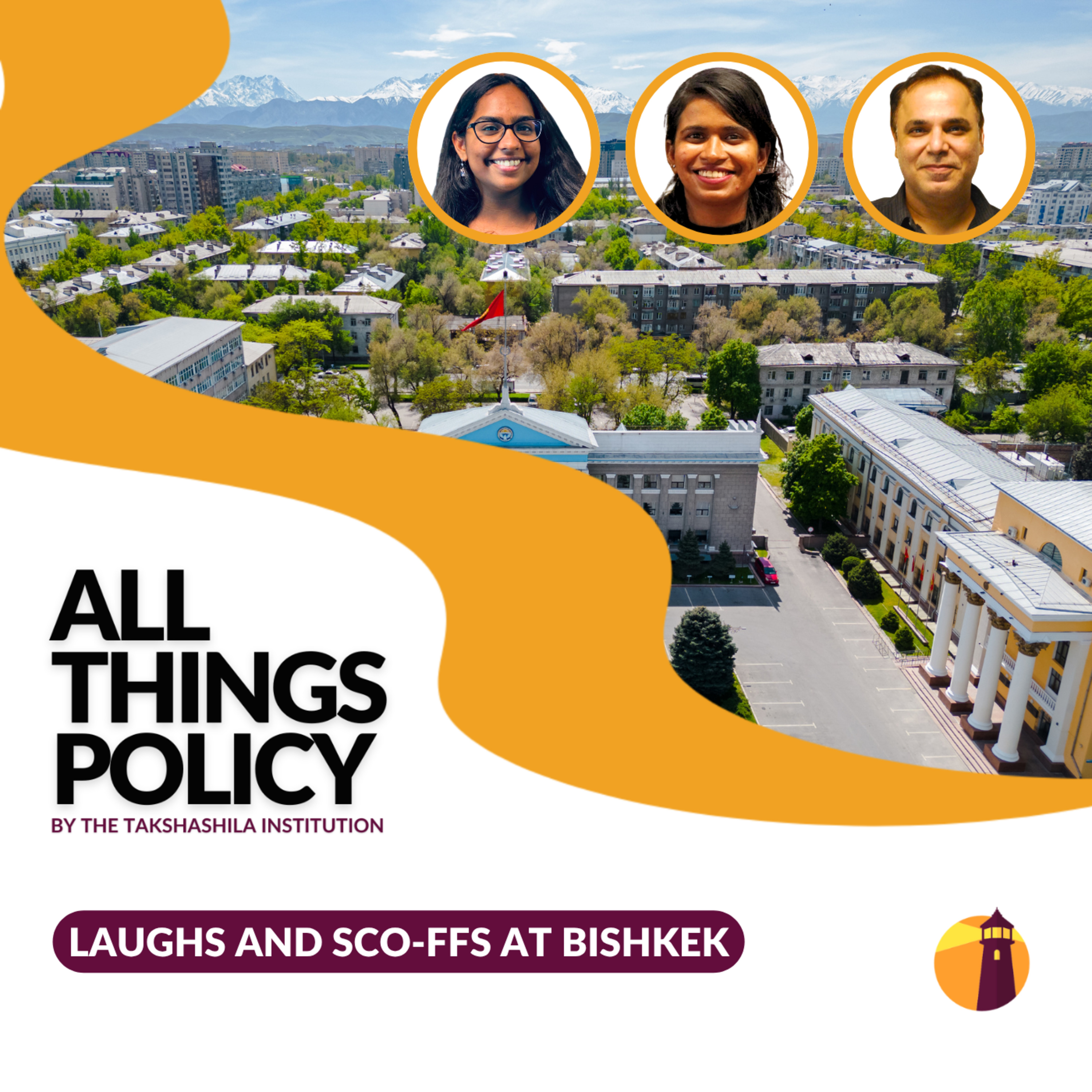
In this episode of All Things Policy, Anisree Suresh sits with Manoj Kewalramani and Anushka Saxena to unpack the 26th SCO Summit. They analyse the key takeaways from the Summit and its Bishkek Declaration, the utility of the Organisation itself from an Indian perspective, and its wider impact on regional security and cooperation.
All Things Policy is a daily podcast on public policy brought to you by the Takshashila Institution, Bengaluru. Find out more on our research and other work here: https://takshashila.org.in/research-areas
Check out our public policy courses here: https://school.takshashila.org.in
Get every episode summarized
Each time All Things Policy publishes, we email you a written briefing from the transcript — the topics, who appeared, and any specific claims, with the ad reads skipped.
Email me new episodesFree for 3 shows. No card needed.
Hosts & guests
Transcript ready
392 searchable segments. Every word is indexed and playable.
Full transcript
All Things Policy — Laughs and SCO-ffs At Bishkek. Machine-transcribed; use the interactive transcript above to jump the player to any line.
Welcome to all things policy, a daily podcast by the Taksashila institution. We are a bunch of policymakers based in Bengaluru and we like bringing fresh perspectives to Indian affairs and Indian perspectives to global affairs. So grab a cup of coffee, sit back and join us for today's chat. Hi everyone, welcome to this episode of All Things Policy, a Ministry Surish, a research associate at the Taksashila institution and today two of my colleagues from Taksashila's Geostrategy Program join here to discuss the recent SEO summit in detail. Manoj, who is the chairperson of the Geostrategy Program and Anishika Sakseena, who is associate fellow at the Taksashila institution, welcome both to this episode. The 26th Shanghai Corporation Organization Council of Headzov State Summit, which took place from August 31st to September 1st in Kyrgyzstan, marked the 25th anniversary of the founding of the
SEO. So leaders of the member countries signed the joint Bishkek Declaration, addressing regional security, economic cooperation and global issues. So one of the key takeaway from the declaration for me personally was that there was some stress on the double standards in the fight against terror that's considered unacceptable by some members and a larger call for international community to combat terrorism, including the cross-order movement of terrorists, which I think it's very important given that it's adopted by countries like India, Pakistan, Iran, Russia, China, Belarus and this interrelation countries in the SEO grouping. And these are the countries with like you know, varying at times even opposing views on many of these issues, including terrorism. So this is something we can dive deeper in this discussion, the larger SEO approach towards terrorism and also to analyze the Bishkek Declaration, particularly from the point of user of like China, Pakistan and of course India. Let's zoom out first. I think it's very important to
discuss the utility of SEO before we dive into the details of the outcomes of this 2026 summit. So in an increasingly fragmented world, the SEO raises a very important question, whether countries with very different interest and political systems still build meaningful forms of multilateral cooperation and whether it has any utility in the new world order. Mano, let's start with you. Thanks so much, Anasi. Look to the broader point that you made about the utility of the SEO and whether it is worthwhile having a platform where countries that have very different interests can come together and can talk about some of the challenges that they face jointly at least in a broader sort of abstract sense or in a principled sense. Yes, it's always important to have that and it's always better to have that than to not have that. You know, that's the only way that you can come together and at least start to understand each other and
where each other's red lines are or what each other's concerns are and try and find some degree of common ground despite your interest being very, very different. So short answer is yes, I think it is useful. The long answer is, is it effective in trying to then bridge that gap and has it been effective in bridging that gap and being able to actually address the concerns of each of these countries? And if you take the example of terrorism that you talk about, my view is that not really, you know, you've seen all the big players in the SEO, Russia, China, India, Pakistan, Iran and of course, the Central Asian countries. All of them have very different security concerns even with regard to terrorism and each of them therefore identifies what they see as primary threat in that sense and therefore they look to address that and therefore so you end up with these broad platitudes that we are all against terrorism and
principle but you can't really seem to agree on who you think is a terrorist and that's a challenge right? That's a global challenge also and is so is the challenge in this institution and therefore what you're seeing is you're seeing some agreement on things like okay we'll try and look at financing, we'll try and look at flow of information, we'll try and look at radicalization but at the heart of it, can you move states which seem to be supporting non-state actors for these kind of activities, violent non-state actors? The answer is not particularly right and I think this bishkek declaration at least in my view in some ways does a disservice to from an Indian interest point of view on the issue of terrorism and I can go into that into more detail later but that's my opening view that yes it is useful to have the platform but I think its effectiveness has been extremely limited. Yeah thanks, Raj, Anishkar, do you want to add anything to it? Yeah thanks so much Anishri, I think yes my manager has already given the lay of the land
really articleically but just a couple more points I think yes as Manoj mentioned the bishkek declaration has a couple of really important issues and when you read some of those paragraphs even beyond the fact that there are some of them read like gratitude and read like lip services to the divergent interests and concerns of various countries. The fact is that sometimes it came off to me as surprising that India agreed to sign on to something like this given that the SEO at least in principle is a consensus based organization although language in these end documents or joint documents that come out at the end of the summit finds ways to circumvent that idea of consensus but yes in principle it's a consensus document which means anything that does come out at the end of the summit has probably been agreed to or agreed upon in principle by all of the 10 member states. So hence my surprise and as Manoj said we can
get into that going forward but I think on the broader question of the utility of the SEO especially to India I think a couple things stand out as to what it has been able to do for India in the past eight years since India became a permanent member or exceeded to the SEO. One is of course you know we always have to look at what India's opening principles around engaging with SEO were and Central Asia figured out figured to be a really important part in some of that. So has the SEO been able to act as a platform where at least on the sidelines India can engage with all leaders of all five Central Asian Republics to a great extent yes and a lot of the good developments in the bilateral between India and the Central Asian Republics have coincided with the enhancement of the SEOs operations. This is not to say that the SEO is responsible for them but at least it gives that kind of a room and a platform where once a little bit of mutual trust
is established you can proceed to closer partnerships at the bilateral level and that's exactly what Prime Minister Modi also alluded to when he went to Uzbekistan just before the Bishkek summit and India and Uzbekistan signed a joint statement saying exactly that right and then the other thing is of course as Manoj again alluded to the idea of just being on the table and getting whatever you can from there so I'm sure you know you already see so many divergent views coming from both China and Russia on a lot of issues and you know that's a no-limits partnership but not so much right they will have divergent views on a lot of things and again we can get into those but I can only imagine how much more interesting it would be when the doors are closed and when the issues of what terrorism means what security means how to address regional security when all of those come up how countries debate them out and how they're how they're writers and their diplomatic
delegations negotiate them and how language is twisted just a little bit to make it more palatable to one dissenting party all of those must be things that representatives of Delhi would really gain value from watching and that can only happen when you are in that room and when you are represented on that table and then those are take away is that can eventually maybe you know help you shape better foreign policy so that is me looking very optimistically at what happens behind closed doors of course some of those divergences come out in let's say put in giving a press conference after the summit or Xi Jinping making his own speech which is separate from what is seen in the declaration but some of them I'm sure are hidden from the rest of the world and that's where I guess the value of diplomacy or diplomatic learnings would like for India yeah so if I remember it correctly last year's SEO minister summit which happened in Beijing ended without a joint statement as I think in their refuse to endorse the joint declaration and one of the reasons mentioned by India itself
as that it wanted to mention the concerns of the terrorism in the document which some other countries did not agree with so basically failing to arrive at a consensus on the issue of terrorism right however at least this time the members were able to arrive at a consensus and came out with the joint bishkek declaration which includes again measures to strengthen cooperation against terrorism and other transnational security threats which is a significant given the series of even that was happening in the last you know couple of years maybe in the global seas right and one thing also that I felt like is good to highlight here is that I think the group is meeting for the first time since the US-Israel war on Iran began more than six months ago and almost all parties of the group if not directly affected at least by the economic impact of the West Asia war they are also equally affected in that sense and the declaration kind of condemned the US anisrael attacks on Iran and supported Iran's right to peaceful nuclear technology under NPT in that sense so much come maybe we will start with you like what are your thoughts on the
Bishkek declaration largely right thanks for that initially I think one of the things that needs mentioning here is that I think it was the concluding communique of the defense ministers meeting at SEO last year in thing though when China was still the chair of the SIOVET Indian Defence Minister refused to endorse the final communique because there was no proactive mention of the tragedy in behelgum and the consequences of states monster terrorism in particular I think from one particular party that has always been a problem for us right and is represented at the table and talking about Pakistan so I think that's when we saw that consensus process actually play out a little bit but also where India particularly I think the rise of value from being in the table right which is it's one of those platforms where you have China, Russia and Pakistan and yet because of the nature of the platform you have a little bit of leverage to not allow them if I'm a say so to shape the
language around terrorism or even on the war in West Asia to some degree now that takes me to the Bishkek declaration right and what was a problem actually this time around there are two or three things that stand out to me in terms of takeaways as to what was interesting or surprising as I talked about it before one was of course India kind of going back on a stance that it had communicated in June of 2025 when it had said the NEA had particularly come out with a statement after an SEO meeting which condemned the attacks on Iran and upheld Iran's sovereignty and territorial integrity right and at that point NEA had come out and said that look we have these conversations with Iran we expressed our position to them our position is clear and known to the world but that said that this SEO statement that has come out on Iran and specifically condemning the attacks on Iran and upholding its sovereignty and it's right to defend itself and so on and so forth we don't particularly
associate with it and we did not participate in the articulation of that statement but this time around the Bishkek declaration says exactly that but it also references that June 25 meeting not to say June 2025 but it says with previously already discussed this position it was also already articulated by the SEO and we're reiterating here that we should we are condemned the attacks on Iran and we uphold its sovereignty right so and of course India signed on to that document so it's a little triggering for me if I may say so that divergence kind of stays there then the other thing is about and this is something very interesting and very unique to the SEO in some ways right and this is what I was talking about and I said that there are ways in which the language is used to circumvent consensus so at the Astana Summit in 2024 we saw that the declaration document had said that the BRI is this amazing initiative by the Chinese and ABCDEF members endorse it and so all
the eight members aside from China and India were mentioned in that operative paragraph as endorsing the BRI as wanting to engage with it further but in but India was excluded and of course rightfully so but the fact is that like the choice the SEO made was to still add that appreciation for the BRI and still go ahead with naming each of these eight countries rather than avoiding a discussion on that one unilateral subject completely and this that that's the same choice that has been made this time around in the Bishkek declaration as well again the eight members aside from China and India named and again the BRI is uphead right and finally there's one thing that isn't reflected like it is reflected in the Bishkek declaration in the discussions on the regional order in the cotton code Middle East and the attacks on Iran but broadly this has been a trend in some SEO meetings in the past two years or so where the foreign foreign ministers of from Islamabad
and Beijing would meet and the Chinese would come ahead and say that look we totally support Pakistan led mediation in West Asia and we also encourage other members to do exactly that and this is a trend that hasn't just reflected at the SEO particularly the SEO foreign ministers meeting earlier this year but also other multilateral fora like the ashyan right so I was of course I was a little bit worried that language might just also enter the declaration but I guess that would have been one step too far because nobody else is obliged to back Pakistan led mediation in West Asia so we saw the language be slightly more neutral on that front but yes this is an undercurrent in the SEO that again kind of needs to watch out for yes what is do you want to add something to that? So firstly yeah Anushka's correction on that and the caveat on that that you know India did acknowledge Tianjin declaration and also this one it signed on to both of them the process to signing on to Tianjin
was obviously a negotiation over Pahalgam and the Tianjin declaration specifically included a mention of the Pahalgam terrorist attack but interestingly the subsequent line talked about also the terrorist attacks in Pakistan particularly the Jaffar Express attack on May 11 2025 and the Kusdar attack on May 21st 2025 so there was a certain equivalent set was drawn which was clearly the compromise that Beijing seemed to work out between India and Pakistan in this declaration again like Anushka pointed out there is a particular sentence which depending on which language you're reading if you're reading the Russian draft of the declaration or if you're reading the Chinese draft of the declaration there's a slight difference but basically the sentence begins with the paragraph on terrorism and then it talks about how any efforts or any acts to discredit SEO entities or the government or state organs of entities of SEO countries it will not be acceptable
that's a very interesting sentence it's never been there in SEO documents before by some measure it is there as protective of Iran because of obviously the American actions in Iran and the talk of Iran as the state sponsor of terrorism the Americans constantly talk about that but it also is quite interesting because it can actually be used to criticize Indian points about Pakistan right India talks about Pakistan being a state sponsor of terrorism the military she had the complex been supported and that's been in the position from the Indian perspective that the Pakistani army in particular is responsible and this is state sponsor terrorism happening within India cross-border terrorism so this is a quite puzzling sentence that we seem to have the Indian government seems to have agreed to and it's quite ambiguous it could have been far more
if we vocal a sort of a more un-equivocal on Iran if that was the target of the sentence so I think that to me that stands out the other thing that I think not so much the declaration but I think broadly the summit and I don't want to go over the points that I'm not going to talk about but just broadly think of the summit to me what's interesting is that increasingly at least from Tianjin onwards the Chinese seem to be arguing that they are the driving force behind the SEO and they are shaping the agenda of this organization the Chinese Foreign Minister you know today first of 4th of September in the Chinese media there was an interview published by the Chinese Foreign Minister where he's talking about what was achieved during the SEO summit and it's interesting that he frames this summit in Bishkek as a process that is taking forward what was agreed in Tianjin so the agenda was set in Tianjin and now what's happening is basically building
on that agenda and the Tianjin summit set in agenda for 5 years and this is now sort of the next summit are going to build on this so it tells you about how Beijing is sort of looking at this and one of the big points that he's talking about is economic cooperation the SEO was conventionally a security oriented organization towards non-traditional security terrorism things like that it's increasingly getting an economic flavor last year in Tianjin they agreed on establishing SEO development bank that's not coming to play so far but that's one thing there's an interbank consortium that's being worked out there is an investment fund that's being talked about so the economic dimensions I think matter the other dimension I think that matters is the energy aspect of the SEO it is a club where you have the world's largest energy producers but also the world's largest energy consumers in some ways and there's all this talk about creating an energy consortium how that comes into being whether that comes into being is something to be seen but the fact that
you're seeing this as the priority tells you a little bit about how difficult it has been to actually come to some agreements on issues of terrorism and security but on issues of economic interest and economic security there perhaps is far more alignment that's emerged particularly given American policy since the return of Donald Trump to the White House yeah I think that's a very important point managed given that China is the biggest trading partner for most of the member countries of SEO if not all the economic angle and how the like you know I think there were a lot of mentions about the ports and logistics centers by 2030 and some AI related investment opportunities at being spoke which I think like BRI of course there will be some pessimism from India's perspective at least one has to agree that at least these conversation about connectivity and free flow of trade is happening at the time when the world trade is increasingly becoming fragment so coming back to the terrorism aspect that we are
initially discussed so SEO has a joint body the regional anti-terrorist structure which again artistry is intelligent sharing training and institution building in that's it how the grouping has members who at times try to hold each other responsible like as with India and Pakistan and may disagree also on what terrorism or extremism could mean in practice right so in that sense how do you see the effectiveness of the grouping in addressing their commitment to like combating terrorism or like extremism right so just broadly and then you know I'll throw it to Muno which I think it's very interesting and important to understand some of the work that the regional anti-terrorist structure aimed to do when it was formed right and some of those mandates so to say are really specific right and even if some of our expectation is that at least there should have been some progress since 2004 in or something meaningful or efficient when it comes
to countering terrorism I think the rats framework since it began with one foot out the door if I may say so right so what was some of these mandates it was stuff like preparing a shared database of prescribed individuals and organizations and coordinating exercises like and I think they call them solidarity exercises and also sharing intelligence on threats right so some of these functions are not only better done bilateral for example when there is so much difficulty in defining terrorism China and Russia or China and Pakistan are better off conducting a bilateral exercise on counter terrorism than all the 10 members of SEO right and if it's SEO plus it's even more complicated which is why despite the existence of rats you see that China would prefer individual counter terrorism exercises with Belarus with Egypt with Russia so on and so forth right so that's one there so so joint exercises in particular were best when there is trust
and some sense of common lingo between members of that exercise right and clearly that doesn't exist in the SEO so that was if I may say so doomed from the very beginning on the issue of yes maintaining the shared database and issuing threat alerts and all of that I think again this could be one of the sports where India could potentially push for I know more efficacy I know there is one database that has certain names of prescribed individuals and organizations but of course just like at the UN level we see that the Chinese are not so comfortable with designating Pakistan based terrorist organizations at India's behest the same way we see a similar disparity kind of manifested in the database that the SEO maintains right so in that sense I think the other two bits about sharing intelligence and maintaining that database become more lip service but if again if I have
to be really optimistic those would be the two places that are genuinely easy for India to push for at least with my I don't know Central Asian countries or with Russia to some extent through the SEO because the body's already exist and they're already taking in some money right so just under the threshold of the joint exercises these could actually be really meaningful if some trust could be built or if it is only carried out like a bilateral or a trilateral level with members of the SEO yes I know actually my view on this is that I mean I agree with Unish Cup but my view is also that I think it depends on what is your expectation if your expectation is that this is going to become something purposeful which is going to seriously deal with a shared set of terrorism that's not going to happen because like I said in theory the threat is shared in practice the shared the threat is not shared the people or the entities that India thinks of as terrorists who are threatening its security are very different from the people in the entities that China wants constrained are very different from the people in the entities that Pakistan is concerned about so it's very difficult therefore
and you know so these are the cross-purposes also in some ways with each other's interests so you're going to see you know very little action where however this thing can actually be useful is that it provides an opportunity for you to get you know in the same room in the same operational environment as forces from other countries with whom otherwise you perhaps would have not exercised right it also allows you to go to terrains which otherwise you perhaps would have not gone to so while substantively and materially your forces might not get much you might not be able to deal with the issue terrorism this joint exercises even at this multi-gratting level can be useful for that sort of exposure can be useful for building connections between forces can be useful for understanding what kind of weaponry others use can be useful for getting some insight into mindsets in psyche so it can be useful in that sense but that's again very low levels of expectation from when we think about joint exercises and what they're supposed to achieve given these grand objectives
and goals that have been outlined in terms of broadly you know SEOs approach to security I think there are some places where I think they can work together right so drug trafficking is something where I think you can do some things together telecom fraud and those kinds of issues are ideas where I think something can be done together but again it depends on what's the nature of threat perception and is that is a jurisdiction of threat perception similar for all countries you know for example Chinese are quite interested in tackling telecom fraud but a lot of the individuals who are involved telecom fraud outside are also Chinese individuals so they are quite interested in dealing with that from an Indian point of view the telecom fraud challenge is actually much more internal than external in some ways but there are external elements to this on drug trafficking I think they can be much more that can be done among all of these countries but if you step back and just look at how
the coherence of the organization is when it comes to broader security issues you will see lots of friction and it's not just India Pakistan that seem to be at logarithmic with each other China and Russia also have very different interests in some ways although they have found common ground in Central Asia the Central Asian countries themselves actually want to create other alternatives for themselves rather than China and Russia and an example of this is you know in 2021-22 you had border clashes between Kyrgyzstan and Tajikistan you know hundreds were killed and it was only 2025 they found they signed a border delimitation agreement but in that process one would have assumed that the SEO would play some sort of a role two of its important members are actually at lower heads and conflict with each other over a border issue but the SEO did not play a role one would have assumed the China being the biggest trading partner and you know presumably the leader you know a great power would step in to do some sort of mediation but it did very little
actually the entity that did most of the mediation and most of the work there and the scene seem to have been Kazakhstan so I think that it's worth thinking about also the agency of these other countries when it comes to security concerns you know but yeah stepping back on the terrorism issue I mean I agree with Anshkha I think that the very limited that can be done some things can be done so it's a matter of what your expectations are from the grouping yeah I read it somewhere that SEO scheme members fear each other at least as much as they need each other and the reasons they need each other is also kind of varied in that sense so I think that also says something about the future of SEO in some sense within this regional security and all these issues right now coming to India's presence in the grouping like how do you view India's national interest yeah represented in the grouping in the sense basically like how to make SEO work for India whereas it will go to your first yeah how do you make SEO work from it I mean the first thing is that there's been lots of debate within India that you know why are we on this table is it necessary for
India to be there to my mind you know the time for that debate is gone we are on the table and I am of the view that it is better that we are on the table particularly after you know the shifts in US policy oh you know since 2025 I think it's much more useful that we are on the table I think the Indian objective of getting in the SEO was a you know there are a couple of broad objectives one was obviously that it gives you a gateway to Central Asia you wanted to be in a place where you could talk to Central Asian countries that was a shared interest between them in India so the SEO provided you a good platform without necessarily creating geopolitical intrigue with China and Russia the Russians were quite keen to have Indian board so it's you know so to that extent it was worthwhile it's also coming at a time when they draw down in the US first posture and Afghanistan was taking place so you knew your continental security environment was going to change because the US was pulling back and if the US is pulling back then there are other actors in the region that you will
have to engage with because your continental security environment is going to change so again it was a good decision in that sense to be on that platform how do you make it work for India it's hard and I think what India should do is India should look at primarily some of these economic gains it can be made India should look at what it can do with Central Asian countries and expand its stake over there particularly its energy related engagement with that region um unfairly and most importantly I think India should be using this platform far more effectively shaped the discourse around terrorism terrorist financing radicalism and literature around those things and at least try and build some sort of congruence and between bigger countries in the region whether it is China whether it is Russia whether it is Pakistan about how terrorism can be deeply disruptive for each of these
countries and therefore they must agree to certain baseline standards on what must not be acceptable and work towards implementing it it's very hard it's going to be extremely difficult you're in a club in which you know at least two of the biggest actors in that club are not necessarily out of the most interesting actors Chapakistan and China are not necessarily friendly states in that sense um so it's going to be really hard but I would rather that you are at the table um focusing on energy economics and trying to shape the discourse on terrorism rather than not being on the table absolutely uh Anishka do you want to add anything to that? uh right thanks for that I mean I think um Manoj has uh adjusted this question rather beautifully but um please pardon me in advance for being almost funny in the next couple minutes but I had two ideas actually and they won't exactly fix everything and make the SEO work but I would really find it interesting if some of this is experimented with um at least in the short term especially considering that Pakistan is the chair for the SEO in the year to come right?
yes um so of course this remains up in the air whether the Indian Prime Minister will visit the leader summit in 1027 which will be in Islamabad or will the foreign and defense ministers meetings go as uh Pakistan as a chair would want them to be but I think um two things that we should definitely try and experiment with to at least put forth our interests forward is and just to see see how the room reacts right um one is language on state sponsored terrorism uh I know it may throw up obvious issues with Iran but it will definitely throw up obvious issues with Pakistan but um if you look at the compromise that Manoj talked about in the Tianjin declaration after the defense minister refused to endorse the defense ministers summit meeting to communicate that compromise involved the naming of the Helga in addition to the terror attacks that took place in Pakistan so every chair I would just partially accredit to this that to the idea that every chair
would want the summit that they host to end in a declaration so we should definitely try and throw around the idea of including language on state sponsored terrorism at the next summit and in the next declaration right especially because it matters to us and it wouldn't be tantamount to just getting peanuts on the language on terrorism right let alone meaning and action the second idea was going to be um putting forth uh language on connectivity that benefits us again if you go back to the point that Manoj made about how central Asia is an important partner for India and India has always strived to build trust at the SEO and then implement it in bilateral engagements um one of the things that took happened at the India Central Asia dialogue last year was that India proposed I think adding uh Kazakhstan and Turkmenistan if I'm not wrong as uh permanent stakeholders in the INSTC project and even in Chabahar but India's own commitment to Chabahar has been diocese since then
nonetheless if it's still serious about it and if it's still serious about the uh in-tash not-sout transport corridor uh I think it could also be interesting to not just disagree with the paragraph on BRI but also add language that talks about other projects that are useful in the region right INSTC and Chabahar just being examples of that so these are the two kind of thought experiments that I am thinking about as to what how India can perhaps at least uh shape the room as opposed to just voicing contest uh easier said than done of course and diplomacy is much harder than it what it could look like to me or to us uh but these are just some of those ways you could make the SEO a little bit better for yourself in addition to everything that Manoj talked about now I think it's a very important point given that uh in the end Pakistan also have not had any sustained talk uh for a really long time and although there were attempts to resume contacts
some of these efforts were kind of derailed by like you know either string of terror attacks and the pretty measures that followed by it so I think um and there are a lot of media hype now like you know whether Pakistan will be inviting India for the next summit that's happening in Islamabad so yeah do you have any fun predictions on it Manoj like you know what are you use on like you know whether India will be attending or should India be attending I have grown too old to predict geopolitics anymore I realize uh you know with a little bit of age there is some wisdom that has come that uh you should avoid predicting such things but uh you know my sense is uh there is some momentum that now seems to be uh emerging at least in Indian discourse uh about some sort of willingness to be able to talk to Pakistan obviously it's not being expressed at the highest levels of government but for example you've seen people from the RSS uh you know the ideological sort of fountain head to which the BJP aligns to uh and you've been seeing some discourse among them about uh how it
might be worthwhile talking to Pakistan there is some reports of you know how some dialogues you know track two kind of conversations have been attempted uh so there might be some momentum where there might be some conversation which might any of that materializes and that's a big gift right in India and Pakistan there is uh then you might actually use next year summit as an opportunity uh to there might be a visit um but all of this is very very contingent as it stands today I would say it's highly unlikely that the Indian Prime Minister will visit but we'll see uh you know there is some momentum which seems to suggest that uh at least early feelers of conversations between the two sides uh have existed now for the past few months uh we'll see where that goes uh again I'm not predicting anything yeah i wish got the i will have the predictions but right just a very quick thought on this I think um I don't have Manoj's wisdom but I will definitely say that I will not go to the prediction route but on the second part of the question
which is about should India go again I I call the sentiment that you know um and you know I might annoy a lot of cricket lovers out there but I think it's one thing to demand um you know exclusivity in terms of the venue in which you will play matches especially that when news Pakistan it's whole another thing to shana multilateral forum uh because of bilateral issues and all the more reason when that bilateral issue is something you want to articulate and talk about and contest regarding it helps I think to be there uh of course India can always rely on things like underrepresentation or um uh non-consensus it can refuse to sign on to the declaration and all of those things so that might just be other ways uh that Delhi should be open to consider if the beginning response isn't already that we will not go to Islamabad right so uh so uh so that would be my thought on the question of should India go I think yeah yeah thanks
Lord Anishka and thank you Manoj I think this is a really interesting discussion to get an overall view of the SEO summit and the key takeaways from it of course uh in a very brief time of discussion that we had uh thanks a lot for joining and thank you all you're and for listening to this discussion thank you if you liked our show dive into Taksha Shilaz research on technology strategy and economic affairs check us out at our Twitter handle at Taksha Shila INST or our website Taksha Shila dot org dot in
More episodes
More from All Things Policy

A New Congress, A New Challenge for India-US Ties?
All Things Policy

America Votes | Why should India care?
All Things Policy

The Limits of US-China Cooperation on AI Safety
All Things Policy

The Medical Wild East
All Things Policy