Get every episode summarized
Each time The Big Story publishes, we email you a written briefing from the transcript — the topics, who appeared, and any specific claims, with the ad reads skipped.
Email me new episodesFree for 3 shows. No card needed.
About this episode
“Stories that matter, podcast that resonate. A mid-what the Prime Minister called a ferocious storm, Mark Carney believes Canada's newly proposed associate membership in the European Union would help protect its sovereignty.”From the transcript
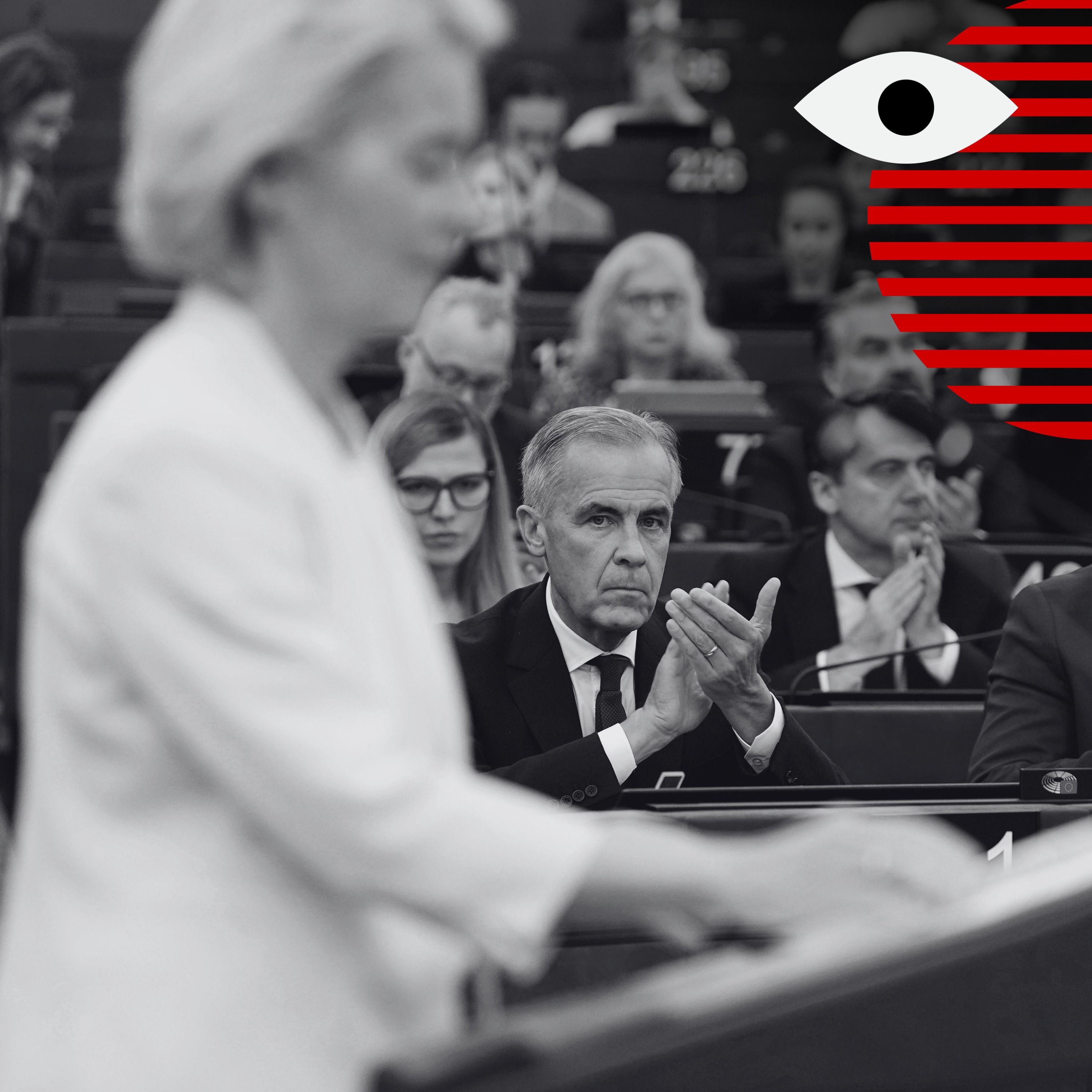
Prime Minister Mark Carney has made history in Europe. On September 16th, he became the first foreign world leader to ever attend the State of the European Union address, delivered by President of the European Commission Ursula von der Leyen. During that address, von de Leyen invited Canada to become the first ever "associate member" of the EU. On the 17th, Carney himself addressed the European parliament, acknowledging the invitation, and expressing Canada's desire to become closer to Europe.
Host Caryn Ceolin is speaking with Dr. Kurt Hübner, professor in the European studies department at the University of British Columbia, about what it might mean to be an associate member, why Canada and the EU are reaching for each other, and what the future of Canada and Europe might be in the age of Donald Trump.
We love feedback at The Big Story, as well as suggestions for future episodes. You can find us:
Through email at [email protected]
Or @thebigstory.bsky.social on Bluesky
Hosted by Simplecast, an AdsWizz company. See pcm.adswizz.com for information about our collection and use of personal data for advertising.
Get every episode summarized
Each time The Big Story publishes, we email you a written briefing from the transcript — the topics, who appeared, and any specific claims, with the ad reads skipped.
Email me new episodesFree for 3 shows. No card needed.
Transcript ready
252 searchable segments. Every word is indexed and playable.
Full transcript
The Big Story — Is Canada's future European?. Machine-transcribed; use the interactive transcript above to jump the player to any line.
Frequency podcast network. Stories that matter, podcast that resonate. A mid-what the Prime Minister called a ferocious storm, Mark Carney believes Canada's newly proposed associate membership in the European Union would help protect its sovereignty. Canada welcomes this ambition. I will tell you polling shows that an overwhelming majority of Canadians support much closer ties with Europe. In an address to European Parliament, Carney said an emerging new alliance between the territories would shield both Europeans and Canadians from being dominated, but he stopped short of endorsing the associate membership described by the President of the EU's executive arm Ursula von der Leyen a day earlier, a designation with no legal framework as it doesn't currently exist. It would also be up to European states whether Roger Leyen's proposal goes ahead and some nations may not be inclined to give our country
special status, especially if it undermines their own economies, posing significant obstacles to an enhanced Canada EU partnership. I'm Karen Sjolin and today on the big story I'm speaking with Kurt Huber, professor in the European Studies Department at the University of British Columbia, to discuss what's still uncertain and why talk of an associate membership is likely just that. I'll talk. Kurt, welcome to the big story. It's a pleasure to have you on. Thanks for having me. Could you just reflect for a moment? I suppose on the specter of Prime Minister Carney being the first foreign head of government to attend the state of the EU address, the most politically significant moment on the EU's calendar, then going on to address the European Parliament. Just how symbolically important was that for Mark Carney as well as for Canada? Yeah, I think so. It was really a very highly appreciated gesture to invite Prime Minister
Carney to join the state of the and the and the and the and also to talk in front of the European Parliament. So it speaks a bit about on the one side the kind of admiration of the, let us say, the broad spectrum of political agents in Europe towards Canada. And it's also a signal, so to say, to invite him having dear in this very prominent way, the signal towards the United States of America, you know, it tells us something about this and merchant strategy of the European Union to join up with others. And obviously, Canada is seen as an ideal candidate also, I should add, to the fact that I think so in most quarters of the member states of the European Union, people voters, but also politicians, they're looking full of admiration that Canada is besides China, the only relevant country that is was willing to object those attacks of President Trump.
And you know, it's a scene as a kind of, I don't want to say model, but something it is really a great little of admiration put it this way, a lot of political capital also that now Mark Carney is using for the benefit of them. Yeah, I certainly have questions about how he is using his political capital, but I do wonder the headline this week was the president of the European Commission in her state of the EU address offering Canada such a deep connection to become the EU's first associate member as she coined it. What is the practical significance of that? Yeah, I'm an end of meantime, we know, I think so, I hope so that we know that everybody knows that this term associate member is actually, you can forget about it. This was my first response when I read about the voice of journal on the weekend a couple of days ago that there is a rumor that you will offer something like this. I was immediately looking at myself, I'm teaching now your immigration doing quite a lot in this area and never heard this as a valid legal term,
and indeed it is not. At the same time, it's also a kind of ping pong game, I think so we can also have in the line was using the term at her address at the state of the union and at least nominally, Marconi was taking it up and but then he get more concrete. So there is no associate membership in the making. We have to be realistic and Marconi used his presentation in front of the European Parliament to add some flavor to be more concrete, a bit more concrete, pretty displayed because it's pretty clear that also often the line will never have any kind of opportunity, I'm pretty sure about that, to make an associate membership happen. There is no appetite on the side of European member states to go into this direction, the German representative as a federal European union made it, we did it clear that Germany would not support something like this. There's a lot of strategic element, nothing to be Canada because the EU is in a mess regarding other enlargement candidate applications. Should the EU, for example, give some express
kind of quick access to Ukraine, there's all those kinds of debates. Now Canada, out of starting getting another special status according to the line, this would not work with the member states. Yeah, what certainly struck me more than how Donald Trump would react to all this, which we'll talk about in a moment, was how the member states would react to it because I mean, keep in mind, 10 European nations have yet to ratify the existing Canada Europe trade agreement, despite it having been signed in 2016. And these are not just any countries like France, Italy, Ireland, they are among them. And so it's hard to imagine that all of a sudden, suddenly, all 27 member states would welcome Canada with open arms in this kind of way. Yeah, I'm going to again, this holds for this status of an associate member. It may not be so relevant for other ideas that have brought forward by Mark Carney, but you're correct coming back to Asida, the company's trade agreement. 10 countries haven't ratified it. The main elements,
when it comes to trade of good services, a lot of other structures have not been any problem from all of those 27 countries. It's particularly the so-called state-invested dispute mechanism chapter that deals with the fact that private companies can bring government in front of the court if they see their interest in a kind of urgent way violated. That's a longstanding issue. This was at a time when Asida was negotiated already a kind of breaking point. They watered the down, they changed a lot of language and so on. So from my perspective, it would be ready to get signed, to get ratified. But then since 2017, we see the rise of writing populist parties in Europe. There are some cases there in government. In other cases, there are supporting governments. There are very strong European parliament. All those institutions that are relevant are now full of writing populist and they don't have the little bit of interest to,
let us say, for us are internationalized European activities. So they are very, by definition, or less, have a very nationalistic kind of perspective involved looking. So I would be very skeptical. And you mentioned France, for example, in my debut presidential elections coming up next Macron's time is running out. And let us assume there would be somebody from Résent Mont-Nassie, becoming president in one way that they would ratify Asida in the current consolation. Or think about Italy. Meloni is not a bit interested to do those things because this would create a lot of internal domestic pressure in those countries. And they keep it like it is. Not ratifying, but still Asida is working so far. If I could return to this characterization of the steeper alliance between Canada and the EU as Canada becoming an associate member, which Prime Minister Marcarni then rejected after his speech to the European parliament,
do you think Miss Von der Leyen was taking a risk by using the term associate member? Yeah, I would say it's going too far, but Ursula von der Leyen is famous. Also back in her time, before she was president of the Cursion, back in Germany, she loves to have big birds, big terms. And if you look at her tenure, there are so many initiatives with coming with big birds. And afterwards, not a lot has happened. There are all kinds of alliances when she likes to play around with those kind of birds. And I think so, it's a lot of symbolic policy from her from her side. And I remember in the commission, but also around in Europe, they know now in the meantime this kind of behavior. And they don't take it so seriously because they know something like this is in the hands of the member states, of member governments, and they have control. You know, that you have to think about the European commission is not even an agency that can make laws or making those things. They are kind of, they are the principles of the member states.
And the commission is the agent that acts in the name of the member states. And the member states are then in the so-called European council. And you haven't heard one beep from a European council when it comes to this proposal of Ursula von der Leyen because the member states there would turn it down. So it's more a kind, as I mentioned, also a signal internally that Ursula von der Leyen was using as a gesture guard. It may be not too bad. But you need to racing the way it adds you members. It needs to add flexibility rather than just very kind of rigid and large band processes we know in the meantime that comes with an animative and it comes with some decision making. The EU has become a kind of an agent. They move very, very slowly until they find a compromise. And then support of all members in critical questions. The problem has got bigger or disappeared or whatever. So they need to think about that. And the thing Canada is seen as a candidate because there is, as I mentioned, admiration. There's a lot of
sympathy towards the countries. They say, why not using the case of Canada to really change internally how we deal with those countries that are close to us in values, interests and so on. But don't want to become a member of the EU. And Canada don't want to become a member of the European Union. Just to be clear, do you think the kind of alliance then that Miss von der Leyen is offering is more symbolic than? Yeah, it will be a kind of second best. What will happen from my perspective is something that is not surprising, but still, there will be in the next couple of weeks, months, there's in October, there's the summit coming up in Canada in Montreal. Montreal, exactly. So there will be negotiation teams looking for such as sectoral deep partnership agreements. And Mark Kahny in his speech in front of the European Parliament laid out which sectors he would prefer, which are of interest. And I think this will happen. This is, let us say,
a kind of second best. It's far below any kind of membership. And it's much more easy to navigate inside the European Union because they're the Commission, respectively, if the European Council, will be very interested. In my opinion, there's a put it this way. The EU is an urgent need for a couple of supply goods, particularly, let us say, rare or materials. They need it also for modernizing for digital modernizing of third economies. They needed for the climate change, transition policies, and all this stuff is not existing in Europe. So they get it from outside. So Canada would be the best part on this respect. And Kahny was already indicating that there will be one sector where we will work much, much closer. From a Canadian perspective, I would be highly, let's say, critical. We have these kind of resources and we can sell them. But it brings Canada more and more into this kind of natural resource economy. That's not a forward looking
to a 21st century strategy. It needs other elements. And Kahny mentioned them. In one, there will be one field that will be highly critical. It can be more than symbolic. It can be really something new. This would be closer cooperation, really quick cooperation and a joint action when it comes to coming up with regulating artificial intelligence. There's now this debate. And both entities have expressed and also lots of the line besides talking about Canada in her speech. See, I don't know, she dedicated quite a lot on AI. Because this is also seen as a critical element for the EU that is, you know, but backward in this regard. They need to catch up. And they need it to do it in a way unlike what is happening with the hyperscaler in the US. They want to reduce dependence. And also get another lock in more regulation when it comes to AI. And this may be a common interest and both sides. Canada and the European Union. And this would be a kind of positive, I think so.
Beyond those common interests, you know, Mark Karnie is seeking access to the EU's Territory Its Market. It's funds and programs without, as you mentioned, becoming a full member of the block. And I just wonder what Canada should be prepared to give up in order to gain that greater access to the European market that Karnie is seeking. Yeah. And I think the just lot more than CTA already offers us a generous book. And because as you know, there's more than 90% of all kind of trading goods are terry free in the meantime due to CTA. It's very, but we have quantity restrictions. So there may be discussions about in October, saying rather than that Canada is allowed to export X tons of disindisgote. They may get X plus or something like this, but they can't become a member of the common market in full access. When this would totally undermine and violate the way the EU is acting. And in order to do this, like Switzerland, like Norway, you have to give up the runnety. And that's something that Canada is on. It's prepared for Canada
as that in Karnie said. He will not do that because you need to follow all the regulations. The so-called I keep coming to here. This is our, I don't know, 200,000 pages of regulations, norms, and standards. And you have another to have the right to do independent decision-making in all those areas. So there will never be a full access of Canada to the common market. It will always be respected. But Norway is paying into the budget of the European Union in order to access. They're following totally all the kind of rules and regulations because if not, they would not be able to sell their goods and products. And they're not sitting in the table. So in Manjano, they're definitely also seeing Norway a bit of discussion in Marching now. We should be now eventually joined the European Union that we have a saying. We already pay, we follow many areas. There are rules and norms and so on, but we have no political influence. So this would be the necessary step. And I don't think so that Canada is prepared. We are
defending our surrounding. Mark Karnie mentioned this in Toronto as his investment summit a couple of days ago. We were saying, you know, it was a right thing to walk away from the negotiation table with the US because it's an only about economics. It's also about surrounding. And I agree. This was the right way to go. But when it comes to European Union, it's all about giving up sovereignty. That's the principle of the European Union. It's a deliberate process that this decision on the side of governments to transfer power of decision making in critical areas from the nation's state to something bigger in this case, the European Union. And you know, and this is something I don't see this in the near future as any way that Canada do this. Also, because we are still continue to be highly dependent in many aspects of the United States of America. And they would like that. Yeah, let me pick up on that point because Miss Von Der Lyon made it clear that this new partnership with Canada shouldn't be viewed as as an anti-American move. I think she said something to the effect of this is not a partnership
against anyone else. But you know, the case for this emerging new alliance wouldn't have been made if it weren't for for Donald Trump. What message do you think Canada and the EU are trying to send to the US? Yeah, I mean, she tried to to be in a kind of a tactical way to reduce a bit the importance of this emerging cooperation closer partnership between the two entities, Canada and the European Union. And you know, sometimes those words are important because Donald Trump is not somebody who would know about the details what's going on and understand those details, but he is very focused on those big words. We heard about partnership. He was getting already angry. So you know, I said this was a different life. I said, don't take it too little. It's on. But in reality, it's totally the idea that something Marconi laid out in his famous tape Davos a speech time ago. Say, the middle powers, whatever this means, it's been a long debate about that, but the middle powers need to very close to form a kind of a block and alliance that with the rules that
are based on the rule of law and all those kind of things. So and that's one of the thriving elements. You know, now we see with this EU, Canada relationship that Kronet tries to work out to make happen what he announced already in Davos. And to get from other term that has been used also by also laughing the line or taken up by Kronet, the alliance of the future. So you know, it's will be open for others. So that's an other element when it comes to the big thing. It's again, it's very kind of loose alliance is a loose kind of term. But still signaling that what may be the terms of cooperation or deeper cooperation partnership between you and Canada may lead to something bigger. And this is some goes beyond the nutron that we say, so we see the global political economy dividing up in blocks. You know, currently it's more or less a big block led by the United States of America. It was all the kind of means getting led in America and bought with sometimes with
military means, sometimes with other means. Then we have the Chinese block as original power, but with ambition to get more. And so we can see now a transatlantic block of formation, Canada, the European Union that may try to get a kind of counterweight or what's happening currently the last couple of years in the overall global political economy situation, we are just experiencing. You mentioned earlier how a Mark Carney is using significant political capital to sell this new relationship with the EU to the Canadian public. And you know what, the Canadian public largely feels optimistic about it. Like polling indicates, I think it's around half of Canadian support joining the EU, a majority support these closer ties. And I just wonder given all you've laid out in managing expectations here, how can Canada convert all that optimism now into some sort of credible strategic new alliance with Europe? Yeah, the support that is being shown in those polls is I would say, man,
idea to say that it's mainly based on an extremely low level of information. Nobody knows what the European Union is. If they would be aware what they would have to give up, if they become a member stage, then the mood would change. This would not be anti-EU, but it would be basically a need to find different ways. And that's not a realistic part of what currently discussed. With those departures, you know, you can avoid all those kind of problems with membership and still get quite a lot out of closer relationships between the two entities. So I think so, this is also, I can observe, maybe I'm wrong, the very careful mitigation in Ottawa, not to over expand the expectations, you know, something because this would lead to political disappointment and voters may then go for something totally different. So what needs to be done is that one of the accompanying strategies is necessary to inform
the Canadian public what the EU is all about. Now we are focusing on also often the lion, as I mentioned, the commission is the agent, the principal, other member states, and therefore we need to go back and think about what is the sentiment, the strategy on the level of member states to come closer to Canada. And then as we already discussed, then we come to the conclusion, there is a willingness to move closer, but not full membership or anything like that, or associate member. And I think so here in Canada, we have to go through the whole, the same kind of discussion processes, therefore it's a good thing that we talk, that we have to be realistic. What is the price we have to pay if we are going for a more full membership, or whatever kind of pandices, or wouldn't it be better to deal with those other options that are on the table and still keep our identity, keep our identity, but are close to the Europeans in many, many aspects.
Sure, no, I certainly take all those points. I would just push back respectfully on on Vonder Lyon. Certainly I take your point, she does not represent the EU's 27 countries, but she does set the blocks agenda. She commands a very mighty bureaucracy, and I would argue that what she says has weighed. Yeah, I think that would disagree. If you go back to the commission, and particularly under the tenure of the line, her second term, there are so many initiatives, let us see, the capital union, the digital union, those kind of big bands, we could go into detail a lot of them. And really, nothing is happening, because the commission can't do so, they can propose things, and that's what they are doing. She is a proposal machinery, if you like, but also in the way it varies within the European Union, is the commission can't propose out of the blue things, even though sometimes also the line is doing it, usually they are talking with the European Parliament, because since the most recent treaty of the European Union, nothing is happening without the
consent of the Parliament. And there are also usually commissions, also usually in contact before a plan is getting on the table with the Member States. So this most recent initiative, introducing the term associate member was a scandal, which is pretty clear. There was an uproar in many Member States, and even within the European Commission, because it was clear, why would she use the term that has no legal basis, something that is not existing? In a radical way, I would say that's fake, but I'd mentioned at the beginning, it's not fake, I think it's part of a strategy to kick start a discussion, and she is willing to take the heat. But it's not something that is realistic in the sense that there is a proposal, even within the committee, nobody knows what is all about it, but I talk to a lot since the last couple of days, with people close to the commission, old colleagues, and so for my academic connections, and the same kind of thing, nobody knows, they're never presenting, why did she do that?
And so my explanation is what I just gave you. So it's not so powerful. Yeah, certainly, as you've laid out, it will be up to the 27 Member States to decide whether or not that that proposal goes ahead. Kurt, I've got to leave it there. Really appreciate your time for this conversation. Thank you so much. Thank you so much. And that was the big story. We'd love to hear your thoughts on this conversation. Send us an email at hello at thebigstorypodcast.ca. You can always reach us on Instagram at frequency pods or on blue sky at the big story. If you know someone who might enjoy this episode, be sure to send it to them. Listen to the big story every day on the secret, or wherever you get your podcast. The big story is produced by Maria Costane. Diana Kay is the head of strategy and content. Desi Nair is the manager of podcast operations. Dylan McGuire is our associate producer. I'm Karen Siegelen. Thanks for listening.
More episodes
More from The Big Story

How Ontario kept a man in isolation for 20+ years
The Big Story

Weekend Listen: What did Carney gain with his Investment Summit?
The Big Story

Big Headlines: 'O Canada' performed at Buffalo Bills' home opener despite recent...
The Big Story

Big Headlines: Carney addresses EU Parliament as the push continues to get Canad...
The Big Story