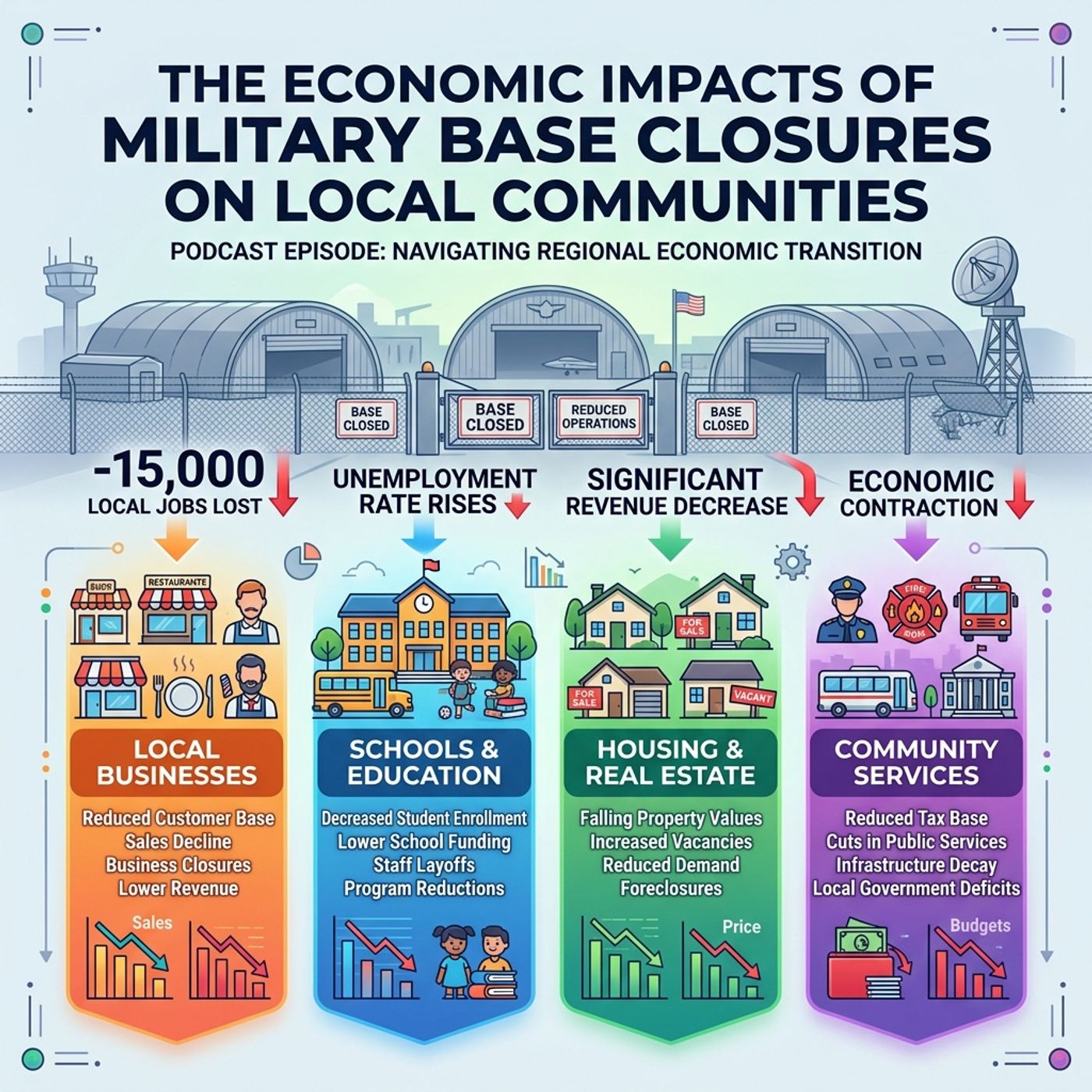
How US Base Closures Impact Local Economies and Your Money
Get every episode summarized
Each time Conspiracy Theories Exploring The Unseen publishes, we email you a written briefing from the transcript — the topics, who appeared, and any specific claims, with the ad reads skipped.
Email me new episodesFree for 3 shows. No card needed.
About this episode
“Yeah, it's even better with Chamba by my side. Let's dive into the recent closures of military bases in the U.S. And more importantly, how these changes may ripple through your personal finances.”From the transcript
To understand this, we need to look back at the Base Realignment and Closure process, or BRAC for short. This initiative started back in 1988 and has gone through several rounds, the latest being in 2005. Through these rounds, a significant number of military installations have been closed—121 major bases to be precise. The goal? Enhancing operational efficiency in the military.
Become a supporter of this podcast: https://www.spreaker.com/podcast/conspiracy-theories-exploring-the-unseen--5194379/support.
Get every episode summarized
Each time Conspiracy Theories Exploring The Unseen publishes, we email you a written briefing from the transcript — the topics, who appeared, and any specific claims, with the ad reads skipped.
Email me new episodesFree for 3 shows. No card needed.
Hosts & guests
Transcript ready
46 searchable segments. Every word is indexed and playable.
Full transcript
Conspiracy Theories Exploring The Unseen — How US Base Closures Impact Local Economies and Your Money. Machine-transcribed; use the interactive transcript above to jump the player to any line.
Tyler Reddick here from 2311 Racing. Victory Lane? Yeah, it's even better with Chamba by my side. Race to ChambaCasino.com. Let's Chamba. No purchase necessary, VTW Group, void work prohibited by law, CTNCs, 21 Plus, sponsored by ChambaCasino. Let's dive into the recent closures of military bases in the U.S. And more importantly, how these changes may ripple through your personal finances. 13 bases have closed, and while that might seem alarming at first, the broader economic implications may not be as dire as many believe. To understand this, we need to look back at the base realignment and closure process, or BRAC for short. This initiative started back in 1988 and has gone through several rounds, the latest being in 2005. Through these rounds, a significant number of military installations have been closed, 121 major bases to be precise. The goal, enhancing operational efficiency in the military. Now, when bases close, local communities often panic about job losses and
economic downturns. For instance, think back to Castle Air Force Base in California. Initially, the local economy felt the shock. There were concerns about unemployment and decreased spending among residents. But what researchers like Ted Bradshaw at UC Davis found is quite interesting. They discovered that over time, those economic impacts were not as catastrophic as expected. Unemployment rates stabilized and local income levels adjusted, demonstrating how adaptable communities can be. Another important angle to consider is employment. Studies show that the job loss associated with base closures isn't as massive as you might think. Research analyzing closures between 1971 and 1994 indicated that the loss of military jobs typically doesn't lead to a proportional decrease in overall local employment. In fact, the employment multipliers from these closures often come in at under one, which means that while military positions may vanish, other job opportunities tend to spring up
to fill that gap. Speaking of gaps, the Department of Defense has pointed out just how significant the financial savings can be from closing these bases. By the end of fiscal year 2001, they had already saved about $16.7 billion, with projections to save an additional $6.6 billion each year moving forward. That's substantial when you think about how much could be reinvested elsewhere in the economy. Of course, not everyone is ready to embrace these changes. Many residents express concerns about losing their economic safety nets. Local businesses fear the immediate drop in revenue as military personnel and their families relocate. However, experts suggest that while there is an initial disruption, history has shown that communities often find new ways to adapt. Over time, new job opportunities can arise in the private sector, helping to revitalize areas affected by base closures. And it's essential to remember that the Brax process is designed to be insulated from political
influence. Various researchers, including Scott Bollier and his colleagues, have pointed out that closures aren't being dictated by political whims. They are part of a strategy to make the military more efficient while also managing taxpayer dollars. As we wrap up our discussion today, it's clear that while the closure of military bases might stir up immediate concerns, the long-term economic impacts are often mitigated by community resilience and the emergence of new opportunities. So how does this affect your finances? Being aware of these developments means you can make informed decisions, whether that's investing, budgeting, or assessing your local economic landscape. Thanks for joining the Fortune Factor podcast. Tyler Reddick here from 2311 Racing. Another checkered flag for the books. Time to celebrate with Chamba. Jump in at chambacasino.com. Let's Chamba. No purchase necessary. BTW Group, Void we're prohibited by law. CCNC, 21 Plus. Sponsored by Chamba Casino.
More episodes
More from Conspiracy Theories Exploring The Unseen

The Global Chain Reaction_ Petrodollars and Your Wallet (Part 1) (1)
Conspiracy Theories Exploring The Unseen

The Petrodollar Pivot_ Part 3 (1)
Conspiracy Theories Exploring The Unseen

The Invisible Tax_ Why Your Dollar Doesn't Go As Far (Part 2) (1)
Conspiracy Theories Exploring The Unseen

Stop Swiping_ The Offline Revolution - Part 2 (2)
Conspiracy Theories Exploring The Unseen