Get every episode summarized
Each time The David Frum Show publishes, we email you a written briefing from the transcript — the topics, who appeared, and any specific claims, with the ad reads skipped.
Email me new episodesFree for 3 shows. No card needed.
About this episode
“Tired of rage scrolling through AI Slop and ClickBape just to get a handle on today's news? Meet InPress, the algorithm-free news app that makes it fun and rewarding to stay informed. Track your media literacy and rediscover reality.”From the transcript
Get every episode summarized
Each time The David Frum Show publishes, we email you a written briefing from the transcript — the topics, who appeared, and any specific claims, with the ad reads skipped.
Email me new episodesFree for 3 shows. No card needed.
Know when Eric Holder turns up
Follow Eric Holder and once a week we email you every new episode they appeared on — including guest spots the show notes never mention, because we read the transcript.
Follow Eric HolderFree. Pick your own day and time.
Hosts & guests


Transcript ready
532 searchable segments. Every word is indexed and playable.
Full transcript
The David Frum Show — How Trump Could Threaten the 2026 Election. Machine-transcribed; use the interactive transcript above to jump the player to any line.
Tired of rage scrolling through AI Slop and ClickBape just to get a handle on today's news? Meet InPress, the algorithm-free news app that makes it fun and rewarding to stay informed. Track your media literacy and rediscover reality. Download today at inpress.app. That's I, N as in NewsNerd. Press. From rethink the creative marketing studio at the Atlantic and Walmart, OnSolid Ground is a new podcast exploring the increasing threat of natural disasters. I'm journalist Caroline Modoresi-Torani and I spoke with those on the front lines of disaster response to understand how communities build resilience before, during and after a storm. Listen to OnSolid Ground wherever you get your podcasts. Hello and welcome to the David Fram show.
I'm David Fram, a staff writer at the Atlantic. My guest this week will be former Attorney General Eric Holder. This week's book will be Agrippa, a novel by Robert Harris. I want to just issue a caution about the interview that you're about to see. We had a little trouble this week with the video recording. About half the video got gobbled up by the internet gods. There will be some interruptions of the video flow, but you will be able to see most of the show in video and of course the sound quality is perfect all the way through. If you're listening, you won't notice anything. If you're watching, you may see some interruptions, please forgive us. We did the best we could. Before either the dialogue with Attorney General Holder or the novel, Agrippa by Robert Harris, I want to offer some opening thoughts about the recent state visit by the Chinese president and Chinese dictator to Washington DC and his lavish reception by President Trump. I often think that when future historians try to make sense of the Trump era, among the things they will note is this was a real acceleration in the decline of American
prestige and power in the world. The Chinese visit drives home what the challenge to American leadership in the 21st century has been. China is becoming a bigger and stronger country. There's no way around that and that is potentially a very good thing. They have lifted hundreds of millions of people out of poverty, a great gain for human happiness. They have produced products and services that are of use to the whole world. We're all better off because of China's rise. If China becomes a good global citizen playing by the rules, we will all benefit from the transformation in Chinese power that has happened since they broke with the rigidity of the Mao Zedong system and introduced some degree of market mechanism into Chinese economic life. But right now China is turning a snarling face to the world and we all have to worry about Chinese aggression, Chinese subversion, Chinese intellectual property theft. China just not playing by the rules of global trade. So there's a tremendous human achievement. There's a great human opportunity, but there is also a great danger. The difference between China and dangers that America has
faced in the past is that unlike past adversaries, China is not only a military competitor to the United States, it is also a technological, economic, and financial peer. The United States has not faced a country that was simultaneously an adversary and a peer really since the confrater of the British empire before the Civil War. And then you had the advantage of great common interest, great common language, many common values. Those things are absent in the relationship with China. If the United States is to balance China's power peacefully, it has to approach this problem in a very different way from the way it approached the problem of the Soviet Union. One more difference is that China is so enormously big, bigger population and economy nearing the size of the United States. So to peacefully balance China, the United States just can't do it on its own. It's going to need a cook to marshal a global coalition of some kind. And not just the familiar and easy coalition with like-minded democratic powers, powers of the European Union, Australia, Japan, Great Britain, others.
To balance China, the United States has to work with more uneasy partners in Dinesha, Malaysia, Vietnam, the Philippines, India. Countries that don't necessarily share political systems with the United States may not share values and may not share a view of the world that is exactly like that of the United States in the way that fellow democracies did. So it's a hard problem. But the Trump administration has been all about severing those connections, both to the old familiar allies of the European Union and the other democracies and of course to the new allies where they have created point of friction after point of friction through their aggressive trade practices. They have left the United States alone in the room with the Chinese without friends that can rely on, without friends who can rely on the United States. And the consequence of that aloneness was on display at the state dinner, which is the Trump basically had to suck up to the Chinese. It was a disgusting thing to watch. They're the shameful incidents of mocking his predecessor to the Chinese leader. When you think, what do the Chinese make of this? They saw this is a political
system that is isolated. This is a political system that is permeable. This is a political system that is based on one family's appetites. This is a political system we can push around and push the United States around. I think we can expect a lot more of this dinner marked a real way station on the progress of American decline. Let's hope it's a correctable one and let us try not to fear that it is not a correctable one. And now my dialogue with Attorney General Eric Holder. But first, a quick break. If you're trying to get news today, you'll find a lot of biased algorithms, rage-bait-and-day eye noise. Think social media. That's where impress comes in. It's a social platform on top of factual journalism, not the other way around. Track your reading and earn points. Strava for your brain. Plus, you can connect with other users in your city who share your genuine curiosity. Ditch the echo chamber for reality with InPress. Download it today for iOS
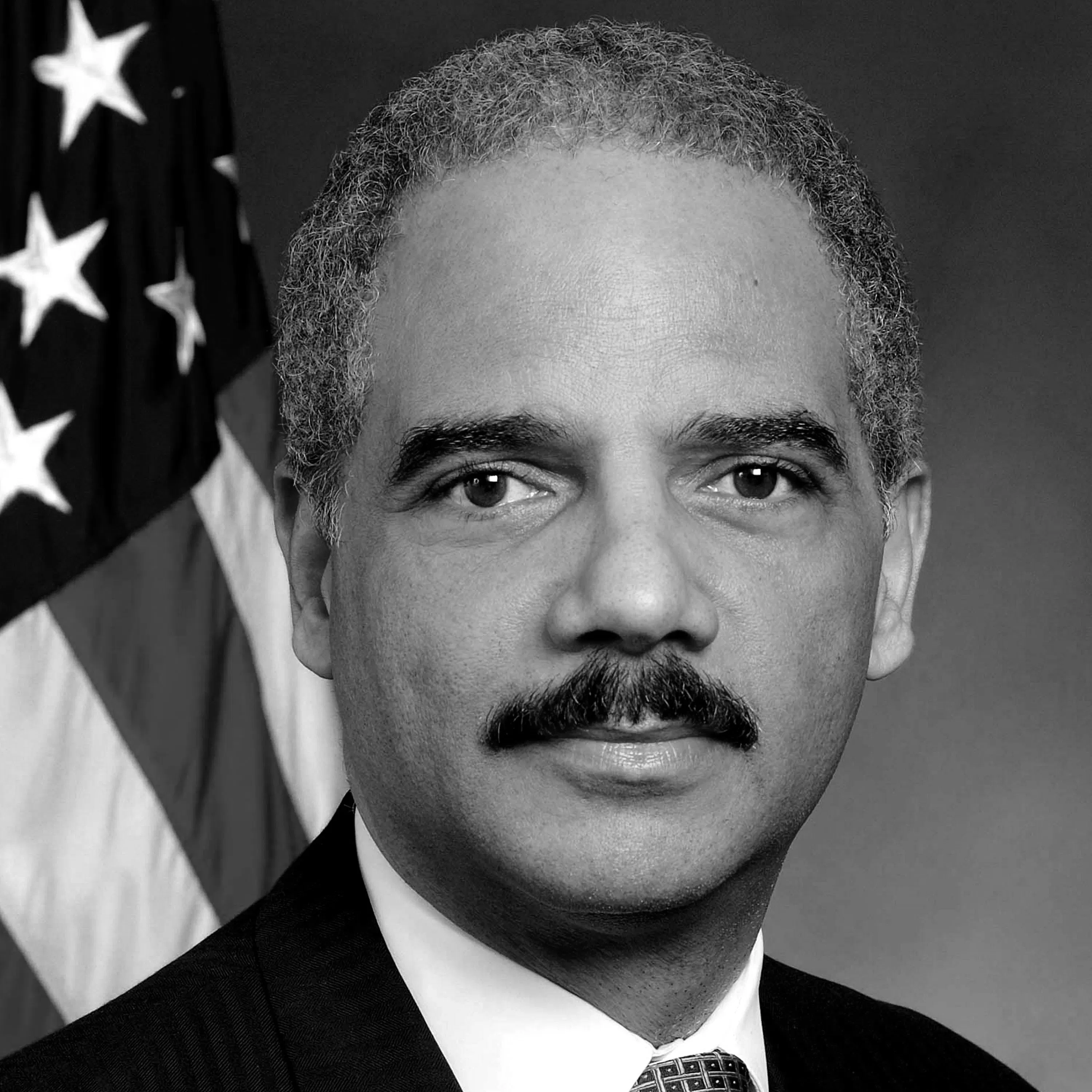
or Android at InPress.app. That's I, and as in NewsNerd, Press. From rethink the creative marketing studio at the Atlantic and Walmart, OnSolid Ground is a new podcast exploring the increasing threat of natural disasters. I'm journalist Caroline Modoresi-Torani and I spoke with those on the front lines of disaster response to understand how communities build resilience before, during and after a storm. Listen to OnSolid Ground wherever you get your podcasts. Eric H. Holder Jr. serves as chairman of the National Democratic Redistricting Committee. He served as Attorney General of the United States from February 2009 to April 2015.
Before that, he served three decades in public service with appointments to Senate confirmed positions by President Reagan, President Clinton, and President Obama. Attorney General Holder was born in the Bronx, New York, and grew up in East Alameda, on-premise Queens. He holds undergraduate and law degrees from Columbia University, and it's a great honor and pleasure to welcome to the David Fram show. Could you be here with you, David? And I'm glad to hear you mention East Alameda, I'm proud to be a Queens boy. Glad to mention it. Let me ask you about the thing you have been working on so intensely in this present cycle, which is how do you feel and how should people listen to you feel about free and fair elections in the cycle of 2026? Well, I think we ought to be concerned about the state of our democracy generally, and the way in which our elections are going to proceed this year more specifically. I think we have seen that certain groups of Republicans have done whatever they possibly can to ensure a victory for them that might not necessarily be supported by the number of votes
that they actually get. President Trump's determination to get five extra seats out of Texas by doing a mid-cycle redistricting, actually a mid-cycle, Jerry Mander is an indication of that. We see what's going on in Missouri now, where Republicans are going to the Supreme Court, with a third time to try to stop the people of Missouri from determining whether or not they will support a redistricting, another Jerry Mander, that Republicans have tried to put in place in Missouri. So I'm worried about that, which Republicans have done. And then, you know, after the Supreme Court decision in the Shelby County case in 2013, the Cal A decision in this last term, Republicans have used those tools that the Supreme Court has given to them to try to come up with ways in which they can disenfranchise, you know, certain people. Well, let's go step by step through your areas of worry. And you, as I think you've alluded to three different things there. So let's go slowly through the first one, which is President Trump has
threatened a series of deviations from all past election practice, grabbing ballot boxes, threatening to send troops, interfering with voting by mail, that category of previously unseen activity. How worried should we be about that one? I don't want to alarm people. I don't want to be hyperbolic or alarmist, but I think we've got to be prepared for just about anything. Donald Trump has shown that he's prepared to use all the levers of power that he has in order to ensure a result that he wants. And he cloaks this in this notion of concern about voter fraud, which is close to non-existent. And I think that they will potentially deploy ICE agents at or near polling places, you know, potentially declare an emergency of some sort to try to use federal power. I've seen that the Justice Department now says that it is recruited 1000 monitors or observers that they're going to deploy to, you know, various sites around the
country. I think all determined, all in an attempt to come up with ways in which they can determine the outcome of elections in various states, regardless of what it is that the people want to do as indicated by the votes that they cast. We've seen President Trump invoke various kinds of emergency powers for the president in various kinds of situations where emergency powers have not been invoked before, not natural disaster, but just something's happening that he doesn't like. And he then uses federal and presidential power in new kinds of ways. Could that intersect with free and fair voting in dangerous ways? Yeah, I think the potential is certainly there to do that, you know, declare an emergency of some kind. I don't know what it would be a national security emergency. I mean, he seems to focus on national security as a way to do the kinds of things that other presidents did not have the ability to do, whether it's tearing down, you know, the East Wing building in an arch, you know, excluding the press from the White House press room by because
of some kind of national emergency. And so declare a national emergency and then do a whole variety of things to keep troops in places where they shouldn't be before deployed ICE agents in neighborhoods where they need not be. You know, I think these are all, all possibilities that we need to be concerned about. And it is something that we on the Democratic side have tried to prepare ourselves for by going through, you know, a series of tabletop exercises to anticipate that which the president might try to do and then come up with ways in which we can push back against that and do so in a timely way. You know, not do something that will be effective two weeks after we go to court do whatever it is that we do, but actually stop that which the president is trying to do the Republicans are trying to do. And so they don't have the impact that they want. In these tabletop exercises, when you think about things that the president might do, there are precedents not in
the mainland USA, but in Puerto Rico and the Northern Mariana's territories where elections have been delayed or sometime because of natural disasters. Now, in those cases, the national natural disaster really happened. And people were dislocated and the machinery of government wasn't interfered with. And there were more urgent priorities than holding a vote. And the vote was then after the delay was properly rescheduled at a future time and conducted in a free and fair way in those areas. But those are precedents for the use of executive power in not states, but territories. Is there any foothold there that a president could use in the mainland USA? Yeah, I suppose you could point to those rare instances where natural disasters have had an impact on the ability of people to cast ballots. But we also have to remember that we conducted national elections during war. I mean, you know, during civil war, World War II. And so the resilience of the American electoral system has been tested in a whole variety of ways. Now, if a hurricane
was to somehow, you know, hurricane Sandy was to version two was to show up, I don't know, in New York. And that meant that people could not get to the polls. Yeah, there are ways in which you could delay the vote. But I don't think that's likely to happen. And I do think that our history really shows us that there is little, if anything, that we can not handle and allow the American people to get to the ballots, get to the polling places and cast ballots as they always have when it's bright and sunny, whether it's raining or whether it's snowing. I think the American people are really charged up about this election. And I think that they're going to push through anything, whether natural or something fermented by this president, they're going to push through all of that to make sure that their voices are actually heard. Can you update us on the state of the gerrymandering push counter push? I mean, it was initiated by the Republicans who did an off cycle gerrymander
in Texas, as you said, Democrats responded. And for a time, it looked like the Democrats actually were more successful. Now, it looks like that balance of power has reversed itself. How do you read the gerrymandering war? And what large implications does it have that the two parties are engaged in this kind of contest each with the other? Yeah, I mean, I we formed up the National Democratic Redistricting Committee that I've been shared of since January of 2017, all with the note, the thought that we wanted to do away with partisan and racial gerrymandering, which in if you look at in historical terms, both parties have engaged in Republicans, maybe more recently since certainly since 2010. And what we we were pretty successful, New York Times said that I think in the 20-22 election that Americans were going to vote on the fairest maps in a generation within saw the president try to go into a process by which there would be this partisan gerrymandering that has had a really negative impact on our ability to get that fairness. And as you calculate all the things
that Republicans have done, all the things that Democrats have done in this what I call race to the bottom, Republicans end up with, I think, about a five-seat advantage as result of the gerrymandering that they the mid cycle gerrymandering that they have done this year. Now, you have to understand that had when Steve Bannon just looked at that proposal that the president made, they were anticipating that they might get as many as 21 additional seats. But as a result of what happened in California, the inability as a result of popular, discontent, South Carolina, Georgia, we're not we're not able to do what they wanted to do. Court victory in Utah was something that helped Democrats, people, Republicans in Indiana refused to go along with what the president wanted to do. But after you boil that all down, you end up with about a five-seat switch to the to the Republicans as a result of this inappropriate mid cycle redistricting. Is there any way for the national political system to
draw back from this kind of behavior? There are certain limits on how far you can go, neither party pushes the other to the extremist verge. Is there any way back or once you escalate, is there are you forever on a cycle of up escalation, up escalation, up escalation? See, that's a really good question. And the answer is yes, there is a way to get back to maybe get back to a place where the nation has never been but get to a place where the nation should be. And that is to simply ban partisan gerrymandering. And Congress can do that. Congress has the ability to determine the manner in means by which elections are held. And Congress could simply say we're banning mid cycle redistricting. We're banning partisan gerrymandering, specify in the statute exactly how courts might interpret whether or not a particular state is in fact engaging in gerrymandering. And my hope would be that if the House is taken by the Democrats, that as a bill that they will
introduce, I don't expect necessarily that Donald Trump would sign it. But if there is trifecta democratic control after the 2028 presidential election, my hope would be that there would be a standalone bill that was simply ban partisan gerrymandering, ban, mid cycle redistricting, and get back to the way in which I think the founder is intended, which was, as you say, have the census done in the year ending in zero and then have redistricting done in the year after that. It is entirely possible. You mentioned in your introductory review of all that was going on, the drawback of the Voting Rights Act. And that is interacted with partisan gerrymandering in ways that are complicated and often unexpected where basically right wing Republicans and minority Democrats develop a common interest against non-minority Democrats in moving minority voters into safe seats and leaving the rest of the state for the Republicans. As the Voting Rights Act has been reduced in scope by the courts, what does that mean for the future of free and fair elections in
the United States? And had you moved to a more colorblind system of seat allocation while protecting the often infringed upon rights of minority voters to have their votes taken seriously count and count equally? Yeah, you know, there's not a tension necessarily between trying to protect the rights of people of color and making sure that lines are drawn in such a way that they are more generally fair to allow communities, various communities of interest to vote in a cohesive way is not inconsistent with having a system that is perceived to be fair. The Voting Rights Act was, I think, really, it was the crown jewel of the civil rights movement and allowed for the registration of African Americans, particularly in the South, the flowering of African American political power and then after that Hispanic political power. And that has made, I think, the nation better. The retreat by this Supreme Court or the demolition of the Voting Rights Act by this Supreme Court, I think,
has had and will continue to have a negative impact on fairness around the country. But I also think it's an interesting thing. If you again, ban partisan gerrymandering in those places where you have a history of racialized, racialized voting, polarized and racial voting, banning partisan gerrymandering has the equal effect of eliminating racial gerrymandering, particularly in the South. I think a lot of the things that have concerned this Supreme Court about the Voting Rights Act are really inconsistent with certainly the findings that Congress made, a series of findings that Congress has made when Bill was first passed and then reauthorized and the reauthorizations were all signed by Republican presidents. This Supreme Court looks at an America that I don't think truly exists when Chief Justice Roberts said that America has changed.
Well, yeah, that's true. America has changed. We're different now than we were in 1965, but we're not yet at the place where we need to be when it comes to having race neutral, redistricting, race neutral, electoral processes, what everybody has the opportunity to cast a ballot. One study shows that black folks are a lot more likely to have to wait in line for an hour in order to cast a vote than their white citizen counterparts. That's the kind of thing that I think we can't turn away from. That's just a reality that continues to show the problems that we have in this nation. Would you mind taking us on a short history of the Voting Rights Act? It's reauthorization and what the Supreme Court has done? I think a lot of people have a general sense of what happened, but the idea that this is not a history that begins and ends in 1965, but it's an ebb and flow over time. Could you take us through that starting in 1965 and bringing us up to the present? Yeah, 1965, we see the Selma to Montgomery March after Bloody Sunday, where John Lewis
and others had their skulls cracked on the N. Mimpedis bridge. The nation sees that. Lyndon Johnson says that in a famous speech, we shall overcome proposals of Voting Rights Act of 1965, which is past. And the Voting Rights Act essentially said that in those jurisdictions that were covered, that was the technical term, that had a history of racial discrimination against African Americans and allowing them to both register and to vote, that the federal government would have the ability to put upon those jurisdictions a pre-clearance responsibility, such that if those states engaged in voting changes, moving polling places, closing polling places, other electoral processes, you had to get the approval of the federal government. And those again were primarily southern states, but interestingly, over time, parts of New York actually came under the jurisdiction of the Voting Rights Act and other northern states. The Voting Rights Act was then
reauthorized two or three occasions after. Let me pause you. That original law was time limited. It was time limited. And it had to then be reauthorized. The last time it was reauthorized, it got just about three, four, five negative votes in the House of Representatives. It was passed unanimously by the Senate, that is the reauthorization, and then signed back into law, I believe by President George W. Bush. And this was after Congress had conducted really numerous hearings, thousands of pages of testimony, and then made specific findings. The Supreme Court in the 2013 Shelby County case made the determination that the coverage formula, that is to decide, which state should be covered by the Voting Rights Act, had been outmoded, outdated, and as a result, through that out, which took away from the government, the ability to use that preclearance authority.
And as a result, we saw a whole range of things happen relatively quickly. 25 states put in place a whole range of voter suppression, things, 1700 polling places closed around the country, a great number of purges of voting roles happened, about 40% of which happened in places that had previously been covered by the Voting Rights Act, therefore disproportionately impacting people of color. And we have seen with the demise of the Voting Rights Act, and it's further attempts by or successful moves by the Supreme Court in the Cala decision just recently, to do away with section two of the Voting Rights Act, which said that if you can show that the power of people of color was diluted by moves that people in power took with regard to electoral things, that could also be challenged. The Supreme Court has essentially taken away that ability, it's essentially destroyed the Voting Rights Act. In spite of the fact that, as I said,
Congress made specific findings. The Court has, I guess, in some form of fashion, made its own determination, its own findings without conducting hearings necessarily. And that, I think, has been, it's had a negative impact on the ability of African Americans to get, and other people of color, to get the representation to which they are entitled. And right after the Cala decision, we saw a number of states automatically start redistricting in such a way that they drew out of power. African Americans, Hispanics, who were in seats that had been previously covered by the Voting Rights Act. What remains if anything of the Voting Rights Act? Not much. You know, there are still ways in which parts of the act can be used. But I think realistically, in order to get back to where we were, a new Voting Rights Act has to be put in place. One was proposed and passed through the House,
the John Lewis Voting Rights Advancement Act. It was filibustered in the Senate to come up with a new way in which a coverage formula could be determined. And that would be responsive to what the Supreme Court found issues with in the 2013 Shelby County decision. And so I think that's another thing that a new Congress would have to do. So there are ways in which you could get back to a more modern version of the Voting Rights Act, but it would require an active Congress. Do you have any sympathy for the argument? The argument in 2013, a scientist said it was John Robert said and the majority for which he spoke said, you can't base 2013 voting rights law on the realities of the country as they were in 1963. Do you have any sympathy for that point of view? And is there any way that a legislative drafts person could write a law? I said, okay, John Roberts, we can see your point. Let's base the laws on the realities of today, not 1963. I mean, I do think, you know, when the Court says that, if you look at that in a vacuum,
okay, so yeah, that kind of makes sense. But that ignores the fact that Congress actually conducted hearings, had people come and testify, made findings, thousands of pages of testimony and findings and exhibits. And on the basis of all the work that Congress did, they reauthorized the Voting Rights Act. That was simply ignored by the Court. Could Congress come up with a way in which they satisfy the concerns that were raised by the Court in the Shelby County case? I think absolutely yes. You could come up with a new way in which you make coverage, the coverage formula apply to certain states based on a new history that is determined by tests that would be put in place by Congress, that show that in fact, states are doing things inappropriately and then have a negative impact on the ability of certain people, you people of color. That's the focus of the act that people of color have been treated unfairly. Yeah, Congress could certainly draw a new Voting Rights
Act that would answer the concerns that were raised in the Shelby County case. I want to pick up a thread that you left tantalizingly dangling earlier in our conversation. You talked about how President Trump has given orders to the Justice Department to do things that you found ominous. You headed that building. You served that building for many, many years, and you headed that building, I think for the third longest serving Attorney General in American history, how robust and how not robust is the Department of Justice to this kind of pressure? One of the things that would hold and what do you observe that would be in danger of snapping under that kind of presidential pressure? That's a really good question. I think that they have been very careful in the way in which they have really changed the Justice Department and made it an arm of the White House. One of the ways in which they did that was to get people who served in the Department of Justice over extended periods of time. These would be Republicans, Democrats, Conservatives, Progressives, people who left their political leanings at the door and
simply enforced the law. So they've taken huge numbers of lawyers in a variety of places in the Justice Department. They're now no longer in the Department and replace them with ideologues who do the kinds of things, do the bidding of the political arm of the White House. The Justice Department that we have now is almost unrecognizable to me and would be unrecognizable to Republican Attorney's General as well. I didn't agree with everything that Bill Bard did or John Ashcroft did or just sessions did, but they operated within certain parameters in the way that I'm sure they didn't agree with me. I hope they would say that I operated within certain traditional parameters as well. What we see Todd Blanche doing, Harmeet Dylan doing at the Civil Rights Division is inconsistent with the way in which the Justice Department has conducted itself under both Republicans and Democrats. The inability of Todd Blanche to say, I'm not going to take
political direction from the White House or try to extoll the virtue of the independence of the United States Department of Justice. Again, it's inconsistent since Watergate certainly with the way in which the Justice Department has conducted itself. Again, under Republican as well as Democratic Attorney's General. What would have happened if President Obama had said to you, Attorney General Holder, this person really bugs me. I want you to find some way to bring charges against that person if you possibly can. Now, you will say President Obama wouldn't have said it. Let's say he was just in a very, very snappish mood one day and he said that what would happen? I would have tried to persuade him that that was a bad thing to do for a whole variety of reasons, but if that were not, if I did not convince him of that, I would have resigned and it would have been a noisy resignation. The Attorney General has the ability within the large conference room
that is right outside the Attorney General's personal office. He has the ability to put up four portraits of your predecessors. I had Justice Jackson, Van Attorney General Jackson, I gen. Reno, who I worked for, Bobby Kennedy, who was one of my idols. But I also had Elliot Richardson up there. He was there to remind me that you might at some point have to do something inconsistent with what your president wants you to do. That may mean that you're no longer going to be Attorney General of the United States. That's why Elliot Richardson is one of my personal heroes. If Barack Obama had told me to start an investigation of David from Polis Taxes with absolutely no basis for that or even the suggestions that I would get from him, forget about whether there was a basis, that is something that for me would terminate my time as Attorney General. But I would not be one of these people who would go out quietly. I would explain to the American people exactly why I was leaving and what the danger was of what the president was asking me to do.
Let me ask you about something else that has happened a lot both in the first Trump term and even more in the second. I wrote at the beginning of the front presidency in article, which I quoted something that I heard when I was visiting Hungary in 2016. And so many point out there that look, Hungary is a signatory of the European Convention on Human Rights, it's under the jurisdiction of European courts. Victor Orban, authoritating that we is, can't simply toss people in prison. He can't have death squads. He can't seize property. But what he can do is make it clear that there is a much better treatment available to his friends than there is to his opponents. The friends get VIP seating. Everybody else just gets the regular treatment. And the phrase that this person used, which I quoted in many articles, was in a modern state. The real power of control of control of the government is not the ability to persecute the innocent. And that's the thing we've seen Trump use his power much more to do is to say, if you're my friend, then the rules don't apply. What should an attorney general do when confronted with the president says, well, this person's been good to us. He's been a generous donor to important causes just to give him a cut him a break or use a friend of ours. He's asked for a pardon for
a form of business associate. What is not happening there that should be happening? You simply tell the president, no, you've got to have that ability. You've got to say to the president, no, we're not going to subvert the processes that we have in place and give a pardon to somebody who has broken the law, hasn't met any of the requirements that the Justice Department has in place and has applied uniformly to decide who's worthy of a pardon. You simply say, no. In the same way that if the president tells you to go after somebody, you say, no, we're not going to do that. The president tries to tell you to stop an investigation of somebody who is a supporter of the president. You say, no, we're not going to do that. If that again means that you're going to lose your job as attorney general, well, there's great honor, I think, in that. You stand up for a system, a neutral system. That's what the attorney general does. When I was up for confirmation
as attorney general, remember Pat Leahy was then head of the Judiciary Committee said, you know, you're not the secretary of justice. You're different from other cabinet members. You're going to be the attorney general of the United States and there has to be some distance between you and the president that you serve, the administration that you are a part of. That really resonated with me back during the confirmation process. As I said, Elliot Richardson's example was always from me a guiding principle. Let me ask you about one last field of questioning. The United States has a long and unhappy history of electoral shenanigans of all kinds, partisan, racial, all kinds, but one of the things at least in the modern era that Americans have known is the shenanigans stop on the voting day. Once the votes are cast, whatever difficulties were put in the way of certain people or other people, whether it's by race or by political party, on their way to the vote. Once the ballots are cast, then the process goes forward in a secure and safe way. So much so that people didn't even know
what happens between you vote. Then there's inauguration some weeks later and you don't think about too much about all the mechanics in between. We saw in 2021 an attack on the integrity of an election after the election. And again, it's hard to remember when that had ever happened before. Do you have any fears that such an attack could happen after the election of 2026? And do you have any instincts? But what if someone were to be mind malicious enough to try such a thing? What are the avenues they might try? Yeah, I actually have a way in which I look at this whole this whole electoral process in 2026. And I break it down into three kind of three segments. One, what's going to happen before the election with regard to structural changes that have been tried to make people have been trying to make, you know, the the Jerry Mandarin that's been going on. What actually happens in that second segment with regard to when people are actually casting ballots. And that means from, you know, from early voting up to election day. And then what happens after election day when the votes are to be counted and when then people are supposed to be certified
as winners. And I've been parts of groups that have tried to do again, these tabletop exercises with regard to all three of those those segments to try to anticipate that which might happen. You know, I don't think we necessarily see another January 6 where there is, you know, an insurrection, you know, on the hill, but there can be a whole variety of things that happen from election day and then, you know, the weeks after that where things are done to try to, you know, counterman that which the American people have decided by the way in which they have asked their votes. And so we've got to be prepared for all of these possibilities. You know, I think one of the ways in which we counter that most directly is to have as many people get out there and cast votes as is possible to make sure that the margins in the elections that are to be decided are big enough such that they can't be they can't be monkey with. But so at the end of the day, I'm actually pretty
confident that although they're going to be bumps along the way and we're going to see things that perhaps we've never seen before that we're going to get results that are consistent with the desires of the of the American people. But I don't think that we can simply hope that is going to happen. We have got to be prepared to fight if that's necessary. Can I say a cynical thing without casting doubts on the integrity of American government all of that? Is there any way for a hekeemed jeffries to communicate to a Mike Johnson? Speaker Johnson, if this is a free and fair election, you're probably going to lose. And after you lose, you're going to go into business as a consultant with a big salary and a big office and a very sweet life. And if the process of certification goes smoothly and lawfully, your clients will always get a respectful hearing here from the new majority. We can't say I can't say they'll always win. We'll always get a respectful and attentive hearing. If there's any shenanigan, however, no one will get a hearing. Is there anyone to communicate that? Yeah, I don't think that's a bad message. I mean, I actually
think that, you know, if Democrats were to take over the house, they need not replicate that, which I think Republicans have done groups of Republicans have done in while they've held power in these last couple of years to get back to kind of norms would be a good thing. But also to hold out the stick, which is to say, as you said, look, if you all try to do things that are inconsistent with how we normally conduct elections and certify elections, there's going to be a price that will be paid. I don't think that's a bad thing. But I also think that's the kind of thing that should be publicly said, you know, it shouldn't be just a conversation between Mike Johnson and Hakeem Jeffries. That is something that, you know, Hakeem Jeffries, other leaders in the democratic party should make known publicly so that people on K-Speed, when they're making determinations as to who's going to represent them, lobby for them in front of this new democratic majority,
understand that there's a price that those people who have been defeated Republicans will have to pay for the inappropriate things that they have done. But, you know, my hope would be that if there is, in fact, a change in leadership in the House, that it happens in the way that it normally has occurred that people leave the House, that's what they want to do, go make, you know, gobs of money doing things, representing people and bringing their points of view to, you know, back to the House. I, you know, I've got some issues around old lobbying, you know, all that stuff in the revolving door, but at least, you know, try to, let's try to do things in a way that's a little more consistent with the transfer of power than we have seen, you know, in recent times. And I ask you for a final, sort of summing up view of, as people listen to your voice, and they hear your concerns about 2026, they hear, there's been also some guarded optimism in some of the things you've said, how should people, I mean, we're now into the voting season, early voting
will begin very soon, if in some states I think it's already begun. What mentality should people who hear you bring to this election? How, where should they be? How hopeful should they shouldn't be? How fearful? How brave? What, what, what, what would you say to them, just as you sign off? I would say that the American people tend to underestimate the power that they have. I mean, as you kind of at the beginning went through a whole number of positions that I have held, you know, almost sounds like I couldn't hold a job, you know, but I had a, I had a series of, of government positions, but I hold the most important title now that I've ever had, and that's American citizen. And I think that people need to understand that American citizens have enormous amounts of power, that when we act together, when we are focused on our, our civic and political life, we change this nation. We have changed, done things that seemingly were impossible, got women in the right to vote, ripped down a system of American apartheid, all because the American people decided that that was no longer going to be allowed or the changes had to be made.
You know, Dr. King said that the Ark of the Marl universe is long, but it bends towards justice, but here's the deal, it doesn't bend on its own. It only bends when people like us. The American citizens put their hands on that arc and pull it towards justice. We have had that power in the past, we still retain that power now. The American people, I always say, are slow to rouse, but once we get focused on something, once we commit ourselves to it, we are a mighty force. And this is as true in 2026 as it was during the civil rights era, as it was during the suffragette movement. If we are prepared to fight for our democracy, if we are prepared to make our voices known, we can still have the America that we want. And if people are afraid. Which through those fears, you know, I'm sure that Dr. King, you know, John Lewis, Diane Nash, Susan Bianthony, Elizabeth K. Stan, I'm sure that they were afraid. I'm sure they had doubts about their abilities
to do that, which they wanted to accomplish. And nevertheless, women got the right to vote. Decegregation occurred. I mean, this nation, this is our 250th anniversary. It took courage for a bunch of farmers, you know, folks to take on the mightiest empire in the world and declare that we were going to be a free nation. If we're going to honor that past, we have got to push through the doubts that we have. We have to have the courage that they have. We have to honor them by acting in ways that are consistent with what they did and make better the nation that is exists now and make better and more hopeful of the future that I think this nation can still have. I believe in this country, you know, I really do. And we go through these, know, these times where we have great successes and then we have retreats. But the arc of this nation has always been generally, you know, in a positive way. This can't be the first generation of Americans that fails to defend our democracy. And I'm confident that, you know, that we won't be.
Attorney General Eric Holder, thank you so much for your continuing public service. Thank you for joining me today on The Neighborhood Front Show. But thanks for having me, Dave. If you're trying to get news today, you'll find a lot of biased algorithms, rage-baiting, day-eye noise. Thanks, social media. That's where in press comes in. It's a social platform on top of factual journalism, not the other way around. Track your reading and earn points. It's like Strava for your brain. Plus, you can connect with other users in your city who share your genuine curiosity. Ditch the echo chamber for reality with in-press. Download it today for iOS or Android at in-press.app. That's I, and as in NewsNerd, press. From rethink the creative marketing studio at the Atlantic and Walmart, on Solid Ground is a new podcast exploring the increasing threat of natural disasters. I'm journalist Caroline Modoresi-Torani, and I spoke with those on the front lines of
disaster response to understand how communities build resilience before, during, and after a storm. Listen to on Solid Ground wherever you get your podcasts. Thanks so much to Attorney General Eric Holder for joining me today. David from show. As I said at the top of the show, this week's book is an historical novel, Agrippa by Robert Harris. Marcus Vipsania Agrippa was the right-hand man of the first non-assassinated emperor of Rome, the emperor Augustus. He was the general who masterminded Augustus' victory at the Battle of Actium, the battle that confirmed Augustus' rule of the Roman world. He built aqueducts. He was a great engineer. He was also the main planner of the Pantheon building in Rome, and his name is still on the facade to be seen by tourists of the Pantheon. M Agrippa, Thecate, Marcus Agrippa, made it. Romans of the day usually admitted
his middle name, Vipsania, so he they knew him as we know him, Marcus Agrippa. This is a novel about Agrippa's life, which is a challenging thing to do because Agrippa left very little record of anything he wrote or said, quite unlike his contemporaries Julius Caesar, Marcus Isra. I had the opportunity to ask Robert Harris about this book at an event in Washington a little while ago. I interviewed him at the Georgetown Barnes and Noble Bookstore, and one of the questions I asked Harris was about his attraction to this historic novel form. Why did he do it? Most of his output has been said in times past, often in the Roman world. Harris, a very witty man, gave me two answers as to why he chose this format. The first answer was that they dead people, ancient people, can't sue you. He wrote a novel that was based on the life of Tony Blair that raised a lot of libel risk, and he learned a lesson from that. He also said that things that are set in the past become less dated. If you write a novel set today, 10 years from now, people notice the technology looks old-fashioned, whereas if you write in Roman times, no one minds.
That was an interesting answer. I didn't find it quite satisfying to the question, why do I as a reader like to consume historical fiction? I thought about that sometime after our dialogue in at the Georgetown Barnes and Noble. Here's a thought that I offered to you. There are two things of you study history that you need to keep in mind, and they're contradictory. The first is that people in the past were very much like us. They loved, they feared, they lived, they died. And in other ways, we're completely unlike us. They've done not only material conditions, but moral conditions are very different from our own. And in particular, it's very hard for people who live in the modern world of science to put ourselves back into a world where religion was more central than it is today, and where the fear of magic and incantations was as powerful as it was, for example, for the ancient Romans. But as you keep these two truths in mind, there's a question that the person who wants to understand the past must grapple with. And that is which of the two truths to keep uppermost at which time? I think as you begin to be interested in history, the truth
you need to grapple with first is the similarity of the past. That's why you care so much about it, is because you recognize that people then were like people now in very important ways. And only later and secondarily, and as you go deeper, do you need to grapple with the second truth, which is how different they were? Historical novels are a great entry into the similarity. The novelist inevitably assimilates the past to the present. If you read an old-fashioned historical novel, Ben Hur, which is written in the 19th centuries, you're struck at what a 19th century person, the Ben Hur in the 19th century novel was. And if you read a grippa by Robert Harris, written in the 21st century, a grippa seems like a very 21st century person. So you can get a sense of the drift away from the reality of the time by how close these people come to you. But because they come close to you, you can begin to care about them and to investigate more. So historical fiction can be a great entry point into the understanding of the past. It shouldn't be the finishing point, because then you need to grapple with the other truth
of the difference of the past, of the difference within then and now. And maybe as you study the past longer, it is those differences that come more and more to the fore as things that really fix your attention and help you to understand why the past is so important to understanding the present. That's it for this week's edition of The David From Show. Thanks so much for joining me. I will ask again if you are minded to support the work of the program. The best way to do that is by subscribing to the Atlantic. Please share and subscribe and like and heart and whatever you do on social media to bring this program to the attention of other people who might be interested in it. Thanks so much for watching and listening. See you soon. Bye bye. .
This episode of The David From Show was produced by Nathaniel from and edited by Andrea Valdes. It was engineered by Dave Grine. Our theme is by Andrew Edwards. Claudine Abad is the executive producer of Atlantic Audio and Andrea Valdes is our managing editor. If you're trying to get news today, you'll find a lot of biased algorithms, rage-baiting, day eye noise. Thanks social media. That's where InPress comes in. It's a social platform on top of factual journalism, not the other way around. Track your reading and earn points. It's like Strava for your brain. Plus, you can connect with other users in your city who share your genuine curiosity. Ditch the echo chamber for reality with InPress. Download it today for iOS or Android at InPress.app. That's I and as in NewsNerd Press.
More episodes
More from The David Frum Show

Trump’s Desperate Diesel Plan Will Backfire
The David Frum Show

How to Argue in the Trump Era Without Losing Your Mind
The David Frum Show

Trump Has Turned America Into a Credit Risk
The David Frum Show

The Atrocities That Shaped the Modern Middle East
The David Frum Show