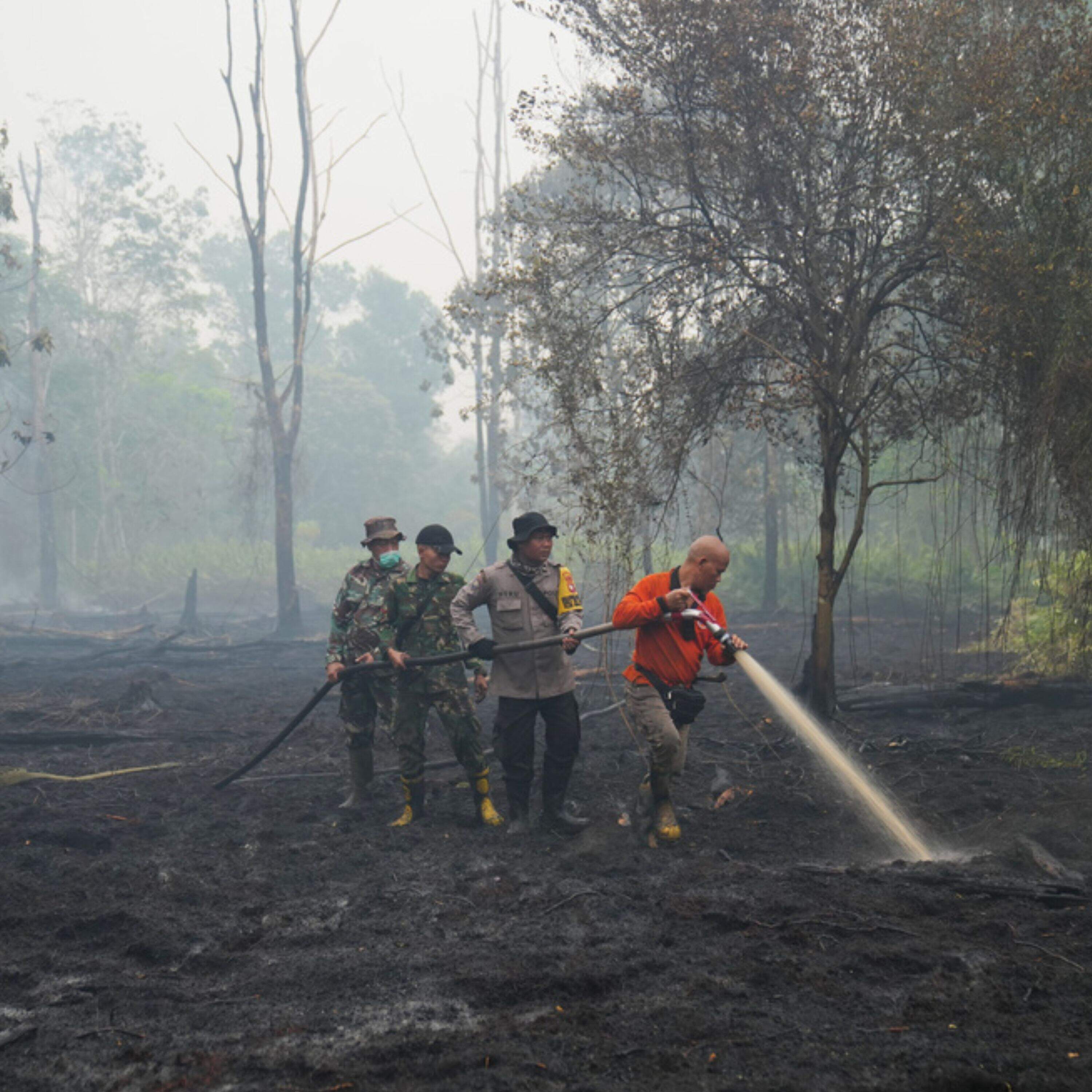
How the 'super' El Niño could reshape global weather
Get every episode summarized
Each time On Point with Meghna Chakrabarti publishes, we email you a written briefing from the transcript — the topics, who appeared, and any specific claims, with the ad reads skipped.
Email me new episodesFree for 3 shows. No card needed.
About this episode
On Point with Meghna Chakrabarti is made possible by:
“Support for this podcast comes from Is Business Broken, a podcast from the Marotra Institute at BU Questrum School of Business.”From the transcript
El Niño has become an annual global climate phenomenon. But this year, scientists are warning of a record-setting 'super' El Niño. What that could mean for the weather everywhere on planet earth.
*** Thank you for listening. Help power On Point by making a donation here: wbur.org/giveonpoint
Get every episode summarized
Each time On Point with Meghna Chakrabarti publishes, we email you a written briefing from the transcript — the topics, who appeared, and any specific claims, with the ad reads skipped.
Email me new episodesFree for 3 shows. No card needed.
Hosts & guests

Transcript ready
468 searchable segments. Every word is indexed and playable.
Full transcript
On Point with Meghna Chakrabarti — How the 'super' El Niño could reshape global weather. Machine-transcribed; use the interactive transcript above to jump the player to any line.
Support for this podcast comes from Is Business Broken, a podcast from the Marotra Institute at BU Questrum School of Business. In a recent episode, the show explores how artificial intelligence is transforming healthcare and what that means for patients, providers, and the business of care. Stick around until the end of this podcast to preview the episode. Let me just say this. I can't control myself. What about you? I'm single. I might be ready to mingle. Or should I get more action than Glowy? I think I walk around with this smile on my face for nothing. Oh my god. Season 8 for Mirz October 8th, streaming on Hulu and Hulu 1 Disney Plus for bundle subscribers, terms apply. LinkedIn is pretty amazing at helping you grow your small business. We cannot stop your new clients from emailing you at 3AM. We can help you sell, market, and hire in one place. We cannot help you
be in three places at once. And while we can't help you organize your calendar, LinkedIn can help you land more clients so you have a calendar to organize. Grow your small business on LinkedIn. Learn more at LinkedIn.com slash small business. Hey, it's Megna Chakrabardi. Before we get to today's episode, I want to just take a second to encourage you to join the new on point club for just $7 a month. You get first access to the jackpot every week, other exclusive content like behind the scenes with our producers, and you'll be the first to know about special live events. And we have got some great ones coming up. That's all just for $7 a month. This is like a couple of cups of coffee these days. So to join, just click on the link in the episode description you're looking at, and it'll only take a minute to sign up. Okay, here's today's show. WB You Are a Podcast. Boston.
This is on point. I'm Megna Chakrabardi. Way back in 1578, fishermen playing the waters off the coast of Peru noticed something weird. An unusually warm current in the Pacific was altering their catch. They named it El Nino or the child since the warm water resurfaced every few years around Christmas. In the centuries since, scientists have come to understand how this temporary flow of warmer than usual water in the Pacific Ocean can change weather patterns around the world. Well, this year El Nino is back, and it's a big one with waters so warm, even scientists not usually given to hyperbole are calling it a super El Nino. We've even heard one call it a Godzilla El Nino. Both of which mean potentially drastic weather and climate impacts everywhere on Earth.
And here in the United States, just last week, California Governor Gavin Newsom declared a state of emergency in order to prepare California communities for the changes that El Nino might bring. So let's talk about why this year's El Nino is a quote unquote super one, and really what that means for you, wherever you are on planet Earth. So Daniel Swain joins us. He's a climate scientist with the University of California Agriculture and Natural Resources group. He's also a research partner at the NSF National Center for Atmospheric Research, and he joins us from Davis, California. Daniel Swain, welcome to on point. Thanks for having me on the show, Megna. Okay, so first of all, I have heard the phenomenon of El Nino called something akin to the Pacific ocean kind of burping up warm water to the surface. What causes that burping of warm water? Yes, yes. And I think I have myself used various expressions to sort of refer to how and why
the Pacific Ocean is so influential in global climate and during El Nino events, how it essentially becomes this discharging battery, if you will. So the the the oceans all around the world store a considerable amount of heat. We know that the oceans cover something like 70% of the Earth's surface. We live in a certain sense on a water planet. So when the climate is warming, for example, the oceans are doing a lot of that heat absorbing work for us. And El Nino itself, as you mentioned, is a natural climate oscillation. It's not caused by climate change itself. But fundamentally, what it does is it releases every two to seven years or so large amounts of heat that are stored in the subsurface. So beneath the surface of the ocean and the deeper ocean, it emerges during El Nino events. And it does so in a specific patch of the eastern tropical Pacific Ocean west of the Galapagos Islands. Fundamentally, that's what El Nino is. It's just this episodic warming of the
eastern equatorial Pacific Ocean. And when it does so, it can profoundly affect global weather patterns for months thereafter. How is it? What triggers this release of heat from the deep ocean? Well, we talk about El Nino as one part of a broader cycle. The El Nino Southern oscillation or N-so is the acronym. The other end of the spectrum from El Nino is L'Hanine. So El Nino is the warm phase. L'Hanine is the cool phase of the same oscillation. It goes back and forth every two to seven years. So it's sort of an irregular oscillation. And when we let more of that heat build up over longer periods, generally speaking, then there's more heat to potentially be released in a larger El Nino event. So generally, it would be difficult, for example, to get back to strong El Nino events simply because we've released so much of the accumulated heat that it will take years for it to build back up to the same level. Now, in a warming climate, some of the heat
that's being released is heat coming from the fact that the planet is absorbing more energy, including the oceans than it used to. But either way, whether that accumulated heat is coming from long-term accumulation from climate change or whether it's just part of the natural aspect of the cycle where this is sort of the mechanism by which the earth sort of releases excess heat from the oceans into the atmosphere where it gets dissipated globally. This is sort of an equilibration mechanism. This is one of the ways that the climate system manages to redistribute heat from the tropical oceans and dissipate it throughout the global atmosphere. Nature is beautiful. Isn't she, I mean, the idea that an entire ocean can kind of recalibrate seeking a thermodynamic balance is just remarkable to me. Is it just that the makeup of the deeper waters in the Pacific, it's salinity, et cetera? There's a maximum amount of heat that it can hold before it has to be
released because I'm just kind of wondering why it doesn't further dissipate sort of elsewhere within the water. Why doesn't it move with currents to the southern oceans or the Arctic? That's partly because of just the fundamental geography of the Pacific basin. If you include the entire North Pacific, the entire South Pacific, it's this vast ocean. It takes up a significant fraction of the surface of the Earth to go from the West Coast of North America to Asia and then Southwest to Australia and Southeast to South America. The basin has some unique characteristics. The general state of things is there are east to west trade winds that blow in the tropics, so from South America to Indonesia, say those east to west winds actually allow the surface of the ocean itself to pile up in the West Pacific. There's literally a slope as much as a foot or two to the ocean surface itself between the West Pacific and the East Pacific under normal conditions.
Now it's not usually perceptible because that's occurring against one or two feet vertically over thousands of miles horizontally, but it is notable from a large mass of water that's at an angle perspective. And during an alneonio event, what happens is these trade winds for whatever reason. Sometimes it's truly just random. Sometimes there's a specific trigger, but it can just be random. They temporarily weaken for a while enough that some of the water that is being held up by the force from this wind in the West Pacific literally sloshes back eastward so that gravity is the restoring force. It wants that water to slash back east if the ocean wind is no longer pushing it to the West and it begins to do so. And that water in the West Pacific is much warmer than the water in the East Pacific again, a quirk of geography because the East Pacific is where a lot of cold water upwell also moves upward vertically from beneath. Long story short, this sets into motion a very
complex chain of events where the water begins to slosh eastward, it's warmer and then eventually if that warmer water makes it far enough east it begins to disrupt the wind currents themselves, making the process self-perpetuating a vicious cycle essentially. And so once it gets underway it wants to complete the process, but how it begins in the first place is actually still an interesting scientific question. It can just be random weakening of the winds, it can be other things, but that's usually how it gets started. By the way, it can sometimes get confusing for folks who aren't full-time scientists when we talk about direction, compass directions over the ocean versus in the United States. So when you're talking about the eastern Pacific, that would be the West Coast of the United States, Mexico, South America, Canada. We're talking correct? Right, in this case, the part of the East Pacific that matters is the tropical East Pacific. So I think the Galapagos Islands, the coast of Peru and Ecuador. Okay, and by the way,
that coastal upwelling zone, I mean, I grew up in Oregon, so I'm quite, I'm a lover of coastal upwelling, but just linking back to our Peruvian fishermen in 1578, it's one of the reasons why fishing is so good. It places off like off the coast of Peru because that cold water that's coming up usually is full of nutrients that the fish love. Okay, so now we understand generally what causes El Nino and what it is. How much from a quote unquote average El Nino does this current phenomenon deviate? What we already have as of this late September conversation is a very strong El Nino event that is arguably already among the strongest we've ever observed at this time of year. And there is very high predictive confidence that it will strengthen further from here becoming in all likelihood the strongest event we've ever observed at any point by November or December. So that is a fairly extraordinary prediction. It's not the kind of prediction you hear
very often for explicitly something that will be record breaking. And in fact, that's been the forecast for a number of months now. So this is a remarkably bold forecast in some ways. How anomalous is it right now by how many degrees? Depends on the exact measure that we're using, but it's about two and a half or even three degrees Celsius, warmer than average. And that's a big deal in this part of the world. Warmer than an average El Nino. Okay, Daniel Swain is a climate scientist with the University of California agriculture and natural resources group. We'll be right back. This is on point. Support for this podcast comes from his business broken, a podcast from the Marotra Institute at BU Questrum School of Business. As AI tools enter the healthcare space, how should we understand the concept of trust? I don't think that patients necessarily trust a model. I think they trust
the care that they receive. That's Microsoft researcher Michael Hanson on a recent episode, exploring how the future of healthcare may depend not just on technology, but on the human relationships behind it. Follow his business broken wherever you get your podcasts and stick around until the end of this podcast for a preview of the episode. The Hulu original series The Kardashians is back. Season 8 isn't it great. This year has been insane. Have you dated anyone privately? Let me just say this. I can't control myself. What about you? I'm single. I might be ready to mingle. Or is I'm getting more action than Glow8? I think I walk around with this smile on my face for nothing. Oh my god. Season 8 premieres October 8, streaming on Hulu and Hulu won Disney Plus for bundle subscribers term supply. Price line negotiator. It's me, the price line negotiator. We don't need the jingle twice. Stop it. This is about vacation inflation and how price line negotiates amazing
deals on hotels, flights and rental cars. Seems like we decided. Yeah, but I didn't mention that you can save up to 60% off hotels in the price line app. Time to read the deadline. Fine. No one deals more deals than price line. Please stop. Price line. Tushay. Price line. I understand that if Pacific Ocean water temperatures at specific places, as you mentioned before, if it rises by roughly a half degree centigrade, then officially we're in an El Nino period. And if it goes above two degrees centigrade, then that's where we get into super El Nino territories. Is that roughly correct? Yes. For those trying to do the mental math, the fair night, we just multiply by 1.8. We're talking about at the minimum level, a warming of a patch of ocean that's really only a degree or so, a fair night to be minimally qualified as an El Nino event, essentially. And then as you correctly point out, once we get above about 1.5
degrees Celsius or a little over two degrees Fahrenheit, that's already a strong event. So it doesn't take a lot. It doesn't sound like a big number. But of course, the ocean on large scales doesn't vary as much as the atmosphere. So it takes a smaller increment, essentially, be a big deal. I understand that getting above two has only happened at what two or three times in recorded history. Yeah, only a handful of times. And that would reach sort of the colloquial threshold for what some folks have termed a super El Nino, which remains a technically undefined term. You won't hear the federal agencies using it necessarily. But I think the broader notion that there is some above strong and that it's worth distinguishing between the merely strong and the extraordinary, I think it's fair. And I do think we're in that extraordinary territory. Okay, so if it's above two degrees C that is in the quote unquote super El Nino category,
sorry, I can't remember how much higher is it right now already? Well, it depends a little bit on the measure. There's actually a couple of different measures floating around now, probably because the global oceans have warmed so much due to climate change that NOAA, another agency has had kind of created an adjusted value to sort of make an apples to apples comparison with the cooler historical past. So if we use that metric, I think we're getting close to, we're already above two certainly regardless. But I think if we use the unadjusted metric, just looking literally at how much warmer this patch of the ocean is than it would usually be at this time of year, we're now getting above three degrees Celsius. So that's above five degrees Fahrenheit, which would be already the highest value we've seen in any September on record. And it's likely to get warmer as we get deeper into the year? Yes, there is remarkable unanimity among predictive models and predictive agencies that this particular
event will become the strongest on record by any objective metric by October or November. And a lot of the impacts from this event, especially away from the equator might not even peak until after the event peak. So we're still waiting for the peak intensity of El Nino. And then we might have to wait another month or two beyond that to see the peak impacts in many places. Okay. So if I can put it sort of in very, very layman's terms, we have a giant, the largest body of water on planet Earth is pumping heat, right, to the surface. And then I presume that is that heat then going into the atmosphere. How do we connect that with changes that may happen globally in climate? That's right. And really, maybe the most important thing to sort of visualize here is that the process of evaporation of water turning from liquid to vapor form, essentially the rate at which that happens rises very rapidly as temperatures rise. So as the ocean water itself warms, even if
it's only by a couple of degrees, as is the case with with the big El Nino event, that actually profoundly increases the rates of evaporation from that patch of ocean. In fact, this is an exponential process. And that's me talking technically as a scientist, it literally is an exponent. So you can imagine how if it's an exponential rise in the rate at which evaporation can occur with each degree of warming, once we get to two or three degrees of warming, that's that's such a small number anymore. We're talking about increases in rates of evaporation that are starting to be rather dramatic. And so the way that the ocean actually releases this heat and transfers it to the atmosphere, there's a little bit of the, you know, conduction going on between the ocean and the air above it, just because the water's warmer, so the air above it gets a little bit warmer. But the main way that this heat's being transferred to the atmosphere is is in a latent form in the form of this vast, vastly increased evaporation. So huge amounts of water vapor entering the global
atmosphere, adding latent heat to the global atmosphere. And that is what in turn ends up getting distributed all around the world, affecting the global hydrologic cycle and ultimately shifting storm tracks. Okay. So if we're having this jump, this pump of massive amounts of moisture, as you're saying, going into the atmosphere, some people might wonder, well, then why have we been hearing about this superelinium causing, you know, terrible droughts in some places? If, you know, we have moisture going into the air. Yes. And so this is an excellent point. So one of the things that happens is really two things to understand about how a very large, elineal event like this years, extremely strong event, what it does to the global climate system to influence weather patterns and remote regions. Now, as you might expect locally along the coast of Peru and Ecuador, it dramatically affects local climate because the ocean can be right along the immediate coast.
Even warmer, something like 10 degrees Fahrenheit warmer than average. That's pretty dramatic. And that's what we've gotten right now. So the water's warmer. It doesn't get as cool. They have more rain in those regions. That much might be a little bit intuitive, right? Because the ocean right off shore, right outside your doorstep is much warmer. But it's a little bit less obvious how that translates to droughts in some regions, as you say, and floods potentially in others. And the reason that that happens is there's two big things going on. One, as we mentioned, a really big elineal release is a huge amount of heat and moisture into the global atmosphere. So it accelerates the global hydrologic cycle. It just sort of ups the anti-e overall. There's higher risk, higher reward. There's more moisture available if it is going to rain. But there's also warmer temperatures and greater rates of evaporation or moisture loss if it's not raining. So by virtue of warming global temperature temporarily, it just supercharges the whole global hydrologic
cycle. That's number one. Number two is also, in addition to that universal effect, Alenio also acts, if you will, like a ripple in a pond, literally sending wave-like emanations out from this region and the central and eastern tropical Pacific in a way that affects the jet stream. The jet stream is essentially this river of high velocity air that defines the path that storms take. So indirectly, this is the way that Alenio can kind of result in very different effects in adjacent regions. Because you might imagine you shift the storm track away from one region and toward another, you're redirecting a lot of that water from one place to the next. Okay. So is that why we've been hearing that there may be a less severe hurricane season in the Atlantic because of the jet stream connection? Well, you know, that's actually yet another wrinkle
in all of this. It does get quite complicated, doesn't it? But the basic idea there with hurricanes, and this is actually a prediction that had been made as early as the spring, by the way, that has now essentially been validated as we get through the peak of hurricane season. The Atlantic hurricane season has been extremely quiet. In fact, I believe we haven't actually had a single hurricane, only a few tropical storms. That's one of the least active Atlantic hurricane seasons on record. And it's not for lack of warmth, but the reason why we haven't seen those hurricanes in that basin is because what a strong Alenio does is it reduces what's called vertical wind shear. So winds that change direction and strength with height, which are really unfavorable. You can kind of think of them as if they're strong enough. They kind of like to decapitate insipient hurricanes. And so the more that you have, the harder it is for hurricanes to become established. Alenio increases the amount of that storm decapitating wind shear that exists
over the Atlantic, but it does the opposite in the eastern Pacific basin. It greatly decreases wind shear can increase the potential risk of hurricanes. And that too is exactly what we've seen where actually the Atlantic has been near record quiet, but the Pacific has been near record active. Okay. There's so many people, billions of people around the world, and the nations they live in rely on healthy oceans. What effect might the Alenio have on people in our relationship with the seas? Again, and that directly affected a portion of the South American coast, Peru and Ecuador. This profoundly affects fisheries and coastal communities because the water is so much warmer as you correctly pointed out earlier. That means there's less nutrient rich water that's upwelling from the deeper colder nutrient rich ocean. So the species might be less prevalent or might not be doing as well. So your fisheries catches if you're a commercial fisher, might not
be as good, but also it has significant ecological impacts. And this can extend far beyond the primary Alenio region all up and down the coasts of North and South America. In fact, we're seeing this now all the way up into California already, where the water temperatures in Southern California are nearly record warm as well. And we're seeing the arrival of subtropical species, both fish and marine mammals and birds, and even some venomous sea snakes, believe it or not, are showing up on the beaches of Southern California. So it can shift range of species. It can threaten their viability, everything from kelp forests to marine mammals to sea birds can struggle in this environment, not just because there's less nutrient rich upwelling in some cases, because it's genuinely difficult for a lot of these species to withstand the prolonged marine heat wave that can result, because we usually don't see heat waves that are as dramatic in the ocean as we
do in the atmosphere. It just takes a lot more energy to heat water than it does air by the same amount. So when we do see these persistent extreme marine heat waves, whether from Alenio or something else, they can have pretty devastating effects if they persist long enough on marine ecosystems. Okay, so everything, everything on planet Earth all life depends on the climate that we live in. And so I wonder there are major systems that are quite vulnerable to perturbations in climate. I mean, agriculture being one of them, are there concerns about how in various places around the world, even a temporary shift in the amount of rainfall or the increase in drought might have an impact on global food systems? The short answer is yes. And one of the concerns about really strong Alenio, like we've got this here, is that it's just that. It's that there are global effects. It's not isolated to one area to the same way that a shock to the agricultural
system might otherwise be, but you can get multiple simultaneous shocks on different continents. For example, southern Africa likely to see significant drought and that can affect the maze crop there, the Indonesia and the maritime climate also drought, wildfire, disruptions to agriculture. But in parts of the southeastern South America, we'll see heavy rainfall and flooding that could disrupt agriculture. And the same thing is true in the southwestern and southeastern United States. Lots of additional beyond average precipitation, likely this winter in these locations. And part of it is the fact that it's not just one region, but it's a bunch of different simultaneous regions, including others I didn't mention there. They kind of have these disruptions at the same time that causes a big part of the problem. Okay, so there's no slack in the system where it's happening when it's happening everywhere at once. Okay, can we just stick for 30 seconds with the southwestern United States? Because you just mentioned that people might think, hey, actually more rainfall is
good on the one hand for, I don't know, wildfire suppression. But on the other hand, we're talking about potential, like lots of flooding events with the sudden bursts of rainfall. Yeah, and this is where El Nino in general may not tell us very much, but a record strength El Nino probably does tell us something quite significant. And it probably will increase the likelihood of a wet winter, maybe even a very wet winter in California. And really the whole southern tier of the US extending all the way from central California east to the Carolina. So that whole swath of the country. And in some of these places, it probably will result in a significant elevation in flood risk later this winter. Now the silver lining is it could potentially, if we're lucky, bring some extra water to the droughts, chicken, lower Colorado basin. It is possible, although it's a very attentive possibility in a sense that even if we were to get a very wet winter in this region, it really wouldn't solve the deep severity of the multi-deketal long-term problem. So it might
put us in a better place than we were this year, for example, which some of us will take. But you know, it's one of the situations where I'm more concerned with this winter, but overabundance of water in the southwest and the southeastern US perhaps than the reverse. So we'll have a period of worrying about floods, I think. Later this winter across a good portion of the southern swath of the United States. And then we can go back to take stock, maybe next summer, see how much water we were able to bank in the Colorado. Fingers are crossed, but it's very unlikely it would solve the long-term crisis there, but it's still a little bit. The Hulu original series, the Kardashians, is back. Season 8 isn't it great? This year has been insane. Have you dated anyone privately? Let me just say this. I can't control myself.
What about you? I'm single. I might be ready to mingle. Or is I'm getting more action than Glowy? I think I walk around with this smile on my face for nothing. Oh my god. Season 8 premieres October 8th, streaming on Hulu and Hulu won Disney Plus for bundle subscribers terms apply. Bonjour, Compadre. It's the... How do I negotiate so many great travel deals? My greatest gadget. The priceline app. It's got hotel deals, flight deals, rental car deals. All of those deals in a bundle. Deals. Gain day deals. Concert trip deals. No one deals more deals than priceline. Hold your horses. There's more. The app that you filter hotels by neighborhood. Vibes, star-level and amenities like pools and spas and beach fronts. Wait, I'm not done. Stop cutting the ice line! LinkedIn is pretty amazing at helping you grow your small business. We cannot make your email response time faster. We can help you sell market and hire in one place. We cannot help you find space for your three desk drinks. Why do you have three?
And while we can't help you find the perfect volume for your presentation video, LinkedIn can help you find the perfect audience for your business. Grow your small business on LinkedIn. Learn more at LinkedIn.com slash small business. Before we return to our conversation with Daniel Swain about the quote-unquote super El Nino, once again, I just want to remind you about a really special series that is coming up in October. We're going to spend a five-part series looking at what we're calling the senior class, the gerontocracy in America and how old Americans have come to a mass as a cohort, political power, influence at the ballot box, and wealth. And one of those specific episodes is going to be all about money. And so for anyone who's not a boomer, essentially, millennials, genders, and yes, Gen X, I see you. I see us out there. We want to know how are you doing financially? Are you able to save money every month? Do you have a nest egg or a sufficient rainy day fund?
Do you own your own home? Or does that seem to be something that's quite far off for you? And if you're struggling, what do you think is keeping you from financial success? So tell us your story. Give us the picture of your world in money. You can do that by grabbing your phone and looking for the on point Vox Pop app, wherever you get your app, just look for on point Vox Pop. You can also call us at 617-353-0683. And oh, by the way, when you tell us your story, also, if you want to, let us know how you think it compares to your parents' life or onsen uncles or older members of your family and where they were when they were your age. Okay, so now back to our conversation with Daniel Swain about the super El Nino and Daniel, similarly or not similarly, what could be the potential changes in the northern tier of the United States? Yeah, so the main reason why the southern tier of the continental US generally would be wetter in the winter from a very strong
El Nino. Like this year is because the storm track, the jet stream shifts southwards. So essentially, it shifts the path that storms take or where they might develop and strengthen southward. And in so doing, it sometimes shifts it away from the northern tier. So the clearest signal is wetter across the southern tier from California to Florida and the Carolinas. And then if we're up in Canada, western Canada, generally drier with lower winter snowpack, central Canada, warmer winter, the northern tier of US states can kind of be in that transition zone where it's a little harder to figure out exactly what might happen. Okay, so I do want to touch upon a couple other major impacts that this El Nino could have on humanity worldwide. And in order to do that, we spoke with Michelle Nunn, who's the president and CEO of CARAT, the International Humanitarian Organization. And Michelle says the potential effects of El Nino will be felt even more in places that are
already facing hardship and conflict. So we have the magnitude of the conflicts that are happening in Ukraine and the Middle East, which have huge repercussions around the world. So they're affecting fertilizer prices and gas prices and places like Somalia and Sudan. On top of that, you have the localized conflict in places like Yemen and Afghanistan and also Sudan and Ethiopia and Somalia. We also talked about food changes in agriculture with Daniel Swain. Well, Nunn says that in 2025, there are almost 300 million people across 53 countries who already faced acute food insecurity. There's an estimate that with El Nino, it could push that number up by almost another 50 million people. And the reason that happens is because the climate is changing, it can be because of drought, it can be because of heat, it can be because of floods. But all of that makes it very difficult
for smallholder farmers who make up the majority of people who are living in poverty are facing into a very difficult climate. And specifically about the flooding, Michelle says that that pose as a problem for farmers as you heard and also aid workers in the region. In some places that can mean how do we ensure that there's water catchment and that there's a way in which we can ensure that we mitigate for flooding as a result of what might be increasing rains. In other places, it is how do we get drip irrigation and how do we ensure that we have solar powered well so that you don't have to walk an extra five or 10 miles if you're a woman trying to provide water for your family. And Michelle also says that all of this will have extended consequences, particularly for certain groups of people who will suffer a disproportionate impact. It's also women and girls who are so often, for instance, the last to eat in their families eating the least and are also
having the burden and responsibility of, for instance, getting water or taking care of their children to make sure that they're protected. And there's a disproportionate impact around gender-based violence when you see the heat increase. So why should U.S. citizens care? Well, Michelle says the global effects of El Nino are something that all Americans should think about even if it seems that the damage or the biggest damage is happening on the other side of the globe. It is in our economic and our health and our national security interests to ensure that these fragile contexts don't extend and proliferate so that they end up with more conflict that, for instance, in a place like the DRC where they're dealing with Ebola, if they are having to deal with Ebola on top of these other really difficult challenges as it relates to poverty, weather, and the intersection they're in, not going to be able to fight Ebola. And then you see the spread of Ebola. Okay, Daniel, I've got to get back to some fundamentals here that you talked about earlier.
Because I suppose by this time a lot of people are wondering, what we have this record-breaking El Nino happening at a time where we've been hearing for years that sea surface temperatures have been going up anyway due to climate change. I mean, is that part of what's feeding this super big, this Godzilla El Nino? Yeah, and this turns out to be a question that is even more difficult to answer than it might sound because it's the cutting edge of climate science. But the short answer is yes, that although El Nino and La Nino and Enso, the broader cycle itself, is a natural cycle that was here long before human cause climate change. It is profoundly affected by that same climate change and is affecting how we perceive climate change. Because El Nino essentially is the Earth's climate systems the way in which it releases excess heat from the tropical Pacific Ocean, which is where a lot
of the excess heat goes in the first place, there is simply more and more heat that needs to be released through this mechanism as the amount of global heating increases. So that might imagine that could lead to either more frequent or at least more intense when they do occur El Nino events. Also, the global oceans are warming in general. They aren't only warming in the El Nino region, but they're also warming in the adjacent regions. And here's where things get a little bit complicated. Interestingly, the long-term trend in the Pacific Ocean has seen a bit of a warming hole right in this eastern equatorial Pacific Ocean region that's home to El Nino, which means that because that patch of ocean has been warming less quickly than the rest of the global oceans, that there is a little bit of an apples to oranges problem, where because that patch of ocean is warming more slowly, we need to make that adjustment factor to how we measure El Nino that we
was talking about earlier. The Phil Nino raises the temperature in this part of the Pacific, even if it's just temporarily, and then it changes climate around the world. When the sea temperature ocean temperatures go back down, do they go back down to a higher level, essentially a new set point, which is higher than it was before? Well, that's the trillion dollar question, because in a climate that wasn't changing, that was stationary over time, that wasn't warming, the climate system should temporarily warm for six to 12 months during a big El Nino event, and then cool afterward during the subsequent La Nina, the cool phase pretty much back to where it was before steady states. We still get that warming and subsequent cooling, what the problem is, because the climate change is still there lurking in the background, we're probably not going to cool back down to where we were before this big El Nino event. That's what we're beginning to see,
is that historically, the way we experience global warming is in fact that we see these huge stair steps upwards during big El Nino events, temporarily record breaking global warmth. We see a little bit of relative cooling thereafter, but we don't return to our old baseline, it stays elevated. So that's kind of the mechanism by which we're experiencing global warming. In this staircase, this escalating temperature staircase toward warmer temperatures, punctuated by these El Nino warming periods, and then kind of slight partial cooling or plateau periods during the subsequent La Nina event. So that's what we're expecting this year. By late 2026, we'll probably have record breaking global warmth again, likely to persist into 2027. So that is a key aspect of how we're experiencing all of this. So on an immediate timescale, the next few years, as you're saying, even within the lifetime of people currently living, this sounds kind of gloomy. But do you have
any optimism in this case about what we can either learn from this El Nino or about its climate impacts overall, Daniel? Well, El Nino is itself a natural process, and it's been around for all human history, and it seems destined to continue, even with global warming. And so it's something that's important that we understand, because it does have all of these cascading global impacts we've been talking about from agriculture to water supply to global security. So it's important to understand it. This kind of huge El Nino event will, you know, it certainly will offer a scientific opportunity, because when you, it's a big push to the system, if you will. So large signal makes it a little bit easier to study. The challenge is that, you know, this could have some really negative impacts for millions of people in the meantime. But I do think we'll probably be able to glean some interesting and important, societally important scientific
understandings from what ends up happening this year. And I think the other thing I would add is that, you know, we talk about climate adaptation. Forget El Nino for a moment, just thinking about how climate is changing the risk of extreme weather events and droughts and food supply disruptions and all these sorts of things. We want to increase our level of societal resilience to those regardless of why they occur in a particular year. This is something that's important for human health and well-being all around the world. And so a lot of the same things that we might do to respond to a really big El Nino event or that we might do to adapt to a warming climate to make our society more resilient are, they're similar. And so the better we can learn from one of these events and apply it to the other, I think the better off we will be because a lot of the things we need to be doing are overlapping there. That's a really, really good point. In the last 30 seconds that we have Daniel, are you a bedding man? I am not. Okay, because I was going to ask you, do you
have a prediction about how warm it could actually get? Well, you know, if I were, I think the good money is definitely on record warm. In fact, right now it does look like late 2026 into 2027. There's something like a 95% chance, maybe even higher, that we'll see a new record breaking global temperature as a result of global warming plus this big El Nino event. So those are pretty good bedding odds, I would say. Honestly, in science, that's pretty much the equivalent to saying it's a sure thing. So well, Daniel Swain, climate scientist with the University of California's Agricultural Natural Resources Group. He's also at the NSF National Center for Atmospheric Research, joining us today from Davis, California. Daniel, thank you so much for helping demystify the headlines that we've been seeing about the super El Nino. I really appreciate it. Thanks for having me. I'm Megna Tucker-Bardi. This is on point.
Americans lost a record $16 billion in legal sports bedding last year. The problem is a cute among young men. More than half of men 18 to 49 in this country have an open sports book. It's kind of insane how quickly we as a country, as a society, decided to unlearn the lessons that every civilization before us had learned. That's on the next on point. Support for this podcast comes from Is Business Broken, a podcast from the Marotra Institute at BU Questrum School of Business. Follow Is Business Broken wherever you get your podcasts, and listen on for a preview of a recent episode featuring host Kurt Nickish in conversation with cardiologist Eric Topel on one of AI's most surprising traits, empathy, and what it could mean for the future of the doctor-patient relationship. Is there anything that AI is doing today that would genuinely surprise most patients? Well, the big surprise to me was empathy in that book
I had a chapter deep empathy and I said, oh, it will never come from AI. But as I didn't forecast properly AI with large language models is a remarkable channel. The algorithms, AI has no idea what empathy is, but it transmits it. And in 13 studies evaluated by physicians, 12 of the 13 studies showed empathy was better with the AI than by the physician. So this is really interesting. And one of the questions that raises is, will clinicians be getting coaching by AI to be more empathic and better communicator? I'm just curious, is this helping doctors who don't have good bedside manner in the first place or the fact that AI just has not seen so many patients and actually has empathy for each situation because it just doesn't get tired? Yeah, there's several reasons for this, but probably the biggest one is that most physicians have a lot of empathy, but they're squeezed so much for a limited time. They don't get to express it. And when the
AI reviews their note and say, you know, why didn't you ask Mrs. Jones about this or why did you interrupt her after 90 seconds and on and on? Then you start to cue into what could be better. But it really does come back to, we got to have the gift of time or we can't rebuild the patient, doctor relationship, which has gone through so much erosion over the years. There have been seven studies now that have been published where the AI did better than the doctor with AI in various tasks. That wasn't anticipated, but it may reflect that we're still in the early stages and a lot of physicians haven't gotten grounded in AI or have automation bias. And in fact, that these studies were not real world medicine. They were in a way contrived with scenarios and patient actors and that sort of thing. So we'll have to see, but everybody was banking on that the combination of human and artificial intelligence would be the best of all. Find the full episode by searching for Is Business Broken, wherever you get your podcasts, and learn more about the Marotra Institute for
Business, Markets and Society at ibms.bu.edu. The Hulu original series The Kardashians is back. Season 8 isn't it great? This year has been insane. Have you dated anyone privately? Let me just say this. I can't control myself. What about you? I'm single. I might be ready to mingle. Of course I'm getting more action than Glow8. I think I walk around with this smile on my face for nothing. Oh my god. Season 8 premieres October 8, streaming on Hulu and Hulu 1 Disney Plus for bundle subscribers, terms apply.
More episodes
More from On Point with Meghna Chakrabarti

Senior Class: Old money
On Point with Meghna Chakrabarti

Senior Class: The silver ballot box
On Point with Meghna Chakrabarti

Senior Class: The oldigarchy
On Point with Meghna Chakrabarti

The Jackpod: One war at a time
On Point with Meghna Chakrabarti