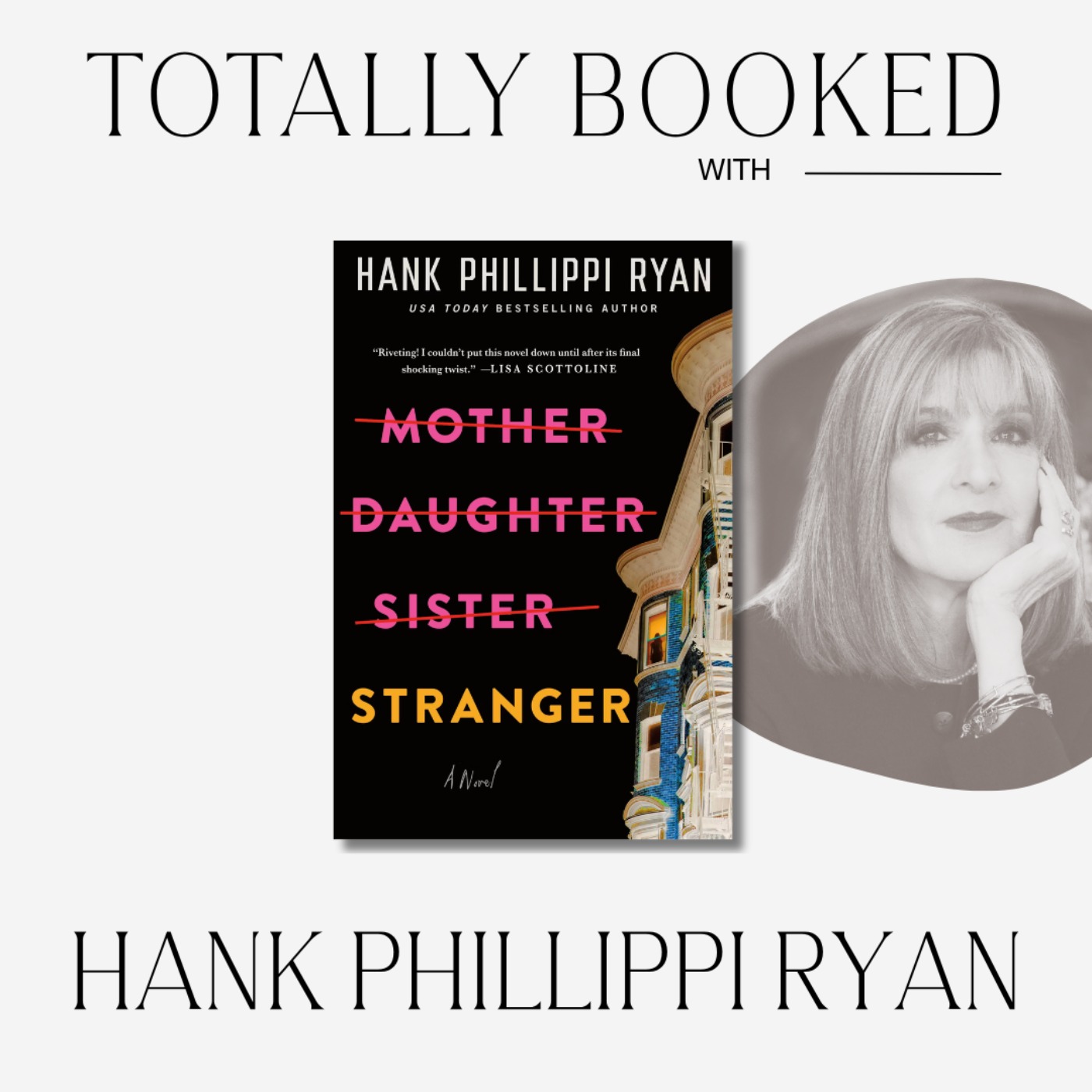
Hank Phillippi Ryan on What Happens After the Happy Ending
Get every episode summarized
Each time Totally Booked with Zibby publishes, we email you a written briefing from the transcript — the topics, who appeared, and any specific claims, with the ad reads skipped.
Email me new episodesFree for 3 shows. No card needed.
About this episode
“I've interviewed more than 2,000 authors on this show and learned endless amounts about storytelling, reinvention, and life itself. Because when you talk about books, you're really talking about life.”From the transcript
Hank Phillippi Ryan sits down with Zibby Owens to chat about her new novel Mother Daughter Sister Stranger, a twisty thriller about Eliza’s search for her sister Bea who goes missing on the eleventh anniversary of the plane crash they survived but killed their parents.
Hank talks about how stories shape our lives, family lore, the experience of writing a young character on the cusp of growing up, and why reading the end of a book first teaches her about story construction.
She also recounts growing up as the oldest of five children in rural Indiana, how her books benefit from her long career as a TV crime journalist, the question of ‘what happens after a story’s happy ending?’, and the touching reason she and her husband celebrate the day before their anniversary.
Learn more about Hank at https://hankphillippiryan.com and follow her on Instagram @hankpryan.
Hosted on Acast. See acast.com/privacy for more information.
Get every episode summarized
Each time Totally Booked with Zibby publishes, we email you a written briefing from the transcript — the topics, who appeared, and any specific claims, with the ad reads skipped.
Email me new episodesFree for 3 shows. No card needed.
Hosts & guests
Transcript ready
143 searchable segments. Every word is indexed and playable.
Full transcript
Totally Booked with Zibby — Hank Phillippi Ryan on What Happens After the Happy Ending. Machine-transcribed; use the interactive transcript above to jump the player to any line.
Welcome to Totally Booked. I'm Zibi Owens. I've interviewed more than 2,000 authors on this show and learned endless amounts about storytelling, reinvention, and life itself. Because when you talk about books, you're really talking about life. So get ready to hear from today's best authors, the best selling, and the not yet discovered. Come find your next great read and the story behind it. Enjoy! Hank Philippi Ryan is back on the podcast to discuss her new Vic, mother, daughter, sister, stranger, and novel. Hank is the USA Today bestselling author of 17 Thrillers, including one wrong word and all this could be yours, which was the 2026 Mary Higgins Clark Award winner. Hank Philippi Ryan has won every major award in the mystery genre. With her Thrillers translated into multiple languages worldwide, her fiction is inspired by a lifetime of investigating true crime during her storied career as an on-air reporter for Boston's WHDHTV, where she was awarded multiple honors for her groundbreaking journalism, including an unprecedented 37 Emmys.
Her work has resulted in new laws, people sent to prison, homes removed from foreclosure, and millions of dollars in refunds and restitution for victims. A TEDx speaker and in-demand literary moderator, she has been called a superb and gifted storyteller. A Chicago native with roots in Indianapolis, Hank lives in Boston with her husband, a nationally renowned civil rights and criminal defense attorney, enjoy our conversation. Welcome, Hank. Thank you so much for coming on Totally Bucked to talk about mother, daughter, sister, strangers, although mother, daughter, sister, or crossed out. So do we just call it stranger? What do you think? We call it mother, daughter, sister, stranger, definitely, because every woman is at least one of those, right? And some of us are all of them. And so the book is about roles and what role we play and how those roles can change. And how even a mother and a daughter and a sister can sometimes be strangers to each other. Very true. Well, you start the book with a punch, right? It starts off after a plane crash, the memory, the hazy memory, the wondering of what happened, what was memory, what was fact, and how these sisters survived, and then how they approach raising another daughter into the morass of life.
Talk a little bit about why this construct for it, why this particular set of what ifs and all of that. Well, it's interesting because I always think about, did you ever lie to your mother, and of course we all did. And I started thinking about what if our mom was lying to us as well? What if did we keep secrets from our mom? Sure we did. What if she was keeping secrets from us to and how would we ever know. And then the other sort of element of this to our actually one is when I was in college long ago, I made a game during Thanksgiving and brought it home, which was called familial pursuits. And it was all questions about things that had happened in my family over the years. I had four siblings. And it was like where was Hank when the barn burned down, questions like that. And everybody had a different answer. Everybody had a different absolute memory of what had happened. And probably none of those were the actual truth. And so it made me think about how as a family, every family has a history, every family has a story, every family has lore.
And we grow up believing that those stories are true. But what if something happens in your life to indicate to you that maybe what you always believed, what you were always told is not true. And how much would you want to find that out? Is it better just to leave it the way it is with your happy memories or even sad memories leaving them the way they are? Or would you be compelled to go find the truth of what happened. So those kinds of things put together the final little, the final little element of the book. And I wonder if you had this happen to you too. And my mom would read me stories when I was little and she would say, you know, and they all lived happily ever after the end. And I would say, well, what happened after that? And she'd say, no, honey, it says the end. I would say, but it can't be the end. You know, they lived happily ever after forever. Nothing bad ever happened to them. And you know, she, she always said it. I was a problem child, you know, asking questions about those things. But to me, the characters were real and they had to live on. And so that was another element that went into this story. How stories shape our lives bottom line. And what if those stories turn out not to be true?
Well, I'm glad you touch on this topic because I am often thinking about what happens to characters long after the book ends because you spend hours in happening lives. And sometimes like yours in a first person narrative where you're so in it with someone. You can't just shut that down. Where does all that curiosity go? How do you make sense of feeling so connected to something perhaps fictitious and then not knowing what else comes down the line? It's like a crazy exercise when you think about it. It is. It's kind of joy. It's kind of the magic of creating a character. I mean, we write characters. And they feel real. They feel real to our readers. We hope. And they certainly feel real to us like friends. And they have intentions and they have agency and they have hopes and fears. And they feel real. I mean, one of the things that's so interesting about writing fiction is that, you know, I don't use an outline. So I don't know what's going to happen next. And as I started this book, it was about a young woman who is a wannabe literary agent who secretly writes a blog about happy endings where she gives every character in every book a happy ending. Nancy drew does not marry Ned Nicherson, but she marries a criminal defense attorney. And she goes off to be a justice activist.
You know, but you know, what happened to Nick Caraway in the great Gatsby. Where did he go after that fateful summer. And so she creates endings for books. She created a new ending for the little prince. And and Zibi, all of that got cut. All of that got taken out of the book. I mean, that was what started me in writing this as well. My main character, as you as you say at the beginning of the book is she and her sister are the soul survivors of a private playing crash that killed their parents. And you know, as she'll tell you in the book, she took psychology 101, she knows that her search for happy endings for her characters is really actually her search for a happy ending for herself. And she's clear about that in the book. So I didn't need all those blogs to tell you that. But Eliza is in search for happy endings and she becomes a book agent, a romance book agent, because those happily ever after endings are required.
And that's what she wants in the world. And when her sister, her dearly beloved sister goes inexplicably missing. She and her 11 year old niece, hyper must go on the hunt for Piper's mom to find out what happened. And she knows that there may not be a happy ending in this story, but she's determined to find it. Well, Piper is okay with the the happiest of endings just being a piece of pizza at the end of the day. So, you know, less the children. Thank you for only pizza as Piper. As Piper will tell you, there's no question about that. Piper was really fun to write. It's fun to write an 11 year old because there's so on the cusp of wanting to be an adult half the time she wants to be an influencer and half the time she wants her stuffed animal. And her mom is missing, but she loves her aunt, but and she has kind of a complicated history. So, how do you, you know, how do you as someone's aunt step in for somebody's mom? What does it mean to be a mom? And what can you give a child, especially when that child's future is in such jeopardy? And that's what I wanted to explore in mother daughter sister stranger. And you see the themes coming through now, the relationships between mother and daughter and sister.
And which how much do we really know about each other because Eliza's sister B would never disappear would never abandon Piper, although it feels like that's what she's done, especially on the exact 11th anniversary of the plane crash. B has disappeared. That is just it's remembrance day and she be would never not be with Eliza on that day. So you can see that something untoward has happened, but how bad is it going to be and what's really behind Eliza and B's life story? Wow. Did you, this is a stupid question. Remember in stay is did you come up with that or is that a thing? No, that's I came up with that. That's a fictional thing. Yeah, for them. It's real. It's real to Eliza and B obviously, but no, that's a thing that felt right, right. And that's what they talk about is how do you, how do you grieve a parent who's dead, who's left you physically, but certainly not emotionally, who's left you with love and love.
And left you with questions you remember them and it's nice to have a day where that's your total focus that you come to the cemetery, you tell them how you are now and you relate one story that you remember from your past. So I wanted to take that day and make it be really sacrosanct, you know, show you that B would never on purpose miss this day. Wow. Well, I have an 11 year old and it's funny because when I was reading the book in my head, 11 sounds younger than like my actual child is 11. I mean, like 11 year old child, I don't know, maybe he's mature or something. I don't know, not that you wrote Piper young. I just mean when I hear 11 year old, I think, oh, well, easily distracted. Like you could probably pretend everything's fine, but like they are too smart for that, right? They're the 11 year olds are not getting any will over their eyes. That's true. And we embrace that in Piper. I love that. How Eliza embraces that in Piper. She respects her and she thinks about that.
You know, she, she, and there's this balance of listening to her and understanding her grief and her fear and her, but her, her child like a little bit denial that something bad has happened. So those are the rocky steps that you have to take with somebody who's that age because they're not really, you know, they're not even teenagers yet. And some of that when you're, when you're supremely worried, you might pretend that everything is going to be okay, especially if you have an aunt who has no idea how to be a mom. Yeah, but it's really just trying to do her best for this little girl who she obviously deeply loves. Well, I like how you included the game. Maybe you didn't have the blogger, but at least she could play the game of like, let's write a happy ending for this story. And that's, that's very fun. Obviously, love games. This is, this is great. What other games do you have up your sleeve? We'll see. You know, it also that the game that they play of endings allows Piper and what Eliza is really doing is allowing Piper's imagination to grow, allow her to think of stories and what might happen.
But that's a, that's a good technique to have in life is to see what, imagine what might be ahead. It's a problem solving thing that she's teaching her and she's also teaching her to be optimistic. How do you have a happy ending? How do you look forward to something even as Eliza fears that something really awful has happened and worries, how is she going to explain this when the devastating thing happens? How is she going to handle that with Piper and what will her responsibilities be? I mean, this is a fast paced page turning thriller. I hope that's full of twists and surprises, but it turned out also to be sort of a love letter to mothers and daughters and sisters about those relationships and the bonds that we have that with the ones that we love. Amazing. Well, in your acknowledgments, you write that when you read a book, you go right to the ending and you almost see it as a disservice to the author by not doing that because you're going to be so busy trying to figure out everything that all the clues and everything they got to the end and instead you want to be able to focus on the language and all of that.
Tell me more about that because I rarely go. I mean, I don't think I ever go to the ending because for me that that takes some of the enjoyment away from the ride. Yes, you are obviously so absolutely right. There's just no question about that and I hope that your millions of listeners will not flip to the endings and my books or your books or any or anybody's books. So don't do that. I do that. But for me, at least as an author, I do it as an exercise, sort of an educational exercise, almost as research, almost as deconstructing. So in certain books, I'll read the first chapter, then I go to the end to see how it ends and then I go back to the first chapter and read it from the beginning to deconstruct how the author got there and also to sort of respect the author's writing enough and enjoy it enough. So I'm not worrying like is he going to die? Is she going to die? Are they going to fall into the river? What's going to happen to the dog? Who is the bad guy?
Because in a really good book, you know, if we're lucky to read a really good book, we're turning the pages as fast as we possibly can, right? To see what happens and all that gorgeous setup that you know all that beautiful writing and all that wonderful structure and all that foreshadowing all those clues that every good author has put into their book. We just miss because we just want to find out what happened. So it's sort of allowing me to take away the suspense and I know that's the point of reading suspense is to have suspense, but you know whatever. And I read it for education. I read it to teach myself bottom line. I read it to teach myself how to be a better writer and the wonderful books that I read by wonderful authors that I admire. I try to understand how they got to that ending. So, you know, and I don't care if I know the ending because it's it's a different way of reading a book, but to me, to me, it is just it is just as enjoyable. Well, you, as I said, to be a great don't do this at all.
I do as I do not as I say or don't do never mind. I don't even know the expression. We have talked about this in the past, but you came from a career in TV journalism and transition to being an author yet you're your appearance on the scene of all of these things can do nothing but inform the quality of your writing. Talk about how using that type of lens helps when you're creating scenes and and suspense and page turning pages. Thank you. Yeah, it's so interesting. Isn't it? I'm a firm believer in that everything we do in our lives. It is, it is there for what it is, but it is also the foundation for the next thing we do. I don't even know what the next thing we're going to do is going to be and yet everything we've done delays that groundwork and there is nothing that could be better groundwork for writing crime fiction. Then having been a true crime reporter, having been an investigator reporter, you know, I did that for 40 years, but from the standpoint of suspense, you know, I don't want you to turn the channel when my stories are on TV.
And I don't want you to be able to put my books down, you know, I want you to Mr. Stop on the subway because you want to just have one more chapter or stay up, you know, just a little bit longer for one more chapter. So that idea of entertaining, of pacing, of curiosity, of suspense, of twists and surprises, of of being of changing someone's life. I mean, it reminds me that as an investigative reporter, my stories, what are the key of writing a good investigative story? You have a character who you care about, right? Who has an important problem that needs to be solved, your track down clues as a reporter and following leads and going to places and doing interviews, you're hearing people talk. And in the end, you want the good guys to win and the bad guys to get what's coming to them. And you want some justice and you want to change the world a little bit. And that's exactly the same in investigative reporting and crime fiction writing, isn't it? That's a good story. Also, you want it to be entertaining and enlightening and new and unique. I mean, I've been a television reporter for 40 years.
And I started out covering cat shows and craft shows and moved on to basketball finals and then finally political conventions and true crime. And no matter what story I did, I wanted it to be a gem, the best story about a cat show that anybody has ever seen in the universe. You know, every story was important to me, no matter what it was. And I would raise the bar on myself every time and writing my stories, be better, be smarter, be more entertaining, be faster, be more unique, be more important. You know, I've gotten, you know, we've changed laws and changed lives in Massachusetts. I've gotten millions of dollars in refunds and restitution for crime victims in Massachusetts. So telling telling a story and creating a little movie about an important thing and then having it have a great result is absolutely spectacularly rewarding. And I took all of that passion and all of that search for justice and fairness and equilibrium and social justice. And I put that all into crime fiction.
So it, it's just changed my life so much to have that television background. I embrace it every day. The one thing, and I'll just say this very, very quickly, the one thing that was different about writing for television and writing for crime fiction is that I'd never, when I started writing my first book, when I was 55, 20 years ago, when I started writing my first book, I didn't know whether I could make stuff up. You know, I'd never done that before. I'd only used real facts, real setting, real dialogue, real clues, real documents. And I'm sitting here right in the same place that I'm sitting right now looking out the window at the Sugar Maple tree and thinking, I'm going to, I have to use my imagination now in a different way. And will I be able to do that? You know, it's really a challenge and a lot of magic to create a new world and new people that never existed before. And I just, I just embraced it every day now.
I love that. You mentioned that you are one of five siblings. So what was your relationship like with your siblings given that sister is one of the mean moniker's on the book? How long do you have? It's a good relationship. You know, I'm the oldest. So you can, you know, you get the hierarchy right away. So I spent my life telling them all what to do. And what was the age range? So there's me and then my sister Nina who's three years younger and my sister Nancy who's 10 years younger and my sister Liz who's 11 years younger and then my brother chip who's 12 years younger. So I'm much older than chip, you know, so that you know, at that point your relationship really, really changes. It's horrible. My sister Nina who's so close to me and my and I used to gang up on my little, our little sister Nancy that we make up. We'd make up rules and games like you can use you can use foreign words and scrabble when we did it, but but Nancy couldn't do it.
You know, we play cards and say, oh, yeah, it's are always, it's are always wild cards and she'd say, no, they're not and we're like, yeah, they are. It was pretty terrible. Some of us are still close. Some of us are not so close. You know, every family is unusual in its own way. So, you know, I learned a lot from them. You know, Nina was the popular one and Nancy was the chef and Liz was the equestrian and chip was the is all of the NAR alive was the political activist. So, we had a we had a good family. We lived way out in rural Indiana. So rural that you couldn't see another house from our house. And my sister and I used to okay, my sister Nina and I used to ride our ponies to the library to get books and we fill up the saddlebags with books and read up in the hay loft of the barn behind our house. So, you know, Nina and I fell in love with Nancy Drew out there and then she went off to do her own thing and I stayed in the hay loft with Sherlock Holmes and Agatha Christie and all the wonderful golden age mysteries and I became a I became a reader and then a writer.
Wow. Gosh, that sounds like fiction right there at the saddlebags. Like, this is I mean, I mean, people listen and can't see you, but you don't look old at all. Like you don't look like it is remotely possible that you could be describing this type of scene that sounds like it's out of little has on the prairie or something. It doesn't need I know it is quite a picture I turned into kind of a city girl, but those that background, you know, being outside being on my own, you know, I had I was the geekiest nerdiest little girl most unpopular person you could ever possibly imagine. I had no friends and no dates and no fun and no parties all I had was books all I had was books and it seemed very bleak and sad at the time, although I loved it, you know, I completely loved it and now look, you know, how formative that was I wouldn't be right here talking to you if that childhood hadn't happened and that that is astonishing to me. Wow, do you feel that all of your siblings would step right in if God forbid something happened?
Yes, I only pause because I think how much I wouldn't like to ask them to do that, you know, in what a sad situation that would be so, you know, you and I are writers, you know, we come up with every possible terrible thing that could possibly happen and it goes through our mind in a minute. But sure, of course, and I for them there's no question about it no matter if we're far away from each other, if we haven't talked to each other for a long time, you know, if something happens, who are you going to call is your family, you know, under no matter what circumstances. I didn't mean to be so dark in my questions, I'm just like thinking about the plot of the bug and all of that and, you know, not every not every sister would pick up the slack in that way. And I do think that one of the things that and you're right, of course, not every sister would pick up the slack and not every sister is required to pick up the slack, you know, that's why every family is different. But in mother daughter sister stranger, B and Eliza went through this terrible thing together, they were in a plane crash, their father was the pilot, their parents died, they were in the sister seats in the back, they were in the hospital together, they were teenagers at the time.
And they spent their time in the hospital trying to figure out what happened and why that plane had crashed. And as a result, their bond is even more special. I mean, they're not only sisters, but survivors. And that survivor bond is incredibly strong. And so again, that's why in mother daughter sister stranger, when B does not show up to pick up her daughter, piper, that it's not like oh, she's flighty, oh, she forgot the day. There, there is something really wrong and only Eliza can figure out what that is. And she has to take piper with her. So on one, on one hand, it's sort of this funny little homes and Watson thing with piper as the sidekick detective, trying to help, but with an undercurrent of something really bad has happened. And you know, that's the thriller aspect of the story. What do you think is the hardest thing that you've had to survive? Oh gosh, it's interesting. I was thinking about that just today, the things that happen in our lives, whether it's the loss of someone or the divorce of parents or my own divorce or disappointments in, you know, I've one side and down the other.
And I was thinking today about how I hope I've changed over the years in my response to that, you know, how, how sad or upset or embarrassed or humiliated or grieving we are in the world. There are endless numbers of people who are worse off than that, whose lives are incredibly tragic. And you know, we're just, I think to myself, I'm just a little, I'm just one little person with a little disappointment, you know, just, you know, try to keep the world, try to keep the world in balance a little bit. I own my sorrow when things happen if I'm upset, if the rug gets pulled out from under me, you know, I can be, you know, kicked off my equilibrium, you know, pretty easily. But I just, you know, that's why my books are about empowerment, I think, Zibi, is that if there is a Hank DNA to the book to all of my books, it's about a strong woman who gets the rug pulled out from under her.
And I think that she doesn't expect, expect. And she needs to get her power back. And I, and I, you know, of course, I want to like to twisty page turning, you know, total immersion stories. But I also, when I have an undercurrent for readers of when something terrible happens, you can survive and you can get your power back and you can regain the balance in your life. And you can even be happy. We both all had times where we think I will never be happy again. I will never be happy again. It can't be. But I will tell you this, when I met my husband, my current and all the last husband, Jonathan, who's in the other room, we met about 30 years ago, and we don't celebrate the anniversary of the day we met. We celebrate the anniversary of the day before we met. And we call that you never know day because you never know what wonderful thing is around the next corner. And when we're sad and when we're disappointed and when we're feeling like giving up that our life is over and that we will never have a happy ending, how many times does, you know, the next day or the next week, something happened that wouldn't have happened without the bad thing.
And makes the bad thing be worth it because this wonderful thing happened that we never could have predicted. And I, you know, that's what I live by. You never know what wonderful thing is around the next corner. And we only have this one life. We have this one life. And we have some power to choose how we're going to live that. We don't have power to choose what will happen all the time, but we do have the power to choose how we're going to deal with that. And I'm still working on that. And we're all still working on that. And I think that's why I do what I do now. But you never know what wonderful thing is around the next corner. I love that. Oh, thank you for sharing that. I gave me goosebumps. Thank you so much for discussing your family and this family and how to how we can all rewrite our stories essentially. So thank you so much for coming on. Mother, daughter, sister, stranger, congrats. Thank you, Zibi. Thank you so much for all you do. Love you.
Hi. Thank you for listening to Totally Booked with Zibi, formerly Mom Stone Have Time to Read Books. If you loved the show, tell a friend, leave a review, follow me on Instagram at Zibi Owens, and spread the word. Thanks so much. Oh, and buy the books.
More episodes
More from Totally Booked with Zibby

Rebekah Lowin on Impossible Jewish Joy
Totally Booked with Zibby

Elizabeth Wellington Rollins on Writing Her Way Home
Totally Booked with Zibby

Meg Mason: The New Reese's Book Club pick!
Totally Booked with Zibby

Susan Coll on the Nonsensical Business of Publishing
Totally Booked with Zibby