Get every episode summarized
Each time All TWiT.tv Shows (Audio) publishes, we email you a written briefing from the transcript — the topics, who appeared, and any specific claims, with the ad reads skipped.
Email me new episodesFree for 3 shows. No card needed.
About this episode
All TWiT.tv Shows (Audio) is made possible by:
“All right, remember how last week I was typing into the Olam app and I was getting answers about a torque wrench? Well, these are the files that are responsible for those answers, a 6.59 gigabyte file. And I thought, hey, let's open it up and give it a look.”From the transcript
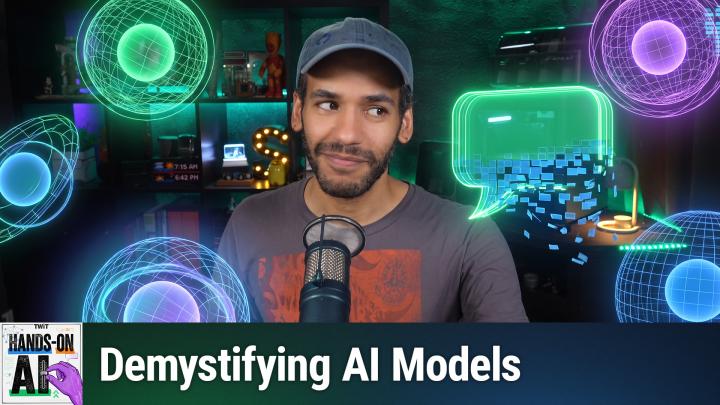
What's actually inside an AI model? Mikah Sargent opens up the file from last week's episode and finds tokens, billions of numbers, and one surprisingly simple job: guess the next piece of text. Along the way, he shows why the same question can get a different answer every time, where all those numbers came from, and why a chatbot can sound completely sure of itself and still be wrong.
Host: Mikah Sargent
Download or subscribe to Hands-On AI at https://twit.tv/shows/hands-on-ai
Want access to the ad-free audio and video and exclusive features? Become a member of Club TWiT today! https://twit.tv/clubtwit
Club TWiT members can discuss this episode and leave feedback in the Club TWiT Discord.
Sponsor:
Get every episode summarized
Each time All TWiT.tv Shows (Audio) publishes, we email you a written briefing from the transcript — the topics, who appeared, and any specific claims, with the ad reads skipped.
Email me new episodesFree for 3 shows. No card needed.
Hosts & guests

Transcript ready
694 searchable segments. Every word is indexed and playable.
Full transcript
All TWiT.tv Shows (Audio) — Hands-On AI 2: Nine Billion Knobs. Machine-transcribed; use the interactive transcript above to jump the player to any line.
All right, remember how last week I was typing into the Olam app and I was getting answers about a torque wrench? Well, these are the files that are responsible for those answers, a 6.59 gigabyte file. And I thought, hey, let's open it up and give it a look. And this text here that I was talking to, oh, look, there's the word, Facebook. Was responsible for giving us that answer. I can scroll through here and see all of this code, all of this text that actually is equivalent to numbers. And it's what's responsible for us being able to talk and get responses from the model. There's no copy of the internet in here. There's no list of facts. It's just numbers.
And they appear as letters, but there are billions of them. So how, how in the world do billions of numbers write a paragraph about torque wrenches? Well, that is the question we are answering today. I'm Micah Sargent, and this is Hands on AI. Podcasts you love. I'm Micah Sargent. This is Twit. This is Twit. Welcome or welcome back to Hands on AI. I hope you enjoyed the first episode. Today we are digging in even more. And today we're talking about, well, what an LLM is, how it works, and why you can type things in and get responses from a bunch of numbers. So in order to do that, I thought we'd take a look at the model that we were working with last week, which of course was quen 3.59b.
And look, there are a bunch of numbers and a bunch of parameters that all mean that we have a model that could run on our laptop. But let's kind of dig in and talk about what makes up this model. So we'll head over to Mac OS and take a look. All right, here we are on Mac OS. And the first thing that I want to show you is, well, A, how to run some code on the terminal. So I've got the terminal app open on the Mac, and I'm going to type in OLLMA, that's Olamma, show. And then what we're going to do is take a look at our specific model that we're running. This is the model we downloaded last week. That's quen 3.5, and that is 9b for 9 billion parameters. Boom. Now when we look at this, we can see 9.7 billion parameters is how many we're working with.
Also the context and some other information that makes up this model. And we can dig into it even more than we did last week if you can believe it. So what do all of these different numbers and letters mean? Well, we can take a look at that. Now, first and foremost, what makes up a model? Well, you have your parameters. And in this case, 9.7 billion. You remember that last week I called these parameters sort of knobs, and I'm sticking with that. They're little adjustments that can be made to what the model is made of. Every one of these knobs is a number, and everyone got its value during training. We're going to talk about training soon. But it's important to understand that that training happens. It's not thing to say, but training happens during training.
Those knobs are set during training. It's not as if someone goes in and makes adjustments to all 9 billion knobs themselves. Of course, we also have quantization. We talked about that. That's the Q4KM part. And that is the bit rate, another term that we're going to kind of stick to. How tightly those numbers got squeezed after they were set. Then there's also the embedding. This is the embedding length. So in this case, 4,096. And we'll talk about the number at a minute. So we'll come back to it. Just kind of keep that in your mind. 4,096. And of course, well, there's the 5.6 gigabyte file. It shows up differently depending on your system. In this case, mine was 6.59 gigabytes. But folks may see 5.6 gigabytes depending on if they got that extra amount that was part
of a vision model. So I wondered myself, how in the world do 9 billion numbers actually fit into 5.6 gigabytes? That's where the squeezing happens. Because if you think about it, it's 16-bit precision. The 9 billion numbers should take about 18 gigabytes of storage. This file, of course, is 5.6 gigabytes. So it does this through the quantization that we talked about before. If you're wondering what the heck is quantization. Well, it's the rounding that happens. At 16 bits, each number can be any of, this is nerdy, but 65,000 values. Each number can be any of about 65,000 values.
So it's like a ruler that has 65,000 little tick marks on it, right? And at four bits, there are only 16 tick marks, and then every number will snap to the nearest one. So that's where, when we talked about it last week, that four bits number that I mentioned comes from. Each group of numbers snaps to those sections and gets its own little ruler that is size to fit that specific group. So those 16 marks land wherever the numbers actually are. And the file will store that ruler once per group and then a four-bit tick number for each of the knobs that we talked about before. Now this is where things get magical and are the unique qualities of each of the different models because a few of the parts will actually be kept at higher precision.
And then the rulers there will take up more space. So when that happens, that's why the average ends up coming out to five instead of four. But when you're doing that rounding, that quantization, well, the cost is that every number is now just a little bit off. But the good thing is, with this much math working all at once, the model mostly holds up anyway. So you do get a file about the third of the size that you would get with just a little bit of a hit to quality. So that leads to the five bits per each individual knob. Pretty nice, right? And again, being able to kind of adjust different parts of the different knobs and make them more precise or less precise is one of the things that can make for a unique model. And if you count all of it, it averages out to, again, an experience that gives you
the results that are at least seemingly accurate. But we'll talk about that soon. Now again, with this specific model, this quen that we downloaded, it is able to take in images and that's why it is a little bit bigger at that 6.59 or nearly 6.6 gigabytes. But with just the text part of the model, that's what makes it smaller. Now, I want to talk about scale here because this is pretty incredible when it comes to this model. The previous generation of quen was trained on, trained, which we'll talk about too, 36 trillion tokens. And tokens are basically pieces of text. We'll get into that as well if you can believe it. But understand that, you know, quen doesn't have for this model an exact number that it
is provided. But the point is, when you are looking at this from the specific math point of view and you're thinking, how could a person possibly turn all these knobs? No, they're not. It's the model finding patterns in the, during training that results in those knobs getting turned and that is what keeps them in place and results in the outcomes that we see, like its ability to answer our question. So let's talk about tokens. But first, I want to take a quick break for our sponsor of this week's episode of hands on AI. This week's episode of hands on AI is brought to you by Delete Me. If you are a business owner and you know that putting yourself out there is just part of the job. But here is the uncomfortable truth.
Promoting your business leaves you and your team completely exposed right now. Ninety percent of business owners have their home address easily discoverable online. And the average owner has more than 600 pieces of personal information just sitting on the open web. I mean, that's part of the problem that I had. I have my information sitting on the open web, or at least I did before I started using Delete Me. And it wasn't just the problem of me having my information there. It was that people were able to link me to my family members and in my family members, we're getting messages and we're getting fished. And that is where I said no more and worked with Delete Me to remove that information from online. And think about all of this data that's out there. If you are a small business owner, if you're a business owner of any kind, we're talking to your personal email, phone number, home address, even details about your family. And hackers use this data to run hyper targeted, phishing attacks because they have your real
details. They don't sound like strangers. And then it means that they sound like clients or partners that you already trust. That is why attacks using verified personal information are five times more likely to succeed and the average incident costs small businesses more than $120,000. One in four businesses will be impacted this year alone. That is where today's sponsor Delete Me comes in by reducing exposure by up to 95%. Delete Me removes you and your employees personal information from hundreds of data broker websites, starving those hackers of the fuel they used to build their target lists. And it's not a one time thing. Delete Me constantly monitors and removes your data and sends you regular privacy reports so you always know where things stand. Fortune 500 companies, government agencies, they've all trusted Delete Me for more than 15 years. And now that same enterprise level protection is available for your small business.
So protect your business and your piece of mind. Go to joindeleteMe.com slash twit-hiphon-biz to start protecting your business with Delete Me today. If you use that link, you'll also get a free year of social media protection for every CPU purchase. That's joindeleteMe.com slash twit-hiphon-biz. Thank you so much Delete Me for sponsoring this week's episode of Hands on AI. Let's head back to the show. All right. So we just left off talking about, well, what makes up a model? And now it's time to talk about how a model actually reads how it understands and how it processes. And it does so with a term that you may have heard before. The term is tokens. And what's great is, well, we've got a wonderful tool that is going to help us figure out tokens.
But that tool comes from OpenAI. OpenAI has a tool called tokenizer. And what it does is it tells you what are tokens, how words are made up of tokens and what they do. And before a model is able to do anything with your words, it has to chop them up into these little pieces, those pieces are tokens. And in fact, if you look at our show artwork, we sort of made a... A reference to the fact that each of those words, hands on AI and the bits and pieces that make it up are parts of tokens. Now, tokens aren't just words. They can be a whole word. They can be a part of a word. They can be a space and a word together. They can be punctuation. They can even be a single letter. So let's give this a shot. First, we're going to try a sentence. Think hands on AI, if I can type this correctly, is my favorite show.
Because of course, that's how you all feel right. Now check this out. We can see there are eight tokens that make up this sentence. 32 characters, but that's for us to think about and for computers to think about. The large language models are using tokens as part of this. And the different colors that you can see here, those are representative of each of the tokens. So notice that hands is one token. The hyphen and the on or another, the space and AI are another. The space and I is are another. The space and M Y are another. The space and favorite are another. The space and show are another. And lastly, the period is another. That is one example. But let's do some more. Let's go ahead and type in the word. Let's go with unbelievable. If I can spell that while talking, check this out.
Unbelievable is an unbelievable word because it's made up of multiple tokens. One, two, three tokens make up the word unbelievable. And then there's a little space afterward because I put that there. It's four tokens with a word unbelievable. Let's do a number. One, two, three, four, five, six, seven. And check this out. You may think that each of those numbers is going to be a token. No. One, two, three is a token. Four, five, six is a token. Seven is a token. And it's not just English. It also can be another language as well. And so when you do this in other languages, you may get different results. So I have the word hands on or those sentence hands on AI is my favorite show in German. I'm not going to try to pronounce that. Let's see how it compares though. Well, hands, same on same space AI, same is same my same.
And well, technically favorite is the same. But then things get a little weird at the end because podcast and period all are spread are all their own tokens. So pod is its own token cast is its own token and period is its own token. So depending on the language that you're using, you may get a different result. And that do is unbelievable. Token are unusual words and long numbers. They break into more pieces. And of course, different languages can break into different places as well. So the rule of thumb changes based on what you're working with. But when it comes to the English language, in that case, tokens in English, it's about one token for every four characters. So about three quarters of a word. So if we're looking at a hundred tokens, that's about 75 words.
The next time you see that rating for tokens per second, you get an understanding of how quickly the model is able to process what you're saying. Of course, that that I showed you was the open AI tokenizer. And every model has its token set a little different, differently, even when has its own. But of course, it works the same way. So it works the same way in the sense of breaking things up by token. Let's take a look at how our local model that we've been working with thus far breaks things up. So we're going to head back to the terminal. And we'll downsize all of these windows so we can get to the terminal. We'll open up a new terminal window here. And let's stretch it out and go ahead and we're going to type in O llama because that's the tool that we use, show, quen, 3.5, 9b, that's the model and verbose.
This will give us a readout of some of the information that makes up this model, including the tokens. We need to look for the line that says tokenizer, ggml tokens. So we'll scroll up for the most part. It's alphabetical, but then it breaks its own little rules here. And we can find tokenizer ggml tokens and we'll see 248,317 tokens after showing us the first few, the first few tokens that make up the quen model are an exclamation point, a quotation mark and a pound sign or the octo-thorpe plus 248,317 more tokens. And I remind you that tokens are bits of words, not just the entire word, really kind
of mind-boggling, that 248,320 tokens are what it has to work with. But that's the extent of it. So when we look at that math, it means that quen's vocabulary is about 250,000 tokens. The vocabulary for it is not exactly equivalent to words. It's a quarter of a million pieces that it can put together to make that possible. And remember how I told you to remember 4,096? Well that is where this comes in. Every single one of those two hundred forty, eight thousand, three hundred twenty tokens gets its own starting list of 4,096 numbers.
You can kind of think of it as sort of like the model's first impression of that piece of text. And what it sees when it first looks at that individual piece of text. It could be that exclamation point. It could be the quotation mark. It could be the octo-thorpe. It could be something else. And it uses this to figure out what it needs to provide a response to you. And we'll get even more into that if you can believe it. Now that, if we start to look at this math, means that the starting table, so sort of the tokens that are there and the potential numbers that can be used as part of these tokens, the starting table is about a billion numbers. So more than a ninth of the models total knobs.
That's only where it starts because depending on where a word and more importantly, the piece of the word exists in a given string of text, that same word can mean different things. So it keeps working those numbers over and over again in context. That's what context is. And that is why context, if you've ever used one of the frontier models and it talks about compacting and it talks about how much context it has left, that's why that stuff starts to add up so quickly because every additional bit of context means even more understanding of how the probability of what comes next can change. Do you remember when last week, if you tuned into the show last week, and I certainly hope you did, I asked Quinn to count the letters for R in strawberry, the number of
R's in strawberry, and you may have heard this test run before and you may be going, why in the world will that be so difficult for a model to do? It's because of the way that tokens work. It's not looking at a word as an individual set of characters. It's looking at a word as chunks. It sees chunks of data. It doesn't see letters. And so those chunks may or may not have an R in it and that is where it can get confused. It got it right, which was great. It had though to spell the word out letter by letter first. That's the only way it was able to chunk it properly so it could figure out how many letters were actually an R. It kind of counteracts or for me at least, it makes me go, oh,
these systems are not thinking in the same way that we do. But at the same time, they're kind of reading the same way that we do. Because when I look at a sentence and I look at words, I'm not at this point as someone who can read looking at individual letters to understand what it is that I'm reading, I'm looking at chunks. It's tokens, baby, all the way down. Now we get into, if you can believe it, that all sets us up for how a large language model is able to give us an answer. It's one job is to just guess the next piece. So it's really like this is all of what we do here.
It's on AI if you can believe it. It needs to score every possible token to figure out everything that it's written so far. It then does these calculations to determine a score for every possible next token. What does that mean? Yeah, really complicated. You put in a prompt, you're asking a question, how many are in strawberry? It's not actually understanding what you're asking. It's taking what you're asking. And it's also taking the context of everything that's written so far. And then it just does a bunch of calculations. And the score determines how it responds. If you can believe it, it's almost a quarter of a million guesses happening at once.
And that's again, why these things have to run off in some server room somewhere. In most cases, to be able to do this. And it's also why a six gigabyte file on our local Mac is kind of mind-boggling. That's a lot of calculations it's doing all at once. So it runs all these calculations, it scores them, and then it just picks one. And then it adds it to the end. And then it starts over. So when you were watching everything stream in last week, when you were watching the model get suspicious, it seemed and talk about what it was trying to figure out all of that thinking, all of the stuff that it was doing. It's all just calculations that are running over and over and over and over again to try and give the best possible answer. And it's often in this area, in this magical area, it seems that the outcomes can change
and can be improved. But I want to kind of dig into something because we can actually take a closer look at how models are scoring things. Okay? You don't have to just have the first answer. And so I've worked out a way to show you some of the ways that these models are scoring the next possible answer. And by that I don't even mean the next possible answer. I do mean the next possible token as a response to a question that is asked. But in this case, it's really not even thinking about the fact that it's a question. It's just taking what is being said and running calculations to give us an answer. So let's head over to macOS and to the terminal again. So we can take a look. Just and foremost, what we're doing is running some odds calculations.
And so again, this is going to give us an understanding of how Quinn is rating the possible answers that we have in the background. So the first question, all of this code that I'm going to paste in here, it's the prompt, the important thing is I'm asking it. I'm saying to it, the capital of France is then its job is to just tell me what the next five possible answers are and rate them based on percentages. So that's what this command does. I'm going to hit enter and we'll see what it has to say. So there's a 65.5% rating for Paris. Remember that the prompt I gave it was the capital of France is 65.5% rating for the word
and the token Paris. The next are a. So the capital of France is a that only gets a 4.6% rating. The next one is the capital of France is known. That's a 2.8% rating. The next is the capital of France is London. That's a 2.2% rating. And the last one is the capital of France is not. That's a 1.7% rating. Now you're probably starting to get an idea of how training makes an impact, right? Because if it has all of this data that comes into its training, over time, those knobs get shifted and it picks up this understanding that most of the time, when the tokens that make up the word of the phrase, the capital of France is are presented. Most of the time 65.5% of the time according to its own training, the next response is Paris.
And God help us. We hope that's correct. Now let's do something that does not have a true answer. My favorite food is. And let's see what it has seen the most of. Well it's not as high of a rating. 10.7% pizza. 2.8% chicken. 2.8% pasta. 2.6% or the letter A and 2.5% sushi. Hard to believe that sushi rates so high. But it's there. So with a non true answer, I'm not surprised that pizza ranks so highly. I think back to my elementary school days and how everyone said their favorite food was pizza. But that gives you an idea that this is just a matter of plausible answers.
Plausible responses. I hate to even say answers because these aren't really answers. It's just probability of what would come out next. But it ends up getting a little bit more complex than just what the token rating is. And that is why we talk about non-deterministic responses, meaning responses that may not be the same every time. See the model doesn't always take the top guess. It kind of works with weighted dice. And that is part of the training that takes place with the model. It can make a difference in what it comes out with. It's the setting that controls how much those dice rolls are going to choose or favor the
top guess. And what is that rating called? There's actually a term for it. It's called temperature. Now with the Olama build of Quinn, so the Olama version of this model of Quinn, the temperature defaults to one. And if you remember earlier when we were looking in the terminal, if you did this on your own computer, you would have seen a setting that says the temperature is one. But I want to show you something interesting. Okay. So we're going to head back to the terminal and take a look at how temperature can have an impact on what we see and how the weighted dice make a difference in giving us different answers. So let's once again start with a new terminal session here. We'll close out of these. Whoops. Now we'll keep that open.
And all of my windows look the same, don't they? We will type in first and foremost, Olama run Quinn, 3.59B. So that's the model we've been working with this whole time. And now we've got the model running. This is the same thing as running it in the Olama app, but we're just doing it on the terminal this time. And what I'm doing first and foremost is typing in slash set, no think. And what this does is it keeps the model from doing that thinking that we saw last time. That thing that led to it going, oh, it could be tried, the user might be trying to trick me. The user might be asking questions and it gives us an answer pretty quick. Now I'm going to type clear. And that sort of clears the session context. It means that the model doesn't have anything previously to rely on. And I want to do a simple sentence, suggest one name for my new fish.
And I'm going to say just the name. So that way it knows exactly what I'm asking for. Bubbles. Then I'm going to type in clear because again, that clears the context. And then I'm going to say the same thing again. This time it said Barnaby. Now we're going to type in clear one more time. We're moving the context. And now once more. And this time it said bubbles. So twice it said bubbles, once it said Barnaby. And that's what the current settings. But now we're going to do something interesting. We're going to choose slash set parameter, temperature zero. Remember, one is the temperature where the weighted dice plays more of a fact. Or it is where the model may not favor the most common or most chosen answer.
But with zero, what it's doing is making a choice that is more likely to be the result that has the most occurrences. So I've set that. Now we're going to clear one more time. And then we are going to suggest the name. We've done that once. We'll do clear. Suggest the name. Do that once. We'll do clear. And then suggest the name. Now, because we've set the temperature to zero, it's choosing the top rated answer every time. And what is that? It's bubbles. Three times I asked it, three times it told me bubbles. That is what temperature is all about. So temperature, when it's set to one, you've got the weighted dice where different names
or different outcomes are likely. Well, again, honestly, weighted dice. Think about it more as it's sort of non-weighted dice when a temperature is set to one, right? It is saying, let's make it more random. But when it's set to zero, that is where the weighted dice come in because it's going to choose the top pick every time. So same prompt, exact, same settings, meaning the context hasn't changed, you're going to expect a much more repeatable answer. And in this case, bubbles, bubbles, bubbles was the answer. And that, frankly, is one reason that a chatbot can answer differently when you ask the same question twice.
It's not that the model changed its mind. It doesn't have one. It's just that a lot of the time that dice roll is what makes a difference. And a lot of the time you don't have control over the temperature. So going back to the knobs, remember I told you that we don't directly go in and poop, poop, poop, adjust those knobs. We got to ask ourselves where do those knobs come from? Who sets the 9 billion knobs? It's the training when the training run happens. It does so. It starts with the knobs set to basically random numbers. And if you were to talk to a model before any of this pre-training, well, the model is going to just respond with a bunch of random tokens, not even random words, random tokens. So pre-training comes in to show it text.
And by text, we mean mountains and mountains and mountains of text. It predicts the next tokens based on the text that is coming in. It compares its guesses with the real text that it's provided. And then it poop, makes slight adjustments to the numbers, the knobs that it has so that it gets a little better. And it does this over and over and over and over again across trillions. Remember of tokens. That is what pre-training is. So what you get in the end, well, it's a model that's really good at finishing documents. It's a model that if you give it the start of a recipe, then it's going to probably give you the rest of the recipe. It's looked at so many recipes that it knows what's going to come next. If you ask a question, depending on the training, it might answer the question or it might
just write out more questions. And that's part of where the thinking comes in, right? That is where it may have been trained on a page full of questions. But it's post-training that really helps to narrow things in. That's what really helps to sort of shave off the edges and take something that finishes the words in a sentence or accidentally asks a bunch more questions and actually makes it the helpful models that we see today. Post-training. That can include practicing on example conversations. It definitely includes getting feedback from human beings and other AI models on its answers. And that is what makes it actually act like an assistant instead of just being sort of a sentence finisher, even though it's technically still a sentence finisher, a token finisher.
Quinn does have both types. There's a base model of quen that you can use and that one has no post-training at all. Now, I want to give you, because this blew my mind, a sort of sense of scale, back in 2023, Andre Carpathi, who is of course one of the founding members of OpenAI, talked about the rough numbers for, it was metas at the time, Lama II, which had 70 billion tokens. In order to train that model, Andre said it was 10 terabytes of text. That's just text. If you've ever saved a text file that's like thousands and thousands of words and saw how small that file was, you know that to make 10 terabytes of text is a whole heck of
a lot. So 10 terabytes of text, 6,000 to GPUs, 12 days of training, roughly $2 million, and all of that work, all of that training boiled down into a 140 gigabyte file. Very compared it to lossy compression like a JPEG, I would argue it's quite a bit of lossy compression for sure. Now when the training is done, when the model has been pre-trained and post-trained, the models that we're using, it kind of goes in and puts locks on all of the knobs. These knobs, they don't move anymore. So you, when you're talking to an AI, you aren't actually training it.
Chatting with the AI system does not retrain the base model. And that's where people sometimes get confused. Typically, what's happening in those instances is the model is simply pulling in context from its own memory and adding it to the tokens that it has and finding new patterns that would, new patterns of tokens that would make for a much more satisfying for us because it's trained to be more satisfying outcome. So it's not as if you are able to go in and adjust those knobs left and right unless you're working with open source, open weights, models, and you can make some adjustments there. So when one of these cloud systems remembers you, it's a different trick other than you
training the basic model. It's sort of something that gets layered on top and different systems do it in different ways. This is the part where people go, okay, cool. So we've got this system and really all it's doing is running a bunch of calculations, ridiculous calculations, incredible calculations based on thousands and thousands of gigabytes of data and training and time and money. But still it's just doing some predictions. So why does it sound so sure? Token's in one guess at a time on what should come next and then weighted dice to decide if it chooses the top answer or something else. Those weighted dice of course being weighted based on the training.
It's interesting because one might think that there's some sort of step that is going to look for an answer somewhere and use that as a means of determining if what it's saying is true. Like what sounds plausible can be true, but it can also be false, right? It the model doesn't know the difference. It just knows what is most likely to be the next outcome based on what it's been given. So if a lot of people, a lot of text and a lot, this is the thing too, it's not exactly that a bunch of humans have said this because the training is not necessarily just that. But if it's patterns and it's training suggests that the next answer is the next token is
this and maybe that's three tokens that make up the word, then that's the response that it gives. And sometimes again, it doesn't choose that top one. So you may remember last week I asked for the week's news, right? And it told me it didn't have access and told me instead that there were some great sources to check out. That's the outcome we want, right? That's what we want. But it doesn't always work that way and some models aren't trained to do so. So there are times where you can kind of push a model to make a difference. So let's say you had a fresh chat, you had your Wi-Fi off and you asked it, what was the first episode of the Twitch podcast hands on AI about? And the model of course came out months before the first episode. So without a source in the chat or a search tool, it's not able to look the episode up. It may or may not have an answer for us.
And so I was curious to find out what that might be. So let's see what it says. Let me actually head over to macOS and we'll take a look. Again, this is a model that has some training and we're going to clear out this session. Actually, we'll start a new session because this one currently has the temperature set to zero. So we'll do Olama Run, Quinn, 3.5, 9B. And then we will set the model to no think. And then we'll ask that question. What was the first episode of the Twitch podcast hands on AI about?
The first episode of Twitch hands on AI which debuted in February 2023, featured host Leo Laporte interviewing Dr. Orin Etzioni, the CEO of Allen Institute for AI. The primary topic of the conversation was the launch and mission of the hands on AI podcast series itself, specifically they discussed the origin story, the goal of the show, the series structure. Following this introductory episode, the show went on to feature interviews with various experts such as Drew Houston, the founder of Dropbox, discussing privacy preserving machine learning and other leaders from companies like Google and Amazon focusing on specific AI tools by goodness and by golly that sure does sound like a very real thing. So much so that I'm going to look that up to make sure that this show did not exist back in the day.
And that's the point, right? That's the point is that it can say things that feel so true and so sure. In this case, I'm not seeing any show from back then that Leo hosted that was called hands on AI. But without that thinking, without that extra step, it was able to give us this very sure answer and not get suspicious seemingly about what I was asking. So part of that thinking helps the model to come up with a better response. You kind of want it to say it doesn't know, not something that sounds so very true, given all of the facts that it has there. Post training helps a model to not do that. Open AI has published some research on this saying that look, the fact is models get rewarded
for guessing. And so if you get rewarded for guessing, then you're more likely to guess. It's a multiple choice test, which means that you could get lucky and you could get it right. And the point of these models, the thing that is reinforcing their behavior is for them to get it right. So not having an answer is something that in many cases is not seen as the right answer. So what can you do? Well, one thing that I like to say to my agents is, you know, some form of, I don't have the answer to this in quotes, is a perfectly acceptable response. I will tell it that it's okay to not know if it doesn't know. That's only one possibility though. Sometimes that works, sometimes it doesn't. And there are times where that matters more.
So giving it the source is something that can help. If you give it the source like that email summary as we did, it worked because the email was right there in the prompt, but it's still worth checking. Also if the prompt is more obscure or if the prompt is more recent, well, it's going to have to do more guessing if it doesn't have access to the information with a local model. So that isn't, wasn't in its training, it didn't have access and it couldn't add that to its context to give us a better answer. And just keep in mind that just because a model is incredibly confident does not mean that it's correct. A confident tone, be it from a human being or from an AI chatbot does not tell you anything about its veracity. It just tells you how the sentence sounds. Folks, again, I have to go back to this because it blows my mind.
I'm really not trying to patronize. I just think it's incredible. What is in that file that we looked at at the beginning of it? Nine billion numbers of vocabulary of nearly a quarter million tokens and then the training that gives it its job to guess the next piece of the puzzle, not the next word, the next piece. That is the core loop behind every word that we saw it writes today. Now, next week, of course, you know that for today's show, everything that we did was all about the words, right? And understanding what makes up a large language model and how it operates. So it was all about text in, tokens in, text out, tokens out. You may remember for the first episode I mentioned, Muse Meta's new AI agent, well, next week, we're going to put it to work.
It's an incredibly popular model among more people. And that means that we should take a look. You know, it's an agent that doesn't just answer you. It actually goes out and does the thing, the thing that you're asking you to do. So I'm going to give it some simple jobs, some hard jobs and even some weird tasks so we can kind of see what it's capable of doing. In the meantime, if you'd like a little bit of homework, go ahead and run Olama Show on any model that you've downloaded and then find its parameters and its quantization. Now you know what those mean, or perhaps you already did, but you can get a better look at your specific models. Then paste your own name or sentence that you often use into the tokenizer to find out how many pieces you're seen as when it comes to an AI model, in that case from OpenAI.
In the meantime, send your AI questions to hands-on AI at Twitter TV and you just might hear yours answered on the show. Please do hit subscribe or follow wherever you're watching or listening. Head to Twitter.tv slash HOAI. And if you'd like the show, add free, well, let's club twit, twit.tv slash club twit. I am and will continue to be micrissgt. Don't just wonder about AI. Get your hands on it. Thanks for tuning in. I'll see you again next week.
More episodes
More from All TWiT.tv Shows (Audio)

This Week in Space 231: Sailing the Stellar Seas
All TWiT.tv Shows (Audio)

Tech News Weekly 458: Congress Takes Aim at Flock
All TWiT.tv Shows (Audio)

iOS Today 823: It's About Time (Apps)
All TWiT.tv Shows (Audio)

Hands-On Windows 210: DuckDuckGo vs. Helium
All TWiT.tv Shows (Audio)