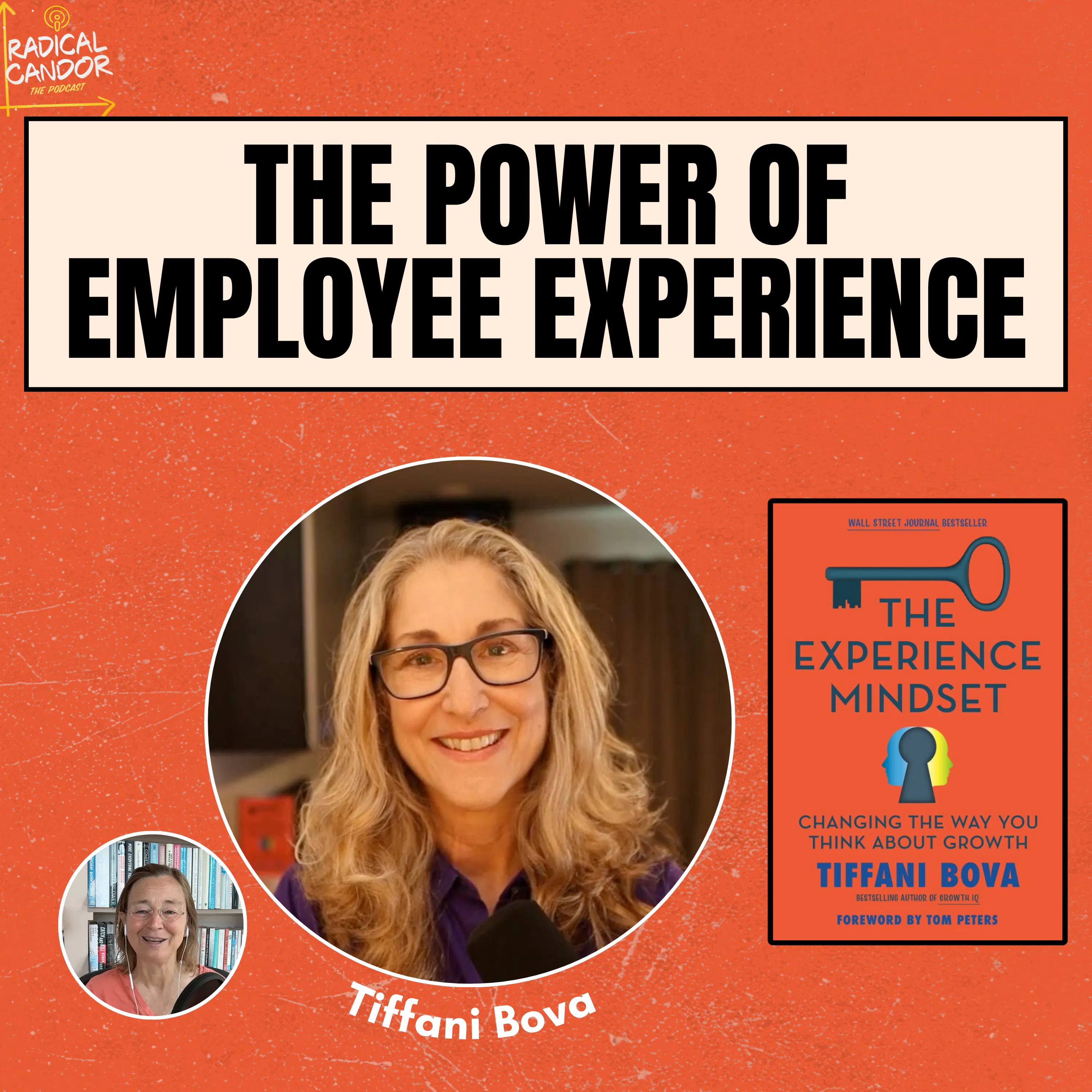
Fixing the Employee Experience (with Tiffani Bova)
Get every episode summarized
Each time Radical Candor: Communication at Work publishes, we email you a written briefing from the transcript — the topics, who appeared, and any specific claims, with the ad reads skipped.
Email me new episodesFree for 3 shows. No card needed.
About this episode
“If you are entering any technology conversation with, I'm going to do more with less versus saying, how do I use tech to allow me to the art of the possible and to do what I'm doing now differently, either more effectively or give me that scale I need or open…”From the transcript
Get every episode summarized
Each time Radical Candor: Communication at Work publishes, we email you a written briefing from the transcript — the topics, who appeared, and any specific claims, with the ad reads skipped.
Email me new episodesFree for 3 shows. No card needed.
Hosts & guests

Transcript ready
1,414 searchable segments. Every word is indexed and playable.
Full transcript
Radical Candor: Communication at Work — Fixing the Employee Experience (with Tiffani Bova). Machine-transcribed; use the interactive transcript above to jump the player to any line.
If you are entering any technology conversation with, I'm going to do more with less versus saying, how do I use tech to allow me to the art of the possible and to do what I'm doing now differently, either more effectively or give me that scale I need or open up freedom for creativity in my teams. Like it has to be something like that. And I think that's where people are like, sounds great on a bumper sticker, but I need true ROI to get people to invest in this technology. And if I'm going to spend X, I need Y back. And it's like not everything in the business has that direct line ROI because it's not possible. Hello everybody and welcome to the Radical sabbatical. I am Kim Scott. And while the rest of the Radical Canter team is on sabbatical, I am talking to the authors of the books that have meant a lot to me. And I'm thrilled to have today Tiffany Bova,
author of the Experience Mindset. I love your book Tiffany. So welcome. I feel like if everybody can put the ideas in your book in the place, it's not just that their companies will be more successful. You've solved all the world's problems with this book. I don't think so. But it's a big book. I solved some of my own. I solved some of my own. How about that? All right, for those of you who don't know Tiffany, Tiffany has spent nearly 30 years inside some of the biggest evolutions in tech. As Fale, Sales Forces, Former Growth and Innovation of Angelist, Research Fellow at Gartner, and now Chief Strategy and Research Officer at Future Up Group. So thrilled to be here with you talking about your book. One of my favorite parts of your book is how you open it. I mean, you've written more than one book, but today we're talking about the experience mindset. But one of the things that I really love
is that you offer yourself some critical feedback as you open up the experience mindset about how you fail to write as much in the past as you wish you had about the impact of the employee experience on the customer experience. So say more about that. Yeah, I was radically honest with myself. Yes, you're radically candid with myself. It was self-awareness and radically candid simultaneously. So my first book, Growth IQ, was sort of like a culmination of my practitioner operational experience, right? Running sales, marketing, and service, in tech. Then 10 years at Gartner, right? Advising, start it all, the way to the largest, you know, number one largest tech company in the world. And I felt like I had a good handle, right? To put it mildly. I felt like I had a good handle on it. I never believed I knew everything. I mean, obviously, but I felt like I had a good handle on it. And I really spent time on what are the buckets of ways to grow? And after thousands of conversations and literally, right?
You know, over the course of a decade, I felt like I'd landed on the 10. And the very first one was customer experience. It was like, I was part of the team that made the prediction that the CMO would spend more on tech than the CIO back in 2008. And when we said that, everyone thought we were crazy. And you are Microsoft, Salesforce, SAP Oracle. Others all went out and bought technology companies to get their hands on that marketing spend that CMOs were now going to be spending. And it was not for technology. It was really about this customer experience, right? And so I was all in. Like, yeah, this is it. So it was my number one path. I started there, right? The whole nine yards. And then I started working at Salesforce. And then I was standing on stage one day. And I said, I didn't think it was a coincidence that at the time when I say we, right, at the time, we were one of the best places to work globally, one of the most innovative companies in the world and the fastest growing enterprise software company. Right. I didn't think that was a coincidence.
So I went to our CMO and I said, could I prove this? And that sort of put me down this path of all the research we did for experienced mindset. Well, now I'm like three months, four months into it. And I'm like, oh my God, right? I go back to growth, I do. And I'm like, let me just do a quick search. How many times did I say the word employee? And I'm like, walk, walk. You know what I mean? Not as many as you would wish. Not as many as I thought I should have had, considering I thought I had it nailed. So this was kind of a meoculpa. I had no intention, as you know, Kim, like to write another book. It was not like on my bucket list. Yeah. And then I found myself with this information and I said, I would be remiss that I needed to go back and do this meoculpa. So that was the story of the self-reflection of, this is kind of the 11th path that I didn't write in the first book. Yeah. Right, right. And you have such a good, you have such a, I love a good framework. And you have a great framework at the core of your book, showing sort of how people process technology and culture
all combine to create this experience mindset. So let's just, let's walk through it. Let's start with people. You have this incredible stat that, of course, caught my eye. 87% of executives don't know what to do with the employee feedback that they collect. And employees who give feedback that goes nowhere conclude that their executives don't listen or don't care or both. So what is going on? Yeah, so let me qualify a little bit. I am not a people expert. So I look at people in a very specific lens, at the moment that matters when a employee touches a customer in some way. Right. Like the obvious or sales marketing service, right? But it could be a web designer, because you're touching a customer via a digital website or an app. It could be the packaging team that builds the package for a product you've built. Like that all touches a customer. So don't just think customer facing.
So I focused on that moment that matters. So now let me go back, right? To what you just asked. That you are correct. That people feel like leaders feel like when they do these surveys, that they're satisfying, that well, we do a survey. Yeah. Like, and they tell us and I'm like, OK, well, what did you do with that? What did you do with it? And I was shocked at the answer. But then I always, and I used this in the book. I used it in both books, actually. I used the undercover boss television show as just my reality check. Yeah. That there is a perfect live example of. Right. I'm guessing they all do surveys. And I'm sure that their employees are telling them these things. And so people want to feel heard. They want to feel like their opinion matters. They want to feel like ideas can come from anywhere. And I think this was my way of showing these very illuminating statistics from the research. And this was global, by the way, far less of size and region and industry. So this is not just a US thing or a Europe thing,
or it was global. Some countries were better than others. But for the mean, it was not a good look. Yes. I love the undercover CEO. So explain for folks who are not familiar. What happened in that story? Undercover boss is a US show and a UK show. And I don't know if it's in Canada and other places. But I know it's in the US and the UK. And the whole concept is a CEO does something shocking. Yeah. Leave their office. And they wander amongst the people. Yes. In the wild. Yeah. And they experience the truth. First, they are at the edges. Yes. Everything happens at the edge. Yeah. Growth happens. Think about a iceberg. Growth happens at the edge. It melts at the edge. Yes. So the edge is the people, the front lines, that could be, depending on how big you are, they could be 100 levels below the CEO. They could be two levels below the CEO. But as companies get bigger, leaders get further and further away from the edge.
And so undercover boss does this. They put on a disguise of the CEO in the first three or four minutes of very expensive prime time US television. And I'm like, it's such a waste because no one would recognize them anyway, because they never leave their office. Right. But the whole concept is that they go out and talk to the people. They mop the floors and clean the toilets and empty the trash and use the technology and use the app and organize the utility closet and go through the inventory. And they do all these things that they probably have never done. Now some CEOs have moved up the ranks like through the company over decades. That's less common today. Right? Yeah. So normally people are bouncing around. And once they get to leadership, they rarely go back down. Right? Yeah. So for me, I think the management by wandering around, which is Tom Peters in search of excellence. And also Abraham Lincoln, I think, was a little bit as well. And Tom used it from Bill Hewitt, from Hewitt Packard.
Like that he would go to the manufacturing plant. So you hear Ford say those things. Costco, Southwest, where these CEOs are like always out. They're out. Right? And so it sends multiple messages. I get to have a conversation with the CEO. They heard me. They listened and maybe even actioned something that was my suggestion. I'm all in. Like when times get tough and they ask me to buckle up and work a little longer or pick up an extra shift, I'm in. I'm committed. I'm aligned. I believe you had me at hello. Right? Yeah. Yeah. It's so good. It's really interesting. One of the things that I, when I was at Google that I would struggle to do is make sure that I was still answering customer. But I managed a team that did a lot of things. But chief among them was customer support work. That I was actually answering some tickets. And that was important because I, then when people came to me with suggestions,
understood why it mattered. Because I had struggled with. So when somebody came to me and said, we need programmable keypads. I understood why they needed programmable keypads. But the other thing that happened when I did that was that somebody came up to me and very kindly and gently said, Kim, you know, wish you'd quit grabbing tickets because you're not doing a good job answering them. And you're hurting my, you know, you're hurting my customer satisfaction metrics. And so it's important, I think, to go in and be humble. But to figure out what would you have advised me in that situation, like, should I stop doing the tickets? Should I have my own keypads? I would almost take it as a learning moment. So let's just say you were a regular employee and the answers weren't very good. Yeah. Like, what is the problem? So I would go, okay, I hear you, thank you. Yeah. What is my way forward?
Like, what would be, if I were, and you know, this were my job, right? Because clearly you were jumping in, which I love. But it wasn't your day job. I agree that it has value. But then you could have said, so what would that, what would happen if I were, this was my job? Yes. And quality was low. What's the next step? Like, do you put me through a training? Do I have to shadow people? Like, let me do that. Yes. So you just kind of keep going down the process, which I think goes back to this. How would a leader know if you just stop doing it? Yeah. Then what you've just said is if someone isn't doing a good job, the company would just fire them. Yeah. Maybe that is, in fact, true, I don't know, right? But the point being that you would have learned more had you said, tell me more. How can I get better? Like, what can I do? Yeah. And then I could have learned about the training. Correct. But how do you, because it's like that, these things are very rarely common sense. You need to learn how to answer the questions correctly.
Yup. You need training. And so let's talk for a minute about training. You have one of the quotes that you have that I love is some leader will say, well, what if I pay to train them and then they leave? And what is your response to that? What if you don't train them and they stay? Yes. Exactly. Yeah. That is the right answer, because they're not doing as good a job as they could be doing if you would invest in them. Well, just like your example. Yeah. Like, I wasn't, I was, I was very well-meaning. But I wasn't doing a good job answering the questions, because I hadn't been properly trained. OK. So you could have kept going and provided really bad customer service. Yeah. Or I could have gotten trained. Or you could have gotten trained, right? And now you could, they could say, well, we want to hire people that are already trained. It's like, OK, well, you might be able to hire a customer service rep from another company. And then you're hiring them for a customer service role
in your company. But that doesn't mean they're going to do a good job in your company. Yeah. They didn't know the antents product. Like, you have to learn it. You have to learn it, right? And you don't know our systems. And you don't know our processes. You don't know our escalations and our approvals. And you don't know our billing system. Whatever, it is not the same. And they don't know your customers. Yes. Yeah. Yeah. Right? And so that needs all that needs to be trained. All that needs to be trained. And when I was selling technology, I will tell you that was, I was just having this conversation with someone. That was the number one budget line item that it would get cut when we were selling very large technology transformations. Could be million dollar, like some software, right, for the legal industry or some, you know, this is back in the late 90s, early 2000s. We were selling things. And I was selling multi-million dollar projects or half a million dollar projects. And then it might be 50,000 to 200,000 in training that would always get cut. Yes. And then they would come back to me and be like,
gosh, we're just not seeing the ROI. You know, Tiffany, everything you said that our attorneys or whatever would be able to do, they're not doing. I'm like, we'll have they been trained. Well, yeah, we gave them a half an hour lunch and learn. I'm like, OK, you've just asked them to completely change the way they work. They've manually tracked hours for some of them decades. And now you're telling them to push in their phone, the client number, and it will track how much time they were on the phone. And then they need to do something else. And you're trying to change your behavior. And while you're now recouping all this extra money, they don't know how to do it. Or they forget how to do it. Or their secretary does it. Yes. Their illegal does it. So you know what I mean? Like I give that as a dramatic example. But it is an area where the people training is one aspect. But I would tell you also one of the stats in there that worried me was when people get hired and they're told sort of what the environment is like. And then they join in their like in the first 30 days.
It's like, this is not what I thought it was going to be. I haven't been set up for success. Yeah. Yeah. And most executives think they've invested enough in employee training, or at least half of them. Actually, let's pause. I think you said 52% of executives think they've invested enough in employee training, which is pretty bad, actually. That means like what are those other 48% who know they're not doing the right thing? Why aren't they doing it? But only 36% of employees think that their company has invested enough. Like how is this happening? Well, L&D needs, we need like L&D of the world unite. Well, I agree. And I, you know, again, staying in my lane, we looked at the top disconnects between employees and execs. And this was one. There was outdated technology, there was broken process, like there was a bunch of stuff. But this is one. And so let's go back to where we started the survey.
Like let's just say that they're saying, do you feel like you have, I'm sure the question is something like, do you feel like you have what you need to do your job? Yes or no? Right? Let's just say. And so they come back and say no. And let's just say half say no. Who's responsible to go back and fix the problem? And identify what is the problem? Because sales might have a different no than customer service, than finance, than legal, then the supply chain people, the manufacturer. Everybody might have a different no. And so one would argue HR is the place. But I think in the research as well, nobody owns employee experience. So this is not just an HR issue. No. And it can't be. That would be a dramatic over-delegation to HR. I say this is an HR situation. I feel like the, I mean, I think that the employee surveys, they're like fire alarms, but they're not the fire department. They're going to tell you there's a problem. But you've still got to send people in to put the fire out. And the survey is not going to do that by itself.
Yeah, one of the examples I gave in the book that I love, Michelle Romano is a, she's a dragon on Dragon's Den Canada, which is a US shark tank version. Yes. Yeah. And so she had a company, she's a double unicorn. So she's built a $21 billion businesses. And she did it before the age of 40. I think it's before the age of 35. If we really want to feel under shevers, yes. OK. Anyway, it was in a heavily regulated industry. And she started to feel like her culture, her people, she had made a couple acquisitions. And she felt like it was kind of getting away from her. So she's like, you know, I could go out and do this massive study and hire a consulting firm where I could do a, you know, a employee survey. And five months later, we would have that. You know, she's like, yeah, I'm not going to do that. And so if you have children in your car and you're listening to this podcast, you know, cover their ears or turn this down. But what she said was she set up a mailbox, an email box that's too big shit we do at.
Yes. And her company name. Yeah. And so it was like 110 employees. And so she said the four executive, we are going to focus on this. We're going to say on Friday, we don't want one thing from every person. Yeah. And so they did. They got 110 responses. OK. Then they put them in buckets. What's a fire drill that we can fix right now? And we have to fix. What is not a total fire drill, but we need to fix it in the next 30 days. What is a nice to fix when we have a little bit of time? And what is a good to know can't fix? Yeah. And the good to know and can't fix was we're highly regulated. We can't do what you want us to do to eliminate three steps, because we have to get that data or whatever. OK. And then the fire drill, like someone was assigned. And then she said in two weeks, we're going to have an all company meeting. And so two weeks later, that in all company meeting and they showed, here's the 110 things. 30 of them are already fixed. 30 of them are amazing. You know what I mean? 30 of them are fixed in the next whatever, two weeks. These 20 will not be fixed. And here's why in these five, we're going to put later.
Now what did that do? I can only imagine everybody was so happy. Like, I'm sure it also was really good for business. But the first thing it did was it made people feel happy. Like, because dealing with stupid shit, it's like getting stuck in traffic. It's very, it's bad for morale. It's waste of time stuff, right? Yeah. And it's frustrating and it's not necessary. So it plays in both the people and culture aspect of this that, okay, they asked, we answered, they actioned. Yeah. It was a long way, right? And then if they're not going to do it, then they told us why? I might not like that I still have to do it. But now at least I understand why I'm doing it. Yeah, right? Why we're not fixing it. Yeah. Yeah. We did a version of this when I worked at Google. We took the bug tracking system and we turned it into a management tracking, a management bug. And so he said, everything that is irritating in your day, file a bug. And these are, you know, maybe the systems and maybe the processes and maybe stuff your
managers asking you to do. Like, we want to fix these. And I'll never forget there was one young employee who described what he had to do to go to the bathroom like to get somebody to cover for him when he went, it was ridiculous. And I remember my boss, she sort of clouched her head and she said, oh my God, I'm so sorry, you know. And she assigned somebody to fix it. But I think becoming aware of the stuff that people are doing that is idiotic, that you have asked them to do it. You may not be aware, but it's your job to become aware, I think, as a leader. Well, and, you know, very radical candor. Like, you also have to be able to, somebody to say, like this process sucks. Yes. Like, you have to create a car. Yeah. Right? Yes. Yeah.
Like, my, you know, my hair is on fire every day. I, like, I waste at least four hours of my eight hour work day looking for data or switching between apps or chasing someone for a signature or trying to go to the bathroom. Right? Yeah. I got to go. Yeah. It is, it's really, it's really important. There's a, there's a company called Joyus in New Zealand. It's a New Zealand based company. And they, they have created a system that kind of does what that bug tracking system, the manager fix it week does. And they were working with a, a large telecom company. And the people who worked in the, who drove the vans out to fix the lines, the, you know, your, without to fix your internet, there was a, there was a wrench that was consistently missing in the van. So the person would drive out. And if this particular wrench was an in van, they had to drive back and get it.
And it was like a, it was stupid. You know, when it was irritating for the customers who was irritating for the guys driving the vans or the people driving the vans, and it was, it was expensive. Yep. And yet somehow the, this complaint didn't get fixed until they implemented this joyous system. So I'm a huge believer in figuring out what are you going to do as a leader to encourage people to complain? That's what you're really talking about. Yeah. And I think again, I think look, the, the people process technology or P P T as is it is known is not a Tiffany Bova thing. Yeah. It's been around since the 60s. I borrowed it and added culture. Right. Because I think people in culture in today's world, also given where I was working at the time. I saw the difference between the two. Like the people create, you know, the company. And the framework by which we were working in that was absolutely the culture.
And people would ask us all the time, like how do you, how do we do what you do as it relates to the culture that you fostered that has speed and innovation and growth and that mindset and all of those things? So that is why I separated it because I think they are two different motions. Yeah. Although sticking before we move on to process, one last thing on the people thing, which is management training. Most new managers are not bad people. They're good people, but they're often bad managers because they get no, nobody teaches them what the job entails. And so, so you, you talk in your book about the lack of management training and the problem there is when you throw a manager into the deep end to see if they're going to sink or swim. If they sink, that's bad, but they also drag a whole team of people down with them. It's incredibly demoralizing and expensive. And yet companies will not invest.
Even the companies I know that really do a lot of investment. That means they reserve a day and a half to teach new managers. It gets, it's madness. So anyway, here's for investing in real people, training people how to be good managers. We'll make a difference. Yeah, well, I use myself. So the reward for being a high performing seller is you get a promotion. Yeah. To management. Yeah. And nobody tells you what that means. And I was horrible. Yeah, me too. That's why I wrote the book. I was horrible. And, but, and I wasn't self aware at the time to know I was horrible. In looking back, I realized I was horrible, right? But my manager realized I needed some executive education. And so I went and did an award and executive program and blah, blah, blah. So that helped me be able to sit at the, you know, at the executive table and talk to a board. Yeah. So that was greatly helpful for me. And I never would have done that on my own.
Obviously, it was too expensive at the time for me to do that. Yeah. So I would say that, that, a Gallup just, it was, it's been after my book. So it was maybe a couple of months ago where Gallup, you know, it tracks employee satisfaction. And the biggest dip was in management, in middle management was the biggest dip. And so that was the biggest dip, which then is you start to see middle managers dip. You start to see the rest of the workforce dip. And so it's like two quarters before the workforce sees it, the managers start in, you know, the famous quote, right? People don't leave companies. They leave managers. And is it really the managers fault? You know, or usually not trained. Usually not. I'm doing the best I can with what I know. And I, you know, but I don't know how to deal with conflict resolution or give someone radical candor or, yeah, or create a psychologically safe environment where all the little buzz things we all talk about. Yeah. Yeah. Unless they meet Kim Scott and read her book and listen to this podcast and go on their own self journey. No one is holding their hand. Yeah.
I mean, I think one of the, one of the best moments of my whole career came, I, I'd given a radical candor talk at a company and a young woman came up to me and she said, I became a manager a year ago. And she said, and it was really hard. And it's kind of her eyes filled with tears. I could tell it had been because it is very hard. It's a hard, it's a hard thing. And, and she said, and I read your book and it made me feel like, you know, it was a lifeline. And that's why I wrote the book because it's the book I wish I had had when I became a manager and kept making all these terrible mistakes that I didn't, you know, and tend to hurt people, but I did. I hurt people. So anyway, here's for self education. If your company's not educating you, but let's encourage companies to do this. All right. So now that's the people. There's infinitely more things to be said about people. But let's talk about process because you have so many great anecdotes about process
going. All right. What's the one thing people need to think about when they are fixing their processes? I want to start with some people hate the conversation of process period. Like, yes. Yeah. I love a good process that doesn't, because process doesn't need to mean bureaucracy. A process can be the source of freedom. Correct. Correct. Yeah. But it's usually viewed as the former, right? Yes. And then you see red tape or micromanaging or something like that, where the process is, I'm at starting here. Mm-hmm. Where let's go back to calls, right? Customer calls has a problem. All the way to resolution. What's the process? Yeah. Right. And people journey map and map processes and all that. But sometimes organizations will change something in isolation and it adds another step or two or three or ten to someone else's process and they never understand the unintended consequence of that change.
Yes. And so a lot of this falls in the fact that even midsize and sort of smaller on the enterprise side don't have change management teams, groups, a change management office. No one is watching. Like there's not a project management office, change management office. And you might go, oh, more bureaucracy, more layers. And it's like, it's actually to eliminate that bureaucracy and get rid of layers. So that things aren't just added. Like what happened in the Michalronov example was in the acquisitions, they just bolted on the new processes on top of existing processes. And because it was faster and they didn't have the time and the integration and all that. So it wasn't intentional, but then it landed in something that used to take four steps, it's taking nine steps and no one knew it, right? Yeah. And the process is also the human. I have to do something. I have a job, how easy, how much time, how quickly can I do it? What is my distraction? What is my level of comfort and understanding? And so it is very hard as an individual contributor to improve the processes of your
day to day life. Yeah. You have to live with them. And that's demoralizing. Unless, right? You can go and say, listen, I open and close a ticket. 100 times a day. And I have to do these three things. In my next one, I'm one with my manager. I'm going to raise the idea of if we could just eliminate this and this, like it might be better. So again, from post it notes, which were created by somebody way on the edge, right? A secretary. Yeah. Not even an executive assistant, a secretary, right? Right. We're dating this. Right. And then all the way to someone actually saying, I think there's a product here or I think there's a way to do it better here because I'm in it all day every day. And that is also out of undercover boss because what happens out of that is that individual employee, the manager or the leader, right, goes, I want you to run this because no one knows this better than you. And you'll understand you have empathy for the role. And there's a perfect example of that idea bubbled up.
Unless you're on undercover boss, how do you create that environment for process reengineering and rethinking and ideas to foster in a way that isn't distracting, right? Because if you're in a large company, you could get a thousand ideas a day and some of them are a waste of time. And there might be a diamond in the rough that would really open up and unlock freedom and more focus on the things that are more complex and humans can do. And now with AI, you can find those broken processes so much easier, right? And you can help empower people to fix the processes on their own. Yes, yeah. I think that it's so important. There was one point in my career where so many people were coming to me with these bright ideas. I was a leader of a couple hundred person team, a lot of young, energetic people. They kept coming to me with these process ideas, but they kept assigning me the work of fixing everything. And I'm just one person. I couldn't keep up with all these bright ideas.
And so I had this, and I found that I was starting to sort of be a downer. I was starting to push them away. And I realized I needed to create a process around our process. And there was an ideas team that would solicit ideas from people and stack rank them sort of like you were describing PZRO, P1, P2. And say we're going to do these, we're not going to do these, but they would explain why that ideas weren't going to happen. And they could assign me work. They could assign me action items, but only five or ten action items a week, not five hundred. Because I think one of the things with process is that you've got to push the decision about how to fix these processes into the facts. You'll burn out if you're leading a big team. There's a million little things. And that's where I think really sustainable competitive advantage comes from is these lot of little fixed tweaks to process. Yeah, but again, go back to what if we don't train them and they stay?
Yes. What if we don't pay attention to these processes? Because I will tell you, I don't know about you, but in any given week, I at least one time, like I'm not going to make this at least ten times, but at least one time I hear I'm trying to increase productivity by people. Yeah, at least one time. And I'm sort of saying that to just be a little funny, right? Yeah, it's more than once. But give me at least not zero. Yeah. Okay. All right. So if everyone is hyper focused on more productivity of people, now that we're on people in process, right? Then if you train them more, they're going to be more productive. If you eliminate unnecessary steps, they're going to be more productive. They're going to do the things that actually have higher impact. So instead of looking at AI and technology as a way to get more productivity, like that in isolation, hence why I have PPPTC, right? Yes. You cannot just say tech is going to fix it because the people and the processes have to follow the tech. So people are trained and you have the right processes and you're not bolting one more
thing on top of ten, you're saying if we do this, we're going to eliminate three. Yeah. But what comes off the plate when you add on the plate? Like just that one simple question. You want me to do this, you know, manager, leader, whatever. What am I taking off my plate? What am I not going to do? Yes. What am I not going to do? Yeah. I'm already working full time. Yeah. I feel like process. It's a little bit like barnacles on a ship. And so you need to scrape them off every so often if you're going to, if the ship is going to go faster, you don't want the process to expand. You want it to shrink. Yeah. There was a, take some discipline. There was a stat in the book that it's dated now, but it was from Bane. And I'm going to get the numbers wrong because I'm doing it from memory. But it was like one stat was for companies under five billion and one stat was for companies over five billion. So obviously, very big organizations. Yeah. Yeah. But it was somewhere in the range of the 90% of the reason companies find it harder to grow is internal inertia, bureaucracy, right? The barnacles are on the ship.
The barnacles, right? The barnacles. So it will slow you down. Yeah. Yeah. Unless you use technology to automate it. I love what you said about the use of technology to improve your process because what are we going to stop doing before we think about what we should automate? What can we just stop doing? Seems like an important question to ask. Otherwise, you're kind of paving the cow paths. You're automating things that you can just stop doing. Yes. Yes. So I think that's why change management is important. And that's why this is very much a marketing thing and you're probably, for those of you who will hear this, you might roll your eyes. But journey mapping processes is really powerful. Yes. Like the guy for the bathroom. Here's the nine things I have to do to go to the bathroom. Instead of, if he just walked up to someone and said, look, I really need you. Can you cover me? I got a pee. Can you cover me? I got a pee. Right? Yeah. I've been looking for someone for an hour.
Right? Right? Yeah. Right. I am going to write down the nine things I have to do to actually go to the bathroom. Right. Okay. And then someone goes, okay, well, let's eliminate to the point, Kim. Right? Let's eliminate that. Let's streamline this. This is ridiculous. Yeah. But someone may not know the process. Yeah. So the first thing, if you're listening to this and you're like, oh my god, I hear myself in this story. Yeah. You do something all day every day. If you mapped out step one to step 95, whatever it is, like I was working with a client in Canada, it took him 22 minutes to do a return. Okay? Over the phone. And so that's three an hour. That's 24 in a shift. Okay? It's like, do you think that percussive wakes up every day because of my god, I can't wait. I'm going to do 24 returns today. It's going to be a killer day. I'm so excited. Yeah. No. So we journey mapped it and of course took it down to like three or four minutes. And now you get more productivity.
The person doesn't feel like here's another return. It's not because they don't do returns. It's a call center. So it's not always a return. They're doing a bunch of different things. They're doing a bunch of things, but I'm being, you know, trying to be specific. So, you know, in this case, and no one had any idea. So you're asking for more productivity. Mm-hmm. It's a very metric driven role. Yeah. How many calls? How many heads? How much time on the phone? Add heads, like, you know what I mean? I mean, it was a very metric driven business. Yes. And so if you can get and improve those processes in other parts of your business, getting a product out the door, getting a bill out the door, getting an RFP out the door, closing your books, like getting a contract done, like we could go through. Everything is time. Yep. Yeah. And I think also, everything is time, but there's also growth. The unlock here is growth, like, yes. Because if you tell your people, okay, we want you to be more productive so that we can fire half of you. Like, that does not create a great percent. Correct. Right. So you want to say, if you can say 50% of your time, I'm going to give you time to do
work that has meaning for you. That's more interesting. That's going to help you grow in your career. And that's going to help this business grow. I think you've got to make sure that you're aligning the incentives correctly. Yeah. And I'm going to do my best, also not in the book, but I was doing something in the call center and automating. And it was like a good, again, I'm making this up. I'm directly correct. It was like a thousand people in the call center. Yep. We're either going to let you all go. Oh, wow. Or we're going to re-skill you to a new product offering where you will now be these virtual designers for Ikea stuff. Wow. So they did. That's amazing. And they've now, it's now almost a billion dollar business. Wow. Yeah. That's what you want to do for people is you want to say, we're going to teach you something new. Or you're going to better yet, you're going to teach us something new. What you want to be doing. What? Because you want to push the decisions about what people should be doing into their data
that they know what they should be doing better than you do if you're eight steps away from what they're actually doing. Yeah. And it's just a great, it's a once in a lifetime example. If only everyone would do that. Right? Yes. That had the culture that that's what they were going to do. A Lego or an Ikea or a West or there is very specific brands and examples and cultures and things like that. But I would say if you are just automating to reduce heads, I'm not a fan of it. Yeah, I'm not a fan either because you're not going to get the bet. I mean, you're not going to do a good job because what you're doing in that situation is you're creating every incentive for people to throw wrenches into the gears. People are rational actors. Why am I going to help you fire all the person to my left and the person to my right? Yeah, I'm not going to do that. But if you're going to help us do something new and interesting with our careers, yes. And stop doing this brain dead process that you have in mind.
Yes. And I think that technology and automation really has the potential, especially now with AI, it has the potential to allow people to automate the routine, boring, tedious work that they don't want to do, allowing them to do work that is interesting to them, that has real meaning to them, that is going to help them grow or is just more fun. But only I think in your book, you had the stat that 33% of employees agree that their company automates routine work and 50% of the C suite agree with that. Again, the gap is enormous, but also like those other 48% of the C suite, like what are you all doing? Why are you not automatically? You're pretty consistently across all the stats. It was 50% or north thereof of leaders not having the right insight, right? Yes. But only part of the story, let me say part of the story, because it's not the employees
are 100% right in the executive. It's somewhere in the middle, right? But I think that the gap between the two, that is a communication problem, that is a leadership problem, that is a transparency problem. That is all the things we all talk about, right? That is what leadership is about. Even if it's not good news, you should be able to stand up there and go look, I know that this feels very heavy and you have to do it. This is why people are like, okay, it's like when you're a kid. You have to take out the trash, do the dishes, whatever. And you're like, you know, and then you sort of say why? Because you know, mom or dad, I have to put the baby down and it would really help me. Okay, now I understand. Now, kids are a little different. They don't understand everything. You know, the way we, well, it depends. But the way we are is adult. They understand a lot. But you know, ultimately at the end, people just kind of want to know the why and they want to know the how and they want to know what they need to do. You know? And also what's in it for them. Yeah. It has to be something in it for them. TPM, Toyota's process manufacturing was so good about this, about using technology and
process to help people encourage frontline workers to say this is broken. It's annoying, it's expensive. And I think as we move forward with AI, we've got to take much more of a TPM approach and much less of a tailorism. You know, I'm going to watch you work and clock it. How long it? What are some of the things that you're seeing that companies are doing that are really helping people say this, you know, this is how I used AI and it was a triumph and this is how I used AI and it was a disaster and let's have more triumphs and less disasters? Yeah, and I think tech is just so woven into everything. You know, I think when you and I started, it was not as woven in as it is today. And now it's just ubiquitous, right? Yeah. In every part of the globe, right? I mean, there's the joke that there's more cell phones on the planet than toothbrushes. I mean, it is, yeah. It is, they are, it is everywhere. Yeah. So, you know, ultimately, I think that I am a fan of tech and human, not tech alone, not
human alone, but the marrying of the two. And I think AI has accelerated a conversation around what humans want to do and what tech should be doing versus, you know, kind of overall. And I don't know necessarily when you layer AI in, it can be super disruptive, if not sort of guardrailed, right? Yes. Yeah. And it can be super effective if done right. Yeah. Yeah. So, you know, some of this is, who is making those decisions? Is it the CEO? Yeah. CEO, is it somebody who's like in the process learning team? Like, yeah. Let's pick a place. And so, you see these use cases of call center processes, sales, marketing. You see these use cases where, you know, they deploy it in a very specific function. It gives improved productivity. You see the lift and they start to expand and start to expand.
You don't hear like Ford just recently had like let go of all these people because they had done AI and then they rehired them back. It was like 10 months later. Yeah. And some of that was institutional knowledge that the people had that AI did not. Yeah. And, you know, and what is the balance between the two? So, you know, this is a, if you are entering any technology conversation with, I'm going to do more with less versus saying, how do I use tech to allow me to the art of the possible and to do what I'm doing now differently? Yeah. You know, more effectively or, you know, give me that scale I need or open up freedom for creativity in my teams. Like, it has to be something like that. Yes. And I think that's where people are like sounds great on a, you know, bumper sticker. But I need true ROI to get people to invest in this technology. And if I'm going to spend X, I need Y back. Yeah. And it's like not everything in the business has that direct line ROI. Yeah. Because it's not possible.
Yeah. It's easy in the front line because it's how many calls, how many tickets, how many sales, how many churn, you know, how much, what's the average sales price, what's the cat, what's that mean? All that stuff is very metric driven. The rest of the organization is not quite so metric driven. And so, you know, what are you really trying to improve? And I think overall, this is a step from Mulesoft that there's like 970 average on enterprise, 970 unique applications in the four walls of an enterprise. Wow. OK, at 970. Yeah. OK. Oh my god. You know, some of it is only like in manufacturing or legal. You know what I mean? So everyone has their own. But if you collectively, it could be one person has one tool, right? So yeah. OK. And only like 26 or 27% of them are integrated. Wow. OK. So that means as a human, I'm switching between multiple applications all day every day. And it's like 2.2 seconds, 0.2 of a millisecond, right, of time for you to switch.
If you go from tab to tab, and if I ask people, if I could see them, I'd be like, how many apps do you need to do your job? Less than five, no hands go up. Five to 10, some hands go up. More than 10, the majority of the room. And then I ask how many tabs do you have open and everyone laughs? Yeah. Right? It's like 100. And then you go, OK, how much time do you actually waste only switching between apps? And this was an HBR study. It was like five weeks of time. Switching between apps. Yeah. And it's like the, I forgot who the writer was, but the mail, the mailman came and rang the doorbell in it, like destroyed a day's worth of productivity. Sometimes like switching between apps, contact switching is real. And so even you know a Slack message, an email, a phone call, a Zoom. Yeah. We rarely carve out time to sit and think or do work. You're sort of doing it in between this, you know, and so late at night when you should be sleeping. Yes. So tech is either a big distractor or it could be a big enabler.
And I think that that's where we've gotten too far away. And I worry that there's a lot of course correction needed in that particular bloat category of to do my job. I need seven apps. Yeah. And also I think there's this desire to like centralizing control it. Whereas what you really need is for people to say, here's how, here's, here's this one little thing that I'm going to automate. And it's going to be hard to figure out how what, what the ROI is on that. If you have thousands of employees who like their job better because they've been able to use AI to automate something that's irritating, that's going to add up to a much better employee experience. Absolutely. And I, you know, I was one of the guys on my team. We do, you know, calls with clients all the time. And at the end of the call, you know, we want to sort of send a, hey, thank you for your time. And here's what we talked about. You know, here's some, just want to recap sort of some of the advice I gave in.
Here's some research we think this is for clients. Okay. Right. And so that takes, call it 10 minutes. Yeah. 15. And if they do four to six of those a day, you know, do they have an hour and a half to do these fall? And so the time it happens at the end of the day, then they forget the 8 AM call they had. Yeah. So he created a script, right, using co-work and absolutely it takes the recording of the call, summarizes, drafts the email, drops it into his Gmail draft folder. The end of the day, he has like seven drafts and he could just go in and then he puts his voice on it. He can revise that. Yeah. He can clean it up a little bit and hit send. So you just asked the question, right? What can you do and what's working, not working? And so then I had him tell us at the team meeting. So like the rest of the team is like, I want to do that. And then everybody's on the other side. And the script, right? Yeah. They use the script, right? Then someone else is like, I have it scan my calendar on a Monday and it goes through client meetings and it helps me get prepared. Here's the last three things you talked about. Right.
You would need 10 minutes or 15 minutes to prep for every call and now it's pushing to you. And so I want that script. So and then people can share these skills. People can share it, right? And so, but it by the way, I have 10 very smart people who can do these scripts and can do these skills and could do on their own in isolation. And I could have 10 people running in 10 different directions. Yeah. Coordinating them has been difficult, right? Because they all are the smartest, you know, at what they're doing. And it's, and I'm like, look, it's not about that yours is I need a standardized way we do that. And I need a standardized way we do this. So that there's one skill and we're all doing the same thing because if someone subs in for you for something and they get something totally different or they get nothing, then it's not a great experience, right? If they've come to expect from him that they get this and then they talk to one of you and you don't do that, they're like, wait a minute. Why am I not getting that? Right? So, you know, it really is about that leaning into that experience.
Yeah. I think AI is giving employees, bionic arms and legs, but that means when they jump, they better jump in the same direction because they don't, they're going to pull each other apart. That's right. All right. Last but not least, culture, culture. How can leaders create a better culture for their employees? Yeah. And I'm going to go back to what I said at the beginning, like I had no idea the true power of culture until I worked at Salesforce. It's you and I met when I was working at Salesforce. And it was a leadership offsite. We were in Palm Springs. I remember it well. And you gave a radical candor presentation and I ran up to you after and I'm like, I want to know you. Like, let's get to know each other. You had me on your podcast. Yes, I asked. And then I had you on my podcast and here we are. It's probably been 10 years now. But that was, like, I think that was my second month. And the presentation the next day blew my mind, right?
Just like, this is not, you know, I'm not in Kansas anymore. You don't even kind of a, yeah, okay, wow, right? And just the way, you know, 60,000, 50,000, 40,000 people can move very quickly as everything to do with culture. Yeah. Like, yeah. Right? And so I was like, I had a front row seat. I never would have included it had I not had that front row seat. Yeah. Right? One of the main things in my role there was people would come and want to know how did we do our V2 moms, which is the way in which Mark started the company, bending off our CEO, started the company and it became the framework for culture. So it's V, the number two, and then MOM. So it's vision and values. Those are the two V's. And then methods, obstacle and metrics. That is V2 mom. He would do his and then it would and he would do the companies. And it would cascade to his team and cascade and cascade and everybody in the company had
to do a V2 mom. So if I were meeting with Kim one day and I didn't know you, I could go see your V2 mom. Oh, wow. Full transparency. I could see marks. I could see our CFOs. I could see a sales right. You know what I mean? Like you could see anybody's. So I knew what was important to you and what you were focused on. Right. So that when I met with you, I'm like, okay, I, I, I, I, I'm here to help that in this way, right? Right. And when COVID hit, we had a COVID V2 mom, right? Because all of a sudden, everything was flipped upside down. The company couldn't go in this direction because everything's happening. We need a, you know, we need a COVID V2 mom. And that sort of was drafted and rolled and executed in like, you know, days. Wow. That's incredible. So that is the tip of the spear example, right? But people will come in and go and many customers of theirs will have, they, they have their own V2 moms, like they've gone through the exercise. It could be a division of a massive enterprise. It could be an entire company like, and they come up with their own version of whatever
that look like, right? But that's because people were starving for a framework of how do I even understand what my culture is? What's my vision? What's my values? What's my methods? What's my obstacles? What's my metrics? Like how do I do it? What's in my way? And what's my metric, right? All aligned to the vision and values of the company. Right. Right. So it was a, I never would have written that chapter had I not had that experience. And a lot of it was informed on, I can absolutely state that there is power behind a positive culture where people know how they play a part in the business, what their role, if the impact is, you know, how the impact is on communities and the world. And, you know, it's a very unique place, you know, with the 111 model. And I mean, there's all kinds of things around the values of that business. Is it always perfect? No. Of course not. Right. But, whether uncomfortable or not, we're going to have the conversation. Yeah.
Yeah. And where did the V2 mom come from? Like who, like, Mark did it. Mark started it. Mark started it. Yeah. Mark started it when the company was founded. So that's why what I also learned is if you grow the business from day, and it's kind of day one, right? From day one with V2 mom. Doesn't matter if you're one to, and he, oh, we're off in jokes. It was Parker and I sort of, you know, we had to keep ourselves accountable, right? Yeah. Okay. To 50,000 employees that nothing wavered. That's amazing. But if you're an organization that doesn't have that, and you have a thousand employees, how do you corral the culture and introduce something like that when you already have a culture? Yeah. What is it? So it's easy when you're starting from day one out, right? But if you're not, and you're trying to course correct, it gets more difficult. So culture is one of those things that, you know, culture eats strategy for breakfast, lunch, dinner, like, you know, whomever you want to quote on this. But all of it comes down to, you know, what is it that you want your business to stand
for? Because people will take jobs because of that culture. Yeah. They will, you jobs because of that culture. They will invest in that in your business. They will buy from you because of the culture. They will not buy from you because of the culture. Like, you know, you and I could go on for hours about the not buy for culture, especially over what's happened in the United States over the last six or seven years. Yeah. Like, there is a lot around this, right? Like, what do you stand for? And, but I do think there's a fine line between the corporate what I stand for, what do I personally stand for? I mean, there is a fine line. You're just never going to agree with everybody you work with and what the problem is. No, and no, should be. I mean, I think a belief that goes on challenge becomes a prejudice. So we want that we want to have these disagreements. We want to have people who believe different things in a company. One question for you, where does executive versus frontline employee compensation go? Is this a people problem or is this a culture problem? Because one of the most dramatic graphs in your book was about what has happened over
time as productivity has improved the amount of money that's gone to to frontline workers has not improved with productivity. It's gone instead to executives. And listen, I'd be remiss. It's just not my lane. It's just, and I am really clear about it, right? Like anything that's has to do with like comp and, you know, benefits and those kinds of it. It's just, it's just not my lane. Like I really try to stay in that, you know, that moment that matters. But I will tell you, right? Like if someone's underpaid, their attitude is different, right? If they feel overworked, their attitude is different. So I agree that that is part of this. But I would say the audience for that would have been HR, right? We're not in this sort of like, it's kind of a role that doesn't exist, you know? And what I said in the book is I'm not advocating for a new role necessarily because we don't need another role. But we do need the executives to agree that these things are important and someone has to be responsible for having this conversation like Michelle did or like Mark has done or
like Ikea did or you know what I mean? Like someone has to be when someone makes a change to customer, raise their hand and say, hold on, what's the impact to employees? Yes. Yeah. So, so important. Tiffany, thank you so much. I always learn a ton talking to you. In addition to buying a copy of the experience mindset, where can people reach you? How can they hire you? Where can they follow you? What do you want them to do? So I have a podcast called What's Next. I'm in the tailing of the podcast. Yeah. I'm at the 10 year mark in about eight months and I think I'm in a retire at 10 years. I think I'm going to retire it in 10 years. Oh my gosh. It's been a really good run. 400-something shows. I'm on LinkedIn. I'm active. I have a newsletter. I'm on social media on Instagram and acts. And I always love feedback. Look, if you've read the book and you liked it, I'd love to hear why. I'm open to all of it. Yes. And I'll say that is true. You really are open to the feedback. So reach out to Tiffany. TiffanyBovah.com is your website.
Correct? Yes. All right. Thank you so much. Great job, buddy. Thank you everybody. Thanks, Kim, as always. It's always a pleasure. Thank you. This podcast is based on the book Radical Canter. I'm going to talk about it. And I'm going to talk about it. Yeah. This podcast is based on the book Radical Canter. The kick-ass boss without losing your community by Kim Scott. The Radical Canter podcast, Dean Music, was composed by Cliff Goldmarker. Follow us on LinkedIn, Radical Canter, the company, and visit us on RadicalCanter.com.
More episodes
More from Radical Candor: Communication at Work

The Science Behind High-Performing Teams (with Ron Friedman)
Radical Candor: Communication at Work

Ways to Manage - Back by Brain Science (with Caroline Webb)
Radical Candor: Communication at Work

Get Situated for Success (with Angela Duckworth)
Radical Candor: Communication at Work

Revolutionizing Meetings: From Sabotage to Strategy (with Rebecca Hinds)
Radical Candor: Communication at Work