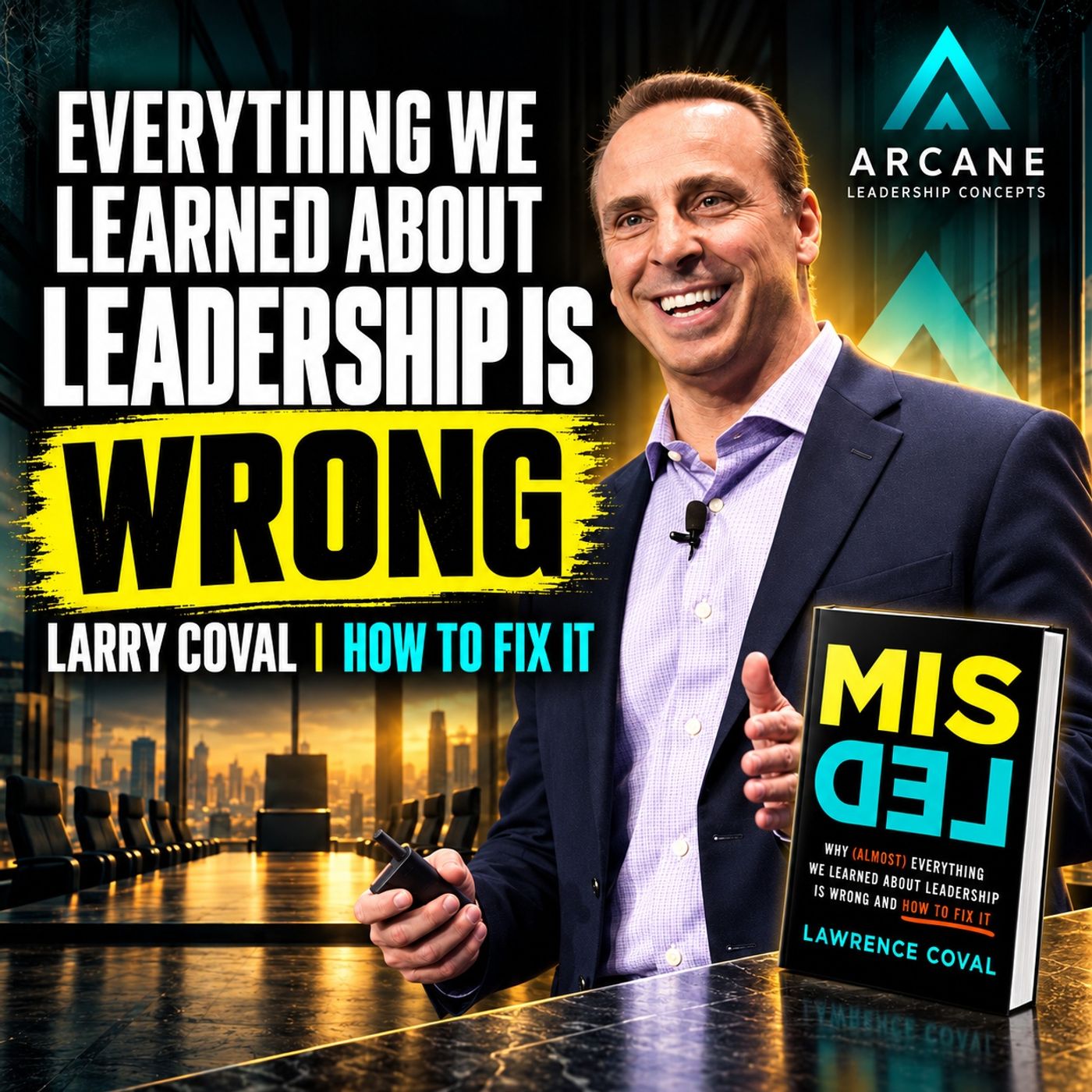
Everything We Learned About Leadership Is Wrong: Larry Coval on How to Fix It
Get every episode summarized
Each time I Am Refocused Radio publishes, we email you a written briefing from the transcript — the topics, who appeared, and any specific claims, with the ad reads skipped.
Email me new episodesFree for 3 shows. No card needed.
About this episode
“You are listening to I Am Refocused Radio with your host, Shemaya Reed. This show is designed to inspire you to live your purpose and regain your focus. And now, here's your host, Shemaya Reed. Is that something that's buzzing around here lately?”From the transcript
https://arcaneleadership.com/
Become a supporter of this podcast: https://www.spreaker.com/podcast/i-am-refocused-radio--2671113/support.
Subscribe now at YouTube.com/@RefocusedNetwork
Thank you for your time.
Get every episode summarized
Each time I Am Refocused Radio publishes, we email you a written briefing from the transcript — the topics, who appeared, and any specific claims, with the ad reads skipped.
Email me new episodesFree for 3 shows. No card needed.
Know when Larry Coval turns up
Follow Larry Coval and once a week we email you every new episode they appeared on — including guest spots the show notes never mention, because we read the transcript.
Follow Larry CovalFree. Pick your own day and time.
Hosts & guests
Transcript ready
132 searchable segments. Every word is indexed and playable.
Full transcript
I Am Refocused Radio — Everything We Learned About Leadership Is Wrong: Larry Coval on How to Fix It. Machine-transcribed; use the interactive transcript above to jump the player to any line.
You are listening to I Am Refocused Radio with your host, Shemaya Reed. This show is designed to inspire you to live your purpose and regain your focus. And now, here's your host, Shemaya Reed. Welcome back to I Am Refocused Radio once again be here today and be have another amazing show on it for you all today. Let me ask you a question. What do you think about self-awareness? Is that something that's buzzing around here lately? I mean, I see on my feet if you have podcasts like I do, almost every show is talking about it. Well, we have a special guest today who's going to give us a little bit more clarity. My guest, Larry Covill, he brings more than 35 years of leadership experience from managing 10 your employees at just 23 years old man. He was killing it back in the day. But he's doing even more great things turning that around struggling teams and developing future executive. He has a argument that is very simple right to the chase.
Like I always say, get to the point leadership to ultimately be measured by whether the people will be led or growing performing and succeeding. If that's not enough, he has a book that you can get is misled. While almost everything we learn about leadership is wrong and how to fix it. If you have more that you want to know, I mean, it's got very sleeves like I do. He has amazing website. Go to arcaneleadership.com. I'm going to get right to the point and welcome to the show because that's 90% was on bio. This guy has a lot that he has going on. So Larry, thank you for letting me do a little justice on your intro, man. You have a way more to cover, but how you doing today? I'm done well. Thanks for having me. I appreciate you being on. Showing for people in the hardest moments of their lives is not just something that you have been used to doing in personal lives on personal level, but also work. What is that?
What part of that should say me so much to you in law? Well, I had my own personal experience with that where I lost my mother almost 26 years ago to a long battle with cancer. And the people I worked with were so kind, so forgiving of my mood changes and just who I had become after losing her because she was such a powerful force in my life. And in that moment, I really learned what the power of supporting people when they're in their most difficult moments can be to the relationship that people have with the people they work with, the people they work for, the people that work for them. So that became kind of a part of my repertoire as a leader. And I made sure that I knew enough about the people that worked with me and for me so that I could tell when something was going on, I could ask the question and they could talk to me about it. They felt like they were in a safe space and hopefully I could offer some measure of comfort to them.
But more importantly, support them as they went through whatever it was, whether it was a divorce or the loss of a family member like I had or just economic struggles. I mean, there's any myriad of things that are going on in people's lives. And the more aware you are and more able to provide some flexibility to them, the more they'll appreciate you when things settle down and be willing to walk through fire with you. Like I said, the intro self awareness has been something that we've been hearing a lot of lady on amazing shows, but kind of dive deeper on that and what it actually means for a great leadership is a possible that we are leaning to heavily on it or not. Well, I think that one of the things I keep coming back to is that the data around leadership isn't really healthy right now. Employing engagement is very, very low and worse than that, the people that are charged with fixing that employing engagement, namely the leaders themselves are seeing the biggest decline in leadership engagement that we've ever seen since we even started doing those kinds of surveys.
So that's really frightening. And so why is that important because if you think about all pods and all the keynote speeches, all the books have been written on the subject of how to lead well, they lean more towards feelings, they lean more towards empathy and vulnerability and authenticity and all the things that end and why. And what they really should be focusing on is how well those leaders enable the success of the people that work for them. What do they do and to propel them and lift them up every single day because those are the things that matter. So when it comes to things like self awareness, I think self awareness is so important because in my book, I start right out of the gate talking about the different types of leaders that are out there. Maybe somebody is kind of a mother hand, they protect their people from reality, shield them from all the noise, that kind of thing. Or maybe they're just, you know, a relentless driver who's never satisfied, you know, matter how well you're doing, they never give you that compliment.
Whatever kind of leader you may be, the more you understand that, the better able you are to work on the things you need to work on, whether it's adding new skills or suppressing some negative behaviors, both of which I also talk about. In the book, so it's, it's really important that you are self aware because that will help you see yourself with who you are. And if you aspire to be better for your people, you can see the space between where you are today and where you could be tomorrow. Well, again, listen to, I'm we focus ready and watching this online talking to our guest today, Larry Koval go to his website is our crime leadership.com. And if I can, I have it right here in my, in my notes. You have amazing words like by the way, when you think about all the work that you put in, I mean, we all know it takes a lot of time of failure and success, it takes turns right one day you're on top of the mountain and next day. You're back in the valley on the humble pie, but when you look at all the years, it took for you to not just carry your team, but to position yourself to have great success in the world of entrepreneurship is very tricky.
Where some of the core principles that have been able to sustain not just your success, but keep you grounded. I think the most important thing that you can do to help your people be successful is to immediately right out of the gate, day one with your relationship, talk about who you are and where you came from. I think they need to hear the story. And once they have that they kind of get a feeling that, OK, I found a connective tissue between that person and who I am. So, you know, they're not some sort of robot that just came in here to be my boss. They're a human being that has struggles, they've had successes. And when you can identify with some of those things, there's a level of trust that starts to get built. But even so on day one, I've always made sure everyone understood what success looked like. And to me, that meant setting crystal clear expectations. This is what's going to look like a good day.
This is what's going to look like a mediocre day. And this is what's going to look like a day that you want to really come back from tomorrow because it wasn't up to standard. And everybody's going to have those good mediocre and bad days. It's just going to be the way it is. So, if you know that and you can give grace to them for those mediocre and bad days while keeping an eye on those things, but also celebrate the good days with them. Again, what you're doing is building a relationship that's not hierarchical. It's more person to person. And the more I was able to do that with the people that I led, and you know, I led really large organizations at one point over 700 people reported into my organization. So, it wasn't easy to establish those relationships with every single person. But enough people knew about me so that that kind of word on the street spread out there. And people said, oh, yeah, he's a good guy. He's, you know, here's what he's about. They would tell my origin story to their peers if they hadn't heard it directly from me.
So, all of those things contribute to providing the foundation for the actual plan and you're going to do as a leader. You know, one of the accountability models you're going to put into place and what kind of observation and coaching are you going to do. But it's those first few days in the relationship that matter the most. And I guess CEOs today and those that you work with in the past. A lot of them can have big inspiring vision for their companies. But a lot of times that vision can either become a distraction or it can be something that they might need to refocus on and look at what's reality. How do you balance that with those that you work for in the past or within the past? How can CEOs today have a better grasp of that balance? I think it's important for companies to have a vision and to make sure that it's known. But I think it's even more important for companies to find ways to live that vision. And so it's really more about those daily interactions that take place within the organizations that really kind of either erode that foundation of vision or add to it, right?
And they're going to have to build it up. But if you step back from the idea of vision for a second and remember why people go to work. They're there because they have economic goals. They want to put their kids through college or they want to put a new roof on their house before the rain start coming with El Nino or gosh knows what, right? It's vital that CEOs understand that that's the primary motivation for why those people come to work. And the data underscores the fact that a majority of employees in any organization, any company, any business, don't pay as much attention to the poster on the wall that has the vision statement up there as CEOs think or would like. And you got to be okay with that. You just got to embrace the fact that people are there and have their own unique motivations for wanting to be at your company doing the work that they do and maybe, you know, those things change over time.
But it's really important that CEOs understand it and not make vision the conversation all the time because we know the data again tells us that remote workers, especially people that aren't physically co located with their beers and bosses and things like that have a lower inclination to connect to anything like a vision statement. And we've ever seen an employee survey data before. So just the fact that we're not there in the office all the time, like the pre pandemic world had us, you kind of get the sense that a lot of these people are removed from whatever it is that we call corporate vision or even corporate culture. Taking all those things into account, I think sometimes yes, CEOs tend to over index on vision statements and, you know, again, what are the what are the posters and, you know, what are the screen savers they send across our computers, when we're sitting at our desk, those are not the things that drive employee engagement, employee performance and employee loyalty.
And once we get comfortable with that, I think we can focus on the things that do drive. And spend a little bit of time on the employee perspective. We have an employee who is under performing. That's unfortunate situation, but it's something that does happen. How most responsibilities should fall on the employee. And how most responsibilities responsibilities should be poured on the manager. So the answer is it depends. There are lots of reasons for poor performance. Some of it could revolve around the employee doesn't have the tools they need. They don't have working instruments to help them do what they're supposed to do. And they may have gotten poor training and onboarding as they joined the organization. There are all kinds of things that the leader needs to kind of play detective around and understand those root causes. And if those things are readily apparent, fix those things, you know, fill the gaps, so to speak.
At the same time, you've got to understand that every employee's will and skill. And those are two very different dimensions, because skill levels can be upgraded. Will levels are more difficult to manage and mandate, so to speak. So one thing I always asked leaders and did so as a leader myself was to make sure that you understood, is this somebody that somebody in your in your group that really wants to be successful? But just has some roadblocks that they can't seem to get past because, you know, they just got caught in the in the swirl at the wrong time. You know, maybe it was right after something happened at the company and resources were strained and we couldn't give them the kind of onboarding and training they needed or they've always had a laptop that fizzles out right at the time it needs to be working. I mean, sometimes as simple as that, but other times it's bad fit. We have to observe and coach those people give them every opportunity to be successful. But when we understand that maybe they were a poor hire for the role that they have and took the job simply because they needed a job and that's that happens a lot.
We've got to help them find a better place and sometimes that means that better place is not with your organization anymore, but they will never be happy doing this work unless they can be successful. And if they can't be, then it's the leader's responsibility to help them find that that new path and you know, sometimes unfortunately that path doesn't exit path. Once again, let's not refocus ready and talking to us today Larry come on go to his website is super easy is is arcane latest news should calm. I want to talk about that that word that you can break down for audience. How did you come up with that word and is something special is on the website that you do down is in breakdown for audience. Yeah, it is a special word to me it's become more special over time because it means a lot it reflects a lot of what I saw in almost 40 years of working corporate America. So it is an acronym and in the acronym goes like this as a aspire to be better for your people better leader for them.
Are as reflect on the things that you do well the things maybe you don't do well see that distance between who you are and who your people need you to be. And then see is commit commit to being that person who is willing to make those sacrifices to reach that goal that is going to add new skills or maybe take those two or three really negative behaviors that are creating problems with the leadership and trying to suppress those things as best they can. And then a the second day is where things generally transformative leadership wise go to die and because it's a it's a gut punch for your ego it's really you know reflecting and acting on those things you've committed to and action is where things generally stop. So if you can get to that point then you're just simply navigating some of the challenges that come up that's the end navigate could be that your progress is going slow it could be that you're backsliding a little bit there's a lot of things that happen when you're trying to get better at something.
But if you can get past that you'll get to the e which is evolved and you'll evolve into a better leader and sometimes that's 10% better sometimes that's 2% better but as long as you're better tomorrow than you were today you're you're on that continuous path of improvement it never stops is no end to the journey because there's no end to leadership improvement it's. The environment that's always in flux and so our can is really this kind of unending pursuit of being better for your people tomorrow than you were today and that that really represents the core of all my learnings and how I tried to lead throughout my career. We look at companies and how they are still promoting the best salesperson this best technician the best individual performer into management. Why is it practice that sometimes that happens without first teaching them how to manage people.
We can tell people that this is a problem we can name it and it is named it's called the Peter principle where we promote people into roles where they are finally not competent anymore and HR leaders understand it executives understand it we all talk about it and yet we continue to commit the same error over and over why is that I think there's this kind of romanticized version of how we see. We can see our top performers and we just say to ourselves boy if we could just clone that top performer movement to a leadership role so that they can teach the nine people that report to them the same things that they do today that will drive nine X of the performance we got from that individual then we're going to be sitting pretty that's not how it works in fact it's usually the opposite of how it works we have lots of examples from.
Sports and business and you name it across the society where we take people and put them in positions where they're not equipped to do those things and so that can happen for a lot of reasons but oftentimes what I found is it's not the top performers that become the best leaders it's those people in your organization who have already displayed a desire to help their peers be successful right if they know something and. They see their peer struggling with it they don't wait for them to peer to ask them for help they walk over and say hey I saw you start struggling with this and I would like to help you and suddenly it's those behaviors that you see are the ones that translate really well into leadership and when I've discovered the the mistakes that I've made with the Peter principle I kind of shoved that aside and said the people i'm looking for are the ones that display that behavior that I spoke up and when those are the ones that are going to be the best. So I became the candidate pools I had much more success promoting people from jobs they were in into leadership roles and saw performance upgrades across the organization so yes it's a great question because I wish we didn't do it as much as we still do but you know it seems to be something that's we're addicted to we see that that potential for high performance replication when it's just not a reality.
Speaking of reality and potential put those together like a sandwich feedback is a big word feedback is something that most managers are depending on to help some employee to understand the reality of the situation. Why is that not just an important thing for managers to take to heart but also giving employees feedback direct can sometimes be awkward how do they find a way to do that professionally and also productively. The most important thing you can do to fix that problem is break the cycle most of the leaders out there don't and have never gotten what I would call constructive feedback that is feedback that's balanced it talks about the things they do well and the things that they need help with that they could improve upon I had this interesting experience when I was a young leader I went to go work for a boss who.
Was not someone you would call a more personality in fact you call the opposite of that whatever name you have for and that bothered me because I always try to make friends with my boss I want them to like me and be my champion when I wasn't in the room right say nice things about me when I was there and because I didn't get that more from them. It made me think I was never going to really benefit from the relationship and so early in the process the leader said I'm going to sit down next to you and watch you do your work and so that's what they did I was kind of push both aside you know what's happening here right I wasn't really comfortable with it but when they sat down next to me they didn't say anything they just watch me do what I did they watch me in my meetings they watch me as I was. My desk I mean it was just it was almost strange in the way it was done but I'd never experienced anything like it so I didn't know how to react so I just kind of got comfortable comfortable with it and did my thing and so that went on for a few months and then at the end of it I got this document from them and they sat down with me went through it and it was the most robust coaching document I had ever seen.
Custom tailored to me with all the things I did well that they wanted me to help some of my peers with but all the things that I wasn't displaying as an expert in behaviors like that so they said here's some things I want you to learn and hear the ways I'm going to help you learn them peers me whatever so in front of me I had this road map to being better at my job that I had never gotten from any of those bosses. I was really friendly and comfortable with and so that feedback was that was real talk that was a very honest assessment unemotional about where I where I had my you know what together and where I didn't and I was blown away by that so always being thirsty for feedback I took that and ran with it I started to see immediate changes not just in my behavior but in the productivity of the people I led and my own productivity and so in their own way they found a way to give me really useful feedback that helped me be better at my job and what was once a relationship that I wasn't sure about was one that I treasured in fact I didn't get to work for them very long because nine months later they put me up for promotion and I was off to go work for somebody else and I really regret it not being able to work for them for longer but they were experts in
providing useful feedback and that was the benchmark for everything I did when it came to observation coaching and providing feedback after that and it's how I coached leaders in my organizations thereafter as well. What's again let's not refocus ready and watch the muscle line talking to I guess today Larry cover go to his website is arcane leadership dot com and like we said early in the show as a book you get is misled why almost everything we learned about leadership is wrong how to fix it and this closing final moments if you had something you want to share in last word message to leaders and CEOs out there will that be. I don't get caught up in the noise that has kind of been the dominant voice of leadership thinking for so many years now leadership is not about someone's emotions it's not about their feelings it's not about their empathy or their emotional state of being it's about the skills that are learnable and
practical and the behaviors that they exhibit on a day to day basis that build up employees and help promote employee loyalty engagement and productivity which is all we want from our people anyway. Well I always most I do thank you for your time thank you.
More episodes
More from I Am Refocused Radio

From Limitations to Leadership: Don Shade on Mindset, Sales & Systems
I Am Refocused Radio

Coach Austin Anderson: The Grind Starts Now! 🏀🔥 | St. John Paul II Basketball...
I Am Refocused Radio

Beyond Success: Randy Lyman on Emotional Mastery, Burnout & The Third Element
I Am Refocused Radio

Nobody Can Be You Better Than You: Dacey Triplett
I Am Refocused Radio