Get every episode summarized
Each time The Independent Advisors publishes, we email you a written briefing from the transcript — the topics, who appeared, and any specific claims, with the ad reads skipped.
Email me new episodesFree for 3 shows. No card needed.
About this episode
“But Jessup Wealth Management's Chief Investment Officer Mark McEvally and CEO Math Jessup. You'll hear tips, tricks, and strategies to address your financial well-being and most importantly, convey it in a way that everyone can understand.”From the transcript
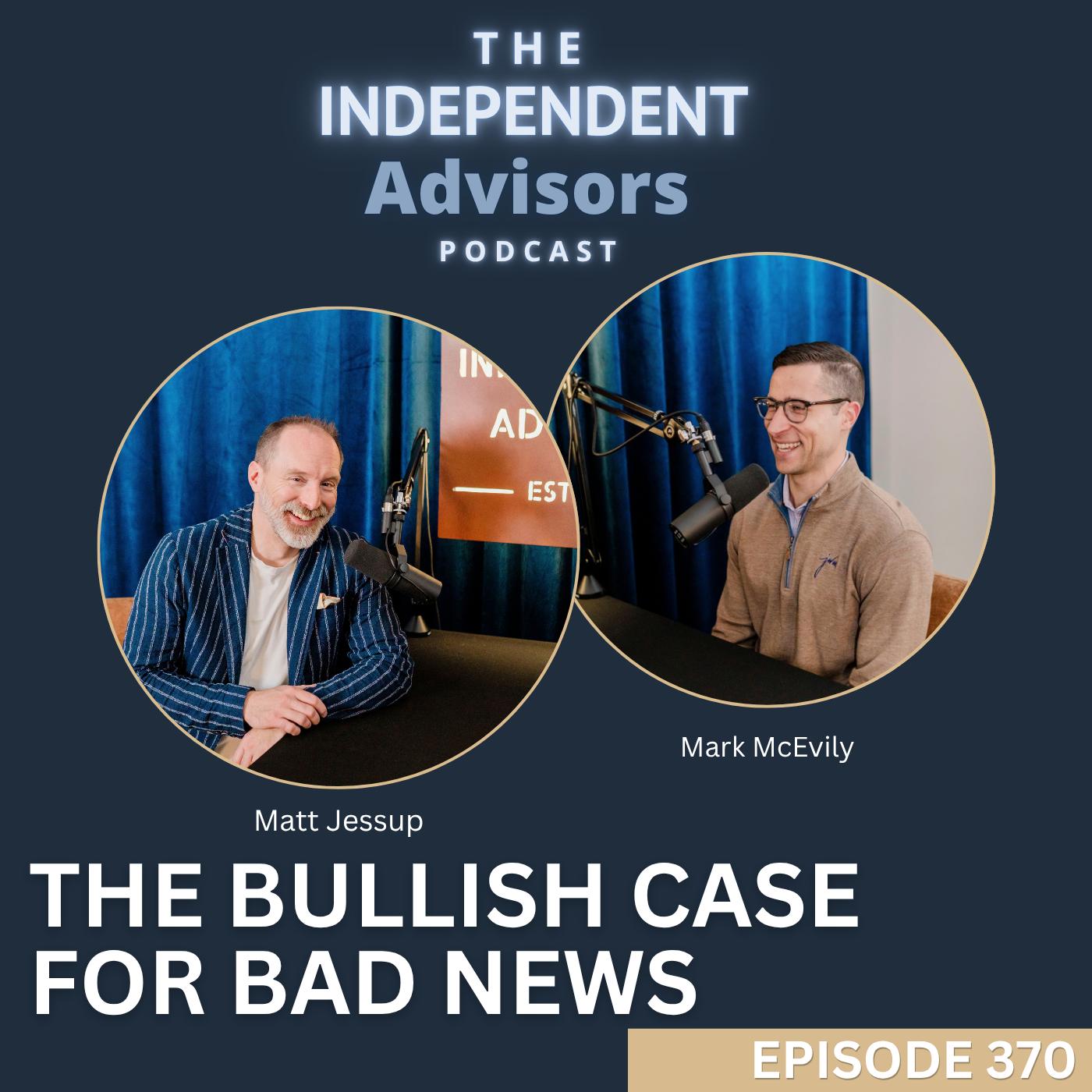
Episode 370 of The Independent Advisors Podcast: The Bullish Case for Bad News. Mark covers a historic rush into money market funds and cash-like ETFs, at levels historically associated with major market bottoms.
He also looks at what history actually says about stocks after the Fed's first rate hike, a wave of bearish sentiment on AI that could be a contrarian signal, and where the market expects interest rates a year from now. The episode closes with a financial planning topic on how much cash to keep in an HSA.
This podcast is for informational purposes only and does not constitute tax, legal, or financial advice. Advisory services are offered through Jessup Wealth Management, an SEC Registered Investment Advisor.
If you've been enjoying The Independent Advisors Podcast for a while now and want to take the next step in your financial journey, I'd encourage you to head to our website, jessupwealthmanagement.com. Matt offers a 15-minute initial call where you can discuss your financial goals and see if JWM is a good fit for your needs.
Scheduling is easy, once you land at jessupwealthmanagement.com just click "Schedule Initial Call" and select a time that works best for you! There's a quick survey to fill out that will help guide the conversation and ensure your time is used efficiently.
If you're ready to learn more, visit jessupwealthmanagement.com and book your call today!
Get every episode summarized
Each time The Independent Advisors publishes, we email you a written briefing from the transcript — the topics, who appeared, and any specific claims, with the ad reads skipped.
Email me new episodesFree for 3 shows. No card needed.
Hosts & guests
Transcript ready
168 searchable segments. Every word is indexed and playable.
Full transcript
The Independent Advisors — Episode 370: The Bullish Case for Bad News. Machine-transcribed; use the interactive transcript above to jump the player to any line.
Welcome to the Independent Advisors Podcast where we dive into the world of stocks, tradable markets and financial planet. But Jessup Wealth Management's Chief Investment Officer Mark McEvally and CEO Math Jessup. You'll hear tips, tricks, and strategies to address your financial well-being and most importantly, convey it in a way that everyone can understand. Hear your host, Mark, and Math. Welcome to episode 370 of the Independent Advisors Podcast on today's show we're covering a few timely and important topics, including the Rush to Money Market funds and their implications for the market, how stocks actually perform after rate hikes and how much cash you should hold in your HSA account. Whether you're tuning in for market insights, planning tips, or just staying informed, there's something here for you. Before we get into this week's show listeners, if you've been enjoying the Independent Advisors Podcast for, I'd encourage you to head to our website. JessupWealthManagement.com.
I offer a 15 minute initial call where you can discuss your financial goals and see if JWM is a good fit for your needs. Scheduling is easy. Once you land at the JessupWealthManagement.com website, just click Schedule Initial Call and select a time that works best for you. There's a quick survey to fill out that will help guide the conversation and ensure your time is used efficiently. If you're ready to learn more, visit JessupWealthManagement.com and book your call today. Good morning, everybody. Solo Sode with yours truly as Matt is out this week. So we'll hop right into it and review the month to date and year to date performance of the major market indices that investors track. This data is from stockcharts.com and as of the market close on September 28th. S&P 500 index up 0.7% for the month and up 13.2% for the year.
Dow Jones industrial average down 2.3% for the month but up 8.4% for the year. The NASDAQ composite index up 2.8% for September and up 15.9% for the year. The Russell 2000 small cap index down 3.4% for the month and up 14.5% for the year. In the Vanguard all world X United States fund down 0.8% for the month and up 14.8% for the year. Three month yield on US treasury bills 4.17% 2 year at 4.92% in the 10 year at 5.22%. So not all bad in September really for some of the major indices that we track. Coming into this month we've been talking about how September is usually the weakest month out of the year. But S&P 500 and NASDAQ still positive. Dow Jones is down a couple of percentage points and Russell 2000 the small cap index down almost 3.5% that's kind of to be expected when you have rising interest rates and rising yields on US treasury bonds.
Because those smaller companies don't have the same borrowing power as some of the big boys in the stock market. So their loan terms are much more unfavorable and they get hit harder when rates are rising. Moving on to big headlines and current events from this week after the China US summit last week. President Trump and Xi agreed to 30 billion worth of tariff cuts on each side for a total of 60 billion. There's still some key factors that remain unresolved but it's a good starting point. And I think the total tariff, you know, TIFF was somewhere around 400 billion. So, you know, in the grand scheme of things not a huge dent in that but it definitely is a start. So we'll see if more gets added to that over the coming months. The other interesting story that kind of developed this week is the Trump administration considering ways to restrict US diesel exports.
So there were reports that the administration was considering a 90 day export ban but the White House has since pushed back on the idea of a complete ban. And their goal was pretty simple, right? Diesel invitaries in the US are very tight and prices are extremely high. I'm sure all of you have seen how high diesel prices are in your communities. So, you know, keeping more American produced diesel here could theoretically increase the supply and when supply increases prices usually come down. But the problem that it could have is that US refineries, particularly along the Gulf Coast, produced more diesel than the domestic market can easily absorb. Which is why a significant amount of it gets exported. And if you suddenly just eliminate those exports, diesel inventories could build up near those refineries and eventually force them to process less crude oil.
And when refineries cut production, they're not just producing less diesel. They're producing less gasoline, less jet fuel, etc. So while an export restriction could help lower diesel prices in the short term, a full ban could eventually put upward pressure on gasoline and other fuel prices. So I think it's important to note that diesel is not just produced on its own. When crude is extracted, there's gasoline, there's jet fuel, there's diesel. So, you know, a drop in production would affect the supply of regular gasoline, right? And then, you know, you have a tight supply and then regular gasoline increases and then we're in the same situation. So for now, there's not a 90-day diesel export ban in place, but the administration appears to be exploring a voluntary or more targeted reductions instead. So this will be a story that we will continue to follow.
Moving on to articles research from this week. First thing I had was a post on X from Ryan Dietrich using research from macro charts on September 25th. Ryan says the rush to money markets and cash like ETFs is real. September phobia is also real. What if all the bad things they keep telling us will happen are overblown once again? And he shares this chart from macro research that Mary Beth will put up on the YouTube page. It'll also be in our show notes. But what it shows is the three-month rolling flows into money market funds and cash like ETFs. And the flows into money market funds have reached levels historically associated with major market bottoms. So if you're looking at the chart later, excuse me, in 2018 this occurred early in 2020 after the COVID crash. It happened towards the end of 2022 after that lengthy bear market.
And then again in early 2025 with the liberation day tariff situation. So it's now showing up again. And if you think back over the past several years going back to 2018, this occurred around market bottoms pretty consistently. So not saying that being 2% off the highs for the S&P 500 is the bottom. But if you are a bullish investor, this is probably a pretty good sign. We wanted to take a minute and tell you about a service we personally use and trust. Life Lock by Norton. With everything we do online these days protecting your identity and personal information is more important than ever. That's why we've partnered with Life Lock, a leader in the identity theft protection industry. Their mission is to empower people to live their digital lives safely, offering tools to help protect you and your family from threats like identity theft, cybercrime, and fraud.
They combine advanced technology with 24-7 support to keep your information safer in today's connected world. We use it ourselves and we think it's a valuable tool for anyone looking to add an extra layer of protection. If you're interested in checking it out, you can use our special link to get a discounted rate. As a heads up, we do receive a percentage of compensation if you sign up using our link. But we partnered with Life Lock because we believe in what they offer. To learn more and get the deal, just head to jessupwealthmanagement.com slash life lock. Moving on to item number two, this was a article on Yahoo Finance written by Brian Sozi on September 16, titled Federal Reserve interest rate hikes usually pound stocks, but then something surprising happens. I just wanted to read a few stats that I found interesting from this article. Brian says the S&P 500 has declined by an average of 4% over the six weeks following the first
Fed rate hike of a cycle across seven instances since 1988. This was from analysis from strategist at the Kobiyasi letter, but stocks recovered all of those losses over the next five to six weeks on average. In the six months following the first interest rate hike, the S&P 500 returned 4% on average after six excuse me 12 months, the S&P 500's average gain title totaled 9%. Positive returns have occurred in every episode except 2022 over the 12 months. So I know Matt talked a little bit about this last week when he was doing a solo episode, but I think it's important to point out that most people think interest rate hikes are bad for stocks in general. Obviously with this data that we just shared not always the case, I think it has a lot to do with the magnitude and the pace of interest rate hikes and also obviously what's going on in the economy.
The narrative of rising interest rates hurts stock prices. Yeah, that's true in some instances, but it's not a blanket statement. Third thing I had was a post on X from Quant data on September 17th. And he was pretty much just talking about how everyone and their mother or bullet or excuse me, bearish on AI and technology in general. So he says AI, I bear's highest reading since spring 2025 in late 2022. And as a reminder, the AI, bearish sentiment percentage tracks the share of individual retail investors who expect the US stock market to fall over the next six months, typically adds as a contrarian indicator, there was a time magazine cover that was bearish on AI, the economist also had a magazine cover recently that was bearish on AI.
So we've talked about the magazine cover indicator before. And when everyone is on one side of an opinion, a lot of the times the opposite tends to happen. So there's people calling for a bubble in AI. You had a bunch of big tech CEOs come out and say that we need to slow the pace of evolution with this type of technology. So there's a lot of negative news out there about AI and not saying that this is going to happen, but more often than not in my experience, that's the exact or near a time that some of these stocks might bottom out and start to perform pretty strongly again after a much needed breather over the summer I might add. So lastly, post on X from Mike Zacardi, CFA and CMT on September 9th, he put out there a chart of
the implied Fed funds rate over the next year. Again, this was back in early September. So it was actually data from before the Fed rate hike two weeks ago. So just want to keep that in mind. Currently, the Fed funds rate is 3.75% to 4% and the implied Fed funds rate a little less than a year from now in August is about 4.27%. So that's what the market is expecting. So a couple more rate hikes between now and in next August. So obviously, this can change very quickly, dependent on CPI data that comes out, jobs data that comes out, but as of right now, this is what the market is expecting. Moving on to the financial planning topic of the week. This was a newsletter from lively on September 14th titled, How Much Cash Should You Keep In Your
HSA. So for those that don't know, rules and regulations now allow for people to invest their HSAs in the stock market or bond market if they choose. Because a lot of people don't need to take money out of that. So they want that to grow X kind of as like a tertiary retirement account that if you do take money out of the HSA and retirement for non medical expenses, you just pay ordinary income tax on the distribution just like you would with a normal IRA. So it's a quick one this week, but I think an important one. They say a simple rule of thumb, keep enough cash on hand to cover your deductible at a minimum. Ideally, keep enough to cover your full out of pocket maximum since that's the most you could owe in a single plan year. For 2026, that looks like this. For self only coverage, the minimum high deductible health plan deductible is $1,700. The maximum
out of pocket cost is $8,500 for family coverage. The maximum high deductible health plan deductible is $3,400. The maximum out of pocket is $17,000. If your cash balance is below your deductible right now, consider directing your upcoming contributions to cash until you've built it up after that. So again, it really depends on your your own personal situation. If you are you know, expensing things from your HSA, this might be a little bit different, but I think this is geared towards people who really are investing a lot of their HSA accounts because they know they're not going to need it for the next couple of years. But if you do know, you're going to need it within the calendar year, 100% agree that that money should be sitting in cash because you never want to have to go dip into the HSA but not have the money be there if the market pulls back 10, 15 or 20%. So that's all I have for everyone today. It was more of a quick one. We will be back next
week for episode 371 and thank you everyone for listening. Thank you for listening to the independent advisors podcast. If you're interested in hearing more, hit the subscribe button so you can be notified every time a new episode gets released. Feel free to share with friends, family and follow us on Facebook, Twitter, LinkedIn and X. Mark and Matt will continue to share beneficial information on these social media sites. Also check out the podcast tab on their website. That's www.jesepelkmanagement.com. There you'll find links to every episode of the independent advisors. Have questions or topics you want to discuss on the show? Send an email with the words questions and topics in the subject line to inquiries at jesupwealthmanagement.com. We'll talk about it right here on the podcast. Certain sections of this commentary may contain forward-looking statements based on reasonable expectations, estimates, projections and assumptions. Forward-looking statements are not guarantees of future performance and involve certain risks
and uncertainties which are difficult to predict. All indices are unmanaged and are not available for direct investment by the public. Past performance is not indicative of future results. This podcast is provided for general informational purposes only and does not constitute either tax, legal or financial advice. Although we do go to great lengths to make sure our information is accurate and useful, we recommend you consult a tax preparer, professional tax advisor, financial advisor or lawyer regarding your specific circumstances. Investing involves risk, including the loss of principle. No strategy can guarantee any objective or goal will be achieved.
More episodes
More from The Independent Advisors

Episode 369: What History Says About Fed Rate Hikes.
The Independent Advisors

The Independent Advisors Podcast - Episode 368: Legacy Giving with The Dayton Fo...
The Independent Advisors

The Independent Advisors Podcast Episode #367: Is the Market Really Expensive?
The Independent Advisors

The Independent Advisors Podcast - Episode 366: September Seasonality and the Pr...
The Independent Advisors