Get every episode summarized
Each time The Brion McClanahan Show publishes, we email you a written briefing from the transcript — the topics, who appeared, and any specific claims, with the ad reads skipped.
Email me new episodesFree for 3 shows. No card needed.
About this episode
The Brion McClanahan Show is made possible by:
“Five players, 26 cases each, one million dollars on the line for every player. On September 25th, Yamavarizor and Casino at Sandman Well makes history with Deal or No Deal live hosted by me, Howie Mandel.”From the transcript
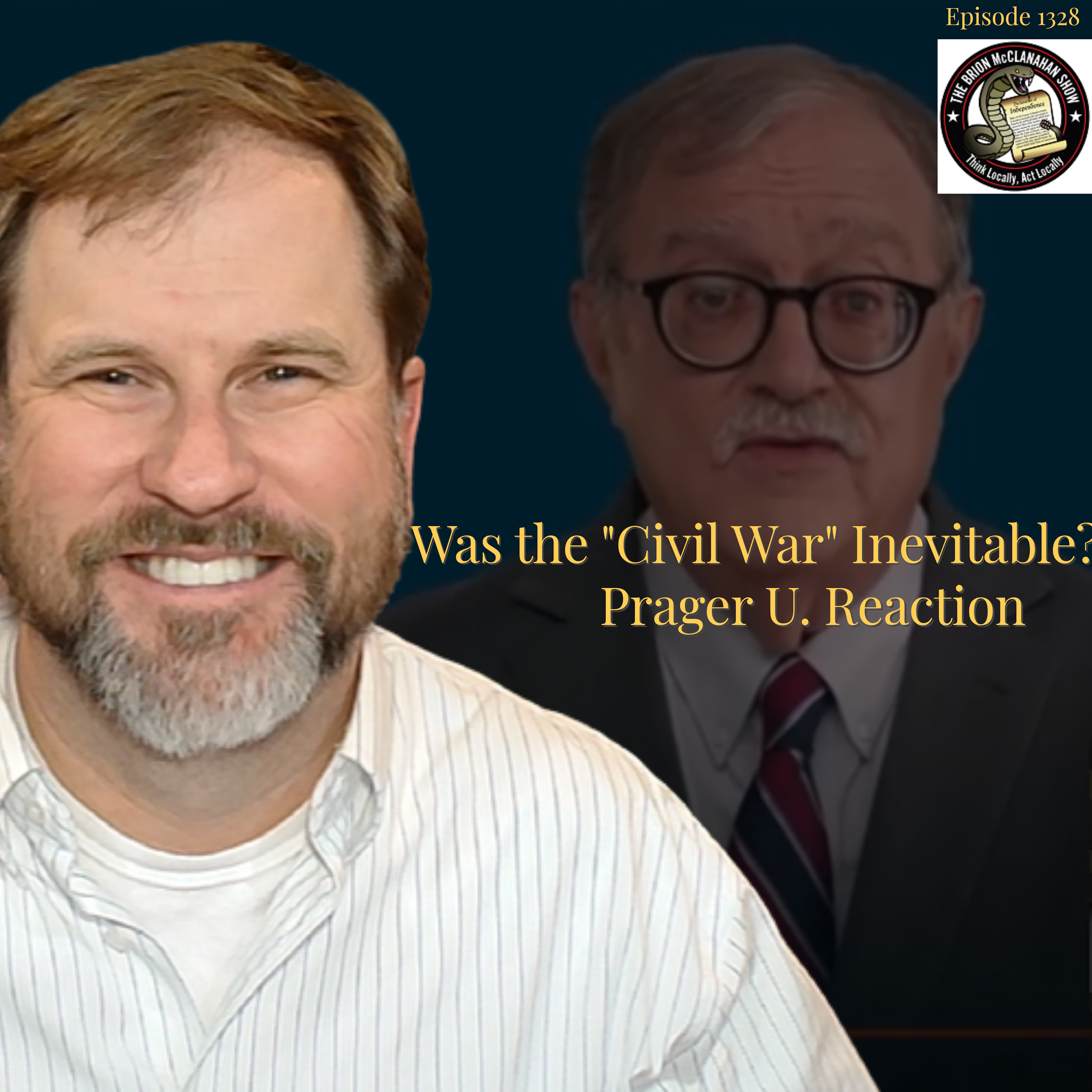
I react to Wilfred McClay's latest Prager U nonsense.
https://mcclanahanacademy.com
https://patreon.com/thebrionmcclanahanshow
https://brionmcclanahan.com/support
http://learntruehistory.com
Get every episode summarized
Each time The Brion McClanahan Show publishes, we email you a written briefing from the transcript — the topics, who appeared, and any specific claims, with the ad reads skipped.
Email me new episodesFree for 3 shows. No card needed.
Hosts & guests
Transcript ready
1,215 searchable segments. Every word is indexed and playable.
Full transcript
The Brion McClanahan Show — Ep. 1329: Was the "Civil War" Inevitable?. Machine-transcribed; use the interactive transcript above to jump the player to any line.
This has never happened before. Five players, 26 cases each, one million dollars on the line for every player. On September 25th, Yamavarizor and Casino at Sandman Well makes history with Deal or No Deal live hosted by me, Howie Mandel. Plain September for your chance to take the stage at Yamavar Theatre and answer the ultimate question. Deal or No Deal? Details at Yamavar.com must be 21. Please gamble responsibly. Push your limits, train with precision, see the results. At Equinox, that's high performance loving. Iconic spaces that inspire. Personal training backed by real data, unlimited group fitness classes from yoga and pilates to strength and conditioning. Elevate your post-performance ritual with sonas, steam rooms, cold plunges, and more. Everything you need to lock in and unlock your potential at Equinox. Start today at Equinox.com.
A clanahandacademy.com is your gateway to a real history education. Go to McClannahanAcademy.com, use the coupon code podcast and take 25% off every class every day at McClannahanAcademy. Get a real history education, I'll see you in class. If you like this podcast and you want it without advertisements, head over to patreon.com and become a member of the Brian McClannahan Show for 10 bucks a month. You get all the podcast ad free, including video, and you also get a special Q&A podcast. I'm only going to answer your questions, your listener generated episodes through those Q&A. So head over to patreon.com, get this podcast ad free. No ads, not even things like this. And you really do help support the Brian McClannahan Show with really cool stuff on the backend. The essential originalist papers is 77 public documents in favor of ratification of the constitution. It is the book if you want to understand originalism.
Get it wherever books are sold online, I guarantee you'll love it. PragerU is back with another stupid video was the Civil War Inhabitable. We'll talk about that on this episode of the Brian McClannahan Show. It's time to feed locally and act locally. Welcome to the Brian McClannahan Show. Welcome back to the Brian McClannahan Show. Glad to be back on the program. Very glad to be here. All right. Gonna wrap up the week with something I don't normally do. I'm gonna do a vlogging through history. I'm gonna be Chris Moury today. You see because supposedly. I'm too biased to do these things. I can't do stuff like this. I mean, Chris Moury, the gatekeeper of all things that are important and good in YouTube video selection of talking about history. I can't do this stuff.
So I thought it'd be really fun to go out and review a video that just came out this week by Wilfred McClay. It's on the war in the subject, essentially. What's the war inhabitable? Did the war have to come? I can't remember what the official title is. We're gonna go through it. I'm gonna watch it and react to it. I'm gonna do a reaction video for you. We're gonna go through the very bad history of this Prager U video and talk about it. Now, who is Wilfred McClay? Well, he teaches at Hillsdale College. He's a PhD from Johns Hopkins University in 1987, I believe. He's written a number of interesting books. He's a conservative. But he has the West Coast Straussian view of everything. He is someone who believes in the Lincolnian myth. He's a Lincolnian. The righteous cause myth. 100% on board with that. And so this is the problem I have with most conservatives.
And look, Chris Maury calls himself a conservative and this is his position as well. They don't get it. You can't be conservative and be a Lincolnian. It's impossible. But they think they can. And of course, they think that they're doing the right thing. They're on the right side of this stuff by supporting the Lincolnian position in a very simplistic view of American history. I mean, it is bad. It's in fact, it's worse than what the left often does. So I hold Prager U responsible for much of the current program against all things Confederate. In fact, I hold them responsible for the destruction of the Arlington Monument, the Arlington Confederate Monument, because they platform Taliban Thai sideurally. Prager U is more responsible for Taliban Thai than anybody else. Thai sideurally was an unknown. Nobody cared about this dope from West Point.
He taught some general history courses there. He was Colonel Thai at that point. He retired a general, but nobody cared about Thai sideurally. He was a woke moron at West Point. Now his father wasn't. His father apparently was a very good historian. And this was Thai sideurally's little book on Robert E. Lee was more about blasting his family than anything else. His father in particular. But when you look at Thai sideurally in his background, nobody would care about this guy. I don't even know if he had finished his PhD by the time he did that ridiculous video for Prager U. And Thai sideurally himself said, I was shocked that Prager U came to me and wanted me to do a video on the war because well, he's not conservative, but you know, he has a uniform on. He's military, so that makes him conservative. So ridiculously stupid. The Prager U people really are. But Taliban Thai makes that video was the war about slavery.
And of course, every leftist in the country aided up. I mean, they lap this thing up like it was the best and most delicious dish they'd ever had in their life. And of course, then you have the dopey conservatives who I've talked about this week, get on board with this stuff. And Taliban Thai because of that, because he was platformed, then becomes this hero of the Confederate iconoclasm. And of course, he's put on the naming commission. He is not the, he's not in charge of the commission, but basically he was. And that commission has done great damage to American history. This is what Trump has tried to undo, but the Congress will just come back in at some point. I'm sure and just change it all. So we're going to go through this thing over and over again. But without Prager U, there's no Thai side jelly. Without Prager U, there's no platforming this bald headed dope Taliban Thai. It's it's shocking how stupid these conservatives really are.
This is what we get. I mean, because he has a uniform on while he's conservative went to West Point. As I talked about yesterday with Robert E. Lee and West Point, and now you've got conservatives at AEI saying, well, we need to take down Lee's portrait, suppose the conservatives. And then you got another dope at AEI. Well, you know, it's conservative thing to do to take down Confederate monuments. Really? That's the conservative thing to do. Okay. I don't think anybody would have called the radical Republicans conservative or the Republicans themselves conservative. They weren't. In fact, they called their opponents conservative, which is kind of fun. But yet somehow that's conservative today. That's how awful these people are. No shame. Now, McClay is, I think he's in his mid 70s now. He's a pleasant fellow. I just think McClay is, you know, just been wrapped up in this righteous cause mythology and linkoning as him for too long to really, you know, change his tune on it. And to say that, I mean, well, I'm biased in this.
This is my bias is coming up. I think that the evidence is all there that McClay is very simplistic telling of this story is bad history. And it should be called out as such. There's no nuance. There's no understanding. In fact, he just ignores a lot of stuff that doesn't fit the agenda. Now I get it. These are five minute videos. And you can't do everything with five minute videos. But it's so cartoonish these things shouldn't even be published. They should just avoid this stuff. This is what you get. So I'm going to do a reaction video and hopefully you'll enjoy my reaction to this. I'm going to try to get, you know, 30 minutes out of it. It's five minute videos. So I'm going to have to take some time to talk about some things that he says in there. I've skimmed it once. So I have some general thoughts. But as I go through it, I'll make some more observations about things. So I mean, this is going to be my essentially not my first reaction because I watched it
once. But I'm going to formulate thoughts as I go. Okay. So off the cuff. All right. So I'm going to vlog through history with you. All right. We're going to vlog through history here. And hopefully I'll do it as well as Chris Mallory does because apparently he's really good at this. Let's go ahead and get started. All right. So we got the typical Prager you set up here. They're a little, they're, they're, they're branding they like to do. If you haven't seen one of these before, this is what it looks like. Maybe you've watched a Prager you video. Maybe you haven't. They're pretty popular. I mean, these things get thousands, tens of thousands of views. I do wish that some of the videos that we do like at Abby Villains to do could get these number of views. But they have big money behind these. They have a lot of money to spend on advertising and other things. So it's, I mean, then they do a nice job. Look the, the graphics, I mean, they're, they're cartoons, but they're well put together. I'll say that from the beginning.
I will give them credit for that. They do a pretty good job. And they bring in some pretty prominent historians and figures to do these videos. So that alone, the, the name recognition gets them views. So they've been able to figure this out pretty well. So let's just go ahead and get into it. Again, these are about five minutes long. So we're going to see how this goes. And again, this is Wilfred McClay. He is a professor at Hillsdale College, as a PhD from Johns Hopkins University, written a number of books. He's pretty well known in conservative circles as a conservative historian. This has never happened before. The players, 26 cases each, one million dollars on the line for every player. On September 25th, Yamavarizort and Casino at Sandman Well makes history with deal or no deal live hosted by me, Howie Mandel. Plain September for your chance to take the stage at Yamavar Theatre and answer the ultimate question. Deal or no deal?
Details at Yamavar.com must be 21. Please gamble responsibly. Push your limits, train with precision, see the results. At Equinox, that's type performance loving. Everything you need to lock in and unlock your potential at Equinox. Start today at equinox.com. Was the American Civil War inevitable? From the... Now, let me just start with that. Was the American Civil War inevitable? Now, if you don't know, this is actually a big historical question. It was four years. If you go back to the middle of the 20th century, there's something called the Blundering Generation School. And essentially, what that school argues, and this is people like Avery Craven and James G. Randall and people like that, what they say is that the war was inevitable. That it could have been avoided. There could have been a compromise at some point, but a really stupid crop of politicians,
including Abraham Lincoln, blundered their way into the war. It wasn't just on the south. At the end of this video, McClay basically puts it back on the south. It wasn't just on the south. There were mistakes made over and over and over again by people like Stephen Douglas, by people like Abraham Lincoln. In fact, Randall's pretty hard on Lincoln at certain points. And so it was Craven. Right, none of these people were pro-southern, but they actually would be honest enough to say, you know, this wasn't just on the south. The north blundered into this thing too. And I remember when I was applying for a job at an institution, I didn't get, I was the finalist and the other person got the job. But this was asked of me in the interview. Do you think the war was inevitable? And so by simply asking that question, you're setting it up for a debate that's been going on the profession for decades. Now do I think the war was inevitable?
100% absolutely yes. And I think you can answer that question in a variety of ways. Could it have been avoided with a compromise? Maybe? Could it have been avoided if Lincoln didn't decide and the Republicans didn't decide to essentially ignore the Supreme Court because that was the real issue in 1860 and 61. They were saying we don't care what the Supreme Court says. We're going to continue to push this political position. And so when you start looking at succession and what's happening there, southerners didn't believe they could trust them and for good reason. But was it, I mean, did it have to come when it did? I mean, did Lincoln have to go the south into the war? There's two different things here. There's succession in the war. Those are also separate issues. Session didn't have to mean war. We've come to this belief that somehow because these states left the union, there had to be war. That's not true. They didn't have to be war. Lincoln could have let the states go.
Could have happened that way. You didn't have to have this bloodshed. But we've decided that succession means war. Again, this is a false premise. You can have succession. You can have a a a a a succession of states or individuals or even in a personal relation. It doesn't have to go to war. Only one side decides that they're going to abuse the other to keep them in the abusive relationship. Do you have to have war? And whatever means that as it could be, you know, a legal fight, it could be all kinds of things, but it doesn't have to lead to war. So that, that simple question is a big, if you don't know, it's a big question in American in a storyography, and you have people that would argue it wasn't inevitable because, well, it happened. So clearly it was. You have people argue that it wasn't inevitable that it could have been avoided. But a lot of these people now are seen as outdated,
the cravings and the Randalls. I mean, they're recalled all kinds of names by people like Kenneth Stamp and putting them in a position where these people were being characterized as prosa, than which they are not. But simply asking the question, you're one of the more famous books recently, a disease of the public mind by Thomas Fleming, essentially, formulas that the war wasn't inevitable. I mean, Northern abolitionists could have been less obnoxious and people could have not listened to them. And maybe we wouldn't have had such a strong sectional conflict, that could have happened too. But of course, he was blasted for that. Paul Goldfield's American flame. Now he was one of the, I believe one of his advisors in graduate school was of the blundering generation school. So, or something in that way. I can't remember his personal background, but he's tied into that. He kind of falls into kind of a blundering generation school that maybe it could have been avoided. But the issue always comes down to, well, if we have or the war,
a slave would have gone on longer. And of course, this is why you can't do this anymore because people have, you know, this self-righteous moral preening to them. That's part of the issue. But anyways, let's get back into the video. A founding of the country, the issue of slavery divided North and South. That division brought the two sides to the brink of civil war three times, 1820, 1850, and 1860. Now, let me stop there for a second. So from the beginning of the country, slavery divided the North and the South. Not true. He said it from the beginning of the country, slavery divided the North and South. Simply not true. In 1776, every state in the United States was a slave holding state. So from the beginning of the country, this divided it. No. In fact, John Adams was writing a pro-slavery constitution. For Massachusetts, that one was scrapped and they got a different one. It wasn't explicitly pro-slavery. No court then decided that that constitution would then be anti-slavery. But it wasn't through the political processes
or court in Massachusetts. And of course, there were people that were anti-slavery in Massachusetts. You know, generally you would find those people. Thomas Jefferson had some pretty harsh language about slavery in the original draft of the declaration. But that wasn't adopted. So, I mean, was this such a division? I mean, George Washington is trying to re-acquire slaves that were stolen by the British. And that's the language he used, stolen by the British at the end of the American War for Independence. This was not in the South. These were slaves in New York. So was this really dividing America from the beginning of the country? If we just back up for a second here, let's listen to his language on this. From the founding of the country, the issue of slavery divided Northern South. From the founding of the country? No. That's mistake number one. Not from the founding of the country. Puritans were heavily involved in the international slave trade. Puritans were heavily involved in as absentee owners and Caribbean plantation,
sugar plantations primarily because of things like molasses. They wanted to make the rum. They were distilling all this rum so that they could use that because you could trade so many gallons of rum for a male slave in Africa. And they would sail the ships over to Africa, get the slaves and bring them back. In fact, between 1804 and 1808, two thirds of the slaves that were delivered into Charleston, South Carolina from the international slave trade before it was shut down. Two thirds came from Rhode Island. So, Rhode Island ships. This was Rhode Island. So was that really dividing the United States from the beginning of the country, the founding of the country, fall statement? Not at all. This has never happened before. Five players, 26 cases each, one million dollars on the line for every player. On September 25th, Yamava Resort and Casino at Sandman Well makes history with deal or no deal live, hosted by me, Howie Mandel. Plain September for your chance to take the stage at Yamava Theater and answer the ultimate question.
Deal or no deal? Details at Yamava.com must be 21. Please gamble responsibly. Push your limits, train with precision, see the results. At Equinox, that's high performance living. Iconic spaces that inspire. Personal training backed by real data, unlimited group fitness classes from yoga and Pilates to strength and conditioning. Elevate your post-performance ritual with sonnas, steam rooms, cold plunges, and more. Everything you need to lock in and unlock your potential at Equinox. Start today at equinox.com. That division brought the two sides to the brink of Civil War three times, 1820, 1850, and 1860. Now that we were now on the brink of Civil War in 1820, that's also a false statement. Now on the brink of war there. Now Northerners wanted to secede in 1794 and 1800, 1801, 180304, 1812, 1815.
Now if you want to say that we were on the brink of Civil War because the North wanted out several times, well then I guess you could argue that point. But not in 1820. There's no threat of war there. Southerners were thinking about things. Northerners were thinking about things, but this came down to power. He's talking about the Missouri Compromise, which we'll get into in a minute. Now if you made the argument we were on the brink of war maybe in the 1830s, like 1832, I could buy that one. But what was the issue there? Not slavery, it was a tariff. Now you'll have people that will say, well yeah, McCleod, here it was a tariff, good stuff, good tariff, today we're against tariff, cause a slavery. This is one of the primary arguments. But I don't think the evidence really points in that direction. Now of course Daniel Webster go to the South and defending slavery in the 1830s, because they felt like, well this institution's being attacked. And you did have some defenses. I mean look, the very first real positive good speech in the US Senate was made by a South Carolinian smith
around during the Missouri debates in 1820. But he's also in that speech, pointing out to have hypocrisy of the North and this whole thing. Saying y'all are making a ton of money. Have made a ton of money on slavery. I don't want to hear any of your quibbling about this. What it came down to as James Monroe pointed out was power. Everybody knew it. There's a very famous book by a guy named Glover Moore on the Missouri controversy. And he gets into this. The issue in 1820 was political power. The issue in the 1810s was political power. It was always about political power. 1850 you could say there was some rumblings about war there and of course then again in 1860, we'll get into that when we get there. The first two times they pulled back, the third time they went over the edge. Let's take a closer look at each of these turning points. In 1818 there were 20 states in the union, 10 free and 10 slave. That year Missouri petitioned Congress to become a new state, a slave state, breaking that balance. To resolve this dilemma, the great political pragmatist of the age,
Kentucky legislature Henry Clay promoted the idea that the territory of Maine could be admitted as a free state. To prevent future conflict, a critical detail was added. A line would be drawn, extending westward at latitude 3630. Slavery would be prohibited in the land's north of this line and permitted in the land south of it. Now let's get into this because this is all true, right? I mean all this did happen. This is Missouri compromised. Now the initial proposal actually had Alabama coming in as a slave state and Maine as a free state, which would not solve the issue. So the issue became the territories. And this really is a constitutional question. And you even had subuners that would vote for the Missouri compromise and would vote for the ability to prohibit slavery in Missouri. They were out there. They would be on board with the Congress having the power to do this, right? Because this would be a supposed municipal power of the Congress. I mean there's many of them.
Philip Pendleton Barber who was an old Republican thought that Congress could prohibit slavery in the territories. But the issue became Missouri as a state, right? So there was a question, there's a difference between states and territories. No one believed in the South that anybody could prohibit the state of Missouri from having slavery. The state of Missouri, if Missouri wanted to be a slave state, well then Missouri should have that authority to do it, just like any other state in the union. But there were certainly people in the North who were pressing the issue and saying, no, we can prohibit Missouri as a state from having slavery. James Monroe drew the line there. He said, that's never gonna happen. That's never gonna happen. You cannot prohibit a sovereign state. The people of this sovereign state from deciding on this issue themselves. That's the way it's worked the entire time. Now we can have this conversation about the territories, but a state is entirely something else. So that became the real issue,
a state versus a territory. What can you do with a state? What can you do with a territory? And this balance of power was important, right? So you have now the balance of 11 and 11, right? And why was that important? Well, McCleay makes it seem like, well this is all about this moral issue of slavery, false. What was happening by 1820? Well, you started seeing the North become much more interested in what's called, quote unquote, nationalism because it starts helping their northern sectionalism. Well, if they control the Senate, and they can do that through acquiring, having more free states, so to speak, well, they can control the Senate, they can get their political economy through. And that political economy started focusing on things like federally funded internal improvements, protective tariffs, central banking. Now, it doesn't mean that southerners were entirely against this stuff.
In fact, as you move forward in the 1830s, there's a discussion of this. And southerners were on board with some of it at times. Henry Clay himself was a southerner, but he calls this the American system by the middle of the 1820s. And so power becomes the issue. New England believed they had been shut out because of the War of 1812. They were very much against it. Threat to succeed, at least wanted constitutional amendments that would do things like, I don't know, eliminate the three-fist compromise of the Constitution, make a rotation and office for the presidency. I mean, these were some of the things they wanted, right? Because it was about power. Everybody knew it. This is only a few years after the Hartford Convention. That was the major issue. Okay, and people like Governor Morris, who's wrote the final draft of the Constitution Committee of Style, he's favoring succession in 1812. I mean, you had New Englanders and Northerners,
which they called the Eastern States then, favoring succession. Now, did that mean the South was gonna invade to go to war? Absolutely not. So to say that there was almost war in 1820 is stretching the truth. Within 12 years, when Andrew Jackson threatens to use force against South Carolina, yes. Then we could have had potentially war. And in fact, in 1836, you've got a book entitled The Partisan Leader written by a Tucker of Virginia, saying, yeah, I think that war might be a possibility because while Virginia is gonna secede from the union over the election of Martin Van Buren. So you've got a lot going on here, but it's a little bit of a stretch to say at this point. Now, was this Missouri Compromise Line constitutional? It depends on how you look at the issue. Did the Congress have municipal powers over slavery in the territories? You can, I can make an argument both ways on this issue. One, that well, there's no power over it for Congress at all. But if they have municipal powers,
that means they can do just anything they want. This is Philip Pendleton Barber's argument. But there were a lot of people that were, certainly opposed the Congress having this kind of power in the territories and there were people that thought they did. So even in the founding generation, there was certainly some, some discussion about this. Let's keep going. This became known as the Missouri Compromise, signed into law by President James Monroe in 1820. And then another challenger rose. The land acquired by an overwhelming victory in the Mexican War, 1846 to 1848, expanded the nation all the way to the Pacific coast. This blessing came with a curse, where the additional states carved out of the newly acquired territories, be slave or free. Many of the south insisted on the former, many of the north insisted on the latter. That's true. One of the funny things about this because oftentimes you get to this point you hear, yes, it's the slave power.
You start seeing that argument by the 1840. So we're talking about 1848, when the war is over, one of the most ardent opponents of acquiring this land was John C. Calhoun. The man who had made the very famous or infamous positive good speech in the United States Senate in 1837 was very much opposed to acquiring all of Mexico number one, but even some of the Mexican session number two. He thought that this might be a bad move. Now, of course, he did talk about land and he wasn't necessarily 100% opposed to it. He thought that buying it was a stupid idea. It should have just been given to us as indemnity for the war for the things that they did. But regardless, this land was basically given over by Texas, some of it. And of course, California becomes a state out of it, which he's gonna get into here in a minute. But I mean, look, this was a contentious issue and there were southerners that were against it. Calhoun, again, being one of them,
his Calhoun resolutions though in 1848 made it pretty clear that if we're gonna acquire this territory which southerners have blood and died for, then they need to have access to it, which would be the common property of the United States. That's his argument. And when you get to 1850, the late 1840s and 1850s when he's making these arguments, he's pointing out that nobody cares about the Constitution anymore. And this really is about power. And all these issues that have been wrapped up for years comes down to power. This was the disquisition, all of these things, but when you look at tariffs, banking, internal improvements, territory, slavery, whatever it is, it's really about power at the end of the day. So what James Monroe said in 1820, it's what Calhoun was saying by the 1850s, everybody knew it, but we're all hiding behind these issues. Well, it's really about slavery. No, it's about power. So it is always about in this period of time, power. And what you can do with it. And for the North, it was loose construction, unconstitutional legislation, spending a lot of money, acquiring debt, that's what it came down to. southerners, not as interested in that.
Though, I mean, somewhere, but the south as a whole, not interested in that. Given that the balance of states at this point was 15 and 15, the stakes were very high. Henry Clay proposed a new compromise with concessions to both North and South. For the North, California would be admitted to the Union as a free state. And the slave trade would be abolished in Washington, DC. For the South, legal rights would be strengthened for southerners to reclaim fugitive slaves. And the North would be forced to cooperate in that effort. Now, that's an interesting point. He makes it. This is all true. That fugitive slave law was then highly opposed in the North. In fact, they st- I mean, they were resisting the fugitive slave law before this, but after the compromise of 1850, they really started resisting it. And they said that legally it was, I mean, it was dubious. It had all kinds of problems with it in terms of not just enforcement, but the way that the law would be interpreted
by the courts. And so Daniel Webster, who's still alive in Calhoun, dies in 1850. But Daniel Webster is in Massachusetts trying to round up fugitive slaves. Webster himself in 1830 had said, look, I'm not opposed to slavery in the South. I mean, they have every legal right to have slavery there. I'm opposed to it myself and wherever I, I don't want it there. But Daniel Webster goes into Boston and he's trying to round up fugitive slaves because he said, this is the deal we caught. Right? So this is the compromise. And so it's interesting how that worked out. But that was part of it. And with northern resistance to this, you see this comes into it. You've got to look at it. The North started resisting this much stronger fugitive slave law. And southerners, and they were passing personal liberty laws and they were doing things that would be in their mind unconstitutional. This is why they start saying that you can't do that. I mean, yes, we believe in nullification, but we can only nullify things that are not in the Constitution. And it's certainly clear, and this is the Southern argument,
that the fugitive slave laws in the Constitution. Now, looking back at it, we can look at the mechanics and say, was this a little bit a little bit abusive here or there? Were they doing things that necessarily didn't fit? You know, the North got into non-common during, which in fact, southerners actually supported where the federal government couldn't command state forces to enforce the fugitive slave law, but they couldn't prohibit it either. They couldn't prohibit, say, marshals from going into doing this stuff. So there's a lot of legal nuances here. Again, this is a five minute video, so it's pretty basic. But there's things going on here that created all kinds of legal and political problems. In addition, the future states derived from the territories of Utah and New Mexico would decide for themselves whether they would be free or slave, a concept known as popular sovereignty. The aging clay, however, no longer. Now that's true. In fact, opponents of this, though, called it squatter sovereignty.
They didn't like it. But Lewis Cass of Michigan was really the man behind this. In Lewis Cass, who was nominated for president by the Democrats at one point, believed that this would be a political solution to a constitutional problem. You see, because again, did the Congress have the power of the territories? Or not? This, of course, would end up in the Supreme Court. This is the very famous or infamous Red Scott decision. Roger Tony says, yeah, the Congress has no control of the territories like this. He uses an argument of substantive due processing. The fifth amendment would prohibit Congress from acting on this. We can criticize that decision. But to southerners, it was settled law after that point. Now, even after here, we get popular sovereignty. The south, I mean, people like Webster and other thought, well, they're never going to get slavery out there. You can't have slaves in the desert, southwest. This is not going to work. Right? So this is kind of a dumb issue. But anyways, continue with it.
Dinger had the power to push the proposal through Congress. It took a new rising star, Illinois Senator Stephen Douglas, with the help of President Miller Fillmore to get it over the finish line. That's all true as well. And Douglas, a major factor in American politics, not somebody that people talk a lot about. But certainly they talk about him with the Lincoln Douglas debates, but it was known as a little giant. This man was a political heavyweight in Illinois and also in the United States Senate. He was one of these blundering generation individuals, right? So Henry Clay and Daniel Webster and John C. Calhoun, Compromiser is trying to work stuff out. Douglas, not so much. And he did stupid things, which McClay is going to get into with the Kansas to Braske Act. But Fillmore, of course, Zachary Taylor had died in 1850. He didn't get into all this history, but Zachary Taylor dies in 1850. And Taylor was opposed to a lot of the compromise of 1850, which is part of the problem. Well, he dies. Zachary Taylor, of course, a southerner.
He's a family swim Virginia. He's got a plantation in Louisiana. He was at one point, Jefferson Davis's father-in-law. So and he had said, you know, as southerners were starting to resist some of this stuff that he would hang southerners if they had tried to secede at this point. There was some discussion about succession even in 1850. You had pretty strong pro-sassession groups popping up in the South around this time. You also had pretty strong anti-Southern groups popping up in radicals, popping up in New England. The only one of those individuals that remained in Congress really after this, after the compromise of 1850, were Charles Sunder. And so it's an interesting hall that worked out. This has never happened before. Five players, 26 cases each, one million dollars on the line for every player. On September 25, Yamavarizort and Casino at Sandman Well makes history with Deal or No Deal live, hosted by me, Howie Mandel.
Plain September for your chance to take the stage at Yamavar Theatre and answer the ultimate question. Deal or No Deal? Details at Yamavar.com must be 21. Please gamble responsibly. Push your limits, train with precision, see the results. At Equinox, that's high performance-loving. Iconic spaces that inspire. Personal training backed by real data, unlimited group fitness classes from yoga and pilates to strength and conditioning. Elevate your post-performance ritual with sauna's, steam rooms, cold plunges, and more. Something you need to lock in and unlock your potential at Equinox. Start today at equinox.com. The country greeted the compromise of 1850 with wild enthusiasm. 100% true. This was a popular compromise, and people thought it settled the issue. It was done. That's where the blending generation comes in, because Stephen Douglas opens the wounds in the middle of the 1850s.
It was against civil war. It had been averted. But throughout the decade of the 1850s, both sides hardened their positions. The underlying problem, the incompatibility of slavery with the fundamental American commitment to the right- Now, this is all false. Where are people by the 1850s more interested in anti-slavery sentiment? Yes. To say this became the fundamental issue of the 1850s is entirely wrong. If Stephen Douglas never opens the wounds again with the Kansas-Debraska Act of 1854, we never see this again. Slavery would have been, certainly, would have lasted in the south as long as southern states wanted it to last. You can make an argument. It's still might have existed into the 20th century. Certainly, as possible. But because that bill is passed, and it's passed because Stephen Douglas wants to organize
his territory to make money on railroads, that's really what he's interested in, we get opening of these wounds. But again, to show this, a lot of Americans started having these principled arguments against slavery. No, most Americans didn't care. He had some, but most Americans just didn't care. They weren't that interested in the issue, and the issue settled. We got this. This is done. Even when you get to Dred Scott, there are Americans saying, well, it's settled now, that the issued settled. And the majority of Americans would say that. You see, Lincoln only got 39.6% of the popular vote in 1860. The majority of Americans believed that the issue is either settled by the Supreme Court or a compromise, whatever it was, it's settled. Stephen Douglas thought, you know, popular sovereignty would still be legal, even though the court said it wasn't, as he's got that issue, which is why Southerners wouldn't support him. But regardless, this is painting the picture that Americans had come out and they started
believing the proposition nation, false. False, you had some, but not the majority. It's a dignity of all human beings had not been solved. This became clear when Congress passed the Kansas... Now, let me say that too. I think this is where, you know, even someone like Nicole Hannah Jones is correct. I've said before, she's correct, but there's two sides of Lincolnian coin here. She believes she argues that that was a founding principle, right? The proposition nation is real, but nobody was committed to it. Someone like McClay would say the proposition nation is real and people were committed to it. But they both believe in the same thing. I would argue the proposition nation wasn't real because I would agree with Jones that people weren't committed to it. That's because it didn't really exist. Most people didn't believe in it. You see, it was something else. So that was the issue. Brasca Act in 1854 and the idea of popular sovereignty was put to the test.
It didn't go well. Partisan from both the North and the South flooded the territory, hoping to influence the outcome of the vote. Did the new state of Kansas be slave or free? The two sides clashed. The Lord was spilled so much so that the conflict came to be known as bleeding Kansas. One thing I'm glad they did there, so John Brown, that's the real blood being spilled. I mean, the violence in Kansas from pro-slavery forces or pro-slavery settlers was minimal. John Brown was a homicidal maniac. And he was a terrorist. This exactly what John Brown was. And unfortunately, you have people on both the left and the right running around now praising John Brown and being very pro-John Brown. This is awful. John Brown was, I mean, they show him here with a hatchet. He slaughtered people in their sleep. Homicidal maniac. And we should not treat him as anything but that. He was a terrorist.
The violence was not confined to Kansas. In 1856, Massachusetts Senator, of course, any brings in the press in Brooks canning here, where Charles Sumner is whacked over the head. Let me let him finish the statement here and then I'll say something about this. Charles Sumner was beaten nearly to death in the Senate chamber by South Carolina Congressman Preston Brooks. Beaten nearly to death is a little bit of a stretch. He was beaten pretty well. But he left his seat open as protest, not because he was needing to convalesce or needed extra time, unless you count PTSD. But Charles Sumner played this up. And there was other instances of violence. There was actually a, a, a, a, a, a Western Republican or at least, you know, a, a Northern partisan who bragged about beating people up. So it wasn't just Preston Brooks. This stuff was going on. There's, there's actually a, a book about this.
And it's not pro Southern. It was, it was written, you know, about the violence in Congress recently. I can't remember the, it's back over my shoulder. I can't remember the title of it in, in the author. But there's a book about this kind of violence in Congress and how this was pretty commonplace in the anti-bellum period. We get a little shocked if somebody yells out, you're a liar in Congress or start yelling in Congress during the, say, to the Union address, which of course, that's a, that's a relatively recent thing. They didn't do that in the 1850s and 60s. The president would just have the message read to Congress. They didn't appear in person. So, you know, we've changed the way we've done that since Woodrow Wilson. But regardless, violence was pretty commonplace. I mean, people were dueling and all kinds of things. This wasn't unusual. It makes it seem like it's unusual, but it wasn't. Wasn't unusual at all to have violence between two members of Congress when they had a disagreement. Books had become enraged when Sumner belittled the South's defensive slavery and personally insulted Brooks's relative, South Carolina Senator Andrew Butler.
That was the real part. He's going to make it out. Well, it was all about a defensive slavery. No, no, no. This is really about the personal attack on Andrew Butler. So, Andrew Butler had a list from a heart condition. So Sumner was, you know, ascribe as an ass by some people. But Sumner would list through some of the speech and that's where, you know, Brooks took issue with that. So, there's that as well. But instead of condemning Brooks, many of the Southerners lauded him as a hero, mailing him gold-plated canes to replace the one with which he battered Sumner. That's all true. They sent him canes from all over the South, hinted again, things like that. In fact, there was a plaque made in honor of pressing Brooks at the South Carolina Library. It used to be there. I think they took it out, but it was a, you know, a recognition of Brooks' heroism from the people of South Carolina. That's all true. They did that. That was a measure of how far the two sections had drifted apart.
Okay. Not the only measure. You have people in the North. This is where he avoids this. People in the North were calling Sumner's and Charles Sumner was doing it. They were calling him vomit and devils. I mean, literal devils. The characterization of Sumner's that they were subhuman. They weren't even human anymore. We had dehumanized, northerners had dehumanized the South and Sumner's were getting tired of it. And when you have that kind of rhetoric, it can create these problems. Now you could say Sumner's were doing some of the same things, but really this is not the South simply taking and abusing the North. That's how it's often portrayed. You know, Sumner, oh, with his little pen, but he had such a really nasty things. And they just weren't going to take it. These people were being dehumanized, called all kinds of names. They had enough of it. So they decided to lash back out. By the end of the decade, it was clear that many Southerners wanted out of the Union. They were convinced the North wanted to destroy their way of life.
But few on either side believed it would actually come to secession and war. The newly elected president Abraham Lincoln hoped it would not. Bloney Lincoln had all kinds of opportunities to compromise. He wouldn't compromise. And McClell is going to get into that, but he wouldn't compromise. He was not interested in avoiding the issue. And where you compare that to James Buchanan, James Buchanan, of course, is president during secession winter after Lincoln is elected. Southern states start leaving. Of course, South Carolina first followed by the other deep Southern states, the cotton state, so to speak. And there was no war. You see, secession doesn't have to lead to war. You can't inset secession to legal, but you can't stop it. He wasn't going to go to war over it. Lincoln though made a conscious decision. And he was told as much by his cabinet when he pulled them after he came into office in March of 1861. He wanted to provision both fort pickens and fort sumpter. He was told, if you do it, it will lead to war. And Lincoln knew that if he did it, the South would be forced into firing the first shots.
He could say they started the war, but in reality, by simply sending in provisions, he started the war. When fields got told him, you do this is going to want. We just blockade the South. They'll eventually have to come to the negotiating table and bargain with us because they can't ship their cotton out. They can't get stuff. We'll just do that. That's ultimately what won the war for the North. I mean, it was the blockade. When the South couldn't ship their cotton out and the British started looking in other directions and they couldn't get any French or British recognition, that's what won the war for the North. In reality, they needed foreign interference. They needed foreign influence. They needed foreign weapons and foreign money. They needed these things. And of course, they had private investment from some outside sources from foreigners, but they really needed that recognition. Some private investment. They did have that, some loans and other things, but they really needed that recognition. They really needed the British to come in and break the blockade, but it just didn't happen. He had even promised that he wouldn't interfere with slavery in the States where it already
exists. That's 100% true. In fact, the Corps went amendment, so called, Resolio Lincoln amendment. Lincoln had his fingerprints all over it. He lied when he said, why is this coming by attention? There's this amendment going through Congress. It's going to protect slavery in the Southern States. It didn't just come to his attention. He helped write the darn thing. As Daniel Croft, who's a very established minister, and has pointed out, you know, the other 13th amendment, Lincoln was all over this. He knew it was there, but that wasn't the issue. It wasn't about slavery in the States where it already existed. It was about the territories which Southerners would have said would have been solved by the Supreme Court and the Dred Scott decision. A decision Lincoln said we're going to resist. The Republican said we're going to resist. And when that became the case, you had the issues. Did. Surely as in 1820 and 1850, a new compromise could be reached that Lincoln wouldn't budge on two principles. One, no expansion of slavery into the new territories and two, no succession.
Okay. So, no succession, you wouldn't budge on that. Well, the South wouldn't have stayed out of the Union had there been a compromise. In fact, there was an attempt at compromise. It's called the Critton in Compromise. And there was a committee formed in the United States Senate. There were more Democrats on that committee than Republicans. And the chairman of the committee, Jefferson Davis said, look, if we can't get at least a majority of the Republicans, or five on them, on the committee to support any proposal, I will vote against it. And so this is the committee of 13. And so when it became clear that they couldn't get the Republicans to support any compromise proposal, he voted against it along with another Southern Senator and the compromise goes down in flames. But there was actually the peace conference. There were people in Washington, DC trying to avoid the war. Who was the problem here, not the South? Jefferson Davis, president of Confederacy, willing to compromise. Southerners willing to compromise over and over again. Look, maintain, they're even coming up. We'll extend the Missouri Compromise line to the Pacific.
We'll go there. We'll do that. We'll get rid of, we'll ignore the Supreme Court. We'll do something else entirely. We don't have to go with the Dred Scott decision, even. This is what we'll do. We'll make constitutional amendments out of this stuff. John Jay Critton from Kentucky, Lincoln, no. So who is really leading to the war? Was it Southerners or was it Lincoln? In some ways, I think McClay is not even realizing what he's doing here, but he's accurately putting the blame back on Lincoln. If the point was avoiding the war, you could have done that. Now would slavery still have existed? Absolutely. And Lincoln was fine with that in the States where it already was. He had said this openly. What it had had an opportunity to quote, expand into the territories possibly, but again, as people argue that might not have been that valuable anyways economically. So what's really the issue here? Well, Abraham Lincoln is pushing an agenda. He had written to people on the Republicans on that committee. Don't compromise.
Don't compromise. Don't compromise. Why? Because he knew it would destroy the Republican Party. But there's a final settlement. Lincoln's a one-term president at best. And the Republican Party ceases to exist. Now by 1865, Lincoln's fine with that because they didn't like the radicals in the party anyways. But in 1860, 61, this could be a real problem. For him, as for Andrew Jackson, as for James Madison, the union was perpetual. Okay. Here's another ridiculous assertion. Why bring in James Madison? The James Madison really think the union was perpetual. They had a perpetual union, the articles of Confederation, and James Madison, along with the founding generation, had a whole new constitution without unanimous support, by the way. It only required nine of 13 states, according to the articles for any changes to be made, were required all 13. So they essentially seceded from the articles to create the United States Constitution.
So was that a perpetual union? I mean, you could have had Virginia out of the union. You could have had any state out of the union. Heck North Carolina, Rhode Island, were out of the union. So was that perpetual? Come on. Why bring in Madison? Andrew Jackson, yes. I mean, you can say Jackson was more in line with Lincoln on use of federal power and of course opposition, it's a session and nullification. But even Madison, author of the Virginia resolves, the Virginia report of 1799, very much in line with what the South would say in the 1860 and 61. So why bring in Madison? Well, because then you attach it back to the founding generation, which is a false thing. This has never happened before. Five players, 26 cases each, one million dollars on the line for every player. On September 25th, Yamavar Resort and Casino at Sandman Well makes history with deal or no deal live hosted by me, Howie Mandel.
Plain September for your chance to take the stage at Yamavar Theatre and answer the ultimate question. Deal or no deal? Details at Yamavar.com must be 21. Please gamble responsibly. Push your limits, train with precision, see the results. At Equinox, that type of performance loving. You need to lock in and unlock your potential at Equinox. Start today at equinox.com. For the South, however, non-expansion was a formula for slavery's extinction. By 1860, the free state slave state balance was already 18 to 15 against them. Session appeared to be the only way to save their way of life. Session is the only way. Now, some people made this argument, of course. But even during the war, I mean, this was brought up. If we leave the union, so slavery is going to die. So we should stay in the union. It's never been better protected than in the union. There was an argument. It wasn't. So the deep South states certainly had that agenda, that interest.
You can go read the debates from the Georgia Session Convention. You've got people like Stevens arguing against Session. You've got other individuals there arguing this very thing. Look, slavery is going to die if we leave. But that wasn't the entire South. You had states like Virginia, North Carolina, Tennessee. They didn't leave right away. They didn't leave the union. North Carolina, you had way mates, sewer, and courting these upper South unionists, saying, look, we're going to protect slavery. We're going to keep it. Don't worry about it. And they didn't leave until Lincoln sent in the troops. Then they left. So was the session the only way to preserve their way of life? Or was it opposition to unconstitutional acts by the Republican administration? So was the Civil War inevitable? Did it have to happen? Well, few things in history are truly inevitable. But it's hard to see how some form of conflict could have been averted. Given the intransigence of the South, the incompatibility. Okay. Notice what you did there.
Well, it's hard to see that this conflict because of the intransigence of the South? He just said, just a minute before in this video, Lincoln said, I'm not compromising. I won't compromise on anything. So was it the intransigence of the South or the intransigence of Abraham Lincoln? Which one? I mean, that's a big question. Which one? So the nerves were willing to compromise, but Lincoln was not well, then my clienty had it. It's about slavery. The slavery, Lincoln's going to be very easy. He's getting slavery. Not in the South, not in the States. It was about the Western territories. And I think he does bring this up. Look, it was about power at that point. Northerners saw this away to gain power. They already had 18 states. They can get more states and then they can get their political economy. Notice what the Confederate Constitution does. It prohibits things like federally funded internal improvements. And protective tariffs. They go after that stuff. You see, you can see in that Constitution the things that they were worried about, that the general government had done through loose construction.
And they thought they could prevent it in their own Constitution. That's a whole nother issue, though. But this is not on the South. But Clay puts it back on the South. Was it really on the South? Could the war have been averted? I think it could have been if the Republican Party had been willing to compromise, which they were not. Jefferson Davis, the Clinton Compromise. Do you put the Clinton Compromise to a vote of the people in 1860? It would have passed. The American public would have supported it. That is. I think with a crushing majority, I think you would have had about 60% of the people in favor of it. But that didn't happen. And so we got war. Not because the South wanted war, but because the Republican Party was unwilling to compromise. Slavery with American fundamental ideals and Lincoln's unwillingness to let the South to seed. Everything had to give. And it did. And Wilfred McClay, Professor of American History at Hillsdale College, an author of Land
of Hope for Prager University. There you go. All right. So, hope you enjoyed this reaction video. I got 50 minutes out of a five minute video. So maybe you liked it. If you liked this kind of stuff too, take McClain and Han Academy classes because I do a lot of these things there. You can find hopefully a good history education, a real history education at McClain and Han Academy. All right. See you next week at the Bryan McClain and Han Show. See you then.
More episodes
More from The Brion McClanahan Show

Ep. 1328: Honor Without Goodness?
The Brion McClanahan Show

Ep. 1327: With Friends Like These...
The Brion McClanahan Show

Ep. 1326: No Federalism No Constitution
The Brion McClanahan Show

Ep. 1325: Should We Scrap The Constitution?
The Brion McClanahan Show