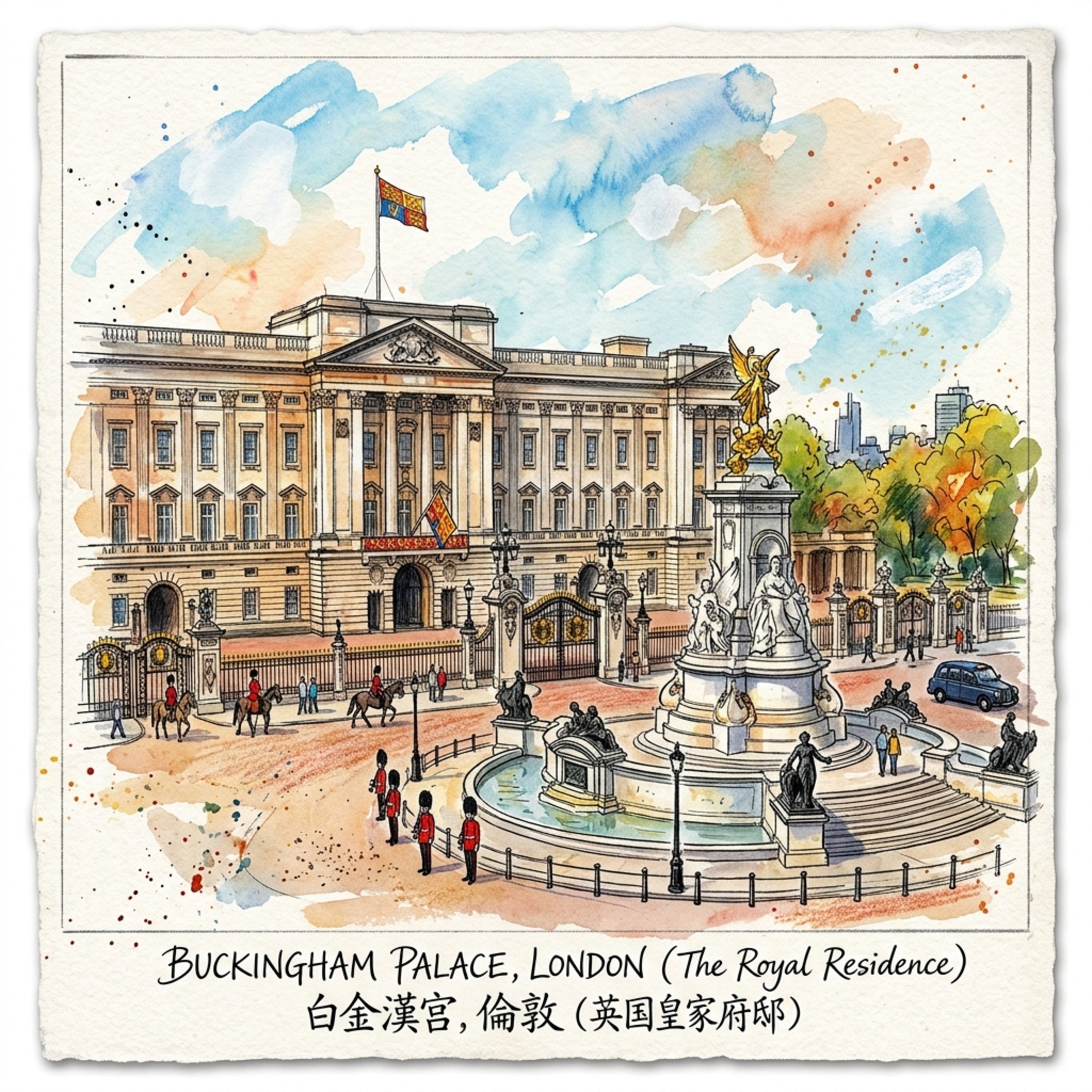
ENG-Buckingham Palace Historical Walking Tour Itinerary
Get every episode summarized
Each time Historical Travel Stories💕旅行の歷史故事 publishes, we email you a written briefing from the transcript — the topics, who appeared, and any specific claims, with the ad reads skipped.
Email me new episodesFree for 3 shows. No card needed.
About this episode
“You know when you see a really elaborate magic trick and the whole point of the illusion is getting you to focus on the shiny object? Right, so you've completely missed the trap door right under your feet.”From the transcript
The provided historical dossier examines Buckingham Palace not as an inherently sacred location, but as a site whose symbolic aura has been repeatedly manufactured and challenged over time. It details how the land transitioned from a monastic estate and a failed Tudor mulberry garden into the ultimate seat of British sovereignty, shaped by deliberate civic architecture and processional design. Furthermore, the text explores moments of significant institutional vulnerability and national trauma, such as notorious palace intrusions and wartime Blitz bombings. Ultimately, the sources reveal that the palace serves as a renewable symbolic capital for the state, requiring constant architectural and narrative re-sacralization because the ground itself possesses no native spiritual foundation.
The Unwritten Pages of Yesterday Listen carefully to the long wind and speak of the old river
Support this podcast at — https://redcircle.com/shows/cfc0e32d-c1fc-435f-8d4b-b3f5fb352872
Read the full story with photos and day itinerary on my website⬇️
💕 Subscribe to unlock historical walking route maps and day-trip itineraries 💕
🔗 Website – Historical Travel Stories (5 languages): https://www.lawrencetravelstories.com
- Japanese historical travel stories: https://www.lawrencetravelstories.com/japanri-ben/
- Hong Kong historical travel stories: https://www.lawrencetravelstories.com/hong-kong-xiang-gang/
- Taiwan historical travel stories: https://www.lawrencetravelstories.com/taiwan-tai-wan/
- The UK historical travel stories: https://www.lawrencetravelstories.com/united-kingdom/
The Unwritten Pages of Yesterday 細 聽 長 風 說 舊 河
Get every episode summarized
Each time Historical Travel Stories💕旅行の歷史故事 publishes, we email you a written briefing from the transcript — the topics, who appeared, and any specific claims, with the ad reads skipped.
Email me new episodesFree for 3 shows. No card needed.
Hosts & guests
Transcript ready
411 searchable segments. Every word is indexed and playable.
Full transcript
Historical Travel Stories💕旅行の歷史故事 — ENG-Buckingham Palace Historical Walking Tour Itinerary. Machine-transcribed; use the interactive transcript above to jump the player to any line.
You know when you see a really elaborate magic trick and the whole point of the illusion is getting you to focus on the shiny object? Right, so you've completely missed the trap door right under your feet. Exactly. We tend to look at certain famous buildings the exact same way. We see the guards, the gilded gates, the sheer imposing scale of the architecture. And we just automatically assume there's this impenetrable ancient force field of authority around it. Yeah, it's like a cognitive shortcut. It really is. We assume the sacredness of the space is just a hard historical fact. Like it's something woven into the literal ground-over centuries. But what happens when you look past that shiny object? Welcome to the deep dive. I'm your host. And today we've got our hands on a really fascinating universal spiritual geospatial historical dossier all about bucking him palace. I'm so excited to get into this one. Same here. And okay, let's unpack this because our mission today is to completely strip away that pristine royal facade.
We really need to look at the very ground it's built on. Right, we're going to explore the actual history of how the space was used. And we'll point out five physical hidden gems you can actually go visit as a tourist today. Which I love because it makes the history tangible. Totally. By the end of this conversation, you're going to see how the quote-unquote sacredness of the UK's most famous building isn't ancient at all. It is a completely 100% manufactured illusion. And just to set the parameters for how we're analyzing this dossier, we are examining this through the very real lenses of documented history, civic geometry and public memory. No myths today. Exactly. There are a lot of myths out there, but we are expressly avoiding any imported mysticism or, you know, ancient magic or pseudo-archeology. Because the real story is weird enough. Oh, it's so much better. The verified bureaucratic history of this site is honestly far more bizarre and revealing than any supernatural myth you could invent. Bizarre is definitely the right word.
Because I mean, if you picture the origins of the British monarchies headquarters, you probably imagine ancient nights, pristine royal decrees. Maybe a castle that's in there since the dawn of time. Right. But the reality between 1066 and the 1670s, this site was a marshland. Literally a soggy, tens-flad plain bog. It belonged to the monks of Westminster Abbey until King Henry VIII just forcibly seized it in 1536. During the dissolution of the monasteries, yeah, which is a massive historical rupture in itself. Oh, for sure. That was the state-taking church land. It was a forced secularization of something previously considered inviolably sacred by the church. So right from the jump, the ground's sacred status is being rewritten by whoever has the most power. Exactly. It's fluid right from the start. But it doesn't just become a palace right away. In 1608, King James I decides he wants to rival the French silk industry. He wants an economic powerhouse. Right. So he plants a massive four-acre mulberry garden right on this seized marshland to feed silkworms,
but he fundamentally botches the execution. He really does. It's almost comical. He plants the wrong species of mulberry tree. He bought tens of thousands of black mulberry trees, Morris, Niagara, when silkworms actually need the white mulberry, Morris, Alba. It's a spectacular failure of agricultural intelligence. Just a total disaster. The silkworms won't eat the leaves. The thread they do produce his course and completely unusable. And the whole grand economic experiment just collapses. It's just wild to me. It's like buying a multimillion dollar luxury estate today. Only to realize your foundation is built directly on top of a failed 17th century strip mul. That is a perfect analogy. And the crown just abandons the silk idea. And eventually this royal enclosure evolves into a highly disreputable pleasure garden. And well, disreputable is doing a lot of heavy lifting there. Yeah, I bet. That's the polite 17th century term for a place of let's say, very questionable late night morals and clandestine meetings.
So you have stolen church land turned into a botched agricultural startup turned into a shady nightclub? I have to imagine people at the time saw this as some kind of karmic payback. They absolutely did. At the time, they viewed the world through what we'd call providential political theology. Meaning everything was assigned from God. Yes. In that era, royal misfortune wasn't just viewed as bad luck or poor planning. It was widely interpreted as direct divine commentary. Wow. You see his land from the church, you try to build a massive economic engine for your own glory. And it spectacularly fails. The public notice the irony. Wait, so basically 17th century Twitter would be saying God hates the king startup. That is exactly what they were saying. But there's no need to import a supernatural curse to find this fascinating. The documented legal and religious history is the real story here because it just keeps changing hands. Right. The land goes from monastery to crown to failed tech startup to carnival grounds before eventually becoming the most regulated austere space in the country.
And for you listening, here is the first hidden gem you can actually seek out today to connect with this chaotic history. This is a great one. A single surviving 1609 mulberry tree from James the first botched experiment still stands in the southwest corner of the Buckingham Palace garden. It's amazing. It survived. Yeah. Today, the garden actually holds the UK's national collection of 40 mulberry varieties, which they deliberately planted in 2001 to sort of reclaim the history. A bit of a PR move there for sure. But if you take a tour and walk near that corner, pay attention to the ground. The soil there still retains the distinct squishy dampness of its original marshy, tems floodplain character. It's a living breathing monument to a royal failure right on the grounds of their ultimate triumph. And I think this messy foundation perfectly sets up the next phase of the palace's life. Because when you start with chaotic, unsacred beginnings, you set a precedent for a building that fundamentally struggles to figure out what its boundaries are.
Oh, definitely. Fast forward to the Victorian era and the physical vulnerability of this place becomes a massive crisis. Yes, the era of the great breaches. I want to introduce you to a kid named Edward Jones. He was a 14 year old Taylor son from Westminster and he essentially became Britain's first celebrity stalker. It's such a bizarre story. Between 1838 and 1841, he repeatedly broke into the newly occupied palace. One time he disguised himself as a chimney sweep, which is very de-Kenziean, very. When they finally caught him, he was found carrying Queen Victoria's underwear and a regimental sword. And in 1840, he was actually found hiding under a sofa just 10 days after the birth of Princess Victoria. What's fascinating here is the context of the timing. Queen Victoria was the very first monarch to use Buckingham Palace as a full-time official residence. So they were still figuring things out. Right, the building's identity was completely in flux. It was trying to shift from being just a fancy aristocratic townhouse into the supposedly inviolable seat of state sovereignty.
And a 14 year old boy just shattered that illusion. Edward Jones proved that this sanctity was purely aspirational. It was an idea in the Queen's head, but it wasn't legally or architecturally enforced yet. I actually want to dig into that legal aspect because the dossier highlights something mind-blowing. Breaking into the Queen's bedroom wasn't technically a crime. It wasn't a criminal offense. That is insane. Because trespass, that specific time in English law, was only a civil matter. It was a tort. Unless you broke a lock, which is burglary, or stole something of significant value, you were just trespassing. The state was genuinely in a panic because they were unable to prosecute a 14 year old boy in any meaningful criminal court. So they have the most powerful monarch on earth, and her legal team is basically saying, sorry, your majesty, best we can do is sue a teenager for walking on your rug. Precisely. They were so terrified of the PR disaster, and so legally toothless, that they resorted to essentially kidnapping him.
Which is a whole other level of crazy. They dragged a force him into the royal navy. When he refused to conform, they just deported him, first to Brazil, and then eventually to Australia, without a proper criminal trial. And the ultimate irony is, if you find his gravestone in Australia today, it misattributes his crimes to Windsor Castle. He doesn't even get credit for the right palace. Exactly. But this spatial vulnerability is something you can still experience. Here is your second tourist gem, the marble hall. A brilliant example of architectural dissonance. Completely. Imagine you're taking a tour of the palace today. You walk into the marble hall on the ground floor. It's public, it's ceremonial, it's all cold, echoing stone. Very formal. But pay attention to the exact moment you transition toward the private apartments. Suddenly, your feet hit plush carpet. The acoustics go completely dead. The hushed intimacy hits you instantly. It's a very sudden shift. That tiny, jarring physical shift is the transition Edward Jones exploited.
The building's own architecture put the profane public space immediately adjacent to the sacred private space with virtually no buffer zone. The architecture didn't know how to protect a monarchy yet. It practically invited the intrusion if you knew which unlocked order to push. So in the 1800s, they couldn't legally or physically keep people out of the building. But fast forward a hundred years and the crown realizes something crucial. That physical walls matter a lot less than symbolic ones. Yes. And ironically, it took a German bomber blowing a literal hole in the palace to help them build an impenetrable narrative wall. Talk about a pivot. Let's go to the morning of September 13, 1940, the height of the blitz. And it was a Friday the 13th, no less. Right. King George VI and Queen Elizabeth are inside the palace having tea. Suddenly a German bomber, a Heinkel H.E. 111, drops five high explosive bombs directly on the palace grounds. Terrifying. Four staff members are injured. One tragically dies and the royal chapel in the south wing is completely obliterated.
You would think this would be a moment of absolute terror and weakness for the monarchy. The ultimate fortress, the symbol of the empire, breached from the sky. It shatters the illusion of safety. Here's where it gets really interesting though. It looks to me like they realized the physical damage was actually a PR gold mine. Absolutely. Queen Elizabeth famously steps out into the rubble, dust everywhere and says to the press, I'm glad we've been bombed. It makes me feel like I can look the east end in the face, meaning the heavily bombed working class neighborhoods of London. It's a legendary quote. It seems incredibly calculated. Did they weaponize this tragedy to manufacture a bond with the public? They absolutely did. And it was a stroke of genius. If we connect this to the bigger picture of what geographers call collective memory geography, this is a masterclass in narrative engineering. How so? Well, historically speaking, looking at Luftwaffe tactics. That raid probably wasn't a targeted metaphysical strike on the palace specifically. It was an area attack. Bombs were falling indiscriminately across London. But the crown didn't play it off as random bad luck.
Exactly. They recognized the rhetorical power of the moment. They converted a random chaotic strike into a unifying national artifact. They spun it. Big time. Bucking and palace suddenly transitioned from being an exclusive elite fortress into a communal grief container. The structural damage wasn't framed as a private, royal misfortune. It was framed as a shared national wound. They bled with the people. Which leads to our third tourist gem. And this one is actually an absence. Because that bombed royal chapel, it was never structurally rebuilt as a chapel. Which is such a profound spatial choice. Instead, in 1962, they redeveloped the ruins into the Queen's Gallery. Right. The tourists buy tickets and walk through that gallery today to look at old master paintings, completely oblivious that they are standing on the exact site of the palace's most direct experience of national trauma. It's really wild to think about. You are standing in the literal blast zone that solidified the modern monarchies connection
to the British people. It's the physical space where they rhetorically re-sacralyzed the building. They took a catastrophic physical breach and turned it into an impenetrable narrative wall that shielded the monarchy for decades. But narrative walls don't stop physical intruders. No, they don't. And as perfect as their PR was in the 1940s, their physical security apparatus in the modern era was shockingly flawed. Which brings us to a mind-boggling modern parallel to the boy Jones. Let's fast forward to July 1982. Oh, the Michael Fagan incident. A complete collapse of the security state. So Michael Fagan is an unemployed 33-year-old guy going through a messy divorce. With summer, he's wearing jeans and a t-shirt, and he decides to scale the 14-foot perimeter wall of Buckingham Palace. A wall, by the way, that is topped with revolving spikes and barbed wire. He gets over it, and he shinnies up a drain pipe, not just once, but twice, weeks apart. The audacity is just... Wow. On his first trip, he wanders around, views some royal portraits, drinks half a bottle
of white wine, sits on a throne, and leaves. Which is baffling enough on its own. But on the second trip, he scales the drain pipe again. It's 7.15 in the morning. He walks straight into the sleeping queen's bedroom, holding a shard of broken glass from an ash tray he broke in the hallway. Terrifying for her. The queen wakes up, sees a bleeding man at the end of her bed, and has to calmly chat with him while repeatedly trying to press the panic button and phone the palace switchboard, which goes completely unanswered. This raises an important question about modern security. Because on the surface, it's almost identical to the 1838 Edward Jones breach, but with a terrifying modern twist. Wait, I need to stop you there. Are you telling me that 144 years later, after two world wars, the invention of radar and the dawn of the computer age, the legal loophole from 1838 was still open? Unbelievably, yes. Fagan could not be criminally charged for breaking into the queen's bedroom. You have got to be kidding me. I'm not. The trespass was still essentially a civil matter.
He was only charged with stealing the half bottle of wine on his first trip, and a jury actually acquitted him of that. That is staggering. But the real modern tragedy here, the real mechanism of failure, is bureaucratic. It wasn't that the technology failed. The palace had stayed-of-the-art high-tech alarm sensors on the walls and the roof, and those sensors worked perfectly. They detected Fagan scaling the wall. They rang in the police control room. So why didn't the guards swarm him? Let me guess. Is it alarm fatigue? Like when your neighbor's car alarm goes off every time a truck drives by, so you just stop looking out the window? Exactly that. The police on duty assumed it was a glitch. They thought a bird had tripped it, or the system was malfunctioning, so they manually turned the alarms off twice. Wow. It's a fundamental failure of institutional trust. The technology had outpaced human belief. The symbolic wall of the palace was totally intact in the public's mind.
Everyone thought it was a fortress, but the human operated literal wall collapsed entirely because of complacency. Which brings us to tourist gem number four. And I love this one because you don't even need to buy a ticket. This is a fun one. You can just walk up to the public pavement on the west and south sides of the palace exterior. You can stand there. Right up at that perimeter wall, see the revolving spikes, and trace the exact drain pipe route Fagan used. It's right there in plain sight. You can stand at the exact point of historical rupture and just marvel at how a barefoot guy in jeans bypassed the most famous, heavily funded security apparatus on earth just because a guy in a control room thought the alarm was annoying. Which brings up a great paradox, doesn't it? If the physical security is historically this messy, if the legal protections were to work historically, this full of holes. And if the ground itself is just an old marsh, how does this building consistently project such an intense aura of authority?
Why do we still fall for the magic trick? Exactly. And the answer to that isn't magic. It is deliberate, engineered architecture. Let's look at the approach to the palace, the mall. If you trace the history of that famous red road back to the 1660s under Charles II, it was nothing special. Not at all. It was just a treeline dirt alley used for a French lawn game called Py-my. Basically an early version of Croquet. Right. It was purely recreational space. Right. But then in the 1820s, an architect named John Nash gets his hands on it. And later, between 1901 and 1911, Sir Aston Webb takes over the redesign. The big guns. Yeah. And they fundamentally re-engineered this simple park alley into a massive, intimidating processional axis. They widened it, straightened it, and terminated it right at the massive Victorian memorial with the palace facade looming behind it. And this is where we have to explicitly debug a very persistent myth. Oh, please do.
Starting in the 1920s, there was this trend of esoteric writers claiming there were ancient mystical laylines running through this part of London. Got named Alfred Watkins coined the term in 1921. Okay. When these ancient druidic energy currents aligned perfectly with the palace and the mall, giving it a supernatural resonance. But the dossier says that's complete nonsense, right? There's no ancient magnetic field keeping the monarchy in power. Complete nonsense. It is not ancient magic. It is highly documented 19th and 20th century state architecture. They just built it to look that way. Exactly. Nash and Webb deliberately built a fixed sightline. The engineered and urban approach that visually forces your eye straight to the sovereign's residents. It's what architects call a built argument. A built argument. I like that. It encodes political theology into city planning. It is essentially saying visually, physically, and politically, all roads lead to the crown.
Which brings us to our final tourist gem, the ultimate vantage point to see the magic trick at work. Yes. If you go stand at the mall's eastern viewing point just southwest of Admiralty Arch, you will see exactly what they engineered. Look down at the red tar mecha dam beneath your feet. It's very striking. That wasn't an accident. It was deliberately chosen and colored to look like a permanent rolled out ceremonial red carpet. And from that spot, you'll see this perfectly unbroken visual line leading straight to the palace. It's all about perspective. The trees and the road compress your peripheral vision, forcing you to look forward, and then releases that visual tension right at the towering monument. It operates exactly like the approach to the altar in a grand cathedral. But it's totally secular statecraft. It's a psychological trick played out in urban geometry. They didn't discover a mystical alignment in the earth. They manufactured a visual one from scratch to make you the individual feel small and the
state feel incredibly huge. So what does this all mean? When we zoom out and look at all the pieces we've unpacked today, the failed mulberry start up on marshland, the teenage stalkers exploiting civil loopholes, the brilliant PR spin of the blitz, the ignored alarms, and the engineered red roads. What's the big takeaway for you? Listening. The meta-analysis of this whole dossier synthesizes into one core insight. Looking at palace is not a side of inherited ancient sacredness. The ground itself has no continuous sacred property. Because it just keeps getting seized, replanted, breached and repurposed. Exactly. What the palace actually represents is renewable symbolic capital. Renewable symbolic capital. Yes, its sacredness isn't a permanent ancient force field. It is a fragile narrative that has to be periodically built, breached, rebuilt, and rhetorically reasserted by whoever holds the levers of power. When a teenager breaks in or a guy in jeans climbs a drain pipe, the sacredness is breached,
the illusion cracks. But when the crown uses a World War II bombing to bond with the public or builds a massive red avenue to intimidate visitors, the sacredness is rebuilt. It's a constant, active, desperate cycle of manufacturing authority. That is wild. The next time you see Buckingham Palace on TV, or you're walking around London checking out that squishy, damp, mole-berry tree, or standing in the blast zone of the Queen's Gallery, or looking down the engineered red tarmac of the mall. I want you to remember that you are looking at a brilliant piece of ever-changing, manufactured stagecraft. A stagecraft that is incredibly well-documented if you know where to look. And we highly encourage you to go dig into this yourself. Don't just take our word for it. Seriously. We'll look up the UK Home Office Freedom of Information release on Michael Fagan. The file reference is literally 66674, Intrusion, Palace, Fagan, 1982. It's a fascinating read. Reading the actual bureaucratic panic of the police trying to explain why they ignored
those alarms is mind-blowing. Or go dig into the World War II Luftwaffe operational records and see the debate for yourself. Was that 1940 bombing truly an accident of area bombing or a targeted strike? The history is right there waiting for you. Getting into the primary sources really changes how you look at structural power. Which leaves us with a final thought for you to mull over. If the aura of one of the world's most famous and supposedly inviolable buildings is entirely manufactured and has been physically and legally broken so easily by teenagers and unemployed citizens, what other sacred institutions in our modern society are just relying on a really good coat of red tarmac and some clever PR to keep you out. It makes you wonder how many other magic tricks we're falling for every single day. Just because we're too busy staring at the shiny object to notice the trap door. Keep questioning the force fields around you. Thanks for joining us on this deep dive.
More episodes
More from Historical Travel Stories💕旅行の歷史故事

JPN-バッキンガム宮殿の歴史を巡る1日散策ツアー
Historical Travel Stories💕旅行の歷史故事

FRA-Itinéraire de la visite à pied historique de Buckingham Palace
Historical Travel Stories💕旅行の歷史故事

SPA-Itinerario del recorrido histórico a pie por el Palacio de Buckingham
Historical Travel Stories💕旅行の歷史故事

CAN-白金漢宮歷史散步一日遊行程(廣東話)
Historical Travel Stories💕旅行の歷史故事