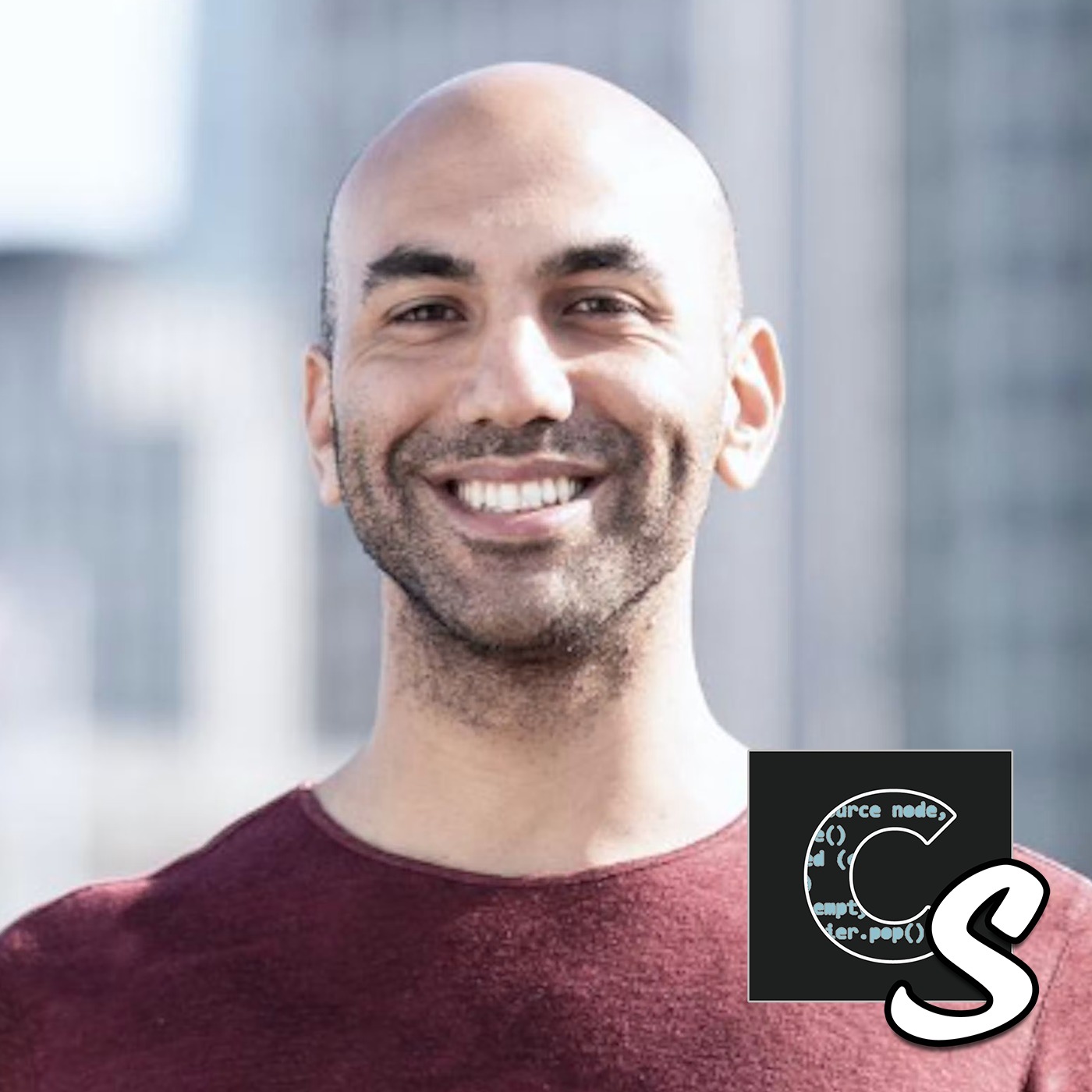
E13 E6: The Spatial Web Shift: Building Decentralized AI Knowledge Graphs with Yaniv Tal, Co-Founder & CEO of Geo
Get every episode summarized
Each time Code Story: Insights from Startup Tech Leaders publishes, we email you a written briefing from the transcript — the topics, who appeared, and any specific claims, with the ad reads skipped.
Email me new episodesFree for 3 shows. No card needed.
About this episode
Code Story: Insights from Startup Tech Leaders is made possible by:
All brands on Code Story: Insights from Startup Tech Leaders →
“And it's a very non-traditional thing that we're building because it's part web protocol and it's part consumer application. And those two things are very different things, right? Like a core web protocol, it's job is to be perfect and to never ever change.”From the transcript
Yaniv Tal grew up in the Bay Area in the 90's with parents who were engineers. They were both in electrical engineering, specifically digital/signal processing. He really saw the internet sport up into a massive thing. He studied the hard sciences (electrical engineering, math and physics), and his first job out of college was at HP, doing board b ring up for printers. Outside of tech, he is recently married, having a lovely wedding on a beach in Mexico. When asked "what do you do for fun?", he can't answer it, cause he is a bit of a workaholic and loves what he does. But, he does make sure he spends quality time with his new bride.
In 2017, Yaniv founded a protocol called The Graph, one of the core web3 protocols. After many years on this journey, he started to have a vision around the world's broader knowledge in a decentralized, verifiable way. Eventually, he and his team set out to launch a a solution around this vision, designed to solve fragmentation of knowledge, vulnerable to centralization, silos and misinformation.
This is the creation story of Geo.
Links
https://www.linkedin.com/in/yanivtal9/
Current Sponsors:
Checkout our Stacklist! https://stacks.codestory.co/
Hosted by Noah Labhart | Technical Founder & Startup Mentor.
Our Sponsors:
* Check out Granola and use my code granola.ai/CODESTORY for a great deal: https://granola.ai
* Check out Perplexity and use my code pplx.ai/codestory for a great deal: https://www.perplexity.ai
Advertising Inquiries: https://redcircle.com/brands
Privacy & Opt-Out: https://redcircle.com/privacy
Get every episode summarized
Each time Code Story: Insights from Startup Tech Leaders publishes, we email you a written briefing from the transcript — the topics, who appeared, and any specific claims, with the ad reads skipped.
Email me new episodesFree for 3 shows. No card needed.
Hosts & guests
Transcript ready
804 searchable segments. Every word is indexed and playable.
Full transcript
Code Story: Insights from Startup Tech Leaders — E13 E6: The Spatial Web Shift: Building Decentralized AI Knowledge Graphs with Yaniv Tal, Co-Founder & CEO of Geo. Machine-transcribed; use the interactive transcript above to jump the player to any line.
And it's a very non-traditional thing that we're building because it's part web protocol and it's part consumer application. And those two things are very different things, right? Like a core web protocol, it's job is to be perfect and to never ever change. And a consumer app's job is to iterate almost hourly, daily based on user feedback and adapting and really having an incredible user experience. And so doing those two things together has really been the core challenge. My name's Yineet Tal and I'm the founder of GIA. This is Code Story. A podcast bring you interviews with tech visionaries. It's like six months moonlighting. It's the loss in other back times. Who share what it takes to change an industry? I don't exactly know what to do next. Who do many goes to get right? Who built the teams that have their back?
The company is its pitiful. The teams help each other achieve more. Those proud of our team. Keeping scalability top of mind. All that infrastructure was at the end. Yes, we've been fighting it as we've grown. Total waste of time. The stories you don't read in the headlines. It's not an easy thing to achieve, my friend. To get some shelf and best of it off and try to begin. To ride the ups and downs of the startup line. Need to really want it. It's not just about technology. This is more on Code Story. I'm your host, Noah Laphart. And today, how Yanev Tall has built the network for organizing knowledge that we can collectively govern and most importantly, trust. This episode is brought to you by Tiger Data. Stop bolting separate databases onto your stack. Tiger Data is 100% unforked postgres. Same ORMs, same drivers, no pipeline maintenance. As Cloud Flares team put it, you keep analytical and config data under one roof with specialized OLAP performance.
Try it today at TigerData.com. This episode is brought to you by Protected Harbor. Your infrastructure scales. But does it actually understand your apps? With Protected Harbor's application aware infrastructure or AAI, your tech automatically aligns with app performance while built-in zero-trust security verifies every user and workload. Give your team total control without the complexity. Go to ProtectedHarvard.com slash Code Story to learn how. This episode is brought to you by Render. Stop jumping between four vendor consoles just to host your stack. Render runs your web services databases, background workers, and AI workflows all in one single cloud platform. Connect your repo, push your code, and your live. No serverless timeouts or crazy setups. Ship faster today with Render.com. Yanev Tall grew up in the Bay Area in the 90s with parents who were engineers. They were both in electrical engineering specifically digital signal processing.
He really saw the internet spin up into a massive thing. He studied the hard sciences, electrical engineering, math, and physics. And his first job out of college was at HP doing board bring-up for printers. But outside of tech, he's recently married having a lovely wedding on the beach in Mexico. When asked, what do you do for fun, he can't answer it. Because he's a bit of a workaholic and loves what he does. But he does make sure he spends quality time with his new bride. In 2017, Yanev founded a protocol called the Graph, one of the core Web3 protocols. After many years on this journey, he started to have a vision around the world's broader knowledge in a decentralized, verifiable way. Eventually, he and his team set out to launch a solution around this vision designed to solve fragmentation of knowledge, vulnerable to centralization, silos, and misinformation. This is the creation story of Geo. Geo is a network for organizing knowledge
that we can trust. And the problem we want to solve is it's so difficult to know today what is true. We're constantly bombarded with information, social media is a very chaotic environment, and our systems for organizing and making sense of what's happening in the world, it feels like I've really broken down. What Geo does is we organize knowledge into a knowledge graph. And it's a really flexible way of representing information where you can structure and add free-form relationships between different things. And then we have a governance process on top. And a way of organizing that so that communities can collaboratively organize knowledge together. And what that does is it creates a global, interconnected graph of knowledge and information where you have the full provenance. You can see where things came from. You get more context. And we think is really a solution to this information problem that we're facing.
All of this actually started for me closer to 2016 into 2017. I founded a protocol called the Graph, which is one of the core Web 3 protocols. At the time Ethereum was taking off. And it was a really exciting time to start tinkering around with blockchains and diving into this new world. There were some really great ideas, but the reality is all of this stuff was still super early. There was a lot to still figure out. This journey that started back then was now going on nine years. It really had the initial vision for what we're building today really still back then. And it came from actually like a lineage of computer science and really great thinkers. Essentially what we're building is actually the realization of what the original architects of the web actually wanted the web to be. Timbers, Lee, and all of those guys were working on this thing called the semantic web.
The idea of the semantic web is that the knowledge and information should live outside the context of any one application. They wanted the web itself to be this open web, an open interconnected graph. And that's what they realized, right? Not a web of pages, but a web of data. We had these standards, RDF and Sparkle for querying, but there were quite cumbersome. And there were a bunch of problems with the early attempts to do this. You saw graphs becoming popular a little bit later with things like GraphQL, of course, from Facebook. And that was adopted through a lot of different companies. But we still kind of had this thing which was the web really re-centralized around these large tech platforms. And that was not what the web was supposed to be, but that's what ended up happening, right? We had Facebook, Google, Twitter, these large tech platforms where more and more of the activity that was happening on the web got centralized
into these large tech platforms where the value that we're creating is getting trapped and stuck and controlled by these giant databases that were proprietary and internal to these companies. What Ethereum and these blockchain protocols are trying to do is open this stuff up and really re-architect our core coordination systems so that they're more open, transparent, interoperable, and really aligns with actually those original visions of the web. And so as soon as I started tinkering around and trying to build decentralized applications, realized that the infrastructure was not really ready. You couldn't build these apps at scale. And that's when I started building the graph and then ultimately led me to Geo. Let's dive into what you would consider the MVP for Geo. So the first version of the product you built, how long did it take you to build and what sort of tools were using to bring this to life? It's been a pretty wild journey.
We spun Geo out as a separate project back in 22 and there's a whole story there that's actually quite fascinating around decentralized organization and software engineering and how that came to be. But so it's basically been four years that we've been heads down building. Now it's rare to take this amount of time for building any kind of product, but it's really what it's taken. And so I've been self-funding Geo for the last four years. We've got a great team that's been working on it and it's a very non-traditional thing that we're building because it's part web protocol and it's part consumer application. And those two things are very different things, right? Like a core web protocol, its job is to be perfect and to never ever change. And a consumer apps job is to iterate almost hourly, daily based on user feedback and adapting
and really having an incredible user experience, which can be challenging on its own, right? Especially on a brand new sort of application stack. And so doing those two things together has really been the core challenge. Geo itself, it's a complex system and our approach is a little bit like an Apple approach, which also is a little bit different than what you would generally do with a protocol stack. But we think it's been important enough to really think of it as an integrated system and to get all of the pieces working well together. And so the pieces of the stack is first, you need like a knowledge graph standard, right? Something that could replace RDF as almost a serialization format, but really it's like a graph data model and getting the specifics of how you actually structure this graph, getting that right. Then you have this on-chain layer and the infrastructure and the on-chain layer does a few different things
and one of them is this governance system. And so you have different participants that can perform different actions. And it's essentially think of voting, signaling, up voting, down voting, approving, rejecting, all this kind of stuff. See, it's almost like a social layer that is happening through governance. You need to index all of this and the database and indexing aspects of this are really quite interesting. There's a lot to be said about taking essentially an immutable blockchain and making that queryable over history and how you structure this really across space and time. On top of that, you got to build an SDK so that people can build custom applications. And so it's a whole development environment for building apps on top of this open, interoperable knowledge graph. And then we ourselves actually started with this thing, which is the Geo browser. And that was always a kind of a controversial concept,
but a browser of this new verifiable web where everything that you see inside of this browser is attributable, right? That there's the full provenance. You can see exactly who published what went, right? It's cryptographically signed. And so you can do full verification of every single thing that you see in the browser along with this history. So you start to see like a get for data. Right? So imagine if you're browsing the web and every single thing that you see you can see the full lineage, the full provenance, it's like get and all of that is available through this browser. So those were all of the different components. And really we focus on different components at different times going across the stack, getting cohorts of users. And we've had plenty of different cohorts throughout the last four years where we build a piece of it. We put it out there. We get people using it. And then we learn and iterate. And so it's really been, it's really long process.
And we're now at this beautiful point of convergence where the pieces are really snapping together. And we're really excited for where things can go from here. This episode is brought to you by FitNixah. All right, quick question. How many times have you tried to fall asleep only to be held hostage by a snoring partner, obnoxious traffic, or your upstairs neighbor practicing tap dance? Yup, in there. Listen up, because I just found your new secret weapon, Somnipod's 3 by FitNixah. These bad boys are ultra slim coming in at under 10 millimeter stick and just 3.3 grams light. That means if you're a side sleeper, you won't even feel them in your ears. Plus, they pack powerful hybrid active noise canceling that shuts down up to 42 decibels of total noise. Goodbye snoring. Hello, sweet dreamland. And it gets better. They feature built-in white noise, high-res audio for daytime tunes, and overnight AI sleep tracking, so you can actually see how well you slept. You even get 10 custom tip sizes in the box
to guarantee that perfect custom fit for your ears. Upgrade your sleep tonight. Head over to go.fitNixah.com slash code story or use the link in the show notes right now. Because FitNixah is giving code story listeners $10 off of the Somnipod's 3. Experience what uninterrupted rest actually feels like. Trust me. Your brain will thank you tomorrow. This episode is brought to you by TigerData. If you're like me, your architecture diagram started simple. Until someone added a specialized time series DB, a couple of pipelines, and suddenly, you're babysitting four databases at 2 a.m. Stop doing that to yourself. Inner TigerData. It's 100% unfort, pure postgres, same drivers, same ORMs, same standard SQL, zero new query languages to learn. And not just in theory. Plexigrid consolidated four database is down to just one instance and got 350 times faster queries. Gluco in just 3 billion points a month and Orker processes over $500 million
in daily trading volume. Maybe you've heard of Cloudflare? Yeah, that Cloudflare. The way they put it with TigerData, you get OLAP speed right alongside config data all under one roof. As you can see, TigerData handles series scale. Storage compression is absurd, and your Cloud Bill will thank you. So streamline your stack today. Head over to TigerData.com and see why over 3 million TigerData databases are running right now. That's TigerData.com. Okay, that's actually a perfect segue. I want to dive into some of those components and what you mentioned about how you decided and to build those at different times and kind of wrap that in a box. I'm looking for a roadmap. How do you build your roadmap for Geo? How do you decide that, okay, this is the next component or this is the next most important thing to build or to address? I'm definitely a believer that you want to get things in front of users as soon as you can. I think there's only so much that you can build in a vacuum.
The one place where it for a system like this that is this complex, that fortunately I had the luxury to do was to take time before scaling it. To me, there's a big difference between getting user feedback and essentially locking something in and scaling it. Once you have thousands of users, hundreds of thousands of users, it becomes really hard to make structural changes. You get a little bit locked in. And so that's the part that I really wanted to take our time before doing. But we had real users using the product within six months. And we're looking at about six months of integration cycles from applying our learnings and then making changes. So where we started, our first version was actually a native app. Actually the first one was React Native. And really where I wanted to start with was the user experience. We started with this kind of just UI-only browser
to try to understand, create like a block-based editor similar to Notion. Notion was big, but not even as big as it is now. I feel like Notion did something that was really big in the world of user interfaces, which is something that people tried to do, you know, for even decades, which is create a generalized application, framework that people would actually want to use. But started out is almost like a notes app. But if you see how Notion's used in different organizations and personally for a lot of people Notion had replaced their CRM, their project management tool, all sorts of different things that would have been specialized apps into this one generalized app. And I think what they really proved was the power of this block-based editor model. And so we kind of started there. And then from there, it originated on the data layer. And our first version had a relational model.
I always suspected that the graph data model was the right one. And there were all kinds of interesting things to figure out around the type system that you would use for something like that. How you define the ontologies, how rigid or strict to make different things. All of this was really through a process of exploration where we started with the users first and then put something in front of them. And the direction that we took with this was to try to find a nice cross-section of use cases because having a personal application is different maybe than a business application or a community-based application. And so trying to have a wide cross-section of different use cases where we can test with users, learn, and iterate, that was basically the process. I'm curious about team, right? You got to have the right team at the helm to do something big like Geo and the graph and those things.
I'm curious about what you look for and those people to indicate that they're the winning horses to join you. I think that the biggest thing that I start with is mission alignment. It has to be someone who, through their own journey, has come across the core problem that we're solving and really believes that it's a problem we're solving. And then from there, I look at someone who has really been on their own journey where they've just pushed their own limits every step of the way. I love to understand where people started, what their journey was, that they weren't just going through the motions, right? But that they were actually driven by something inside themselves to continuously push and improve and discover new things. And I think you can tell that by really hearing people's stories. Skill, I actually find, is pretty easy to evaluate for. And it really falls out of those things. If someone's really driven and has a purpose and is smart and thinks through things well, usually they can learn the skills through that process.
And then someone who's great to work with that cares about other people, they want to be helpful. So you get a little bit of that and that was the kind of things I look for. This episode is brought to you by Protected Harbor. Guys, I'm sure your IT infrastructure can scale but does it actually know your applications need? Or is it just throwing bandwidth at the problem and hoping nobody breaks in? That's where Protected Harbor, an application-aware infrastructure, or AAI, comes in. Instead of hoping for the best, application-aware infrastructure, aligns your tech resources directly with what your apps actually need to perform safely. Plus, it's engineered with built-in zero-trust security. That means every user, device, and workload gets verified continuously. No automatic passes, no free rides. You get total visibility and ironclad control without making life a living nightmare for your dev teams. You get to build, deploy, and scale on infrastructure designed around security from day one. So stop assuming your network is safe and start knowing it is.
Go to ProtectedHarbour.com slash code story. To learn how AAI can strengthen your stack today, that's ProtectedHarbour.com slash code story. This episode is brought to you by Render. If you're building modern full-stack apps or AI agents, you know the drill. Your front-end is on one platform, your database is on another. Background jobs are on a third, and half your day is spent jumping between vendor consoles. It's exhausting. That's why you need to check out Render. Render is the cloud for builders, a single platform for your web services, Postgres databases, background workers, and cron jobs. You connect your Git repo, push your code, and it's live in production with automatic TLS and zero downtime deploys. Connect your repo, push, and done. Plus, unlike serverless platforms that time out mid-execution, Render's compute is persistent with features like Render workflows, long-running AI agent loops, and multi-step jobs run smoothly without you having to build complex, Q, or retry logic.
Over 6 million developers are shipping on Render, scaling from early builds to millions of users on the exact same platform. Head to Render.com and ship your next project today. That's Render.com. This will be super interesting because I'm not sure in my mind how to approach the question. So I'm just gonna ask it broadly, how did you approach scale in the beginning? And that's technological scale, it's team scale, it's all the things for Geo. And have there been interesting areas where you've had to fight that as you've grown? I wouldn't say that we're at the scaling portion yet. The graph definitely went through scale. And had a period where we had our own fail whale sort of thing. People remember the early days of Twitter, famously the site would go down every once in a while and they would just put up this hilarious whale. We had those times where we brought down the entire web three industries several times where the ducks just stopped running.
Everyone was building on the grass and so their apps would stop loading and just because things were growing so rapidly. But do you learn about the architecture as you go? Right, a lot of the things now, it's a very parallel first mentality and there are a lot of things in the architecture itself to make sure that you can shard things properly and so you don't hit these bottlenecks. But I would say that aspect of taking our time to get the foundations right, it's not always the right thing to do. A lot of times it's better to just ship and get it out there and grow. But I do think that if you're building a core protocol, your job is to get it right. And we haven't scaled it yet, but pretty confident that the time we spent to get the foundations right or the thing that's going to allow us to scale. I'm curious, as you step out on the balcony and you look across all that you've built thus far and I would include Geo and the graph and all the things you built, what are you most proud of?
I'm most proud of the fact that we never compromise the vision. And I think that can be really hard when you're doing things that are unproven. It's very natural to want validation, right? We all want validation, the market wants validation your investors want validation, everybody wants validation. But validation is hard to get if you're creating something that's genuinely new. Right, by definition, if you're creating something that's never been done before, it is not validated. And somehow you have to maintain its this balance between a sort of idealism while also actually being ruthlessly pragmatic. Because if you're too far in the cloud, you're going to miss it. And so you have to constantly be checking yourself against reality but somehow holding the principles and the ideals in the destination firmly in mind
and not compromising on the things that will allow you to get to a place where something that is genuinely new really exists. And for us, that's been compounded across a few different dimensions. We have the core technology and you have a question, can something like the semantic web actually exist, right? Or is it just a failed idea that there's a good reason why it can't happen and won't happen? So that takes some belief, right? Can decentralized coordination work or is everything going to be concentrated inside a few handfuls of companies? When it comes to crypto and web three, can we create new economic systems that incentivize behavior in new ways? Or is the pure, for-profit company model, the only model that can work? All of these are really big questions. And you have to have a little bit of belief and I think the fact that we've maintained that belief through almost a decade now
and continue to build, continue to charge forward, I think that's the thing I'm most proud of. Let's flip the script a little bit. Tell me about a mistake you made and how you and your team responded to it. When we started GIO, I'd mentioned that we'd started with this React Native app. And there were two things that we realized from there. The first was that actually what we were doing, bull native would have been better than React Native because we just really wanted the best possible performance we could get and that was important. But then the second thing we realized at the same time was that the development velocity was too slow for any type of native compared to web. And we wanted to be iterating and shipping new updates to users and we needed to be able to rapidly iterate. The web was actually the right platform to start. That was a difficult decision in which spent six months on the initial version and we realized we had to start over from scratch. But I think that was the right decision to make.
And sometimes you have to take those and you learn a lot from every iteration. You've got the artist mentality and you've got the business person's mentality. I think that the artist in you has to always be ready to start from scratch, to not be too attached to anything that you've done. And that's probably necessary to achieve perfection. The business person in you probably just wants to ship the thing and it's good enough and no rewrites. And there's certainly a time and a place for that too. Plenty of companies I think are probably guilty of maybe rewriting something to some new framework with questionable business value. So you don't want to do those all the time. But I think that was an example of a time where we recognized it. We made the course correction and I'm glad we did. Yenif, let's move into the future. This will be exciting. Why you built GEO and what you're excited about doing in this decentralized knowledge graph. What does the future look like?
For what you're building for, where the industry is going, where does that the buzzword AI fit into this and all the things coming with the future looks like? The North Star that I'd be looking to is can we improve the quality of discourse? I feel like these are so polarized and that shows up in my friend groups, with my family, with all kinds of people where people have just flintered. And it's hard for them to even talk to each other sometimes all political issues. And then you see it at a local level where I think we're living at a time where resources are no longer in strength. We have the capital. It's really coordination. It's alignment. It's can you get people to agree and can allow people to move faster, right? So that we can build more and we can solve our problems and move faster. To me what I would love to see is improving the quality of discourse, helping to get back to some foundation of shared facts, shared reality, and balancing still freedom,
right? Freedom to also disagree. And we believe in pluralism. So that the system should allow for different points of views to coexist. But having a structure within that, for things to converge over time, for people to better understand each other's differences, maybe resolve some of those differences. If you start with more of a shared language, you get back to more shared facts. I think it improves that ability to have that hard quality discourse. And that's a big piece of what we'd love to see. And if from there we can help companies work better, industries work better, and even get into things that touch on government, local government, national governments, to assist in policy, and these sorts of areas we'd love to be helpful there. And so those are the sorts of things that I see in our future, and where I think we can make a lot of impact. And AI is obviously a really exciting place. And I feel AI touches on every unit of organization,
your own personal productivity, your company's productivity, the industry level, of course, up to governments. And I think there's a bunch of ways that a global interconnected, verifiable knowledge graph really intersects with AI. One way that you could see this sort of knowledge graph is as being like a collective memory system. I think intelligence is no longer the bottleneck. I love seeing the new models come out and they keep getting faster and smarter, but we're already getting to a point where these models are really good. And the question becomes, what are you feeding into these models? What are they being trained on? What are they answering their questions against? Right, if you ask something, is it getting the most up-to-date information? Is the information accurate? Does it have the full context? And that applies with your own workflows as well, right? As a developer, if you're using AI to write code,
you know that the context that you feed your AI is super important if you're giving it out-to-date, out-of-date docs. It's going to give you the wrong answer. And how you structure the knowledge and information make sure that it's accurate up to date. It's really important at all of these levels. Your personal memory systems, the collective memory, I think it's really important that we get the structure and the organization of that, right? Let's switch to you. Who influences the way that you work? Name a person or many persons or something, you look up to and why. This one is going to take me back to 2015 with an engineer and architect, Rich Hickey, who has a huge influence on me. And a lot of the ideas that we're still working on. And I loved his talks where it was part great software engineering and part philosophy. I would say Rich Hickey as an engineer has been one of my greatest influences. And today, I think there are some really great entrepreneurs
out there. And I'm just really amazed at just the pace of progress. I think the thing that I keep coming back to those is kind of alignment because I feel like there's this separation between the frontier and the everyday person. You have the Elon Musk's and the Sam Altman's and all of these folks that are really at the frontier pushing things. And then you've got everyone else that feels like more, more and more either not bought in or not keeping up. And I would love to try to see some of that divide clothes a little bit and farming people to be more knowledgeable, to participate in a process, to be part of the conversation, so that we can move society forward together. That's something that I see because I think we got to keep pushing forward. But I really hope we can bring everyone along for the right. Okay, and the last question. So you're getting on a plane and you're sitting next to a young
entrepreneur who's built the next big thing. They're jazzed about it. They can't be showed off to the world. And can we show it off to you right there on the plane? What advice do you give that person having gone down this road a bit? Get your stuff in front of users as soon as you can. That's number one. And number two is make sure that you're working on the right problem. I think when you build something, you're going to be dedicating many years to it if it goes well. And you really want to have a problem that if this was all you did for the next 10 years, 20 years, you would be happy that you spent that time on that problem. To me, the problem selection of making sure that it's a real problem, right, that it's worthy of your time. And that it is the right fit for you, right? That there's something really deeply about you why like this is the right one for you. And if you get that right, I think everything else snaps into place. That's fantastic advice. We need to thank you for being on the show today and thank you for telling the creation story of Geo.
Thank you so much. It was great being on here with you. Thank you Noah. And this concludes another chapter of Code Story. Code Story is hosted and produced by Noah Labhart. Be sure to subscribe on Apple Podcasts, Spotify, or the podcasting app of your choice. And when you get a chance, leave us a review. Both things help us out tremendously. And thanks again for listening. Capital One's tech team isn't just talking about multi-agentic AI. They already deployed one. It's called chat-concierge and it's simplifying car shopping using self-reflection and layered reasoning with live API checks. It doesn't just help buyers find a car they love. It helps schedule a test drive, get pre-approved for financing, and estimate trading value, advanced, intuitive, and deployed.
That's how they stack. That's technology at Capital One. Capital One's tech team isn't just talking about multi-agentic AI. They already deployed one. It's called chat-concierge and it's simplifying car shopping using self-reflection and layered reasoning with live API checks. It doesn't just help buyers find a car they love. It helps schedule a test drive, get pre-approved for financing, and estimate trading value, advanced, intuitive, and deployed. That's how they stack. That's technology at Capital One.
More episodes
More from Code Story: Insights from Startup Tech Leaders

S13 Bonus: The AI Marketing Cloud: Harnessing Predictive Intent to Scale Growth...
Code Story: Insights from Startup Tech Leaders

S13 Bonus: Scaling Real-Time Search Data: Secure APIs for AI Infrastructure with...
Code Story: Insights from Startup Tech Leaders

E13 Bonus: The AI SAST Shift: Eliminating Vulnerability Backlogs with Santiago C...
Code Story: Insights from Startup Tech Leaders

S13 Bonus: The Enterprise AI Chip War: Rethinking LLM Silicon & Inference with V...
Code Story: Insights from Startup Tech Leaders