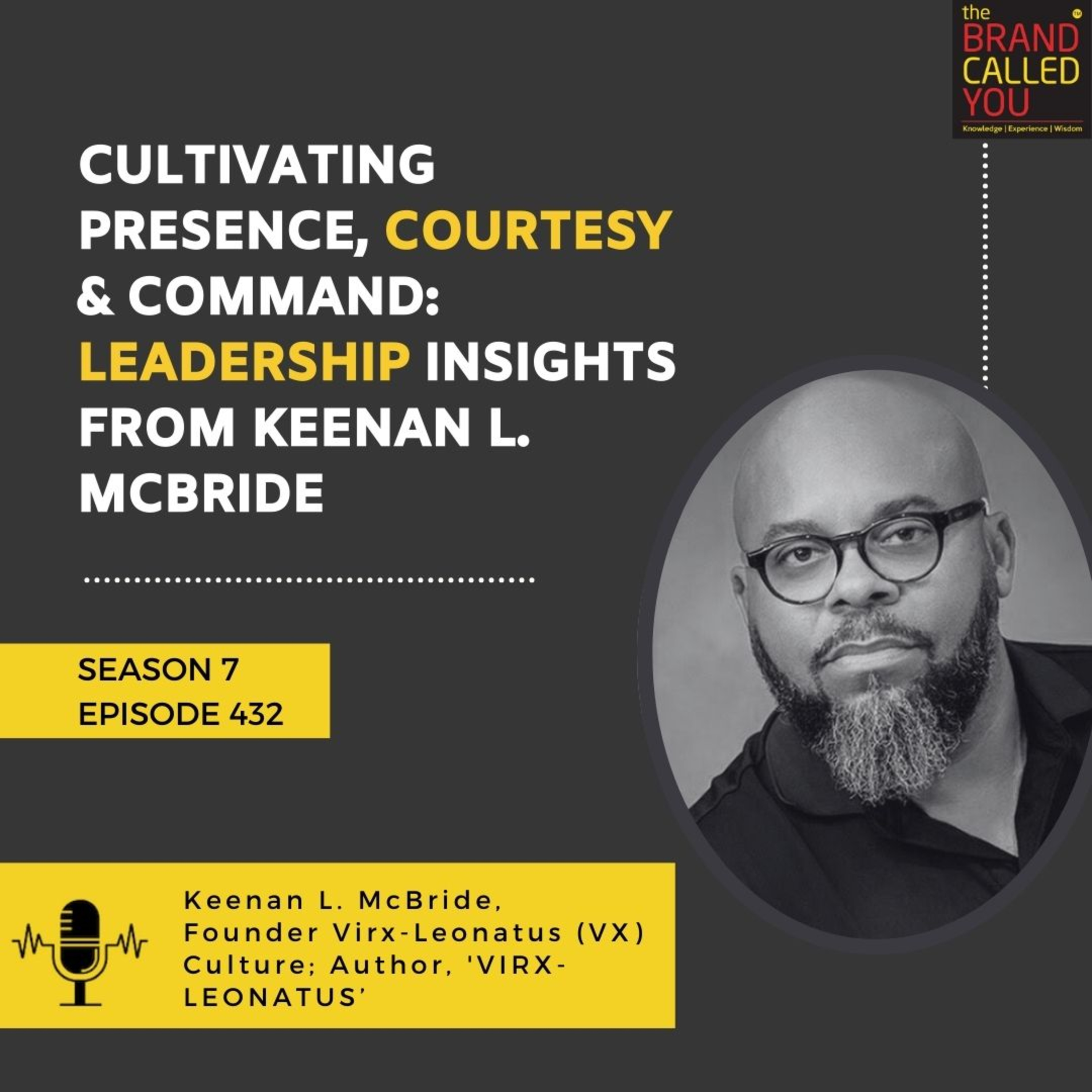
Cultivating Presence, Courtesy & Command: Leadership Insights from Keenan L. McBride, Founder of VX Culture & Author
Get every episode summarized
Each time The Brand Called You publishes, we email you a written briefing from the transcript — the topics, who appeared, and any specific claims, with the ad reads skipped.
Email me new episodesFree for 3 shows. No card needed.
About this episode
“A what-cast and podcast show that brings you leadership lessons, knowledge, experience and wisdom from thousands of successful individuals from around the world.”From the transcript
Join us for a transformative conversation with Keenan L. McBride, author of VIRX-LEONATUS and Founder of Virx-Leonatus (VX) Culture. Hosted by Ashutosh Garg, this episode explores Keenan’s 30-year leadership journey, the profound influence of his father, and the principles behind the VX Culture philosophy.
Discover why discipline, empathy, presence, and courtesy are not merely “soft skills” but powerful strategic advantages in business and life.
Keenan explains the five pillars of the VX philosophy, the leadership lessons inspired by the lion, and why true authority is defined by quiet command rather than loud dominance.
Whether you are a leader, aspiring leader, or someone rethinking organizational culture, this episode offers valuable insights and inspiration.
The shift from operations to strategic leadership
Lessons from overcoming early career challenges
How personal presence and image shape leadership
The strategic value of courtesy and empathy
Building organizational culture through the VX philosophy
- In this episode:Practical ways to develop confident, authentic leadership
Get every episode summarized
Each time The Brand Called You publishes, we email you a written briefing from the transcript — the topics, who appeared, and any specific claims, with the ad reads skipped.
Email me new episodesFree for 3 shows. No card needed.
Hosts & guests
Transcript ready
196 searchable segments. Every word is indexed and playable.
Full transcript
The Brand Called You — Cultivating Presence, Courtesy & Command: Leadership Insights from Keenan L. McBride, Founder of VX Culture & Author. Machine-transcribed; use the interactive transcript above to jump the player to any line.
Welcome to another episode of the Brand Called You. A what-cast and podcast show that brings you leadership lessons, knowledge, experience and wisdom from thousands of successful individuals from around the world. I'm your host Ashutosh Gargant today and I'm delighted to welcome an accomplished professional and a respected author from South Carolina, USA, Mr. Keenan El McBride. Keenan, welcome to the show. Thank you Ashutosh, I appreciate you having me on the day. Thank you. Keenan is the founder of Virzai Lyonatus or a VX culture. He's the founder of Success Strategy Training and Development LLC and he's an author of a book which is titled Virzai Lyonatus, the Art of Presence, courtesy and cultured command. So Keenan, before we come to your book a few questions for you, looking back on nearly 30 years in industry, what were the defining moments
that shaped your evolution from an operations leader into a coach, strategist and a cultural thinker? Well, I have to say that honestly it was my being able to work on both sides of the equation. Working in operations, of course, you learn the the ins and outs of what to do, how to do, why to do. And then when you switch over into leadership, which my first foray into that was just through continuous improvement and learning and development of course. And you learn more about how people learn, what makes people learn. And so that kind of started my my inquisitiveness if you will into that foray into that that culture. And so I just I've been in that culture now ever since some over over 20 some years and I'm not looking back. Fascinating.
Your work reflects both discipline and empathy. Was there a specific challenge or failure early in your career that taught you the importance of balancing the two? Actually, yes. I was working for a large company now I'm at one time and the my boss actually left the company and you know I was left in position there to run our training program. So in running the training program, I was doing so without the title of a manager at the time and without the salary of a manager. Yeah. For almost two years, I was basically running the training program with two gentlemen reporting to me and a document control specialist. And so I could have easily let that make me bitter. Yeah, I could have easily let that shape me into something that would not be
productive. However, I use it as an opportunity to make myself better. I saw that I was going to be exposed to things that in another world, I wouldn't have been. So I learned how to do those things. I learned departmental budgets and balancing budgets and working with agencies of the state and working with partners and other third party entities, those types of things that that working with other people. And so I kind of look at that as my tuition. Yeah. For what I missed in salary, I gained an experience. Correct. What a great response. Thank you. You also credit your father as a foundational influence. How did his example shape your understanding of presence, conduct and leadership long before you had the language for it? Basically is his presence. I was blessed enough to have a father that was always there. He from day one and with discipline
and discipline that I deserve. Yeah. Yeah. And it's with discipline and with his words and his lessons. And, you know, he was always he always showed up to what he needed to show up to. And one thing about it is I had him all the way through my formative years, all the way into my adult years. And, you know, unfortunately, I just lost him in November. Oh, sorry. Last year, thank you. But, you know, he was around long enough to see my own children grow to adulthood and be a consistent presence in their lives as well. And he was there every day. He worked every day. He showed me the right way. And so I just have that, you know. Absolutely. And I can understand that fully. My father was a very highly decorated bigoted general. And he was my closest friend. So completely, I'm not understanding empathize is what you've said. But, Keenan, now let's move to your book. You're also for book title,
Veerze Leonatus, the art of presence, courtesy and cultured command. And before I ask you a question, I'm going to ask all of you and listeners to go and check out Mr. Keenan and McBride's book. So, my first question for you, Keenan is you introduce Veerze Leonatus not as a brand, but as a philosophy. Why was it important to frame this work as a way of living, rather than than the leadership method? Well, there are so many methods on the market. You know, we could all name an acronym or some other method that we were familiar with. However, leadership in my opinion, from what I, in my research, I found leadership boils down to one thing and that is people. And so reaching people, one thing we try to do is get people to do things that we want them to do.
And to me, leadership is about connecting with a person to make them want to do something. And so, Veerze Leonatus as a philosophy, it's about connecting with a person, but not in a way to where I'm giving up authority, but I am turning that authority into more of a quiet strength. So, where it zooms from me versus you hearing it from me. And based that on five distinct pillars, Veerze Leonatus culture, with the first being refinement of mine, we have to change the way that we think and the way that we see people. And the second being elegance and expression, and dealing with people, dealing with people with respect, dealing with people in a way that draws them to us versus repels them. The third one being courtesy and charisma. People love people that they want to be around.
That attracts people. And so being courteous, being charismatic, having a drawing effect on people, being able to show people that, hey, I actually am concerned about you, those things attract people. Very interesting. Yeah. And the other, the last two were culture, excuse me, confidence and command. Right. But you still have to have a measure of that, but not in a way that repels, and then cultural appreciation. Correct. Correct. Well said. The lion is central to your book. And I see a lion just behind you over your left shoulder also. What qualities of the lion best capture, the kind of leadership modern organizations are missing today. One thing is, if you can picture a Savannah, a watering hole, and you've got other animals that are around. Yeah. And the lion is there. The lion makes its appearance. Other animals may not see it.
But they know it's there. So in that same vein, the world just knows you're there. Are you walking to a room? You walk into a place you're at your place of employment or wherever. And people know you're there. They don't have to hear you. And this is not from the standpoint of fear, but it's a standpoint of security. And verse, you lead by dominion. Instead of leading by domination. And dominion basically meaning I care for this assignment. This is my team. Yeah. They can come to me. I will take care of them. And when people feel that you will take care of them, they will follow what it is you need for them to follow. Absolutely. Absolutely. Absolutely. One of your strongest ideas is that crew power lies in restraint.
How does restraint actually increase authority rather than weaken it? Give me an example. Yes. If you can picture a crane holding a 1,000 pound weight. Okay. Are you going to walk underneath that weight? Even though the crane has got it. The potential is there for it to fall. Correct. And so I speak about something in the book called potential. And that potential is through our actions, through our words. Our team knows that we have the potential to act. We have the potential to hold people accountable. And we don't mind doing so. However, that potential just means I don't always have to use that. My presence alone and my concern alone in effect kind of works as an accountability factor
in helping people because you have to have three components that you have to have with people. And that is there. You have their hands because they're working for you. You also need to have their heads as you want them to think but you need their hearts to make people want to. And so when people feel security and they feel good leadership and concern and empathy, they do whatever you need them to do. People will follow you and you can have a good relationship. Yeah. Yeah. Well said. Well said. He wants to write that a leader's image sets the table before their knowledge is served. What are some of the common mistakes leaders often make in setting the table? Well, one of the most often I say, I have a, I call it a leadership triad that I promote is you have to know the part, act the part and look the part. And if you
miss any one of those three factors, you'll flame out after a while. And so a leader has to set the table in the fact that they know the part. They know what it is that they are trying to accomplish. They have the mission. They have the vision. You act the part by not deviating from that listening to your team, but at the same time being in there to guide them as necessary and be a sounding board. And then you look the part. If I'm looking for a police officer, I'm going to look for someone with a police officer's uniform. Right. I'm going to look, if I'm looking for a doctor, I'm looking for someone in a doctor's coat or whatever. So if I'm looking for a leader, I'm looking for someone that looks and carries themselves as a leader, not arrogant, but confident. Very well said.
Let's talk of courtesy. You know, so curtail often dismissed as an outdated or soft in today's environment. Why do you believe courtesy is in fact a strategic advantage? Yes, courtesy is actually the language of the refined. And I say that because what that shows is your ability to be courteous, even in high pressure situations, shows that quiet strength. It shows that restraint because people will say things and do things in order to make you break your courtesy. Once you do that, you see power to them. And you allow them to become your judge, your jury or executioner. And so by keeping your restraint and by being courteous and showing that you can do so even under pressure,
then you actually say to others that you possess a massive amount of power and restraint because they wonder how you're able to do so. And in the long run, that builds relationships. Absolutely. You know that you put it very, very well. I would never have understood how courtesy could be a strategic advantage, but you clarified that. Thank you. You also emphasize silence as a leadership tool. How can leaders learn to be comfortable with silence without appearing disengaged? One of the sayings I do have in the book, if you learn to become the room's point of stillness. And if you can imagine a boiling pot, well you can't see clearly what's on, you know, in that water, it's boiling. You can't see clearly. But when you turn the heat
down, the water stops well and you can see clearly. So being the leader, if you have to listen to all of the ideas, listen to all of the conversation, but then be the point of stillness for the room to clarify everything, bring everything together. And where a lot of leaders may make a mistake at is wanting to be the first voice heard, the strongest voice heard. But what you do then is you create group think because your team then will just follow what you say. Yes. I think that's a great idea. I think we should go in that direction. So if you really want to hear what your team thinks, be the point of stillness. Don't mind the silence. And clarified. Yeah. Very interesting. You also, let's talk of empathy. Empathy is positioned as an ethical cornerstone rather than an emotional impulse. My question is how should leaders practice empathy without compromising standards?
Well, to do that, one has to look at people almost in the same way that we learned to appreciate art because I'm a lover of the arts. I love art. And when you look at people that way, when we look at art, instead of saying, oh, that's a, that's a pretty picture. That's a nice picture that you means a lot of times we say, how does that portrait make you feel? For example, one of my favorite artists is Claude Monet. As a matter of fact, I have a print of his behind me. And when I look at a Monet piece, it gives me inner peace. I feel peace. I feel calm. And so if we look at empathy, empathizing with people where they are, that actually helps us deal with difficult people or people that we made deem as difficult. Maybe we couldn't get a good relationship with this person before.
But looking at them, looking at their situation, how dealing with that person makes me feel, how are they feeling? It broadens our perspectives. Whereas at one time, this person may not have been in my foreview, but now since I've taken the time to broaden my perspective, I can now see this person for where they are and relate to them. Well said. Once you relate to them, that's when you get that heart and you develop the want to. Amazing. Moving on, you write that confidence is certainty without comparison. And I love these little, little quotes from your book that I was able to pick up when I was going through it. Therefore, my question is, how can leaders cultivate this kind of confidence in a competitive environment? I can say three words. Know your craft.
Know your craft, but also always, always, always be willing to learn. When people see that their leaders are willing to learn. And don't just, they're not too arrogant to say, oh, well, I don't need to learn. Either I know everything. That's not going to get us anywhere. We have to be willing to learn and improve and grow. And really, that shows confidence on the leader's standpoint, because I am showing you as my team member, I need to learn also. I'm lying with you. So if a leader is confident enough to express that type of vulnerability, the team feeds off of that. And they all learn together and they grow together. Very interesting. Very response. Your book places strong emphasis on grooming, posture and conduct. And I can see you live that as well.
Why do these details still matter in an e-delve remote work and informality? If I'm a football player, I actually said it better. If you look good, you play good. To still that quote. So that also works to garner respect. You have to you have to build self respect first before you can expect any respect from others. Yeah. One thing that I am big on is carrying yourself how you expect others to treat you. Yeah. You see, I can't set a messy table and then expect five star dining. Yeah. And so I'm not saying you have to wear a suit and a tie every day. No.
Even though I am definitely not in the suit and tie all day. Yeah. Yeah. But whatever you're in, if it's a uniform, it's whatever it is, it can be neat. It will rain and clean. Presentable. Yes. Well said. Well said. Kidding at time for two more questions. If an organization adopted the VX culture collectively, what changes would employees feel first at a cultural level? One of the biggest problems that companies or organizations have is communication issues. If you go into a company and they say, what are the biggest problems you have? Well, it's communication or either they say they tie it to leadership a lot of times, communication and leadership. So with VX culture, VX is not a quick fix. It's not a fancy new acronym or method, but it works on the person. So it's not it's about building us into better
people based off of fundamental characteristics that we're generally taught as children, but it's expanded as adults and how to apply it organizationally. And so that filters throughout an organization. You want to communicate. So you look for more ways to do so. You want to lead. So you look for better ways to do so. You want your people to want to follow you. So you look for ways to connect with them. It's all in developing a want to because you grow as a person. Fascinating. And my last question for you, if my viewers and listeners could internalize just one idea from your book and you've given so many, what should become their non-negotiable leadership standard? Oh, you're right. There is a lot in there I could draw on, but
you know, I think I would have to use. It's about presence and it's actually dealing with a pillar number four dealing with confidence and command. And it's that presence is the silent introduction of words, a silent introduction rather before words are spoken. And so how we show up, how we present ourselves, how we speak to others, or rather even before we speak to others, just how we show up and our movements, our actions, those speak the loudest before we even say a word and so develop your presence. Fascinating. And on that note, Keenan, I just want to say, what a fascinating conversation this has been for me. You know, we every point that you gave me was almost like an interesting
101 for culture, leadership and presence in the corporate world. I just loved your five pillars and how beautifully you've explained them in so many different aspects that I spoke about with you today. Thank you for all these stories, thank you for all that you have shared with us, all the very best for your book. And thank you again. Good luck. Thank you so much Ashutasha. I really appreciate you having me on your wonderful show. Thank you. Thank you for listening to the brand called You Video Cast and Podcast. A platform that brings you knowledge, experience and wisdom of hundreds of successful individuals from around the world. Do visit our website www.tbcy.in to watch and listen to the stories of many more individuals. You can also follow us on YouTube, Facebook, Instagram and Twitter. Just search for the brand called You.
More episodes
More from The Brand Called You

Who Leads When AI Thinks? | Adrian Wolfberg, Author & CEO, Organizational Insigh...
The Brand Called You

Love Your Profit: Kirsten Graham, CEO of Six Figure Business Coaching, on Financ...
The Brand Called You

Leading with Purpose: Soyini Coke, Principal at Annona Enterprises & Host of Cap...
The Brand Called You

Unlocking Human Potential: Sam Kukathas, Founder of Soul Purpose Leaders, on Tra...
The Brand Called You