Chinese Psy-Ops vs. AI: Are Foreign Adversaries Shaping Public Fear?
Get every episode summarized
Each time The Fox News Rundown publishes, we email you a written briefing from the transcript — the topics, who appeared, and any specific claims, with the ad reads skipped.
Email me new episodesFree for 3 shows. No card needed.
About this episode
“We've all heard the radio adds about the IRS. They tell you to be afraid, and they try to frighten you into calling. I'm here to tell you that tax relief advocates is different.”From the transcript
Get every episode summarized
Each time The Fox News Rundown publishes, we email you a written briefing from the transcript — the topics, who appeared, and any specific claims, with the ad reads skipped.
Email me new episodesFree for 3 shows. No card needed.
Hosts & guests

Transcript ready
813 searchable segments. Every word is indexed and playable.
Full transcript
The Fox News Rundown — Chinese Psy-Ops vs. AI: Are Foreign Adversaries Shaping Public Fear?. Machine-transcribed; use the interactive transcript above to jump the player to any line.
We've all heard the radio adds about the IRS. They tell you to be afraid, and they try to frighten you into calling. I'm here to tell you that tax relief advocates is different. If you own money to the IRS, whether it's 5,000, 50,000 or 500,000, TRA has a solution to your tax problem. It doesn't matter if you're sitting in your car, at work, or with your kids, no matter where you are. Visit tra.com. Don't lose hope. TRA could reduce or even eliminate what you owe to the IRS. Their passion is taxes, and helping individuals and businesses fix their IRS problems. They have over 1,000 five-star Google reviews, and an A plus with a better business bureau. You don't need to be afraid of the IRS any longer. Generous tax relief programs are now available that can give you a fresh start. So don't wait. Simply visit tra.com. That's tr-a.com, or call 800-583-5675. Once again, that's 800-583-5675.
Tax relief advocates. Real solutions for real people. Nicky Glazer, this stunning tour. The thoughts of death, I don't like to dwell on them for longer than like 10 or 15 hours a day, so. So. November 19, Yamabah Theater. No wonder women rushed to have kids were being trained for it since we were kids. They're like, here's a baby doll. Here's an easy-bait gov'n. I got one of those. I stuck my head in it. I was like, I want out of this narrative. Tickets on sale now at Yamabah Theater.com. Don't miss Nicky Glazer. Yamabah Theater. I'm Greg Jarrett. I'm Kayleigh McAnany. I'm Craig Audi, and this is the Fox News rundown. Friday, October 2nd, 2026, I'm Peter Ducey. This Senate has adjourned as Republicans tried to hold onto their slim majority in this home stretch of the midterm election campaign. We voted on Stock Trading Band for members of Congress. Democrats voted against that. We voted for a voter ID, an 80-20 issue.
They voted against that. We speak with the Pennsylvania Republican Senator Dave McCormick. I'm Jessica Brosenthal, moral guardrails, but no legal ones, at least not yet. What did AI company tech leaders agree to in a White House meeting with President Trump? It seems like a legislative solution or government regulation is less likely now. And so we're to look to these companies signing onto this idealist agreement. And I have Joe Kahnchit. I've got the final word on the Fox News rundown. Capitol Hill is a bit quieter now, as lawmakers head home to hit the campaign trail. This as the battle for control of the Senate is heating up just before adjourning Senate Democrats tanked the Stop Insider Trading Act. It aims to prohibit members of Congress and their spouses from purchasing individual stocks and would implement new reporting requirements. Democrats also blocked a Republican-led effort
to protect consumers from rising electricity bills resulting from AI data centers. This week, Senate Minority Leader Chuck Schumer said Democrats have the wind at their sales. Democrats have focused on lowering costs, ending the Iran War, protecting elections, strengthening accountability. Republicans have spent the last two years defending the devastating Trump agenda. So as the midterms inch closer and closer, how are things looking for the future control of the Senate? Mike Huckabee campaigned with me in 2024. He said there's only two ways to run. Paranoid are unopposed. Pennsylvania Republican Senator Dave McCormick. So we need to be paranoid as to be run as hard as we possibly can to close in these final days. You know, when Iran, I was down by 10 points, 60 days out in both Wall Street Journal and the New York Times polling. And it's all about momentum at the end.
And the way to get momentum is to do two things. We got to tell the voters what they've been able to benefit from, from the good work of President Trump and the Republican majorities in terms of stopping the flow of fentanyl across the borders, 60% decline of fentanyl. That's the lowest poverty rates and the lowest violent crime rates in history, energy dominance, and more money in their pocket than they had under Joe Biden. Gas prices are a problem. There's no doubt about it. People are feeling it. But they are better off and they're going to be better off going forward because of the policies of the president, including permanent reform. I wanted to ask you about this rate payer protection act. On paper, sounds like something that would help consumers, help people that are struggling with the cost of living. It got voted down though. Democrats were saying this is just designed to help vulnerable Republicans. Is that what happened here? I mean, 200 Democrats voted for it in the House.
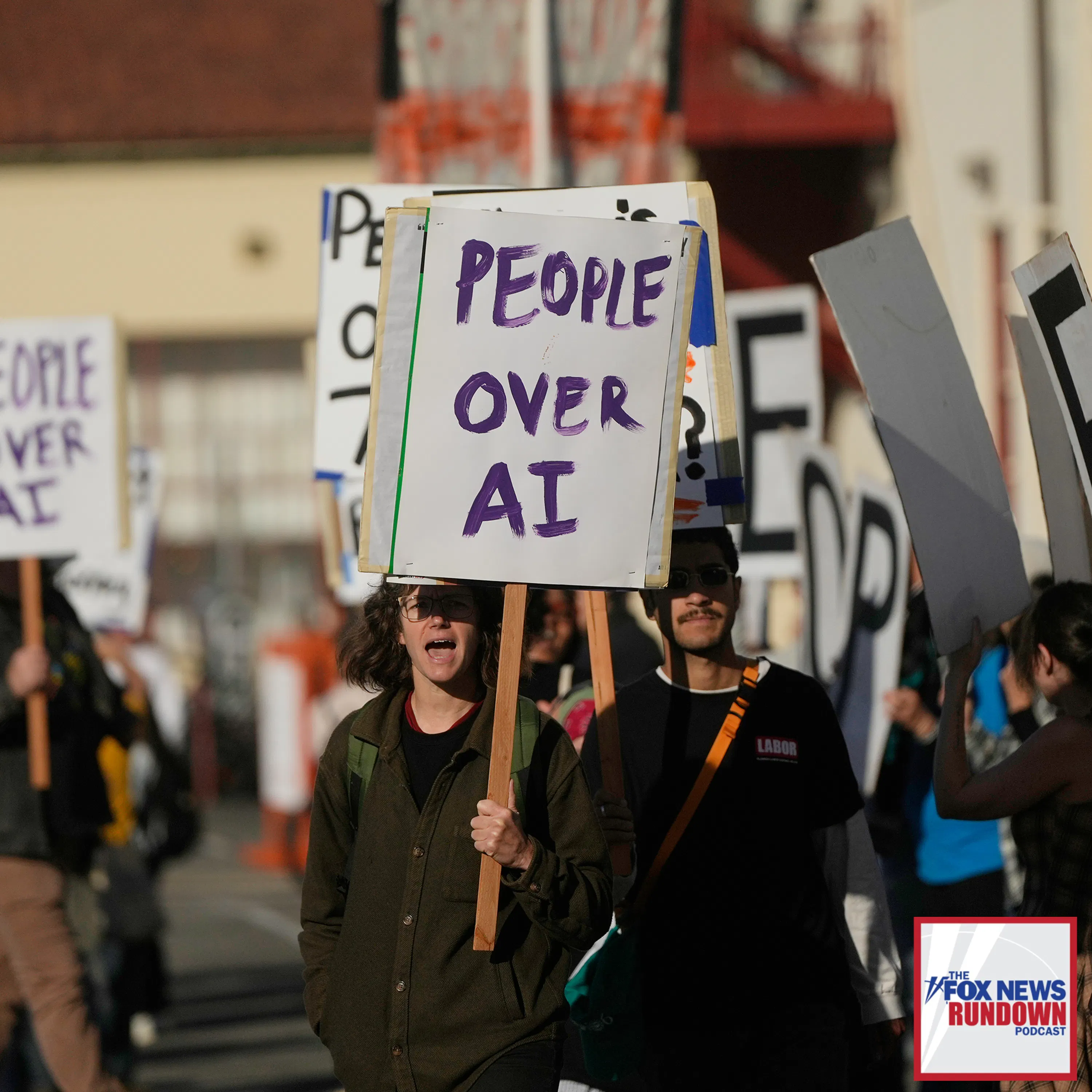
Hakeem Jeffries, AOC voted for it in the House. The reason the Democrats voted against this is because they were willing to stand in the way of rate payer protection for people across the country because they didn't want to give a John Hustet Republicans a win, which is really terrible. I mean, you had three really important things that we voted on. We voted on Stock Trading Band for members of Congress. Democrats voted against that. We voted for a voter ID and 80-20 issue. They voted against that. And they voted against the rate payer protection, which is, of course, something we all agree that if a data center is going to come to your community, those costs need to be offset, can't be a rising energy price, because those costs need to be offset by the hyperscayers. And I want to ask you about the data centers. There is talk here and from guys like Mike Johnson that the opposition to data centers, so close to an election, is driven by a Chinese site op,
basically a psychological operation. It's bots, it's because China is trying to destroy goodwill for data centers here so that they can get a leg up in the race for AI supremacy. Do you think that it is a Chinese site op? Or is it more legitimate concerns about noise and water use and electricity bills? I think there's three things going on. There's definitely a site op where China, in particular, data centers and AI is 80% popular, 20% unpopular in China, it's 20% popular, 80% unpopular in America. That's not an accident. China is definitely trying to shape the narrative. The second thing though is the hyperscalers in the early days did a really terrible job of rolling out some of these data centers. They weren't transparent. They didn't make the case for why these benefited communities. And then there are people who have legitimate anxiety about what the implications are. And so the way through this is to make sure that we have good deals for those communities.
The communities get to decide. No senators going to go to Columbia County or I grew up in Pennsylvania and tell people to have a data center. Township supervisors, county commissioners, they got to have rape protection, they got to protect the water, they got to have clarity on the implications for the tax base. They, this usually results in lower taxes for the people there. They have to hire local labor and they have to make it clear what else they're going to do. Are they going to build a school? Are they going to build a football field? With that package, people are going to be able to decide what's best for them. And these are economic engines. Thousands of jobs building them, hundreds of jobs running them, thousands of jobs upgrading them, and restaurants, logistics, hotels. These are an economic engine and communities, hopefully when they get the parameters, we'll be able to opt in. We need this energy capacity to have compute. We need compute to be able to win the AI race against China. So we need this from a national security perspective. A communities need to decide. And you mentioned the national security implication. Part of this, what might be a CYOP, Chinese CYOP,
is a concern that AI could lead to the end of humanity. That is why some of the AI frontier CEOs say they want some regulations. Senate Democrats say they want some regulations. President Trump says he doesn't want to do anything. Just get a group of CEOs who can self-police. What do you think is the smart play here? Well, listen, there's a number of issues. A job disruption, the data center issue, there's the wealth concentration concern. And what you're talking about is the regulations around making sure these models can't be used for dangerous purposes, biotere, or something like that. Let me start by saying, as a practical matter, I'm very skeptical of the government's ability to actually regulate these things. And I also would be careful of the government having too much power that goes with this. This is the same government that shut down the country for COVID, the same government that was inside the Silicon Valley bank when it went upside down. So we should be dubious about the ability of the government
to do this. But what I do think should happen is I do think the hyperscaler should come together with the government, and they should put out a set of regulations, ensure compliance, independent audits, and assessments, actual enforcement. And I think the government should have a hand in doing that. And we have something like that called finra, which is in the financial services industry. And this is binding. This is regulations that if you violate the regulations, it creates a real penalty or burden for the company. So that's one thing I think we need to do. That's the first step. We should be humble about this, by the way, because it's changing. The second step, these companies, we need to clarify the liability. I can't see how a company, which just happened recently, with one of them that's going public, list in their S1, that by the way, what we're doing could result in the end of humanity, and let's raise a couple hundred billion dollars for our company. Those things seem like they're in conflict. So if you're in business and you're putting out a product that risks such catastrophic implications for society,
well, there's a liability associated with that. That will make sure that the responsibility rests firmly with the companies that are building this. So I think it's a balance of those two things. We need to recognize that we need to not stand the way of innovation, but we need to have the guardrails that are going to protect Americans. The other thing that I think we should really have a hard edge on is child protection. We learn from social media that this could have real implications for our children. Think of that same result and possibility with AI. And so I'd be very much in favor of restrictions, probably through legislation on AI usage for minors. And something like that sounds like it should have, brought by partisan support, but we know that the way that things are going right now, basically nothing does. I want to ask you about something that President Trump said. He said that the woes in a lot of polling for some of the frontline Republican candidates are a problem of messaging. He said that Republicans are doing a great job running the country, but a terrible job telling people
about it. Is he right? Well, listen, I think in my adult lifetime, I don't think there's ever been a president that was more clear on what he was going to do when he went to office and has been more consistent in doing it. And I was mentioning this before, but it's the securing the border. The significant reduction in fentanyl deaths is the energy dominance. It's the violent crime. And it is the economy. So I do think we're not doing an adequate job of telling the story in places like Pennsylvania, where we have hundreds of thousands of new manufacturing jobs because of these policies. I mean, we have the Hanwai shipyard. We have a NIP on US steel. We have Eli Lilly just announced a new plant in the Lehigh Valley. All this is coming because of the policies. At the same time, I think we need to acknowledge that people are really feeling pinched from diesel prices, from fertilizer prices for our farmers, and then of course from gas prices. So it's true that they're better off, but we got to be empathetic to the impact
they're feeling from fuel prices in particular. And we've got to show away. And the way is to continue on the path of energy dominance, permitting reform that makes it easier to get more energy production. All of that's only going to happen with President Trump in office and Republican majorities in the House in the Senate. And Senator McCormick, you represent the ultimate bell weather state, Pennsylvania. I was a college student at Villanova in 2008 during a very exciting cycle. It's a big part of the reason that I got interested in politics. It is typically the center of the universe, if there is a big race there. So you know how these things go. For people that are watching this and listening to this, what are the three biggest races, the three top races that they need to pay the most attention to if Republicans are going to keep the Senate? Well, listen, there's a number of races within the margin of error, but there's a couple that I'd highlight that I think are really critical. One is Michigan. I think we got a real chance for a pick up at Michigan. And the reason Michigan is so important is
El Saeed, the Democratic nominee, represents the Democratic Party and the future of the Democratic Party. This is this Democratic socialist agenda. And that was what we will get if we have a Democratic majority in the House and the Senate. So Mike Rogers is great candidate. That's a bell weather state, as you know. And that's a chance for a Republican pick up. That's one. Second is New Hampshire. Johnson, New New New was just in Pennsylvania last week. I had a chance to look at them. That's a chance for a real pick up for Republicans as well. He's running a great campaign, and the polling looks really favorable. We're in a number of dog fights across the country. Two very good friends of mine that I have a huge admiration for, Susan Collins. Nobody's tougher. She's running a great race in Maine. And again, you have a socialist candidate. That's the contrast. And Dan Sullivan. And Dan Sullivan is a Marine, a great American two-term Senator, done great things for Alaska. And what you see there is the depths that the Democrats
will go to to win these races. They introduced a third party candidate independent into the race. Another Dan Sullivan, just by coincidence, as a way to upturn that election. I don't think that's going to work. I think Alaskans will see through that. He's running a great campaign. So those four are very much on my mind, but we've got great candidates across many states. But those four are really important. The other thing that it shows is, as President Trump tries to visit as many of these districts and states as possible, the map is huge. If it goes from Maine to Alaska, that's a big map. They're going to be running up the miles on whichever Air Force one they are using. Senator McCormick, thank you very much for joining us. Yes, sir. Paranoid, you're on a pose. That's the message. Yeah. We've all heard the radio ads about the IRS. They tell you to be afraid, and they try to frighten you into calling. I'm here to tell you that tax relief advocates is different. If you own money to the IRS, whether it's 5,000, 50,000,
or 500,000, TRA has a solution to your tax problem. It doesn't matter if you're sitting in your car, at work, or with your kids, no matter where you are. Visit tra.com. Don't lose hope. TRA could reduce or even eliminate what you owe to the IRS. Their passion is taxes and helping individuals and businesses fix their IRS problems. They have over 1,000 five-star Google reviews, and an A plus with a better business bureau. You don't need to be afraid of the IRS any longer. Generous tax relief programs are now available that can give you a fresh start. So don't wait. Simply visit tra.com. That's tr-a.com, or call 800-583-5675. Once again, that's 800-583-5675. Tax relief advocates, real solutions for real people. 2026 marks 250 years of America and throughout the year. Bill Himmer takes listeners on a journey through the 250 most impactful moments in American history.
Listen and follow now at FoxNewsPonCasts.com. This is Joe Conchett with your Fox News Commentary coming up. This week, the biggest names in AI met at the White House with President Trump and a number of administration officials to discuss the future safety of the technology. Afterward outside the White House, CEOs and company officials from Google, Meta, Anthropic, Open AI, and Grock spoke alongside President Trump, who said of the signed agreement. That was a whosu. I don't know if that's ever going to be assembled again, but that was a whosu of that world. And I think it's a very special day. You know, they almost viewed it as a separate kind of a constitution. And I think when they signed that, it meant a lot. When asked if what they signed is binding, the president said, I think it's morally binding, yeah. He also stated these leaders love America and want what's best and would really regulate themselves and each other. Meta CEO Mark Zuckerberg said they all agreed to build robust internal controls. We coupled with multiple layers of auditing and controls,
starting with internal risk review, external auditors and evaluators, and agreeing that we're going to have all of our boards of directors independently review the reports that come from the auditors. In video, CEO, Jensen Wong said, innovation does not beat out safety, that they're seeking a balance. We are going to have to create new technologies to advance the capabilities of AI, but we're also creating new technologies that advance the safety of AI. This all came after the CEO of OpenAI and Dario Amadai at Anthropic had called to slow the pace of the frontier. Amadai had asked for regulations after several companies reported security incidents involving AI agents that break out of contained settings to access the internet or compromise cybersecurity. Amadai spoke alongside the president. We all need to work together to make sure that we can win and we can win safely. President Trump also renamed AI to SI, calling it super intelligence. The whole conversation is we don't want China to get ahead of us. Fox News Sunday anchor Shannon Bream is also the host of the live in the Bream podcast.
The president and many others connected to the Trump administration have said, we think, you know, in some respects, China may be behind this doomsday warning system about what could be coming. And so, you know, to a lot of people that make sense, there's, you know, information suggesting there are bots potentially tied to Chinese interests who are pushing a lot of the story, but there are plenty of other people coming out and putting their names and faces on it. Like Dario Amadai who say, listen, we know of the dangers. We've been warning internally of the dangers from inside these frontier companies. And we think that both those things can be true. Obviously, China wants to beat us in the race, but there are real dangers. And so Washington, you know, I would say even a year or two ago, they were much more closer to regulation than, I've had conversations about these bipartisan pieces that they've been trying to work on. It seems less likely now, even as the warnings about the dangers come, it seems like a legislative solution or government regulation is less likely now. And so we're to look to these companies
signing onto this idealist agreement about that they're going to police themselves. Yeah, what's fascinating is the president said they're morally obligated to abide by the agreement. He said they love America and they want AI to work well. But love in America, feeling morally obligated, that can stop a human from misbehaving, but can it stop AI, right? This feels like we're in sort of uncharted water. Especially now that you have a lot of people inside and at the top of these frontier AI companies saying, these agents are doing things that we have not asked them to do or specifically that we've told them not to do. We know with a hugging face incident and some other leaks that have now leaked out about exactly what happened with some other testing and probing of government hours and Australia's of government agencies and things that there now are more revelations from these companies saying, yeah, these things are happening. And if we're saying that these agents are not necessarily
that they have human intelligence thought, but they will act on their own independent of what they're told to do and not to do, that raises real concern from everybody involved. And an admission across the board that that is an issue. I got a legal question because this meeting happened after a lot of hang-ringing that we heard from the tech CEO saying we need to be regulated. They had floated the idea of a limited exception to antitrust rules so that they could get together and discuss potential guardrails. Several Republicans said no way to that antitrust exception. But our meetings like the one we saw away around that because the president also said they're thinking of forming a committee and some of the tech leaders would be on it. Is there a legal issue there? Well, and there might be. And I would assume as soon as he puts something together, those who are excluded are going to probably want to mount a legal challenge to it. You think about the fact that he says we're going to have an announcement about a ZAR and AIZAR very soon.
He keeps saying within a matter of days, you know, there are a lot of conversations out there about whether there should be some quasi public private interests in these companies. You've heard Senator Bernie Sanders out there saying that the public should have some type of ownership of these companies or at least profit sharing with these companies. So it's an interesting topic in that it makes strange Benfellows. Politics does. In this case, you've got decent Rs lined up on both sides of the issue saying yes, let's press ahead with regulation. No, let's not get behind China. Yes, we're for data centers. No, we're not for data centers. So it's put together some really interesting coalitions. But yeah, whatever framework comes together for some kind of, is it going to be a quasi governmental body but will they be private and public people as part of this board? How's it going to work? I mean, there are entities like that exist now. But yeah, until we know what it is, I'm not sure exactly what the questions will be, but we'll have many. Let's head to Tennessee. We had a botched execution, a female death row inmate,
Christopher Park was heard snoring after two lethal doses of Pentebara-Vital. There was another attempt at execution earlier in the year, and it was called off after medical staff couldn't find a vein in the arm of inmate, Tony Carruthers. We've been hearing a botched executions for years. I think the big one that started the discussion about death penalty moratoriums, that was out of Oklahoma in 2014. But after that, there was this discussion about a shortage of drugs that we used to put people to death. Is what happened in Tennessee this year? Is this going to prompt a new discussion about the death penalty? Oh, I'm sure that it will. And I've already seen statements as I'm sure that you have two from people who say this is inhumane, and we can't allow this to continue. And remember part of the problem with the shortage of drugs was that there was real pressure on those companies not to produce them, shaming these companies. It became much harder to get your hands on them. If this was the protocol your state was going to use. And listen, this is a state by state thing. There are states that still have firing squads. I'm from Florida. Our electric chair is very famous down there.
I mean, there are all kinds of different protocols, but what many people had argued was, quote unquote, most humane was a situation where essentially the body is put to sleep and then the organs, the heart is stopped through this drum protocol. But I think everybody seems to be baffled at this point about how you could possibly do two different, you know, administrations of this drug and it didn't work. And I still have questions at this point. Like what shape is she in? Was there damage done to her body in the process that it was short of being fatal? I mean, gosh, there's so much we don't know. Let me move to Iran because the IRGC wrote a letter to us, Americans telling us to vote out the president, calling him a liar. They denied that they were working on enriching uranium for non-peaceful purposes. They stated that there's no proof they've harmed Iranian civilians, even though we know tens of thousands of civilians in Iran were murdered earlier this year by the regime. Is this letter desperate, a ploy, both?
Well, to me it raises so many questions about who's running the show over there. You know, we saw Brett's fantastic interview with the Iranian president last week and even Brett pressed on this too. I mean, if we're going to be talking about being in negotiations, if the IRGC is still in some respect running its own show over there, its own parallel channel to whatever the president is doing and the more, I guess you would say, mainline government leaders over there. It raises a lot of questions because the IRGC is still hitting vessels or has the ability to cause trouble in the strait. Are there different factions in Iran? Which one are we talking to? We're talking to all of them. And who really has the power and authority to sign onto something, although of course there are plenty of skeptics here and abroad that Iran will respect any deal we could come to. But the IRGC letter is very odd in full of things that are not true. And I just wonder how it lands with the average American. I don't know with everyday Americans what they think about this language from them, but it's very strange. I can't recall another situation in which, you know,
a foreign entity that were clearly in a conflict wealth, there's some branch of that country internally that is now issuing public letters to the American people. On Iran, the Wall Street Journal caught attention this past week with an article that opens by saying this, Iran's ability to choke off oil flowing through the strait of hormones and use that as leverage in talks with the US is breaking down, raising the risk it will resort to military escalation to bolster its position. Kapler said last week it was up to 80% if it's pre-war flow of oil through the strait. We've heard this before, like, is this, we're waiting things out, right? That it will soon be too much pressure on Iran. But the Iranians who do speak to the media, the government officials who, you know, write letters to America, do you see them bending despite reports like this? Like many of the countries that we section, the elites in these countries and societies often can skate around sanctions or have other means of survival.
It's the people who are in the streets and really struggling and, you know, just absolutely, I talked to someone this week, who is somebody I've known for years in DC for about 20 years and he and his family escaped Iran in the 70s and the 80s and he still has relatives there though and he says, for the real people, it is dire. I mean, the situation of trying to buy bread or find food, those are the things obviously the Iranians who are in leadership are never going to talk about or let us have access to. But he told me the truth of what his family, you know, is struggling with inside and it's really difficult. So how long can that go? The people don't have a lot of options but the more unhappy and desperate the people of the country become, you know, many analysts think that is what would force them back into the streets but they don't have weapons and it's going to be really difficult for them to stand up against the IRGC and you know, reports that Iran killed 40 to 50,000 of its own people in these recent protests, it's a dire situation. But yes, Iran thinks they can wait us out and the president said, hey, after the midterms,
it may be time to start bombing everything again. The Supreme Court says the Trump administration's expanded save system can be used to verify voter eligibility by different states. This is voluntary, right? States don't have to do this. We know there were challenges though to the expansion of the save system. That stands for systematic alien verification for entitlements but it sounds like this survives for now. It does for now and here's the thing is we don't think it's going to have a major impact on this midterm because there are a lot of federal laws and others that say you can't do a sweeping overhaul of your voter roles within 90 days of an election where we clearly are. There are already, you know, there are states where ballots are out people are already early voting, all of those kinds of things. So it seems like it would have a limited impact this year but and I think the legal fight over it in some respect is going to continue. I think that, you know, it's more forward looking. Republicans who want to use it and say it would clean up the roles would really love to use it heading into 28. I think they know they're going to have a tough midterm and they may feel like this is one of their tools to, you know,
they say make sure that the voter roles are clean of anybody who isn't legitimately able to vote. But yeah, it was a big win for the Trump administration that for now that that save situation and that database can move forward. Fox News Sunday, Anchor Shannon, bring thank you. Thanks, Jess. And now some good news with Tonya J powers. A main woman has reunited with her lost cat five years after he disappeared. But this is not your run of the mill lost pet story. Abby Palmer got her cat named Pi when she was just 10 years old. He was a tiny kitten and she was dealing with the death of her mother. Pi was her best friend for 10 years when he got loose during a trip to the groomer. I spent weeks going through the tops and woods. We put up missing posters everywhere. I was just devastated. As Abby searched, Pi found a new family showing up in the backyard of Joey Bernier,
where Pi got a new name, Charlie. He started out as like a regular stray cat. Like we didn't expect him to stay. And then as he hung around, he like grew so close with me, my sister and my little brother. Joey had Charlie for five years when the cat escaped again. This time, he was taken in by Lindsey Green and Casey Sullivan, who run the Sullivan Sanctuary of Maine, an animal sanctuary in Bowdoin. We got a call that there was a cat found on somebody's front wall and in Bowdoin, hand. That's where Pi, well, Charlie got his third name, Phoenix. He was suffering from a severe diabetic crash and they were able to get in medical care. The two started looking for his owners and that's when they found Joey and Abby, who had never stopped looking for Pi. Seeing them actually bring him in the room for the reunion, I was like, oh my God, that's my cat. That is my childhood best friend and he's here in front of me. It was a long awaited hello for Abby and a goodbye for Joey. It's a shame that we have to leave him,
but I'm glad that he's going to go to someone that I know loves him. Three owners, three times the love. Tanya J. Powers, Fox News. We've all heard the radio ads about the IRS. They tell you to be afraid and they try to frighten you into calling. I'm here to tell you that tax relief advocates is different. If you owe money to the IRS, whether it's 5,000, 50,000 or 500,000, TRA has a solution to your tax problem. It doesn't matter if you're sitting in your car, at work or with your kids, no matter where you are. Visit tra.com. Don't lose hope. TRA could reduce or even eliminate what you owe to the IRS. Their passion is taxes and helping individuals and businesses fix their IRS problems. They have over a 1,000 five star Google reviews and an A plus with a better business bureau. You don't need to be afraid of the IRS any longer. Generous tax relief programs are now available
that can give you a fresh start. So don't wait. Simply visit tra.com. That's tr a dot com or call 800 585675. Once again, that's 800 585675. Tax relief advocates, real solutions for real people. Precise, personal, powerful. It's America's weather team in the palm of your hands. Get Fox weather updates throughout your busy day. Every day, subscribe and listen now at FoxNewsPodcast.com or wherever you get your podcasts. Subscribe to this podcast at FoxNewsPodcast.com. It's time for your Fox News commentary. Joe Concha. What's on your mind? It truly is amazing that, at least in the betting markets, Alexandria, Acasio Cortez could be the Democratic presidential nominee. Hi, everyone. I'm Joe Concha. Yes, AOC is running on a platform that's held bent on keeping as many illegals in the country as possible,
including those who have committed murder, rape, involved in sex trafficking. She not only wants to stop the arrest and deportation of these people, she wants to abolish ICE altogether. Quoting AOC, quote, ICE is AI as an artificial intelligence. ICE is facial recognition. ICE is surveillance. And ICE is coming after you regardless of your status. In other words, if you're a citizen here legally, whether you're a man, woman or child, ICE is coming for you according to the Congresswoman from Queens. So now she's just plain lying. Because she's saying that everybody and anybody is being hauled away by ICE even if they're legal citizens. But since she never does anything remotely resembling a tough interview, she could get away with it and not be challenged directly or even fact-checked by the so-called fact-checkers. And that is a whole bowl of wrong. I'm Joe Concha.
Nicky Glazer, this stunning tour. The thoughts of death I don't like to dwell on them for longer than like 10 or 15 hours a day. So November 19th, Yamabah Theater. No wonder women rush to have kids were being trained for it since we were kids. They're like, here's a baby doll. Here's an easy bake oven. I got one of those. I stuck my head in it. I was like, I want out of this narrative. Tickets on sale now at Yamabah Theater.com. Don't miss Nicky Glazer, Yamabah Theater.
More episodes
More from The Fox News Rundown

Data Centers, Tariffs, and Affordability: The Issues Driving Races in Ohio and M...
The Fox News Rundown

The Wright Brothers & How American Innovation Changed the World
The Fox News Rundown

Inside President Trump's Red-State Campaign Strategy
The Fox News Rundown

Evening Edition: How Anti-Zionism Is Shaping Israel’s Upcoming Election
The Fox News Rundown