
Building Wealth Is Only Half the Battle | WealthWise Banking EP. 91
Get every episode summarized
Each time WealthWise Banking publishes, we email you a written briefing from the transcript — the topics, who appeared, and any specific claims, with the ad reads skipped.
Email me new episodesFree for 3 shows. No card needed.
About this episode
“We're literally putting our families well at an autopilot. I don't care what season of life or what's going on in any market.”From the transcript
Website: www.WealthWiseBanking.com
LinkedIn: https://www.linkedin.com/company/wealthwise-banking
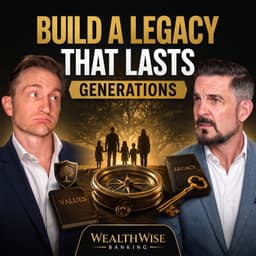
Last week, we explored how to write it and legalize it by defining your family’s values, priorities, and vision. Now, we’re taking the next steps: fund it and run it (live it). In this episode, we discuss how to put resources behind your family’s plan, build wealth intentionally, and—most importantly—pass on direction, values, and wisdom, not just money. Discover why lasting family wealth is about more than financial assets—it’s about building a legacy together, one generation at a time.
EPISODE HIGHLIGHTS
Intro - 00:00
A Shift Toward a More Holistic Financial Strategy - 02:05
Why the Hosts Say There Are Too Many Bad Actors in the Industry - 08:05
Putting Investments to Work to Fund Premiums - 13:40
Passing Down Direction, Not Just Money - 18:51
Turning Family Wealth Into a Team Sport - 26:26
ABOUT YOUR HOSTS
At WealthWise Banking, hosts Jeremy Huggins and Jason Sipple combine decades of experience in finance, leadership, and wealth-building to help listeners eliminate debt, grow wealth, and build lasting legacies.
Jeremy, a West Point graduate and Special Operations Veteran, brings a strategic, disciplined approach to financial planning, shaped by years in high-pressure environments. Now a real estate investor, airline pilot, and certified Infinite Banking Concept Practitioner, he helps clients unlock financial freedom through IBC strategies designed for long-term stability.
Jason, a 5x Ironman Competitor, money mentor, and founder of Founding Fathers Financial, has guided thousands toward debt elimination, cash flow optimization, and legacy building. Through Founding Fathers, Jason leads a community of men focused on aligning wealth with purpose, fostering leadership, and building legacies that reflect their values.
Together, Jeremy and Jason share real stories of transformation, showcasing how listeners apply the Infinite Banking Concept (IBC) to take control of their financial futures.
Beyond the Mic: Jeremy enjoys fitness and outdoor adventures with his wife and two dogs, LB and Tito. Jason balances mentoring, Ironman training, and community-building through Founding Fathers.
🎧 Tune in weekly to learn practical strategies and simple shifts that unlock financial independence and lasting success.
Get every episode summarized
Each time WealthWise Banking publishes, we email you a written briefing from the transcript — the topics, who appeared, and any specific claims, with the ad reads skipped.
Email me new episodesFree for 3 shows. No card needed.
Hosts & guests

Transcript ready
344 searchable segments. Every word is indexed and playable.
Full transcript
WealthWise Banking — Building Wealth Is Only Half the Battle | WealthWise Banking EP. 91. Machine-transcribed; use the interactive transcript above to jump the player to any line.
We're literally putting our families well at an autopilot. I don't care what season of life or what's going on in any market. Pick one. I don't care if it's up or down because of these companies and the solvency and the strength behind these companies and how these assets are created. The family's net worth is being purchased. It's on autopilot and it's giving us tax advantages along the way. Like that would I'd say if I did anything different. I know in talking to countless people in our system, that is the one thing that I do that's very different from everyone else is I don't actually fund my own premiums. My investments fund my premiums and my family's net worth is on autopilot. Welcome back to another episode of Wealthwise Banking. I'm here with my coach, Jeremy Lee Huggins. Last week we left a hanging. He a little bit bad but I don't because there was so much value packed into last week's episode about writing it and about legalizing it. And so this week we're going to go into the last two parts of fund it and run it or as I say, live it. And Jeremy, I'm excited to be back with you. How you doing, brother? Doing great, man. So again, we that whole
episode, this is just a continuation from the conversation we had last week where we really talked about your values and priorities. We put legal structure around what you define that was important. This episode is all about making sure those resources reinforce the plan because you could have a family constitution. You could have great legal structure. But if you don't have resources to reinforce the plan, guess what? You just had a great conversation with an expensive piece of paper. So we're going to get into this episode now. We're going to start talking about how do you actually ensure those resources show up today tomorrow, but also beyond you. And then helping to pass on clarity, not just confusion. How do we pass on direction? Not just resources. That's going to be the final segment of today's episode. So tune in. We're glad to that you stuck with us from last week and you carried things into this week. And we'll go ahead and get started. So let's pick it up from where we left off. Now we get to the third part, right? So we get to the the part that we probably talk about the most. But again, what's maybe been the biggest change, you think, in the funded part since you and I met to where we're at now? Yeah. Well, when we first met,
you and I were both big into infinite banking, right? And over the past year, I've actually taken a step back from infinite banking because I look at things from a wider lens. It's neither good or bad, right? I don't think that there's anything that's bad about how R2 paths have a little bit separated with that regard. But what I look at is the full resource pictures, right? As someone who's dealing with a lot of different net worth members, right? Everyone who's like, my highest net worth, I mentioned before, he does $300 million per year. Not as net worth. He's doing $300 million per year. And looking at his structure, which at the time, he had zero structure, not even really will in place. All the way down to people who are kind of just getting started, like with my own family, right? My siblings, they don't have any trust that are in place. My idea of resources have changed dramatically, right? I'm looking more at, even my philosophy around investing.
I used to be really, really heavy into real estate, real estate, real estate, real estate, right? And I've seen the dark sides of owning too much real estate as well. So, diversification, I would say to answer your question, it's growth. It's working with other people that are in the industry and being willing to say, I don't have it all figured out. What else can I learn from other people? I think that's maybe that's the answer to the question. I love that answer. I think it's a power. You've expanded, you've expanded my horizons a ton with our friendship, with our podcasts, with our collaborations in this space. And there was a point where I was so excited about, you know, what I learned from our Nelson Nash when I asked for a philosophy, a financial philosophy. But the more peers I meet, the more people I've seen doing this for 40, 50 years, you know, the more I realize that this is a more holistic approach to everything. It's not a one, it's not one size fits all and it's not just one solution.
Right. Yeah. Right. It's not one solution. Like, there's, I'm leaning more towards your thinking on the infinite banking concept that I am, the people who are purest on infinite banking, because I feel like there's so, there's so many great things you can do with whole life as long as from a mutually owned dividend paying company. Yeah. Right. There's not a wrong thing to do. All of it is still about the end strategy at the end of the day. And the question is, what is it serving? You know, what are you solving? What are you solving? Yeah. When we're looking at Fundit, so here's that third step, right? That we're talking about now. Fundit, the whole purpose of this right here is you need resources to actually reinforce the plan. So to summarize, write it was your values and priorities. The output was a family constitution, a family compass. Once you get clear about what was important, you put legal structure around that. So that legal structure is what passes resources on today, tomorrow, but also beyond you. But where do those
resources come from? Resources come from the Fundit piece. This is the part where Fundit can come in many different forms, right? It can come in inheriting a business. It can come from and getting retirement accounts. It can come from different investment and brokerage accounts. The Fundit piece that really started this entire journey for myself and for Jason and how we came together was high-cash value life insurance because it's the one asset class that ends up ensuring that the resources are there when they matter most, whether they're there today as an opportunity fund. They're there for me. I use it for real estate, but I also use it and other people use it. And the reason I started teaching it as an emergency savings account because the wrapper is life insurance, guess what? There's a death benefit and that death benefit does what shows up when your family needs it most. My family right now, the fact that it's showing up for my family to reinforce the plan is incredible. My stepmother should never have to work another day in her life if she doesn't want to.
Having those resources at key moments in your life when pressure shows up because life events, they don't get scheduled. It doesn't show up on a calendar, right? Whether there's an opportunity or it's an emergency or a passing. All of those need resources to show up at critical phases of your life. Your brokerage accounts, it may not be a good time to sell. Your retirement accounts, you may not have the ability to access it because of age without penalties without taxes. High-cash value life insurance is money that you can access today tomorrow but also beyond you. It's an opportunity fund and an emergency savings account really is providing your family a piece of mind. That's why I like it. I don't think there's another asset class out there that has all those guarantees where one dollar has multiple jobs. That's why you and I reinforce it. We spend a lot of time on the fundate piece. Fundate really comes in different shapes and forms but if we get really clear what's meaningful, what's manageable, we can build you a plan. And as your family expands, as your values change, guess what? You can change the plan. You can adapt the plan. You can add to the
plan. I only have six plans. Yep. Right? I own six. The plan's expanded. Yeah. And I keep saying there's all these different books out there. The permission to spend is another one to solve. I mean, Tom Wolf right in our space who's got all the licenses and getting one of guys PhD. But then in a day, everybody I'm here and talking about is like, oh, it's a best kept secret. Why is it the best kept secret, Jeremy? Maybe this is not the way we're going with this episode, but why is this the best kept secret? Why aren't more people believing in what we believe to be the best kept secret? Well, I think part of it is the people who kind of get in here and architect these plans. I'm put quotation marks around that for those of you who can't see me. It's a low barrier of entry, man. It really is to become a life insurance agent is a low barrier to entry and people are sold that they're going to get rich building it out. To be very clear, all the plays that we build, yeah, we get paid off of it, right? The insurance carrier pays us,
not you. But the way that these are built are meant to maximize your value. We typically take, I would say, on average, about a 70% reduction in the commissions. Yeah. And that's probably the average, right? Sometimes we take more, sometimes we take less, but by and large, you take around 70% reduction. Well, anyone who makes that their their primary industry, the primary thing that puts food on the table, who the hell is going to volunteer, especially when they just get started to take a 70% reduction and what the carrier is going to pay them out. So there's bad actors. And so what they do is they come in with all these, let's do the right, they're infinite banking. Let's do the Rockefeller waterfall strategy because they heard about it on a TikTok and it's going to make them wealthy. They don't know what the hell they're doing. And that's why Jason, I think there's too many bad actors in the industry at the end of the day. They're not looking out for the best in the best for that family, for that individual and what and tailoring something that's custom in them. Oh, and by the way, it's not easy to build it, right? You got to spend time to learn what's actually important for that person and then architect a plan. That's what meaningful and manageable.
But you also have to have the expertise. I know people in our industry that are Nelson Nash, infinite banking practitioners who don't know how to build a freaking illustration. They have any other people, Jason, they pay people to build the plans. Again, I've I've ranked them right up there. I'm not gonna name them, but I ranked them right up there with a person who's just getting started because you might as well. You don't know how to build the plan. I mean, what are you doing? I can read a book. I can regurgitate it. That's BS, man. I think it's absolute BS. There's too many people, even with a practitioner designation that don't deserve it. Amen. Amen. I know who's passionate and heated about that. Yeah. Yeah. It was good, man. It was good. I actually talked to a I'm helping a guy who has a policy that he thought was a banking policy. And it's just an all based policy. It's a whole life policy. And then when you work with our Joe Schmode death benefit, then we went back. It's a good policy. I'm it's a great company. It's so like you wouldn't 1035 it. It's not he's not capitalizing it with a ton of money.
The legacy piece is important. It will have cash value, but it's slow, man. It's slow building. It's slow. It doesn't have any cash value in year one. It does everything. Daddy day rams, he says, right? It doesn't have any cash value from day one. Guess what? It should. But then the first 30 days and these have significant cash value. And it has to be there. That cash value is there because typically generation one, we need it. Yes. Eat it for opportunities and emergencies. To lock something up for 10, 20, 30 years. The Dave Ramsey's credit, he hits the nail on the head. To be very clear, death insurance. Most death insurance doesn't have cash value. Life insurance, living capital does have cash value and you have it in the first 30 days. That's the difference. You got anything else you want to share on this piece of it? Yeah, one more thing. It's not a freaking investment. So for anyone who's marketing and as an investment, you're wrong as well to include our infinite banking brothers and anyone trying to use an IUL on attach it
to the stock market. You're wrong. You're absolutely wrong. And I'll go ahead with you. Well, I'll even go step further. You're leading people to a very, very painful future and you're an idiot for doing it. So learn learn what it actually is. Like seven, talk to an SVP of one of the big mutuals, right? That supports infinite banking. Always at the Nash think tank. And he's like, yeah. And I was like, don't you guys sell IULs? And he's like, yeah, well, our, our, it's made me mad, Jeremy. Our actuaries said that they work and seven of every 10 permanent policies, permanent life insurance policies sold in the United States right now are IULs. And what's like, that's because the people that are selling them, even if they think they're doing good, they're putting themselves first. This is something I learned back in recruiting. They're putting themselves first, then the carrier, then the client. It's backwards, man. It's always got to be the client, the carrier, then you as the agent, right? As the, the, the bread license broker.
Well, you were not going to get along so well on this because we have the same understanding that if you put other people's needs ahead of your own, you'll have more business than you ever need because of the referrals and the repeat business, right? Just do the right thing. Like stop chasing the immediate commission because that's what they're doing. And IULs pay a ton of commissions. There's a ton of fees associated with them. But they're detrimental. They're falling apart. And I've never seen one work. I keep, I keep waiting for someone to bring me one that works. I'm never out of over a hundred of them. I'm undoing a family, a grandfather who has 11 of them in his family, a successful entrepreneur. And he's, you know, has his grandkids living in homes that he paid off and he's starting, now he's starting correctly engineered whole life policies for banking. So they can buy the property from him with the cash value from their whole life policies. How cool is that? Now they're just paying him rent. He's going to take the rent and putting
into the whole life policies, build up enough capital and they're going to buy the asset from him. Well, this goes into how does Jeremy pay his premiums, right? Yeah. Otherwise, fund my policies. And this is actually when I'm architecting, I kind of shared it on the last episode on how I do my structure and how you can do it generationally. But I don't fund my own policies, Jason. I have my assets fund my premiums. When I'm looking at doing it, again, if you're at level one, you're just getting started, you might have to fund that out of pocket until you build enough cash value. That cash value might just be your piece of mind fund. It might be the emergency savings that you need for the next COVID event or dot com bubble or whenever, like if you're out of work for a period of time and gets you through that season of life. But when you build enough cash value, when sky net, Jeremy, when sky net comes, when sky net, when the term, when you build enough cash value that now you can start using it for opportunities, well, opportunity strategic opportunities produce returns. Guess what I do with those returns? Those returns fund my premiums. I put my family's net worth on autopilot when I'm
using cash value to pay for assets. Those assets give me returns. A portion of those returns get reinvested back into the policy. The cash value increases again. I rents and I repeat because the rapper's life insurance, the death benefit also compounds over time. And then like I mentioned in the last episode, the one that I did solo, a portion of those death benefits do what? They go back into the trust. The trust does what purchases assets. Those assets produce returns. Those returns fund new policies on the youngest blood relatives maxing out the insurability. We're literally putting our families wealth in autopilot. I don't care what season of life or what's going on in any market pick one. I don't care if it's up or down because of these companies and the solvency and the strength behind these companies and how these assets are created. The family's net worth is being purchased. It's on autopilot and it's giving us tax advantages along the way. Like that would I say, I did anything different. I know in talking to countless people in our system, that is the one thing that I do that's very different from everyone
else is I don't actually fund my own premiums. My investments fund my premiums and my family's net worth is on autopilot. That blueprint is very unique. I found. I love it. I love it. It actually yeah. Right now I fund our premiums 31% yeah 31% of what we what I make per year goes into funding our premiums until we start having the cash flowing assets. I mean, I was shared with our members. I have money locked up in this joint venture where I look really smart. I've had a lot of money coming in and that stopped last August. I haven't seen a penny from it just hoping the capital comes back. You know, I'll track it and again, it's about the end strategy. So why would I have one strategy that's investment only and another strategy that's family protection only, right? Because typically that's what life insurance people buy protection as income replacement. Why don't I do both and there is a way you do both. You do exactly what I just said. You have assets that fund your
premiums your cash value builds you buy new assets as those assets grow and compound the whole net worth the whole ecosystem compounds like it's literally putting everything in overdrive when you start using it as a both in strategy. It's not an either or that's probably the hardest thing for people to understand is they're taught they're trained the financial industry trains you to thank singular stop thinking singular think what else can I do. I have lots of questions. How can I how can I do both. You know, when I'm here here's another way like rich dad poor dad difference between assets and liabilities. This is an asset is probably the strongest financial asset that you'll have because every dollar has more than one job. Plain is simple like that's why I love it is it is a foundational asset. It's not a growth asset. Be very clear, but I'm using it to buy growth assets aren't I? It's a both in strategy. Yeah, and and when you use it as a both hand if something happens on your growth asset and you lose the money, guess what the money that you use to buy the asset is still growing
still growing still growing. And so everyone here is us say it clearly once at least in this episode everything we're talking about is over time. The longer you're in this the better it gets. It gets better every single day like Jeremy, we're looking at policies now where they've grown without doing anything this year. You know, the money's out and it's not liquid right now, but the policy still has grown over a thousand dollars in a month, right? Like those, I mean, it's every day it just keeps getting better and better and better. Now compound that on multiple policies on multiple family members, right? Start expanding that ecosystem generationally. Like that that turns into true wealth like wealth that you could actually access today and no one's stopping you from doing it. Oh, and by the way, there's a ton of tax advantages to doing it this way, right? We just keep more of what we make. Create, keep multiply and do it generationally. Yeah, this is the multiply piece. So let's wrap it or take it back into the where we kind of started and go back to the living it part. Running it,
living it. Yeah, this is this is the governance, right? We're alluded to this in the very beginning. This is succession planning. But succession planning again doesn't have to be morbid. It literally is just getting the family involved. It's having discussions is going out what Jason just did, spending intentional time with the people you love. That's it. This is the part though that I find a lot of especially high net worth people, people who keep themselves busy. I'm too busy to do this. Okay. Well, at one point at some point in your life, you're going to be in a box. So I got it. You're too busy today. But what are you leaving behind? Because it's either going to be direction or it's going to be confusion. It's one or the other. So if you truly care about these people, the ones that you call family, if you truly care about them, are you going to give them direction? You're going to give them confusion. If you're a leader, step up and give damn direction, man. Like this is, I also get really, really passionate about this because that guy who does 300 million dollars a year, you know what his whole plan was? He's fallen the Warren Buffett quote of,
I'm going to leave them enough to where they never have to worry, but not so much where they basically ruin themselves. What do you mean, ruin themselves? Like, did you not pass on good values and priorities of your kids? Like, were you not present? Well, if you're not, if you're not doing it today, get busy getting present. Spend time with your kids. Figure out what's them. Yeah. What do you, what are you avoiding? And men, men do that a lot. We, we do that because as providers, protectors, creators, we find a lot of significance. I would guess this guy is, he sounds like an outstanding guy, but I'm guessing that he has a lot of significance as his top need, like growth and significance, meaning that he's not turning and saying, like, the expectations, I don't want to spoil my kids. I'm just going to let them figure it out versus let me see what's important to them and let me help them do the repetition of working towards their personal goal and making sure they're doing it based on our values and what we stand for. Right? So, you know that study I mentioned earlier by Roy Williams of Vic Pryser 32 families 20 years, right? 70% of that family's wealth is lost
because of a poor communication. You know what the number two leading factor was? The children were not prepared to inherit the wealth. Yeah. It did not. They basically got resources with no direction. I've met those I've met some I've met some of those folks where they they weren't given the direction. They had money and a trust and now their financial habits are horrible because it was never discussed. They have tons of debt. They're over leveraged. They're making a mess of it. They have trustees. They can't get in. I mean, it's just when you're not prepared, there is there's a lot of danger to it. And I think I actually think this piece other than the finding your destination, I think this piece is the most overlooked and least utilized piece of it. I think it's the most fun. I think it's the most fun. It's a little bit, I mean, if you're a parent and you haven't done these kind of things, it's intimidating. But get over yourself. You have no problem meeting, you know, meet your kids friends or take it in the baseball games or meeting the other families,
right? Like you figure stuff out on the way. It's like they didn't know how to do stuff and you do it with them to help them figure it out and you support them when they're vulnerable. They support them when they have problems. This is the same thing. You we had Diego stand up in our retreat. Jeremy, this is probably the highlight of the retreat for me. And actually the last day, Patty prepared the boys. Like, look, you're going to pick one of these seven values on this white board and you're going to talk about it and you're going to talk about what it means as a family, what it means to you. And Diego spent time like over an hour preparing and had it written down. He said, you know what? You know, I've told you guys some stuff recently and I'm not going to share anything, but I told you guys some stuff recently that I need help with. And you know, and because of the space we've created the last couple of years, I knew I could ask you guys. I could tell you guys. And I also know it takes courage for you to bring us here when we don't want to be sitting in the room. We want to be in the pool. We want to play mini golf. We want to do this. We don't want to be sitting here listening to, you know, dad's like Jeremy every time I get up the talk, I was like, okay,
well, let me see what time it is. All right. I got about eight hours. So then I started like back when I was six years old. And then the next day was back when I was four years old. I remember, but Diego talking about the courage to just do the thing, to bring the family together to sit down and talk one day to talk about your identity. Who are we as a family? Where are we going? What's important to us? Day two, talk about banking. We showed them all of the, you know, the truths about our money. What's coming in? What's going on? How much does it cost to run the business? How much does it cost to run the family? How much do we pay for subscriptions for television and like everything? Like how much of the portion like they start, they know how much we make because I tell them. And so they think we make great money. It's okay. Well, 31% that goes into life insurance. This is how much we pay in taxes. This is how much we pay into the business. We broke down everything in that. And the third day is when we really came back and we talked about the values piece of it.
Like what's it look like to live the values? How are we going to live them going forward? And Diego's was courage. And he said it is so, there's so much courage just to do the live it part, the run it part. Yeah, it's hard. And nothing worth, nothing worth having comes easy, right? Like I'm full of all these little silly quotes, but label. It's hard. And I think a lot of families, especially leaders of families, whether it's the husband, whether it's wife or heck. I mean, even if you're just leading yourself at this point, it's hard to one admit that you don't have it all figured out. Okay. And you don't have to be, you don't have to have it all figured out. Let's give ourselves some permissions, some grace here. Yeah, permission. You don't have it figured out yet. Yeah, correct. Yet. But also, if you're not in being intentional about this, what are you stealing from your family? Where are you taking from them? It's selfish to leave it all in your head. It's selfish to not have the courage to stand up and lead. If you're thinking that it's going to be
difficult to have these conversations because my children are adults and they have their own families, guess what? You still are a leader. Your patriarchy or a mature, right? You still stay up and lead. You can still lead from the front. In fact, I'll tell you that as an adult, I would love to have these conversations with my parents, right? I might be a little bit different. Maybe your kids have different priorities or maybe you're estranged from your family. Just reach out. The conversation does not, in fact, I would say it should not start with money. It just starts with, hey, let's get together for dinner. Hey, let's, let's share a memory. Let's talk about where that memory came from. Hey, what did we actually learn about it? Right? Just let it evolve naturally. Just spend time, quality time and do it intentionally. Don't steal from your kids. Don't steal from your generations by keeping everything in your head. If there are values and priorities, if there's things that you care about, pass them on. Do it intentionally. The way you do that, the way that we've been doing it before we could read them right, is storytelling. Just start with storytelling. Once you start telling
the story, follow the natural progression, start writing it down. Now create clarity, put legal structure around it, use resources to reinforce the plan, live it, run it. That means just rinse and repeat. That's all we're doing. We're living the story. We're passing it on. Get them involved. Get them involved. I mean, another powerful moment was standing there and telling the family, like, look, this is the third year. This is the third time we've done this. There's four of us here. One day, there's going to be six. One day, there's going to be eight. One day, there's going to be 12. One day, there's going to be 20, 30. I don't know ultimately, but like I told, I look at both the boys. Every time this is another thing and Jeremy, I think you would really appreciate this and everyone listening as well is when we speak, when each of us speak about our identity or values, the banking, the laws of wealth, whatever it is that we're talking about, we get up and we face each other. No one's sitting down the couch. We're all sitting, but then whoever's speaking gets up, faces the group and we talk. It's a leadership moment. I told the boys, I'm like, look, I know your
board. I know you want to be out there, but your jobs are going to be sharing this with your older cousins, with your younger cousins. Like, you see, I want to have this conversation. Like, you just said, I wish I was talking to my family. I am slowly having these conversations with my father, my mother, because that's why I do this. I do this because I want to stay together. I saw my family fall apart when my grandparents died and the family got fractured because there was no direction and there was a lot of misconception on what was left and the money and all this stuff and fight. It was a lot of confusion and it was ugly and like, my father still doesn't talk to his brothers, kids who are my cousins, right? And I don't want that. Like, I, you know, in some day, I believe everything I'm doing, everything I'm learning, everything that we're doing together, with not only you and I, but with all of our listeners, all of our members, all the builders, is together we're all going to go further and we're going to make our families better and we're
going to make our communities better and we're going to make this planet better. We're going to make everything better by communicating. It's a team sport. Yeah. This living is a team sport, isn't it? Yeah. Living is a team sport. And you know, it's probably why loneliness is one of the leading factors. I think it's the leading factor. I think it out ranks heart disease. Someone check me on that, right? Put it into the comments what the leading factor is or where loneliness measures up, but I believe loneliness is actually the leading cause of death. People aren't part of a team anymore, right? So this is a team sport. We've been going on for a while here. I think this is going to turn into two episodes. So here's the thing. This is what I'm going to leave you guys with at these sort of conversations. If you want to be part of a team, Jason and I are part of your team. We're not going to be your coaches, right? To be very clear, we're your teammates. And we are going to help you. And we're going to help you be the captain of your own team. We're going to help you write it, your values and priorities help you create a family constitution.
We can help you legalize it. Recommend the proper folks that are going to help put legal structure around what you define important. We can help you fund it. Today, it's more and beyond you. Access and liquidity as well as protection. And we can help you with run it and living the life that you want to live, write it, legalize it, fund it, run it. We're doing it. We're part of your team. We want to help you build an incredible, an incredible team that wins championships. If you want to do that, guess what? There's an easy way to start. You go to weltwisebanking.com. You book a call. That's the first step. You don't have to have it all figured out. Just rely on people who are a part of your team. We want to be your teammates. Again, we're not your coaches. We're your teammates at the end of the day. You're part of an incredible team. The weltwise banking community is part of an incredible team. So this matters to you. Go to weltwisebanking.com. Book the call. Take the first step. Let's just figure out where you are today. That's it. Just have the conversation. Well said. And as always, Jeremy, you're already in banking. You're just not the banker. Yeah. We look forward to meeting with you guys. Take care.
Take care. Thanks for joining us on weltwise banking. If today's episode inspired you, please subscribe, leave a review, and give us a like. It's a simple way to help others discover these empowering strategies and join our community. Together, we're building a network of people who believe financial freedom is within everyone's reach. Remember, financial independence is about making every dollar work for you. One step at a time. Until next time, stay inspired, stay in control, and keep building your legacy the wise way.
More episodes
More from WealthWise Banking

How to Build a Family Legacy That Lasts 1,000 Years | WealthWise Banking EP. 90
WealthWise Banking
Would You Give Your Kids $10 Million Tomorrow? | WealthWise Banking EP. 89
WealthWise Banking

How Do I Prepare My Kids for Life Without Controlling Their Path? | WealthWise B...
WealthWise Banking

If You Are a 401K Millionaire, You MUST WATCH THIS. | WealthWise Banking EP. 87
WealthWise Banking