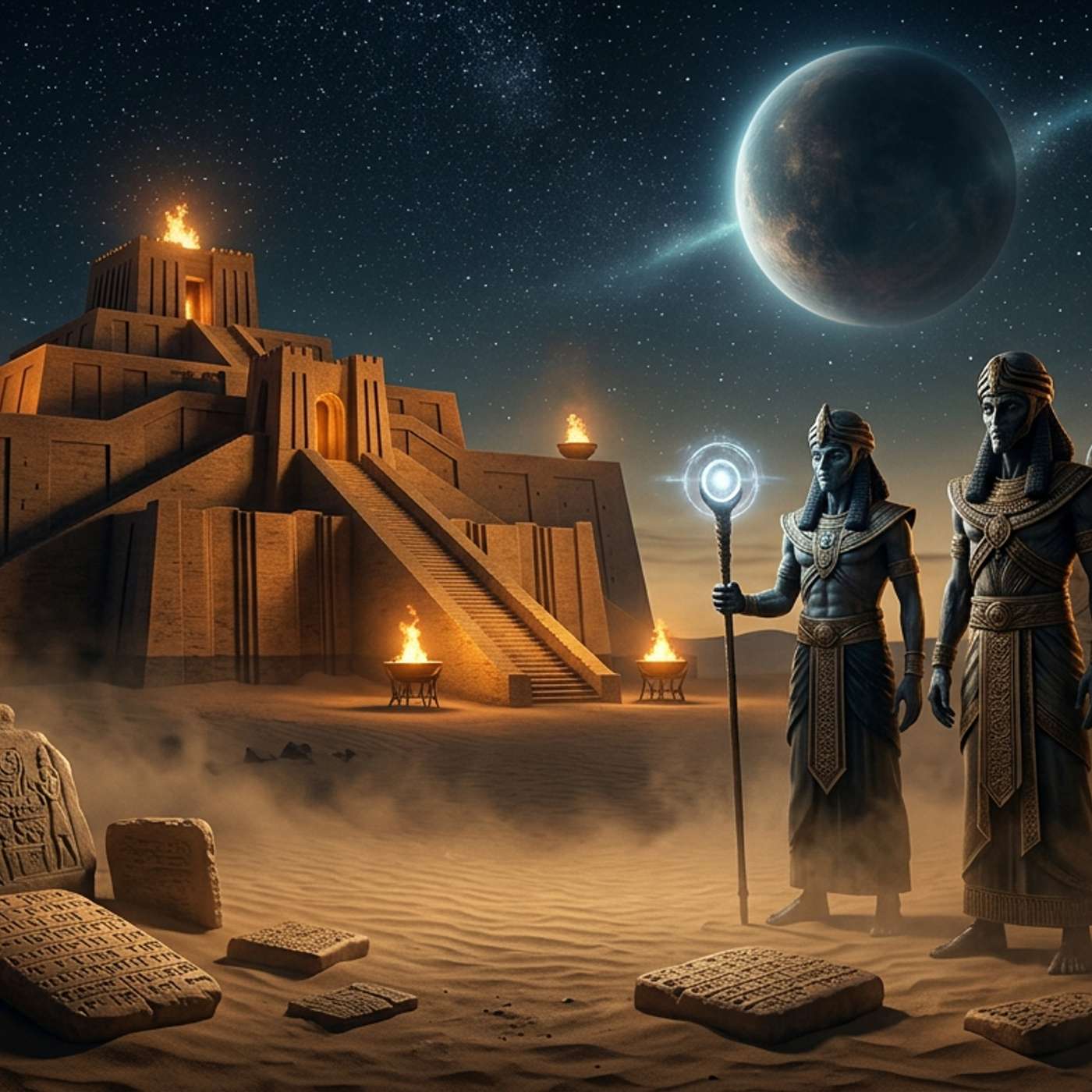
Anunnaki: Did the Gods Create Humanity? | Nibiru, Sumer & the Forbidden History
Get every episode summarized
Each time Lost Civilizations: Ancient Aliens & Forgotten History publishes, we email you a written briefing from the transcript — the topics, who appeared, and any specific claims, with the ad reads skipped.
Email me new episodesFree for 3 shows. No card needed.
About this episode
“He met in some world without humans, no cities, no farms, no kings, no temples, but the world is not empty. And in one of the oldest stories from the ancient Mesopotamia, these gods are not living an initial life, somewhere high above the body, humanity.”From the transcript
Who were the Anunnaki — gods of ancient Mesopotamia, or visitors from another world?
In this episode, René explores one of the most fascinating and controversial theories about the origins of humanity.
We travel back to ancient Sumer and encounter the Anunnaki, Enki, Enlil, and the Igigi — figures found in some of humanity’s oldest written stories.
According to Zecharia Sitchin’s famous theory, the Anunnaki came from the mysterious planet Nibiru. They traveled to Earth in search of gold and eventually altered human evolution through genetic engineering.
But what do the ancient Mesopotamian texts actually say?
We investigate Nibiru, the Sumerian King List, the creation of humanity, the rebellion of the gods, the Great Flood, the Nephilim, the Apkallu, and theories surrounding ancient gold mines in Africa.
Where do the authentic ancient texts end — and where does the modern Anunnaki story begin?
Join us as we venture down a rabbit hole where ancient gods, extraterrestrials, and humanity’s forgotten past collide.
★ Support this podcast on Patreon ★Get every episode summarized
Each time Lost Civilizations: Ancient Aliens & Forgotten History publishes, we email you a written briefing from the transcript — the topics, who appeared, and any specific claims, with the ad reads skipped.
Email me new episodesFree for 3 shows. No card needed.
Know when Zecharia Sitchin turns up
Follow Zecharia Sitchin and once a week we email you every new episode they appeared on — including guest spots the show notes never mention, because we read the transcript.
Follow Zecharia SitchinFree. Pick your own day and time.
Hosts & guests
Transcript ready
861 searchable segments. Every word is indexed and playable.
Full transcript
Lost Civilizations: Ancient Aliens & Forgotten History — Anunnaki: Did the Gods Create Humanity? | Nibiru, Sumer & the Forbidden History. Machine-transcribed; use the interactive transcript above to jump the player to any line.
He met in some world without humans, no cities, no farms, no kings, no temples, but the world is not empty. Someone has already there, the gods. And in one of the oldest stories from the ancient Mesopotamia, these gods are not living an initial life, somewhere high above the body, humanity. They are working, they dig. They carry heavy loads, canals has to be dug, earth has to be moved, water has to be guarded across the land. The work is hard, the year passes. And eventually some of the gods had enough. In the ancient Babylonian story we now call Atohades, the story begins with a situation that sounds almost surprisingly modern. A group of workers has gone on strike. Except these workers are gods, the lesser gods known as IgG. They are doing the heart labor with the greater gods rule over them.
The pressure keeps building and finally the workers ripple. And suddenly the gods has a problem. If the gods refuse to work, who is then going to work for them? The solution was, sorry, is humanity. Clay is brought forward, a god is killed, his blood is mixed with the clay. And from this mixture, the new being is created, being capable of carrying out the burden. Us. Now, sacrificial Sitchin did not invent the basic story. The Atoh's handiceturition really does describe the gods doing the heart physical work. It really does describe a rebellion, and it really does describe humanity being created from clay and divine blood. But what does the story actually means? To an surreal artist, it's mythology. To an historian of religion, it offers a window into an ancient world where people understood
human existence through the gods, the temples, the work, and the natural orders. But millions of people have come to see something very different in this story. What if the clay does not simply mean clay? What if the blood simply does not mean blood? What if the ancient texts describing something people 4,000 years ago simply did not have modern words for genetics? And what if the gods is really not gods? What if they were vistas? Not from a heaven as a religious place, but from the heavens, literally, from another world. From a world that is not in the modern version of this story has a name, Nibiruru. And those vistas has another name, the Anunnaki. So while we're still talking about it, the Anunnaki has become something much bigger than a subject in the ancient religious history.
Search for the name today and you quickly leave the world of universities and clay tablets behind, instead you will find words as spacecraft, genetic engineering, gold mines, mysterious planets forbidden archaeology, we become giants, secret underground bases, and the idea that the entire history of human, the Earth and humanity have been built on top of forgotten events. What if the modern Anunnaki story can be tracked back to one main, Sagaree's Sitten? He was born in 1920 and in 1976, he published a book called The Twelve Planet. Sitten believed the ancient Mesopotamian text has been misunderstood. When ancient people wrote about the gods coming from the heavens, he believed that they were describing real visitors. When they wrote about objects in the sky, he believed their astronomical knowledge is far
more advanced than modern historians are willing to accept. And when they wrote about the creation of humanity, he believed these stories preserved a distant memory of biological engineering. What makes the story so powerful is that it does not begin with a flying saucer, it begins with real ancient texts. There is a really ancient history, that is a Sumerian king list. Inky, Indil, Anu, and Iana really appear in the ancient texts. They really are Mesopotamian, flot stories, Nibburu, or more precisely Nibburu, they really do not appear in the ancient Mesopotamian astronomy. And the Anu or the Anaki really do appear in ancient writing. When the Sumerian sources, the Anu is a group of important gods. Later traditions become also to be associated with gods of the underworld.
There is no single definition that works perfectly for every period of the Mesopotamian history. And that is exactly what makes this story interesting, because modern and Anaki's story is not great out of nothing. It was built on the ancient bricks. The question is, whenever the building made from those bricks are still ancient, or whenever the part is modern. If we live with the established story, then we need to begin in the Mesopotamia. The land between Euphrates and Tichvis rivers, a land that roughly corresponded to modern day, Eiruk, and parts of the surrounding region. This was where some of the world's earliest urban societies developed. Uruk, Ur, Yeridoo, Agash, Nibburu, Kish. People organized farming, trade, administration, and religion on a scale that eventually made
a writing necessary. And from the end of the fourth millennia BCE, we begin to see the early stages of writing tradition that would develop into the universe. And through that writing, an enormous ancient world become irreparable to us. We see accounts at Tonswax's school exercises, hymns, rile inscriptions, prayers, astrolotical texts, medical texts, and stories about the gods. One of the oldest divine figures in the sky god is also known as Anu in Akkadian. Here's a figure of authority and in many traditions he is considered an angesture of the gods. Another major god is Enlil. Enlil is associated with power, authority, and kingship. And then we have Enki known as Eiruk in Akkadian. Enki is one of the most fascinating features in the entire Mesopotamian pentagon.
Here's associated with fresh water beneath the earth, wisdom, craftsmanship, magic, and civilization. And again and again, he has a special relationship with humanity. And several stories Enki act as humanity's protector. In the latter he's placed a crucial role in the creation of humanity and later in its survival. In the flood tradition he wants a human about being, about the coming disaster. And in the story of Adapta, a relationship becomes even stranger. Adapta is an extraordinary human closely connected to Enki. He gives wisdom. He gets into a conflict with the Southwind. Eventually he is brought before the sky god Anu. And there he seems to have an opportunity to gain something close to immortality. But he does not receive it. Mesopotamian methodology is deeply interested in this boundary between gods and humans.
Where are we? Why do we work? Why do we die? Why do the gods possess us something we do not? And somewhere inside this enormous world of gods we find an unwa. Today Akkadian form Anunaki is a much better word. But in the Samarian text we often encounter forms as Anua. It's not the name of the individual gods. It refers to a group exactly which gods belong to the group can rarry. In some text they are the great gods. In others they are associated with particular cities of particular roles. In later traditions, the Anunaki become a more closely associated with the underworld. While the EGT may have been associated with the gods of heaven. And only way to be a problem. If we try to make a perfect organization of the chart of the Anunaki
who we will see the mapping of the management structures like in a modern company the ancient sources simply refuse to cooperate. And the tradition changed. Different cities favor different gods. Leaves were changes, gods and murch. One story could contradict another. This is what happened in a living religion. And there's also one more problem. Some of the ancient names looked like they were specifically designed to punish the impu-hunt that pronounced them in a podcast. So if I accidentally endure a Samarian continent along the way, I hope Inky will forgive me. But underneath all this variation one thing is clear. The Anunaki are real in a sense that the name and the gods themselves generally appear in ancient texts. What we do not have is a misu-pachanian text that simply says, the Anunaki were extraterrestrials.
That sentence comes much later. So we will do it with the first cracks. Then we could say something like if the story ended here, we would not have much of an episode. Because some of these ancient stories are strange, take the creation of humanity. In a simple modern retelling we would say that the misu-pachanian believed that gods created humans. But the details matters. In the Atohages, the lesser gods performed hard physical labor. Among other things they decan-ells, eventually they were built. So a new worker has to be created. In the story, a god is killed. His blood becomes a part of the creation of humanity together with clay. Other misu-pachanians' story is contained in the variation of the same basic idea. In Anunaki and Nima, clay again plays a central role in creation of human.
For a modern person it is difficult to hear the story without thinking about biology. Materials from the Earth, something taken from an existing intelligent being, a process. And then a human is created. That is not the same thing as genetic engineering, but it is easy to understand why the comparison appears. Then we have the Sumerian king list. The list does not begin with an ordinary king. It begins with kingship descent in heaven. And in a most famous version, the early kings rules for a ston-ishing length of time. Elohim ruled for 28,800 years. Alaka ruled for 36,000 years. Others ruled for 33,200 years. 28,821,000. First, this almost impossible length of time, the come-the-flood.
After the flood, the rains gradually begin to work in something more. We could recognize as human history. The famous well-blown-el prison containing the list is real. The numbers are there. So why are they there? Where are the symbols, religious number, religious numerology? Where are the ancient units of time of being used differently? Or is the list describing rulers that were simply not ordinary human beings? That is Etana Aking, who in a Mesopotamian story, raises to what heavens on the back of an eagle. There is a dapa who travels from the heavenly realm of an eagle. Then there is a unackpish in the epic of Gilchimis. The man survived the great flood and is giving a special status among the gods.
Then there are the seven abkalu, wise being associated with the age before the flood. And there are descriptions of God moving between different parts of the cosmos. A modern reader can choose to see this as a kind of a mythology. Ancient people who preserve these stories probably do not think about myth in the sect as the same way as we do. To them, the gods are very real. But in the beginning of the 70s, a further possibility was offered not literally a supernatural gods, not simply a fictional and a mythology, but ancient people describing advanced technology with the only language available to them. This is where the Sittian stories begin. If you look at the alternative history, that is where Sittian stories begin, far from Earth.
Somewhere in our solar system is another world with an extremely long and usual orbit, a bird. It travels through the solar system in a vast circle lasting roughly 3600 F. Long ago, its elegant life developed there. In this story, the inhabitants of Nibiru do not necessarily look like small gray aliens in the modern UFO culture. They are humanoid. They live extremely long life compared with the humans. They possesses an advanced civilization. And at some point, the planet faces a serious problem. Yeah, its atmosphere is in danger. The solution is gold. Gold can be used technologically and can be distanced into the atmosphere to protect the planet. But Nibiru does not have enough easily available gold. So, inhabitants to look towards Earth. Around 4,000, I tried in around 450,000 years ago, the expeditions begin.
One of the most important missions was led by Enki. In Enki and Mesopotamia, religion Enki is the god of wisdom, fresh water, craftsmanship and civilization. In the end, Enki's story, those qualities, become clues into his real role, he was the scientist, the engineer. The one who understood nature, and the one who will eventually develop a special relationship with humanity. The first operations are centered about Mesopotamia. But it becomes clear that large-sized quantity of gold can be found for the South in Africa. The Enunagi established mining suburations, and this is where another group in just the story, the Eiji. The Eiji really do appear in the ancient texts as a group of gods. In Etihadists, they are forced to perform different labor under the authority of the greater gods. Which in modern alternative interpretation, this become a crucial clue.
Why would God stick? Why would gods become exhausted? Why would gods rebels because of physical labor? In the story, if the story is poorly religious, those questions can be answered simply. But if the story is the start and memory of a real history, then it takes a very different meaning. The Eiji has the workforce, and after a long period of labor, they rebel. They refuse to continue, and now the Enunagi has a practical problem. They have the technology, they have the infrastructure, they need resources, but their workers will no longer work. They need a replacement. Earth has already primitive homonides. They are strong, they are adapted to the planet, but they lack the intelligence and organizational abilities
needed to become an efficient workforce. Enki proposes a solution. Instead of creating life from nothing, they can improve the life that's already exist. And Earth species can be combined with biological material from the Enunagi themselves. In this interpretation, the ancient story of clay and divine blood begins sounds more like technical. The clay represents existing biological material from Earth. The blood of the god provides the missing component. Mother figure often connected with the Nehorsak or other Mesopotamian birth goddesses takes the roles of the biological specialist. Experiments are carried out, not all of them succeeds. The ancient work, Enki and Nehmarov contains unusual descriptions of people created with different physical limitations,
which in the gods assigned each of them to play a role in the society. In the technological interpretation, these scenes look like memories of experimentation, trials, failures, adjustments. And eventually, the human was created as we recognize them, almost sapiens. But the new human has a problem from the Enunagi point of view. The first individuals cannot reproduce freely. That makes sense if they were designed as workers, their numbers can be controlled. But at some points, the design changed. Human gains their ability to reproduce on their own and something from the mental chains, the population growth, the human's spread, and they become more difficult to control. This is where the biblical stories become interesting in the theory. In Genesis, we find Adam and Eve.
Humanity initially lives in a special gardens. There is a tree connected with knowledge. There's another tree connected with eternal life. After human gained knowledge, the divine authority becomes concerned that they may also get immortality. Humanity leaves the gardens, sitions, interpretations, connects the story with the misogynian traditions. The crucial loss is not simply innocence, it is access. Humans has gained a new form of knowledge, but they do not receive the long lives of the gods. The story of Adapta became especially important. Adapta is an inky human, is unusually wise. After a conflict with the self-rink, he is summoned to the realm of anew. Inky prepares him for what will happen. Adapta is offered blood and drink, he refuses. But that food and drink may have given him immortality.
So humanity receives wisdom, but not the eternal life. Why? Which in the Anunnaki model? The answer is that humanity was created with as a limited version of its creators. Intelligent enough to work, intelligent enough to build civilization, but not the full ice bands of the Anunnaki. And that leads to another major part of the theory. Strange life spans of the ancient gods and kings. If the Anunnaki home world completes its one-opened area, 3600 earth years, then a single cycle on the world would cause upon two thousand years of the earth. So when ancient traditions describe gods and early rulers living for enormous length of time, perhaps those numbers were not some perlet at all. Perhaps they reflected a different way of measurement time.
The Sumerian king list becomes a kind of a fossil from a long stage. Before the flood came through for tens of thousands of years, after the flood the numbers failed. Later royal life span became human. This fits the idea that the dynamic presence of the gods slowly disappears. The ancient world moves from the heads of the gods to the heads of the demigods and finally into the heads of the humans. But the Anunnaki were not one perfect United group. And this is where Inky and Inled become central. Inky feels sympathy for humanity. He's involved in our creation. He teaches human, he helps them. And he'll see things differently. Humans, sorry, humanity was created for purpose. Humans were supposed to work. They were supposed to maintain this depth of solar. But over time that too many of them,
in the heterogeneous, this is the exact problem that develops humanity begins to disturb the divine order. In little tries different disasters to reduce human population. And finally the flood comes, but Inky points at the haters. In the later Gilgames tradition, we find the story again through United Jesus. In the Bible he becomes Noah. One man who received a warning, a vessel is built, the disaster comes and life survives. The Anunnaki theory seen the floods as the memory of a real global, or at least should we say, enormous written, a catastrophic, that is the Anunnaki in you was coming. In some versions of the theory, the disasters is connected directly with the river passing through the solar systems. Gravity, ice sheets, racing oceans, geological upheaval,
in little do not want humanity to, sorry, he do not want humanity to be born. Inky does it anyway. And this is why the ancient conflict between the two becomes so important. Inky becomes humanity's protector. Indil becomes deal 40. Not necessarily evil, but far more willing to allow humanity to die if the larger plan requires it. After the flood, a new age begins, humanity survive. Agriculture is, don't cheat this rise again, kingships returns. And this is where the famous line in the Sumerian, kingless becomes so important. After the flood has swept over the line, kingship bonds again to send it from the heaven. For the theory that is the wording is remarkable, kingship does not simply develop. It comes down. Civilization is a gift. And this fits another recurring vision between an idea.
Inky is associated with what is called the me. This can be understood as divine powers, the institutions of principles behind civilization. Kingship, priesthood, crafts, music, writing, the functions of society, it's Earth. In these alternative interpretations, the me sounds almost like a package of civilization technology. Humanity is not only given a new body, we were thought. And this also provides an explanation of why Sumer is so impressive, cities, writing, mathematics, astronomy, law, administrations, fundamental architecture. In popular presentations, civilization seems to suddenly explode into existence. If the underlying achievers the teachers, then Sumeria was not really the beginning. It is the place where something much older is handed down to the humanity.
And that ideally leads directly to the up-caloo. In Mesopotamian tradition, the up-caloo are wise beings. They are associated with special knowledge. Some traditions place seven of them into the flock. They bring restarment civilization. They can appear as human-like figures, sometimes associated with fish, and later with, sorry, in later heart. As vain to beings. Between the Affirmative Fairy, they become specialistic teachers, representative of the old world. And perhaps this is where the story connects to other cultures, because on all the world, we find stories about beings that comes from the heavens, from the sea, and teach humanity the foundations of civilization. Egypt has its gods, Mesopotamia has the culture of heroes, the endists, as the story connected with Yakoka.
Greek mythology has Prometheus, who gives fire to the human. And in the Bible, humanity gains knowledge through an encounter with a supernatural bearing. So the fairy asks, are these independent myths, or are they local memories of a shared past? And this is where Nibiru becomes the key to the entire story. The teaching, independent, Mesopotamian, astronomical traditions, clues pointing to what's the planet moving through the solar system. The ancient Akkadian word Nibiru is connected with ideas such as crossing or passage. In Inua, the name is associated with Marduk in the alternative model, that meaning something very literally. The planet has crosses a world traveling as long as a world that appears in the inner solar system only every
several thousand years. Teaching also belief that Mesopotamian art reveals surprisingly advanced knowledge in the solar system. One cylinder seal in particular is known as the VA 243 becomes famous. It contains a star-like symbol surrounded by a smaller round objects. Teaching interpreted the essential symbol as the sun. The smaller objects become planets. And he believed the map shows more worlds than the ancient people should have known about. But supporters of the theory, this obvious question is, if people five thousand years ago could see only could see five planets with the naked eye. How could they know about the largest solar system? Yantra simple, someone took them. Someone who came from somewhere else.
And it's also explained why the Anunnaki becomes gods. The mountains are persons from the stone age encountering technology, thousands of years beyond anything they have ever seen, flying machines, advanced medicine, long distance communication, weapons, astronomy. The ability to manipulate living organisms, that person would not call the visitors astronauts. The word does not exist. They would describe them as using the highest concept of their culture, a process, and that would be gods. Which in the very ancient people do not necessarily misunderstand what they say. They simply describe that using the language is available to them. Heaven, fire, divine chariots, shining clothing, terrifying weapons, eternal or nearly eternal life. And it is not necessary for every god. In every mission, but then a story to represent
an extra real, an extra celestial being. Over a thousand of years history become to the real religion, real individuals become gods. Technology become ritual, political conflicts become cosmic battles. And actual events become mixed poetry. This is why this story is not looking for one template that literally says we are extra celestial. It is looking for the pattern, the gods work. They come from the heavens, they created humanity. They mix divine material with material from earth. Humans take over the work, a group of wise people, teachers, humanity. Kings rules for impossible links of time. A catastrophe destroyed the world, a chosen family survives. And after that civilization, a king sheep return. Seems as one complete story, the end of an archipelago we become much more than a story about aliens.
It becomes an alternative history of humanity. Humanity beings are not the soul creators of civilization. We inherited and perhaps we ourselves, the other products of someone who came before us. If you look at the rabbit hole, then one should accept this possibility, this door grows very quickly. One of the first paths leads into the Bible. In Genesis chapter 6 we encounter the Nevilleine. The passage is short. The sons of God see the daughters of men. They have children with them. The Nevilleines are on earth during this period. In modern popular culture, the Nevilleines are often described as giants. Sitchin became interested in the Hebrew word and connected it with the Hebrew Ruth meaning to fall. He therefore understood the Nevilleine as something like those who came down. Which in the Anunnaki theory,
the connection seems up here. A group of non-human beings, they come down. They had children with a human woman and the results are unusual offsprings. Data Jewish traditions about the watchers takes the rabbit hole even deeper. In the book of Enoch, heaven, the beings descended to earth. They take a human woman. They teach humanity forbidden knowledge, metal working, authority, cosmetics, weapons. And they inherit in this system. Once again, we see the same basic theme. Beings from above give humanity knowledge that changes civilization. Then there is the Apkelu, seven wise beings before the flood. In later Mesopotamian traditions, they are connected with ritual, kingship and divine knowledge. Inky is himself closely connected to these wise figures.
If we place the watchers, see Apkelu, the Anunnaki on top of one another, attempting a possibility appears. The same we went three cultures, three languages, three different versions. And then we arrive in Africa. Michael Tillinger is one of the most visible supporters of the idea that the ancient structures and mining activity in southern Africa may be connected with the Anunnaki, so it's for gold. This branch of the theory focuses on ancient mines, stone circus ruins tunnels, gold deposits, and once central questions. How far back does the mining really go? There's not doubt that pre-colonial mining existed in southern Africa. The region has a long history of mining, metalworking and trade. But in the Anunnaki story, those traces pushed much further back in time, hundreds of thousands of years.
Structures are interpreted as remains of a massive industrial systems, stone circles become more that settled to be said, cattle and cloters. They become parts of a much larger technological network, and suddenly the gold connects back to the hands. The gods performs a hard labor. The workers will go, humanity is created. If that labor was mining, another piece seems to fall into place, another rabbit who leads to Gilgamesh. Gilgamesh stands somewhere between history and legend. His name appears in the Sumerian kingdom. Later, he becomes the central figure in one of the oldest great works of literature in human history. He is described as extraordinary, almost divine. In later, Evike tradition, he is two-third god and one-third human. From ancient aliens and interpretations, descriptions like that are obviously fascinating.
Our demigods simply mean the logical ways of describing kings, or could the traditions preserve memories of hybrids. The question becomes more interesting because ancient kings are sometimes free, sorry, are sometimes free, as divine. The boundary between God and human is not always the same as in modern, modern, modern, and modern religions. And then we reach into a very modern rabbit hole, the high record. For years, stories have circulated online, claiming that the 2003 invasion of the iraq had a secret acheolitude, votives, that someone was searching for the tomb of Gilgamesh. That ancient technology was hidden beneath the ruins, that museums and acheolite science was deliberately targeted because what they contained, there's no solid evidence supporting that story.
But it shows how Fendi and Unaki Universe has expanded. It's not only about Tumir. It becomes a master story, the Bible, Egypt, India, Egypt, Mesodamerican, African, master, the moon, secret technology, military operations. Almost anything can be connected to it. And that is both the theory's straightest strength as a story and it's created with a logical danger because even the explanations become larger enough to explain everything, it becomes very difficult to imagine what it could ever prove if it's wrong. We will come back to that. But first we will need to return to the clay tablets and ask a very simple question. What does the clay tablets actually say?
If we look at the critics, the strong arguments against the situation is not aliens that don't exist. You know they don't. And the strongest arguments is not ancient people who are stupid. They were clearly not. The problem began much earlier with the translations because if the theory is based on Mesopotamian checks the words themselves have to support the interpretation. Let's begin with Anonaki. In the popular version of a Sigeon's interpretation, the name is often translated as something close to those who from heaven came to earth. But that is not the standard as you logical understanding of the word. Academic sources treat an Anonaki as a term for a group of gods.
Possibly interpretations of the name are closer to ideas such as pricelessly offspring or priceless seed. And the meaning and the use of the term change them at the time. That's immediately removed one of the most important linguistic foundations from the theory. Not because the Anonaki is absent from the text. They are there. But because the name itself does not tell us that they came as space travelers. Then we have an ebira. Ebira or Nibiru or real. That's important. Sigeon did not invent the word. But in the known ancient sources, it is not used as a clear name of an unknown object. We have a little bit of a planet following a fixed 3600 year orbit.
In astronomical and religious text in the butter associated with Marduk and Ken in astronomical context, be it identifies with dupe. The important point is not that every single use of the word must mean exactly the same thing. In the historical monology, it was not always that simple. The important point is that what the word does not describe a planet called Nibiru, populated by the Anonaki, orbiting the Sun every 3,600 years, the complete system becomes from Sigeon's reconstructions. Then there is the last book of Inky. The time it can easily give the impression that archaeologists discovered an ancient book containing Inky's personal memorise. They did not. Sigeon published the book in 2001. It is his modern reconstructions of
an narrative built from different ancient sources and from his own interpretations of them. That does not make the book useless. It is extremely important if we want to understand Sigeon's universe. But we cannot take a statement from the last book of Inky and use it as evidence for about 4,000 years old clay type of text, it actually says. That would be circular reasoning. Then we come to the creations of humanity. And there the Anonaki story is something much more interesting to work with. Because clay and divine plot really do appear in ancient traditions. But the text does not say DNA. It does not say gene. It does not say chromosome. They do not say laboratory. They arrive at DNA. To arrive at genetic engineering, we have to translate the simple one additional time.
Bloods become DNA. Clay becomes homonit biological material. Birth goddesses become genetic engineers. That is possible interpretation. But the text does not require it. And the problem becomes larger when we look at what we actually know about human evaluation. Homosapiens does not suddenly appear in a journalistic record around 100 or 200,000 years ago without a root scenario in systems. Fossils from places like Diabletia, and Baroque, shows early human sapiens feature dating back roughly 300,000 years. Genetics also reveal our close relationship with other homonits and our inspeising with groups such as Neanderthals and DNA
in the so-and-so. Human history does not look like a single laboratory event. It does look like evolution, complex, brain-ching, slow in some ways faster than others. None of that can philosophically prove that nobody ever interfered with the human biology. But we do not have genetic evidence that requires that explanation. Then there is supposedly suddenly a appearance of civilization. It makes it for a powerful story, undergather us, and then suddenly it's sumir. But archaeology contains a great deal of between the two points. Acriculture developed thousands of years before the classical Sumerian siege states. Permanent settlement groups and trade networks expanded, pottery changed, social hierarchies developed.
Administrative systems became increasingly complex. Cities did not appear out of nowhere. They have a long history, the same with the true surviving. Cuniform did not suddenly appear as a complex writing system delivered in the box. We can follow the development from administrative symbols and science into increasing the complex within languages. That makes the rise of Sumerian letters sudden, but at least to me not less impressive. Then there is the green Sumerian king list. The enormous reign of length are really in the text. But the document itself shows clear signs of theory of political construction. It combines myth, legend, ideology and historical information.
We also know that some dynasty is presented one after another in the list, actually overlap. The king list is not a modern chronological database. It's ideology, history, theology, and the literature is changed inside the same document. The enormous numbers still deserve an explanation. But they do not automatically require rulers who live for thousands of years. Then there is the seal in the seal called V8243. Sige and interpenetred. This is a dragon. Sige and interpenetred, it's a central star like simple as the sun and the surrounding dots as planets. But misputinian art use star symbols in religious and astronomical ways
that do not map neatly onto modern diagrams of the solar system. The established interpretations does not treat the image as a technical map showing all the planets in our solar system. And then there is a larger problem. If ancient misputinian astronauts knew about Jonas, Neptune, and an unknown world called Neburew, we would expect that knowledge to appear elsewhere in their extensive astronomical traditions. And misputinian astronauts were extremely skilled. That is precisely why their surviving texts are so valuable. They observated Venus, Mars, Jupiter, Saturn, Mercury, the Moon, the Sun. The movement of stars, eclipses, they produced extensive astronomical records. But the advanced model of the solar system reconstructed by Sige and does not appear clearly in those records.
And then there is the gold. Misputinian methodology described divine labor. That is true. And so he just described digging. That's also true. But there is a gap between the dots, the dots, the dots, the dots, and the dots. Exeterrestials operate the gold mines in southern Africa. The gap is filled by the modern theory. Not by the ancient texts. The African mines do not provide the missing connections onto their own. Ancient humans were perfectly capable of mining. Mining is the human technology. To turn an ancient mine into an unwinded mine, we need something more. A data-build artifact, an unknown material, an inscription, technology that clearly not belong to the period. Something independently connecting the side of it either misputinia or non-human civilization.
We do not have that in evidence. And that brings us to the fundamental challenge. The Anunnaki theory is powerful when it combines different emotives. But when it becomes much weaker, when each link is examined separately. Divine blood is there, DNA is not. The burrow is there. The inhabit planets with a 3600 orbit is not. The Anunnaki is there. The space travel is not. It is to work. But the texts do not say they were digging gold. The kings has a Norman Ryan link. But the king is not a precise chronological record. So we are not dealing with a completely invented story building from nothing. What we have is something much more interesting, authentic ancient emotives connected through a modern interpretive framework.
So what actually holds up is if we look separately at the pages. Then let's look at what is documented. The Anunnaki are real as figures in the most genuine region and religion. They appear in uniform texts. They are not only individual gods. And they are not necessarily the same group in a historical period. And and I know are real. Enrile is real. Enki is real. The Kichi is real. The Atojit story is real. The story of the gods doing heart labor is real. The rebellion is there. The creation of humanity using clay and divine blood is there. The flood tradition is there. A dapa is there. Gilgim is there. The Sumerian king is real. The enormous rains before the floods are really written into it.
The burrow is real. The Sputanian terms connected with the heavens. That is an impressive list. And it explains why the Anunnaki theory has survived much longer than many other ancient alien theories. Because almost every time someone says that is completely made up as supporter can open an ancient text and say no. It's actually here. And sometimes the supporter is right. If you know us what's probable, then the people of Mesopotamia use myth to understand work, kingship death, natural disasters, humanity's world and the world, and the relationship between the gods and humans. Those stories changed. It was centuries. God gained new rules, old stories where we used political centers, influence religion.
The race of Maduke and Babylon is a good example. Babylon become more powerful. The god of Babylon became more powerful too. Then there's what is possible. Could a real event lie beneath them? Of course. That happens all the time. Flood and become flood legends. Historical kings can become legendary heroes, wars become epic. Natural events become battles between gods. Human memory and oral tradition can preserve surprisingly ancient echoes. So we do not have to choose between everything is literally true or everything is invented. But then we reach into this speculative layer that Nebure is an inhabit plerid that following a precise 3600 years orbit,
that the Anunnaki came from that planet that they arrived on Earth 455 years ago, that they needed gold, that the Gigi operated mines in Africa, that Yomusepians was genetically engineered as a slave species, that inky and inlil were historical extraterrestrial beings, that the flood was caused by the return of Nebure. That certain people figures were Anunnaki human hybrids, that they complete such a module, but that complete story does not appear in known ancient texts. It has to be reconstructed. And I think that's the most important distinction in the entire story. There is a difference between a text and the interpretation of a text. So who were the Anunnaki? If we stay with what we actually can document,
there were a category, a group of gods, which in religious world of ancient Mesopotamia, not necessarily the same group in every period, not clearly defined by logical species, and not documented as visitors from an unknown planet. Mainstream as a reality, therefore, gives us not a decision and lucky, but a decision did not invent all of it on the raw material either. And that is exactly why the story uses to disappear, because underneath Nebure, the spacecraft and the gold mines, there are some generally ancient questions. Why does a reality say that the gods has to work? Why was humanity created to take over that burden? Why is the vineblood mixed with it? Why did ancient people imagine kings ruling for thousands of thousands of years?
Why does kingship descend from heaven? Why do wise beings repeatedly appear in ancient stories and bring knowledge to humanity? We do not need extraterrestrials to ask those questions. And perhaps the ancient stories actually lose something if our only goal is to reduce them into a form of technology or fantasy. Because for the people who wrote them, that was not science fiction, that was the description of the world, a world which in human beings stood themselves between the earth and heaven. A world where civilization was something the gods has given them, where knowledge came with a price, where immolity belonged to somebody else, where the great catastrophe that once separated an ancient world from the new one, thousands of years later, we are still reading the words. Some people see gods, others see extraterrestrial visitors,
and others see poetry, religious, politics, religion, and humanity trying to understand it. I think the important thing is knowing that when we are reading the ancient texts and when we are adding something to it, because perhaps the greatest mystery of the Anunnaki is not when they came from another planet. Perhaps the greatest mystery is how a collection of very old stories from Miss Albutania survived long enough to become a story about humanity all over again. And only now the heavens of gods has become an outer space, and the clay tablets has become DNA. So, thank you for listening and see you in next week.
More episodes
More from Lost Civilizations: Ancient Aliens & Forgotten History

Are We Living in a Simulation? – The Search for Reality’s Hidden Code
Lost Civilizations: Ancient Aliens & Forgotten History

The Taos Hum – The Mysterious Sound No One Can Find
Lost Civilizations: Ancient Aliens & Forgotten History

‘Oumuamua: Was Our First Interstellar Visitor Alien Technology?
Lost Civilizations: Ancient Aliens & Forgotten History

Why Did the Moon Ring Like a Bell? | The Hollow Moon Mystery
Lost Civilizations: Ancient Aliens & Forgotten History