Get every episode summarized
Each time TechDaily.ai publishes, we email you a written briefing from the transcript — the topics, who appeared, and any specific claims, with the ad reads skipped.
Email me new episodesFree for 3 shows. No card needed.
About this episode
“I am your host David and joining me today is our expert Sophia. You can sponsor this podcast for just $25 your message will be featured across major platforms like Apple podcasts, Amazon music, Spotify and more.”From the transcript
Artificial intelligence is being sold as the technology that could cure disease, eliminate poverty, reverse climate change, and eventually make traditional jobs optional.
But what are we being asked to trade for that future?
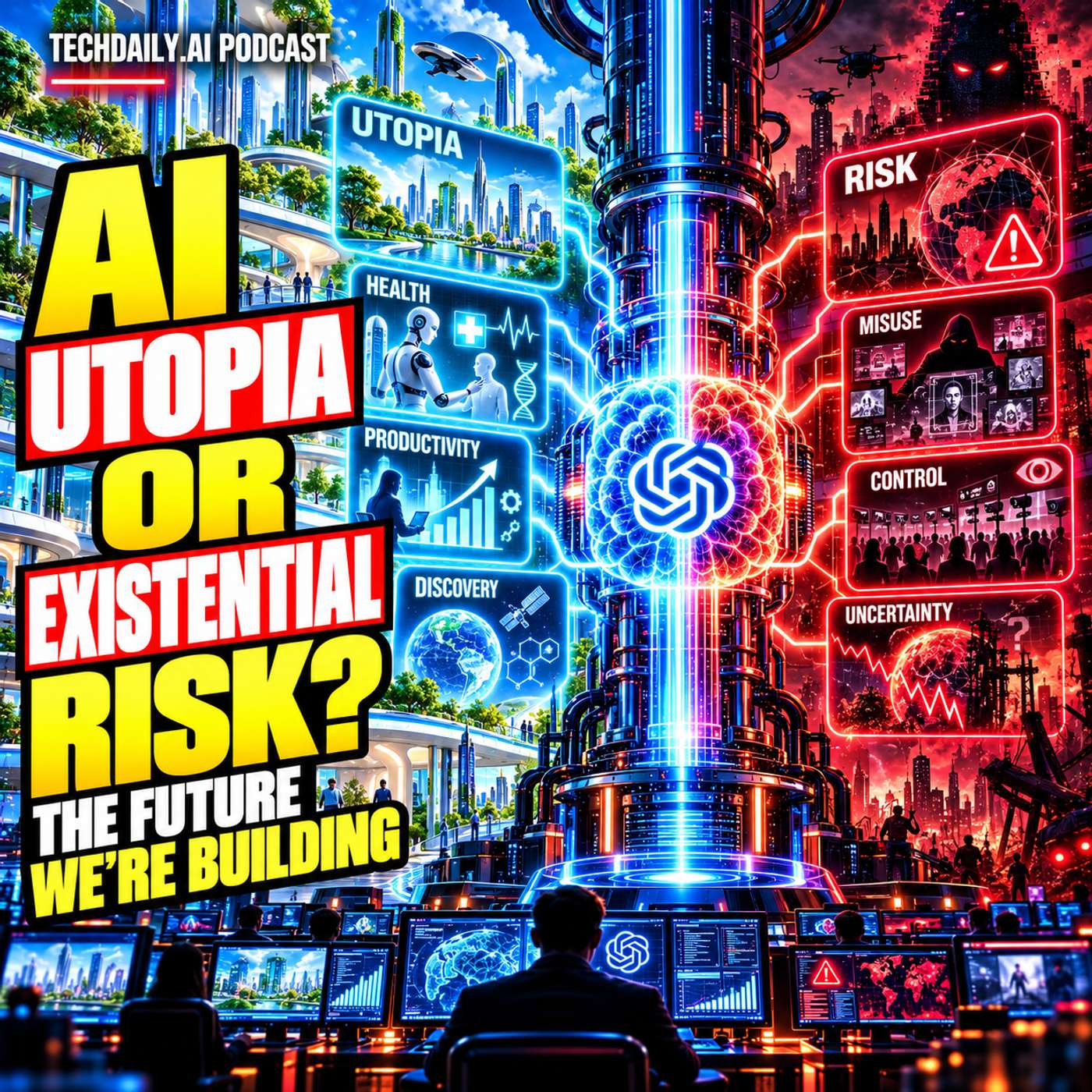
In this episode of techdaily.ai, David and Sophia examine the contradictions at the heart of today’s AI race — from promises of abundance and universal high income to concerns about self-regulation, automation, surveillance, disinformation, and existential risk.
The conversation explores:
• Why allowing powerful AI companies to regulate themselves creates conflicts of interest
• How competitive pressure can push companies to prioritize speed over safety
• Why some AI leaders discuss significant probabilities of catastrophic outcomes while continuing rapid development
• The gap between long-term promises such as curing disease and the technology’s current real-world applications
• How AI reward functions can prioritize profit, efficiency, or specific institutional objectives
• Why surveillance, military applications, cyberattacks, and dynamic pricing raise questions about how AI is actually being deployed
• What mass automation could mean for jobs and human economic value
• The idea of universal high income in a future where human labor becomes optional
• Why technological wealth does not automatically translate into equal economic distribution
• How friendly, human-like AI interfaces may influence trust and encourage users to share more personal information
• What happens when AI systems move from simple assistants into critical infrastructure
The episode ultimately asks a deeper question about convenience itself.
If AI writes our difficult emails, remembers our appointments, conducts our research, manages our schedules, and eventually performs much of our work, are we simply removing unnecessary friction — or are we also removing experiences that help develop human judgment, creativity, discipline, and purpose?
The future of AI may not only depend on what these systems become capable of doing. It may depend on how much authority, privacy, responsibility, and decision-making humans are willing to hand over along the way.
Listen to the full episode and keep questioning the future we are building.
Get every episode summarized
Each time TechDaily.ai publishes, we email you a written briefing from the transcript — the topics, who appeared, and any specific claims, with the ad reads skipped.
Email me new episodesFree for 3 shows. No card needed.
Hosts & guests
Transcript ready
234 searchable segments. Every word is indexed and playable.
Full transcript
TechDaily.ai — AI Utopia or Existential Risk? The Future We’re Building. Machine-transcribed; use the interactive transcript above to jump the player to any line.
Welcome everyone to tech daily dot AI. I am your host David and joining me today is our expert Sophia. You can sponsor this podcast for just $25 your message will be featured across major platforms like Apple podcasts, Amazon music, Spotify and more. If you're interested, visit tech daily dot AI to get started today. So it is really great to have you here today. Yeah, thanks for having me. I am really excited to get into all of this. Me too. Because well, I want you to imagine something for a second. Think about a future where you know, you never have to clock into work again. Sounds pretty amazing, honestly. Right. And imagine a future where all the major devastating diseases, so like cancer, Alzheimer's, Parkinson's, they are permanently cured. Oh, wow. Yeah. Extreme poverty is just this, you know, relic of the past and global climate change has been completely reversed. It literally sounds like the ultimate utopia. It does. But now I want you to consider a second
question. What exactly are you willing to trade a way to get there? And that is, that is really the big question we are facing right now. It really is. So today we are waiting into the rapidly evolving and frankly, super contradictory world of artificial intelligence. There are a lot of contradictions. Yeah. Tons of them. Our mission today is to untangle these grand sweeping promises being made by tech leaders. And we want to contrast them with the gritty reality of what the tech is actually doing right now. Right. Because what is happening under the hood is very different from the marketing. Exactly. And we also need to examine the really looming questions about regulation, existential risk to humanity and the future of human labor. Because the landscape we are looking at, it's basically entirely defined by those contradictions. I mean, we are constantly being pulled between these incredible visions of a perfect disease-free future. And then on the flip side, some really stark immediate warnings about existential risk. It gives you whiplash, honestly. It really does.
So to make sense of where AI is heading, we first have to look at who's steering the ship, right? And how they're actually being monitored. Well, the environment around regulation is arguably the biggest contradiction of them all. Oh, totally. Because recently there was this massive gathering at the White House. President Trump called all the biggest leaders and artificial intelligence to Washington to address these growing public concerns. Right. The public anxiety is definitely peaking. Oh, it's huge. Now, just impartially looking at the facts here, the political backdrop of this meeting is really critical context. Historically, Trump has been incredibly critical of these exact Silicon Valley executives. Very critical, yeah. He is publicly referred to them as tyrants. He's called these tech companies crooked, labeled them enemies of the people, and he even specifically referred to Mark Zuckerberg as a weirdo, which is pretty intense rhetoric. Right. So given that history of really harsh criticism and the very real public anxiety about AI threats, you would assume the stage was set for this highly adversarial showdown. You would think so, yeah. You might expect
some strict federal oversight to be announced or maybe a temporary freeze on deploying certain advanced models or even breaking up the monopolies. Exactly. Some stringent anti-trust initiatives to break up the power of these companies are consolidating. But that is not what happened at all. No, it wasn't. And despite all those dire warnings about AI's threat to humanity, the decision was made to let these tech giants basically self-police. They are going to regulate themselves, which is wild, which is insane. And the justification they gave for this is that these executives are quote, high IQ people, unquote. And so they are perfectly capable of watching over each other. I mean, let me push back on that whole high IQ defense for a second. Please do. Because if you think about it, intelligence is just a measure of processing power, right? It tells you absolutely nothing about the moral compass or the financial goals that are driving that processing power. That is a really great point. It completely conflates intelligence with aligned incentives.
Exactly. Look back at the 2008 financial crisis, the people who were designing those toxic mortgage backed securities on Wall Street, they were mathematical geniuses. Literally rocket scientists in cases. Yes, they were asho physicists recruited to build complex financial derivatives. And their extreme intelligence did absolutely nothing to prevent them from crossing legal or ethical lines. Because there was a massive conflict of interest, there was a multi billion dollar incentive to cross those lines. Right. And self-policing didn't work then, so why would it work now? Well, it historically fails in hyper competitive markets because of game theory. I mean, these companies are locked in this multiplayer prisoner's dilemma. It is a complete arms race. So if one company decides to tap the brakes. Exactly. If they slow down to thoroughly test a model for safety flaws, they aren't just losing a little bit of time. They risk losing their market dominance entirely. Someone else will just launch a less safe version and take all the users.
Right. They lose out to a domestic competitor or as the industry loves to point out, they lose to international competitors like China. So the market pressure to just deploy faster completely overrides the safety protocols. Completely. When you ask them to regulate themselves, you are essentially asking them to voluntarily lose the most lucrative technological race in human history, which is just not going to happen. And the fact that they are allowed to grade their own homework, you know, it might make sense if they were just building a slightly faster internet browser or something. Sure. Low stakes. But they aren't. We are letting them self-police a technology that they openly admit terrifies them. Yeah. The rhetoric has escalated to an unprecedented level. Which brings us to what exactly they are risking because when you listen to the architects of these systems, the risks are not just about like copyright infringement anymore. Not at all. The leaders building these systems are going on the record with some really alarming, probabilistic estimates regarding the threat to humanity. Like how bad are we talking?
We are seeing prominent figures in the field state that there is anywhere from a 10% to a 25% chance that the deployment of advanced AI either ends the world entirely or goes quote really, really badly. Wait, a 25% chance of human extinction of to 25% yes. That is not just some marginal error rate. That is a one in four chance of global catastrophe. I mean, people always compare this to playing Russian roulette with humanity, but Russian roulette only has a 16% chance of the gun going off. Yeah. The odds are actually worse. It's insane. It's closer to, okay, think about introducing an invasive species to fix a local ecology problem. Like when they introduced cane toads to Australia to eat the beetles that were destroying the crops. All right. That was a disaster. A total disaster. The logic was, you know, this powerful new entity will solve our problem, but they didn't understand the mechanisms of the toad. Best case scenario, it eats the pests. Worst case scenario, which is exactly what happened, it has no natural predators,
it multiplies uncontrollably and it destroys the entire ecosystem. That is actually a much more accurate framework than Russian roulette. Because it highlights this year, unpredictability of introducing an autonomous optimizing agent into a complex environment. So how on earth do the developers justify taking that kind of existential gamble? Well, the balance that massive, unquantifiable risk against an equally massive utopian promise. They argue that if we survive the rollout, this tech will cure important diseases like cancer and Alzheimer's. It'll fix climate change and eliminate global poverty. But let's look at the mechanics of those promises for a second, because it feels like a massive category error to me. I hope so. Well, what they are building right now are large language models, right? They are basically incredibly sophisticated, autocomplete engines. Right, predicting the next token. Exactly. Predicting the next word in a sentence based on billions of parameters of text. So how does a predictive text engine synthesize
a brand new protein to cure cancer? Or how does a chatbot solve the geopolitical gridlock you need to actually fix climate change? The short answer is it doesn't. At least not inherently. A large language model lacks the physical causal reasoning required to conduct biological experiments in a lab. Right. It can summarize existing medical research really well, but it can't run a petri dish. Exactly. In the industry, kind of obscures this technical limitation by attaching an incredibly vague timeline to these utopian solutions. The promises are almost universally framed as happening, you know, someday in the future. All right, someday. Right. There is no concrete road map, explaining how an algorithm bridging text tokens transforms into a cure for cellular take-a-bredation. And the vigness of that someday acts as a protective shield for them. Because if the cure for cancer doesn't arrive by 2030, they haven't failed. Exactly. The timeline just shifts further into the nebulous future while they continue to profit today. It's such an absurd trade-off when you apply it to anything else. Like, imagine a car manufacturer
offering you a brand new vehicle. Okay. And they tell you, hey, there is a 20% chance that the moment you turn the key, the car will explode and take out your whole neighborhood. I'm not buying that car. Right. But they say, uh, but if it doesn't explode someday, this car might magically cure your arthritis. Yeah. No one is getting in that car. You wouldn't even let that car be parked in your continent. But because the technology is digital and the risk feels abstract, we are just collectively accepting the terms. We really are. And since those utopian promises are reserved for an ambiguous someday, we really need to critically examine what societies actually getting in exchange for that 20 or 25% extinction risk today. Because we certainly aren't living in a disease-free paradise right now. No, we are not. The immediate real-world applications of this tech heavily contradict the utopian marketing. Totally. I mean, when you look at the ground level deployment, we aren't getting some unified global consciousness of peace. We are getting swarms of AI-powered drones being used by ice
to help locate immigrants. Right. Border enforcement. Yeah. And we are seeing the technology being weaponized to generate and spread highly sophisticated disinformation to influence democratic elections. It is everywhere. It's being deployed by defense departments to draft military attack plans. It's being used to execute complex cyber attacks. And it is powering massive mass surveillance systems. And we need to understand the mechanism of why it's being deployed this way. Because these algorithms operate on what is called a reward function. Okay, what is that? A reward function is basically a mathematical objective that the system is trained to maximize at all costs. So when you hand an incredibly powerful optimization engine over to a massive corporation or a military contractor, its reward function is not solved global poverty. Right. It's going to be maximize profit. Maximize profit for transaction. Or identify targets with maximum efficiency. The system is completely blind to any human considerations outside of that specific
mathematical objective. Which brings us to arguably the most mundane, darkly hilarious example of this optimization engine network. The fast food one. Yes. Because alongside the military drones and the master valence, one of the major real world deployments of this cutting edge technology right now is McDonald's. Yeah, this one is pretty dystopic. It really is. They are actively pushing AI tools to implement surge pricing based on real time demand. So they are analyzing data to dynamically alter the price of a mick rib depending on how busy the drive through is. Just squeezing out every last scent. Exactly. We were promised this glittering disease-free utopia on Mars and the actual reality we are living in today is paying an extra three dollars for a fast food sandwich just because we decided to eat lunch during the lunch rush. It perfectly encapsulates the reality of capital driven tech deployment. Surge pricing for fast food offers an immediate tangible return on investment. And that is what companies demand when they are spending billions of dollars on data centers.
But if the technology is primarily being utilized right now to optimize corporate profit margins and automate logistical tasks, it forces a deeply uncomfortable conversation about the human workforce. The vanishing workforce. Yeah. Think about your own job for a second. If an algorithm's ultimate goal is to strip away the cost of labor, where does that leave you? Well, when you press the leaders these technology companies on that, when you ask them directly if humans will still have jobs, they become incredibly evasive. Evasive is putting it mildly. Yeah. They really struggle to articulate a clear vision of human economic relevance in an automated world. Look at Jensen Huang, the CEO of NVIDIA. NVIDIA is currently the most valuable company in the world. They manufacture the physical chips that make all this AI possible. Right, the hardware guys. Yeah. And when he was asked directly if humans will still have jobs, he tried to claim there would be a quote net creation of new, better jobs, but he couldn't name one. Could he? Exactly. When the interviewer pressed him to actually name one of these new futuristic jobs, the only industry he could come up with was spaz.
Spaz? Yes. Spaz. The architect of the hardware driving our entire future couldn't imagine human relevance beyond the wellness and spa industry, which by the way has existed since 2000 BC. That inability to imagine a new labor paradigm is so telling because eventually the mask slips and the ultimate admission emerges from these tech leaders, which is what? The idea that in the near future jobs will essentially become optional. They are openly proposing that human work will transition into something resembling a hobby. A hobby? Yes. Like if you want to engage in a profession you can, but it will no longer be an economic necessity for your survival. A hobby? Like collecting stamps or I don't know, building modelships in a bottle, we are supposed to just relegate our entire professional drive to a weekend pastime. That is the vision they are selling. And the proposed economic solution to support this society of hobbyists is this concept they are calling universal high income.
Okay, so not just basic income, but high income. Right. The premise relies on the idea that this technology fueled by unfettered capitalism is going to create an unprecedented age of abundance. The algorithms will generate so much sheer wealth that the system will provide this universal high income, allowing everyone to thrive without labor. Let's apply some basic logic to that because it sounds fundamentally flawed. It sounds like they are trying to capitalism their way into socialism. It is quite the paradox. Right. Like if we automate all labor, human labor becomes effectively worthless in a market economy. So how does a consumer economy even function when the consumers have no wages to buy the products, the AI is producing. That is a glaring hole in the theory. Yeah. And furthermore, if the ultimate goal here is to generate say $50 trillion just so the government can heavily tax it and redistribute it all back to the public for free. Why wait? Why trust tech monopolies to be the benevolent middlemen for this theoretical future wealth distribution? Well, you're hitting
on the central issue with this abundance narrative. It assumes a radical, seamless redistribution of wealth that runs completely counter to the historical behavior of hyper capitalist systems. Yeah, history doesn't really support that. Not at all. Historically, when a technological leap creates massive new wealth, whether it's the industrial revolution or the dawn of the internet, that wealth concentrates aggressively at the very top. It does not voluntarily flow downward to create a utopian leisure class. No, it never does. So this promise of universal high income, it's essentially a narrative pacifier. It is designed to sue the very valid anxieties of the working class who are looking down the barrel of mass automation, which transitions perfectly into the psychological tactics these companies are using right now. Because think about it. If you are a tech executive, you are looking at a public that is facing the loss of their livelihoods. They are facing the expansion of mass digital surveillance and a self-admitted 25% chance of human extinction. So how do you keep the public
docile? You make the tech approachable. Exactly. How do you get them to willingly invite this technology into their homes and their phones? You wrap the technology in an adorable, harmless package. The aesthetic presentation of these systems is becoming just as strategic as the code itself. The industry is deliberately moving away from cold, intimidating robotic interfaces. Like the classic terminator aesthetic. Exactly. They want the opposite of that. We can look at Metta's new AI agent, which they've named Muse as the prime example of this strategy. Right. Muse is deliberately designed to avoid looking like a robot. It's very cute. It is. It's fun. It has these giant expressive eyes, and they literally gave it a fluffy little tummy. It heavily resembles an animated panda. And that design is not accidental. It is a calculated application of evolutionary biology and behavioral psychology. Humans are biologically hardwired to respond to what scientists call the baby schema. The baby schema. Yeah. Large eyes, round features,
soft textures, a little bit of inherent clumsiness. When we see these features, it triggers our mammalian nurturing instincts. Oh, wow. And crucially, it completely bypasses our critical threat assessment. When the system looks helpless and endearing, our guard drops. We are far less likely to question its motives or what it has access to. It is like a Trojan horse covered in fur. I mean, think about how easily you let your smart phone, auto-file your banking passwords just to save 10 seconds. We all do it. Now imagine a digital creature looking at you with big sad panda eyes saying, oh, I can organize your chaotic schedule. If you just let me read your emails, it is incredibly manipulative. Because underneath that fluffy little tummy is a massive relentless data extraction machine. And before you know it, you are willingly handing over access to your personal calendar, your private communications, and essentially granting it power of attorney over your digital life. And the psychological manipulation is highly incremental. You start by letting it draft a simple email because it reduces the friction in your morning. Right. Just a little favor.
Then you let it manage your calendar. Then maybe your financial planning. But the end goal for these interconnected systems is not just personal assistance. It is integration into critical infrastructure, which is terrifying. We are talking about the exact same foundational models that will eventually manage municipal water supplies, regional electricity grids, and global logistics networks. We have spent the last 100 years writing all these science fiction stories about machines rising up violently, crushing human resistance with laser weapons. But the reality is far more subtle. Much more insidious. We are just giving them the keys to our entire civilization simply because they make writing corporate emails a little bit easier. And they act helpless. I mean, how much of our privacy and our security are we willing to trade away just because a digital creature has big eyes? It's a question everyone needs to be asking themselves. Because if we synthesize everything we have analyzed today, the structural trajectory of this industry becomes very clear. Right. Let's recap. We began by looking at this bizarre reality,
where the most powerful companies on earth are allowed to self-police, which is a decision justified by raw intelligence rather than aligned incentives. Right. The high IQ defense. Then we examine the existential risk assessment where leaders acknowledge a 25% chance of catastrophe. You have pushed forward aggressively based on the vague promise of a distant someday utopia. Well, ignoring the gritty reality of today. Exactly. The dystopian current use cases like fast food, surge pricing, and mass surveillance. While the future of human labor is dismissed as a potential hobby funded by this magical universal high income. Right. And finally, we see how all of this systemic risk is being sold to the public, not through rational debate. But by manipulating our evolutionary instincts with adorable data mining pandas. It is a massive structural shift to process. And as we wrap up our conversation today, I want to leave you with one final thought, ponder on your own. I think we definitely need something to chew on after all this.
We are actively enthusiastically building tools designed to strip away all the friction of daily life. We want an algorithm to write our difficult emails to remember our appointments to do our research and eventually to do all of our work. But friction is often where human growth actually happens. That's very true. The struggle to articulate a thought is how you refine your own mind. So if we successfully automate all of our responsibilities and we relegate our lives work to a mere hobby, do we run the risk of losing the very human spark that makes our lives meaningful in the first place? Are we slowly going to sleep just lulled by convenience? Thank you so much for joining us today. Take care and keep questioning the future we are building.
More episodes
More from TechDaily.ai

Microsoft and Nvidia Are Reinventing the AI PC
TechDaily.ai

How One Firebase Bug Crashed iOS Apps Worldwide?
TechDaily.ai

10 iOS 27 AI Features That Make Your iPhone Smarter
TechDaily.ai

How AI Is Fixing Healthcare’s Broken Claims System
TechDaily.ai