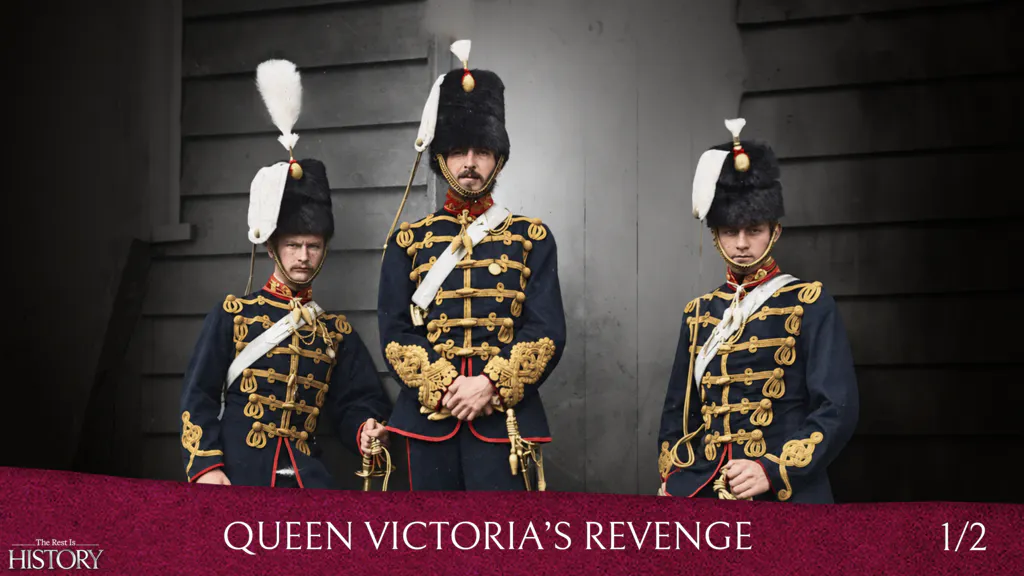
706. Queen Victoria’s Revenge: Storming the Citadel (Part 2)
Get every episode summarized
Each time The Rest Is History publishes, we email you a written briefing from the transcript — the topics, who appeared, and any specific claims, with the ad reads skipped.
Email me new episodesFree for 3 shows. No card needed.
About this episode
The Rest Is History is made possible by:
“Right now, all of Mint's plans are $15 per month, even unlimited. Upfront payment of $45 for three months, $90 for six months, or $180 for 12 months, plan required $15 per month equivalent, taxis and fees extra.”From the transcript
Get every episode summarized
Each time The Rest Is History publishes, we email you a written briefing from the transcript — the topics, who appeared, and any specific claims, with the ad reads skipped.
Email me new episodesFree for 3 shows. No card needed.
Know when Emperor Tewodros II turns up
Follow Emperor Tewodros II and once a week we email you every new episode they appeared on — including guest spots the show notes never mention, because we read the transcript.
Follow Emperor Tewodros IIFree. Pick your own day and time.
Hosts & guests
Transcript ready
766 searchable segments. Every word is indexed and playable.
Full transcript
The Rest Is History — 706. Queen Victoria’s Revenge: Storming the Citadel (Part 2). Machine-transcribed; use the interactive transcript above to jump the player to any line.
This episode is brought to you by Mint Mobile. Right now, all of Mint's plans are $15 per month, even unlimited. Go to MintMobile.com slash history. Upfront payment of $45 for three months, $90 for six months, or $180 for 12 months, plan required $15 per month equivalent, taxis and fees extra. Initial plan term only, greater than 50 gigabytes, may slow when network is busy. Includes up to 20 gigabytes of hotspot, capable device required, availability speed and coverage varies. See MintMobile.com. This episode is supported by Anthropic, the team behind Claude. Now, history's biggest leaps started as hard questions that people didn't want asked.
Yeah, there's a classic example of that at the end of the 15th century. And the hard question in particular was, what is out there beyond the Atlantic Ocean to the West? And as you will know, the man who found the answer to that question was the explorer Christopher Columbus. And he realizes, or rather everybody else realizes, that there is a vast continent out there. And it is, of course, the Americas. So, your Anthropic knows the importance of questions, and it's why Anthropic is founded on one hard question above all. How can we ensure that the AI revolution really goes well for ordinary people? So they asked over 100,000 people, and what came back wasn't just fear. There was hope as well. People wanted to know, will cancer ever be cured? Camp kids have a better future. It turns out that there is hope in hard questions. Ask yours at Claude.ai slash raster's history, and keep thinking. Queen Carvania stood haloed by the morning sun, an army hung on her every word. My champions, I have sold my chariot on Carvana to
a lovely SUV, an inexplicably queenly offer. They're even coming to the castle to collect it. Tonight, we feast! An offer you can feast on. Sell your car today on Carvana. Pick up Fismele 5. A commotion at the doorway brought me back to life, trying to start up and failing thanks to the weight of those infernal clanking manacles. That's the door crashed again. I was aware of a swing figure in the middle of the room. Beared the waste. How are you? How are you my dear friend? My best friend. Cry's this apparition, whooping with laughter. Thank God I am well. Are you well? Oh my good friend, my heart rejoices to see you for the friendship I have entertained for you
has not diminished. Be of good cheer, for though you are bound with fetters of sump-sun and zedakaya were bound even with fetters of brass. Yet, his voice trailed away muttering and who else? Yeah, Joachim also was bound and Manessa, they were bound by the power of God, and so was Gosem, who was sold for a shaman, whose feet they hurt with fetters, and he was laid in iron. And then he gave another crazy laugh and almost fell over. But have no fear for the hour of your deliverance is at hand. My eyes had recovered from the lamp glare, but I could hardly believe them. For the newcomer was Theodore, King of Abyssinia, and he was daggaringly drunk. That was the great Victorian hero, Sahari Flashman, remembering his first meeting with the emperor
Teodras II in his memoir Flashman on the March. It is to reiterate a novel, not a work of history, but it is very, very deeply rooted in all the historical records. And in the book Flashman has been sent on a secret mission to recruit allies against the Abyssinian Emperor Teodras II, as part of a British expedition to rescue several dozen European hostages. And even though Flashman's part of it, as we've said, is invented all the most jaw-dropping parts of the story in the novel, Teodras, his mountain lair, the British expedition are absolutely true. And today we have reached the melodramatic climax of the story. And Dominic, this is ultimately, it's a British imperial version of the Iranian hostage crisis, isn't it? Yes. And if only Jimmy Carter had paid attention to the lesson that could have been learned
from from our glorious boys in 1868, the way that they solved the problem of hostages in the hands of an unfriendly regime. So true, I'm not sure his knowledge of Victorian imperial history is as good as it should be. One of the, one of the flaws, he spent too much time fighting rabbits. The key, as far as I can tell, is to involve railways and elephants. Elephants, which may be where Carter went wrong. Definitely. So let's remind people where and when we are, summer of 1867. So for four years or so, this crisis has been rumbling on in the mountain kingdom of Abyssinia. And at the root is the Emperor Teodras' simmering rage. And the fact that Queen Victoria has not been answering his letters. And he has taken a group of Europeans hostage. So most of the mission is, but also to remind people, the British consul, Captain Charles Duncan Cameron, and the foreign officers agent, Hormuz Rassam. And he's holding them in his mountain top layer, his citadel of
Magdala. And the hostages have been smuggling out these increasingly desperate messages, a reporting that Teodras is descending into insanity and basically begging the foreign officers to use force. And last time he ended with Lord Darby's conservative government, sending an ultimatum to Abyssinia, giving Teodras three months to release them. So let's pick up the story on the 19th of August in London. We are at 10 Downing Street. And chairing the cabinet is Lord Darby. And Lord Darby is a proper Victorian grandee. Formerly awake, now a conservative, incredibly rich. He has coal mines in Lancashire. He is classically educated, is it brilliant debater. He's a man who likes shooting and horse racing. He's sort of Victorian politics bingo. And he runs the country in Kahut's with his sort of ally in the common spenjamined Israeli. He was the the longest serving conservative political leader ever. 22 years. He was prime minister multiple times, but only for very short
spells. Yeah. And he never had a majority. No. And he relied, I mean, he's in the lords and he relied on disraeli to run things in the commons. Anyway, they meet his cabinet and they agree this cannot stand. As British governments always do, they blame their predecessors, the liberals, and this. The liberals sort of sorted this out. However, they didn't. And here we are. And we are being embarrassed in the eyes of the world. In particular, we're being embarrassed in the eyes of our subjects in India and in South Arabian places like Aden. And we cannot lose face in front of these people. We cannot be humiliated by an African king. So Lord Arbis ministers have already been in touch with officials in Bombay to discuss an intervention plan. The army in India has been put on alert. And they've agreed that the British authorities in India will meet all the costs and important points. Although they do as flashmen and his interlocutor were discussing in our first episode, they do end up putting a penny on income tax to pay for it all. British governments love
for raising spending to fund the fence, don't they? They do. Well, there's a lesson here for Andy Burnham, I think. Anyway, they've also appointed a guy who will run the expedition. And this is the veteran British commander and chief in Bombay, who is Lieutenant General Sir Robert Napier of the Royal Engineers. He's a tremendous man. Napier is a tremendous man, actually. He's one of the stars of the British army. And he's one of those in an age when British commanders actually quite often turn out to be unbelievably useless, but foods. He is not a buffoon. He's not a buffoon at all. He was born in Ceylon, now Sri Lanka, into an army family. He had fought in two wars against the Sikhs. He'd commanded the defense of Lucknow in the Indian mutiny. He'd led troops into Beijing in the Second Opium War. He's incredibly popular with his men. Everyone agrees that Napier is a charming, polite, brave, level-headed, very methodical commander who doesn't like wasting the
lives of his men. He looks as he should. He's a big man. He's got this incredibly kind of weather beat and face. And he's got this very large, but also slightly sad, melancholy moustache. Which again, I think, is in keeping, but not in an effectual man. He's an engineer, isn't he? Yes, exactly. He gets things done. He gets things built. He doesn't fathoround. Yeah. And that's key to this whole story, really, I guess. Our American listeners will perhaps welcome a comparison with Ulysses S. Grant, who's been distinguishing himself at this time, though he's not as corrupt as Ulysses S. Grant. Of course. And not as boring, so I think the American listeners will enjoy it when we make those points. He's 57. His wife is beloved wife to whom he's been very happily married, has just died. And so Napier has ventured again into the into the lists. And he's just got married to an 18-year-old. Well, I don't know what to say about that. Would you make a that? Well, I'm waiting for you to say the salient fact about this woman. What is the salient fact?
She's from Montgomeryshire. She's Welsh. Oh my word. How did I overlook that? So yet another series about Welsh history. Oh, mad that I missed that. And my apologies go to the people of Wales for missing that important detail. Yeah, you're just blanking Welsh history again, Dominic. Can I get to you one other amazing thing? Do you know when she died? 1944, very close, 1930. Wow, age 89. That's bonkers, isn't it? That's, it lifts up. It is. She lived long enough to listen to jazz and to go to the cinema to see King Kong. She lived a long time. She saw the jazz singer. She did. That's what killed her. Yeah. Alright, so Napier, this is quite a tough gig for Napier. Now, you may think are the Europeans against an African kingdom, a little bit of walk over, not a bit of it. The history of European intervention in these years does not give great grounds for confidence. So the most famous or
infamous British intervention of recent years was probably the Afghanistan, the first Anglo-Afghan war. The retreat from Kabul in 1842 and absolute shambles, tens of thousands of British casualties, unutter humiliation. Flashman's first adventure. Flashman's first adventure. Flashman then pitched up in the Crimea in the mid-1850s. Now, there, of course, technically one, but the British and French between them lost more than 100,000 men. The campaign was notorious for disease, terrible conditions, kind of industrial slaughter, very miserable. And we will be talking about this in a month or so. We will indeed. While this Abyssinian crisis has been brewing, the world's attention has been on Mexico. Where the French had intervened, with their puppet emperor Maximeleon Habsburg, friend of the show, and the French had lost almost 10,000 men. And again, they had been defeated. So European interventions, in this period, have a pretty checkered record. And people say at the time, this is going to be the hardest yet. The Abyssinian
interior is not properly mapped. It's mountains, it's gorgeous, it could not be more challenging. Intel is absolutely useless. The climate is punishingly hot. There's cholera, there's typhoid, there's lions, the snakes, baboons, baboons, everything could go wrong. In Bombay, Napier's officers prepare by going to every library in Bombay and scaring every single history and travel book they can find for reference sister Abyssinian. And they write in report. And the report concludes there are few countries about which we know less. That's reassuring. So to give you some examples of what they don't know, they don't really know where Teodros is. They don't know how much support he has. They don't have any relations whatsoever with the local warlords, the people who are rebelling against him. They don't have any sensor, which way they will jump. They don't know where to land. They don't know what route to take to Magdala. And they don't know how they're going to get out again without being attacked. But as you said, Napier is an engineer. Yeah. So he is the perfect man for the job really. He plans this really methodically. And he says, right, let's work
that backwards. What we would need, we'd need 5,000 men to get these people out. And what would those 5,000 men need? They would need supply lines stretching back to the coast, stretching for hundreds of miles. So we'll need another 10,000 men to guard the supply lines. Then we need a coastal base. And we ideally want two connections, one going up the Red Sea to Suez and another going across the Indian Ocean to Bombay. And to plan all this, we're going to draw on the resources of the entire British Empire. So as Philip Marston says in his book, The Barefoot Emperor, from Liverpool to Woolwich, Chatham to Bombay, Chatham. That was a little gift to you. Oh, great. So this is really another story about Chatham High Street. Aiden, Timodras, Quartanasters and storekeepers, technicians and chemists, coolies and cooks, design clerks, bookkeepers and stewardors began to work towards freeing the captives from the grip of what the newspapers called the Gorilla King. And they go into incredible detail. Marston's book is brilliant on this.
They work out, you know, to the sort of last pound exactly how much salt beef, salt pork, they'll need how much vinegar and mustard, how much rum and champagne and beer. Champagne. They had to take champagne with them. That's essential, isn't it? Of course they do. You can't fight a war in Abyssinia without plentiful supplies of champagne. They stoppile bibles and prayer books and pickaxes and gunpowder. And one of the things they stoppile at very tellingly, copper, telegraph, wire. So this is going to be it's described in the time as a campaign to rival the adventures of Alexander the Great or El Ancourtez or Pizarro or whatever. But this is going to be the most technologically advanced military campaign in history. So Napier is taking seven photographers. He's taking a portable telegraph system. He's taking all kinds of water pumps and things. He's taking flares to light up the camp in case they're attacked at night.
It's just kind of the great exhibition on maneuvers. Yeah, the touring great exhibition. Like Napoleon in Egypt, he's taking what Napoleon called them, they called them Savants, they're French campaign. So he's got geographers and meteorologists. He's got a boat from the Bombay Zoological Society. He's got a geologist from Calcutta. He's got a British Museum archaeologist who's coming along to kind of check for relics. And the presser with them, so we mentioned in the first episode, Henry Morton Stanley of the New York Herald, GA Henty of the Standard, which is a London paper. So they've got all that. They also are going to take a lot of cash and this is an incredible story. They will need cash to buy supplies when they get to Abyssinia and also to pay off the local warlords. And British agents in Africa report. They say, well, that neck of the woods, in East Africa, there's only one commonly accepted universal currency. And this is, believe it or not, the Austrian silver tarlar, which was minted first by Maria Theresa in 1741. How come it's
they popular in Abyssinia? This I have been unable to determine. It seems improbable. So apparently, the silver tarlar that they wanted most was the 1780 edition, I don't know why, but this was the one that was regarded as the gold standard, the silver standard that was very popular in East Africa. And mind bogglingly, people were still using this as currency in the 1950s. These Maria Theresa silver coins. And for some reason, they have just become entrenched and accepted in East Africa. But they're no longer making them in Vienna. And Napier's agents, first of all, Napier sends agents to Central Europe to buy up as many of these old coins as they can. And then he sends a representative to the official mint in Vienna to persuade them. He said, the British will supply you with silver. And can you produce these tarlers? And the official mint in Vienna is turning out 20,000 of these a week purely for the expeditionary force. So all this takes a lot of money.
Derbys government has set a budget of 2 million pounds. Even before they set off, it balloons to 4 million. And it ends up costing the British taxpayer 10 million pounds. So when you do the calculation, that is the equivalent of tens of billions of pounds today. This was an extremely expensive enterprise by the stands of the day. Can I just ask, this is a surgical strike. They have no plans to occupy Abyssinia or anything like that. It's in and out. No talk of regime change, no talk of anything. Yeah. But the hostages. And secondly, they are doing this ultimately, you think, not for humanitarian reasons, but to affirm the prestige of British Empire in the face of the Ottomans, the French. That's ultimately the reason. Yes. I think it's hard to distinguish those two things. I think people at the time would have found it very hard to distinguish them. In the same way, let's go back to the comparison with Iran in 1980, the response to the Iranian Revolution and the hostage crisis. The plight of the hostages in that story became tear jerking,
was on American newspapers and bulletins all the time. But it is also about prestige. But in the minds of the policymakers, it's inseparable, really, I guess. And I from the question of prestige. And I think the same is true here. Ultimately, I think they don't care that much about the hostages, about some missionaries. I mean, it's brilliant for the press, right? The press care. But I think if you're Lord Darby or Benjamin, this really you care far more about British prestige. Britain cannot afford to be humiliated. Because it is billions, billions and billions in today's spending. Yes. And we know, we know we see now how governments hate spending money on the military. They do. But it was equally governments sometimes think that they disagree a face they cannot possibly lose. The humorous magazine punch. They got a joke. Yeah, slightly unamusing rhyme. But dash the expense. However immense, we can nothing cheaper than fight. And I think what they mean by that is the cost to the British people of losing face will ultimately
be greater than that of the balance sheet. That actually in the long run, it's better to pay the money now. Anyway, let's move forward to the autumn of 1867. So by the final week in October, the advanced party, which has made up a Bombay Marines and Bombay like cavalry and engineers and sappers have landed in a place that they call Anasley Bay. And if you look it up, it is now the Gulf of Zula in Eritrea. They've found an anchorage for 100 ships. And then they send back measurement specifications for three large peers, which they will build to help them unload the ships. And so in the next few weeks, more men, more supplies follow. I mean, it's mind-boggling, the Enterprise. Hundreds of tons of coal. There are tramway sets. There's pile driving machinery. And so by the new year of 1868, they have landed 13,000 soldiers, 20 miles of railway track, and 44 elephants, which were shipped across the Indian Ocean, in specially reinforced
transports. That is seven more elephants than Hannibal took. Really? Seven more to Italy? Yeah. Haravanapia. And while they're doing that, their sappers are literally blasting away through the cliffs to find the best route to get to the Highland Plateau. So they're going to have to head up 8,000 feet above sea level. And then they're going to have to travel through the kind of gorgeous and the ravines for another 350 miles until they get to Magdala. On the 7th of January, Napier himself comes ashore from the SS Octavia. And Napier like all proficient commanders has a great sense of political theatre. He is dressed in his full uniform. He's got all his medals. The ship's guns are firing a salute. There's a marine band playing. He comes ashore, everyone cheers. And Napier is a, I mean, he's a very, very proficient commander. He's not bothered about the costs. He says, look, the government of India will pay and the British government will back them up. I want more mule drivers. I'm a men need more boots. You know, his men love him for this reason.
And within a couple of weeks, they have started work on the railway. And the railway will bring all their supplies inland from the coast. And they've also set up, I mean, this is an incredible achievement. They have basically a field telegraph all the way to their advanced guard. They'll travel without the whole way, basically unspooling copper wire as they go. So by the 25th of January, 1868, Napier is ready to set off for the great trek to Magdala. And as planned, he has 5,000 men that will go ahead as the spearhead. And behind he has 7,000 men who will guard his supply lines. And as they set off, they must look absolutely outlandish to the locals. I mean, they must look like people have landed from Mars or something because the British cavalry lead the way. And I say British, this is British and Indian. There are Sikhs. There are recruits from across the Indian subcontinent. So there's lots of people in turbines and stuff. But they're all wearing their
British army red jackets. Then there's the supply chain, 7 miles long behind them. There are the 44 elephants who are dragging the field guns, the kind of heavy guns. God, Teodross would love that. That's always Christmas has come at once. And they have military bands playing the whole time. So I mean, they're basically like a sort of roaming orchestra. And they they trudge into the highlands making very slow progress. Napier is of course conscious. The big issue that they face is if people attack them on routes, if they wall or it's attack them. And the key moment really comes at the end of February. So they've been on the road for a month or so. And he enters the territory of one of Teodross's key rivals who is a guy called Rascasse, who is the king of Tigray. And basically the road to Magdalene runs through this this kingdom of Tigray. And Napier, he's a great diplomat. He waits for this guy. He stops. He waits. He wants to greet him with full military
honours. He has his troops drawn up very smartly. When this bloke arrives, he says, would you like to inspect our guns? Here, I brought you presents. I brought you an Arabian horse. I've got your rifle for you. I've got some nice glassware for you. I mean, he says to Kassar, my troops will not loot. They will not steal so much as a kind of a loaf of bread. We will pay for every sack of grain. If you help us, I promise you the friendship of Queen Victoria. And it works very well. This guy says to him, well, you're a very impressive person. He gives him a lion's skin cloak. And he says, I will bring you weekly supplies of food, which he does. And I think there's an implicit understanding here. There's never written down. And it's never explicitly stated. But I think it's pretty clear. And Napier knows this man expects him to deal with teodross once and for all. That is the quid pro quo. You've been comparing this to the conquistadors in America. And this is a very familiar story, isn't it? You know, whether it's
the Aztecs or the Incas, that the local, not necessarily even subject peoples, but inferior rivals who want to throw off the hegemony of the local big power that they team up with the Europeans. Exactly. I think that's exactly it. The difference, I guess, is that the British don't want to stay. You know, the conquistadors want to stay. They're their own agenda. The British really just do want to get in and get out. Now, this is probably a good point to ask, what has happened to the hostages? We haven't seen them for a while. So we last saw them in the summer of 1867, so almost a year ago. What have they been up to? They've been stuck in their huts at Magdala. They've been playing cards, and I mean, they're kind of manicured, so I don't know how he said that is. I'm supposed to bent over. I mean, cards is one thing. Yeah. They've been reading the Bible. They're allowed to use all their old stores. And actually, so they've been eating very well at Magdala, because they brought up a lot of their old kind of stores and stuff. So, insanely, they've
been having like four course meals, soup, starter, a main course and stuff. So that's all, that's the good news. The bad news is they're still in chains. Some of them are very ill. They're very depressed, but then in December 1867, a traveler arrived in Magdala with a message for Dr. Blanc. And this was the news that the British had landed on the coast. The first British sort of engineer had landed on the coast. Dr. Blanc said later, it was one of those exciting moments in a man's life that few can realize who have not passed through months of mental agony and then been suddenly overcome with joy. So, it's kind of like exciting for the hostages, the British are on their way. But of course, they're now in a state of unbearable tension because Teodross has been gone for years, two years or most. Will Teodross get back to Magdala before the British? And if so, will he have them or killed or will he agree to see sense? They don't know. And this of course brings us to Teodross himself. As I said, he's been gone for ages on campaign. He has been fighting rebels and
stuff. But that automating 67, he too began to head inland. He left his northern capital to head back to Magdala. And with him, he brought his army. He brought a huge horde of camp followers, a huge horde of prisoners that he had taken. So, he's got about 50,000 people with him and above all his favorite things, which are his guns. So, listeners may remember that he was getting his Swiss and German missionaries to try and build guns for him. And they have finally managed to cast what he really wanted, which is a giant mortar. And this is a 70 ton mortar. It's mouth, it's two feet wide. So, it's a huge caliber. And he calls it sabastapal because he loves the Crimean war. So, Napier had been told Teodross has got these guns. And Napier assumed, well, when Teodross goes back to Magdala, he'll obviously leave these guns behind because they're so heavy
and he's not going to try and drag them. But no, Teodross is dragging these guns back to Magdala. And he's very excited about the chance of using them. Can I ask Dominic, these missionaries, these Swiss and German missionaries, obviously making guns, we said in the first episode, isn't really part of what they're about. No. But have they up their game like this point? Are these functioning? Well, that is a great question. And you know what, we're going to find out. We're going to find out what happens because Teodross has not yet fired it. Teodross has experimented a little bit with these guns because they never really fired them in anger. Okay, exciting. And this is something for listeners to look forward to. Now, he knows at this point, so that's the same with the beginning of 1868, he knows the British have landed his agents of intercepted messages from Napier to the local chiefs, you know, basically trying to get the local chiefs support. Teodross has reaction, people who are fans of his erratic behavior will be pleased to hear that he reacts in a very peculiar way. So first of all, he says to his German missionary gunsmiths, he says, this is brilliant.
The one thing I've always wanted to see is a really disciplined European army and finally, I'm going to get the chance. So his plan appears to be that he will get to Magdal of first. He will line up all his guns. Then he will test them against the British army. He thinks that when the British see Sebastian Paul in action, they will respect him and they will see what a great king he is. I want an impressive person here. And they'll definitely want to come to an arrangement with him, perhaps I am a treaty. This is his thinking. He tells his courteous, he says, I've heard a prophecy that a European king will meet with an Ethiopian king in this country. And after this, a great king will come. But I don't know whether I shall be that great king or someone else. That's modest of him. Yeah, even so, you know, he's very keen, he's very excited. He's also started rebombarding his old crush, Hormord Rassam, the British agent, the guy from
Mosul who used to be an archaeologist in the British descent. But he's still chained up at this point. He's chained up at Magdal in the mountain in the mountain layer. But Teodras has started writing sending him love letters again. I mean, the same thing to write to somebody who you're keeping as a hostage. How are you? How are you, my friend? The nearer I approach towards you, the happier I feel. Oh, my friend, do not think I bear any hatred towards you. I've placed you in a present position in order that I may come to know the people of your country. It's kind of the opposite of the Stockholm syndrome, isn't it? Yeah, where you're captor. The captor falls in love with the captive. Yeah, exactly, exactly. And the mad thing, the maddest thing is Teodras says to him, the thing I'm really looking forward to is I'm going to, I can't wait to show you some master bowl. I have had a large mortar cast, which is the Tamiya on the road. But when I reach Magdalor and you see it and admire it, I will forget all the trouble it has given me. So basically, it's the master pole for Teodras is a bit like the owl man for the Aztecs. Yes, it is. It's the
ultimate weapon that will definitely win in the war. It will win in the war and also win in the undying affection of Rasam. Right. So finally, Teodras arrives at the mountain top on the 27th of March, 1868. It's a very gothic scene. So a storm is breaking overhead, thunder, pouring rain. He arrives at the mountain top and his guards immediately bring in Rasam. And Rasam is shocked to see that Teodras has aged a lot in the last couple of years. He looks very gaunt, very haggard. Now, Rasam probably hasn't aged brilliantly because he's been chained up in a hot. But Teodras has been off on campaign. His mental health isn't great, to be honest. And he greets Rasam, his hostage against the backdrop of the British invasion of his country with the mad greeting today, we must all be English. And what does he mean by that? God knows where unsuitable clothing for the hot temperature. React to everything with sort of insucient
understatement. But that's not his style at all. No, he loves the available explosion. No, I think what he means by this, he means he's just, I think it's just so excited that the British are coming in a weird way. And he says, I can't wait to show you sabastable. And he says, the two happiest days in my life are when sabastable was cast. And also, today, when I get to see you again, I mean, it's so unsettling. Kalam, our producer will enjoy that will enjoy this reference. There's a scene in I'm Alan Partridge when Alan Partridge is effective in taking prisoner by crazed fan called Jed. And this is basically Rassam's situation. He's been taken prisoner by Teodras. But then Teodras' mood changes abruptly. And he says to Rassam, I hope Mr. Rassam that when your people arrive, they will not despise me because I am black. And then, and notice a fatalism. One day you may see me dead. And while you stand by my corpse,
it may be that you curse me for my bad conduct towards you. Rassam, I think, finds it hard to know. No. Keep up with all this. Yeah. And the maddest thing of all, right? So Teodras almost tearful with his love of Rassam. And you know, morbid thoughts and all this. And then as soon as his guards take Rassam out, Teodras hurts his gorgeous and says very bitterly, Rassam has made ashes of us. I've a fool of me. He's pretending to be my friend. But he's been plotting to slaughter Rassam ravish our wives and reduce our people to abundance. It's kind of um, 16 year old girl with a crush. I love him. I love him. He hates me. Yeah, that's exactly what it is. Yeah, that's exactly what it is. This is exactly his attitude to Rassam. Now, that's Teodras. General Napier, a very different kind of man. His, his, his, his, his moustache and his, he an interested engineering project. Exactly. His men have now trudged all the way to the edge of the Jitter gorge, which is
about 50 miles from Magdala, we're now early April. So this is very sort of sunscorched barren terrain. It's hard work now. They're a long way from the coast. They've traveled more than 300 miles. And on the 6th of April, they get their first glance of the summit of Magdala in the distance. So one war correspondent said it rose like a great ship out of the surrounding billows. And Napier now sends ahead a messenger with a final ultimatum. By command of the Queen of England, I am approaching Magdala with my army in order to recover from your hands. Envoy Rassam, console Cameron, Dr. Blanc, Lieutenant Prido, and the other Europeans now in your Majesty's power. I request your Majesty to send them to my camp as soon as it's sufficiently near to admit of their coming in safety. There is no reply. But Teodras does know that the British are very close now. Every morning Teodras very excitedly has been scanning the mountains with his telescope. Is that the telescope he got given? Yeah. He's freeing it away.
To be didn't smash it. No. Clearly it didn't break. He's been staring through his telescope. And on the 7th of April, which is the Tuesday before Easter, he sees the first red British uniforms on the other side of the Bishilo gorge. And he shouts, perhaps unexpected. He shouts very loudly with excitement when he sees them. He shouts, hurrah, there go the donkeys. Does he? The donkeys of the British? Not all these mules that Napier's had brought over. The British have got mules with them. So maybe that's what he's talking about, who knows? And then he hands the telescope to this Swiss missionary called Theophilus Valbire, who he's very keen on. And he says to Valbire in a very jaunty way, there you will see your brethren who have come from England to kill me. Trilal. Yeah. So the next day is a Wednesday. Teodras gets up before dawn. Now usually he dress quite austily with a white robe and a red border. But today, because the British have come, he's very excited. He's wearing a white silk gold threaded robe with white pantaloons. And Rassam said rather disparagingly, he looked
more like a harlequin than a sovereign. It's something really sad about that. He's trying to look regal. He's trying to make a splash only to be the victim of massive British sonobbery. Yeah. He's dressed inappropriately. Rassam has obviously become very naturalised. You know who Teodras will get on absolutely superbly with? And it's a man we're always pleased to get back on this bug cast. The Kaiser. The Kaiser. He and the Kaiser, which got us. So well. That's the similarity, sir. At this point, Teodras orders that all the prisoners be brought down. He's got a military camp lower down the mountain. And he has all the prisoners brought down. So this is the hostages, but also this great horde of Ethiopian captives. So these are, as I said before, captured rebels, rival chiefs, criminals, all of this. And these blocs, he's treated very badly. They're ravaged by disease and half-staffed. And Teodras says, you know, it's a little gesture to the British. Choose 70 of these avicinian captives and let them go. And so they let these people go. They go off and head
off towards the British. And then Teodras draws up his army and he gives a truly deranged speech to his army. He starts to inspire them. He says, the British are coming. And be in no doubt the British are much better than we are. They are better equipped and they're stronger. They're very dressed as bedecked with gold to say nothing of their treasures, which can only be born by elephants. Are you ready to fight? And enrich yourselves with the spoils of these white slaves? Or will you disgrace me by running away? I mean, that's sort of a leap. He's gone from sending British a better to saying, we'll get all their treasure. And I kind of gristled old veteran steps forward and says, only wait to your majesty until those ashes make their appearance. And we will tear them to pieces. And everybody smiles as, ah, yay! Yeah. And Teodras greets that West. Thanks to this man. You old fool. Have you ever seen an English soldier before you know where you
are? Your belly will be filled with bullets. Oh my god. It's like Henry the Fifth Attaching Corps. So if you're one of his men, he's sending very mixed messages. He is. Yes. He is. It was slightly deflated, I think. So the next day, Thursday, Thursday before Easter. Teodras has been drinking a lot, probably too much, I think. And he drinks a lot that morning. And after lunch, he decides to retire to sleep it off. Now before that, he said to his generals, okay, you can release all the remaining Abyssinian prisoners. Released them all now. Now these people have all been shackled up as well. I mean, the people manufacturing chains in the Kingdom of Abyssinia must be making absolute killing. And it's taking ages to get all their shackles off. And about four o'clock that afternoon, the very hung over Teodras is woken by the sound of prisoners complaining that the guards are taking too long to get their shackles
off. Teodras goes berserk of this. He calls for a sword and he immediately stabs two of the prisoners to death. Then he says, how many are left? It's about 300 left. He says, bring them all up to me. They line them all up on the cliff. And then one by one, he has them thrown over the cliff to their deaths. And then he tells the guards go down and finish all the survivors off. The whole thing takes two hours. It's a horrendous scene, obviously. But Teodras does feel bad about that afterwards because that evening, apparently, one of his servants heard him praying aloud, telling God, confessing to God that he was drunk when he ordered the massacre and asking for forgiveness. Please don't count against me because drink had been taken. I don't know what God's view of that was actually. I don't think very approving to be honest. It's really not. So we come to the crucial day. And this is the 11th of April 1868. It is good Friday. Teodras knows that the British are very close now. He knows that they are about to reach in a few hours the plateau of Aroji, which is just below the fortress at Magdala. They should be there by the afternoon. And this will be
it. This will be the moment of decision. And we will find out what happens in that moment of decision after the break. This episode is sponsored by How the Teodras Lost Their Heads on National Geographic. You and I think we know the story of the Teodras, don't we? But this series puts them in a very different light because it asks, what if the biggest Teoda stories were investigated like modern true crime cases? A brilliant idea. So just to emphasize, this is very much not a traditional history documentary. And we could not be more excited about it. So this is a series that explores some of the best known figures of the Teoda era and also some of the less well known. And it uncovers fresh evidence that shines a new light on the stories behind their demise. Yeah, I'd really love to get into some of these Teoda stories. You know that the one that's always fascinated me as him and the eighth and his ulcer. I'd like to have forensic scientists looking at it.
How we got the ulcer, how it was treated. I don't know if that's one of the cases they're doing, but I know they're doing the absolute best cases, so it probably will be. Well, don't it? The only way to find out is to watch how the Teodras lost their heads on Sunday at 8 p.m. on National Geographic. This episode is brought to you by Mint Mobile. Right now, all of Mint's plans are $15 per month, even unlimited. Go to MintMobile.com slash history. Upfront payment of $45 for three months, $90 for six months, or $180 for 12 months, plan required $15 per month equivalent, taxis and fees extra. Initial plan term only, greater than 50 gigabytes, may slow when network is busy, includes up to 20 gigabytes of hotspot, capable device required, availability speed and coverage varies. See MintMobile.com.
Welcome back to the rest of history, where it is Good Friday, 1868, and the Emperor Teodras is preparing for his final showdown with Lieutenant General Sir Robert Napier, and the two generals are very different characters, aren't they Dominic? They are. They could not be more different. Napier has probably been studying engineering measurements overnight. Teodras drinking, feeling bad that he's been massacring people, throwing them off cliffs. He gets up early and he goes to church. Then he orders, all the European hostages are still at his lower camp. He says, I've changed my mind. Take them all back up to the top of Magdala. I mean, all they've been doing for about the past two years is trudging up and down this map. Yes, miserable business. They've had a very confusing time. Rassam, who's still on talk, speaking terms with him, says to him, please, this is probably your last chance to ask General Napier for terms. Teodras says, I will do no such thing,
as he has been sent by a woman, meaning Queen Victoria. So he was all talking about Queen Victoria before. Yeah, it's not very galant at all. No, exactly. He's led himself down there. That's very poor from Teodras. Teodras now divides his forces. He will stay on the heights with his guns, which he's very excited about. And the rest of his men, so he's got about 7,000 sort of loyalists. He wants them to charge the British as soon as the British arrive on the plateau. And he gives them a slightly disconcerting send-off, as this is what he says to them, take leave of your families. For today, you will have the honor to die with a king. So, Chachillion. Now, meanwhile, Napier's men are climbing onto the plain of Aroji, and they're climbing up through this valley and punishing heat. It's a really grueling march. I mean, they've come a hell of a long way. They're wearing these very heavy packs. They haven't gone much water. The weather, I mean, you know, the gods have written the story. There is thunder in
the air. The storm is going to break. It's a very ominous atmosphere. And of course, I really mentioned the best-known British intervention overseas at this point is probably still 1842 Afghanistan. You know, this is the obvious parallel. They know that these things don't always end well, despite their technological superiority. Henry Morton Stanley, war correspondent, said at the time, you know, he remembered this terrible suspicious silence as they advanced up the valley onto the plateau. And I think a lot of them probably are thinking this has got kind of Afghanistan marked too written all over it. At some point, people will emerge over their horizon and we will all be butchered. I mean, part of the kind of the vibe of the Afghan war was British soldiers in red uniforms being shot at by snipers from behind rocks and things like that. This is a key moment in the history of the British armies in it because they are not wearing
their red coats. Exactly, right. Exactly. They have brought along with them for the first time in combat, carkey battle uniforms. As you say, previously, they had worn their kind of bright resplendent red, but they finally decided to compromise with the reality and to bring it. This is the first time that a British army has gone into combat wearing carkey. They don't all wear carkey, I think, but certainly proportion of them do. So they're now stumbling out about four o'clock onto this plane from the valley. And on the heights above, Tiodras has been watching their advance. And now he sees them coming and he shouts to his men, be not afraid of these English soldiers because they are like the Philistines who made war against David. But remember, David smoked them in the name of God, I shall conquer. Look at those slaves. They're women. Look at them. They bring you clothes and riches and pay. Go down and help yourselves. And at this moment, you know, proper Hollywood stuff, the storm breaks.
There's a great crash of thunder overhead. And at that moment, Tiodras shouts to his gunners, open fire. And the first shells shriek through the air towards Napier's men. So some of the guns are working. And at that point, down below, the Abbasinian troops that have been waiting gave a great kind of cheer and a kind of war wop. And they charge onto the plane themselves, some of them on horseback, some of them running. They've leveled their spears. They're singing their war songs. It's the kind of rider, the rarerim of the back of the pellenore fields or something. And tremendously rousing and exciting moments as they race towards the British. And for a moment, you know, if you're watching the film of this, it looks as if Tiodras' plan has worked. It looks as if the British have walked right into a trap. They've walked into the guns. They've walked into the charge. And they're going to be swept off the plateau. But it doesn't quite work out that way. So first of all, the guns, these guns, they
he loved so much. I mean, never get a missionary to build you a gun. That's the lesson of history. Is the lesson of history? A Swiss missionary. The guns are so inaccurate that the shells just sail over the heads of Nipia and his men. Has he fired Sebastian Pol at this point? I don't know that he ever does fire Sebastian. Oh no. But one of the guns early on, one of the guns explodes that it bursts. And at this point, I think some of the gunners lost heart. Shoddy Swiss workmanship. Exactly. So often the way with the Swiss isn't it? Now, meanwhile, the sort of his assault troops or whatever are charging at the British. Now, the British have us taking aim at their rifles. But the Abyssinians know they've charged guns before. They've charged riflemen before. They know that basically what will happen is the rifleman will fire, but then they'll have to reload. That's a massive faff. It takes the mages.
And you can be on them and you can butcher them. But what they don't know is the British have a secret technological advantage. The British have bought for the first time state-of-the-art Snyder Breach Loading Rifles. So these are rifles that you can reload with the breach in seconds. Yeah. We have got the Snyder Breach Loading Rifle and they have not. Correct. And that means that collectively the British lying can fire about 30 to 40 rounds a second. And there's no let up in the rate of fire. And so the Abyssinians are charging towards them thinking at some point they're going to stop and they're going to reload and that moment never comes. The first to fall are the Abyssinian chiefs and kind of captains because they are wearing bright red kind of scarlet shirts. That is ironic. So they're sitting ducks. They are shocked down. They're men keep coming and then the bullets just a hailer bullet just knock them down in their hundreds. And they keep charging. They keep charging again and again and the British just keep on firing. It is a total blood bath. And from the heights teodros is watching and he just cannot
believe it. So this continues for the next couple of hours. The last dusk begins to fall and the fighting dies down. And the survivors struggle back to teodros' camp and in the dark he calls out to them where is so and so where's so and so naming his chiefs. They're all dead. All the people he knows by name are dead. So in all he's lost about a thousand men just under a thousand men, thousands more wounded. The British have lost two men killed and about 20 wounded. I mean you could hardly imagine a more lopsided battle. Teodros is stunned. I mean the weird thing is he always kind of knew I think that the British would be a tough challenge but he didn't think they'd be this tough. And he retires to his tent in the sort of terrible silence. He doesn't know what to do. Does he free the hostages? Did he start killing the hostages? Did he try to run away? Well when in doubt send another of your letters to Rassam I think is his general approach. So he
sends that someone other of his mad notes. How have you passed the day? Thank God I am well. I ae being a king could not allow people to come and fight me without attacking them first. I have done so and my troops have been beaten. I thought your people were women but I find they are men. They fought very bravely. Seeing that I'm unable to withstand them I must ask you to reconcile me to them. And Rassam scribbles him a note and says I completely agree. A dawn I think you should send a delegation to Napier. Maybe send that missionary with a reverend flat and left-end at Prido and they can carry your peace offer to Napier. So that night nobody can sleep because it's just a lot of wailing as the Abyssinians mourn their dead. And at four o'clock in the morning Teodros summons flat in Prido as Rassam suggested and says I want you to go down to the British camp and discuss peace. So they go down the hill. They get onto the plane. The plane is covered with
bodies. Many of them being mangled by hyenas. So that's a bit disconcerting. Under their white flag they get to the British camp and when the soldiers see them coming the soldiers will start cheering. And they're taken straight to Napier and they say to Napier we've come from the emperor the emperor wants peace. And Napier says brilliant. And Napier dictates a very gracious reply. He says your majesty has fought like a brave man and has been overcome by the superior power of the British army. It is my desire that no more blood may be shed. If therefore your majesty will submit to the Queen of England and bring all the Europeans now in your majesty's hands and deliver them safely this day in the British camp. I guarantee honorable treatment for yourself and for all the members of your majesty's family. And he says Teodros has 24 hours to decide. So the delegation go back to Teodros. And he says I don't really understand what he means. What does he mean by honorable treatment? Do they mean to treat me honorably as a prisoner? Or do they
intend to assist me in recovering my country from the rebels? And I think this is when he's got a real shock at this point because I think he always thought that the British would fight him being pressed by him and his big gun. His guns. Yeah. And then they would help him and they would be great friends. And now he thinks I don't want to be taking it as a prisoner back to London. That is the last thing that I want. So he dictates this very rambling reply. No mention of the hostages. A lot of mention of how terrible the Abyssinian people are. A land of heathens. He describes his own country as he says you are brilliant people. You're a people governed by discipline. I'm very impressed with you, but he doesn't really give Napier a clear answer about the hostages. He sends this message to Napier's camp. Then he goes and sits on a rock alone. His men see him praying. They see him bow three times and then to their horror. They see him pull a pistol from his belt
and put it in his mouth and go to pull the trigger. And his officers rush at him and they jank his arm away. And he does fire, but the bullet just grazes his ear. I mean, you say to their horror, but I mean, he has led them into a complete disaster. So they're still loyal to him. But they must be horror-focused. They stop him shooting himself. Yeah. Because you think what we're all is ranting in his lunatic general behavior. Yeah. They might think this isn't really the greatest war leader we've ever had. You might think that, but maybe some of them just think it's fun. You know, it's you never know where you are. No two days are the same. Because he's busy chopping off hands and feet, isn't he, in throwing people to hyenas? Looting manuscripts. Yeah, he's doing that, of course. Maybe it's that. I don't know. He now throws himself to the ground and he's stopping his disconsolate. He's just in the floods of tears. And then he just down. And for about the 70th time, he says, bring all the Europeans down from the mountain top. It is hard to keep up, isn't it? Yeah. I mean, I mean, you find it hard to keep up. I
imagine having to make the notes. I mean, yeah, yeah, I'm trying to keep track of where everybody is. I thought you were going to say imagine being a hostage, but no, you're the victim here. No, I'm the real victim, I'm almost. Let's be clear. So the hostages are dragged back down. They're completely bewildered. It's very dark. It's a very sort of ominous scene. They're convinced that your dress has gone completely mad. It's going to kill them all. They get halfway down. And then a guard stops them and he says, Mr. Rassam, please, the rest of you stay here. Tildruss wants to speak to Rassam alone. Rassam, who's very nervous, finds the emperor standing alone by the edge of the cliff. And Tildruss, a broken man says to him, you know, Mr. Rassam, that you and I have always been on good terms. I've always had a high regard for you. It's true I behave badly towards you, but that was because of the behaviour of bad men. And Tildruss says to him, tomorrow, when I'm taking prisoner, please stand up for me in the British camp. Put a good word in for me. I want you to bear this in mind. Unless you
befriend me, I should either kill myself or become a monk. Now, goodbye is getting late. Try to come and see me tomorrow if you can. And they shake hands and Rassam sees tears into Tildruss's eyes. And Rassam goes on down the path. And Rassam is terrified when he goes on down the path. He will find that all the other hostages have been butchered. But no, he meets up with the other hostages and they all now trudge on towards the British camp. And they pass through the British lines, great cheering. They've all been freed. It's an incredibly emotional scene. They're shown to Napier's tent. The British agent in Aden, who was called Colonel Mary Weather, has brought loads of champagne along just in case. So he said, I'd mention the champagne. I hope so. That's why they brought the champagne. So they open the champagne. You know, it's all over. Or is it? Not quite. The next day is used to Sunday. Tildruss is still up on the hill. Sends Napier another letter. Very erratic. He tells Napier that
he's tried to kill himself. Satan placed in me the thought that I should die of my own gun. He says, as a piece of offering, I'm going to send you a thousand cows and 500 sheep, which he does. And as the livestock is being led towards the British line, Tildruss says to his officers, surely it is peace now. They've taken my power from me. Surely it is peace. But now the tragic turning point in the story. Napier refuses to accept the cows and the sheep. And I think the reason he does this is he knows that under the local custom, if he accepts them, that means it's all over and is accepted peace. And when Tildruss sees Napier turning them away, he says bitterly to his courtiers, these people having got what they wanted, they now want to kill me. He flirts with the idea of fleeing. He says, you know, maybe we could run away, maybe we could get to Lake Tana, but his men say to him, no, we're not going to flee with you. You're own, you've got to make peace now. We will stay with your majesty until death, but you must listen to
our advice and come to terms with the far endgies, with the foreigners. And Tildruss is devastated by this. They went run away with him and that night he wanders alone on the mountain, staring down at the British campfires. Now, Napier, meanwhile, is down with his senior officers, think about what to do. Deep down, I don't think they want to know the battle. His men are exhausted. They've gone a long way. They're hundreds of miles from home. They have, of course, now got the hostages. They could just turn around and go back at this point. The reason they don't is it's the point that you made earlier on. The similarity with the fall of the Aztecs. They would have to go through lands controlled by rival warlords and he knows those warlords expect him basically to finish Tildruss off. So basically, the deal is he has to finish Tildruss off or else they risk being cut up as they march back to the coast. Exactly. And I think finishing Tildruss off might well involve taking him prisoner and bringing him back to London. And Tildruss is probably frightened that he's going to be
dragged through the streets and chains like a captured general and a Roman triumph, which probably not have been the case. He would probably have had tea with Queen Victoria Osborne House and then being sort of incarcerated in some country house in Hampshire. And in worst case scenario, you're being exhibited at a freak show in the East End. No, that wouldn't. They wouldn't do that. No, of course they wouldn't. Of course they wouldn't. Well, as we would discover in the bonus episode about what they do with Tildruss' son, they send him to public schools. So anyway, Monday morning, Tildruss has been outside all night and he climbs back up to the fortress and his men are huddled around their campfires and they watch him in silence. And Tildruss says, come on, death or glory, one last stand lets attack the British. Bring your weapons and follow me. And he leads them out of the citadel down this path. They get about halfway down the mountain and then a lot of them say, hold on, this is mad. I'm not attacking the British again.
We would rather seek death in Magdal, they say. And a very deflated Tildruss says, fine, we'll go back. So they trudge back up again. What's this up and down, isn't it? I mean, all this story is. I know. Constan is getting a steps in. That's for sure. A lot of his men slip away. Yeah, they know this is all over. So by the afternoon of Easter Monday, he's in Magdal with a dwindling band of loyalists and they're sort of stacking boulders against the outer gate. Meanwhile, Napier has ordered his guns to start shelling the Abyssinian citadel and the shells are getting closer and closer. By about four o'clock in the afternoon, the first British troops were advancing up the path towards the sort of outer gates. And the shells are now landing inside the walls between the inner and outer gates. So Tildruss and his remaining loyalists begin to fall back towards the inner gate. At this point, the British brought scaling ladders with them and they start to scale the ladders and climb the outer ramparts. Some of them get to the outer gate and
they start to force open the doors with kind of crowbars and stuff. Now Tildruss and his companions are kind of firing at them from the inner gateway, but it's completely pointless to are now hundreds of British soldiers streaming up the path and towards the outer gateway. And it's at this point that Tildruss shouts his last order to his men. He shouts, flee. I release you from your allegiance, but I shall never fall into the hands of an enemy. And he pulls out a gun, and he puts the end in his mouth, and he pulls the trigger and bang. That's it. He falls to the ground. And within moments his men are melted away, the gates have opened and the British troops are pouring in, and they see his body lying on the ground in the dust. And he is of course quite dead. And by his side lies the gun, with which he took his own life, and they pick it up, and they see it is the silver dueling pistol that he was given as a gift from Queen Victoria.
The one you told us to remember. Exactly. He's killed himself with his presence from Queen Victoria. You are like Agatha Christie putting the candlestick on the mountain. In chapter two, that check-off's gun. I introduce the gun in Act One and it's going to recur in Act Five. Yes. So that is the end of Teotras, the Emperor of Abyssinia. Dr Blonk, who had been his hostage, did the post-mortem, and Dr Blonk said later, death that gave an air of calm grandeur to the features of one whose career had been so remarkable, whose cruelties are almost unparalleled in history. I mean, I think that's unfair actually. But who at the last hour thought like a brave man and killed himself rather than surrender? And it was actually Mr. Brassam who organized the funeral, which was held in the Coptic Church on the Magdala hilltop the next day. Teotras would have he would have loved that. He would have loved that. That's what he wanted. I mean, he died as he would have wanted in some ways. And he got the funeral he would have wanted, devised by his beloved.
The only thing he'd have liked, I think he'd have liked Queen Victoria to have been there. I think no, I think it's all about Brassam. Yeah, maybe. Don't forget, he'd been very rude about Queen Victoria being a woman. Yeah, yes, yes. So at the end, the other defenders surrendered almost immediately. And this was the cue for the British to start piling into the manuscripts, the relics and the treasures. Now, as we said, this is not an entirely straightforward British bad guy's plundering stuff story, because of course, this was stuff that Teodras had basically accumulated in his campaigns. And he had an absolutely mad collection. So he had religious relics, investments and crowns and goblets. He had a lot of manuscripts. He had musical instruments. He had weirdly a collection of Stafford's Chipottery. He had umbrellas. He had cases of wine. He had carpets. He had lion skins. He had toy soldiers and a collection of cameras, all of which ended up in the
in the baggage of all these British soldiers. There was a massive looting freefrault, which only ended when Napier himself arrived, came up the path. And he came up with a military band playing God Save the Queen and see the conquering hero comes. And Napier said, now come on, we're British, we don't want a massive freefrault. We will distribute the booty properly. And basically, they doled out all the cash to all the troops. And then a few days later, he held a gigantic auction where all the sort of relics and stuff and the cameras and the Stafford's Chipottery was auctioned off to the highest bidders. So we can talk possibly in our bonus about some of the loot. Well, the notorious one is the taboids, isn't it? Yes, they're not books exactly. They're kind of tablets, aren't they? held by the British Museum, I think. And there's one held by Westminster Abbey, I think. So we talk about some of the loot in our special bonus episode on this for Restors History Club members. We also talk about what happened to some of the hostages like
Homers, Restam. And we talk about two other characters that we haven't really mentioned. So one is a guy called Captain Speedy, who was one of Napier's deputies, literally Speedy. That's not his nickname. That was his name, Captain Speedy. But Captain Speedy before this had been Teodros' military advisor. So he had an extraordinary career. He knew all about the guns. He did. And the other person is Teodros' son, Prince Alameo, who, and he was sent back to England. He was introduced to Queen Victoria and he ended up as a border at rugby, a flashman's old school. So we talk about him and his extraordinary trajectory. But back to Napier. Now, we talked before about comparisons with other military expeditions, perhaps particularly those launched by American cousins. And the difference with Napier is Napier has absolutely no interest in installing a client regime, insulting, you know, making Abyssinia safer democracy. Any of that sort of stuff. His orders
was to get in, get the hostages and get out again. And that is precisely what he's going to do. He's not interested in Abyssinia at all. He sends a message to his army the day after the auction. He says, the Queen and the people of England entrusted to you a very arduous and difficult expedition to release that countryman from a long and painful captivity and to vindicate the honour of that country. We've done it. We're going home. The message that Jimmy Carter never got to deliver. Exactly right. So the result of this actually is that Abyssinia is left leaderless and the results is 20 years of chaos. But it's basically it's like they're gone in and they've kicked over an ant heap, isn't it? Yeah, complete chaos. You saw yourselves out. I mean, the thing at what could they have done? They could have chosen a client king. It would probably have all entered into disaster, frankly. I think they absolutely did the right thing in getting out. There's 20 years of civil war. There's then the war in the Sudan, which spills over the Mardi, our old French general Gordon. And it only ends really at the end of the century. Androgyde called Menelic the Second. And he really establishes himself as a kind of Abyssinian hero by beating the Italians
at the Battle of Adoir in 1896, which is seen as a kind of landmark moment, humiliation of a European army by an African one. But all that lies in the future. So Napier and Kho march back to the coasts, their bands playing, their flags flying, they get there in June. Everything is loaded back onto the ships, the railway tracks, the telegraph wires, the elephants. The elephants are all right, are they? The elephants are all right. The hostages. Eight days later, Napier and Barks for Suiz. He goes back to England. In England, he is a hero. We rejoice that the honor of the British flag and the dignity of the British name have been vindicated. Aseatics will ponder and talk over the fate of a man who imprisoned British subjects. And they'll think twice about challenging the power that triumphed over the Black King. So quite pungent stuff from British heritorials. Napier has given the thanks of Parliament. He's given a reception by the Queen. He's promoted to
feel martial and he's given a hereditary peerage. So he becomes Baron Napier of Magdala. And there's still a Baron Napier of Magdala today. And when he dies in 1890s, a national hero and there's a statue put up in Kensington. A Queen's Gate, you can still see it today. But talk of statues. We should end in Havasinia. So Teodros in Havasinia or other Ethiopia, as we now call it, is a cult figure today. So in his brilliant book on this, Philip Marston talks about going to the markets in Addis Ababa and seeing Teodros t-shirts and badges, seeing his image stenciled on the walls of bars. He's now seen as a patriotic hero who died fighting European imperialism, a kind of symbol of Ethiopian independence. And the most obvious reminder of him, you can go to Emperor Teodros Square, which is in the centre of Addis Ababa. And basically, this is a giant roundabout. And
unbelievably, this roundabout is situated on of all things Churchill Avenue, who was at the battle of Ombudsman. He was at the battle of Ombudsman exactly. He was no stranger to a sort of Horn of Africa battle. Now, there is no statue towards us, but you will be pleased to hear that in the middle of this roundabout. There is a replica of his beloved giant gun, Sebastopol. Oh fabulous. So you could go and see if we went to the rest of this history trip to Addis Ababa. We obviously go to the... But what about the actual gun? Well, this here is the thing. The real Sebastopol still exists. 250 miles away from Addis Ababa. It's half buried on the barren mountain top of what was once the fortress of Magdala. There's nothing there now. And it was never fired. No one ever worked out if it worked. It shows no sign of ever having been fired. Oh God. So there it sits.
This forgotten relic of this bizarre episode in a British and indeed African history. And the mad thing about the whole business, as Sahari Flashman rightly puts it in his memoir, it could all have been avoided if only Queen Victoria had answered her letters. Well, on the subject of Queen's behaving badly and disastrous consequences ensuing, next week we are back with the French Revolution and specifically with the terror. So the most dramatic, the most celebrated episode in the whole of the French Revolution. This is Tumbrils, Gilletines, Blood flowing in the streets, the deaths of Mary Antoinette, Dontor, Rob's Pierre, just an incredible drama and a completely blood-soaked climax. And that if you are a member of the Rested History Club, you will be getting all six episodes
this coming Monday. And if you're not and you would like to hear the slicing of the Gilletine for six solid episodes, you can go to the restishistory.com. So huge excitement for that. But I think Dominic, before we go, massive thanks for telling this forgotten but incredibly dramatic story, simultaneously tragic and darkly comic, as is so often the case with British Imperial History. Poros, you feel sorry if it's your dress? I'd have really liked it. You wouldn't like it if it shackles your... No, I wouldn't have wanted to be a hostage. But I tell you what I liked about him, I liked his style as a letter writer. Yeah. I would have loved to get a letter from him. And unlike Queen Victoria, I would have replied and become his pen pal. Maybe Rested History Listness, if those people who feel funny, disposed to Tom, why don't you send in your letters to him in the style of Teodros II and there'll be a prize for the prize is Tom will take you, this the two if you're on a trip to Sebastian Paul to inspect the mortar in the middle of nowhere
in Ethiopia. What could possibly go wrong? Take some dueling pistols with us as well. It'd be great. Anyway, Dominic, thank you. That was great. Thank you for listening. Bye bye. Hop that flight with 350 passengers on. The great game, strategic struggle between Britain and Russia. We assessed a premised up with high confidence it was Russian. Holding the Russians accountable is world war. They took down a British passenger jerk containing 350 people. Man in the Kremlin is playing Alex, go to ask yourself, you want to play or not. You're the prime minister. You don't, nothing.
We would need to understand the policy context. All the relevant context will be structured as a framework today and disseminated into an operation order or frago. The frago that says to kill the president of Russia. Yes. New from Golhanger. Who is going to be able to pull this off? You're my shoulder, are you Sergeant Toppick Duffie? An audio drama journey like no other. Men like Duffie, they are our most valuable weapons. Devised as a technically rigorous geopolitical action forever. We're in Britain, plays its strongest hand against its strongest foe. Go to Italy Duffie! Bear hunt. Available now wherever you get your podcasts.
More episodes
More from The Rest Is History

713. King Arthur: The Once & Future King (Part 1)
The Rest Is History

712. The Terror: The Fall of Robespierre (Part 6)
The Rest Is History
711. The Terror: Killing God (Part 5)
The Rest Is History
710. The Terror: Death at the Guillotine (Part 4)
The Rest Is History