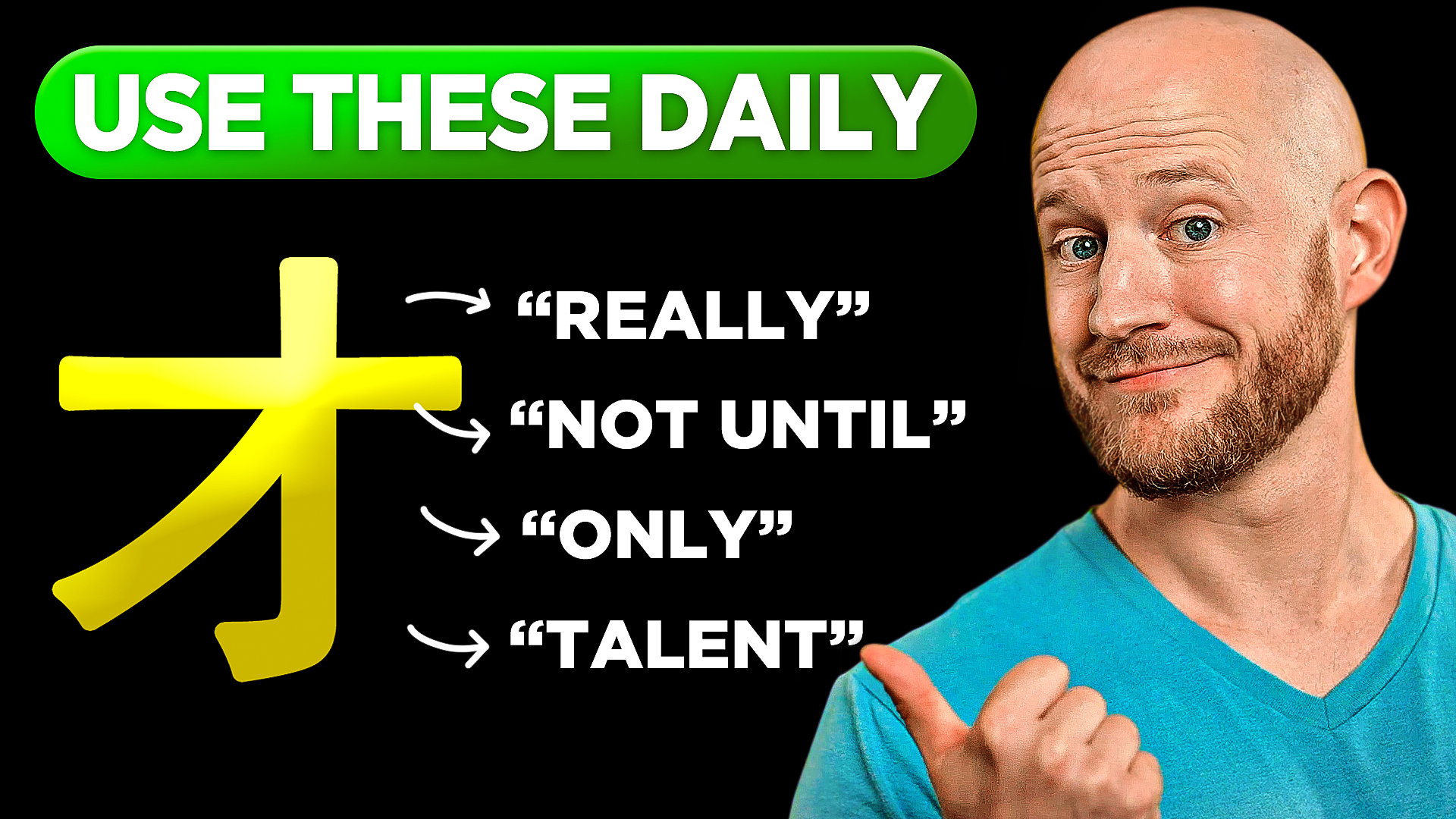
4 Things in Chinese You Can’t Say Without This Character
Get every episode summarized
Each time Mandarin Blueprint publishes, we email you a written briefing from the transcript — the topics, who appeared, and any specific claims, with the ad reads skipped.
Email me new episodesFree for 3 shows. No card needed.
About this episode
“There's a tiny three-stroke character in Chinese that most learners think they understand, and almost none of them actually do. By the end of this video, you'll know four distinct ways.”From the transcript
Get every episode summarized
Each time Mandarin Blueprint publishes, we email you a written briefing from the transcript — the topics, who appeared, and any specific claims, with the ad reads skipped.
Email me new episodesFree for 3 shows. No card needed.
Hosts & guests

Transcript ready
329 searchable segments. Every word is indexed and playable.
Full transcript
Mandarin Blueprint — 4 Things in Chinese You Can’t Say Without This Character. Machine-transcribed; use the interactive transcript above to jump the player to any line.
There's a tiny three-stroke character in Chinese that most learners think they understand, and almost none of them actually do. By the end of this video, you'll know four distinct ways. This one character is used over a dozen high-frequency compound words in Unlocks and the one usage that completely flips the meaning of a sentence, depending on which side of a number you put it on. So this is one of the characters our coaching members come back to you over and over again. They learn the first meaning early, and then for months afterwards, they keep misreading sentences without realizing what they're missing. I'm gonna walk you through seven specific reasons learning this one character is worth your time. So the first reason is that there are one character and seven words. Okay, so what's the character? Well, it's Cai, C-A-I-Sek and Tone. Most learners meet this character early. They look it up. The dictionary says, talent or ability, or maybe they might learn it is just now. They write that down, they move on, and you're missing out if you stop there
because the talent meaning is kind of one of the rarest of the four jobs this character does. The others are the ones doing the heavy lifting and spoken Chinese, and they're the ones most learners walk past it out noticing. So when I say you're already hearing Cai constantly on minutes, every Chinese podcast you've listened to, every show you've watched, every conversation you've half followed, Cai has been in there. Multiple times per minute, quietly caring meaning that you've been kind of letting slip by. So that's the case for learning this character properly, not because it's exotic, because it's everywhere, and your ear is missing it. Would you like to finally make real progress with Chinese? Go to mandarinbleopin.com. You unlock free access to our curriculum, join tens of thousands in our free community, get live Q&As with the co-founders, cool recordings, plus a ton of bonus training. Thousands of members have used these materials to finally start reading, understanding, and speaking Mandarin Chinese within weeks, even days. Just head to mandarinbleopin.com and sign up now, free. Reason number two to learn Cai, the not only just function.
So the next three usages are where most learners get tripped up, and the second one is something English just doesn't have a clean equivalent for. So in English, when something happened later than expected, we use a whole phrase. It wasn't until, or I didn't do something until, three or four words doing one job, but Chinese does it with one character. Cai, watch this. Ta-ba-dian, Cai-lai, he didn't come until eight o'clock. The Cai is doing a ton of work in a sentence because it's saying this happened later than expected. The eight o'clock, that's just the time. Without Cai, there's no emotion to it, but the Cai adds emotion. It's a quiet kind of frustration of waiting. It's sort of like, no, you can't say to clock, you know, you got here by eight o'clock, right? Here's another one. Well, Xianzi, Cai Mingbai. I'm only just understanding this now. Same pattern, same character. Without the Cai, the sentence is virtually pointless to say. It would just be, I now understand. Flat, neutral, no sense of lateness or realization. This is one of the most common functions of Cai in everyday Chinese.
You'll hear dozens of times in any normal conversation. And if you don't know it's doing this job, those sentences will sound kind of vaguely confusing. You'll just be like, why don't you just say eight o'clock or now, but adding that Cai, it's like, this feels late, right? And it's the feeling of the speaker. And this is exactly what's happening to a lot of learners right now, and they don't even know it as they're hearing Cai. Now, the third reason to learn Cai is that you can use it for emphatic contradiction. This is probably my favorite usage because it's almost impossible to translate cleanly in English. And once you can use it, you sound dramatically more native. So when Cai sits before a verb or adjective in a certain way, it carries this energy of pushing back and you're disagreeing, contradicting with feeling. So listen to these. Well, Cai, I really wouldn't go. No way I'm going. Just Cai, this is right, as opposed to what you said before. So this is right, me, Cai Sha. You're the dumb one, not me. In English, we carry that energy with stress and tone, emphasizing certain words, rolling our eyes, raising our voice.
Chinese does it with Cai. You hear this constantly between friends, family, TV shows, online arguments, and once you can use it, you stop sounding like you're reading from a phrasebook, it starts sounding like an actual person with opinions. But more importantly, until you know this usage exists, every time someone says, Ty-Boo or Ty-Due, you'll just think they're saying something about talent or that something happened just now. It won't make sense. So you'll smile politely and move on missing the actual meaning. Now, the fourth reason you should learn Ty is the Zhir versus Ty Confusion. Now, you ask any beginner how to say only in Chinese and they'll say Zhir. And they're right, sort of. Zhir means only in accounting or limiting sense. I only have three. Only friends are allowed in. But Ty also means only and it carries a very different feeling. Ty means only with surprise, with understatement, with a sense that the speaker finds the number small. So look at these side by side. What Zhir, Shikwai Qian, I only have 10 yuan to statement effect.
Ty Shikwai Qian, only 10 yuan. Surprise, the speaker finds that small or cheap, right? Same in this translation, completely different Chinese feeling. If you only ever use Zhir for only, your Chinese will technically work, but it'll be flat. You'll be missing one of the small sharp tools that native speakers reach for when they want to express surprise without saying a lab. And the relief here is real. Once you know Ty has this job, the next time you hear it pop up in conversation, your brain stops trying to translate it as talent, right? You hear it correctly and the whole sentence makes sense. Now, the fifth reason that you should learn Ty is this position flip trap that you can avoid. So this is the one I mentioned at the beginning of the video. I promised at the beginning. And if you've been studying Chinese for more than a few months, there's a good chance you've been getting this wrong without realizing it. So it works like this where you put Ty relative to a number completely changes the meaning of the sentence, saying words, saying characters, different position, opposite meaning, which is kind of how Chinese grammar works a lot of the time. So take these two sentences, what's Shiala, Sanggyu, that's Hai Shiewan. I studied for three months before I finally finished.
Three months felt like a long stretch. What Ty Shia Lha Sanggyu, it. I'd only been studying for three months. Three months feels small, not very long. Now look at those two sentences they use almost the exact same characters, but the only difference is where Ty sits relative to the time phrase. So in the first one, Ty comes after the time. That signals later than expected. Three months is felt as long. In the second one, Ty comes before the time and that signals only this much. Three months is felt as short. So now imagine you've been reading Chinese for a year or two and you've been treating these as roughly the same sentence. Well, both saying something about three months and finishing, you'd be off by a complete reversal meaning potentially, right? So you'd be missing the speaker's actual emotion. You'd be picking up the word, but losing the story. And that's what happens to most learners with Ty. They learn it as talent or just now early on and they kind of recognize it as sentences. And then for months, sometimes years, they walk past hundreds of sentences using Ty and these other ways picking up rough meaning but never really hearing what's being said,
which leads to the next reason, which is that your loosening will collapse if you don't learn Ty. If Ty only shut up and writing, this would be a manageable problem. You could go slow, look things up, or get out, but Ty is one of the highest frequency characters in spoken Chinese. It sits comfortably in the top 160 most common Chinese characters and casual speech leans on it heavily. So open any conversation between two native speakers and you'll catch Ty multiple times for a minute. A few real-world examples you'll hear constantly needs on a Ty lie. Why are you so late? Literally, how come you only just came? What Ty? Well, shit. I really don't believe it. Just more boosin, which is mean I don't believe it. Well, Ty boosin, I really don't believe it. To a Ty Kai shoot, this is just the beginning. If Ty is a blur in your ear, if you hear it, but don't process it, the sentence is carrying it, lose their actual meaning. You might pick up, you come, or I don't believe, or this begins, but the emotional way, the timing, the surprise, and all evaporates. And the silent damage is this.
You don't notice it's happening. You just feel like your listening isn't getting better as fast as it should. You can't put your finger on why, the dialogues feel slippery, even when you know the vocab, the meaning doesn't quite land. A lot of the time, it's because high-leveraged characters like Ty are getting skipped over by your brain. And there's one more reason to learn this character that I think is bigger than all the six ones I've mentioned before, and it's not about what you can't say. It's about what you'll never learn properly until Ty is locked in. Last reason to learn Ty is one that ties everything together. And I called the anchor problem. So the biggest reason to actually learn Ty, not just recognize it, but really know it, has nothing to do with any single one of the four usages I've shown you. It's about every word that contains it. So here's a sample of high-frequency words built on Ty. You've got Tian Ty, which means genius, literally heaven-talent. Tian Ty, that's person-talent, or a talented person, Kotaai. Literally mouth-talent, that means eloquence. Ty Hua, literary or artistic talent.
Duo Ty Duo Yi, multi-talent, literally many talents, much art, Gang Ty. That means just now, or a moment ago, Ty Nung, this is a talent or ability. That's seven words right there, real words, words you'll hear in conversation and reading articles all the time. And there are plenty more. Now, you could try to learn each of those words on its own. Memorize the pinion, memorize the English meaning, drill the monoflash card app, and you'd be doing what my co-founder Luke did before we built Manor Blueprint. He spent nine months on a site called Memorize.com. Two or three hours a day, he racked up over 16 million points. He learned more than 5,000 Chinese words by their English definitions. Then he tried to have a simple Chinese conversation, and he froze. Couldn't use a single one of those words naturally. 5,000 words all floating around in his head, none of them connected to anything. No characters underneath them, holding them in place, no structure linking them together. That's the floating vocabulary problem. And it's what happens when you skip the character layer. If you learn Tian Tai as just Tian Tai means genius, that that word is just,
it's not gonna anchor to anything. It's a noise paired with a meaning. Six months from now, you might still recognize it, but you probably won't. Your brain has nothing to hold onto, but if Tai is locked in as a character, you know the strokes, you know the four jobs it does, then Tian Tai isn't a floating word. It's heaven talent. It sticks immediately. Oh yeah, that's a genius, a talent from heaven. Because it's connected to something you already know. Same with Ren Tai, person talent, a talented person. Same with Kotai, mouth talent, eloquent, same with Gong Zai, Gong means just or barely. Tai carries that only just sense we covered. Put them together, you get just only, just now a moment ago. So it needs a moment ago. So the compound logic carries the meaning instead of you brute-forcing it. And this is the difference between learning Chinese and collecting Chinese. Without characters, you're collecting words. With characters, you're learning a system. And Tai is one of the characters that pays you back over and over again. Because so many high-frequency words depend on it. Skip Tai and you lose access to dozens of words
you otherwise haven't liked. But primarily it's used in those senses we talked about at Bug. And that's why this one tiny three-stroke character matters more than most learners realize. Hey, Luke here. I hope you found that useful. Now if you want to finally have real breakthroughs with Chinese, go to mandarinblueprint.com. You'll get free access to our curriculum, join tens of thousands in our awesome community. Take part in live Q&As with me in Phil, the co-founders, and unlocked tons of bonus courses and merch. Thousands have already gone from zero to reading, understanding, and speaking Chinese within weeks, some in just days. If you'd like to do the same, head to mandarinblueprint.com right now and sign up for free.
More episodes
More from Mandarin Blueprint

This Daily Habit Makes Chinese Fluency Possible
Mandarin Blueprint

The Secret Language Technique Almost Nobody Uses
Mandarin Blueprint

This Habit Is Sabotaging Your Chinese
Mandarin Blueprint

Stop Watching Chinese Shows (Do This First)
Mandarin Blueprint