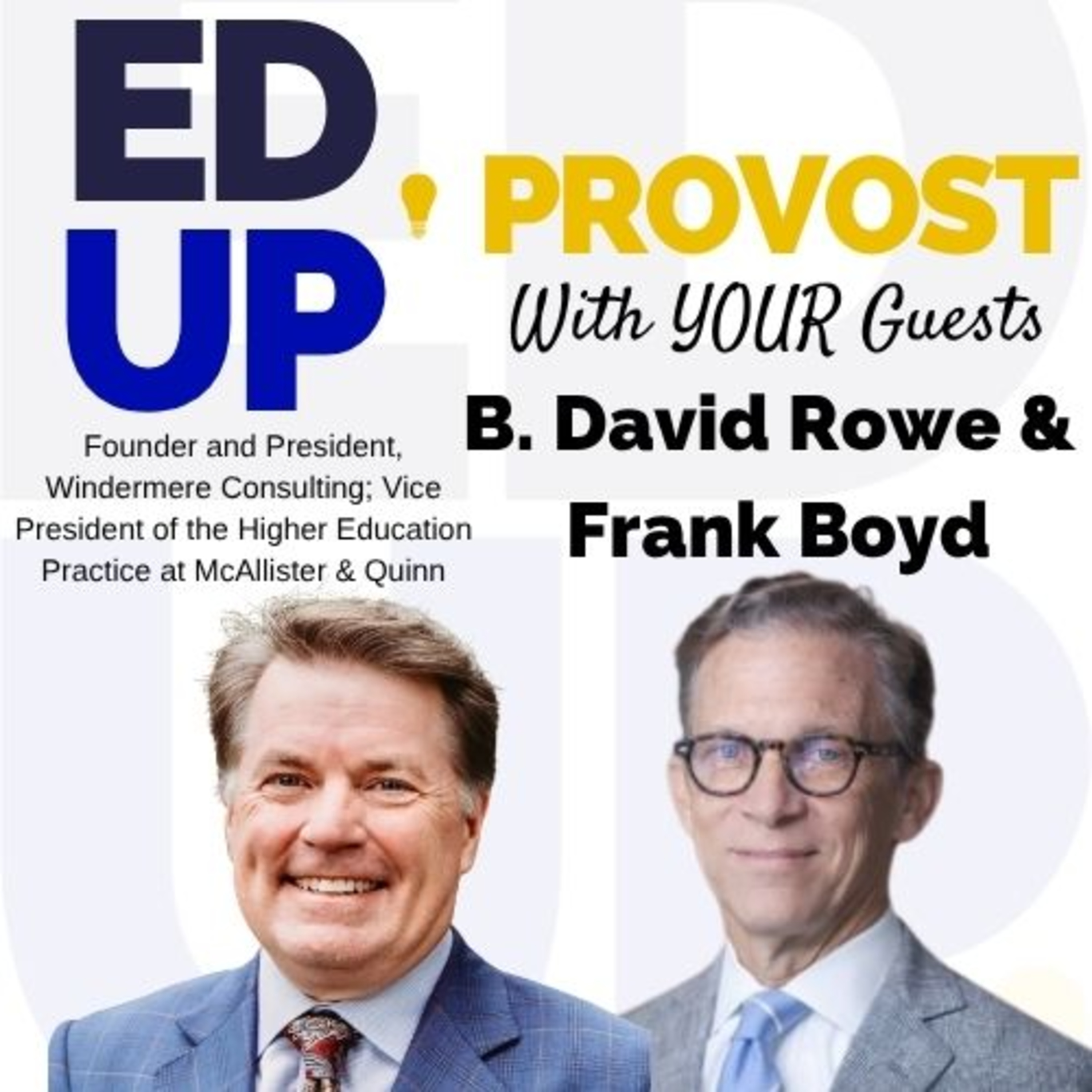
4. Rethinking Shared Governance for Today's Higher Ed: A Conversation with B. David Rowe and Frank Boyd
Get every episode summarized
Each time EdUp Provost publishes, we email you a written briefing from the transcript — the topics, who appeared, and any specific claims, with the ad reads skipped.
Email me new episodesFree for 3 shows. No card needed.
About this episode
“I'm your host, Kregel Tussweitner, Provost and Dean of the Faculty at La Roche University in Pittsburgh, former president and current board member of ACAO.”From the transcript
Get every episode summarized
Each time EdUp Provost publishes, we email you a written briefing from the transcript — the topics, who appeared, and any specific claims, with the ad reads skipped.
Email me new episodesFree for 3 shows. No card needed.
Hosts & guests
Transcript ready
292 searchable segments. Every word is indexed and playable.
Full transcript
EdUp Provost — 4. Rethinking Shared Governance for Today's Higher Ed: A Conversation with B. David Rowe and Frank Boyd. Machine-transcribed; use the interactive transcript above to jump the player to any line.
Welcome to EDUP Provost, the podcast of the Association of Chief Academic Officers. I'm your host, Kregel Tussweitner, Provost and Dean of the Faculty at La Roche University in Pittsburgh, former president and current board member of ACAO. Today, we are diving deep into the engine room of high education leadership, university governance, the critical partnership between presidents and provosts and how to navigate decision making in times of crisis. Joining me today are two senior high education leaders with deep experience in academic administration and board strategy. First, Dr. David Roel, founder and president of the Windermere Group, a high education consulting firm. David has advised over 50 high education institutions and health presidencies, and three independent institutions across the K through 12, college and graduate levels, including serving as president of Centenary College of Louisiana.
Also joining us today is Dr. Frank Boyd, vice president of the high education practice at MacAlston Quinn. Frank brings over 26 years of high education experience as a faculty member, department chair, and former Provost and academic dean at Guildford College, as well as senior research fellow at the high education data sharing consortium. Together, they have co-authored a forthcoming analysis examining governance from both the presidential seat and the provost faculty perspective. Welcome to other Provost David and Frank, it's great to have you both on the show. So glad to be here with you, thanks for inviting us. Yeah, me as well, thanks, Gregor. Well, of course, of course. So let's start with you, David. You've held presidencies at three very different institutions, K through 12, college and graduate level, and Frank, you've moved from faculty to provost. How did those journeys shape your respective understandings of what good governance actually looks like?
Let's start with you, David. Well, thanks so much for that question, Gregor. I think it's interesting to reflect on the journey and how that influences the way that you understand governance. I'd say that when I first started, I had this image in my head that there was sort of an archetype of good governance, and that you were just trying to actually achieve that goal, a kind of a platonic image of what governance was supposed to be. And I think having the different experiences at the different institutions at the different levels, I've learned that really good governance is actually fluid and meets the moment in particularly adapt and agile ways. And sometimes governance requires that the board function as the guardian of the institution, and the presidents and faculty are joining in that effort. Sometimes, I think governance is co-authorship of the institution's future. And then other times, I think the governance is stewardship of the mission, which might mean that you're not necessarily preserving the institutional form as it was inherited,
but really thinking about how the mission might find new expression in a new era. So I'd say that my journey has suggested that governance is probably fluid and adaptable to the moment, not necessarily trying to achieve any kind of specifications that would qualify as right or better than another form. I like that definition. Yeah, so I will say this for the listeners Greg or I have known each other for quite some time, so he's heard a lot of this before in a variety of settings. One of the things about my journey from being a faculty member to academic administrator in Provost is, early on in my career, I found myself serving as an interlocutor between senior administration members of the board and my faculty colleagues, and part of that was, I early on seemed to understand the different roles of these different groups of actors in the overall governance system.
And so oftentimes I would have a faculty colleague rhetorically ask, why does the president say this or why is the board doing that? And going the other way, from members of the board asking me something about a quote from a faculty member. Part of this all rests in something that I've kind of carried with me, and that is, there's oftentimes not a sufficient appreciation of the different roles and responsibilities of these actors in a governance system. And so one of the things I'll say more about perhaps in the conversation is there is a significant difference of understanding about the concept of time and its importance and decision making. And there is not really a shared understanding among these different groups that the responsibilities of each are different, complimentary, but different. And so that transition helped me understand certainly from a faculty point of view what their interests are in that context.
And I'll learn more about the board in the present obviously later. That's also very interesting and it reminds me of something a friend of mine once said, you know, share governance should be shared governance with a deadline. And I think that is so true. All right, well, let's talk about the president provost relationship because that is often described as the most consequential partnership in any university setting from your respective seats, what makes that relationship work and what causes it to break down. I've been extraordinarily fortunate to have just really strong provost chief academic officers in the settings where I've been and my background coming into the presidency was not up to the ranks of the faculty or as an academic officer. So I was highly dependent on really strong chief academic officers when I was a centenary particularly. And I think that understanding the humility, I think on the part of the president can really make that that relationship work very well and also just understanding of the this increase for me over time and understanding of the pinch.
And then I think that provost feel between trying to move the institution forward as well as trying to attend to all of the dynamics of the faculty and the process is the faculty decision making. I think that's just being aware of what the situation is for the provost is extraordinarily important. And the times where I saw that broke down breaking down, I think would probably be around in patients on the part of the president, you know, Frank alluded to time. I think we're going to probably talk about that a couple of different. I think that's the first thing I think I think is going to be a lot more focused on the process today, but you know, just just being impatient and not fully understanding what is going on and why the processes are moving in the ways that they are and at the speed that they are. And I think that lack of appreciation on the president's part for the role that the provost is playing can can actually cause that to break down.
And having faith that the the provost is actually really trying to steward this through. I think it's important and when the provost says no or not yet, it doesn't mean never, right? It just means you've got to wait. So I wish in this conversation I'm going to I would find myself in heated disagreement with David that's not like. So I want to have a concurrence to what David said and I think having an appreciation of the requisites of your colleagues position, the provost has to understand that the president has a different set of constraints, opportunities. The area of remit is different for a president than it is for a provost. Of course, that goes the other way as well as David is already articulated at both of the institutions where I served in leadership positions. I pointed out to colleagues if I cloned myself and Frank prime was the president of the institution and the other Frank was the provost, they would seriously disagree with each other.
They would have different responsibilities and all good things don't necessarily go together. And that's why what David was saying is so important that there's an appreciation and there's communication between the two. The best president I worked for would ask me, should I say this now, would it be helpful for what you're trying to get done if I raise this issue or should I wait? Or what would I say that would be helpful in this venue? And so that kind of collaborative relationship can really, really be fantastic when it exists. Now let's talk about pressure because in this day and age we're under a lot of pressure and high education and shared governance is also under pressure. Now Frank, you've spoken and consulted extensively on shared governance. And so in your experience, where does shared governance most commonly fail? And is that failure usually a structural issue or cultural issue or personal issue?
Can I choose all of the above? You can. But you have to tell us more about that. Yes, I would say, and this goes back to something David was saying at the outset, there is no platonic form of shared governance system that is perfect. And we can just lift it and put it in different institutions. And I think all three of us have certainly seen institutions where the governance system is dysfunctional or failing because of structural, cultural or personal ones. The personal ones are the best stories to tell, right? Because then you have a person with all of their humanity and you can describe their foibles and why the system is running ground. So I want to kind of set that one aside and talk about structural and cultural. I would say the structural conditions for shared governance are really the kind of the seen a quanon of a functioning system period.
If you do not have the appropriate structural foundation, the other things are very difficult to construct. People don't understand what their responsibilities are. They don't understand what the boundaries of their responsibilities are. And so David and I both, David from the board perspective and me from the faculty kind of leadership perspective worked on consulting on governance systems. And he and I have talked about it at length. If you do not have a shared understanding of the roles and responsibilities. And those aren't formally codified in the authoritative documents of the institution, whether it be the bylaws of the board, faculty handbook, etc., etc. It's hard to get anything done. And I would say the other factor, Greg, or that you cite culture, that is a byproduct of the other two.
That that emerges from the leadership itself and how they comport themselves and how they interact with the other constituencies. And the presence or absence of clear and transparent rules of the road, as they say. That's so true. Now let's talk about the board's role, David. As a former president and a trustee, you've seen governance from both sides of the board table. What do boards most consistently misunderstand about their role and what do presidents most consistently understand about theirs? You know, I think most of us are probably wanting to hear the answer overreach or maybe somebody being overly active, a board member being overly active or a board as a group being activist in nature or a president that's taking too much initiative. I'd say that the thing I see most common is probably overdeference.
You have mutual deference between the board and the president. And it's like two people holding the door open for each other saying, no, you first. Nobody's taking the lead. And it'd be better if they actually were saying you first because sometimes they're being deferential without communicating the fact that they are being deferential. So the other assumes that the president seems the board's taking the lead and the board assumes the president's taking the lead. And as a result, you don't really have anyone taking the initiative or taking the responsibility. And at the end, that can lead toward kind of finger pointing. You know, that really wasn't a job that was your job. And so I think communicating about that in advance and understanding what the rules are. You know, Frank mentioned just having a shared understanding of what shared governance is in general for the institution is good. But particularly between the board and the president, what are, you know, who's going to do what and when? And this is also another important point about seasonality. You know, I talked about meeting the moment there's going to be difference in seasons in an institution's history when the board is going to rely on and deputize the president to move forward.
And there's going to be times when the board actually, you know, really maybe withhold some of that authority and some of that commissioning for itself. And the easy thing to think about is the difference between a long serving president and a brand new president. There are other examples of when that needs to be moderated or modulated throughout the course of a presidency. But boards that treat the new president like they've treated the 15 year veteran, you know, might find themselves, you know, in for a root of awakening that there's different, you know, there's not a, again, there's not a, what the board does or doesn't do that's constant across time. And what the relationship is between board and president needs to change for different occasions, different seasons and different, sometimes different crises for the institution. As a good point, this relationship needs to be constantly renegotiated. It does. Yeah. Yeah. Now, let's talk about the provost role with the board because, you know, provost often said that the intersection of faculty trusts on the one hand and presidential authority.
And then they also have staff positions when it comes to board committees. Provo's are accountable upward, downward, simultaneously. Frank, how do you counsel provosts to navigate that tension without losing credibility on either side? Well, I would say, and this is not open to a rejoinder from David. The, the provost position is the most difficult job on any campus. And Gregor, you and I have a lot of friends who have served in the provost role who are now presidents. Not a single one will tell you that the president job is worse than the provost job or more different. And so the difficulty rests on this question because you, you have to have kind of a Janice faced posture where you're facing in both directions, both toward your faculty colleagues. And then of course, the president and the board of trustees, one of the things that I think is key and the relationships that I've had that it really worked well is.
Faculty leadership and the president have understood that I will maintain conversations in confidence always. You cannot have a situation where the president needs to confide in you or ideate about some new initiative or, or share concerns about the board or any aspect of the college or universities operations. And think that the provost is perhaps going to share that with someone else. And it goes the other way as well. A provost has to have the confidence of faculty leadership that they can come to the provost and ask her pointed questions not only about their work, but about what is going on in the college or university as a whole. And that's very, very difficult to maintain so that people have confidence in your position and that they both can count on your, you being candid with them at the same time that you're maintaining the confidence of the other constituencies.
And so the other really important part of the provost unique position is you are called upon repeatedly and constantly, like I said earlier, to explain or interpret things that are going on elsewhere in the institution and there are a million prosaic examples that the three of us could talk about, but some of the best have to do with budgeting. And I'm not jumping to that right now. I hope we'll have a chance to maybe talk about that in another context here later in the conversation, but faculty members oftentimes do not understand the difference between a restricted and unrestricted gift. They don't understand bond covenants. They don't understand how a line of credit works. All of these things are really important for the provost to understand both for their job, but they need to be able to explain those kinds of things to their company. Right. That's a good point. Now, David, you let centenary college through a financial turnaround and length as a seminary through a pandemic era merger.
How does governance actually function in an institutional crisis and how should it function differently than in normal times? Well, I think we have a genuine crisis that does tend to focus the mind and everyone's mind. I really do think that, you know, there, there are a lot of times in higher head history where we said this is an existential crisis, right? And we lived through a lot of them. And so at some point the folks who've been there for 15, 20, 30 years, you know, get tired of hearing, it's an existential crisis, right? And so when you actually do have maybe an objectively verifiable challenge for the institution, my experience is that people do tend to get focused and really want to try to solve the problem. The thing that I would recommend the most is when you are not in a crisis to take that opportunity to work on those structural components that Frank was talking about earlier, make sure when there's no pressure to try to solve a problem that you're actually reconciling the faculty handbook with the bylaws and the bylaws with the charter and both with general practice, you know, even even even if it's written in one way, there may be a practice that has superseded for decades.
The way that it's been written because I find often that those documents are out of sync with one another. The other is just to practice reading them together because, you know, if I've learned that you can actually read the same words and come away with two different interpretations about how this is supposed to proceed. And that can lead to a lot of really anxiety, you know, on everyone's part when you think you're proceeding in the way that we've all agreed to proceed, but there's a other group of folks that are well meaning and in good faith are reading the process very differently than you. And so I think that that's something that you really want to practice outside of the crisis moment so that when you do get into a crisis moment, you have confidence that you have a common understanding of a common set of documents and processes that are there. So the preparation for crisis would be, you know, be as hygienic as possible outside of crisis. But once you're in crisis, I think it's, we've talked a lot about time, you know, I think that's probably the one constraint and one of the things I've learned from Frank specifically and some work that we've done together is just the lack of a time element, you know, in faculty process.
And that's not a bug. It's a feature. And so for the board and the president a lot of times, you know, there, there's a time constraint, even if it's just personal impatience or corporate impatience for a decision to be made. But sometimes there's a there's an actual deadline or runway that you're trying to meet. And so I think being clear about what the actual constraints are are extraordinarily important whether they're financial constraints or time constraints. But then the, I think the final thing that I would say is to the extent possible, bring open-ended questions to the faculty and to the board if you're a president. And, and don't try to, we're, we're most of us are systems thinkers, you know, in the provost office and in the president's office and many board chairs are systems thinkers and like to think through all of the options and the contingencies and the counter arguments and you have all that solve before you even utter the problem to anybody else. And so do the extent that you can kind of dial back and say, okay, here's where I started. You know, this is the challenge we're facing and bring other smart people along with you and the journey may take a different route than you thought it was going to take.
And if you're sincere about that, I think that you can actually enlist people to walk along in the crisis with you as opposed to people that are constantly trying to figure out where you are and how you came to that decision. Now, let's talk about the provost as change agent Frank when a provost wants to drive meaningful academic change. What governance levers are most effective in your opinion and which ones tend to backfire? So I'm going to offer an initial thought on this and all of my colleagues on the academic side of the house. And this may well mean my permanent ex communication. I would say one of the most overrated governance issues that provost deal with it has the least impact on student learning is reform of the general education curriculum. There is a mountain of empirical evidence that the architecture of the system itself has a negligible impact on the learning outcomes for students themselves.
Yet reforming systems of general education, the two of you and your listeners most certainly have heard the the uproamides is something like it has all of the emotional toll of moving a graveyard or something like that. And so meaningful change is really trying to identify aspects of the work and being clear about the outcomes you were trying to achieve. So if I can circle back just very quickly with general education general education has a negligible impact on learning outcomes for students. What really impacts student learning is what happens in the individual classroom. And that has to do with pedagogy that has to do with a whole bunch of other things. What curricular form also does is it engenders among the faculty a shared sense of mission and that that is a really important outcome.
And so this is kind of an echo of some of the things David was saying a moment ago being clear about the goals and the outcomes that one is trying to achieve is really, really important. I can't tell you how many curricular reviews I have seen, especially in recent years, that were designed to somehow save resources at an institution. But that was never stated as a criterion at the beginning of the process. Well surprise, surprise, they get to the end of the curricular review and it doesn't save any money. They've rearranged things, they've achieved other goals. And so being very clear about what a positive outcome looks like besides it's different than it is right now. I think that is the most important thing for that kind of work. That's a very interesting answer and I wish we had, you know, maybe we should have an additional podcast episode, just on general education because I think that's such a rich topic because it seems that lots of schools are reforming that Jen adds.
Yes, ours included and we're pretty proud of what we're doing, but you know, maybe another time we should talk about this. Okay, but David, let's talk about your work at Centenary College because it involved a lot of increases in diversity and international engagement. So my question to you is how does governance either enable or obstruct an institution's ability to redefine its identity and mission? So I would say that probably governance can obstruct or enable you to refine your identity. Yeah, I think that that's one of the things that I would say that the diversity in the international engagement were really inherent in the incendiaries culture already and there were already strong commitments there that long predated my arrival there. But I would say that going through crisis and when you experiment with different changes, you do, you bump into, we talk about bumping into immunities within systems, you know, the antibodies gather up.
Sometimes those are just self-interested points of resistance. Sometimes it's just anxiety creeping up. Sometimes it's the identity of the institution coming up and saying, this isn't who we are. But when you do see that, it gives you an opportunity to identify that as something not to be moved away from but to really move toward. And so I think sometimes when you go through crisis or change, that governance can actually surface the things that are really inherently special about a particular institution and draw you into that so that you can emphasize that and amplify that as the change moves forward. I think the ways in which governance can actually obstruct that is when we particularly use the word shared a lot and there's lots of problems around shared governance, but that that term shared. But one of the problems with it is that also sometimes comes across as meaning distributed favor, you know, that nobody's going to be disadvantaged any more than the other. And so that can often lead to you not taking a strategic stance even in favor of the institution's identity and institutional commitments.
And so if you actually do find some of these things in this case, you know, making a welcoming environment for people from all backgrounds and then also actually engaging the world in an intentional way as a classroom, those were already there. But in order to actually optimize those experiences, you had to begin to say how are we going to be best at this and maybe not some other things, right? And so you do have to choose in favor of those identity markers and those missional commitments. But that sometimes means that you don't distribute favor uniformly across the whole system and some people will feel like their particular interpretation of the mission or the identity of the institution was left to the side as you as you moved into that. I think that governance can actually help you identify those things that are inherent to the institution and also if you, but the place where it can obstruct is when it actually makes you feel like you have to make everybody's interpretation of what the institution is amplified at the same rate, then you're just only doing incremental change in nothing strategic.
Right, because you're dealing with so many different interpretations of the institution. So many great interpretations. I think we all had experiences where you've actually bumped into or you know what the core identity of an institution is. And if you can get on that, double down on that, even though it's at the regrettable expense of some other great ideas, you grieve some of the loss of some of those other great ideas for the sake of actually finding what that, that's what I'm saying. And finding what that, that main lane is and really amplifying it. Now, going back to the role of the provost, here's a question for both of you. If you could give one piece of advice that is one piece of governance advice to every sitting provost in America right now, what would it be? Given your reaction to my last answer, I guess I can't say avoid genetic reform. No, probably not. I actually want to build on something that David was just saying about his work at Centenary and Mission.
He said something like, you have to really focus and decide, look, we're going to be good at some things. And perhaps not some others. That is that you're defining the focus of your mission. You can't do everything. What I would say for provost in terms of one piece of advice is be very, very clear about what you are not going to be working on. And that is be clear with yourself, be clear with the other academic leaders, be clear with the faculty as a whole, because I think there's so much to do in that position. To be clear about what the priorities are right now, goes a long way to help explain why you're not doing these other things. And that can potentially eliminate a lot of frustration all over campus, actually. And David, what do you think? What advice would you give? Every president out there don't leave.
Stay. We need you. We defend on you. So I'm low to actually offer advice to provost. I'm really dependent. It was dependent in all of my situations on the great advice of chief academic officers and genuinely appreciate it. And I will say that I think that provost at their best, one of the things that they struggle with, I think, is, you know, am I presenting the faculty perspective or am I representing the faculty perspective? Yeah. And so I would, and I think the best provost that I know have been able to live into that faculty identity and the administrative identity almost simultaneously and almost in every setting. Whether you're standing at the head of the faculty meeting, sitting at the cabinet table or making a presentation to the board, that you're embodying that, that both of those activities at once, which is really very difficult, I think.
And so you're not favoring one over the other because all of those settings need you need both of you in that, right in those situations. And so the best provost, I think, have been able to pull out their guild cards at faculty meeting is a eight, you know, I'm one of you, I get it, but we still got to do this, right? And they've also been able to pump the breaks on administrative decisions when the faculty perspective wasn't completely understood or appreciated and also really, you know, especially in board deliberations when there might not be. Too many faculty voices or faculty members, even that feel like they can speak up the provost is the one that actually can help frame what the, what the academic integrity issues are what the, the programmatic issues are that really need to be considered before we make a decision that could really affect the quality of the academic program or the student experience.
Now, the reason why I invited to two of you to this podcast is the fact that you collaborated on the piece of examines governance from both the presidential provostial perspectives. Tell us more about this piece. What is the central argument and what surprised you in the process of writing it together? David, I'll ask you to go first. Well, this was Frank's idea. He proposed it. And so I really appreciate him inviting me into this project with him. But the idea is that we would help both of us in our work or running into situations where the board and the president don't particularly understand the faculty's perspective on shared governance. And we also believe that the faculty don't completely understand the board and the presence position relative to shared governance. And this leads to a lot of miscommunication among people of goodwill, you know, good intention. Everybody's got the long term mission and health of the institution in mind. But the ability to kind of do some crosstalk. So here are three different situations.
We want you to understand and I took on the role of the board and the president. This is how the board and the president might be approaching this particular type of question and the ways that our processes would engage that. And then in Frank took the same issue and said, this is the way the faculty might process this. And we try to unearth the things that the others should appreciate about the process that the other body was undergoing. And then we terminated each section with three questions that we thought that boards, presidents and faculty, senators or faculty leaders or faculty members could all ask together just to kind of begin to cultivate a common understanding of how decisions are made at their particular institution. And so that's the framework of it. I mentioned earlier one of the things that I think that really popped out at me when Frank wrote it was this element of time. And I'm not sure that I've ever been able to name that before writing this is that, you know, I thought as president and in my conversations with board members, I think many trustees think that faculty are intentionally trying to do that.
And so that's why I think that faculty are intentionally ignoring the time component of a decision. And Frank had me realize that that is like I said earlier, it's a feature, not a bug, right? There's a different aim here. And that aim is really to get it right, get the process right and come to the best possible answer with the right voices that weighing in on it. And that's, that's a different ethic. It's a different motivation. And, you know, so I think that was one of the things that I learned and I, you know, believe that I can interpret that back to presidents and boards a little bit more succinctly and clearly now than maybe I was able to before. That's great. David and I had we had to overlap on a couple of institutions where we had consulted with them from both of these perspectives. They were working on a governance system and we were in at different times. And so one of the things that David raised repeatedly is shared governance does not mean equal responsibility across all functions of the institution.
And that includes kind of functionally, but also temporarily boards are responsible for the long term fiduciary health of the institution. That sometimes is at odds with things that the academic program would like to do this year or right now over the next two or three years. And so the governance system resolves those those conflicts. And one of the things David and I did agree on very quickly is we keep returning to this issue of time. And one of the things that faculty oftentimes do not appreciate is what are the consequences of inaction and both of the institutions where I worked. If you don't finish this or that in this academic year, we'll just we'll pick it up where we left off next September. Well, what happens if there are actually very negative consequences for the academic program and the institution for not making a decision.
And so with the president and oftentimes with the boards help trying to find a formal constraint that will help impose a time limit on decision making can be very, very help. That's a great point. Hey, now we're almost at the end of our conversation, unfortunately, but I have one more question before we ask the very last question. So my last question when it comes to governance is about the future of university governance. As you know, high education is under normal pressure right now. There's so many issues that we're dealing with right financial issues political issues, demographic issues, etc. Do you think the governance structures most universities currently have are adequate to meet the moment or do you think we need a fundamental redesign in high education? I'll take that one. No, they are not structured to meet the moment generally speaking.
I do not necessarily think that it demands a dramatic restructuring. I think it's really important to remember that shared governance emerged in the early 20th century to provide protection for the academic program from the outside world. And in the last decade or so, what we have asked those same governance systems to do is to instead connect the academic program with the outside world. And so the structure, the cultural underpinnings of these systems are designed for 180 degrees opposite what we actually need right now. I do think most campuses would benefit from, I love what David said about reading together the authoritative documents, reading the bylaws and talking about what they mean. That can really help reorient these processes in a way to meet the moment rather than remain fixed on a governance system that was perfect for 1957 or 1969 or something like that.
I do think that the legacy systems and structures that we have really worked for the first part of my career, you know, and a lot of us where we really could rely on the separation of powers as opposed to the common need to work and act together and decide together. And I think one of the legacy things that's disrupting this is people tend to conflate fiduciary with financial. And you know, and fiduciary has is a much broader set of responsibilities to the mission of the institution that the board carries and the board alone carries. And so I think in the last two decades, boards have really started to wake up to the fact that they have this awesome responsibility and that means they can't any longer ignore the fact that they have authority and accountability for how the mission of the institution is lived out and how the financial health of the institution is sustained over time.
And so the boards that are more, you know, astute and aware of this are starting to realize that there's not a component within the institution that is, you know, immune from that sort of scrutiny. And so what the, what the good board can take can delegate authority and responsibility and authority and accountability throughout the system to make sure that these things are cared for but can't ignore them anymore. And so I think that's really important for boards to understand and for faculty to think that well, the board should just stay kind of in the financial arena and not mess with the academics. And that's really the board is responsible for the academic mission of the institution to, you know, they wise to leave it to the experts to engineer, but there doesn't mean they're not responsible for it. And there's not an academic decision that doesn't have a financial component. That's right. There's not a financial decision that doesn't have an academic implication.
So to think that these are, these can operate in to hermetically sealed environments is a mistake. And I think now we just have to figure out how to come together and pull all of these pieces together and make sure that we have a common understanding of how our decision making processes are going to work. Ultimately, the, you know, the board does have to understand that it has to take responsibility for what's what the decisions are and what the consequences are and everybody else in the system has to understand that the board is looking at it through that lens. Right. Right.
And Joe Pine wrote a book, these more famous or until now, more famous for the experience economy. And he really does chart out these different ways that businesses can have different types of economic offerings, you know, from commodities to goods to services to experiences in this, this third, this, this final book on transformations is what he believes is the ultimate economic offering. And as somebody who's really been in the midst of trying to help academic institutions understand what their business model is not to reduce them to businesses, but to help understand how to sustain the academic mission. I think this book really does bridge the gap between business language and mission academic mission language. So we've, we've been in the transformation enterprise with the transformation mission for a long time. And I'll go ahead and say the transformation business for a long time. Right. This actually gives some technical guides into how to take that missional commitment and put some really strong financial underpinnings with it.
And I think that that, so the transformation economy by Joe Pine just came out in February. And I think it's, it's one that boards presidents should read for sure and, and faculty might find least objectionable business book. And also a book for Provost and it's on my reading list now. So thank you for this book recommendation, David. Frank, how about you? I was tempted to say biography of Miles Davis. I just finished, but that's not applicable here. I've really, really enjoyed ignorance and bliss by Mark Lilla. And it's one of these books that I, everywhere I look now, I find applicability both in my professional life and thinking about the topics we've discussed here, but also the political moment we find ourselves in nationally. And it focuses on this idea starting with Aristotle that human beings want to understand that they want to gain knowledge. They want to understand themselves the world around them.
But there is this philosophical counter current. And we understand a lot more about this from contemporary research and psychology economics, political science. There is a, also a current where people decidedly do not want to understand. And there is a kind of a willful ignorance about particular aspects of their lives, their workplace. And I've experienced it everywhere. I've worked my entire career where you have colleagues, if you say just to take David's earlier example. You know, the board is responsible for the fiduciary health of the institution. And that has meaning here that they mean that you're constrained in terms of the areas where you have input. I've had colleagues who absolutely will choose. They do not want to discuss that. And they don't really want to understand it. And so it is not a maligning of this aspect of us as human beings.
It's just a very area that I, a discussion of why people are willing and sometimes focused on ignoring information or arguments that are counter to their belief systems. And it's actually a pretty, he's a public intellectual. And so it will be readable for any audience. That's great. Ignorant and bliss. Also now on my reading list. Well, thank you so much, David and Frank, for being on the podcast. Thank you for this really interesting discussion about governance. Thank you for having us. Really enjoyed it, Gregor. Thanks so much. You've been listening to Edav Provost. I'm your host, Gregor Tussleitne. Until next time, keep leading, keep learning and stay inspired.
More episodes
More from EdUp Provost

3. AI Literacy Meets Learning Literacy: A Conversation with Joshua Thorpe
EdUp Provost

2. Building the Leadership Pipeline: A Conversation with Reema Zeineldin
EdUp Provost

1. The Economic Case for Educational Attainment: A Conversation with Eloy Ortiz...
EdUp Provost

7. From Upheaval to Action: A Conversation with Arthur Levine
EdUp Provost