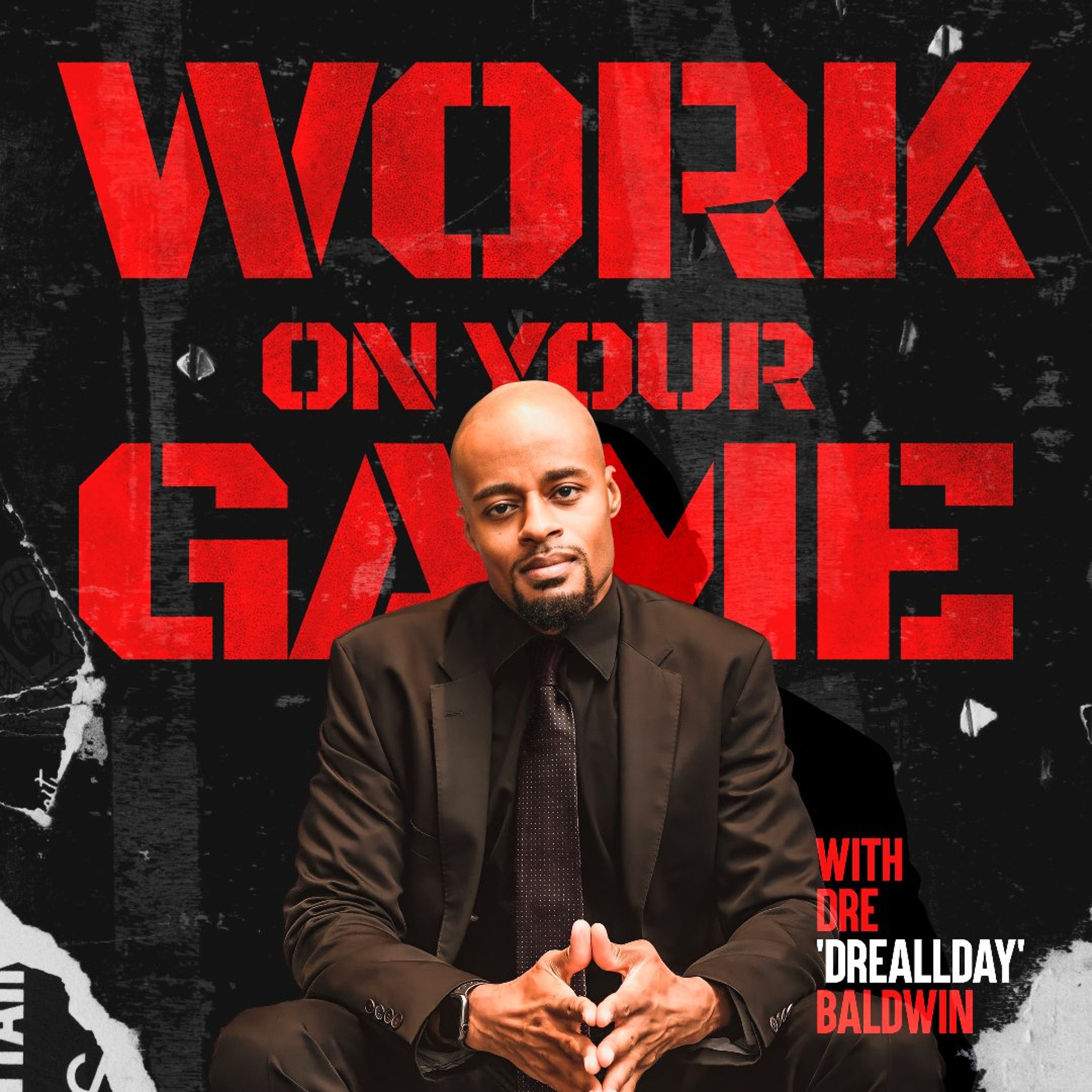
#3793: Stop Accumulating And Start Compounding
Get every episode summarized
Each time Work On Your Game: Discipline, Structure, and Execution Under Pressure publishes, we email you a written briefing from the transcript — the topics, who appeared, and any specific claims, with the ad reads skipped.
Email me new episodesFree for 3 shows. No card needed.
About this episode
“Sometimes, the problem isn't that you don't know enough. The problem is you're too close to your own situation.”From the transcript
Get every episode summarized
Each time Work On Your Game: Discipline, Structure, and Execution Under Pressure publishes, we email you a written briefing from the transcript — the topics, who appeared, and any specific claims, with the ad reads skipped.
Email me new episodesFree for 3 shows. No card needed.
Hosts & guests
Transcript ready
372 searchable segments. Every word is indexed and playable.
Full transcript
Work On Your Game: Discipline, Structure, and Execution Under Pressure — #3793: Stop Accumulating And Start Compounding. Machine-transcribed; use the interactive transcript above to jump the player to any line.
Sometimes, the problem isn't that you don't know enough. The problem is you're too close to your own situation. You've been looking at the same numbers, the same people, the same strategy, and the same problem for so long that you can't see what somebody from the outside world would see immediately. That's what the game session is for. Bring me one real problem in your business or life. I'll ask you the questions, identify what I see, and help you determine your next move. Many three people are in each session, so everybody gets direct coaching. Your investment is $97. Go to workonyourgame.com slash game. That's workonyourgame.com slash game. If you're looking for shortcuts, hacks, or inspiration that wears off by lunchtime, this is not for you. But if you want practical ideas to help you think better, read better, and execute more consistently, hit my free galley game email. One message every day, right to your inbox, at workonmygame.com.
That's workonmygame.com. What you want to do when you are doing accumulation work, as you want to build assets, accumulate assets, they continue creating value without you continually needing to give proportional effort every day. Workonyourgame. This is Dre Baldwin, and workonyourgame is a system that turns discipline into dominance. Today's topic is, stop collecting and start compounding. Now today's episode is about how often people will believe that success comes from accumulating more, that we figure out a formula of a thing that works. Let's just do more and more of it, and that will eventually lead to you collecting more of the things that you want, such as more money, more relationships, more followers, more
knowledge, more information, etc. The highest level of performance, however, is not about you continually collecting. It's actually about understanding that accumulation has limits, whereas compounding does not, because when you are accumulating the mathematical equation is different when you are accumulating them, when you are compounding. One of them is slower, one of them is faster, let's talk about the difference. What this means when it comes to actual achievement, definitely not. It will be a math lesson. Point number one. Today's topic, once again, is stop collecting and start compounding. Number one, accumulation is a linear process. Let's say you accumulate, let's say someone like myself, I have accumulated it, and if you have any of your process, a lot of things that I did a lot of back in the basketball days, I accumulated thousands of videos that I published on Internet, but I had to publish each video one at a time. I could schedule them, but I still had to make the video, the video had to be uploaded, even though I could bulk upload, I still had to upload all 10 videos or 30 videos in once, and I had to schedule them out.
I had to accumulate those on my right blog posts or articles. I have to, each one has to be written, scheduled, put into the right system, scheduled out on the right dates, the right times. When I write books, I still have to write each book, publish the book, get the book out, do the marketing, do the process, make the funnel sell the books. So that's accumulation. If you do enough accumulation, you can stack up something that looks impressive from the outside looking in, especially to someone who doesn't know you didn't see the process, they just see the end product. My wow, this person accumulated all of these things. That's great. The issue is it's linear, and you have to do each one in order for the thing to accumulate. Compounding on the other hand is an exponential process. When you compound things work exponentially, meaning one unit of effort when you're accumulating equals one unit of output. When you're compounding, though, one unit of effort can equal three or five or 10 or a thousand units of output, even though the units of effort are exactly the same. That's why compounding matters more than accumulating. This is the reason why any of you who has read or knows or works in finance, anything
about personal finance, understands that you can accumulate money by get a paycheck, save some money, get a paycheck, save some money, and slowly over time, if you keep doing that, you can accumulate a nice amount of money just by saving up your money. If on the other hand, you allow your money to compound, such as putting your money to work for you, as is always said, and letting the money earn money on its own, rather than you just holding it where it's actually technically losing value because of inflation. But you put the money into something to where it's making money, it becomes worth more. Now your money starts to compound even though you didn't have to do any extra work. So accumulation depends on you continually adding more. It's means you must continually give effort and when you stop giving effort, the accumulation stops. Whereas compounding on the other hand, you put the effort in one time or two times or ten times, but the output from the effort that you put in is done by a multiple, not by an addition. So if you want to get a bigger number, just looking at simple math, would you rather use the plus sign or the multiplication sign? All of you understand basic math.
I'm assuming you understand that the multiplication sign on the calculator will lead to a bigger number than using the plus sign no matter what number you're starting with, along with you're not multiplying by zero. Of course, compounding occurs when the investment you make today increases tomorrow's capacity, but again, in multiples, not just by accumulation because you can literally make today's investment worth more than tomorrow. Technically, I guess if you add up a couple of days in a row, then tomorrow can add up to one, two, three equals tomorrow. You add one, you have four. But if you get three units of output for every day of effort and you do three straight days of output, then you have three, six, nine, the next three equals twelve, and then it starts to build on itself when you're not working. That's what accumulation really does is that things start working for you even when you're not working. And understand that this is not just about units of effort, it's not just about money, it's not just about things that you can count, measure or weigh on a scale. Skills compound on top of each other. When you add skills that complement each other, meaning you already have skill A, and then
you add skill B in the combination of skills, A and B, create something that is stronger than A and B put together, added, but when you multiply A and B together, equal something bigger. As the saying goes, when the whole is greater than a sum of the parts, that's an example of compounding. Trust is something that compounds, reputation compounds, relationships compound. Discipline habits, for example. These all become more valuable because they build on each other and they start to multiply the return when you have a bunch of them working at the same time. For example, I mentioned back in the days when I was making basketball content, the thing that made my stuff stand out was not that I was the best basketball player, even though I was pretty good, is not that I was the best internet publisher, even though I was pretty good, when I first started, it wasn't a million people doing it. There were maybe 100,000 instead of millions as it later became, but what compounded it,
there was the combination of the two. It wasn't just basketball, because again, I was good, but it wasn't like I was the best in the world, and publishing on internet I was good, but wasn't the best in the world, but I was one of only a few doing that intersection at the same time. Those two skills compounded on top of each other. I've just been publishing on internet and it not been basketball. I probably would not have built the name and the brand that I did, or had I just been playing basketball and not gone on internet. Maybe I still had a career playing professionally, but most people who found me found out about me in the United States didn't find out about me through playing in Europe. They found out about me because I was on YouTube. The combination of those two things is what allowed it to compound. Trust is another thing to condense. One person knows you like to trust you. They can reach out to 20 people who they know, and that trust will now get transferred to those 20 people who never met you, but they trust you because someone who they trust already said, hey, this person is vetted. I trust them. This is the reason why when you go to a job interview, if you already have a job or you've had a nice, impressive resume of places you've worked in the past, these are getting
another job because the past places that you have worked are unspoken proof that someone has already vetted and trusted you because you've done this before. If you haven't done it before, it doesn't mean it's impossible for you to get a job. Those of you who are out there, job seeking or will be job seeking, but it's easier when the trust is already proving because you having a past resume shows that someone has already done the work to find out if you're any good because that's how you were able to hold down to other three jobs that you had in the past. This is something that I've said to men over time that as a man, when you're a single man walking around looking for women, it's more difficult than when you're a taken man and a relationship. It's not that you're looking for women, but women seem to notice you more when you're taken and why did I notice you more when you're taken because the woman who is with you is unspoken proof that you've already been vetted by somebody, especially the woman that you're with is attractive because there's an attractive woman. She's what that guy was means attractive women have already vetted this guy as someone trustworthy and worthy of being with.
So that makes the girl who is not your girl interested in the fact that you're you because you already been vetted by somebody who's on her level or maybe higher than her level. So that trusts again, this is all an unspoken conversation. Reputation works the same way. This is the reason why I'm when people sell things on the internet, they usually put some form of social proof on their website. And what is social proof is is you showing other people who've already bought your stuff or used your product or signed up for your program saying, hey, I'm in this program, I bought this thing. It was amazing. Look how great it is. And what does that make other people think? Well, other people have already used this, so I'm not taking a risk. If I was to use it too, I know I'm not going to lose my money buying this product because other people have bought it and they're happy about it. Discipline habits, they start to compound on themselves because your subconscious mind takes over, you start doing things automatically without thinking about it. And it becomes part of who you are, not just something that you do. You don't have to think anymore. It becomes an automatic thing and discipline habits are usually things we know we need to do and we want to do because we know they're going to make us better. So if you can make those automatic, that'd be great, right?
That's compounding point number two. Today's topic wants to get in the stop collecting and start compounding number two. The best assets compound while you sleep now just gave you a few examples of that at the end of point number one. Money for example, is an asset that everybody needs some form of it because we need food, clothing and shelter. And many people, actually not many people, most people when you go to work every day, you go because there is money to be made. That might not be the only reason you work there. It might not even be the number one reason you work there, but you probably wouldn't be doing it if there was no money to be made. If you weren't getting paid or you couldn't make money, you probably wouldn't do it. So we go to work because we make money and money can compound. I already gave you this example. You can put your money into some vehicle where the money is now working for you and it is earning money on its own existence. Therefore it can get bigger even though you didn't have to do anything like work more. Credibility is another thing that can compound. I just gave you an example of this relationships, trust, social proof. Those are all forms of what? Credibility. When people see that other people already know you like you, trust you, have worked with
you, have tried you, have tested you and you have come out looking good and they came out happy with the experience. That is credibility that compounds on top of itself to the point that your credibility is working for you to where let's say if you have a lot of people who see you as credible, you know, they don't even know you. They haven't dealt with you, but they see everybody else seeing that you're credible. They start to believe that you're credible. It becomes a snowball. If it's an end of one random straggler comes in and tries to say something negative about you or question your reputation or your credibility, all the other people who've already decided that you're credible, they will defend you even though many of them have not even had any personal experience with you. Have any of you seen this before? If you haven't seen it before, just go look online where somebody decides to say something negative or questionable about a celebrity who has a big fan base. Most of the people who will come in and defend the celebrity, don't notice celebrity have never met them. They don't have any personal experience with them, but because they already like that
person and they heard everybody else liking that person, the saying they're credible, they will all converge to attack the one person who decided to question the narrative of this celebrity. There are plenty of celebrities out there, politicians, entrepreneurs, athletes, singers, rappers, etc. Who have this kind of effect with their fan bases and what somebody decides to go against them, they're basically kicking over a hornet's nest. One of the things that I didn't get to mention is content. You build content, I mentioned you can accumulate through content, but the content actually compounds. The value of the content compounds are to mess this compound on top of it. The example I used earlier was when I was putting out basketball content, I had to accumulate it by making video after video after video. That's linear work. As the videos kept coming out, they'll bigger my footprint, the longer the tail of all the content, I was putting out the more people started to know my name and the more my name started to get known by other people who didn't have to see me directly because they heard from somebody who heard from somebody who heard from somebody.
Now my reputation started to compound even though I built it through accumulation. So accumulation can actually lead to compounding, depending on what you're doing and how you're doing it. Systems are another thing that compound. When you build the right type of system, it can start working for you in such a way that you don't have to keep accumulating, but the system can start doing most of the work on your behalf. A good example of this is franchising. If you who is in the franchise business or knows anything about franchising, McDonald's, Subway, or other companies that franchise, I think Jersey, Mike's does franchising, but plenty of companies. I'm naming the big popular ones, but there are many other ones that are not as super national popular, but you have a franchise of five locations. That's compounding. You open a burger joint in your town and you create a system for how it works. Now you go find some of who wants to open another burger joint on the other side of town, five miles away. Now you have two locations, but you're only running that main one. Maybe you hire somebody to work the main one.
Everybody's operating off the system. You're making money and you don't have to do any other work. You have to accumulate the build the first one. You have to accumulate the build the system, but once you have the system, it starts compounding. Now you have two locations and then you can build the 10, 20, 50 and before you know it, you're worldwide like McDonald's, orn's theory fitness. I know some people who have orange theory franchises. These are all things that can compound through a system relationships. I've already given you several examples of that. What you want to do when you are doing accumulation work as you want to build assets, accumulate assets that continue creating value without you continually needing to give proportional effort every day. Accumulation is not a bad thing. I want to make sure you understand that. You just want to accumulate things that will eventually start to compound for you. So the fact that you took the time to accumulate actually starts paying you back later when you decide to stop accumulating that accumulation actually still is paying you back in some way. Some people recalibrate before things drift.
Others wait for feedback. They can't undo. Power presence calibration exists for the first group. It is not designed to be welcoming. The location is listed below in the description. Point number three today's topic once again is stop collecting and start compounding. Number three, design your life around compounding. So point two built on point one point three bills on point two. How do you design your life around compounding? I just gave it to you at the end of point number two. As you are going to work every day, you are accumulating days of work. You accumulating time at work. You accumulating knowledge information and experience. You want to figure out systematically, how can this accumulation lead to compounding? Before you invest your time into something, ask whether the result disappears after today or it can continue to pay you dividends in the future of somehow some way. Hent that I'll give you most of the time, most work at the professional level. There is a way. It may not be the way that you're doing it now, but there is a way to get the work you're
doing now to continue paying dividends somehow some way into the future. It may require an adjustment from what you're doing now or in addition to what you're doing now. Maybe you have to take some of the work you're doing and figure out, okay, how do I make this pay off in a different way other than what I'm getting already. For example, when I was making basketball content, I could have not recorded anything. I could have just went to the gym every day. Did the same workouts that I eventually put online and not recorded it. I could have just did it myself. I would have the same skill set, would have the same playing career and people would have known me locally for playing basketball, but no one would have known me through the internet because I wouldn't have published. That would have been an accumulation, but not compounding. Because I put it on the internet, it led to compounding because now a bunch of people know my name. Now I can make money from it. Now I can go sell programs. Now I have a brand. Now I have a reputation. Now I can be a quote unquote influencer back before we were using that term and all of those things.
Red to a segue that led to a segue, the led to a segue, they got me to where I'm at today. So it was a slight adjustment in what I was doing. I didn't change what I was doing. I just made a slight adjustment. Okay, let me just record every workout. Now this doesn't mean each of you should bring a camera with you and record yourself at work every day. Pencil and nature are the work. It depends on what you're doing. You also got to ask yourself, how can I take this and make it something that compounds? If you're a professional in any industry, you have a set of skills and set of nows and a set of experience that is going to be valuable to someone else in your space, either who's at your level of experience, who just doesn't know what you know or someone who is coming up behind you who needs to know what you know, but they don't know it yet. They might not even know they didn't need to know it. If you can figure out a way to package that in a systematized way that they can learn from you without having to go through 20 years of experience like you did accumulation, you can condense that 20 years of experience down into something they can get in a course or a program or training or consulting from you. Now that 20 years gets condensed down to three hours and now you can get that to 100 other
people in the industry. You've helped them save time, energy, and effort and you can get paid based off of what you know. This is what the entire thought leadership consulting coaching industry is based on. What allows you to take your knowledge that you accumulated and a knowledge to compound and build an asset for you, the knowledge itself becomes an asset. The money you make is an asset and then you can decide what to do with both. So before you invest your time in anything, ask yourself, again, as I said, does the result keep paying off after today? And if the answer is no, there's an adjustment you can make to change the answer to yes. So again, you don't have to completely drop everything you know. There's an adjustment somewhere in there to make. This is someone in things that I coach people on by the way, you can go to work on your game, university.com. Winners prioritize work that keeps producing long after the work has been finished. That's where the compounding opportunity exists. Recapping today's class was a stock collecting and start compounding number one. Adding more is not the same as multiplying results.
Number two, greatest assets become more valuable over time. Again, by definition, an asset, something that puts money in your pocket even when you're not working. Invest in what keeps working after you are done giving effort. Again, this is a matter of how you structure it, not in the matter of what exactly you're doing because anything can keep working for you after you're done working. Final thought, average people measure what they accumulate and you can accumulate an impressive lot depending on what you're doing if you're accumulated enough with enough effort enough time, but extraordinary people measure what compounds. Why? Because the extraordinary starts to multiply your efforts rather than just adding your efforts as every human being has a limit to effort. There's only so much effort you can give. There's only so much time you have with which to give that effort. Nobody can super outperform anybody else in that. That's a foot race. You won't be in a foot race. You want to get into a multiplication and exponentially building race. That one, anybody can win.
That one creates the life that the first one can never create. Look on your game. Dre, all day. High performers don't need more information. They need tighter execution. ERI, that's the execution, reliability, index. Measures how often you actually follow through when it matters. If you're serious about results, go to workonyourgame.com slash ERI. That's workonyourgame.com slash ERI.
More episodes
More from Work On Your Game: Discipline, Structure, and Execution Under Pressure
#3792: Obvious Symptoms Vs Deeper Signals
Work On Your Game: Discipline, Structure, and Execution Under Pressure
#3791: You're Getting Exactly What You're Reinforcing
Work On Your Game: Discipline, Structure, and Execution Under Pressure
#3790: You're Solving The Wrong Problem
Work On Your Game: Discipline, Structure, and Execution Under Pressure
#3789: Being Precise Doesn't Mean You're Accurate
Work On Your Game: Discipline, Structure, and Execution Under Pressure