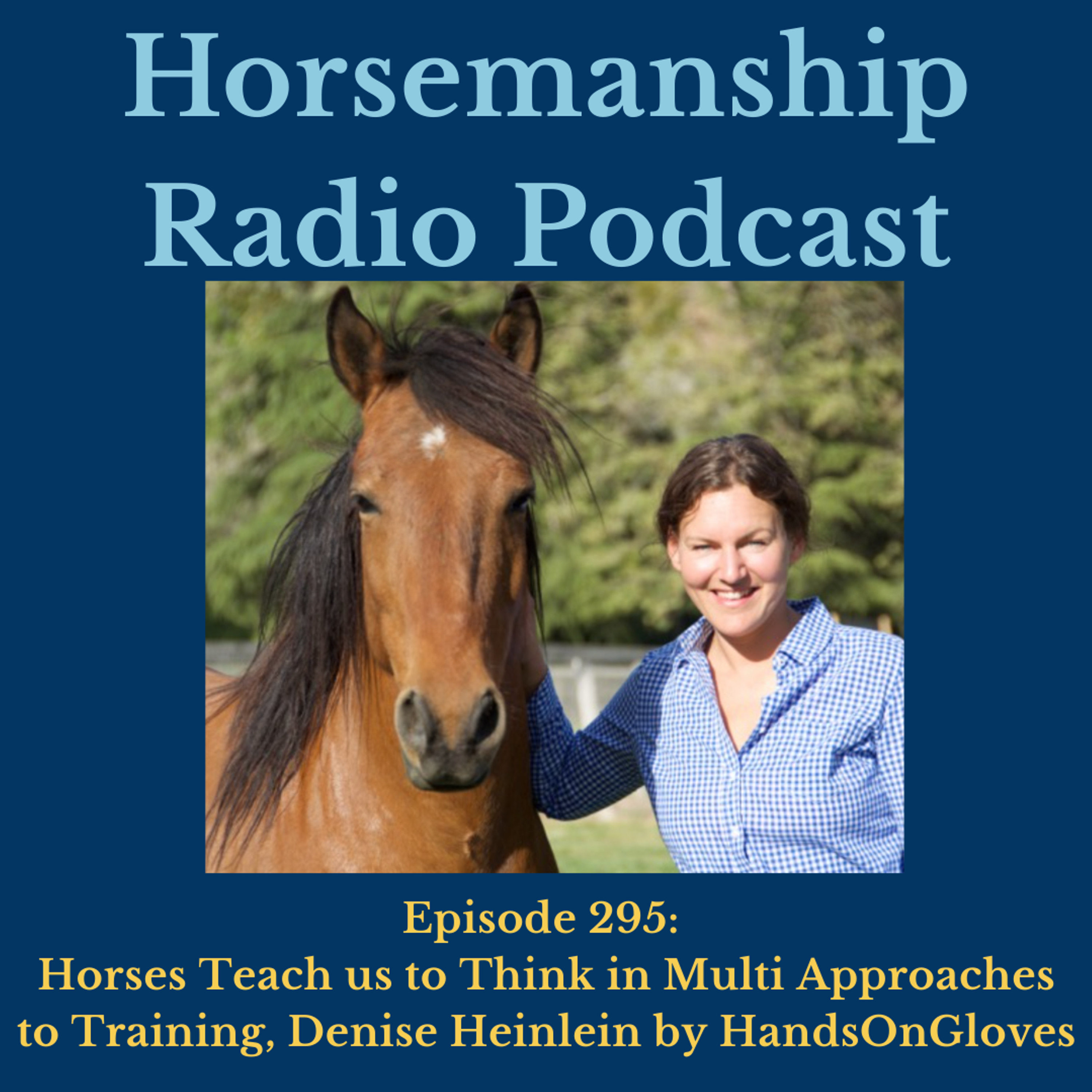
295: Horses Teach us to Think in Multi Approaches to Training, Denise Heinlein by HandsOnGloves - Horsemanship Radio
Get every episode summarized
Each time Horse Radio Network All Shows Feed publishes, we email you a written briefing from the transcript — the topics, who appeared, and any specific claims, with the ad reads skipped.
Email me new episodesFree for 3 shows. No card needed.
About this episode
Unlock a deeper connection with your horse in this inspiring conversation with Denise Heinlein and Debbie Roberts Loucks. Denise, a world-renowned Monty Roberts Certified Instructor, brings decades of experience teaching gentle, trust-based horsemanship across five countries and at the Monty Roberts International Learning Center. Her global perspective on horse behavior, ground manners, and effective communication offers listeners actionable insights that transform how we relate to our equine partners. Together, they dive into how mindful communication, rooted in the horse’s language of Equus, builds confidence, reduces fear, and creates willing partners. Whether you’re a seasoned trainer or just beginning your journey, this episode offers fresh perspectives, practical tools, and heartfelt stories that will elevate your horsemanship and deepen your bond with your horse. Listen in...
Horsemanship Radio 295:
- Show Host: Debbie Loucks
- Guest: Denise Heinlein
- Title Sponsor: HandsOn Gloves, All-In-One Shedding/Bathing/Grooming Gloves
- Photos used with permission
- Learn more about Good Horsemanship at Monty Roberts EQUUS Online University
- Monty's Calendar
- Please follow Monty Roberts on Facebook
- Follow Monty Roberts on Twitter or on Instagram
- See more at: MontyRoberts.com
- Hear all the shows on the Horse Radio Network
- Support the show
Get every episode summarized
Each time Horse Radio Network All Shows Feed publishes, we email you a written briefing from the transcript — the topics, who appeared, and any specific claims, with the ad reads skipped.
Email me new episodesFree for 3 shows. No card needed.
Transcript ready
223 searchable segments. Every word is indexed and playable.
Full transcript
Horse Radio Network All Shows Feed — 295: Horses Teach us to Think in Multi Approaches to Training, Denise Heinlein by HandsOnGloves - Horsemanship Radio. Machine-transcribed; use the interactive transcript above to jump the player to any line.
You are listening to the Horse Radio Network, part of the Equine Network family. This is Debbie Laux, and you're listening to the Horsemanship Radio. Thanks for joining us, Horsemanship Radio airs on the 1st and 15th of the month, and it's brought to you by Hands-On Gloves, the all-in-one shedding grooming and bathing gloves. In this episode, we unlock a deeper connection with your horse in this inspiring conversation with Denise Heinlein. Denise is a world-renowned Monty Roberts certified instructor, and she brings decades of experience teaching dental trust-based horsemanship across five countries, and also at the Monty Roberts International Learning Center in Solvein, California, and the European Monty Roberts Learning Center in Bamberg, Germany. Her global perspective on horse behavior, ground manners, and effective communication offers listeners actionable insights that transform how we relate to our equine partners.
Listen in. Well, I'm able to sit down with Denise Heinlein, and that's not an easy tour. She has been really busy for the last two weeks teaching the Intermediate Course, which is really exciting. We've been talking about bringing in an Intermediate Course, and finally, we did it. We piloted it. I'm so happy for you. I'm happy to have you here and the students that were very exotic, with lots of accents going around, which means they traveled a long way here to be in your Intermediate Course. I'm happy about that. Also, we just capped an amazing weekend, a four-sense in healing, which is our Veterans Program. I know you've been facilitating a Veterans Program in Germany for a long time, too, and so it was nice to have you back for this one, and we can talk about debrief on that, too, and what you learned here, and what we can learn from yours, and success. But let's start today with you as a trainer and a teacher, and you're very good at it. First of all, welcome. Denise Heinlein, one of our most advanced instructors for how many years?
I think I got certified 2009, so now I'm practicing being a teacher in Monty's concerts already quite a while. Yes, you have. I'm super happy to be back, as always, to come back to the roots, really feels amazing. So I love the place here in California, and to be here with your family, and that's surrounding always makes me happy. Thank you. Well, as you know, we're happy to have you back, too. It's a bit of an arm wrestle, because you'll be traveling even like January. Did I just hear you January, February, you're going back to Argentina? Yes. The plan of mine, okay? The quote I love the most about Monty's is like, it's good to have a plan and it's foolish to fall in love with it, but yes, I'm planning to run another introductory course of horsemanship in Argentina, because there, you know, we don't bring the concepts often over there. I mean, we have Melanie, but she is really busy, and so therefore I comment, help her
teach. Good to see you there together. No, not this time, because she's so busy, that's why she has me come to the country, to teach the concepts, and I think I just enjoyed it very much to go around and inspire people and seeing the benefit of this gentle approach and how to communicate in their silent language, in the language of equals with their horses, so it makes me happy. Good. Well, we want you happy, and I think you create happy horses, and maybe that's maybe even more important, because if we can learn from you how to make our horses happy, then, you know, probably we're going to enjoy our horses more, and it's not a struggle to train. A lot of people deal with struggles in training, either with themselves or with their horses thinking that, well, maybe the concepts don't work, because, or my horses just silly and doesn't, doesn't want to do it. What do you think are, you know, what do you think is your superpower?
What is your strength in teaching people how to get along with the horse? Because I think you're pretty horse-centric. Well, that's true. I'm really focused on the well-being of the horse, so I get quite not strict, but really make that as a priority for all of my students, you know, to look that the horse is really understanding us what we want of them. So I, one of my, my superpower as a teacher, I think, is to try to approach in as many different ways as I have to reach the, my students' mind. So they understand what, you know, I try to have them taken. So I'm, I'm, as horses taught me to think out of the box, and as Monty's concept show us how important it is to, to think out of the box, you know, to really meet that individual's needs. And that's what I've learned throughout the years.
And I think this is one part of my teaching, which people like, yeah, good, really good point. Some people make, join up sort of one dimensional, and it really is not at all. It's very three dimensional, and out of the box, it's, that's a term that I wish we get almost, not get away from, because join up is a term that covers so many areas. But, but it becomes a little one dimensional when people think of it very mechanically. So I do agree. I've watched you teach the intermediate course now for the last couple of weeks, and I love how you can come at it from different horses in different ways, for the students to understand. I think one of the things that I saw, we teach at the Yes, No game, which is so fun in all the classes, and I'm not even going to give that away. It's too much of a good secret to keep, but the Yes, No game is really fun. But I notice you use the Yes, No when you're out there working with students from horses too to get their timing better.
Tell us a little bit more about that. Yeah, exactly. So for me to be with the horses and teach them something, or also my students, so to get their timing right, I always make sure they understand that they should guide their horse in every step. So therefore, the Yes, No helps me a lot to make them understand and aware of the fact that each step or even the thought process of the horses, you know, turning their ear, starting to focus to something else. When they pick up all those small little tiny gestures, they are so much better in their timing, you know, to guide the horse into the right direction. So just if they catch up the pathway in the direction we don't want, they can just make a little tiny gesture and move back, and the horse is like, okay, then not, you know, then I change my mind and I kind of focus back on you. And that's what I always try to, you know, make a very strong point off, because then
all of our communication is so subtle, is that the right word, subtle, that you don't even see that there's a constant Yes and No going on, you know, and that's where I have the most fun of, because horses are so incredible, sensitive, that when you meet them on that, you know, stage, then it is really feels like sometimes they are reading your mind, you know, but they don't, but they see those micro gestures we are starting to implement, and they respond to it. And for me, this is where, you know, it kind of gets my interest a lot the last years to, you know, to go to the finest tuning I can get with the individual horse, so that's fun for me. And therefore, I want to, you know, kind of motivate my students to see through all of those layers, you know, we are teaching, so that's why, you know, as you said, you mentioned we have the intermediate course going on now where it's easier for me to incrementally,
you know, bring the students from the introductory course where they learn, you know, the basics and then, you know, kind of, and show them those layers we have to offer, you know, to deep dive into Monte's concepts and also to read the horses language and gestures and know what they really think. Yeah, I mean, it's so hard until you see it, really learning in person, isn't it? I know we have videos and we have a lot of online learning, which is great because it reaches to the corners of the world, which is great. But that nuance, I always love when dad goes into a round pen doing a demonstration and the horse starts to respond right away and the owner looks, you know, flabbergasted, we say, you know, like how did, how did you know? And dad would say sometimes, you know, I don't know, he doesn't know I'm Monte Roberts, you know. So what, you know, what is it about a good horseman? And I think that's what you're describing is they start to work on those, the teacher or the horse start to work on those little micro movements in a dance almost with the
teacher, with the student. And that's when it gets more challenging and more fun. Yeah. And it's like where, you know, the intention and everything comes in. So it's, yeah, it's a never ending journey to, you know, finalize. Yeah. Do you love sharing the knowledge? I mean, I know you love horses and I know that you get some pretty advanced students. But what's your goal in life to, to do with horses and schools? My goal was to be like a very good horse trainer, but then I think as everybody, the realization comes in that I can only work so many horses by myself. And then by sharing all of the experiences I was able to gain, and therefore I reach so many more horses, you know, and kind of hopefully inspire people too, you know, to go around. And I mean, so far I've, have already a lot of my students being instructors too, you know. And, you know, to see this happening, it's just wonderful because you, I mean, I feel
part of Monty's mission there, you know, to make the world a better place. And then for me to go around and teach people in the most beautiful countries, you know, where they show interest, then that's like always a challenge for me to go and see. And, you know, I have to adapt. So adapt to whatever they need to get them hooked. Yeah. And that's like my personal challenge is like, yes, I like that. And how can I, you know, kind of, yeah, do you, do you feel like you're more well-known in Bavaria, where you're from, Bumberg, or do you, do you feel like you're more well-known in other areas? Actually, another area is because I'm really quiet. I have to say that's one thing I want to change. But so far, building up the, you know, European Learning Centre had me stuck there quite a bit, you know. So I've been painting and carpeting and, you know, working and we kind of build all of the place up. So the last three years, since we have it, and I've been, if I'm home, I'm working, you
know. And not with home marketing. Not being able to work on building a structure. And I think that's my next step where I have to go, you know, be more present in Germany and also get the people to know that the European Learning Centre is there. So yes, that's, you know, there is a lot of space, you know, up to, you know, be better at. Yeah. I mean, you know, you can always do so much. And I think to form the structure was needed to now, you know, kind of get people interested in coming. Yeah. Good. Yeah. We're really pleased that you're, your centre of Europe over there, I'm really happy. Dad being 90 right now. Is there anything that you wish you can get done while he's still with us? Yeah. I mean, I think one huge part we were able to get done is, you know, to develop.
And add to our curriculum, you know, so therefore I'm super happy that he's part of it. And he is, you know, kind of putting it out there in his own words, you know, and let the word know that this is happening. So that makes me extremely proud and happy that this is happening so far. You know, so that's not when he's gone, but he was part of it. So that's, I think, really wonderful. And other than this, you know, I'm happy to see him again and again how he, you know, knows so much about the horses to observe him work and that he shares his knowledge still with us. So, yeah, I think the biggest part of, you know, the development of the future and, you know, he was. He's part of it. Yeah, he's part of so that it's wonderful. Thank you. Congratulations on being part of the first generation of the Monty Roberts Certified Instructors. Yeah.
Thank you. We'll continue for sure. When the temperatures drop, don't let winter make grooming a chore. Hands-on gloves keep you connected to your horse with a warm, flexible grip, even when it's cold outside. These patented grooming gloves work in wet or dry conditions, making winter mud and shedding patches and thick coats, easy to manage. No stiff fingers here, no slipping brushes, just your hands and your horse. Used by top trainers and happy horses worldwide, hands-on gloves turns winter grooming into quality time. Visit hands-on-gloves.com and feel the difference, hands-on. Hi, I'm Debbie Laux. If you've ever watched my dad, Monty Roberts, work with a horse, you know how powerful a gentle approach could be. At the Equis Online University, we share that with you hundreds of lessons on building trust, lowering fear and communicating with horses in a way that truly honors them.
We keep adding new video lessons every week because the journey of learning never stops. It has been incredible to see students from around the world transform their horsemanship through kindness and clarity. I'd love for you to join us at MontyRobertsUniversity.com and experience it for yourself. For details about today's show, go to horsepitchipradio.com where you can find links, photos and more information about our guests. We love connecting with our listeners, so please follow us on Facebook under facebook.com forward slash Monty Roberts and Instagram Instagram.com forward slash Monty underscore Roberts. Many thanks to our sponsors, hands on gloves and Monty Roberts University. Be sure to visit all the other great shows on the horse radio network at horseradionetwork.com. Until next time, have many happy horse hours.
More episodes
More from Horse Radio Network All Shows Feed

150: Welfare, Drugs & Other Important Things - Heels Down Happy Hour
Horse Radio Network All Shows Feed

The Business of Practice 149: Managing Your Online Reputation with Tim Scerba an...
Horse Radio Network All Shows Feed

More Than a Trick Roper: Chelsey Bushnell on Making a Life With a Rope - The Sco...
Horse Radio Network All Shows Feed

Dude Ranchers' Association and Studies Show for September 28, 2026 by WERM Floor...
Horse Radio Network All Shows Feed