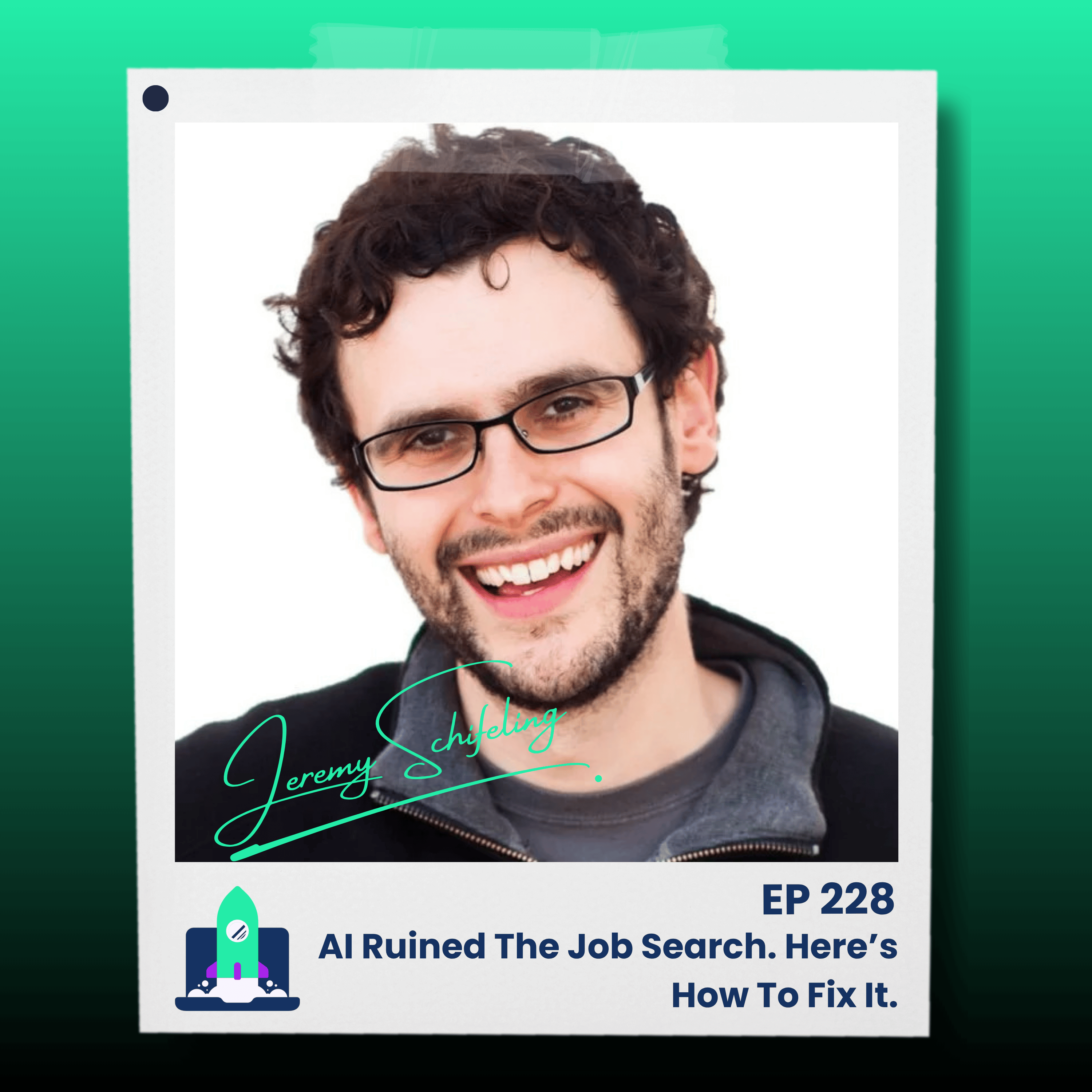
228: AI Ruined The Job Search. Here’s How To Fix It.
Get every episode summarized
Each time Data Career Podcast: Helping You Land a Data Analyst Job FAST publishes, we email you a written briefing from the transcript — the topics, who appeared, and any specific claims, with the ad reads skipped.
Email me new episodesFree for 3 shows. No card needed.
About this episode
Data Career Podcast: Helping You Land a Data Analyst Job FAST is made possible by:
All brands on Data Career Podcast: Helping You Land a Data Analyst Job FAST →
“Hey, Avery here, host of the Data Career Podcast, and super excited to announce our October cohort of the Data Analytics Accelerator is starting on Monday, October 12th at 7 p.m.”From the transcript
Help us become the #1 Data Podcast by leaving a rating & review! We are 67 reviews away!
Former LinkedIn exec explains why mass applying with AI is getting you nowhere. I asked him what works instead.
🧑💼 See 60+ recruiters who are hiring data analysts right now 👉 https://findadatajob.com/recruiters
💌 Join 33k+ aspiring data analysts & get my tips in your inbox weekly 👉 https://datacareerjumpstart.com/newsletter
🆘 Feeling stuck in your data journey? Come to my next free "How to Land Your First Data Job" training 👉 https://datacareerjumpstart.com/training
👩💻 Want to land a data job in less than 90 days? 👉 https://datacareerjumpstart.com/daa
👔 Ace The Interview with Confidence 👉 https://datacareerjumpstart.com/interviewsimulator
⌚ TIMESTAMPS
00:00 – The AI arms race
04:33 – What are we solving for?
10:57 – Referrals were 10x in 2016
21:12 – Anyone can refer anyone
22:18 – Elevator pitch or questions?
36:36 – Is AI useless in the job search?
42:24 – Quality beats volume
🔗 CONNECT WITH JEREMY
🤝 LinkedIn: https://www.linkedin.com/in/schifeling/
📚 Check out Jeremy's books 👉 https://www.amazon.com/stores/author/B00AB7IEX2
🔗 CONNECT WITH AVERY
🎵 TikTok
💻 Website
Mentioned in this episode:
October Cohort of The Accelerator Starts on October 12th
Land your first data job ASAP with The Accelerator. And for this cohort only, get a discount PLUS our premium job board software PLUS our live AI workshops on how to analyze data Learn more here: https://datacareerjumpstart.com/daa
https://datacareerjumpstart.com/daa
Live "How to Become a Data Analyst" Webinar
Come learn the EXACT roadmap to landing your first data job: https://web.datacareerjumpstart.com/webinar
Get every episode summarized
Each time Data Career Podcast: Helping You Land a Data Analyst Job FAST publishes, we email you a written briefing from the transcript — the topics, who appeared, and any specific claims, with the ad reads skipped.
Email me new episodesFree for 3 shows. No card needed.
Hosts & guests
Transcript ready
1,307 searchable segments. Every word is indexed and playable.
Full transcript
Data Career Podcast: Helping You Land a Data Analyst Job FAST — 228: AI Ruined The Job Search. Here’s How To Fix It.. Machine-transcribed; use the interactive transcript above to jump the player to any line.
Hey, Avery here, host of the Data Career Podcast, and super excited to announce our October cohort of the Data Analytics Accelerator is starting on Monday, October 12th at 7 p.m. Eastern, with a kickoff call with me. So I'll be there and all your other peers for this cohort of the bootcamp will be there, we'll get started getting your goals set, and helping you hopefully be ready to end the job when January 1st, 2027 comes around. That's about the timeline we're looking at right now. And for this cohort, we have a special discount for you and a special bonus. One of those bonuses is going to be access to our three AI workshops that we're doing at the end of October, and AI is only becoming more and more important in data analysis. In fact, from January 1st of 2026 till today, the number of times the AI gets mentioned in the job description has literally two X's. So it's becoming more and more important to know how to analyze data with AI.
And so we're going to be doing in these three live sessions is teaching you how to use Copilot, Cloud, and ChatGPT to analyze data. It's going to be a lot of fun. Of course, there will be recordings for those if you can't make the live session. So this is a great time to prepare and get ready for the new year and start the year off right. Lots of companies reset their budgeting and hiring budget for 2027 at the beginning of the new year. So they have a lot of money that they want to actually hire people. Maybe they can't hire people at right now because they're at a budget, but they will be at the beginning of the new year. So now is the time to prepare you guys and this October cohort is a great way to do so. If you've been listening to the podcast and you've enjoyed it, you're going to love the actual bootcamp as well. So you can find all of the information in the show notes down below or head to datacrueljumpsort.com slash DAA. Let me know if you've any questions, Ayan. Let's go ahead and hop into the episode. You could use Cloud Co-Work, you could use GPT Codex. Literally say, here's my resume.
Go apply to a thousand jobs. Don't stop till you're done. It'll do it for you. Is that if we're just applying for random jobs and a completely mechanical way, it's not really 0.01% it's 0% period. You know what the bonus at the top bonus was at Google when I worked there? $25,000. Oh my gosh. Oh my gosh. All right, Jeremy, you are a former LinkedIn executive and an early open AI partner who now helps job seekers get hired. So thank you for joining us today and you're going to talk about how AI has changed the job hunting process. So let's just start with an easy question. Has AI changed the job hunting process? Yes or no? 100%. Absolutely. OK, it is that like how has it changed? Yeah, and so it's changed on both sides of the equation. You know, if you're a job seeker, you have all these tools now. They'll build me a resume chat GPT, write me a cover letter cloud, but it's also changed on the other side where recruiters have all these tools to review your applications.
And so there's kind of this AI arms race where both sides are trying to pump up the volume, pump up the rejections. And I think that ultimately that's left us in a place where both sides are a little frustrated. And hopefully what I can share with your listeners today is how to get out of the arms race and actually connect with real humans the way that we used to. When we talk about recruiters using AI and the job seekers using AI, who's winning in that battle? Yeah, I'd say no one to be honest. Like, so I talked to job seekers all the time, whether you're a brand new grad and you feel like all the jobs have evaporated or a mid-career changer and you feel like what happened to the great resignation, what happened all the opportunities, they feel super depressed. But even with the recruiters, you might think have all the power so I've never hated my job as much as I used to because all of a sudden I'm dealing with way more volume. So much of the stuff is fake because it's AI generated. This is not why I got into recruiting. And so I really do feel like it's left both sides more miserable. What would you say that AI has made job seeking
in the world worse? I'm absolutely. I mean, in the sense that like, I think the best way to think about it is for anyone who's been using AI at first glance, you're like, wow, this is magical. Let's say you're trying to sort of build out your data analysis skills. And you're like, wow, I don't even have to really understand the sequel or the Python as much anymore because I can just have AI banging out. But then you actually run the code and you're like, oh, we got some bugs, we got some problems. I think the same thing is happening with job searching where it seemed like it was gonna be this panacea but actually it's turning more into a nightmare. That's super interesting that you mentioned that. Do you think like that's a total summary of AI as like a totality is like it has great promises to actually do interesting things and it gets you like maybe like 66% of the way there but then the last third is missing. And so you either manually have to go fix the last third and that takes you maybe just as much as time to do the last third or just kind of sucks. Is that kind of what you've been seeing?
Yeah, you know, there are all those interesting studies from early days of AI where program is reporting to the surveyors. I'm saving at least 20 or 30 hours a week and then they were actually measuring the progress the program was making towards code completion and they were like 20 or 30 hours a week slower than they expected to be. And so there really is a disconnect between the promise and the potential and the actual on the ground reality. Yeah, that's super interesting that you mentioned that because I've been one thing I love AI, I'm super fascinated by AI. One thing I've been trying to do with AI is for example use AI to edit the YouTube videos I make because theoretically feed cloth the transcript and the timestamps and then there's all these different libraries that you can use to render different HTML and SVG images and stuff. And you could theoretically edit your videos with cloth. And that's like, I feel like that's like, if you go on YouTube or you go on TikTok or you go on Instagram, especially in the business AI world,
it's like, it's all these promises, like these videos look like this is how I build, I apply to 500 jobs with chat GPT. And you're like, wow, that's amazing. I want to do that. And they show you how to do it. But then no one really shows you the results. And so you're just like, oh, what an amazing promise. I want to do that. And then you spend all the time to actually do it. And then there's like kind of lackluster results. So you're seeing that as well. Absolutely, because here's the deal. I think that number one thing that we all need to do in this AI moment is to step back and try to realize what we're solving for. If our goal in using AI is just to basically throw more sort of darts at the board, but the board does not move like a thousand feet away, just throwing an incremental extra dart is not going to actually increase our chances. But if we say, hey, the whole point of getting a job is to connect with a human on the inside. There is a hiring manager out there who needs my talents to succeed. I got to find them and I have to convey how I can help them directly to that person.
Well, AI can help with that. AI can help you track that person down. But it's not by generating a thousand random applications. It's by getting targeted on what you're actually trying to solve for, which is to find this human in the universe, understand their needs, and connect with them in a deep and meaningful way. And that is so different than what you're seeing on TikTok. Okay, I want to make sure I'm understanding this correctly. So I think for those of you who are listening and maybe haven't figured out how AI, maybe you haven't even used AI to do job applications yet. I think, Jeremy, what you're kind of talking about when you're saying, like sending hundreds of resumes, is there's a bunch of tools out there that will essentially mass apply for you. So if it took you, let's just say, it took you 10 minutes to apply to a job. Now you can apply to like, let's just say, 100 jobs in 10 minutes using AI. That's kind of what you're talking about, right? Exactly. I mean, you don't even need a fancy tool now, right? You could use cloud co-work. You could use GPT codex, literally say, here's my resume, go apply to a thousand jobs.
Don't stop till you're done. It'll do it for you. Wow. Okay. That's super interesting. So, but you bring up a good point that it's like, what's actually the problem that we're trying to solve? And the thing that you said that was interesting was we're trying to talk to a hiring manager. And is that because at the end of the day, hiring is still happening by humans? Yes. And there may be a day, I know that today is stripe analysis, singularity is here. And so maybe that day when AI does all the hiring and the working is not far off, but as long as humans are still involved in the hiring and the actual doing of the tasks, it comes back to human nature. Imagine that there was a boss, say at Google, hiring for a data analyst. That person is sticking their neck out and hiring when everyone else is doing layoffs because they have a massive pain point. They have too much to get done and not enough talent on their team to do it today. And so when they put out a job description, they are really putting out a cry for help from inside the Googleplex, saying,
hey, I need awesome data analysts so I can get my job done. So I can be successful in the world. But if you just blast them with a thousand generic applications, that doesn't give them any signals of the fact that you're committed, dedicated, invested, all the things that we would be hungry for as the hiring manager. It just says, hey, you're wasting my time. And now I'm on to the next. On the other hand, just to give you the sort of comparison, imagine that you did a little research, you understood who this person was, what their challenges were. And again, you can use AI for this. You could put into chat GPT, here's the job description. What are the three pain points behind this hire? And then you reached out and said, hey, this is exactly how I can solve your problems. Here's how I've done in the past. Here's what I can do for you in the future. That's speaking the human language of why they're hiring in the first place, not just this AI game of let me apply for as many jobs as possible. That's the ultimate end goal. And I want your listeners to keep that north star in their minds. That's really interesting that you mentioned that
because sometimes it is really hard to remember what the end game is. I remember in college, I don't know why this was the case, but in my undergrad, University of Utah, it seemed like the STEM career fair always overlapped with midterms. It was always like the same week. And I remember there was me, and then there was this other girl in the program. And I talked to her and she was like, oh, I got to study for this midterm. I can't go to the career fair. And me, I was like, well, I'm only here because I want to get a job. Like, I don't really care about my grades. I just want to get a job. I went to the career fair and she didn't. She got an A on the test. I literally got an F, but I got a job from that career fair and she did it and she struggled. And so I think it's so easy. For some reason as humans, we like to think that like the intermediate step
is the end goal, but you're right. The end goal is to actually end a job. The applying for the job is just so we can get in front of a human's eyes. But it sounds to me like what you're saying is it's not the only way to get in front of a human's eyes. So how else can we get in front of a human's eyes? Yeah, absolutely. So I think at the end of the day, what we should remember is that we are living at this incredibly opportunistic moment. Like there was a time probably 20 or 30 years ago where it was still that old boys club of like, okay, you don't know that individual hiring manager inside Google, therefore you are not sort of eligible for this opportunity. But now that we're living in this age of LinkedIn, plus AI, what's the stock you as a university if you're a test student or a community college student or someone who never even went to college at all, from like literally going on LinkedIn and say, I don't know that hiring me on Google, but I know someone who knows him. Could I ask for an introduction? And I think if you think about what AI is doing to all these digital documents, whether it's your resume, your cover letter, your LinkedIn profile, it's destroying the trust
and the differentiating power of those signals because everyone's resume and cover letter and LinkedIn profile can look amazing right now. But if you have the trust of someone who that person knows and has a relationship with, that is so much more powerful, so much more differentiating than another mass produced application like everyone else out there. That's how you stand out, even if you're not part of the quote unquote old boys network. Okay, so it's about, sounds like it's about trust, gaining these people's trust on the inside. Okay, so one of the examples you gave was like, oh, maybe I don't know the hiring manager, but I know someone who knows the hiring manager. What are some other ways that we can gain these magical human beings trust? Yeah, absolutely. So I think a lot of it is through relationships. And so one of the really fascinating things is if you had to guess every, what do you think was the power of a referral back in 2016, 10 years ago, to give you an edge compared to online job applicants? So imagine someone applies to a job at Adobe,
online, someone else gets a referral, how much likelier is the referred candidate to be hired? I mean, I would say a lot more likely. I would say like five times more likely. For example, it was 10x. 1000% boost, which is crazy for like a coffee chat with someone. Yeah, now that's 2016. If you fast forward today, 2026, what do you think is the advantage of a referred candidate over an online applicant? Well, I would say that since it's gotten so much easier to apply for jobs, you have a lot more applicants. Just by, just like by default, I would say it has to be way more. So I mean, I would probably say more than double, I would guess more than 20 times. Yeah, so it's 20x today. Yeah, which just gives you a sense of like, wow, like remember what we're talking about? This is not a game. This is not a game show. This is your life. If you could get a 20x advantage on an opportunity that changes the course of your career and maybe your life, why wouldn't you go for that? So that goes back to your question, which is how do you get that advantage?
Yeah, maybe you know someone to know someone or maybe you went to the same school, maybe you volunteer with the same organizations. If you literally went on LinkedIn today and said every Googler who volunteers with habitat for humanity, you would find over a thousand Googlers who spend their time on that kind of thing. That is reason for you to reach out and say, hey, we've got this in common. Could I learn whether you're time at Google feels consistent with your values? I want to compare apples to apples. And I think the reality is we stop having to put ourselves in this sort of easy button mentality. Let me just press a button and chat GPT and get the job. And let me instead build a real connection with a real person. Okay, I agree with you and I have two follow-up points. One, you're 100% right. Like with the alumni or with like a non-profit, like when I get, you know, with having like 150,000 LinkedIn followers, I get a decent amount of messages inbound. And I try to respond to the money's like, yeah, but obviously it's an overload. It's an overbearing amount of work sometimes.
So I don't reply to every single one. But if you went to my alma mater, I'm very likely to respond. And it has nothing, I don't know you better. It's just like, oh, you and I lived at the same place for a little while and we cheered for the same football team. And I, for some reason, there's like school spirit in the United States. And I want to help this person. So that's awesome. I agree with that. And two, yeah, like non-profits are really good one are interests like, like for instance, you know, I have my church on my LinkedIn. If you're from the same church as me, I'm probably more likely to respond. Just little human connections like that can make a big difference. I want to go to, okay, so like we can do this, but why aren't people doing it? You mentioned that like it just feels easier to press a button. Is that the number one primary reason why you think? Like even though I know this action is 20 times more likely to land a result, I want to still press this button. Even though I know it's not the right choice. Yeah, so I don't know that people are thinking about it quite rationally. But I think when you're in this moment of like, oh, I need a job.
The single best sort of like quick dopamine hit is that spin of the roulette wheel, right? Apply, apply, apply. Hey, at least I'm making progress. At least I'm putting stuff out into the world versus what I'm talking about is a much slower game, right? You've got to find the person, you've got to find the mutual connection, you've got to ask for the info, you've got to have a chat. None of this is instant gratification. And one thing we've learned about our species in 2026 is we are hardwired to want that quick dopamine hit versus that long-term thinking. So even though every single person knows the referrals matter, very few get them for that exact reason. Do you think people also are just like, they just like shrug off the idea of networking? Because they're like, oh, I don't know the hiring manager at Google, I'm a nobody. And so they're just like, there's no point in trying. Because who am I? I live in this little, you know, podunk area. And I only know podunk people. And I come from this family, we've never been to college, we don't like, I don't know, do you think people get like in their heads
about it that way? Yeah, yeah. So I try not to psychoanalyze the students that I work with. But I think that there's a lot of imposter syndrome, a lot of sense of like, I'm not worthy of referral. Someone else should get that opportunity because they deserve it more. And I think the reality is, I think this is what you teach, you know, through Data Career Jumpstart, is anyone out there could add tremendous value to organization? If you've put in the time, if you built the skills, there is that hiring manager who has that cry for help. But you have to believe in yourself first and foremost before they can believe in you. And I know that's easy for me to say harder to do, but I do think that is an internal barrier that a lot of folks face. Yeah, the imposter syndrome is really hard to get over. That's something we all have to face. I think, and I was being a little trivial earlier that, you know, from being from, you know, maybe a middle of nowhere area. But, and maybe you don't know anyone, but I think there's opportunities to know someone. So for just, for example, you know,
once upon a time, I post every day on LinkedIn and this guy literally commented on my posts like every day for six months. I'm like, who the heck is this guy? And so finally, I reached out to him and I was like, hey, who are you? Why you keep commenting on my posts? And we got in a call and I ended up hiring this guy. And it's like, this guy is from literally from Africa. Like he literally, him and I could be further apart almost in the entire world. But, you know, through the power of LinkedIn, just from adding value and networking, you know, that really gave him a good opportunity to work remotely in the United States. But I think the problem is, is he had to do that? What? 89 times in a row without any benefit, basically. How do you overcome like when networking feels pointless when you're like, I'm planting all these seeds that I'm getting no plants? Yeah, I love that story. But again, that's the hardest case scenario where he had absolutely nothing in common with you, maybe except for shared interests. And so he had to win you over one post at a time.
I want to go back to what you mentioned about being a member of the youths, being a member of LDS, whatever the connection is. There's this concept in human psychology called generativity. You can look it up on Google. And it basically says that we as a species are hardwired to actually want to pay it forward to the next generation, both because someone likely helped us back when we were starting out. And because there may be this evolutionary sort of bias towards you want to see people in that same tribe, that same walk of life also be successful. And so I think the change of mindset for folks is less of, oh, I have to believe in myself 100%, but to understand that I'm actually giving a gift to the other person, you might feel like, oh, I'm wasting their time, they're super senior, they're super successful. What could I possibly offer them? But that sense of being generative, that as an old guy, I get a chance to feel like I'm leaving value in the world, I'm creating a legacy in the world. That is massively powerful for me. And if you give me that gift as a younger person, I'm going to want to go to that for you as well.
So don't forget that you're giving that gift as well as receiving. Important perspective. Yeah, once again, just trying to go through and see if I felt this in my career. When I worked for Exxon Mobile, I was one of three alumni from the University of Utah that worked for a 70,000 person company. Maybe it was like five actually. But one in three on a 10,000 person campus. And yeah, I would have done, I would have gone, I really wanted more youths and more Utah people at Exxon Mobile. Yes. I would have totally tried to help people that needed the help. So that rings true. Also, we should also point out that sometimes, not always, but sometimes there's also financial incentives for these people within the company that if they refer someone who gets hired, they get like a bonus of $500 or $1,000 or whatever. Yeah. So let me just stop you right there. Yeah. Do you know what the top bonus was at Google when I worked there? No. If you referred someone with like very specialized skills. No. $25,000. Oh my gosh.
And then you think about it from the employer standpoint. Data shows that referred candidates are likely to accept the job offer because they've got that friend on the inside, likely to stay longer, and then actually like it outperformed non-referred candidates because they've been hand selected. The reality is it's a bargain for an employer to pay that bonus to automatically have access to the best town in the world. So again, lots of gifts going on here. It's not just purely all zero sum thinking. That's actually interesting that you bring that up because I run a job board where I post data jobs. And I had an ex-colleague reach out to me who's at a different company now. And she said, hey, my company's hiring someone in data. Do you have any recommendations? And so I kind of ask the people that I kind of know that are in the market for a job. And this was a more senior role. So not necessarily like a good fit for a lot of my bootcamp students. It was like a senior data scientist machine learning role. And so I asked kind of some of my friends that I know were in the job market. No one was super interested.
So I replied, hey, sorry, I don't know anyone. But if you'd like, I'll post it on my job board for free and we can promote it for free just because I want to kind of get that side of the job board going. And she said, no, thank you. We're only looking for referred candidates. And I was like, wow, they don't even want the application mess. They only want people who were referred. And I think it's for the reasons you mentioned earlier that a referred candidate is more likely to stay an easier hire, like better performer. It just works out better for them. So it's really interesting that you mentioned that. Is that true? Have you seen that like at other companies as well? Other than Google? Yeah, so funny. I hear that all the time actually. I'm always offering to post stuff because they have all this LinkedIn stuff going on. People say, no, that's more work for me. That's more strangers in my queue. I want less work and more trust, not the other way around. OK. Referred candidates, guys, it's important. Try to get referred. So what can people kind of do to get referred? So we mentioned, we're trying to connect with hiring managers if we can. If we can't, maybe connections of hiring managers.
And we're sending them LinkedIn messages. What type of like, how are we contacting them? Would you say? Yeah. Alps, so first of all, if you find someone inside an organization, obviously the closer they are to the hiring team, the more leverage they're going to have. But when I worked at Google, I would refer people for jobs in India, for legal team jobs when I was a marketer. And so anyone can refer anyone. That's the first thing to know. It's got to find someone on the inside. One you inside next to a mobile. Then when you want to get in touch with that person in the first place, don't send them a cold out reach on LinkedIn. Because most people are not that active on the site. Basically, you could sit there in their LinkedIn inbox forever. Don't send them a cold email because everyone's inboxes are exploding. And they don't know your name. Instead, wherever possible, find that mutual connection on LinkedIn. That warm intro opportunity where, say, Avery introduces you to Jeremy. And now you're coming with that nice halo effect. OK. So that's the dream scenario. You've been introduced to an insider. You've got something in common. Now what's the game plan? I'm going to pitch it to you, Avery. You have two choices. This is like choose your own adventure style.
I'm ready. Do you give this insider an elevator pitch, telling them how awesome you are? Or do you ask them questions about themselves? Oh, yeah. That's a good question. I would probably say everyone likes to talk about themselves. So that's probably the better path. I'd be tempted to talk about myself because I love talking about myself. But oh, me too. And everyone does, right? The reality is, even though business school, like when I was an MBA student, they were like, God, I have your elevator pitch ready. This mythical elevator ride, when you're going to sell yourself, the reality is no one wants to be sold to. No one wants to get a call during dinner offering them a new cell phone plan. Don't be that guy. Instead, bring it back to the human stuff. Like, hey, how did you go from university view taught to ExxonMobile? What surprised you along the way? What do you wish you had known when you were starting over? That's catnip to any alum out there. And then, make sure that when you close that call, you don't just say, hey, have a great life. Thanks for, thanks for the chat. You keep the conversation going.
So I'm going to share my golden question with all of your listeners. I want you to have the conference to say, hey, Avery, this has been awesome. If I could ask you one last question, if you were back at the university of Utah today, trying to break into ExxonMobile all over again, knowing what you know, what would you be doing to get the best shot at this organization? And why do you think that works so well, Avery, based on everything we discussed? I mean, people love to be, like, people love to talk about themselves, and then also people love to give advice and say, you know, help the younger generation. And I think a lot of the times when you ask for advice, you actually kind of end up getting referral. Because they're like, oh, this is what I would do. And maybe I'll help you along the way. Yes, I cannot tell you the number of times. Just by throwing that out there, they said, look, I got referred, my whole team got referred. You got to get a referral. Oh, by the way, we're hiring right now. I get a $5,000 referral bonus. That'd be a resume.
Yeah. So bottom line, like, I know it's almost like inception style, but like give them a chance to lead and play that mentor role versus like transactionally, like give me a referral just because I went to your alma mater. Yeah, we had another recruiter on the channel. One time kind of talking about networking. And one thing they said is if you ask for a referral, you end up with advice. And if you end up for advice, you end up with a referral. So it's good to hear it coming from, you know, someone like you. Okay, so we can do these like, we can get these like warm introductions for mutual connections and then, you know, ask for, be interested in them and then ask for advice ultimately. And that can lead to good things. Is there anything else that we can be doing to fight this good fight against, you know, the applicant tracking system and the AI slop volume, that's basically making it impossible for us, you know, to actually have our resumes be seen by hiring manager. Yeah, a couple things. So first of all, know that there are two kinds of referrals. The sort of basic one that everyone's familiar with is someone goes inside an applicant tracking system.
This is the big sort of like applicant database that every company has. And they basically check a box. So you say, Avery, I recommend you for this data analyst role at ExxonMobile. I mean, that's nice. You know, the recruiter will see it. The hiring manager could see it, but it's still just one little box. The ideal, and this is where it's helpful to sort of steer that alum or that inside it a little bit, is don't just check a box, like go directly to the recruiter, go directly to the hiring manager, ideally if you know them well, and like make that case, because that is way more persuasive than, oh, there's a little extra bonus point attached to this profile. So that's the first thing to know, is there are two flavors of referrals. One is very robotic, one is more human, the latter is more powerful. And then number two, don't be afraid as we talked about, to go directly to the hiring manager. Like if you think about what the recruiter's job is, their job is not to find the best town in the world, their job is to put a warm body in that seat as fast as possible, so they can move on to the 39 other roles
that they have to fill. Versus the hiring manager's is the one person in the organization, who actually has the incentive to find the best person, because it's their butt on the line, their career that's gonna be yoked to yours for the rest of time. So that's why if you can actually build a connection with them versus just the recruiter, there's a lot more alignment between what you want and what they want. This is so interesting that you bring this up, because once again, just going back to job boards. For, or maybe this is the sign that it's time to change job boards, because for as long as I've been an adult, job boards have been what they are, a list, a directory of opening job positions that us, the applicants can apply for, it goes to someone for review, the interview us, we get hired. But it's, and people spend hours scrolling through these job boards and looking and applying for all these jobs, but what we're saying, what you're saying, if I'm understanding correctly, is that's not super effective. The more effective thing is to do this referral thing. So like why don't you think that there's more like
software oriented towards this? Why are there like job boards that only show the like hiring managers in recruit? Like why is the process, it is what it is. All right, this is Avery coming to you from the future. I was editing this video and I asked this question, because I've been thinking about this previously, like why isn't there more like directories that just recruiters and hiring managers, people who want to hire data adults, who are like literally looking for someone right now. And so I actually built it on findadjob.com and I want to talk to Jeremy about that. But I got distracted. I never had the chance to tell Jeremy that I actually built it. And so I want to tell you now, that's why Avery from the future is here interrupting this episode to tell you that it's built. So let me show you. So if you go to findadjob.com, at the top up here, you'll basically have something that says recruiters. If you're listening to audio only, don't worry, you shouldn't be able to do this on your own on your computer or later or whatever. So you click on recruiters, and then bam, right here is a list of 55 recruiters
and hiring managers that are literally hiring right now. So you can scroll through these, get their name, their title, their company, where they got their degree, and then of course their LinkedIn profile. And there it is, that purple hiring sign. So you can literally reach out to these people and send them a cold message, send them an email, and give them your elevator pitch or maybe better knots, give them the elevator pitch, give them ask for advice, because we're learning them and we ask for advice where we connect with them emotionally and humanly first, we actually get more results in the end. And this is actually part of premium data jobs, which is the premium version of findadjob.com. So on premium data jobs, we've always had these premium jobs right here. We have 121 right now posted. And these jobs, for instance, like let's just do this in-tune-level data analyst role at AFFLAC. This was posted a day ago and has a pretty friendly score, three out of 10 on our deaths on how senior it is.
It does require a decent amount of skills here. But anyways, if you click on Conzac hiring team, that's literally gonna take you to a LinkedIn post where some sort of person said they were hiring. And in this case, it looks like this toast got pretty popular during the 31. But typically we try to find jobs that don't have very many comments on them. So you can leave a really meaningful comment. And I mean, like you can definitely outdo a lot of these comments here and send a little bit better of a cold message than these people have. And you can also of course, you can click on this person's profile and send them a cold message here on LinkedIn. So if you're kind of enjoying this type of style of job hunting, then you need to check out find a job.com because we're doing good things. All right, back to the episode, Jeremy, why are there more recruiter directories like the one of my day job.com? Yeah, I think the fun and the problem is economics 101, right? Think about what we know about how marketplaces work. Whereas soon as someone increases the price it drives down to man. As soon as someone increases the supply,
it drives down the price, et cetera, et cetera. There's an equal and opposite reaction. Well, from a minute that monster.com turned on in 1995 or whenever it launched and the first online job where it was born, all of a sudden the amount of applicants just completely exploded. And so then it went from let's have monster.com to LinkedIn.com. Maybe recruiters can go out there and find people. Well, now LinkedIn has 1.3 billion profiles. And so as a result, every signal kind of gets ruined or maxed out by that perfect competition over time, which is why I think we're coming back to some of these natural signals. When you are reaching out to me as the hiring manager or reaching out to me as a refer, it's not just about the actual conversation, it's about what that conversation says about you. Out of 1,000 people who wanted this job, you were the only one who had the cleverness, the guts, the drive to actually reach out and do something different. If I want the one data analyst who's gonna think differently about this role versus being a cog in the machine,
you've just walked the talk when everyone else has only talked it. Such a good point. We just posted a role that we're hiring a salesperson to do some of our sales calls for our bootcamp. And we wanted to hire internally from our bootcamp. So I posted it in our bootcamp community. I think we had 10 people interested. And I said, comment me if you're interested on this page. So 10 people commented me. Out of those 10 people, great. I like all 10 of them. They're good candidates. One of them sent me an email. Hey, I know you haven't told me how to apply yet. You haven't given me any other instructions. But I already want to tell you about myself and why I'm a good fit for this role. And if nothing else, his name's at the top of my mind now, because it's like he's the only one that stood out of those 10 names. And literally in this case, maybe they were waiting for instructions. But all of them had my email. All of them had the chance to do it. But yeah, it's just like, that's just you're right. That doesn't even matter what he said. It's just the fact that he took initiative and said something.
That actually says maybe more than any message could say. Yeah, I think that's the important thing here. It's like, I know when people think about this stuff at a theoretical level, they get exhausted, right? No one likes job searching. It's ego destructive. Where's you down and all these different ways? And yet if you sort of like pull out all the feelings, all the emotion from it, we're not talking about massive investments of time or energy or creativity, just a little spark compared to the average person is enough to put you out there. So hopefully we can lower the temperature on that and say, hey, how do you step one step further than everyone else? And man, Jeremy, you're firing me up here. Because now I'm excited. Now I'm like, how do we tell people this? How do we make it more fun? Because I think that's what it is. I think it's like going back to the dopamine earlier, like if I have cloud co-work, go out there and apply for a hundred jobs for me. That feels good. That feels like I did something today. I did something cool. I did something neat. And if I went out there and I sent, you know, let's even say 10 cold messages, you know, to,
I mean, we'll call them warm messages because maybe we're messaging people who are already connected with. Let's just say none of them reply. Like that doesn't feel good. But the, and let's say I didn't spend the same amount of time on each, the networking one, even though it doesn't feel good, is actually valued more, but it doesn't feel good. So how do we convince people to do that? I don't know. Yeah. I mean, how do we change our species, right? Like how do we go from a species that's like, we're going to live today and burn down this planet if we have to, so like we're going to build a sustainable society that lasts forever because we're thinking like 10 generations into the future. And I don't know the answer to that, but I do know that here's another psychological concept I really like. This is idea of locus of control. Have you heard of it? I've heard of it, but I don't know what it is. Okay. So basically external locus of control is how most people operate. You looked around the headlines because we're so saturated them in them today. And you're like the job market sucks, AI's taking all the jobs, you know, geopolitics is crazy, whatever. And you're like, oh, I'm screwed, especially if you're Gen Z, you're doubly screwed.
And you're like, okay, now I've stopped. I can't do anything about that. But then there's a handful of people when times get tough, whether it's the great depression or the great recession or even this moment, who are like, I can't control any of that stuff that's swirling around, but I can send that email today. I can reach out to that person today. And if you can just sort of focus on here is the one little thing that I can control in my life to take control of my destiny in a way that no one else is doing. Then I think that you focused on the most realizable, most magical part of our ability as humans, which is we do have free will. We do have the ability to make these choices. And that's the choice that I want your listeners to take. Yeah, that's a hard thing where it's like, okay, we can't control the results, but I can't control the actions I take. And so instead of measuring the results, my new result is just going to be how many efforts, how many actions I put in today. And I just trust that the results will take care of themselves if I stay consistent in taking these actions. And I guess I would just tack on that
if you don't trust the stat that Jerry brought up earlier about your 20 times more likely to land the effort. Let's say you don't trust it. Let's say you don't trust me. Maybe you can just like, instead of just applying to a hundred jobs, maybe you just apply to 80. And then you send two messages. Like maybe it's not like you just send 10 messages and you don't plan any jobs. Like maybe you can gradually work your way in. Does that kind of sound fair to you? I love that. It's kind of like a ballad portfolio, right? Open all your eggs in one basket, spend around. Okay. So we've talked about like how AI basically is flooding the applicant tracking systems. Everyone has the same looking, the same sounding resume because they're all using chat GPT. That's trained on all the same data to write the same bullet points. And we're not making it fun of hiring managers. So we can kind of like network our way in essentially and try to get these referrals. Is there anything that like AI is good for? Like is AI useless in the job search? Yes. Well, let's just start at the very beginning. I find that a lot of folks, and I understand it,
if you're unemployed right now, and you're like, I need a job yesterday, you don't have time to fool around with career exploration and finding your path and all that good stuff. But even if you're time pressed, I think everyone now using AI could do a very simple exercise to make sure they're actually aiming in the right direction. Like how frustrating would it be to spend all this time applying and networking just to land a job that you hate? And if you want to prevent that, this is where AI comes in. You can go to AI and simply say, hey, I want you to take everything that you know about me in terms of my strengths, everything that you know about me in terms of my passions. And I want you to figure out the 10 job titles that are a perfect fit for who I am and what the world needs for me. This is a Japanese concept called IkaGai. And because AI is trained on every job that's ever existed, not just consulting, not just data analytics, it can say, hey, you might think that you should be a data scientist, but actually maybe you should be doing BI in the healthcare space because that would be a way better fit for all these reasons.
And I think if people spent even 10 minutes at that initial step before they started applying Willie Nilly, now are they gonna get better results in terms of the applications because they are a better fit, but they're gonna be way happier down the road, which is the whole point of applying for the job in the first place. Okay, so AI can help us, you know, try to figure out what job we actually are interested in. What about like cover letters or resume bullets? What do you think about this? Yeah, for sure. So just to be clear, nothing through the baby out with the bath water, but the reality is is that AI is sort of this thin red light that you have to be careful about. So if you went to chat GPT or clot or perplexity or whatever and said, here's the job description that I want. Here's my current resume, which importing keywords in my missing, it'll be really good at that level analysis. That's essentially what an ATS does. However, where people cross that red line, is they say, great, now give me credit for all of those skills in my experience, bullet points, so I can apply immediately.
And then someday they're sitting in front of their future boss and the boss says, hey, tell me about this amazing thing that you did, and the only problem is they never did it because AI hallucinated it. So again, I think it's totally fine to use AI for the research and the analysis, but if AI is telling our story without our input, now we've got a big problem. Okay, and what about in the education space? Because you worked in the education space with AI, do you feel like AI makes a good tutor? When is it do good things and when does it do bad things? Yeah, and again, it's one of these things where we have to kind of like bind ourselves to the nest Odysseus style. If it's a quote, someone who's in the theaters these days, we're basically we say, if we're going to use AI to learn or to develop skills, we've got to give it very clear instructions. We've got to say, hey, don't just give me the answer, don't just rush to the output, help me walk through the process. And a lot of the tools have these study modes built in. Gemini's got it, a GPT's got it. I think Cloud may have it now. We're basically, we'll never give you the answer. I'll just keep coming back to you with questions,
it's a credit style. But again, I think we have to resist that temptation of the easy button, the instant gratification, if we really want to have a true tutorial type experience. I mean, it goes back to what we were talking about earlier in the episode where it's like, AI is decent at like 66% of what task you give it. And also depending on the prompt and the data you give it as well, like those things can increase. Yeah, it's really hard. I'm going to have weird place with AI where it's like, oh, no matter what I have you do, you do an okay job. And oftentimes that's like a great starting place where it's like, okay, I'll take over manually and I didn't have to do like the first half of this project. Great. And other times it's like, man, I spent so much time writing this prompt and giving all this data. And you just kind of sucked at this that I spent all this time, you know, I'm not getting any results from what you're telling me. It's like, I should have probably just done this on my own or with a human, a human there. And I guess that's kind of what you're saying is like, AI can be useful, but also like keep humans in the loop and just know it can make mistakes.
It can hallucinate. So take a hybrid approach where it's like helping you along the path, but maybe not, you're not writing it as the vehicle. Yes, I'm gonna give you a little analogy here. I think that in some ways, AI reminds me a little bit of a British accent. I don't know if you're like me, Avery is a typical American, but when I hear someone speak to me in a posh British accent, I immediately give them like 20 extra IQ points. Wow, they're so brilliant. Yes. And in fact, when you step in that, you're like, think about what they just said. You're like, no, that's totally dumb, but it just sounded so good. I think AI is the same, right? Because it writes in correct sentences, because it can be opinionated sometimes. You're like, I'm not talking to an intern. I'm talking to a boss, a CEO here, but it makes those intern level mistakes, even with that posh accent. Love that analogy, stealing that analogy. A hundred percent agree. I am, anyone who has a British accent, I trust them 20% more, like 20% smarter. So we're like colonial holdover, right? We're like totally enthralled.
That's so funny. And it's funny, because I lived in Europe for over two years. And they love American accents because they learn British English in school. And they're always like, oh, you sound like you're from the movies. So it's just so funny. They like American accents. We like British accents, I guess. Rasta's greener. Yes. Okay, that's amazing. Okay, Jeremy, rule me this. You know, we talked about networking, but outside of networking, if you were to talk to a job seeker right now, and this AI flooded world with all these different applicants, what is the one piece of advice you'd give them on how they could land a job quicker than they are right now? Yeah, absolutely. And then the number one thing is that you have to be focused. Again, I know that there's this mythical math equation that's running in the back of our minds, where we say, yeah, we know that our chance of landing any job online is like 0.01% these days. But if we just apply to 1,000 jobs, we'll get that one job, right? I think what we don't appreciate is that if we're just applying for random jobs in a completely mechanical way, it's not really 0.01%, it's 0% period.
Because again, especially in a labor market as tough as this one, companies are always going to have their pick of really qualified driven people. And so you're fooling yourself, if you believe, I seem to have enough lottery tickets and I win the lottery. And so my number one rule is, hey, play fewer games, get into fewer of these application matches, but have a winning rate of 1% or even 10% and now the quality piece is going to carry you so much further than the quantity piece ever did. And again, I know that's hard because it takes time to take a little self-reflection, but that's the overarching rule. It's fundamental mathematics at the end of the day. And so even if you hate relationships, if you're an introvert that I am, think about it like, hey, I just need to get myself reasonable odds and this will work out quicker than applying it as 0% rate. I love it. It's don't buy a bajillion lottery tickets by the most likely to be winning lottery tickets. Yes. I love that, Jeremy. If you guys enjoyed this episode with Jeremy,
we'll have his LinkedIn and his website in the show notes down below. Jeremy is an awesome follow on LinkedIn. He has his own podcast and he's written what, three, five books. How many books have you written about landing a day to job? Or not landing at J2J, landing a job in today's market? Yeah, too many, but don't worry about reading all the books. Just get out there, start connecting with folks. That's what I want for anyone listening right now. Hey, that's perfect, Jeremy. So if you guys want to connect with Jeremy, look at the show notes down below. Jeremy, thanks so much for coming on the data career podcast. Thanks for all you're doing, Avery. Good luck to everyone. Alrighty, I hope you guys enjoyed that episode. If you did, I want to invite you to my free How To Land a Data Job workshop that I'm doing on Tuesday, October 6th at 1 p.m. Eastern. I'm going to be basically in one hour giving you the entire roadmap of every step you need to take in order to land your first data job. I'm going to be giving you a lot of the behind the scenes hints and tactics on how to actually talk to recruiters
and hiring managers, how to get past the automatic tracking system, how to actually get experience when you have no data experience, how do you create your own? So it's going to be a lot of fun. I will be there live Tuesday, October 6th at 1 p.m. Eastern. And I hope you will be as well. You can use the link in the show notes down below to register or you can go to the following URL, datacareerjumpsstart.com slash webinar. Datacareerjumpsstart.com slash webinar. And that will take you to the right place. OK, guys, thanks for listening. See you soon.
More episodes
More from Data Career Podcast: Helping You Land a Data Analyst Job FAST

231: Complete Data Analyst Bootcamp: From Zero to Hired [Free Full Course]
Data Career Podcast: Helping You Land a Data Analyst Job FAST

230: The Data-Driven Way to Make Decisions (Parenting, Health, Career): Emily Os...
Data Career Podcast: Helping You Land a Data Analyst Job FAST

229: i asked gpt-6 astra how to become a data analyst (it was wrong)
Data Career Podcast: Helping You Land a Data Analyst Job FAST

227: This Music Teacher Became a Data Analyst in 6 Weeks
Data Career Podcast: Helping You Land a Data Analyst Job FAST