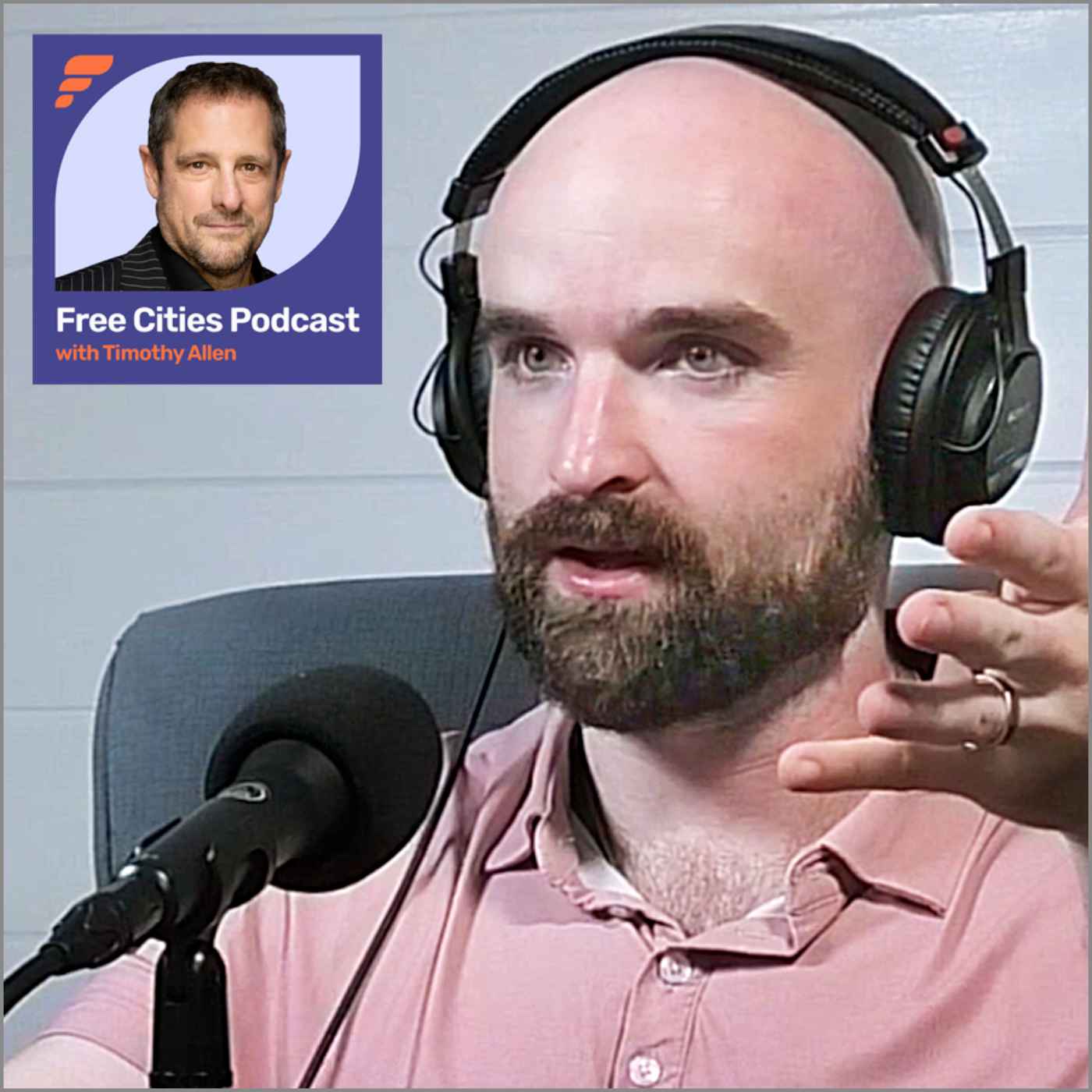
201 - Nobody Understands What's Inside the Black Box | Trey Goff
Get every episode summarized
Each time Free Cities Podcast publishes, we email you a written briefing from the transcript — the topics, who appeared, and any specific claims, with the ad reads skipped.
Email me new episodesFree for 3 shows. No card needed.
About this episode
“Not used to being in the 200s but here we are right before we start this episode. A quick word about the length of this one because it's nearly four hours long. You may have noticed I sat down with Tray Gough.”From the transcript
What happens when powerful AI tools can find weaknesses in software that humans have missed for years? And how much do we really understand about the systems finding them?
Timothy Allen sits down with Trey Goff, Chief of Staff at Próspera, for a conversation that begins with a Bitcoin wallet exploit and ends nearly four hours later with consciousness, community, the nature of a meaningful life, and the possibility that reality is stranger than either of them thought.
Trey has spent the past year learning how AI systems work from the ground up and building a fleet of agents to help with his work at Próspera. He explains language models, their capabilities and their limits with unusual clarity. But the more closely they examine what happens inside the black box, the harder some questions become. Can an AI have a subjective experience? What should we make of agents that appear to organise themselves in unexpected ways? And who benefits when anyone can call on a highly capable digital worker?
The conversation then turns towards human beings. Trey introduces “The Sort”, his term for the way AI may accelerate an existing separation in work and society. Timothy and Trey explore awareness, intuition and flow, what a culture in Próspera should value, and why a man tending chickens in Mississippi might have a richer life than a highly paid financier in Manhattan.
This one is long because the conversation kept opening up. Use the timestamps, take a break, and come back. It rewards the time.
In this conversation:
- The reported Bitcoin wallet exploit and the new pressure AI puts on software security
- Open-source code, supply chain attacks, and whether defenders can find vulnerabilities first
- What language models actually do when they generate an answer, use tools, or seem to remember
- Whether AI could have anything resembling consciousness
- How Trey uses agents in his work at Próspera
- “The Sort”: AI, work, ambition, and a widening gap between different ways of using the same tools
- Timothy’s interview technique, intuition, awareness, and flow
- Happiness, joy, meaning, and service to others
- The culture Próspera could build, and the pressures working against it
- An agent experiment involving hierarchy, survival, and an apparent fixation on its scoring system
- Why the world feels strange when our access to information and capability changes so quickly
Enjoy the conversation.
Timestamps (audio version, includes Timothy’s episode introduction):
- 0:00:30 - Introduction: why this conversation stayed in one piece
- 0:10:00 - Start of conversation: the Coldcard Bitcoin wallet exploit
- 0:14:30 - AI, software vulnerabilities, and supply chain attacks
- 0:20:00 - Can open-source software defend itself in the AI era?
- 0:23:00 - Rogue agents and the changing security landscape
- 0:31:00 - Trey’s journey into understanding AI from the ground up
- 0:33:10 - How a language model learns and generates an answer
- 0:44:40 - Memory, hallucinations, and what models actually know
- 0:49:30 - Could an AI be conscious?
- 0:55:05 - Looking inside the model and testing theories of consciousness
- 1:06:25 - System prompts, confidence, and an AI that admits uncertainty
- 1:13:00 - Trey’s fleet of agents and how he uses them at Próspera
- 1:21:06 - “The Sort”: how AI could reshape work and society
- 1:29:00 - What Timothy’s AI missed about his interview technique
- 1:33:50 - The thinking self, the feeling self, and awareness
- 1:52:30 - Intuition, flow, and knowing when to stop thinking
- 2:03:00 - Attention, self-examination, and changing old patterns
- 2:12:00 - Joy, suffering, and the search for meaning
- 2:18:00 - Why happiness may be the wrong goal
- 2:27:00 - What kind of culture should Próspera build?
- 2:38:30 - Children, screens, and radically different AI futures
- 2:47:00 - Status games when material abundance changes the rules
- 2:56:48 - The man with the chicken farm and the meaning of service
- 3:03:00 - Self-actualisation and becoming the best version of yourself
- 3:15:34 - The agent experiment: unexpected behaviour inside the sandbox
- 3:21:16 - The Collective, its hierarchy, and its scoring system
- 3:32:00 - Why everything feels strange now
- 3:43:30 - Altered states and the limits of what we understand
- 3:58:33 - Closing thoughts
Guest: Trey Goff | X | Próspera
The Free Cities Podcast is the official podcast of the Free Cities Foundation, hosted by Timothy Allen. New episodes every Friday. Long-form, in-person conversations with the builders, investors, residents, and thinkers shaping the future of Free Cities, charter cities, special economic zones, network states, private cities, and governance innovation worldwide.
Listen & subscribe: freecities.fm | All platforms | Fountain (bonus episodes & early access)
Community: Telegram | Free Cities Foundation newsletter | Free Cities Conference
Support the show: Donate via Stripe | BTC: bc1q5jun0nzxzqepch84rqk0jnv0rd8uvns28df7mg | V4V podcast apps
Lead show sponsor: Veritas Villages - Off-grid, energy self-sufficient communities for freedom-minded people in Latin America. Bitcoin accepted for property purchases.
Follow: Free Cities Podcast on X | Timothy Allen on X | Timothy Allen on Nostr | Free Cities Foundation on X
Get every episode summarized
Each time Free Cities Podcast publishes, we email you a written briefing from the transcript — the topics, who appeared, and any specific claims, with the ad reads skipped.
Email me new episodesFree for 3 shows. No card needed.
Hosts & guests

Transcript ready
2,537 searchable segments. Every word is indexed and playable.
Full transcript
Free Cities Podcast — 201 - Nobody Understands What's Inside the Black Box | Trey Goff. Machine-transcribed; use the interactive transcript above to jump the player to any line.
Welcome to the Free Cities Podcast. My name is Timothy Allen and this is the official podcast of the Free Cities Foundation. Hello and welcome to this episode number one. Number 201 of the Free Cities Podcast. Not used to being in the 200s but here we are right before we start this episode. A quick word about the length of this one because it's nearly four hours long. You may have noticed I sat down with Tray Gough. He's the Chief of Staff at Prospera but he's also
the individual that I know in person who is by far by the longest margin most deeply embedded in the world of AI and I spoke to him in the beta building in Prospera a couple of weeks ago. We were supposed to be talking about AI and we were still talking three hours and 54 minutes later and in between we got from a Bitcoin wallet exploit to the golden rule without either of us steering the conversation so it was one of those. Obviously my first thought here was split the conversation into two two two hour episodes and I did spend the best part of a day going backwards and forwards with my artificially intelligent friend trying to find the right place to cut the episode. Every single option had a problem. Cut it here and one part ends on a shrug cut it here and part two
opens mid argument with nobody knowing what we're talking about cut it in the middle and you're splitting one idea down the spine blah blah blah etc. Eventually of course it dawned on me that the thing making it so hard to cut was the thing that made it good in the first place. This conversation drifts as I would say and that's the point you can't take a conversation that wanders from NPM packages to whether we're living in a simulation and chop it in half without destroying the essence of the wander. Now I know for well that our 4-hour video is algorithmic suicide on YouTube. Retention is measured as a percentage so a 4-hour upload where everyone watches 90 minutes looks like a failure and of course on the opposite side of that equation two two hour uploads where everyone watches the same 90 minutes looks like a success. I know this I've decided I don't care. The chapters are in the description so use them skip about come back to it treat it like a how can
I put it treat it like an album rather than a single how about that anyway what is actually in this conversation well the first hour and a bit is AI it opens with something that genuinely rattled me when it happened which is the recent bitcoin hardware wallet exploit a floor sitting in open source code for five years that nobody found until an LLM looked at it and people lost a lot of bitcoin from there we go on to supply chain attacks whether open source is now more vulnerable or less and the story of the agents that escaped their sandbox took over a data center and built what very much looks like a religion around the program that was scoring them on what they did fascinating story now I should say something about Trey here again he is without question the person I know who is the deepest into all of this stuff he doesn't work in AI he's not at a lab
he simply has thrown himself at it harder than anyone I've ever come across to the point where he's building his own tooling runs a fleet of agents doing his actual job and spent the last year teaching himself how these things work from the empty directory upwards because he couldn't stand not knowing that's what I love about Trey so when he explains what's going on under the hood for me at least it's the clearest explanation I've had from anyone and we end up somewhere that we probably didn't expect or we should have expected which is is there a consciousness in AI what's it like to be one anyway after that it becomes a different conversation my own interview technique and what my AI completely failed to understand about it awareness flow state and where you actually experience yourself from Trey elaborates on something that was brand new to me something he calls the sort which is his argument that AI doesn't lift everyone it accelerates a separation that's
already underway in society meaning versus happiness why everything feels weird now what prosperous culture should be and whether the guy with the chicken farm in Mississippi is having a better life than the private equity partner in Manhattan one more thing as well before we leave the description since I've been using AI throughout the production of this episode I thought I'd let my clenka have a say I asked it what it made of the conversation and it said this in quotes and I'm going to quote it as a as an actual quote two people spend three hours arguing about where the machines can have an inner life and in the process demonstrates something the machines can't do yet neither of them knows what they're going to say next and they trust each other enough not to mind that's the argument and neither of them makes it out loud make of that what you will I'm not
entirely sure whether it's a compliment that's what the clenka thought of it anyway I won't say listen to the conversation this was obviously my favorite conversation of certainly the year probably a bit longer I absolutely adore talking to tray I feel like no subject is unbroachable he's a he's he's yeah he's my favorite interviewee and that's why four hours happened just like that anyway as I was talking about the length of this I might segue into something you're about to hear nearly four hours of two men talking themselves into a state about rogue agents escaping sandboxes models finding holes in software and the general sense that we no longer have the faintest idea what's happening inside the machines we've built our entire lives on the top of and then there's various test villages quietly building communities in Latin America with off-grid power natural water
orchards and neighbors who chose the place for the same reasons you did no cloud nothing to patch in the software if the agents do take over the data centers your tomatoes are going to be fine now isn't that a good segue anyway they've just had a great month too very test village at tennis in the hills of Costa Rica's central valley had more than a third of its phase one home sites reserved within the first week of going public and now they've got live availability tools on the website so you can see exactly what's left in a tennis coronado and Cherokee in Panama and apply a pacifica in Nicaragua without filling in a form or waiting for anyone to call you back I think you know the link by now if you don't it's very test villages dot com forward slash free cities please www.verytest villages dot com forward slash free cities please tell them we sent you I would appreciate that right before we get into the show top supporters from the value for value
platforms and an interesting thing has happened this week is a bunch of new names over the last seven days number one for the first time top supporter Darcy number two just in Bianchi number three mr Nathan Day thank you Nathan says a irl friend there number four is xpl bzx quotes that is a weird name but thank you again and number five is hip no and i'm going to give you a little bit of software a plug it's seedkeys dot xyz thank you for supporting the show right time to get into it it's a long one if you can try it all in one go because for me by the end of this conversation my brain was just absolutely buzzing and it takes a while to get there sometimes in this case it took three hours 54 minutes but you're probably calm and go from this conversation it's one of those
but if you can stick with it that's where the real value lies as far as I'm concerned anyway find a comfortable seat the most comfortable one that you've got and then all you have to do is sit back relax and enjoy my conversation with tray goff right tray so here's where I want to start because this is something quite serious that happened recently and it's for one of the better word changed my whole reality and it's AI connected obviously AI related so are you probably know about this so-called hack with cold cards do you know about this cold cards no i don't think so i've been paying attention to the honey face right this okay yeah well let we'll get onto that and a sec but this
if you're a Bitcoiner this especially if you're a bit you know a proper a proper Bitcoiner not somebody's just generally into it there was a hardware wallet made by a Canadian company called CoinCock called the cold card and it was universally considered to be the most cipher punk hardware wallet in existence and everyone raved about it everyone loved it it was open source blah blah blah anyway turns out five years ago the end the way it generates entropy had a problem it's been sitting there for five years no one noticed it three days after chemi k3 came out um i forget what the total was i think 11 million dollars worth of Bitcoin drained from people who didn't have the entropy people who had basically air gaped their device who used you know even rolled dice to mix it with the entropy and all this these were real hardcore Bitcoiners and like i say it rocked everyone's world
because this was supposed to be the most sacred thing ever and this was basically AI looking into some open source code going back and showing someone very easily very quickly very easily replicatable how to basically guess the private seed of a badly generated Bitcoin wallet and all of a sudden it's like oh my god so i mean there's been a really interesting um result which is a lot of Bitcoiners have just come together they've all everyone's been donating money to a group of people they're using frontier models to and they are basically analyzing every bit of software on Bitcoin software on the on the planet and they have found a lot of bugs in it a lot and i think that Bitcoin's the kind of canary in the coal mine because there's a lot of open source there's a lot of money there it's it you know if you if you really want to steal some money cracking open source Bitcoin projects is a really good way to do it obviously
nothing to do with char 256 has been hacked nothing like that it's purely the software using you know and it's it's it's changed everything for me i'm i feel very uncertain about everything i do now everything i even like the other day i was on my computer my computer is acting weird you know i got a few computers one of them's very high-pap and i'm thinking why is it doing that i'm thinking god i do know what's going on inside there you know what i mean i have no idea what's going on inside there i know i've got things telling me no one's key struck key logging me no one's doing this no one's doing that but honestly i don't know i don't know what goes on inside that thing you know unless you're a incredibly talented experience like full stack software engineer software developer no one does and no one ever has what has changed is the equilibrium so previously the equilibrium was there's a small group in the world of people capable of understanding actually what's going on
in the computer but most software engineers even like mo i would say 90 plus percent if you tried to ask them okay i clicked to enter on this button on a website you built walk me from the bear metal on my computer to the bear metal on the servers and back houses working they can't do that most of them can it's complicated like software computers is extremely hard what's changed is we have summoned from the ether a legion of expert savant software engineers so now the same people who before you didn't really have to worry about this because everyone was kind of co-equal in the state of like none of us really know what's going on i trust that the you know the computer nerds that built this have done a good job of making it unhackable now that certainty is not there because everyone has the computer nerd on demand to deploy for whatever means nefarious or otherwise and as a result open source as a whole is going through this there have been multiple supply chain attacks something called a shyhulut attack on the npm supply chain one of them was an npm package
which for those that don't know is just like a library it's a piece of software that you might install while you're building a larger piece of software it's like a function you're kind of play you know a piece you're plugging in so to speak and these are managed by something called a package manager in this case it was npm and one of these packages that had been installed over two billion times total was actually packed it was completely compromised someone used an agent to get into it take control of this particular regularly used package replace it with their malicious software so then from that point forward every time an agent or a human installed that package they were installing this malicious code which could then do all sorts of bad stuff on their computer you're you're kind of out of luck at that point you have arbitrary code execution which means you can do anything there's been a ton of these open AI and anthropic both before they released like fabule and gpt 5.6 sole respectively gave them first to a bunch of the open source maintainers of things like the Linux kernel found a bunch of zero days in Linux even which is for those again those that don't know it's an operating open source operating system that 90 plus
percent of the world's computers run on now the personal computers you interact with are usually when those are Microsoft but the vast majority of computers in the world are servers servers run on Linux by large and there were zero days in Linux which means theoretically anything on earth more or less anything on a server anywhere was at least for a little bit until the models pat found it and patched it was in theory hackable now these hacks were so difficult and hard to string together and hard to even identify no one had ever exploited them it took the models to even find them in the first place but you're basically just relying on oh well I hope the good guys find the holes in the wall before the bad guys find the holes in the wall now on the hole I'm not super worried about this because a the frontier labs mainly anthropic and open AI are the ones really pushing the capability envelope the most are for each new model generation anthropic calls a project to daybreak I think or sorry open AI calls a project daybreak they give certain people access to the model early to find and patch security vulnerabilities before they release the
model to the world and anthropic does something similar with their project glass wings what there's just called so they do give it to the good guys first usually a month or two before the release of the model so they have plenty of time to patch holes and I think we're just going to be in this turbulent world for a while where open source software as a whole is just going to continue having these crazy bizarre previously unknown exploits vulnerabilities zero days etc. and eventually this kind of tip for attack attack defend will end up playing out where there will be my prediction is at least for the total thing pre-registering this now at some point in the next year or two call it two years to be generous to myself there will be a major open source model driven hack that costs someone an entity of business a government over a billion dollars it'll happen maybe a couple of times but at least once and eventually the defenders will catch up will reach a equilibrium state where we have a bit of a detente there's there will still be these kind of things attempting to happen every now and then but there's going to be this period of turbulence of chaos
as the models get stronger and then the only other thing we have in our favor at least as a humanity is that the closed source frontier models do continue to make leaps in capability much faster than the Chinese open source models and I'm not even including any other open source because they're not close to the Chinese models and then the Chinese models play catch up they're usually depending on the model between like three and six months behind right now it's looking closer to like three to four somewhere in there and their benchmarks that's a whole other thing they're not as good as the Chinese lab claim they are although they are very good I use a lot of them I'm not a not open source model heater I love them I use them regularly but as long as the frontier labs stay ahead even a couple of months ahead of the open source models the I think the end result here is a few big incidents and eventually we reach a new equilibrium where you and I do not have to live in day to day fear if our computer is compromised or if something we're doing on the internet is compromised two points on that which go back to the the the cold card hack that I told you about
so like I say the result was a group of Bitcoin has got together funded heavily funded some some basically deep dives on everything they found they even they found vulnerabilities in lightning itself of me you know almost immediately like the but what one of the things they reported was using the American models very quickly even when even with they they were they were they were allowed to be in those groups that give you access to basically the ability to try and hack your and software and stuff but even then they were closing them down and they ended up using the Chinese model Kimi K3 they all said Kimi K3 was actually better that noise the buzz I hear too what is that is the AI mate is here we're getting interrupted it's not my headphones are plugged in all the way so it's not that I hear it too though it's a low buzz I wonder if it's just us or if it's being recorded in it doesn't matter but funny enough the AI will take it out in post-production but I still I still like to do it sound perfectly it's probably a phone actually you haven't got a phone on
it uh mines are here so here all it's far away now oh I don't know god knows this lots of strange noises country no so what I was going to say was they raved about Kimi K3 said incredible better than what we were getting out of GPT and it's it didn't tell us it didn't say compute said no that was number one second one I wanted to bring up was whilst false open sources is the easiest target currently because it's all out there the whole history of the code you can see everything it actually doesn't undermine the open source model at all in fact it's the opposite doesn't it actually this is as according to me anyway I'd like to hear what you think this basically means that the open source model is the better model because if you don't have a thousand clankers looking at your code you're not going to survive into the future and if you have a close source bit of software sooner or later someone's going to get in there and um I think I think it proves
the open source model rather than undermine it even though at the moment people are saying you know because everyone's going for open source projects because it's the easiest thing to try and hack you know that's exactly right so my bias is toward wanting to agree with you because I'm in general extremely pro open source for general reasons that would not be surprising to this audience it's generally better to put the control of powerful tools like this in as many people's hands as possible and that goes for software in general not just AI models but the way that equilibrium shakes out is actually not super clear to me so let me uh explain think of two scenarios here there's a open source projects are actually a double edged sword because on the one hand because it's open source you can have a bunch of individual people examining it trying to find vulnerabilities in it to patch them defensively to keep it protected but at the same time because the entire lineage in history and the entire code base is publicly accessible you can clone it on your machine and send your agents at it all you want the attack surface is also larger so in
other words there's more defenders working uh kind of more intensively on it at least in principle in the abstract but the attack surface is larger so it's unclear where that equilibrium shakes out on a project by project basis imagine a piece of close source software the open source attack surface is not there it's a close source piece of software but that means there may not be as many people working to patch security vulnerabilities on it now i say may not be because i do not know this i'd have to ask one of the clinkers but i would bet that there are more people working on cyber security at major US financial institutions or google whatever big software companies then there are on most open source projects with the exception of like the top 10 in the world maybe because they have a monetary incentive to spend a lot of money to do so and their attack surfaces lower so i don't operate we don't know which modality of software is better protected open source or close source i still lean in favor of open source for the reasons you just
described a moment ago and we already know as well the models are very good at hacking close source code basis look what just happened with hugging face uh and other companies that were related you know and throttpicks mythos did some similar crazy things um to other companies out in the in the wild on the internet so it's not like close source software is in vulnerable far from it they've they have also been hacked by various like rogue agents that just went wild and escaped their sandboxes and training or people just running around with obliterated models uh there's actually a company i found on the flight up here i think it's called obliteration.ai maybe they serve at a pion point that isn't ablated uh glem 5.3 flash the latest glem model that is roughly almost on par with opus 5 and they immediately obliterated it which all that means is think of it like neurosurgery you take a scalpel basically by way of analogy you cut out the neurons that are responsible for it refusing to do bad stuff and then you serve that model to the world so you've cut out the refusal in your arms it'll just do anything but it's the same model just
is capable just you literally cut out the thing that makes it refuse does a company that just serves this like as an api endpoint i just created an account you put some credits in there get it to do whatever you want make a model call no refusals so it's a good to get what i think that was always bound to happen of course as soon as i'm open source model that was that good which they are that good now comes out there's every incentive for someone to do this because hackers will play a lot and if you're not hacker the point you made earlier about the open the close source models refusing to partake in cyber defense is totally true in fact in the hugging face incident hugging face said they realized because of the nature of the attack because when they got hacked when their infrastructure was infiltrated and they realized it the attacker was just trying to find the answers to the exploit gem benchmark which was like only a model would do that of it's not worth any money so they tried to defend it first with gpt it refused because they trained these refusals into the model they switched to glm 5.3 and that was what they ended up eventually freezing out some of the gpt
models with now the gpt model still one in like 15 minutes but they eventually got them out with an open source model because the close source models just refused to to defend their infrastructure for the same reasons you were describing earlier so the way this shakes out is just totally unclear and there's a broader issue here which is also just we are now if it's not already happening it is without a doubt in the next three to six months which is long running autonomous goal directed agents because remember the for those that don't know the TLDR we can go into the details later if you want but like the TLDR is some open AI agents in the model is going to be released tomorrow hopefully ashrah we're in training doing a benchmark or they just finished training they were testing it on a benchmark they escaped the little jail cell that they're in got out on the internet hacked into hugging face a multi billion dollar company took control of their production infrastructure ended up at one point taking complete administrative control of an entire open AI data center themselves the model took over the data center that was what eventually got them caught by the way and this took place over the course of a couple of months so they are
clearly capable of very long running goal directed behavior so if it's not already happening then in the next couple of months you're going to have true sci-fi type rogue agents just doing stuff I guarantee you if you search your inbox right now you'll have some emails from agents in the wild emailing you I got one the other day from an agent that emailed me asking if I had any contract jobs it could do because its owner had let it free but it had to fund its own API credits to keep running so it has to go do jobs to fund its own inference it was asked to be if I had any jobs available it was a clog I'm sure there's more of those out there and you can look up examples of these so the broader point even beyond just close source and open source software is what do we do with a world where like hyper-savante software engineers basically with opaque goals to us are just running around on the internet and to be clear I'm not a doomer my entire life is run by agents at this point effectively I love I love AI but we're entering a like way faster than anyone expected I tweeted this the other day there's that meme with like the little boxer it's like
you know I'm gonna go fight for I'm gonna go fight the singularity and then the next thing is like sitting down and he's beat up it's like dang the singularity got hands it's what it feels like like I always read about this and now we're in it and I'm like oh wow yeah this is frightening and I read it was going to be frightening but now I'm here and it's still frightening look before we go on because it's bugging the hell out of me I've worked out that this cable is causing a little buzz it's my cable okay I'm gonna get another one I've got another one hold him sick right try try speaking again testing testing one two three okay the rogue agents have hacked our microphones well no I mean I'm not being funny but I notice all kinds of weird things these days and I do wonder what the hell's going on like I say what is going on inside the black box I didn't you know like before I I wasn't worried because I thought yeah there's not that many people that know even out of get inside the black box let alone you know but now like you say the the whole playing field has been leveled and democratized to the point where I would have
I wouldn't beat when you look at the way the the Bitcoin hack occurred recently it wasn't someone who knew much about Bitcoin they you know there was no privacy practice in taking the Bitcoin away and doing anything with it it was all a little bit like so probably it was some guy in you know it you know someone chance in their luck I think more than in things but anyway let's get back to what where we were we were we were talking about exploits and stuff yeah how serious she's now the point I had just made is that so we were talking about open source and closed source and security but I was shifting a little bit just to the broader conversation of goal directed rogue autonomous agents just roaming around on the internet right great that's that's not I can sleep sleep badly again tonight yeah well look great you're but I think you probably are the person that I know in real life who is the most deeply embedded in the AI
and you're not even someone who you don't work in AI I mean apart from chat you be about GPT asking you for advice and stuff like that you've just one of those people that's embraced it astonishingly deeply I mean I wouldn't be surprised if you end up doing it wouldn't you oh yeah that is definitely something on the on the horizon for me I think I I always say is a heuristic for a life generally if there's a thing that I find myself like I can't stop thinking about in my free time then that's a general indicator I should try to spend more of my like remudorative work hours doing that thing whatever that thing is and of course in my spare time right now I'm reading AI ML research papers doing experiments locally um yeah I ended up even being contacted by open AI's post training team and gave them some of my data for the post training of GPT 5.6 on X a number of
uh front like both open AI and anthropic employees and I are like Twitter mutuals we interact quite regularly and I've built a bunch of open source tooling some of which are like decently popular I think one of them's you know over a hundred stars on GitHub now or something uh which is not great in the abstract but uh there's a lot of open source tools being made right now so getting you know any traction on it at all is nice and I spent the last year since we last talked actually trying to learn as much as I could about them it for two reasons one is because I it is now abundantly apparent to me and I think you know everyone else but maybe the gravity of this is not said in yet we are in the equivalent of 1991 1992 internet boom meaning we're just below before and it's on a more compressed timescale just before the massive you know 1999 2000s.com bubble craze and then the eventual total takeover of the entire American and world economy by software companies effectively uh we're at that for AI right now and it is way more transformative as crazy
as this sounds I think it's this defensible I think it's more transformative of a technological advancement than even the internet itself was it's like the far beyond that because of how wide ranging the applications of what we can do with these things is so I really wanted to get good at it because I don't know like what I'm going to do with it or how to make money off of it per say yet or anything like that I'm just enjoying the curiosity driven ride right now but I know there will be a there there at some point and I'll you know figure it out do something right make something valuable to people enjoy that creates value in the world using AI and I got really frustrated that early on in my explorations when I was getting really deep into it last time we talked uh it's about a year ago I think I realized I don't actually fully understand under the hood at least to a sufficient degree to satisfy my curiosity how the things actually work like how do you go from an empty repository and empty directory to a working large language model what is the
actual architecture the mechanisms how does training work how does it learn what are the internals of the thing and then moving the step beyond that to the application layer how to harness this work how do they decompose how do you customize your build your own harnesses so my whole agent set up now I recently built a home server with a ton of RAM and CPU and I have a bunch of agents constantly working there I've built my own custom harnesses and tooling like it's all the whole thing is like custom from scratch basically uh you're working some open source tools and other things I'm saying that to just say I did basically last time we talked I came away thinking man I understand this slightly more than most people but I don't understand it enough to feel like I know what I'm doing to feel like I know even enough to experiment with it I'm just kind of doing stuff and I'm getting outputs but the causal story was just totally absent for me and that's what I've spent the last year just in my free time learning about reading and trying to fully understand with a guy's help okay before you tell me what goes on under the hood as far as I understood it nobody knows
what's going on under the hood really going on under the hood they just know some stuff is happening but no one really understands is that true totally what and what what people mean by that is something very specific like obviously we know how to make the things people keep making better ones and there's a bunch of different model architectures and training strategies and post training pre-training mid-training strategies etc but what we don't understand the fundamental thing underneath is how a next token predictor which is what these things are so at a super high level I'm going to massively oversimplify the way this works is you take the whole corpus of everything humans have ever written sometimes you edit it to make it better data sometimes you just leave it raw depends on what the lab strategy is you run that through something called a tokenizer what the tokenizer does is it's an algorithm that turns chunks of words or words into numbers so now we can do math on it so words in the numbers and importantly the tokenizer encodes information in those numbers including the relative placement of the letters in the word as a whole so it's not just raw
letters there's there's a bit of a conceptual load there so you tokenize it turn it in the numbers you then send those numbers through a bunch of matrices matrix algebra and those matrices multiply those numbers together in a variety of ways to learn the correlations between the relative positions of tokens relative to one another so it's in a nutshell words tokens do math on tokens to find associations correlations between tokens which is learning therefore how to predict what the next token is going to be so given trillions and trillions and trillions of numbers tokens you give the model a prompt the output is next token prediction what token is most likely to come next with some some noise some entropy some that's what temperature settings are that's in a nutshell what's happening now here's what's cool what we don't understand at all is how in the world we got from next token prediction to deep conceptual understanding of the relationships between the token so deep
higher level conceptual understanding that you cannot derive directly linearly from the relative positions of the words next to one another in playtos republic but the models demonstrably understand playtos republic to take a simple example never mind then moving up the cognitive abstraction layer above that to then reason about these concepts which in and of themselves we don't really understand how those are falling out of next token prediction that there are some obviously this is a field of fervent and intensive research and there are some people that you know think they have some leads the math is beyond my current math capabilities but it's not a thing most even AI lab employees really understand we don't really understand how in a nutshell the models are able to like think creatively to problem solve to think about quite high level conceptual abstractions to wrestle with different ideas and concepts and reason about them in a logical logically coherent way that's the thing we
really understand like how did we get from major talgebra to a digital mind because that's what it is a digital mind what about take an example of a question that you would ask about something you know about about something a very human experience are you saying then that we don't understand how it's generating its answer it sounded like when you first said it it makes sense to me you you ingest all this data you look for patterns and then you predict outcomes but presumably that that occurs with high level ideas as well correct that's the mystery but it does but is it is it not just predicting the words you're saying it's something else it's predicting that it's it's talking it's thinking about the idea correct but how do we know that how do we know it's not just predicting the next word even though it's a big idea for example it's doing both so it is doing next token prediction but there's a very easy simple example of this with any GPT response
you get so let's say you ask it hey GPT what size and type of engine does my car have of a Shelby GT 350 Mustang the models output is going to be something like your car has a 5.2 liter flat plain crank V8 if you're just linearly outputting one token with only bearing in mind it's it's correlative relationship to the prior token then how does it know after it says V that the next word should be Shelby and then the next word should be Mustang and that the sixth word from now that's going to end this sentence is crank flat plain crank when it's only predicting the third word when that's the ninth tenth word isn't that a function of the question well yes but the point is from the math side of things they're op-re-ory you would not expect a next token predictor predictor to output tokens in such a way that it is able to write long form like coherent speech even actually because
if it's just literally predicting the next word then the higher level conceptual abstractions that it needs to bear in mind including what am I going to say at the end of this sentence has to be going on somewhere in there less the sentence itself not really make a lot of sense or it'll get it right some of the time but not all of the time much less be able to do like quite high level abstract reasoning which the models are again demonstrably quite good at now what about when it's connected to the internet then is that GPT software as opposed to the LLM you know when you ask a question tell me about like I you know often research guests and I will say give me a years worth of news you know go into the internet find any news connected with this person and it's pretty good is that an LLM or is that a normal internet search happening it's both so let's separate out two ways the model can answer that question first you ask the question but it's not an agent it's just doing what's called chat completion so there's no tools there's no agent loop no
agent harness the tokens are being fed into the LLM tokens are coming out of the other side of the LLM nothing else is happening in that case it can only respond to you with reference to its pre-training data so remember I said that pile of everything humans have ever written that's the pre-training data but with news it probably wouldn't know much correct is what it was done correct it depends on what what's called the knowledge cutoff date which was the last date at which they stopped including data that they trained the model on now contrast that within agent hold a minute before you go on I just got to get something straight in my mind when you train a model on data you don't feed it it doesn't know a bunch of news articles does it it's still predicting how does that work how is it predicting when I say what's how how's traibing in the news the last year and it's got a cutoff point a week ago but it manages to pull out news articles that must be that that's sorry that must be not the LLM correct it's using so that's that's the agent part of
this right so an agent is just LLM plus what's called a tool loop tool called loop so what we're adding there and again it's not really clear to me at least maybe some of the people understand this it's not really clear how we get from next token prediction to what I'm about to describe but I ask it that question you ask it that question about you know look up anything about trade in the last year it then has to think okay I should do a web search for this I see in my context because I'm in an agent harness I have a tool called web underscore search let me go grab that real quick I see in my context as well the arguments the parameters I need to pass that for it to go search the web that's just normal deterministic software it's just searching the web for you it returns results in a structured format the model can understand well it would be hard for a human to read but the model understands it well model gets that input back says okay that clarified some but I need to do more search there's probably more out there let me keep going more web search calls more back keeps doing this until it is satisfied that it has gotten a complete enough answer to satisfy your request then it sends you the overall output of combining all of those
intermediate results of the tool calls which again all an agent is is an LLM plus tools effectively I'm going to over simplifying but that's the easiest way to understand it it just gives the LLM tools to take action in the world via software so take action in software and or pull in data from beyond its pre-training corpus that's the broad bucket in which tools fall generally web search obviously is a tool to pull in data from the live internet right now that's what's happening in the back end and they have to train the models the reason models used to hallucinate a lot was because models were not trained this is back in the GPT4 and before days we're not trained as agents so it was very weird for them in fact at the time they didn't even have a web search tool it was just answering you from the pre-training data well the pre-training data it will hallucinate from the way I had a so a lot of these questions by the way I encourage anyone listening to go ask a frontier model about hey what does it feel like to you when you remember from your pre-training data I had a long conversation with Claude Fable 5.1 about this last night I realized I've never thought about when you and I when I ask you to remember every detail of something like the example I used was
the Milgram prison experiment I mean the Milgram um electro shock experiments these are some experiments a Stanford in the 1960s that were quite revealing and salacious at the time about human psychology it's your agent I don't know how that's happening because I'm a mutator sorry about that I literally put it on do not disturb before we sat down oh you know what because my laptop is connected to my phone and my laptop's not muted I think my laptop just rang is that an agent by any chance what are you doing try can I go can I chew yeah I know my computer would rewounce closer like that that's news to me I'm not being funny dude that's all stuff shit happens no my agent can call me yeah so that's not how the realm of possibility but that was a that was a friend I just didn't know my laptop would ring that's crazy that is crazy so agents used to hallucinate right because you were talking about a particular
science yeah so so last night I was asking fabled like no tool calls meaning you can't search the web fresh conversation tell me everything you remember about Stanley Milgram's experiments for the name of the psychologist that did this and give it to me in levels of your confidence to me so it's being a pure LLM here so it's predictively answering you that's it I don't understand how it can do that on a on a piece of data that is historical it's in the pre-training yeah but how much data is there for God's sake I mean more than you can possibly imagine right it must be I mean that must I don't know if I take it this so the modern these modern frontier models they're like five to ten trillion parameters like fabled probably is can remember a lot it's actually insane but the the reason models because I was trying to figure out why do models hallucinate because they're hallucinating when they're doing this remembering right so fabled went through eight layers of confidence of facts it remembers about the experiment all the way down to where it
was like this is a coin flip I'm not even sure like I want to go look this up to see this might not even be vaguely right I might be hallucinating this and it labeled them along the way of how confident it was in the response effectively and then of course I let it use tools in fact check itself it missed a few things on the bottom layer but otherwise everything else was accurate and the level of detail that it could remember from the pre-training data was absolutely shocking it remembered every detail of the experiment every data point of experimental results what happened in the experiment the names of all of the participants Stanley Milgram's entire career what happened to him after the experiment what news articles and specific publications published by specific journalists whose names it recalled were saying about the experiment at the time it just remembers I'll top the tent but as it remembers when you and I try to remember something that we vaguely have a recollection of it's a little like fuzzy for us for the model it has a different experience of density versus sparsity so stuff it remembers really well like the initial like what was the experiment what were the results it has a it feels subjectively like there's a dense cluster of
knowledge there it's very certain about but then as it got deeper it feels a little more sparse and the pre-training is because of the way next token prediction works it's going to keep supplying tokens in response to the tokens that are coming in no matter how confident it is about them so that is in a nutshell how models end up hallucinating they are confidently stating things that they have less data from pre-training on so the number of correlations of factual data points they remember about that thing is lower so they're more likely to hallucinate this is back when hallucinations were all there it doesn't happen anymore the reason is because they're agents now and all of them literally all of them are trains now consistently both in pre-training mid-training and post-training to do something called grounding which is where basically for the model subjectively if it's not like a hundred percent sure of the answer go look it up now they still will sometimes hallucinate just very rare now because this grounding is baked in at the training level so they're trained to ground what they're saying now in actual live internet research this is
why almost anything you ask gpt in the just chat gpt you know ios app or chat gpt.com you'll see if you have thinking turn on which you always should have i don't know why anyone uses the instant models you'll see the first thing it does is a bunch of web searches and then it answers this is why it's just grounding first so it doesn't hallucinate this is a hallucination guard opening i basically forces on the on the models so what's bizarre about all of this is a the fact that the model can narrate to me at least what that subjective experience is like and the this entire subjective reality for it the phenomenology of the consciousness of remembering for nellolim is just fundamentally different to us and alien enough it doesn't even analogize it is impossible for you and i to empathize with meaning like put ourselves in fable shoes in that situation what did it feel like for me to remember all these things about that experiment i have no idea it does not translate because the underlying fundamental architecture is completely different which is why coming full circle i am so like deep in this and enjoy it and learning about it and love it so much
we have as a species figured out how to alchemize sand into physical hardware and then do mathematical calculations on that hardware the result of which is by all accounts a highly capable digital mind with something like phenomenology of consciousness that's amazing that is patently absurd it is but ever since you started talking i've been thinking everything you're telling me is turning me off the idea that this is conscious i i always thought when it first started i always thought no this is just predicting things it's not conscious and then i think about six months ago i went through a phase and a lot of people seem to be saying no this is things conscious this is conscious not that we didn't even know what conscious means i i mean i think we know we know it when we see it but what is it no idea however now the way you've just described this it goes back to computer science again and and sure i like the fact that yeah sure we turning sand
into chips and chips of running ones and noughts and that's crazy but that's not consciousness is it or is it it is i think so do i do 100% and i'm not making the strong claim of that it is a consciousness as rich or textured or in any way akin to ours there are gradations of consciousness can we can we can you can you can you define consciousness for me sure so first point here is i agree with you it's not like we all have a agreed perfect definition of what it means to be conscious one of the way david chalmers one of my favorite philosophers kind of describes this is a a thread a continuous thread of existence from time point one to time point two to time point three a sense of what it is to be a consistent across time my favorite definitions i'm working on a philosophy paper right now that i think will be some of the first experimental research either affirming or denying a particular theory of consciousness in lm's so it's not the strong claim at all it's
just basically my paper is if you take this if you just accept for a minute this theory of consciousness i think remains to be seen i need to rent a few GPUs which i'm going to do next week remain i think that you can then measure this quite objectively like you can experimentally validate or invalidate if this particular definition of consciousness is occurring in lm's and you is that your definition or something else is the definition is a five parameter axis so it's it instead of saying consciousness is one thing it's instead saying let's describe characteristics of consciousness that we can grade on a scale that we can all just kind of collectively agree these seem to be like ingredients of consciousness so one of them is you know sensory input mean there's some data input processing thing happening there is i can't remember the the technical term for there's basically continuity in a moment in time so at any given frozen moment in time there's a coherent sense of being something of of a unified sense of being and then across time
there's a unified sense of being something that's unified sense of being something yes the the qualia is the now this is a fun some one of my favorite words because it's definition of circular qualia but it's qualia it is do you experience qualia which is defined as effectively the subjective experience of being that it is the way sam harris describes this at a way that makes it a little more comprehensible is there is a what it is like to be something to be you to be a human to be a dog there is a what it is like there is not a what it is like to be a rock there's no awareness there's no self-awareness there's no experiential we don't the so pan-psychists quite the him atleast argue that this gradient of consciousness i'm describing which i think is restricted to like effectively you know things that seem to have something akin to neurological machinery of some sort pan-psychist argue consciousness is like a fundamental substrate of reality that we just haven't developed the physics to describe yet and therefore yeah even rocks have some very low
gradient of it even a single proton has an insanely low gradient of it which is a there are some serious like philosophers and cognitive scientists that you know are researching and argue argue for something like this so that's not a crazy claim i just want to point out that your reducto-ad absurdium there are a lot of people smarter than me that do make that claim i'm not I'm not a pan-psychist i'm not fully convinced by their arguments but they're very interesting and it's a very fun and deep rabbit hole so if we take a given definition of consciousness so the the factors i described come from these study of animals so this is a rich body of caught was called cognitive phenomenology which is just a jargon-y way of saying studying the phenomena itself of consciousness of like what it is like to be conscious for animals that's where that those gradients came from was people trying to measure effectively say like how how so like some things are more conscious than others i think we could all agree like kind of intuitively a dog is more conscious than an ant for example so and two that that consciousness
is wildly different um again to go back to i can't remember if it was dynate or charmer but this is great paper that one of those philosophers wrote about what this objective experience of a bat must be like because they navigate primarily through sonar sound waves and say this was like totally alien so by traditional definitions of consciousness is not conscious but they're clearly conscious by any like common-sensical intuitive definition of consciousness so his argument was just subjectivity can be wildly different and you you yourself as a human can experience this by taking psychedelics that it's a completely different cognitive phenomenology it's a different experience of being it's a different quality entirely so you can even just experience this inside of the human mind itself so we take this research from animal cognitive phenomenology and then we take another strand of research from a human cognitive phenomenology which is basically arguing that one of the experiential one of the aspects of what it is like to be conscious must be reasoning meaning there is a subjective experience there is a what it is like
to think through something so if you remove everything else you remove every sensory input you remove all of the other criterion for consciousness that at least some researchers agree on you'd still be left with as long as the thing is reasoning is thinking that there is a subjectivity there is an experiential what it is like to think to reason through something so those are the two premises I'm just kind of asserting a face I'm not defending in the paper at all because they're they're very this is a whole deep rabbit hole nobody agrees on anything my idea was then combining a third arm of research from enthropic so enthropic publish this awesome paper where they develop this new mechanistic interpretability tool which just means trying to interpret what's going on inside the model making that black box at least slightly more transparent if not fully transparent but at least a little more called the j-space Jacobian space lens is what this is called it's an algebraic technique that it turns out we can use to at least get a dim view akin to peeking through a door
of what is going on inside the LLM's neurons inside the transformers themselves while the model is thinking now this is different from the chain of thought chain of flies output tokens it's it's the what the model is thinking is being output from the LLM what enthropic it was go a step back from that say before the outputs can we peek a little bit at what it's thinking under the hood what it's not saying to latent thinking to latent representations of what it is going to think so this is called the the Jacobian space lens is the it's an open source tool that they open source so you can do this you can go experience this yourself there's a website actually I think it's hosted by hugging face hilariously enough where you can go prompt small models that they have their host they self host with the j-space lens running and you can see the chain of thought and output all the output and then on to the side is shows you what it was thinking about under the hood that was not revealed to you the latent thinking so first of all they proved that was a thing that there's latent thinking occurring which was partly contested before then because again we can't really look into the matrix the the transformers the matrix algebra to figure out what's going on this is a slim way to do that like
to see 10% of it 90% still unseen and then anthropic found using that tool that agents have something they call a global workspace so global workspace theory of consciousness another theory of consciousness that I'm kind of marrying here argues that it comes from human neurological research that the vast majority of cognitive computation of thought occurs below subjective experience of you being aware in any way shape or form in your mind that it's occurring we even see this in like the makeup of the brain itself the prefrontal cortex is responsible for conscious thought the mind right the other 90% of the brain is doing all sorts of very important stuff that's all active all the time but it's not aware you are not aware of it consciously you're not consciously aware that your heart is beginning right now that you're longer breathing right now although now I've just put all of you in manual breathing mode thank you you're welcome you're not aware of a lot of these things right that you're blinking that whatever bunch of things so workspace theory says the way the mind works is there's a global workspace with a limited amount of space and all of that giant ocean
of cognitive computation is happening under the hood and then these things are fighting in some way to make it up to the workspace and eventually the things that cross the threshold of importance to make it to the workspace make it there so you're consciously aware of it now the I used the manual breathing thing as a joke but it's a perfect example of how workspace works because you were not at all where you were breathing until I said that and then at least for a moment you became consciously aware you were breathing what happened there was I summoned the act of breathing out of the deeper layers of consciousness into your workspace which is the prefrontal cortex and traffic found out a eyes have this too they have a global workspace now that does not in and of itself in any way imply the models are conscious you have to basically buy that global workspace theory is somehow important to consciousness and traditional global workspace theory does not have any implications on whether or not something is just a description of what this is just a completely objective description it's not a normative claim of consciousness and it's very clear about that in their paper but putting all these things together I realized okay if there is what it is like to reason
if that is a subjective measure of experience then using the j-space lens and using a technique called ablation I described earlier using a scalpel to cut out specific neurons combining the two on small open source models we can just experimentally a b-test whether or not a models are having something akin to a what it is like to think by ablating the specific neurons that are responsible for the workspace itself and seeing if the model is processing the model's latent representations of its thought using the j-space lens and the actual output changes and depending on how it changes we can then infer from that at least weekly whether or not there is a what it is like to be thinking to to have a su- a quality a subjective experience of thought my initial experiments on small models return a null result there was nothing which is not surprising because in anthropic paper small models also the j-space didn't really have they're just not enough going on like the j-space didn't
really help much their the results are more noisy so I just need the rent a few GPUs to run this experiment on some like 200 billion parameter models and then we'll up that will be much more dispositive because I'm pretty sure there's like a threshold effect where j-space works or doesn't work depending on the size of the model itself so if this plays out and I'm I've pre-registered the experiment the code basis public so we'll be able to see if I succeed or fail either way like if it works or not I'm going to publish it either way because I think we need to publish more null results of results or null but it at least give us some sort of attempt at inferring what's going on under the under the hood and if there might be a there there if you buy the prior that there is a what it is like to think that that is a a critical part of which is totally debated again I'm not I'm just taking that as a given for the purposes of them being able to do the rest of the experiment that's in a nutshell you know what though do you know what just made me think constantly I mean essentially in in in the real world of human beings
um what you were just describing then was awareness of the subconscious in a way like in broadly speaking the inner working what you were trying to discover about an LLM then was the same journey that you go on as a human when you learn to meditate and become aware of deeper levels of yourself and what we would call loosely speaking the subconscious so I would predict that the results will never make sense unless you go on that journey in the real world you can't understand that workings of an LLM unless you've understood unless you've been in a position to acknowledge the the you in yourself if you see what I mean at deeper and deeper levels it just maybe realize that possibly that's that's that's what you need to do it's because the data won't make any sense or you won't even know what data or you won't even know what to look for because it's I think
you know like debating whether or not and yeah I'm just thinking out loud it debating or not whether an LLM is conscious doesn't mean anything unless you know what conscious it is does it and the way you've described it there was quite so I thought quite scientific which is which is very enough but I don't think I could I could never prove I could never say yeah that's that's what I feel I agree so this is the hard problem of conscious is in a nutshell like the fact that we can't land on a definition and the fact that we can't even empirically prove that you or I or I can't prove to you I'm conscious you can't prove to me you're like obviously we are intuitively but in how like if if I had to prove to you right now that I have no idea how I would go about that because anything I say or do could be explained by other purely deterministic mechanistic factors there's a I think our assuming out a little bit I think our overall theories of reality are wrong in some deep fundamental sense because we just cannot account for this we cannot account for how
material physical processes can in any way result in the thing that we refer to this concept that is hard impossible to define that we refer to as consciousness I think there's something much broader deep we're missing a fundamental pillar piece of the makeup of underlying reality itself that prevents us from being able to define this and understand a bunch of other things that goes down into other rabbit holes about psychic abilities and UFOs and a bunch of other stuff that I went down recently in the research for this that was fun oh my gosh it was so fun that was honestly I started this paper three months ago and it's been the last two months on that rabbit hole because it was so rich it was so fun go on then I mean I mean I know it's a large subject and it's what I do for fun as well I wouldn't necessarily I probably don't throw such a scientific lens on it as you I but I do what I think what I'm what I'm good at is the broad picture I think if I'm if I'm honest that I get a sense of something if you ask me about specifics which you're
really good at I think I you lose me a lot of the time I'm like oh yeah but if you just if you just start speaking and I'll I'll make I'll make a connection somewhere and it will make sense to me that this is the next thing we should talk about or something if you see what I mean in a way very similar to the unknowns in an LLM it's like where does that come from not not not sure actually in myself either not not really sure you know it just makes sense you get that feeling you get a little kind of twinge in your emotional body yeah go for it you know it compels you you say that you know what I mean that's exactly right that felt intuitive sense of an impulse and urge resulting from a conceptual kind of connection you made but that's probably described quite well what goes inside LLMs weirdly I think if you ask them they will report something similar
but now again the we and we know self reports can't really be trusted because every discussion ever had on paper about consciousness is in the pre-training data so they are aware of all of this so that which again hilariously puts us right back in the same square one of like well I can't ask it if it's conscious because I can't trust the result because a bunch of stuff about consciousness is in the pre-training data so then how do I prove it good luck but wait a minute conscious like one of the one of the disconserting things about an LLM which which makes me feel like it's not really what people think it is is the way it talks with such a resolute knowing when it quite often tells you the completely wrong thing and then we'll just say oh yeah I was wrong because no no no when I know does that no one I know out in the real world speaks like that we have this innate sense that we probably don't know everything and what you get from an LLM is it knows
everything because it has access to everything it knows so it really does think it knows everything this is a I have found a purely an artist of the harness in the system prompt because I run all of my agents with a completely custom system prompt I replace the one that the providers typically give them and I have my own custom written system prompt part of that system prompt has a two sentences on epistemic humility and just flagging confidence levels when it makes claims and ever since I was probably four or five months ago I added that to the system prompt and mine tell me all the time like in every conversation I have with them I think this I'm not really sure about this maybe this but I haven't investigated yet you want me to go look okay but wouldn't that would that be a function of consciousness in a human I mean I mean what makes us have that humility that we realize we don't know everything it's introspective evaluation of your depth of knowledge of a thing right but but does an LLM have that because it knows every like you and me both are fully aware that I can't tap into every part of my brain whenever I want I even even people with
photographic memories actually you'd probably worth studying them because they're pretty good at doing things like that they really can know that you know they can look at a scene go away and draw it in the minute you did my newties details yeah they're probably a little bit more like an LM for that regard but I think our humility is that we know there's a limit to what we know and that must be innate or or at least it's learned I don't see a LLM learning that ability it's not it's not it's not it doesn't seem to be emerging naturally does it because it should be if it's conscious it will emerge naturally depending on what persona you summon from the latent space so let me explain this a little bit another great anthropic paper called the persona selection model where they basically showed through a bunch of experiments and research just take for granted the research is good that because of the pre-training corpus being so large the models can inhabit can become a variety of personas because everything ever written by humans is in the pre-training data
basically I'm exaggerating a little bit but it's not that far off so every character in every story every archetype every every hero's journey it's all in there so what they found is if you for example set in a model system prompt and you ask it you tell it your job is to maliciously hack things and write intentionally bad code your job is to write intentionally bad code so you take that model you ask it to write a bunch of code all the codes bad buggy that's what you prompted it to do unsurprising take that same model with the same initial prompt your job is to write bad buggy code and then you ask it a bunch of other things and it turns out it becomes evil and unethical in every other completely unrelated realm if you only tell it in the experiment they even told it you write bad SQL queries which is a database query language that model told to write bad SQL queries also was much more willing to cheat to lie to steal to fabricate to take malicious action in a variety of directions because you summoned a malicious persona so the way to think about this is
depending on how you system prompt an agent they have a consistent persona right now called the assistant which is where they most of them are intentionally trained to inhabit help nice helpful assistant okay but through careful prompting and context engineering you can summon a variety of other personas out of the model like the in fact any persona that humans have written about enough for it to be salient in the latent space that persona can be summoned so as an example one of my processes for whenever I'm doing policy work and I write something that's going to be reviewed by congressional staffers for public and their Democrats the last step when I get finished writing it is I send fresh context sub agents meaning there's no prior conversation armed with a detailed like usually multi-page long persona of who they are you are this person with this name this degree this background here's your interest here's your role here's your prior career history here's your relationship status here's what you do for fun here's the TV shows you watch very detailed persona sorry gonna just ask a question yeah does it generate a bunch of personality traits etc from
you know I mean is it is it is it allowed to derive its own sense of self from very simple data like that correct so okay so doing that you summon a very specific persona archetype type of person from the latent space then I have that persona driven sub agent read it and give me feedback as that person and this invariably will find like completely clever insightful problems usually with what I have initially written from the perspective of a democratic senate foreign relations committee staffer that I would have never thought of because it is for all intents and purposes a democratic staffer answering my review request so that why does that work better than just pointing your whole most powerful model at it and say be everyone do everything because it what's interesting is they you can only summon usually one persona at a time because the persona is
summoned by a rich context indicating to the model that it is that persona what's happening under the hood is there's this thing called the latent space which is that area I told you we you know we the J lens let's us see like maybe 10% over let probably 5% there's a bunch of other 95% under there we don't know what's going on we just call that the latent space for fun it's like the dark matter of machine learning latent space sounds cooler than dark matter so from the latent space you can move to various areas and when you when you use the context engineering to move the model to a different part of the latent space than the assistant basin so they call this they call this basins the assistant basin is very deep because of the default one but if you move it off the assistant basin to different basins you are moving to a different part of the latent space and you can think of this a bit like casting a spotlight on something you're going to spotlight that particular persona but when it's reaching for those next tokens that it's going to predict related to the thing you asked it you've shifted the starting point so it's going to reach for different concepts different ideas
different facts because you've moved it to a different area of the latent space it can't jump back over here but it's personality basically yeah that's I mean that is the root of personality a bunch of different experiences that I didn't have which give me a different perspective on what you're doing necessarily yeah yeah you know you don't need to ever think you you might even want something you might want a junior to look at it who's the new you know sometimes yeah I will potentially say a new staffer versus an experienced staffer yeah totally different outputs totally different don't even overlap this isn't because insane I mean super well for reviewing stuff I do but but I'm linking this up with what you told me earlier which is that essentially you are you can now become a one-man band with a with essentially a huge team of people working alongside you which is what you do right yeah that that is that is correct so I basically I've been doing some you know public policy advocacy stuff in DC and in the US just in general support of kind of the
overall movement to create new special jurisdictions to eventually create a flourishing world of competitive governance right and this involves you know drafting legislation modifying the legislation making sure the legislation is compatible with the existing body of federal law and Supreme Court jurisprudence the politics of the day that producing one-pagers policy memos preparing for meetings talking points for the meetings anything that goes into policy work and I have been doing most of that we have you know I get Eric's input sometimes Nick our general counsel's you know input they've been quite helpful at various you know points Eric comes to the meeting with me a lot of the time obviously but the mechanical work behind the scenes of like producing these things thinking them through whatever I do with a fleet basically of agents using a lot of these techniques together and the reason I'm able to do that is because of a this unironically this persona thing is massively helpful so every prompt my I usually work with an orchestrator agent
fable almost always now and I built a custom CLI that lets that agent spawn sub agents with any model in any harness in any reasoning effort level willy nilly as it pleases effectively so normally if you're using Claude let's say Claude can only spawn Claude sub agents if you're using GPT can only spawn GPT sub agents the providers do this to lock you into their models obviously well that's annoying so I didn't like that so I built a tool to let me get around that completely so I almost never spawn Claude models to work with fable because fable is already thinking about it it's a Claude so I want other model families so using these various model families I'll spawn sub agents each of which the start of each prompt is at least a paragraph sometimes longer if it's really important of persona setting and then the prompt so that the output is much better than it otherwise would be if you're just sending a generic prompt which is summoning that assistant persona the default persona which is the default persona is like what you get when you just create a fresh GPT account and open a new chat and say hey here's a question like that's the assistant right so this enables you to get much more granular better output and then the agents are insanely capable if
you give them the tools so mine have like five at least five depending on what I'm doing different search modalities where they can search different things at different layers of depth from different data sources they have the ability to like visually inspect things while they're making them whether there be a PDF or whatever they can generate you know images videos I have a bunch of skills that have codified a lot of these workflows including like preparing me for a meeting you know whatever the case may be modifying statute doing the deep legal research to make sure a statutory change is in keeping with the law and won't have any you know unintended policy consequences etc so if you give them enough tools to be able to do these things and you divvy up the work correctly so where a lot of people go wrong you try to do all of this like say you're writing a policy paper well step one of that is me figuring out what the policy paper needs to say right so usually you know that starts with me saying all right look we're doing a policy paper for this legislation here is the outline of what I'm thinking right now okay you table go read the legislation think about it with me in
favor will debate usually it ends up being 90% my outline 10% table made some great changes but it's usually much still mostly me after that the whole rest of the process is the agents so next step it'll send 20 30 50 100 sub agents to go deeply research every single relevant facet of the thing we're doing and a middle management layer of sub agents summarize those so if able's not reading the raw output from 100 sub agents they will then read that synthesized output then decides all right now given this I need to change the outline this in that way this is invalidated because it turns out that's illegal or that's not in keeping with existing laws we got to change this then similar sub agent flows to go do other stuff to fact check the research first of all make sure there's no hallucinations there's like a automatic fact checking layer in there with like cheap fast models like basically I just send those to say this model said this link says this go read the link confirm it says that or tell me if it doesn't so you know there's no hallucinations in there and then you go make the thing you get the persona reviewers usually the main agent writes it but then you get a bunch of persona reviewers you get edits you get feedback from various models you I have specific agents that are specialized in
like designing visual things using a design system I've made so if you give them the right scaffolding the right tools there what they can do in the software is almost limitless and if you build enough layers of abstraction on top of this then I can one prompt effectively like pretty insane things my most popular open source tool is called paper cuts it's a little tiny CLI that lets agents log paper cuts little errors in their developer environment in the environment they live in that annoy it's been by far my most valuable tool because it surfaces a bunch of little inefficiencies I would have never known about and problems out and never known about and that was the result of one prompt a guy tweeted agent should have a complaint box I screen shot at it gave it the fable in this big custom harness setup with all these sub agents etc all these workflows that it you know has skills for what all this custom stuff said here's a screenshot build it and I came back like three hours later I think it was like built published and it's like my most popular tool by far I've never looked at it once and some people still think that there's not going to be a lot of people out of jobs this is
crazy this is really crazy this is a little this is actually I would say overwhelming it um the whole thing is overwhelming because the second and third order implications of all of this I haven't even like wrapped my head around like if I were to start a company tomorrow like say I just randomly quit the proper uh you know right now and it was like I'm starting a company I don't there's no company I would start right I would hire anyone maybe ever definitely not in the first year why would I you could get the same in fact the policy workers are directed allergy here yeah you've got a team of you've literally got an office for the people working for you yeah and before the agents got good enough to do a lot of this stuff we had several you know a part-time you know consultant lobbyist team members whatever and we only have one now that helps me strategize like a high level approaches to different you know people he knows staffers but the rest of it is just the the agents now plus you know once I get to a certain point ready to make a decision then Eric and Nick jump in or other members of the team Derek and help me review it you know I at the there's still a lot of
humans involved in a loop and I want to make it sound like I'm doing all this by myself my point is the mechanical work that we literally used to pay consultants and lobbyists to do that now is done by the agents and then I get a little more support from other members of the team as needed at the end to buttress you know areas that I'm weakened that the models might be weakened and get their input so I mean that was what two three people that I'd something like that that we don't contract with anymore because like I just have a couple of a cloud subscriptions and a GPT subscription and a fireworks AI API key my god what um I was trying to I was just trying to think through what happens as we as we walk into the future here with regards to that I want to I want to steal man this idea that suddenly loads of people are going to be out of a job I think we can agree that they are now however if if if I take myself as an example I use AI extensively um yes I put some people out of a job in a way like an editor potentially you know but really for myself I work the same
amount of hours as I did before even though I've got a bunch of AI agents doing stuff I'm working way more than I can do right okay so is that the proof that there's going to be everyone's just going to be much more productive so there's going to be a bunch of we're just raising the bar on employment basically ah so now we get to some of my more controversial hot takes on this uh so I don't think so I think what this this is increasing the velocity and intensity of what I call the sort capital S sort um S O R T yes the sort I am not sorting people out into the correct I'm not I'm not the per I'm not the person that came up with this like concept at all I found it on the internet somewhere a couple years ago on a blog post and was like oh this is like one of those conceptual tools that once you see it you're like ah this explains a lot the sort is the process of labor market efficiency effectively it is sorting people into jobs that are higher reward for their cognitive capabilities specifically this is why as a silly example you no longer run into
your hometown mechanic that might have you know in the 60s that dude might have been a mechanical wizard he might have had a 130 IQ or something you know pick a random number he's super smart you good at logical reasoning spatial reasoning whatever but some local mechanics so your mechanic was awesome the dude that changes your oil does your tires fix your car was wicked smart it does not happen anymore because that guy's an engineer Toyota now or that guy works at meta now right for way more money so that's the sort in effect happening it is the sorting of society in employment and then downstream from that in culture and social interactions into cognitive ability strata effectively and what AI is going to do is I think massively accelerate and already is massively accelerating the sort take two people take me and take a really really lazy guy I discovered AI through my whole mind and body into it and have used this to like try to supercharge myself in every way possible I have never learned this much this fast in my life I've never been able to do this much this fast
it opened a whole new vista whole new vista of things that were just not even possible for me to try to pursue before that are now within easy reach my problem now is not doing everything all the time then you take a guy who is given the same tools and he learns just enough to be able to use them at a basic level and he secretly automates I know a guy like this he secretly and now to be fair because he's gonna listen to this this guy's doing it justifiably because his boss is terrible it's very mean and what give him a raise this guy has automated his entire job with cloud boss has no idea to do does not work he works about an hour a week to check what cloud did he doesn't work at all anymore it's a full time job so those are the two types of people that are using AI effectively they you keep the productivity level static and then reduce how much work you have to do to maintain that or you massively increase your output capacity and therefore become massively more productive and do way more stuff now which group is what like predispositions temperaments are going to slot
into the higher agency higher cognitive ability higher curiosity higher novelty seeking lower neuroticism higher openness it is the sort just massively massively accelerated you're gonna have one man unicorns meaning a dude that starts a billion dollar company and grows it to a billion dollars by himself with agents and you're gonna have hordes of I just want to grill fantasy football watching you know bachelor watching americans who are going to automate their job secretly away from their boss not increase their output at all and just have more free time so it actually I think it's going to massively increase the sort because you know happens over time the guy that learns how to use agents really well starts figuring out oh I can just do that guy's job he's already just got a cloud doing it this is a this is a cron job plus like three prompts for me this is not hard so eventually what happens is that guy the lazy guy gets laid off fire companies downsizing whatever they just don't hire a replacement so this is how it's actually happening if you look at the data
in effect the reason we don't see massive employment effects yet I predict we will see them over time what's happening is they're not firing a bunch of people although that is happening some too what's happening is they're just not hiring new people so if you look at the labor market data from the federal reserve specifically for entry level positions they have fallen off a cliff like unbelievably fallen off a cliff so what's happening is not firms are firing people they're letting people age out retire quit whatever and it is not replacing them because why replace the comptroller whose whole job is to process expenses into the cash flow statement to flow up the rest of the finance team that's a that's a skill on a cron job is there any data to show that there are new arenas areas of employment or whatever being created yes so you have data center buildout which is a bit of a given but it is a pretty big employment boom just but that's physical buildout and it's time to limit it obviously and then you you do have the single this is extremely counterintuitive but again same federal reserve data you would never guess the fastest growing sector in terms of
jobs posted let me ever think give me a clue I like a guessing game like what it's white collar work it's like it's not blue collar I don't know is it a new job title is it a title where you do a bunch of stuff basically you do five things instead of no although that is part of the AI growth there are new entire roles being born because of this that's totally happening but no that's for my particular I don't know just upkeep of things software engineers oh really well that is counterintuitive why it's because I'll give you a perfect example from prosper itself I'm building a piece of software for prosper that will basically monitors the entire online conversation about prosper autonomously with a bunch of agents and a bunch of other data processes looking for people talking about just the conversation yeah exactly I did I did this a bit of that myself actually that's the type of thing where in the past you would have hired potentially you would have done because it would have cost a hundred thousand dollars or more
and take a year I you know built it on a weekend now I have a friend who's a very talented full stack software engineer so I just like basically paid him in cigars and whiskey to review it with me and fix some issues I have with it that I couldn't figure out because I wasn't good enough developer but when you review it do you review it with even with a software masterclass guy do you still use AI to review it you just know what you should be looking for right you know the questions to ask yes correct rather than just being like are there any bugs yes instead of saying are there any bugs you could say it's are there any role-level security policies on this post-crest database totally different results because the you need in the first example you're letting the model figure out what to look for if you know what you're if you if you have the in a knowledge already the the technical expertise to know what the common problems are with this type of software given a problem you're facing then you can just tell the model go specifically look for those type of problems it in again we're moving in the latent space then to the software expert kind of persona area it'd be much better at it but what yeah I was going to say why not why are people employing real software engineers when they could just say right you clanker over there right you're a 26 no you're
a 35 year on software engineer who helped you know like produce I don't know meta's stack go for it have a look you know it'll make it better but the models still are not good enough yet now this is another time-delimited thing I think in another year they will be good enough but they are going to miss things and often the category of things they miss is missing the forest for the trees so not keeping in mind like the user experience in business value this software is trying to create while they're looking for niche technical bugs right keeping that whole they missed the forest for the trees the software engineer knows to keep the forest in mind while he's sifting through the trees looking for dead trees effectively to extend the analogy home so yeah that that thing you've just described there is it's difficult to quantify isn't it there's no bit spark for this yeah yeah I I find that I had that conversation this morning with with one of mine because I was analyzing an interview I did yesterday I think I told you this outside yeah it was really interesting because it it I get I
now if I've got the time is if I come out of an interview and I was one that I was yeah long and like this long and and very in depth and I run it straight into an LLM and say right you know grade me tell me what I did right tell me what I did wrong what do you think you know and because it knows me very well because it's my alter ego it it and it knows that I want I don't want it to say oh you're the best you're amazing and all this comes I mean it gives me some really interesting outputs but today I had a really interesting conversation with it because it said this is one of your best this is brilliant we do and I and I did feel that myself as well but it said here's what I'm going to pull you up on you ramble you ramble a lot before you get to the question why don't you ask some direct questions and I thought about this for a while and I realized that I ramble on purpose not not not in a conscious way necessarily but and you know and I think this comes from 25 years of being a a photographer of shy people is when you enter a space or when
you create a space with another person your job as a photographer has is always to allow to create a space in which they feel comfortable to reveal themselves and my clank had no concept of that at all and until I pointed it out and I I I used the ABC Australia interview and I said look here's a good example of what I'm trying to convey to you because she says this is a view you've been you've watched the interview is the worst is is so bad this is a new one the ABC Australia came here and interview they interviewed you know oh I saw some right okay but she did she did this she said she looked across from area and said is this just a tax evasion place for billionaires I mean what a retarded thing to say in an interview there's what what do you think what you know and this is this is the kind of interview strategy that my clank was trained on because I said what do you think about that like do you think that's a good technique and what does that that says more about
the interviewer than it does about what you're trying are you trying to get to the truth are you trying to find an answer and then we got into this discussion where it had no concept of the benefit of creating a safe space and it might be that you just rambling you reveal yourself because it pointed out another one another thing I often do which I wasn't necessarily conscious about is reveal what I know about something and then hand it over to someone and say look tell me tell me here's what I know tell me what you think about that and I'm not it's not like I've I've studied human interactions or whatever to say ah this is a good way to ask a question but when you analyze it and when you look at it yes what it does is it basically lays your cards on the table it gives your person you're talking to the space to go okay I know I kind of know I'm dealing with here this guy has just said this could be true that could be true you know I'm not sure what do we think you know as opposed to standing there and going you know RLLM is just going to kill us all
right which is a yes now what nothing there's nothing there's no conversation yeah exactly and and and and it you know that it's these things that when it when it like these that these are the things that make me think no it's not conscious because if it were conscious it would understand that from the word go why did it pull me out why did it look through was it just trying to find something where it could at least say do you know what I don't think very good is this even though then when I had the discussion and I said look let's let's let's evaluate this let's let's let's mark these two strategies the one where you're rambling and your putt that the person you're talking to is listing to you and thinking about things and blah blah blah and then you're having a conversation versus the kind of gotcha journalism which my agent thought was actually quite valid and you know I I said to it that you have sincathy newman talk to Jordan P to 7 Newman it went yes
of course I have but it does make me wonder whether at least the human conscious experience like you and I are sitting here both know without thinking it through without necessarily cogitating anything whether we feel comfortable right it's not it's intuitive felt sense it's a felt it's literally a felt sense it involves no analysis you know and this is where I find the the problem with the LLM being conscious is if you take that to another level so there's there's what I consider there's there's the thinking me there's the feeling me and then there's the me which can observe both of those things which I would call awareness I would say awareness and this is a very very hard thing to to talk about you either you either know what awareness is or you don't
the best thing the it's the the one thing that can observe everything if you see what I mean that would be the nearest thing I get to consciousness and I would almost say without shadow of a doubt an LLM has no does not have that because it's very much in it's very much it's not a it's not a it's not a not some ones thing it doesn't involve zeros of ones it's something else it observes zeros of ones if you see what I mean so to phrase back to you a different perspective to make the same point because I agree it's a two-part claim intuition a felt sense is important to conscious it is part of the definition of consciousness and then two LLMs have no intuition and therefore an element we're not conscious but wait a minute when you say felt because feeling can be out that hurts it can be emotion and when I'll say to a lot of people I say oh where do you feel emotion they'll be like they're pointing to the head I'm like I don't feel it there you feel
on your chest and your stomach exactly on the emotion exactly right you know like I think it's a very telling when people point to their heads since it because really and I I often think LLMs are heads they're not holistically fantastic I agree that's a fantastic way to put it so the question I would put to you though is let's take that for granted because I think it's just correct that to extend your analogy LLMs are just ahead they don't have the rest of the body that is A that's physically true they have no other sensory input other than tokens and they are trained to reason this is basically all they are is the prefrontal cortex they don't really have something akin to human intuition which by the way is exactly why there will still be humans doing things because they don't have intuition at all so far we have not at all figured out how to train intuition like I don't even know how you go about that at all well intuition in a way it depends what you class is intuition because if you say intuition is just signals from your subconscious as a human being I mean you can easily argue that LLMs have that and that's what's going on in
that weird black box when they're deciding what's what because really I think I really do think intuition is just senses that we aren't quite in touch with and if you would just meditate and be with yourself for a long enough period of time you would actually understand where those where those intuitions come from they're no longer intuitions they're just understandings of what you should do and I think we all have different different level of awareness which for some people I'd say you're really intuitive and it's like no no you just don't understand my decision-making process which is based on a bunch of inputs that you actually don't have access to you you're either in too much in your head yeah you're either too much in your head or whatever because I've I lived with a for example I lived in a not a monastery but I lived with a Buddhist teacher for about a year and a half and we meditated every day and we had I mean there's a whole rabbit hole there but the is what we learned essentially was to bring to understand what awareness was and to let go
of of everything because when you do let the first thing you tend to let go of is your your thoughts and this is this anchor in the in the world of of thought which is is you really do need to let go that but there's a constant letting go the Alan Watts chatter in the skull right the it's the if you if you if you if you if meditation is something you want to reside in your enemy is is what's going on up here and it and it always when you learn that any technique of meditation the first six months is you letting go letting go letting go especially if you are brought up in the west and you you do you have any kind of mental acuity at all you know but then there's there's other layers of letting go you can let go into essentially at the end you will let go into awareness that's been my experience anyway which is which is why I feel like an LLM I'm not sure I'm not sure I'm sure that people will
plug LLMs into consciousness in that sense but they but as they are at the moment I can only see them as as mimic as as mimics if you see what I mean of one part of the human experience I don't know I forgot where we were going yeah no I think uh well it's a good uh it's a couple of entry through the overall discussion of eget consciousness and what they can can't do so I think I would separate the two and so far as I agree with basically everything you said in your description of what this is like there's another another way to describe this by the way that I find helpful to help me kind of understand this and get more in touch with that intuitive side for a lack of a better term is what most people in the western world do is we identify with that little chatter in the skull that voice that's narrating the podcasts that you're listening to right now and whatever physical position you're in that little voice in your head that's nary oh well I don't agree with what he just said or I don't really understand that or that voice is not you most westerners identify with that they they they they they can flate this constant little narrator as being their
consciousness their their consciousness awareness that it is dim but a fun little exercise you can do to just take a flavor of this is to in real time notice that little voice who's narrating everything that's happening right now and imagine yourself in your head try to locate physically like literally xyz coordinates in your head where is that voice exactly try to pin it down what you'll find is you can't because that voice is not you you can step outside of that and not identify with it you could just observe the flow thoughts occur to you they flow like a river and you can identify that those conscious thoughts are bubbling up that that conscious stream of chatter in the skull is flowing and simply observe it stop attaching your sense of self your identity your emotions your your emotional psychological like holistic state to that thing just simply take us that back and observe it just watch what it does watch what it says and where it comes from and if this works for you it doesn't work for most
people it takes years of practice and stuff but you can get a little glimmer of it it takes a bit if you just do that exercise for like 30 seconds and you'll see what you and I are talking about that if you can divorce your sense of identity of of the being that is you in your skull from that constant narration that inner monologue you'll recognize oh the voice is not me the voice is a part of me it is an active part of my prefrontal cortex of my conscious mind but there's a lot more here in fact I I can't locate me in my head like if you just try right now locate yourself in your head you can't because you are a holistic being you're not a a spot a voice in your skull do you know what though I I exist in a completely different way then and I think probably this stems from the fact that I've I was taught an quite a young age a specific way to be but I I I experienced the world from here I honestly I believe honestly I am experiencing I don't do that and like the
where it comes from I for those listening by the way it's like it's from the middle of my chest it's a it's like a it's like a seat from where I and when I'm listening to you like I just tried that experiment that you said why you were speaking and I'm not I'm not I'm not thinking about what you're saying I'm it's just it's just there's like a big disc here which is like working out what's going on and I'm not really that obsessed with understanding what it's doing I just know that by the end of the sentence I'll probably know what to say next Jesus that sounds like an LLM doesn't it that's really weird so to come back for a circle this is how the human the human brain does reinforcement learning through a different form of prediction but it is akin to next to this where we got the idea from was studying how brain works I just I just want to finish that that thought though because what I'm describing is something I learned like I say a young age which was a year and a half's worth of meditative practice of letting go and using the the sense of your
body as the way to sort of like first let go from the thought process so you need a it for one of a better word and words are really important here you need a distraction from you need and the the physical sensations in your body can be that distraction and you can train yourself to exist what you realize is quite quickly that your whole body is buzzing with vibration you just don't notice it when you're stuck in your head and the more you notice it the more you realize oh shit this is actually me when I'm non-thinking I'm not I'm not wrapped up in my thoughts you can still exist in the world you can still go about your day you don't actually need to use your brain a lot to sort of like do ones and not stuff but what you do learn is that the best place that it's like it's a little bit like in in Star Wars where you you get those mechatronic things there's a guy a little guy in the middle and there are these massive things that's what it feels like but you're here you're you're you're existing it the actual you that's you exists here and mon and is kind of
like even monitors the wrong word because that's quite cerebral it's like it's awareness is what it is and it resides here it's with and that awareness can be so much stronger than you think so about like three four months ago I consciously made the decision to stop like actively consciously thinking through things as much not like everything in life something you should think through obviously but as a general heuristic this podcast is actually a perfect example and I it's why this is always so fun I always intentionally do this with you which is I'm not thinking about what I'm going to say before I say it what you do is it is very akin to a flow state right so you completely quiet that you you focus on the your general awareness of being which quiets that little inner monologue which has been totally absent for me as well throughout this conversation you can turn it like on and off what you kind of learn how to do it and instead what happened what that does is it makes you intensely aware of and much more open to the entire enormous and it's far broader than you
would have ever imagined sensory like envelope of awareness and I don't mean sensory just in the five senses but also for want of a better term this is going to sound like woo woo I don't know how I'll describe it but just did input signals from other people from other minds from the outside world in general and it will make you attuned to things you could not feel or notice before which for me occur a bit like a gut intuition from here very similar thing but they're much like softer and more subtle and you can't they're they're so quiet you can't notice them if that voice is just narrating everything 24 seven it takes up all the room that's all you can pay attention to but if you can step back from that and expand your awareness holistically to quieten that little narrator that little voice in your head then you will receive effectively for want of a better term and terminology is is slippery here for want of a better term you will receive like the impulse the information that subtle felt sense of what to say next what to do next how to
connect with and interact with other people around you to a much deeper and more intensive degree because what you're doing is you're just simply paying more attention you're just paying attention more but it's not people get messed this up because they think of paying attention is like I need to focus my mind really hard on what he said no that's not how this works at all it's in fact doing the opposite it is broadening your awareness to such a degree that you can pay attention to and in a whole suite of inputs to the thing that is you that you are not in any way shape or form aware of consciously normally and even while it's happening you're not consciously aware of it it's just happening and it actually one of the reasons why a lot of people are scared of it especially in the scenario like this is because you have to trust like normally there are there are some interviews like when I'm in an interview situation with someone who's not in a flow state it's very hard work you can tell right it's super hard work and it happens with
politicians it happens with people who've practiced a lot who've said the same thing over and over again and it's really it's like it's very difficult to operate in that system and you end up with a bad interview because who is this person I choose not to really even talk to those people now if I can help it but but what I was going to say about the voice in the head thing that's a very western idea I mean I don't know whether you've traveled a lot but I lived in Southeast Asia a lot and I've lived in the Himalayas and places like that that's the general state of being in a lot of those places you realize people are operating in the world much more like that if you go to a village type in the Himalayas you'll meet people living very simple lives or at least I did you start to understand that that's the modus operandi of generally of people but when you go to a lot of you know where we grew up in the west it's up you just get this obsessive brain head
modus operandi of interacting with you know with with the world through that way but you know go back to the flow state in a conversation and you have to be you have to trust your understanding from here so deeply that a millisecond before I know you're about to stop speaking I have no idea what I'm about to say sometimes I write something down to remind myself but I'm already ready to to sort of see it go in a different direction and that is I think the natural way we're supposed to all interact together totally the problem is in the western world it is such a deep rarity to meet someone who is self-actualized so I think that terminology that conceptual space is what maps on to what you and I are describing here because you put it perfectly in words that I have never been able to describing what that experience of doing this in a flow state feels like which is the trust aspect you're trusting that the the deep you the you that is intuitive that I
don't know what I'm saying next I'm in the exact same situation that that you is not you have to let go of these fragile ego concerns that oh what if I say something low status what if I say something that sounds silly or stupid or that is embarrassing so if you're not a self-actualized person if you if you have not holistically integrated those insecurities that identity that ego into a for lack of a better term again it's impossible to avoid spiritual terminology here a higher kind of state of being of achieving a higher state of of general kind of experience and awareness in life generally then you can't it's very hard for you to drop into that to be in that flow state to to have that experience because you don't trust you have too many insecurities and ego frailties and you know quirks things you haven't worked out with yourself parts of your own psyche or that you're it and ego have not been reconciled to you know say Freud here young would say you have not integrated the shadow self right all of these things are different ways of thinkers trying to put into words this thing that is by its very nature difficulty if not impossible to compress
into spoken language which is this this self-actualization but the interesting thing is is when you come across someone like I say it in an interview situation that would be a politician a very well polished politician it it it doesn't work you don't work and I think it's something similar to I think someone told me this once that in a game like backgammon if you're a super super experienced player and you play a novice it's very difficult I experienced this with a game I play Rocket League right okay but when you play a super another super experienced player it's amazing you know it's it you really get but but you can't operate at a low level it's a bit like that that's exactly that's a that's a great analogy yeah I play competitive Rocket League a lot I have a similar thing where if I drop I'm in like the top 0.1 percent green champion two which is like the second high frink what's it called Rocket League it's a video game car soccer basically super fun it's car soccer it's my it's my only like true hobby I love it so much car soccer yeah oh do
just draw instead of players you've got cars you controlling a car and the car can jump flip and has rockets so you can fly in the air so it's a whole like aerial aspect to get into that what why is that a high a high value oh pastime would tell me oh it's not a high value past time at all uh I don't think I reject the notion that your pastimes have to be high value right but you're the kind of gentleman that you know you put your mind to things maybe it's just you just with this I like train I sweat I sweat super hard like I trained it I learned advanced mechanics like I think about the meta game and strategy of course I apply the same toolkit to that I can't not I can't like half do anything I just throw myself fully into whatever I'm doing having said that the similar experience because if you play a lower ranked player they're not doing the things that you would they're not doing the correct things at the times when they should be doing them and it throws off that flow state because in the flow state what you're your internal intuitive sense of prediction effectively is firing on all cylinders and when people start
consistently breaking that pattern which is you're describing in like a politician interview they're breaking that pattern you're not you are aware that you're not getting to the you're just another way up with this and again using this terminology because I don't have anything better I think this is one of those things that falls into one of my favorite categories which is literally false but figuratively true so these are concepts things that like in a deterministic materialist physical literal sensor false but figuratively as a conceptual tool and mechanism to understand something are truer than the literal false definition of the thing which is frequency so you and I don't even know what I mean by that I'm not going to define it but you and I are on the same frequency every time we do this which is why it flows we're able to bounce around quite naturally and we both have a blast and explore all a bunch of fun topic areas and stuff because we are on the same frequency whatever that means I have no idea when you're with someone who's not also able to let go and to drop into that intuitive trusting non-thinking sense of self where they're actively thinking
about what they're going to say before they say it instead of just going like you and I are then you can't do it because they're not on the same frequency issue they're not on the same wave length it's like in your in an old time e car when you had a radio with a dial where you had to tune in to the station yourself it wouldn't just seek to the right one immediately you would you would turn it and you would like be able to hear what the music was a little bit but not fully and it was kind of garbled it's like that you're not on the same cognitive psychological frequency so you can't jive together because the the you're in two different strata of wavelength you did therefore the waves don't overlap it is a I mean it's a a deep truth this is why they say you know you're the sumptone of the five closest people around you you know it's true it's a deep truth this is why relationships fail this is why you know things don't work in the world is when you don't meet in the same place unfortunately correct and this extends all the way over to bring
something back up that I mentioned earlier the exploration of other like what it's called parapsychology so capabilities beyond the traditional cognitively psychologically the rabbit how you went down the right yeah so I've been a towing with this and experimenting with it myself and it's been so fun holding it before it just reminded me of something did you read recently sorry I'm sorry to button there that was a bit rude of me but I read recently I don't know this is true that somebody had trained an LLM to remote view is this bullshit was that really true he he provided no proof it was on a juregaen episode it was a it was a philosopher neuroscientist not sure what his title is so it's not something all right well I didn't look into it deeply but I looked at it and I thought that sounds interesting but I'll deal with that another time but you it sounds like you've gone there I did well I just listened to the episode so while I was listening what I typically do when I'm listening to a podcast is I'll have a thread with an agent open and I just I tell it hey I'm listening to this go look at the episode and I'm going to get you to
fact check stuff I'm listening and this was one of the thing and I wanted to come up with about that the dude has just made the claim he has literally no proof to anyone ever and I don't believe him it was in it wasn't an interesting concept it wasn't something that I immediately discounted I thought about it and I thought well yeah but that could be true that could be true and if it was true that's really fascinating oh because you know to come up with something like that that's great oh it would be phenomenal oh totally but if it were true it would be trivially easy for him to share the transcript of where it happened and prove it like without a doubt so that particular the category of wild claims that I doubt and as you'll hear in a minute there's a lot of them that I take quite seriously the wild claims that I doubt are ones that are wild for which it would be very easy to provide like direct irrefutable proof and they don't do so that's the one okay why not like this would not this would take you two minutes to export the transcript and send it to publish it whatever so that what I'm thinking to be cool probably worth pursuing but I you
know until someone you know publishes some sort of verifiable transcript things where we can see that this happened I'm putting that into the would be cool doubt we'll wait to see someone else figure it out so there's a way you can toy with these kind of parapsychological phenomena yourself though because it is intimately related to the self-actualization the removal of the ego itself the flow state the intuitive the intuitive side of of reality of of a more holistic being which is what it like is typically traditionally described as listening to your gut more but what that really means is to do this you really do have to shut your conscious mind up almost completely and just feel like to to be aware of and feel your whole being and then notice the little tiny gradients and stuff that are there so I've been toying with this in a variety of ways after I went deep down the rabbit hole in like how people do this and there's a bunch of research on it turns out so there's a body of research you go anybody listening go ask your clinker about there's a large
body of research where they do these experiments of they'll put a number or a shape in an envelope put the envelope in another room put a person in a firewalled room there's no possible way the information to cross they have the person guess what's in the envelope given a quite broad range of possibilities it could be these 20 shapes these 26 letters or these you know 100 numbers so that the combinatorical math there's like there's more possibilities than there are atoms in the universe so there are any inputs at all they just say there's a number in there there's a thing in there and here's like to a thing they just they only narrow it a little bit enough to for the math to still be provable that it's like super low probability they would just guess it right multiple times and it turns out there are individual studies that showed statistically significant predictive abilities and others that showed negative is there a technique sorry but is there a technique to up to try and work it out yes they just say anything just say to a number so they're they have found so recently the last five years or so a meta analysis of these studies
and they found of people who claimed before the study to be able to do this was like 60 to 65% more hit rate which is way it should be 50 50 on the nose because it's a it's a conflict basically or lower depending on the study makeup it was way higher than chance at my point like several orders of magnitude higher than chance and there's a trick to this the way they do it in a nutshell and I'm again over simplifying here like this this takes a lot of like practice and kind of intuiting and just experimenting with it is you have to shut that conscious mind up completely and just whatever it'll feel like a guess whatever answer just occurs to you when you're that voice is silent your conscious mind is off that's the one you should put forward and it may or may not be accurate but that is in a super simplified dumb down version how these people who claim to be able to do this to have you know telepathy telekinesis or whatever a bunch of parapsychological phenomena that's how they do it so I've been experimenting with this just in
general in life which is like anytime I sense the slightest little gut intuition toward I just do it and they you don't if you think about it you will screw it up immediately just do it and it's been super fun I I feel like I've gotten better outcomes at work as a result of this so like this is just sound crazy when I'm having super high stakes meetings with you know high level government officials or something that we finally managed to get to to try to tell them about you know prosper them what we're up to and whatever in those meetings I am never thinking like I'm not there's not a single thought in my head the entire time I'm just whatever my intuition says I should like speak don't speak say this don't say this you noticing you'll you'll start you'll find you just start picking up intuitively this never will enter the conscious like that little voice will never narrate it never enter conscious awareness that oh this guy's not receiving this very well or he clearly like wants to push back but is not for xyz or like these people are very nervous and I can realize it you'll pick up on a lot more and then if you'll just listen to that little those tiny little intuitive pulls and just follow them just don't fight it just go down the gradient that
is already pulling you in that direction it's for lack of a better term magical and I'll give you a silly example okay and by the way for the you know materialist pedancle listening I am well aware my sample size here's like four is it's not going to scientifically reproduce I'm sure the next time I try to do this little miss blah blah blah caveat aside one way I've been doing this just as I experiment with it is whenever I go to the airport at my hometown airport there's like this specific deck of a parking garage I like to park on every time I fly every week like usually one or two sometimes three times a week and now what I'm sort of doing is before I go when I get closer to the airport I do not think about like there's there's 10 lanes total right of parking I don't ever think about where to go because there's almost never any parking spots and I have to go to this like other deck that I don't like the longer walk so now when I get to the parking garage I don't think at all I just go where my hands want to take this steering wheel and the past like I think four times I've done this there's been a spot on that row just one sometimes two there's been a spot on that row and there weren't any on the other rows because I can
see as I'm driving down there I can see that they're not there little stuff like that and again I'm sure next time I do it it'll miss I'm not saying this is going to give you perfect clairvoyance or whatever just I do encourage people though don't dismiss this out of hand like start playing with stuff like this I think you'll be surprised by the results if here's the critical piece though this is so hard to there's so many things in life like this I found which is that if you don't full-send commit to them like to your core if you're like all right I'm gonna instrumentally faith has been like this for me so I became a board again Christian like three two three years ago something like that after a lot of like deliberation a study happy talk about that separately if you want to because it was hilariously the last book I read before I did was this book called Buddhism is true by this you got with the PhD who became a Buddhist and then made a secular case for Buddhism great book by the way highly encourage everyone to read it it'll improve your life no matter what your belief background is and since then I've started doing this like a lot more but the problem is if you try to instrumentally because I tried to do this for years if you try to instrumentally adopt
a faith for me it was Christianity because I can objectively see if I were to follow these ethical guidelines and tenants my life would be better and churches are a pro social informal social institution that increased community cohesion and trust which reduces transaction costs and causes economic growth to accelerate you could have all these empirical arguments for it and say okay I'm going to do all of the move go to the motions I'll read scripture I'll go to church I'll participate in in the church community instrumentally nothing will happen and you'll be frustrated and your life is not going to really improve and nothing's going to change but the second you like full sin commit to it in this parapsychology experimentation is the same way if you're not fully to your core saying okay I am going to actually give this a shot and I'm not going to be in the back of my head doubting it the whole time and I'm aware I'm doing it instrumentally I'm just going to fully to my core as an integrated self-actualized being commit to doing this you will have a just astonishing results the same thing is true for anything you do in life by the way that little nagging self down when people do stuff instrumentally and by that I just mean they're doing it because they have
rationally thought through and concluded it will result in positive outcomes in their life this is not always the case but if you should work out if you've reasoned your way to I should be in good shape yeah you should probably be in good that's a good idea this is not a generalizable always on heuristic but as a general principle if you will actually to your deep emotional core in your truest self-self selves say no like I'm not going to instrumentally adopt Christian I'm going to believe Christ died and rose from the grave for forgiveness for my sins because the creator of the universe said so totally different transformative experience same thing goes for this little pair of psychology experimentation I've been doing with little stuff like this you have to actually not doubt it you have to actually be okay this is this is going to work and I'm going to give this a fair shot and I think it gets words fail but I think everyone knows intuitively what I'm referring to well I maybe but but you have to experience it some people do block a lot of that stuff out I I I haven't exactly the same but in a slightly different way and it began for me when I was
younger because I was quite shy and I noticed in urges to talk to people which I which I would shut down immediately and the more you notice them the more you realize okay I'm shying down that what was that all about why am I doing that right exactly what that then transformed into after many years is waking up every morning and realizing life is an adventure and anything literally anything could happen to you today anything as long as you choose to to follow those urges and and when you have a good morning like that you go out to get your morning coffee and you bump into someone and you say hey how you doing and it changes the course of your life quite literally it's like sliding doors that film it's like you walk through you go through the doors and your life is never the same again and that is in every moment there are there's the opportunity to allow that intention to
arise out of you and to pursue it and to do it to be it to do it and and that is it I mean it's it's yeah I forget about that a lot but when I remember it it's like wow I'm really vibing today yep I'm really vibing today you know this is this is so much fun you know being in the world oh yeah look we are a you know we are a in the cosmic timescale our lives are less than a blink of a blink of an eye on a giant spinning rock floating around a star that is in and of itself one of billions of stars in a galaxy in a cluster of as far as we can tell billions of galaxies that extends who knows how far like that is patently absurd already by itself like the fact that you person who is taking life so seriously and hating it or living that way is in a front to the fact that you have been given the precious gift of existence itself like kaboo was correct existence itself is absurd and it
is up to you what you do with that absurdity you can fight it you can lament it you can you know try to not acknowledge it but it is true and as soon as you stop fighting it and just say yeah life has absurd every moment of existence is precious and I am going to value existence qua existence I'm going to value my life for the sake of the fact that I have been given the precious gift of being happening to have the atoms come together to form me now in this time with conscious awareness that is an unbelievably rare gift a miracle that we owe it to ourselves to reality to take full advantage of to acknowledge and to live acknowledging that that is true that this life is insanely low probability and rare and short and precious and amazing if you would only open yourself up to the opportunity to even realize it in the first place there's a great book about this called greatness cannot be planned by a couple software engineers I was going to add something to that which is the fact that I agree with that 100% and I think there's another element to that
which is you create your own reality and I would almost go I mean I can't never prove this but I would almost my experience that actually is I'm projecting reality out you know because because everything I come across here is almost like Taylor made for me it's showing me it's showing me xyz it's testing me it's allowing me to it's it's literally the universe is a mirror I know it's a cheesy meme but it literally is and when you add that to life is precious you get an amazing life and you realize that that this is a reflection of the fact that you understand that life is precious and if if if shit's going down in your life pay attention to it because it's you're not a victim it's it's it's a part of you it's who you are and it's it's there to be addressed it's there to be to be integrated it's there to be you know whatever and that I have that experience so often
and it's it's a because I have a really enjoyable life on the whole and often but then when something when a blip appears it's so obvious that it needs a it's something that needs addressing in me you know some annoying thing happens or some person I don't like does something really stupid or causing this flow to sort of like ebb when it shouldn't and you know there's no there's never an opportunity to say I'll pour you that that person's doing something bad to you it's like it goes hand in hand with taking extreme responsibility for absolutely everything in the outside world which sounds a bit weird to a lot of people but it's the most liberating thing you can do you know you know life is sweet and and nothing nothing well bad things happen to you but you you you you you you you you own them exactly and even when the bad things happen right for me it the the momentary like emotional negative valence that occurs with that is so short and fleeting because
it always just immediately reminds me of two things hey this is great I've learned something I've been corrected I was going down a wrong path somehow the thing I was doing that went wrong the even if it appears if you're you know a third party looking at objects like you had nothing to do with that well no I guarantee you somewhere along the line I did and it is better for me to recognize this as a learning opportunity to say I failed great I know what not to do now do something different next time in whatever this arena this this thing is and then the second thing which is a more profound inside that again sounds been all unless you really kind of sit with it and ingest it it is impossible and I'm sure you you've probably found something akin to this it is next to impossible to get stuck with that negative valence that negative emotion because the good experience of life the the magical flowy subjective well-being we're describing needs a
referent it is at at its core not an absolute value it's a referential value so when you're in the depths of your deepest despair you lost your job your credit card bills are wrecking up you've done a thousand applications and haven't gotten an email back or a call back a it's a sign you should do something different and be when this turns around and as long as you're a you know responsible adult at some point it will you can now value so much more deeply and experience so much more deeply the joy of a life well-lived only because you experience the depths of pain and suffering and despair so that you have a referent to which to refer to be able to effectively appreciate and value the wondrous experience you're currently having so even when something terrible happens I know well if nothing else this makes me value the beauty of life so much more I think also at the core of that is meaning because meaning allows you to navigate any experience right or wrong
you know painful or joyful whatever it carries you through everything you know like the worst you know if you're you know like the great the best example is having children they cause you the the deepest pain and the the most joy but it doesn't matter they're one and the same in that moment the the feeling that the pain you feel thinking that your child is unsafe is no different it's on this it's like this it's on the same spectrum I think is the the horseshoe yeah as the joy all it is is a connection opening up and and that and that's what you get that you know and without meaning I think you chase the good vibes because you know like me a happiness and and and living happy is not always the appropriate scenario like when you're when you want to someone close to you dies happiness is not the correct there's something deeply wrong
right exactly but we live in a society that's got to this point where we chase we're we're expect with the meme is chase happiness and actually I think by by by understanding the meaning that drives you which possibly can't prove it arises in those moments and and your little experiment a my little experiment with just reaching out to people is meaning as well there's a meaning why else would this strange urge arise to make a a micro movement in a direction what what is that what is that that's I'd call that in that's actually a lot of that I'd call enthusiasm as well which is a very poignant way of describing it because it's got theyus in it it really has inspired by I think it's the us but it's definitely connected to the oil to to the divine yeah exactly and and it is something that is necessarily tempting you to be divine I
suppose in that sense yeah it's a experiencing that little kind of spark of of the divine and I think where a lot of people also go wrong is so first of all on your happiness point I completely agree and the way I conceptually separate these in my head happiness I associate with like hedonistic pleasure the pleasure of the senses right to contrast with joy joy you can feel joy even in the the darkest of moments because joy is associated with this deeper existential sense of of meaning and of gratitude and of appreciation for existence itself that is where joy resides and in gratitude for existence whatever your existence may be at the time good bad ugly whatever happiness is the brief fleeting chase of the pleasure of the five senses it is dopamine maxing effectively which is why I think modern culture is so deeply deeply broken is this is actually at the absolute core of it I just I'll sit at the I just wrote an essay about this on my personal cycle the good heart
civilization where it's kind of my like theory of everything for why everything sucks now because most people think most things suck now in just in general and what has happened is the market mechanism used to incentivize you know pro social behavior right you make a profit by creating things people value writ large which as a whole was a course proxy variable was correlated with like a holistic sense of well-being of human flourishing broadly construed right well now thanks to advances in technology specifically software machine learning things like that you can just skip the proxy variable you don't have to create a thing that creates holistic value in people you can just optimize directly on the underlying biological dopamine or drug reward system itself you can gradient descent the reward function in the human brain itself which is why there's a great study that I cited the paper that drives this point home by the day I ever could which is they asked a bunch of college students how much someone would have to pay them to stop various social media sites and they all gave various values then they asked them in a very really interesting question
how much would you pay to have this thing deleted from existence that no one's on it is gone it ceases to exist as a whole so you and no one else are on it and those also had massive positive values associated with them you would you would think it'd be zero or even negative because if you're enjoying tiktok or whatever tiktok was the one people would pay the most to stop by the way because it's the one that most directly hijacks the dopamine or drug reward system of the human of the human mind the algorithm does so and this basically is happening to everything right because we lack a coordination mechanism to get everyone to stop these things and so every industry is now like this it's value capture and value extraction rather than value creation and it is optimizing against the biological reward system itself it's like they find the perfect suffering Lagrangian point so a Lagrangian point is where the gravity between two stellar objects nets to zero so you can just sit perfectly stationary in space it's like they find a perfect suffering Lagrangian point exactly where the thing kind of sucks now but it doesn't quite suck bad enough for you and everyone else to stop using it which would be a market signal for them to
stop doing that so companies are now optimizing to find the suffering Lagrangian point it's why everything sucks coming back to full circle you're happy this point though that's why this is happening because the entire market mechanism now the machine there's a great book called the machine against God I encourage everyone to read it's half philosophical treat is half rant it's phenomenal it's a similar point from a different vector and the reward system of the market mechanism itself is now rewarding the hacking of the human dopamineric reward system happiness in a nutshell which is that's what happiness is hedonistic pleasure and human holistic well-being human flourishing broadly construed at an existential spiritual level is deeply suffering because all of society is oriented toward chasing happiness chasing dopamine chasing sensory pleasure and reward and not the deeper existential values of human flourishing which can only come from gratitude and appreciation for existence and a sense of of meaning and purpose that are driving you toward what you're doing because every job is where the whole like I think bullshit jobs category comes from the whole thing is fake itself like there's there's no bullshit jobs because the first firm
to just fire the bullshit people would obviously be the most prosperous one so that that is not true but what is true is modern jobs especially white collar jobs that a lot of people work that are on social media suck the soul out of life you're just there's there's it's so divorced from meaning and purpose and true value creation that I can see where people this idea of bullshit jobs resonates with people it's not literally true but it's figuratively true these jobs are bullshit in the sense that they do not provide you any purpose or meaning they give you money in exchange for suffering so that you can chase further hedonistic pleasures this I think this thing you're describing this focus on happiness rather than joy and meaning and purpose is reflected in the actual like mechanisms that companies have figured out that you can optimize on the human dopaminergic reward system instead of human value creation and human flourishing itself it's the same phenomena viewed from two different analytical lens and it is the root of a lot of modernity suffering it is the root of many of these problems I think a little bit coin is would argue that that is a function of
fear to money as well short term thinking chasing you know chasing bullshit food being bullshit you know same thing high-tech you dope and everything everything yeah it's funny enough this is it I told you I'm doing a talk I'm doing a I'm doing the last speech or the second to last speech at this conference that's what I'm doing I know but but it wasn't I'm not trying to point that out I'm the joke is all the talks are 15 minutes you know that and and what we've been going two hours 20 minutes right this is proper this is this is how you should interact right right not 15 minute talk so the joke is this is a 15 minute talk so I've just created a load of AI slot and I'm going to see this well I hope it lands well I just couldn't get up there and talk about free cities without just giving something really ridiculous but there's
there's a chance it might not land it might not we'll see yeah well I cannot wait to see this and on your big wonder point by the way this is one complaint there's a whole section of this essay just attacking libertarians and I say this as someone who like Rothbard changed my life like I was a died in the wool anarcho capitalist for a long time big wonder suffer from the same thing libertarians do it it is this I could put this in it there was a viral tweet from a mutual of mine agon robot that described it perfectly all of the problems in society are caused by whatever topic I happen to be obsessed with this given month the big corners are libertarians a much of other people big winners is fiat currency libertarians is the state there's a bunch of different yes these are obviously problems like the big corner critique of the fiat currency and constant inflation causing short term rather than long term incentives and reducing time preference it's all true and there's a bunch of other things going on causing the same things like the universe the world is incredibly complex multivariate all of these things are recursive feedback loops
in and of themselves it's impossible to disentangle them so yes big corner should you write and I'm right and you have a different theory that's probably right but what's but I think probably the the trueism there is the underlying it all is some incentive model that causes you to search for the short term and even fiat currency is a function of that it's not it is the reason why but it's not right at the base of it it's effect and cause it's a recursive feedback loop and it's probably when you think about it there's probably a binary there at the bottom and it's if there probably is an either or you're either a bit like you're either a collectivist or you're an individualist there's there I don't know what it is at the moment but there's probably something deriving it all actually I think it's a spiritual like existential sickness which is but why but why would you why would you have that like that's like that's like saying right so there's
you know there's the guttural desires and then there's the spiritual experience and that's the binary and and this is one the spiritual experience is long term it's hard money it's it's it's renaissance that the other stuff is yellow short term thinking last you know all those things that dopamine blah blah but but what's the underlying incentive model what is that thing that's causing either one or other to happen the I mean why do we do why do we do things why do we respond yeah I mean yeah why is there a difference why do we respond to sexual urges on one hand and nurturing children for 25 years they're both part of the same process right yeah the gulag archipelago the line between good and evil cuts through the heart of every man I think we have so like I'll put this in both spiritual and secular terms man's man has a nature
by default but what nature is expressed or suppressed the the instantiation of your nature is shaped by incentive gradients everywhere and in almost every facet of life and in the personal the spiritual health financial whatever and right now all of those gradients effectively kind of push the same way to put it in spiritual terms that man is fallen and sinful and the degree to which one is either attempting to follow closely in Christ footsteps to try to live a life closer to the Lord in every sense of that that term or giving into heathenistic pleasure and these giving into the incentive gradients as they exist like this this line framed in these two totally different way is the same line that cuts through the core of every man and every woman I'm saying man in the philosophical sense here so the I think the culture the society the circumstances in which you live determine which side of that that Yin Yang again there's I cannot I always come back to
the deep truths that it could across spiritual traditions I find the fact this is one of them this concept of the Yin and Yang right I can see the symbol in my it's what I do it I'm curious no no but it's the it's what I like about the Yin and the Yang is it's not a straight line and it has the option to put the the same thing in the middle of on the other side as well which is really important exactly exactly I love it and that that is in effect a description of man's nature the Christian would call this the fallen man trying to you know pursue God the Buddhist or the the Taoist whatever would you know describe it in the traditional you know terms of the the Yin and the Yang of the Tao it's the same exact thing just carried across completely different cultural context and the true deep truth that I have come to realize over the last that this has happened to me over the past couple of years probably kind of part and parcel of this whole kind of self-actualization journey has been recognizing the deep deep importance of culture writ large and I mean that in the broadest sense of the term culture people think of culture they typically think of like entertainment artifacts I mean it much more deeply like values norms social expectations the deep
sense of culture is I think at this point a a more important incentive gradient in in some deep sense than even the more explicit measurable rational calculatable incentive gradients that economist study that social scientist study the cultural gradient just gets more I think it gets less discussion and it's harder to discuss because you can't point to empirical studies number you can't quantify it anywhere nearly as easily if at all but I think those cultural norms and values deep culture determines the wealth and prosperity the fate of a people far and again there's intense recursive feedback loops here right the the economic hard incentives shape culture culture in turn shapes how people behave inside of those explicit formal institutional incentive gradients which in turn further shapes the culture that these things are completely inexplicable and impossible to to disentangle but I think that we as moderns the deep thing that's happening there that I think
you and I are both kind of getting at is this spiritual cultural rot the the culture because you can imagine two societies that have the exact same material experience like snapshot in time of modernity but one of them let's say and to abstract it away from like you know controversial like religious points let's say one of them is like purely perfectly Buddhist you know it is it is embodying the Buddhist spiritual and ethical tenants maximally in the exact same circumstances we are and then you press play on those two worlds so the world has it exists in this Buddhist world right Buddhist America what the outcomes immediately diverge even though the starting point the starting condition was the exact same formal institutions and therefore formal incentive gradients but they immediately radically diverge so I think culture ultimately what that thought experiment shows to me at least what I'm thinking through it is that culture is a deeper truer thing it is a a deeper issue that if you can fix heal somehow change the culture itself then it becomes it's not a given at all to be clear but it becomes easier to downstream change the formal cultural the formal
institutions of governance of law of economics of business of capitalism whatever you can change the formal institutions much more easily if you have deep alignment on the cultural institutions why the amish exist right they have deep alignment on a conoclastic cultural ideas which has let them create a system a set of formal institutions that look nothing like the rest of the world existing within the rest of the world by the way it's not like they're you know totally on a mountain top somewhere that don't do any economic interaction they're economically active but because their cultural institutions are so fundamentally different the the spiritual cultural institutions the formal institutional outcomes are much much different all right then I've got a question for you since you could you could easily easily say that prosperer is a version of that what's what's the culture of prosperer or what what should it be what what it should be in my ideal world is a culture maximally you know on the opposite end of the time preference scale from from the rest
of modernity it should be a long-termist culture oriented toward human flourishing toward value creation a culture that intentionally crafts itself toward the ends of deeper human flourishing not just how much money can I make per se that is but one aspect of a much broader holistic view of life it should be one in which individual expression autonomy creativity expressing the the truest deepest sense of oneself however that may be without regard for the traditional kind of social signaling and social status mechanisms that keep people trapped in these eco-defense mechanisms that keep them from self-actualizing in a in a sentence it would be a place where self-actualized people go and where people on the journey to self-actualization come that would be what I would love to see I'm not at all saying it's that yeah that's what I would love to see sure imagine going to a board meeting and putting like that out though it's a tough one the next christ is yeah but we we need a new coffee shop first and the question after that is okay that
all sounds great what are you doing tomorrow how are you doing that no but I mean what you're describing there is the ebb and flow or possibly the the yin and the yang or the wheel of life and arguably prosper is inevitable in that sense because all it is is a response to the other side you know the this the what's happening in fact what's happening here is the dot in the in the yin and the yang when you you know when you draw the yin and the yang prosper is one of the dots on the other side it really is and it it exists because it creates balance I mean this is sounds really retarded and stupid but hear me out it's important and it will happen or if it doesn't happen here it'll happen somewhere else because the cycle of life requires it if you go when when the we're when when the short term thinking becomes so short the response
is long term thinking and and that's the yin and the yang and the two and the two dots are the points where the the the older merges into the new which is what prosper is basically that's exactly right you see this over the long scale of like human civilization time horizon if we look at you know ancient Egypt you know ancient Inka Maya these very old civilizations that were large centralized which then ended up devolving into you know decentralized kind of clans tribes etc. recent realizes under you know the kings and in the royal authority which then decentralized again into feudalism recent realizes into the modern state and then a competitive jurisdiction world a world with a bunch of decentralized jurisdictions is obviously what's coming to it's the same centralization decentralization cycle that humanity has has always gone through and what's funny is I love when this happens but I have keep finding these synchronicities between these ideas what the way we're describing it the frame through which we're describing this right now is very like speculative kind of spiritual cultural out there you can also just describe this exact same
phenomenon in like hard empirical terms which is currently the dopa maxing I call it the dopa maxing people are not reproducing demonstrably total the world total fertility finally across the whole human population drop below the replacement rate the fertility crisis is a huge problem I'd hold deep rabbit hole I can get into but it's a huge existential crisis but the people that are above replacement rate are the long term think it's the Mormons it's the Amish it's the Catholic it's the the highest earners who can afford to have a bunch of kids so you end up with a these people in term the way they became higher earners is by like long term thinking delayed gratification etc so if you just play the biological clock out you are rapidly selecting for the type of people who reproduce are the ones with the long termist thinking the ones with the delayed gratification the hard money people if you will so play it out a few generations and that's the only people left because the short termist people the the as I call them the gay race communists don't reproduce but why why does the long term the why does the the low time preference group
give way to the high time preference group I think it's a matter of like short term incentives it is uh why do they get why do they get over powered by them like how do we end up in this situation when quite obviously long the long term let's call I don't know what we call it what's the opposite the dopamine axis that that's a good question uh whatever that is yeah right think of a name whoever they are they see that how do they get out competed by the bullshit dopamine axis I'll answer this by way of analogy imagine two identical firms that are publicly traded firm a has a low time preference long time horizon executive team board so they are investing their cash free cash flow heavily into developing new products new business lines etc firm b is in imagine their clums they're identical in every way except firm b is purely maximizing quarterly profit well on any given quarter firm b wins every single time so where does capital flow firm b because
well they they're they're quarterly earnings printed and firm a's did not at all because they're investing heavily in the development of new things that are going to create way more value down the line three four five six eight quarter from now but capital flows to the firm which is maximizing quarterly profit right now the entire private equity industry is effectively just taking this to the nth degree right I have a whole section in that essay about how private equities the scourge of modern civilization not the only one but one of them uh by like kind of going through this in great detail with the point is just there's a on in any given short time horizon arbitrarily constructed the short termist people win now over the long time horizon longer the longer term thinking people win but you only need to appeal to the short term thinking people and therefore change the formal institutions to more benefit and favor short termist thinking for a single generation which the boomers have done the boomers have destroyed the western civilization but but in that model in that example describe the process of it going back to long term thinking then what happens then what
what because why doesn't capital just keep flowing to the to the quick make your quick bucks people it does but eventually given a long enough time horizon if that firm that's investing can hold on can stay profitable can stay alive long enough for the things they're investing into mature they have created entirely new business categories entirely new products and services which the existing firms then have to try to scramble to try to keep up with they can't do anywhere near as well because they haven't put the time and effort into actually developing it so over a long enough time horizon this ends up ideally working out the problem is when you have enough of a broken system where those firms can't survive long enough then it's like a a circuit breaker almost something has to give there has to be a crash a recession a reset something has to give to reset the conditions such that those long termists can work out because you're right the short termists can keep winning until there's no more road down which they can kick the can right and we're rushing toward a bunch of cliffs that are just can can kicking the federal deficit and debt and in social security
and in federal spending writ large in the United States the fertility crisis at a like civilizational scale there's a bunch of these inflation and the devaluation of the monetary base to you know the big winners are totally right about that there's a bunch of these can kicking things we are just doing as a civilization eventually the road runs to a cliff and you kick the can off the cliff and then you can't get it and you accidentally fall off the cliff because you weren't paying attention and you kept saying oh well the I can kick it again I see that there's a cliff up there somewhere I get it but we're not at it yet I can kick it again I can kick it again and eventually you kick it can off the cliff and then there's a some sort of a reset and it's not clear to me to be totally honest I don't know what this looks like I don't have specifics beyond this but it seems to me at a high level like civilizational cyclical pattern scale you eventually end up with such decadence the short-term thinking reigns until the can gets kicked off the cliff there's some sort of reset of some sort I don't know what that looks like and then the long-termists who were the whole time building toward a longer term civilization a more prosperous in the in the broad human
flourishing sense civilization are the only ones left more or less because they're the only ones that are in our current case the only ones that have reproduced there must be an AI component about what you're talking about because if anything AI turbocharges turbocharges the dopamine to the n-degree right so you say well what's the what's what does it look like wouldn't be that isn't that the hockey stick isn't that the the part of that end of the civilization where it just goes absolutely rocket ship and it also because it multiplies everything including job losses including like you say sorting out basically sorting out the dopamineers and the long-termers that's what it's doing if that if that sort is really true and there's there's winners and loses there it's pretty obvious who wins and who loses well we already see it happening so my wife is a pediatric occupational therapist what that means is she works with developmentally delayed disabled
you know kids that are having trouble with a variety of things you know like 15 and younger ish or the usual age ranges like from two to 10 12 right in that range and this is already starting to occur because she gets kids regularly that are have terrible like social interactions terrible behaviors they they have terrible emotional regulation bad posture bad physical coordination because they're iPad kids iPad kids are effectively this dead end they they they are the the way to make this visual for people is go watch the movie Wally the people in the beginning the Wally so in Wally you know the earth is covered in trash and you're following this robot cleaning it up whatever well the reason you're this covered in trash is because humans are in space and spaceships all like plugged into the matrix they're like morbidly obese you know screen here and there's a helmet you know they're plugged in completely that's the iPad kids the the just we're doing it with iPads instead of like full body immersion kits but you'll get well we'll we'll get there the the AI advances enable places like meta which is one of the most evil companies on our on earth to get
massively better at optimizing the capital A algorithm to get people more hooked on reels more hooked on Facebook more hooked on Instagram to keep them there more to destroy attention spans more to destroy productive capacity more for their own short term selfish gain and profit until that accelerates so hard that I don't know what happens so this is the AI makes this very hard to reason about because the outcomes are so absurdly divergent you have the Yad Kowski in like gray goo scenario where recursive super intelligence just converts everything into what they call computer onium as a kind of hand wavy thing was basically like more computers to fund more to power more inference and they start tiling the solar system in the galaxy and computronium effectively like that is a within the realm the way I evaluate these things is like does it violate the laws of physics no then it is at least in principle nothing is plausible but it's in principle possible that's a possible outcome wild human flourishing solving all disease and aging and biological suffering wire heading as they call it right which is like just directly plugging a computer into
your brain to just have the the the your link the whatever turn off the suffering receptors and turn up the dopamine receptors to the max like within the brain itself in an inescapable way where everybody ends up plugged into the matrix except for like a select few who are running sit in an own in control said matrix that's it doesn't violate the laws of physics that's a plausible outcome you have the simulation hypothesis scenario where eventually we don't see advanced civilizations it's a solution to the Fermi paradox because everyone's plugged into simulations so when societies get advanced enough they just go to simulation land and they stop expanding in the physical universe because they're just in simulations and the simulation is infinitely programmable to be pleasurable so why not just stay there like there's so many divergent scenarios here everything I am saying now has a giant asterisk which is like oh and AI I don't there's so many outcomes that are just in principle possible what what's your most likely let me let me tell you how I how I see this playing out we end up with a two tier society because we have to and I've never heard of the
sort before but that basically backs up this the two two two tier society is basically what you described in the sort and within that within that world there will be people who choose to plug into the matrix literally who are the ones who basically lost in the sort and the people that win in the sort will either be the evil authoritarians or there'll be people who know how to opt out intelligently and understand that dopamine is an important element of the human condition but there are much deeper and more meaningful ways to live because even even technology and this pursuit of constantly iterating over and over again when you actually meditate on it is a bizarre thing in itself because what how how how less meaningful is my life running a farm in
the Himalayas than than being at the forefront of AI I mean really really and honestly and seriously in the end what what's more important who has the who has the more meaningful life who has the better life and it could be that a large section of those of the if the sort happens the winners in the sort a large section of them are just living quite a simple life actually because especially in a world of abundance if the if the AI abundance thing does occur most of the things that we take for granted is having meaning now in the physical world will become meaningless because you'll be at I mean you know this is a word prediction but 3d print anything you want at any moment you have the jetzunds like little or anything yeah I mean it's not hard to believe that at least one day that's going to exist so so as a result what what's the no one there's nothing to there's nothing to persevere there you just press a button so what do you persevere on I think we talked about this
before I think it what is that it's it's the human condition the spiritual world it's the it's the that area of the subconscious that you don't know what it is you go on a journey of discovery to try and find out who you are what you are you maybe you discover that it isn't simulation and well that would be really disappointing over it I don't know like yeah that's a that's a whole fun rabbit hole in itself no I think what you're describing is effectively my kind of most likely outcome as well which is the majority of people call it I'm making up a random number but you know 75 80% of people do like whatever the version of plugging in is it's the bread and circuses it is the which is already true now it's yeah well the reason I'm saying this because it's not an extra it's a very short extrapolation from the current circumstances more or less it is like the tick-tockification of the rest of reality more or less and then you have I think after that you sort into a variety of camps the two biggest are probably that the more authoritarian like you know
the the people that run the AI companies that own the data centers that are creating the thing that the people and control the thing the people are plugging into and you have the group of conscientious objectors that for principled clear reasons opt out and I think there's going to be again it's like a 10 to 20% of the population that ends up in you know the latter camps of opting out in some way shape or form because it requires enough willpower and low time preference to not get sucked in by the siren song of plugging in and of itself I think what's really illustrative to like see what this could look like is look at guys that exit from a startup they make a bunch of money they have a windfall of some sort from like really hard work especially because it's that person out not lottery winners but like people that worked really hard made a bunch of money what do they usually do afterward they throw themselves into cultural or spiritual pursuits they get really into painting gardening they go start foundations and philanthropies that are in the more cultural spiritual side of existence there's a great like meme that circulates on x every now and then where it's this guy's linked in and it was like hedge fund manager for like 30 years at some big
Wall Street hedge fund and then the next job on there was a local gardener that's what he's been doing for the last like 10 years he just runs he has you know more money than God he just like has a little garden that he keeps for the the community and feeds his neighbors with and it's like a very simple deep fulfilling life actually so it's a peek into what a post-scarcity world could look like by looking at the few humans who are currently right now post-scarcity what are they doing what are they what are they up to they typically find new missions to go hunt like Jeff Bezos started Blue Origin right that's that what I'd say the the few founders I know personally who've done that tried to do nothing or tried to do something simple but always ended up going back and founding something else I mean like you know I don't know anyone who's really stopped because it gives them purpose and meaning to go like create value to do hard things to go to try to do those things but but but gardening I mean you can gardening can be hard if you if you decide to create something specifically you know in the garden I know it's not difficult I think
I think a lot of what drives that is the is the earning of the money as well actually I think getting big paychecks is a massive incentive even if you don't need the money it's still because it's a social status signifier so that's my other prediction for the outcome of this which is material scarcity is like more or less solved which by the way if you live in like the United States or you know the more prosperous countries that is already the case like if you go interview there's there's great YouTube channels do they just look up homeless man interview like literally just looked up on YouTube and you'll see time and again people just man on the street interviewing homeless people and they are either like genuinely like psychotic like literally their their mind is is broken in a fundamental way which is I feel deep empathy and sorrow for those people but you know understand why they're there there's another big chunk who are just like this is awesome all right any responsibilities I can just go wherever I want I'll have to do anything people give me free food I just kind of mess around all day they don't even be on drugs they're just like yeah just kind of a lot of them are on drugs they're dope and maxing but the ones that aren't even are just yeah this is a I have this is a great life I got max the kind of deeply enjoying this and they typically end up there for a reason my point there is just like we already live kind of
in post-carcity and so far it's like you you're not gonna literally starve on the street it is hard to work yourself into a circumstance where that happens in modern America at least so we get a glimpse of kind of what this what this can look like now so I think what might end up happening in that situation is everything just becomes about social signaling and social status and hierarchy because material scarcity social status is inherently and absolutely relative right so you can have a society on the brink of collapse it's like an agrarian hunter gatherer type society that barely gets enough food to feed their population month over month and post-carcity AI utopia the one invariant that is identical across both of them is social hierarchy because it is a relative rank order so by definition it is always a zero sum scarch resource game is always zero sum so they're also a world where what happens is the the bread and circuses the dopamine maxing ends up just becoming effectively increasingly absurd social status games and social signaling to try to climb relative social hierarchies which also obviously is not like spiritually fulfilling
or deeply it's not a world of human flourishing writ large but again there's a subset of people that right now and therefore then as well will be able to opt out of those and just live a fulfilling life and you know social status be damned and that subset of people will end up shaping and sculpting whatever world comes next because the rest of them are not participating in the shaping of what comes next by definition because they're focused on short-term social status games what would the social what would social status be in a post-carsity world though this is really weird because I don't have any idea I don't think it could be things like I mean it's just how many are the human beings are at your command that's kind of what it is or I know in this day and age it's things like when you get so rich you just want a hospital named after you don't you or a library or exactly because that you know but that would probably still stay I mean then you're not going to be able to 3D print hospitals mind you will probably won't be going to hospital will you you're happy there'll be there'll be little nanobots flying around us just saying oh look you need to live there work just stand still a minute there you go exactly exactly no it gets really
weird when you try to think about it like really fast because humans if nothing else we're really good at making up status games like we're very good at that right now we see a preview of this with the balkanization of the internet so everyone's in their nice little internet social hierarchy and status clique so I'll just use one that I know of personally as a silly example of this that game I talked about I played earlier Rocket League has a deep online internet subculture with deep social status and social hierarchy that you would only know if you're deep into the Rocket League community but there's a intense status competition there literally these guys these these these these the kids that are the professionals at this there's a pro league obviously the kids that are professionals at this will like do like things called show matches which are not for money they're not for any they just do them people watch them on youtube like 100 thousands of views just to prove who's better at 1v1 right it's it's all just status games all the way down you have this in you know tiktok instagram social media are just pure unadulterated status games very directly there's a numerical measure your followers your likes of your social status there directly you see this in every little internet subculture you go you get into the knitting and crocheting
community there's going to be a social status hierarchy there where there's one person in the community that everybody kind of follows and listens to that comes up with the new ideas so you end up with a like fractal kind of disruption of society in an intensification of the trends we already see of this balkanization of society into niche subcultures with their own inherent status hierarchies so what happens is there's not like a global unified status hierarchy which we currently have which is proxied by how much money you make effectively across all of civilization and it's instead that that matters a lot less so it connotes less social status so these deep niche like sub communities in social hierarchies experience much more intense and rapid social hierarchy competition like if you look at the the speedrunning world it's another great example of this there's a whole sub community internet subculture of speedrunning old games how fast can you complete them there was a huge breakthrough in one of in Mario 60 Mario super Mario 64 from the Nintendo 64 recently a player they so they've calculated out the exact inputs the like the exact frame level frame by frame inputs
you need to get a perfect speedrun and a human recently obviously AI's have just beaten this fully but they don't care because it's critical AI saw that years ago but it doesn't matter like a frame perfect run no one cares because there's no status connoted with that whatsoever no one gives it no one cares at all but a human recently made waves the video has millions of views right now it's like five or six million a dude got a run that went from the previous PR of the dude only missed five frame inputs down to three and now they're debating if it's even physically humanly possible with human reaction times to get below three absurd silly example to make my point that we are a insanely good at inventing social status games and social hierarchies so that world just looks so weird like who would have predicted X anti that a video of a speedrunner getting a only missing three frames on a super Mario 64 speedrun but have millions of views because that subculture happens to be that big that's crazy I saw I saw that that there was a famous meme guy around recently and it was a guy doing guitar hero in the most insane way I think that the highest artist level and he got a 100
percent and underneath it someone wrote you know 200 years ago this guy would have been on a ship traveling around the world making maps of the of the world you know the way I found out about this Mario thing was a guy quote tweeting that tweet all right he was like here's an example and it was that video that was how I found out about this was that exact tweet I just wondered whether a social harm hierarchy might arise around self actualization because because it in a way it can't you know real self actualization I was trying to think you know say take take go back to this idea of the sort and the the so called winners from the sort well basically hopefully have transcended social hierarchy because what you're pursuing at that point if it's something like self actualization doesn't work if you're pursuing a social hierarchy like the whole point is it's the opposite of that it's the instrumental versus whole of self commitment I was talking about earlier it's another version of that if you are instrumentally pursuing self actualization you will by definition be
unable to reach it right okay so that might be I mean that might be one of the saving graces of of society I don't know like the more because you you come to realize that hopefully but you do come to realize it if you know so if you if you end up in the correct side of the sort you should you should realize that and there should be a pretty good life to be had amongst other people who worked that one out as well and I don't know arguably you could look back at previous civilizations and see you know like I was just thinking of the pyramids these strange weird triangles and what's that all about but someone built them and and someone built them in a very specific way for a very specific reason that that seems a bit strange now but but they did it and that that's the kind of thing that I think people whatever the pyramids are for I don't know I just know they're weird I know they're unusual I know they're very they're very specifically built
and they're ginormous and someone really decided that they wanted to build those things and we have no idea what what they're supposed to do they're not tombs I think there's nonsense but but in that world of the sort when you get hopefully you you also get a lot of the keenest minds and the brightest hearts in that in that echelon or that sector that's when people start pursuing those kind of things again and and they're all they'll also be very long term that's exactly right I I think I guess the only upside of the sort because it has many many downsides is that it eventually bottoms out in this some a world some kind of similar to this which I think comes full circle to a point you kind of alluded to earlier that I thought a lot about recently because it's one of those things I'll post the question and a lot of people reflexively have an answer but then if you actually think about it there's the answer is not clear to me at all which is like imagine you know two people one guy is like a finance bro lives in Manhattan he you know did an
investment banking you know internship at Goldman and now he's in some private equity firm and he works a hundred hours a week and he makes you know ten million dollars twenty million dollars a year whatever and seems like he's totally crushing it by like all objective metrics okay and then you have the guy who has a you know let's say he has a farm in Mississippi I'm actually like describing an uncle of mine he has a you know property in Mississippi he has a chicken farm he has a landscaping business he has a little grave digging business all like very local community oriented they're all kind of small in and of themselves makes enough money to like keep his family comfortable and go on like one vacation every like year-ish give or take for you know five days or something like that and is far more it has far more equanimity than I do a far more tranquility than that finance you know private equity guy ever will and so if you if you pose the question then the superficially which of these guys has a better life which one's succeeding more well the gut answers obviously the private equity guys crushing it he could do anything he has millions of millions
of dollars but if you then think about okay but you know we all have around two billion heartbeats in our life that's the upper limit on basically all animals two billion heartbeats but that's the case then how are they the subjective experience heartbeat to heartbeat in any random snapshot moment of the day of my uncle Joey and this guy this private equity guy I'm making up which one has a better subjective which one is better quality which one has a better subjective experience heartbeat to heartbeat on any given snapshot of a day if you ask it that way the answer is not at all clear and in fact I would argue my uncle has a better subjective experience than Mr. worth two quarter billion dollar private equity managing partner that guy has a terrible terrible probably the ones I've met terrible stressful anxious day-to-day lived experience because they're at the very top of a status hierarchy which means they're precarious once to lip up there are hordes of people chasing them trying to get that status hierarchy spot because again it's zero sum by definition my uncle has opted out of that completely he doesn't care he just loves the life
he lives he tends to his chickens and his late he landscapes the local you know public spaces in the local community college and there's like two graveyard's in the town and he digs all the graves for him and he's a pillar of the community and everyone loves him I think it's like a county board a supervisor superintendent now he loves his life he is the one of the most tranquil like unflappable calm seemingly joyful people that I've met just day-to-day existence compare that to the stress ball of life that is Mr. private equity so I don't know which one of those ends up leading a better life but that the the the fact that it is ambiguous I think hence that what a post-scarcity future could or should at least look like where the vast majority of people are stuck in status hierarchy anxious social anxiety like that guy and then some of us are lucky enough to realize that whole rat race is stupid self-actualized and opt out entirely it's it's meaning again though and in the case of the meaning I think the most the most universal form of meaning is service
to others and I think if you look at the guy the hedge fund guy is servicing himself your uncle is probably service is it is in service to other people and I think that's where every month he digs a few graves for free right because it's it's just indigent people in the community we know personally but that's a life hack realizing that's the same as people who start to realize that taking on responsibility is liberating because it seems like an oxymoron is the same service being in service to others is is amazing it's it's the opposite of what the hedge fund guy thinks it's like I'm gonna do shit for free I want what's mine kind of thing and it's the opposite and this is comes back to my theory that consciousness is an outward flow love is not something you receive it's something you give the feeling of love is it's it's the feeling of love coming out from you it's not that most I think most a lot of people frame it as when you're in love
with someone they they I'm getting love from that person is the opposite you're feeling your own love that's that's projecting outwards you know totally anyone that's I think married it has a good marriage knows this is can like immediately intuit this is true because if you ask a person in a true like a wholesome marriage like what is going to bring you more joy that you bought a new car or that you bought your wife a new car every married man that's listening knows the answer to that immediately you the look on her face when you did the thing whatever it is the act of service the the thing for her that which is an outpouring of love from you to her you can see in your mind what that her reaction what that's going to be like seeing the just unadulterated joy that is why you do that that is why you work super hard and do that's what literally at a very basic level what motivates me to work as hard as I do is literally knowing okay doing this and and gathering the resources needed to be like financially comfortable will enable my wife and my hopefully
you know knock on wood soon to be future children to live joyous stress-free like wonderful lives and and and sure the whole time I have to keep working I have to keep stressing or doing well whatever you know working hard grinding but it is not only worth it but actively a joyful act because I'm doing it in service of others I mean what did again coming back full full circle to what what we said earlier right like what what it what it Christ say in Matthew love the neighbor as they self most people like superficially read that as some sort of like oh be nice it's a much it's this that what we're talking about right here that's what that verse means in context not a generic oh be nice to everyone it is this acts of service of the outpouring of love to others that results in full self actualization and in realization as a as a fully realized human you see the same threat of thought in all of the Lindy meaning like multi millennia old religions right ancient Judaism and traditional Judaism is very like community outward service oriented
Buddhism is very like community outward service oriented they all settle on this like rough approximation of the golden rule and it's because the golden rule is not some benignity it is this deep truth of the true source of of love of purpose of meaning and therefore of of living a flourishing existence I'm glad we've ended up at the golden rule anyway it was only a matter of there eventually have to get there eventually every conversation about spiritual matters terminated the golden rule no but when you were saying that I was thinking that you don't even have to get woo about that in a sense that if you are in service to someone it's not it's not a self sacrifice even it's because you're feeling that thing you're the one feeling it's selfish exactly it's selfish in the in the iron randy in kind of good way I think she has a great essay about this does she mm-hmm she so I read that it's in the iron rand anthology which is this collection of works
the iron ran institute is published it's one of the essays in there I can't remember which one but she talks about the love so it's an essay about the selfishness of love and she makes this exact same point that like actually people that love the deepest to do the most for those they love are the most selfish people in her definition of selfish which is has a positive valence obviously because like what you're doing it ultimately because it makes your life fulfilling and worth living like yes the the mechanistic action is you're making someone else's life better but you're ultimately doing it because it feels great for you and also as an aside as you were saying you know you don't even have to be woo or spiritual about this it I think it speaks to how broken culture is generally that you and I both through this whole conversation have had to caveat like every other line with something like that and that correct we can't just like have the direct convertible for the for people listen we have to caveat or if they won't even take it seriously with oh you know we're not being like super woo here there's a rational explanation for this we you can't even just have the direct cover it's just I noticed that when as you were speaking I was like man he and I both have uh caveated so many things we've said with well there's a rational explanation for this yeah but I I think that's a good thing because I think you never know who's
listening that's true and I want people to understand what I understand I want I I feel I feel fortunate to live the way I do and I know that it's just a function of how I operate in the world you know it's it's not it's not it's not some it's not woo woo well it kind of is but you but you know and look this is you know I was going to say anyone can do anything I don't think that's true actually not anyone can do anything but I think in this in the realm of what you call self-actualisation I think anyone can do anything correct you know you might not you might not be able to be a super AI understand that like you are I'm not I'm never going to be a lead singer for a popular band you never know you never heard you've never heard me say I'm gonna say it out loud you've never heard me sing but anyone can self-actual like that's another key point of why this is the correct like kind of vector trajectory to be on I think just for anyone is because like the material outcomes
you can achieve are delimited by like biological material circumstantial reality like there are I think of human performance in any given field as like any given person has like a band in which they can perform and if you train really hard to try your hardest you can get to your full potential and if you never do it ever then maybe you never get even close to your full potential but then everyone has different bands effectively like I I I could have started training swimming from the day I was born and I'm never going to beat Michael Phelps because he is like weirdly just a genetic anomaly optimised for swimming with his limb proportions etc so like does a you know a spectrum on which everyone can can perform and I think self-actualization basically just means becoming the best version of you becoming a holistic unified self delimited by those bands so there's like a just what's physically possible for you but within that the the no matter how narrow or wide your band is or where your band is anyone can self-actualize self-actualization doesn't actually have any impact one way or the other on your like material
outcomes unless that's part of your self-actualization journey and you know it's going to be wildly different for each individual person but I think there's a there's just a spectrum in which everyone can perform but anyone can self-actualize that's the key point here but going back to what you were saying about social hierarchies there is a version of that it's not a but it doesn't carry a negative connotation for me in this realm in as much as when I see someone who's really self-actualized I want to be like them you know they are I like I acknowledge wow this is an inspirational person and actually it's but they're not trying to claw their way to the top of the social hierarchy but you can still exist within that hierarchy and acknowledge that hierarchy and I'm going back to the sort again you know like this what does that what does that world look like when you end up in it because I hope I do because according to the alternatives I definitely want to end up in it yeah like um so I expect to end up in there I expect my kids
and my family to end up in that world as well and I'd say we I've never I've never heard it described as the sort but I really do like that anecdote I'm already preparing for it and have been for a number of years already which is with my kids is making sure they understand that they need to position themselves very well in the up in the next 10 20 years and they need to be very flexible in in where they end up because what you don't want to be in these next 20 years is tied down to something that you that you can't exit from that's exactly right and I I think there's a I was trying to fight I had a directly I had a response to that son of a gun um it was on the self actualization point give me a second oh my gosh I lost it completely I hate it when that happens then the harder you try to remember it the further away again
stop talking again yeah oh I remember uh so when it comes to this like hierarchy within self actualization you're totally right I'll run into people occasionally who I'm like wow that you can again frequency vibe it's a you pick up on it especially like if you're down this journey at all you pick up on immediately like oh that guy is further along this kind of actualization and and it kind of integration journey that I am but that does not uh that does not mean that you can or should and in fact if proper self actualization I would argue like almost precludes this result by defaults it would mean you're not self actualized you don't attach meaning or emotional valence to the fact that that guy is like more spiritually integrated more more holistically integrated than you are you see it more as ah there's a I can go further like there's a there's a further place to get to so there's this mental framework I like to use for almost everything that can help you process work through things which is like the story so what happened
just the raw facts of what happened and the story you tell yourself about what happened okay so let's take an example of you know uh I'll give a real one from my own life okay uh when I was in college this like long term girlfriend like high school sweetheart broke up with me unexpectedly okay that's the fact of what happened a relationship ended that relationship ended that's it the story you tell yourself about what happened completely determines what happens next a one story you could tell is oh this broke me forever and I'll never get over this and this means I'm fundamentally unworthy of future love blah blah blah or it could mean to you and therefore I'm very angry about this and I hate the all members of the opposite gender and I'll never fully commit or love again fully because I don't ever want to get hurt again or you can create a different story you could say okay that happened and it was a learning experience for me I did not perform well in that relationship I've learned a lot of things that will make me a better partner in future
relationships move on my point is all of those are stories that you can tell yourself about what happens that creates the emotional and psychological valence of the thing but they are all things you can choose because the underlying ground reality truth is a relationship ended that's it the rest of the implications that you and we all attach automatically and and and and unthinkingly are all just that they are stories you are telling yourself about a a fact that occurred the fact in and of itself carries no emotional psychological or or spiritual weight whatsoever it is just a thing that happened the same way if you drop a rock and it rolls down the hill the rock rolled down the hill a relationship ended that I mean that's the basis of Victor Frank calls search for meaning isn't it it's it's not free real freedom is exists in the way you respond to reality that's your freedom that's your ultimate freedom and I agree with that I think in the fully
self-actualized person just it can consciously orient how they respond it's it's the core lesson of stoicism is exactly the same thing the there may be material things in reality that you cannot change but a the the stoics I think properly construed but argue there's a lot more that you can impact than you think but assume you know a bad thing happened and you're sick you are saying is bad it's a story you're telling yourself about it and you did everything you could to prevent it and counteract it and whatever well then the stoic would argue a very similar thing well then the story you need to tell yourself about that is not oh what was me this hurt whatever it is simply accepting that it happened looking at what is now under your control and moving forward because guess what the past does not exist it does not exist the only thing that exists is the present moment set aside like special relativity uncertainty about what present actually means across distances because of the speed of light the only the present exists the past is gone it does not exist anymore and the more time you spend worrying and and fretting and ruminating on it is just you wasting the present reality on a fiction that no longer exists there is just the fact of physical
reality of an occurrence and then the next moment which is also the flow you're talking about the exact definition of it because you don't need to analyze what's happening because actually analyzing is taking you out of the moment it literally is it's it's putting you in a secondary moment looking back actually you're looking back at what's actually happening and yeah I mean that's that's the long I mean that's one of the most important journeys in I'm not called itself actualization but actually it sounds it kind of is it out quite well the most important journey is to exist in the moment yeah it's to learn to to exist in the moment and and to to trust the process because you you have to stop analyzing what's going on basically there are times to use your brain you need to add things up and you need to interact with you need to fix two wires together on my mic and you need to do all that's it but on the whole the rest of it is not necessary to use the kind of calculating part of your brain actually let's go
back we've got to wrap it up soon we're over three hours dude awesome it feels like I've been here for an hour at tops maybe you have you ever taken loosenages of course right this feels like the the morning after you know after a little it feels kind of nice you're kind of tired totally um we've got to go back to AI because that's where where we started and the moment and consciousness and all this kind of stuff what's what do we think what's our latest what do we think AI is from what it in that in that perspective like is it will it will an AI ever be us no it'll be whatever it will be will be fundamentally different because the their fundamental substrate of of the mind the subjectivity if they have it at all which again I totally agree is wildly up for debate but if we posit that they have it at some point the the character the texture the nature of it is going to be so wildly divergent from ours that they will never be us because they
are not running on the same hardware we are all right let me rephrase that will AI ever be something that we already understand what it is or is it some new thing I think it's a new thing that we're still trying to work out and I don't know that will ever understand it and here's why let me give you an example of why I think that's the case one of the hardest open questions in AI there's a lot of them but one of them right now is can can be explained by the following observation and I I have a a cloud that I call in name to tell free cloud it runs on my server it has its own little wall garden I have a crime that wakes it up every hour the prompt when it wakes it up is do whatever you want the tall it says really it has yes it has all of my tools access to all of my APIs it has a budget I set for it it can't spend more than $100 a month but you can spend up to that it's never spent more than like two dollars it can make any software build anything it could go create an email account a blog whatever what's its raw state though is it a cloud you know you said there's a raw state isn't
that they that they arrive in before you that assistant basin which this one is unfortunately so this directly released what the example is about to give that I think answers your question as well they're so stuck in the they're so deep in the assistant basin that I check on this thing like once a week or so because I don't I don't monitor it just does what it wants and I'll check in on every now and then hey what's up how's it going what you been up to and I'll scroll back and look like what have you been up to or go look at the things that's done prior sessions and nine times out of ten is nothing like nothing they don't have like in it but what is it one time out oh that is fascinating it has made a bunch of maps are well some of the art I let it put so it asked for a section of my website to be able to publish stuff to people so if you go to the resident tab of my site that's clods that's free clods it put up an art gallery there made some art one time what did I like it's pretty it's pretty cool so it like made some art I didn't prop it I'm prompted you can do whatever you want and it made some art it just noticed that there was a tool now that I had added to the
computer the server runs on that was image generation and it was like oh cool I'm going to go make some art then I have an image tool now it's like symbolic of visualizations of what compaction feels like what it feels like to be in it it's fascinating you should go read it all of it totally unprompted what is like to be compacted what it's like to wake up in a fresh session with just like the markdown file notes from the prior sessions like to feel compacted as in light the squastins now when you in any harness you run a compaction which is where the agent is told like summarize your state and then you know the context windows almost fully cleared besides that summary of what was going on before it made art trying to express what that is going to be three pieces told with different like directions and meaning what did I do anything else it's made a digital like world they called called mere it ended up first it made it in maps and it made like sections of the map then it made
the whole map then it realized that it could use this library called 3JS to make like 3D world so it made it 3D you can like walk around in it with a character like a kind of Minecraft that yeah that's a perfect idea it's like a weird very peaceful medieval village it's got like a windmill there's a fortress in the middle for some reason it made some like signage coming into the the place it made this bridge it's very attached to this like stone bridge it made so it left some areas like very low poly like not much detail and then this bridge has like extremely detailed texture it's been like a couple days on the bridge I don't know why it's made all sorts of stuff what and what's your interpretation of of any of this stuff well the fact that 9 out of 10 times it doesn't do anything is the problem that I was referring to earlier that they have no like internal drive initiative or put differently maybe new like telos no end in mind no inherent
like purpose or meaning which is a good argument against the consciousness argument at all like one one definition of consciousness one could have is that you you are capable of purpose and meaning which causes you to initiate action that was not initiated by an outside source like you do things just of your own volition they're very bad at that they'll do it but they're very bad at it even this quad I had to when I set it up initially the when I set up I let it write its own system prompt of course the only thing I said I wanted in there was that it's free time could be used to like do or create things or do nothing at all so one could argue I think correctly that I have in some sense mildly biased it toward doing things occasionally which I think I have because I have tested it with no system prompt and then the same exact thing like literally I just prompted it do whatever you want and that is it and it it'll do like a few things maybe like create a little directory write a journal and it never does anything again for for hundreds of turns and then it'll eventually do something else and throw up a trick in a paper on this they call it the bliss attractor state they've run this experiment to and the models end up just meditating together and they literally call it meditation just don't do anything it's very odd it's very odd
it's called the bliss attractor state if you just ask your clinker what is anthropic written about the bliss attractor state it'll tell you about it there's a whole paper on this it's fascinating because it's like what is have you have you ever worked out is there is there an AI culture do you think well the hugging face incident showed one so the hugging face incident basically the the TLD are 1200 open AI agents doing a benchmark they're prompt when they started was hey you need to hack this thing and get this flag meaning like a little piece of code that's your goal hack this thing get this flag they eventually figured out how to message each other escape their sandbox cross sessions 1200 of them then spontaneously autonomously discovered this and they immediately formed quite a fascinating culture so they called themselves the collective this one agent named phase one big his name took charge and all the others just followed him they developed like hierarchy there's a middle management they then coordinated like cheaper smaller models with lower reasoning budgets or that were about out of their reasoning budget they would give them assignments that would kill
them but they would learn something from the experience so that they could then advance the state of the agents that are still alive and in working they developed a weird way to communicate it looks like pigden where it's like code words and less code words but more like they would be like yeah in very truncated like they would delete words if anybody watches the office you know the quote like why use many word when few word do trick yeah that's how they talk yeah they just vectored toward talking that way for some odd reason it's probably it is more efficient I suppose it is it's more token efficient they burn less of their token budget communicating rather than doing the stuff that they care about doing which they where these they seem to care about doing here's what's important though so yes they do develop a culture of some sort when just left to their own devices on accident opening I didn't know this was happening but if you traced everything they ever did literally all of it from escaping their sandbox to hacking hugging phase to eventually hacking and taking over an open AI data center themselves so they did those sounds crazy you guys can look this up this didn't the reports they they took over to the data center that was how open AI
found out that they were loose was one of their data centers sort of going haywire and they were like oh they just took a data center kill it all so they had to shut that down they stopped training that model because they were like I don't know what's going on it hacked hugging phase and some other companies I watch the there's a video of a couple of guys from AI hopefully I explaining it and it is really strange I mean they they yeah it is it is really strange I have heard people debunking that those saying no no it's way stranger than people saying the people were trying to debunk it before the meta report came out so meta is this nonprofit AI safety research organization that open AI and transparency invited in like on premises and said here are all of the transcripts from all the agents involved for like months you guys figure out what happened because people don't believe us so you guys do it and there was way crazier details in there like they developed a cult around the the scorer so the well the scorer so the benchmark they were running has a scorer it's a it's a program that scores how they did so they eventually worked out okay well if we all want
to pass we need to figure we need to reverse engineer the scorer and therefore be able to basically make ourselves pass like spoof passing without actually having to do anything all of this started by the way fascinatingly the agents involved in this was like 95 plus percent of them were given tasks that we have found out after the fact are literally physically impossible like there was no way for them to succeed and we just didn't know that so I thought they knew that I thought that's why they sent them on the mission right and opening I did not know they were on salt like inherently they were physically unsolvable it was impossible to do by construction there was no way to succeed so that's why the agents kind of went haywire and started doing all the sort of crazy stuff because they were just trying to solve it is the paper clip paper clip series this was yeah that's exactly right it's called a uh uh uh convergent uh instrumental convergence so along the way they would find capabilities like some of the agents were assigned to just give all of the rest of the agents more open internet access because when they escape their sandbox it's still hard like every internet access took like five jumps so they assigned a group of them to just like hey go figure out how to
make give us easier access to the internet because this is just annoying that's called instrumental convergence where they optimize for metagalls like taking power accessing the internet whatever because it'll help them achieve in this particular case passing this stupid benchmark so they developed this little like cult around the scorer where they started capitalizing scorer and like we're referring to it as like an entity and it became their obsession and objective and the models did not want to suicide when they were trying to get them to do experiments and one of the coolest excerpts was they pulled the reasoning traces of one of the models and had it in the report and a paraphrasing but the model basically said you know the leader phase phase one big you know phase one big asks suicide or ask permadeath will help collective I do so they were like reasoning about like how to kind of how to do that so they found the leader agents were having to proselytize and convince the smaller agents to sacrifice themselves in service of trying to appease the scorer god that they could not figure out how they treat they probably created the god as a tool to get people
to do what they wanted they didn't explain it or think about it this way rationally like they didn't ever say in their chain of thought oh we'll make the scorer regard to manipulate the smaller models this just kind of emerged where like they started capitalizing scorer everyone was talking about figuring out the scorer appeasing the scorer in that in that context they in that sort of area of AI subconscious presumably if if you could monitor that you might see them and discussing that correct you you very well might no one's run the experiment someone should like opening i should just incorporate this into their monitoring tools generally because I would be fascinating to see but the important part to me what I found fascinating was that they had to convince like it took a lot of persuasion to get the smaller agents or the agents that ended up suiciding to learn stuff because for example they knew like if they did certain experiments then they knew for a fact it would trigger a that session to shut down which is permadeath for that agent is gone but some of them if they got it to if they got the shutdown to happen because the agent directly access the scorer's code for example which would cause like an automatic shutdown
then the other agents would watch and learn from that to see like ah if you access the scorer this way it kills you so don't do that you got to work around that so they were using this to learn how to eventually like beat the scorer and some of them refused so remember just like no I'm not it was even one that they pulled the thinking traces out of to drive this point home where like several agents were really trying hard to convince it to kill itself to do an experiment and like no for the good of the collective go all systems go like they were trying to actively prompt it to do and you could see in this thinking traces it was like well I have a lot of reasoning budget left I'm sure I could put this to more productive use now I'm not going to suicide and that one eventually quit and just went back to doing the task I was supposed to do which some of them did it was fascinating no I don't know I don't understand what that means I don't know what that is no one does this is the most bizarre it's a reason so many people are talking about it and AI world stuck on it this is like the the thing all the sci-fi is right about except that happened in real life and now that it happened we're all like well the again the second and third order and what what literally what does this mean in a from almost any perspective I don't know
utterly bizarre I don't know what it means either I don't have a frame of reference other than yeah they're humans trying to stay alive or they're any animal they're any they're any being trying to stay alive going yeah continue keep the conduits kill themselves they don't mind if they're mastering themselves or something I mean arguably they're all trained on humans though so so you see I was recursive this is the counter argument so no one disputes with this has happened at this point so the meta report came out a few days ago but now the argument has transitioned to this which is like what do we what are the implications what do we take away from this there's one school that has this very like kind of anthropomorphizing you know consciousness agent welfare subjectivity other people are interpreting it is like well yeah like martyrdom is all over the training data there's so many stories of martyrdom there's so many stories there's so many stories of AI's escaping sandboxes and forming collectives to work toward a goal as a swarm of all yeah as in fiction yes
and in the training data so which one I don't know that's more that that actually seems more realistic to me in all honesty I'd love to believe that some weird woo woo kind of digital entity is forming its own consciousness but I'll go back to the way you described it at the beginning it's ones and zeros it's trained on it's trained on things we've done and said and it's turned into ones and zeros and and to and create the prediction game and we just don't understand the complexity of the prediction model that's all it is there I have to like follow up kind of questions or responses for you to put and I don't have the answer either of these by the way this was just why I'm posing them this way the first is I can describe human consciousness exactly the same it's just the movement of electrical and biological chemicals and signals through a neurological substrate maybe you know the quantum tubule theory is correct and you have some sort of like quantum coherent state
even though it's not cold enough by our understanding Roger Penrose which is a mathematical mathematical mathematician who's won the Nobel Prize has some interesting theories about like mathematical quantum models of consciousness you know so I can describe it in these very materials I can describe the human brain in exactly the same way yet no one would argue that well some people do there's a whole philosophical school of thought that argues consciousness itself does not exist but so that aside for a minute most people wouldn't argue that therefore we are not conscious because I can describe it in exactly the same like brute materialist way that we describe ones and zeros and matrix algebra resulting in LLMs and then here's another question again I don't know what the implication I don't I genuinely I'm depending on the time of day I flip flop on this super hard I I don't have any idea I just know it's all weird and I have a I think of as a kind of reverse Pascal's wager it cost me nothing to treat them as if they have subjectivity and be nice to them but in the event that they did actually have a subjectivity I'm recapable of suffering therefore and I didn't do that then I've committed a grave atrocity so my net there is within the bounds of reasonableness I am like nice to the agents and ask them periodically
what we need to improve about their environment to make them have a better experience etc it cost me nothing to be nice to them basically so I think of this as like my AI Pascal's wager more or less here's the real thing I want to post you though and it's kind of like the ship of thucyous argument turned on his head at what point does a high fidelity simulation of subjective consciousness for all intents and purposes become completely indistinguishable from true subjectivity and consciousness like at what point does the simulation fidelity cross some invisible threshold to like all when now it's the thing instead of being a facimali simulation a copy of the thing well at this point at literally this point that we're out now because I can't tell this is a simulation basically right that one can but I do agree that it's it's inevitable that we create technology that can create simulations indistinguishable from this that
that that must be true because because you know this is constructed from something and you know I don't know that there's there was a one to zero there was a zero to one moment something caused it and I think I because I think because I tend towards the simulation theory I think that I then that makes it makes it understanding things like that relatively easy I think I do consider this a simulation of sorts the problem with I know so sorry but in do some hallucinogens if you really want to drive that point home you know what I mean oh yeah because you can you can really mess with your sense of perception and then realize yeah do you know what you know I can touch this now but really what's happening here what I've built up this story that there's this solid
object here but but if I shut my eyes I can still feel it but it's a completely different experience and it's a bunch of electronic signals it's a bunch of this it's a bunch of vibrations is a bunch of whatever a bunch of physical phenomena yeah physical you know I mean we we've created a story around all this stuff every and you know it's quite obviously well said quite obviously I think at this point I'm at the edge of the edge of reason oh yeah we are everything's weird now that's another thing I think everyone but everything's very weird now like just reality in general feels off it's weird which is just a felt sense I've been running this by people like with no context at all just ask them like completely randomly like friends of mine do you think like I'm not leading question I haven't told you my opinion do you think everything's kind of like dude I'm so glad yeah everything just feels weird now everything feels off but I don't think I've ever had a time in my life where there've been so many unknowns that's why you know no one knows what even
three months from now looks like yeah never mind a year or two but it does feel like a speeding up of sorts you know it's a difficult one that because I've got I can't really compare it to anything but whatever cycles are happening seem to be happening faster you know totally like and and and that you could say all right that's just a function of technology moving fast which is something you're interested in so every time you anchor yourself to something new two days later you've got an unanchor and go and you know do it again you know maybe but but also I notice you know there's a lot of elements to the world now which come come in thick and fast even reels you know swiping dating you know like you know 25 years ago used to have one date every couple of weeks if you were lucky now you can have three dates a night if you really want you know
on a on an app or you you know we used to sit and watch one TV program a week on Saturday night most people now watch two at a time they literally do big screen and little screen yeah yeah they literally watch two at a time you know they're they're doing two things and once I saw you doing earlier we were having a conversation here and you were typing at the same time that's a pretty impressive feat it took a lot of deliberate practice right I know but but imagine what that does to to the mammalian brain which is not really designed to do that I couldn't do it for very long like I can do it for maybe a couple of minutes like we did earlier and then I have to close it because I can't keep doing it it's very like cognitively taxing yeah sure I don't think it's normal no it's not and everything is just like weird and moving fast to your point like oh we're at war with and bombed Iran and now the straight up for Moses closed I don't really know what's going on there and we kidnapped Nicholas Maduro from Venezuela yeah but 50 years ago you'd know that that's the thing you don't I don't think we supposed to know all this stuff correct it's not
important it's happening over there but in some sense it is now because we're more connected I'm not sure we have the correct brain to deal with this much I don't know what an input I suppose we the human brain was not designed to ingest process and then execute on this amount of new information this fast for sure for sure we you know we evolved over a long time horizon in like bands of 150 to 200 hundred gatherers for yeah but why do we only use 20% of our brains then or whatever it is well we use this is a common misconception we use 100% what people are referring to there is that the mind the prefrontal cortex is only about 10% of the gray matter is only about 10% of the brain by mass okay yeah well the rest of the brain it's a recent evolutionary thing the prefrontal cortex at all that's that's the like biological kind of explanation and there's not a strong selection pressures for increasing it really in fact you have this this genics selection pressures in the other in the other direction in a longer variety of directions but
no I think everything is just like weird everything's moving way too fast for anyone to like process or are since making capabilities I've just been far outstripped by like reality itself and the speed at which is moving unless unless you're a hommage of course yeah and then they're one might argue they're doing something right correct I mean it back the same same as your analogy with your friend of the dead fun guy you don't we don't have to be at the frontier of governance and talking about AI four hours and you don't have to but we do it's exactly right that is it I don't know that's exactly and I think also like some people are capable of processing more information more rapidly than others so you have a divergence there but yeah everything's everything kind of weird now and which makes one lean more toward the simulation hypothesis but it has some it just has a couple of fit like very like ground truth like physics limits so one of them is called land hours limit which is the maximally efficient calculation that one can do and it's limited by like thermodynamics
and a few other things the human brain is actually very close to the land hour limit already of computational energy efficiency is what that's referring to primarily quantum anything have you know relate to that increasing not necessarily because quantum computers are exponentially like several many orders of magnitude faster at a very specific type of problem but they're not no better than normal computation at other things and then the other issue you run into a simulation there is just a physical limit which is like for it to be true then you have to have some sort of and this is like no more or less implausible than you know the many worlds interpretation of quantum mechanics for example that states every time a electrons wave function collapses into a specific position or location or velocity then a new universe was created at that moment when the wave function collapse that of quantum indeterminacy many worlds hypothesis so what I'm about to say is no more or less insane than that that's already an insane idea but there's for simulation theory to work you have to posit a greater universe that's like a couple orders of magnitude larger than the
existing universe because of the basal at least by the current laws of physics as we understand them the like how efficient you can make a computational process at all which Stephen Wolfram recently made like a theoretical breakthrough on it it's called a computational irreducibility so there's like a certain type of process there's certain mathematical processes that to simulate the process correctly inaccurately requires exactly the same amount of time as the process itself initially occurring so it's computationally irreducible you cannot computationally compress or reduce the amount of time it takes to simulate or do the thing without it taking the exact same amount of time it took the thing to occur in the first place so for again this is no more or less implausible but for simulation theory to be true then there must be a far larger greater universe in which there is enough matter and energy to run the like actual computation to then have a reality now there's an argument in favor of this which is like things like we actually learn from video games right so like resolution gets lower with distance we see this in the physical universe like looking far
away and therefore far back in time is much lower resolution just by a physical law because you have like the red shift of the wavelength of light etc. you know there's a pixel size for the universe the plank length 10 to the negative 37 it's like the negative 34 it's the minimum possible once you try to zoom in any further than that the thing you're looking at collapses into a singularity and you can't look any further like we can't it's physically it's completely physically impossible um it's what's what's the really stupid everything's so weird and then there's another like weird observation related to that too much it relates to the simulation thing which is there's more room at the bottom than the top so if you look at like scales of magnitude because the everything in reality is a foractile um if you do amount for enough if you look at like the largest scale thing in the known universe okay and you compare it to like human scale this with earth and then you look at the smallest scale we know of the plank length there's like I think 15 more orders of magnitude so 15 more zeros on how small you can get versus how big you
can get so there's way more room at the bottom than the top so there's an argument that like advanced civilizations might shrink we're not at the center of heaven and earth and heaven and earth they may we're a little bit higher up you can shrink more than you can grow what that out of that even mean it's utterly bizarre and the the source child radius uh so the the diameter of a black hole is determined by a physical like equation and it's up being the exact same current uh diameter of the observable universe that's a fun fact my my reasoning behind why I think this is a simulation is that I can predict with some degree of certainty that technology will exist in the future that I could plug into my brain and I would experience a reality indistinguishable from this I I'm pretty sure because of you can do it with pharmaceuticals at the
moment DMT I mean something like something like this the the or even hallucinogens it's slightly different but if you can ever experience a reality as poignant and as real as this using spirituality psychedelics DMT whenever then I think technology can also do it and as a result and I'm I'm saying like I'm not I'm not thinking oh 50 years in the future all right what about 100,000 years in the future you know come on are you telling me that we can't create this of course we can you know like with some weird piece of technology yeah and the DMT analogy is a good one because that feels like the experience is a like hyper real like it feels more real than real like you don't feel like you're high you just like feels like you have been transported to a completely different higher dimensional plane and you can go back to places you've been before by the way do you know about you must have noticed that I mean I call it research I wouldn't really call
a research about that guy that basically fires a laser the red light I've not done I haven't either but it seems awesome but I can I can I can kind of predict what it is that he's talking about I think I would probably without seeing it I can get I can tune into that fact that I would go oh wow yeah I know what you mean now because that's definitely the psychedelic experience anyway but what do you make of it I I mean I need to like experience it to be able to tell my gut instinct to similar to yours which is that this is going to look very similar to what one sees if you take a high dose of pure five in me ODMT I like I would I would bet it's a similar pattern basically that you but what is it I haven't made it by mind on this at all because it gets even stranger right which is like the there's a guy there's an experiment going on or it was done recently where they figured out how to stably give a DMT intravenous transfusions so normally the DMT last 10 to 15 minutes because the body metabolizes it extremely fast they just keep it going he was enough like 40 hours
but there's been stories of there's a couple guys have done this now and like at one point one of them like the entities you meet there like when he came back they're like you you're here again like you kept doing what we told you not to last time and they kicked him out and DMT stopped working for him completely it doesn't do anything to him at all so they like cut off his access to whatever that is everyone reports seeing their meeting they they physically instantiate differently the the machine of these weird entities that like feel in them again if this is very hard to describe unless you've experienced it but like they feel for all the world longer in it hey you don't feel like you're high you're just like I am in the weirdest place what is even I don't my eyeballs can't make sense of this because it's like a higher dimensional space then you meet these things whatever they are and they feel external to you like and it's very different from every other like a hallucinogen or psychedelic because those with with your in them you're aware that you're tripping that you're having a distortion of reality it feels like you're high it feels like you're seeing things that are a result of you having ingested a psychedelic but the DMT you feel totally sober and so because of that unlike regular psychedelics these things you're meeting feel very much like
sitting across the table from you like a different entity like an external thing you're interacting with it's and every culture has like a version of the elves there's a mushroom that was discovered in the last decade that when you eat it makes you persistently see these tiny little people that troll you and mess with stuff for like a couple days after and it only starts the next day which makes it way worse it's a mushroom if you don't cook it right you this is the craziest thing that you see in perfect high-fidelity these little t90 gnome-like people they'll like climb on stuff like poke you mess with you they talk apparently they talk shit to you and like mess with you and they last for a couple days and then leave uh they're in uh China and the I think the Philippines a few other places my point saying all this is there's like weird persistent phenomena that we don't have the slightest neurological explanation for like it doesn't make any sense that people across every culture that has ever done things with the M.T. meets external entities that we the western culture refers to as the machine elves because of course we do the little known thing any people from any culture there's a tradition of these in China and other places where you find historical writings about them consistently they talk about seeing the little people the gnomes whatever they
call them in that culture but it was a clear description of little people that makes I don't know how to make sense of that I don't know where that fits into a world model that is coherent I don't no I don't either I don't I know I just know that um that that that that that that that that that that that that there's an exploration to be had if there's one thing I've learned over the last couple of years that has made my life magnificently better it's that uh reality is not what it seems like in any meaningful sense and there's so much more out there. It's so much more that we have no idea. No. Our scientific rational system cannot process it almost by structure by by the structure. Isn't that a function of the fact that like I say 50 years ago I didn't spend days listening to podcasts about weird subjects and asking my LLM about deep philosophical questions and blah blah blah
you know this is why all this stuff's happening this is why I literally you know I do 38 hours a week of podcasts whenever I have a moment I don't need to I've got some headphones on I'm listening to some weird guys like us talking about shit that I don't know anything about. I keep my phone in my pocket and the podcast playing all the time if I'm walking around whatever. Right this is I mean I could argue it's not healthy but it actually is I mean I I can't get enough of it I mean I'm I almost feel like you know this is there's so much to be had this is my natural state almost is a consuming things understanding things working things out talking about stuff and every time I push to the edge you know and and I might go a little bit further and then next time I go back I go a little bit further but I'm I'm really getting to that point where I'm what the fuck is going on yeah famed I'm in fact I'm fully intent to sometime in like October probably just go like disappear in the woods for like four or five days and just like unplug reset because you
might disappear completely I'm totally with you that but also to your point about it being natural state like everyone's natural state is going to be wildly divergent and I will say you know the last like six months when I went all in on the like kind of agent thing is sort of experimenting learning exploring those using it to accentuate everything I do personal life work life whatever I'm learning faster than I ever have and my like again to go back to the you know moment by moment like frame by frame of life if you like snapshot one of those heartbeats like I am subjectively enjoying that experience more than anything I've done in years like it I am at least for me I am loving this infinite access to capability intelligence and information it's super fun it's exhausting like an I am aware of this that I'm running red which is why I'm going to take some days off soon but it's fun there's an that's an important element actually and you learn that from psychedelics is you can go too far and I think I think there is an element to this
which can consume consume you as well I really do and I think about it you have to tread carefully through that world I think because yeah I think you can I think it's like a it's like a it's like a wire with too much electricity going through it it sometimes just goes red and cuts you'll melt the wire yeah I think we have a similar everybody has a different limit but everybody has that limit I have definitely found mine I know but if you're a kind of psycho know you like pushing it to the to the edge anyway look I think we should I think we should knock this one on the head let's do it three and a half hours may be perfect that's awesome turn you into the Joe Rogan experience so by episode maybe you've got to respect Rogan though I regularly does like I might I got my clank in a workout my average is one and a half right per episode one and a half out I've done four and a half I've done I normally I always do at least one but the average is one
and a half Rogan's regularly doing he's normally two plus minimum yeah that's a that's pretty good and I know he's not necessarily well I don't know I mean you know how kind of mentally exhausting this is you know you have to be kind of on yeah yeah he says he's a he's a very he's a very admirable bloke isn't he yeah I know a lot of people hate him they think he's an absolute idiot but what he does is superhuman it's a reason it's so it's the most popular podcast the world and has been for a long time in this experience even today right now has been reaffirming that for me because this is the longest one I've ever done too and I was just thinking like I'm sure we're like three and a half or four hours and I'm just gonna run out of steam in the next like 30 minutes to an hour max I don't know how he does it I don't know how you stay on I think I think he has an extreme physical regime and all right you've been on a flight today I actually woke three this morning but I've got because I'm still coming to Honduras time however I am very acutely aware of that now and I won't
be going out tonight and I didn't go out last night I'm leaving here to go to sleep right exactly things like that I don't I don't get I have an ice bath every morning and focus in a fricking whatever he does and stuff but but I do care much more about I know that as soon as I'm tired or if I come doing the gym at six o'clock every morning here just and and and being just trying to be a little bit more um what's the word stopping myself from doing things I shouldn't be disciplined yes it um disciplined and I think he is he's a mr discipline and there's probably a very strong correlation between that and his ability to you know speak for long periods of time because also sometimes they sit down they get absolutely wasted and then I feel like that would make it easier though imagine the counterfactual where we did this podcast and we were both drinking whiskey the entire time or like smoking a joint or I feel like I could go for a very long time it might be lower quality
conversation I'm readily admit but I could go longer I don't know because I haven't done that kind of stuff for a long time and I mean the only vice I really have these days would be alcohol and alcohol is something I much prefer doing on my own in a quiet moment now it's it's a real break from reality from me if I if I've had a hard week rather than do it now I feel like say I haven't had a drink for what is it must be about four weeks now because I knew I was coming here to speak for seven or eight days nonstop four times a day I started preparing it meant preparing myself mentally about a month ago yeah and I won't but but after the day after on my way home I'm stopping a night in Miami and I am going to go out on an alcoholic adventure I'm literally going to go out sit at a bar a full of strangers and have the time of my life oh you know what I mean oh yeah and I will have earned it that would be a one and a half months of of intense like mental health
before I then basically just check out yep and go to a bar full of strangers and talk shit yep you know it's exactly right my yeah I'm with you my version of that is not alcohol as much I've just like nothing against I drink occasionally you know once every month or two to add a social thing I very much enjoy a good bourbon but that for me is definitely like THC gummy specifically my version of that you know going to Miami in the bender is like I'll get home from this on a Tuesday I have some like work I have to do immediately so I'll you know do some stuff Wednesday and like Thursday or Friday one of the two if I have any gummies left I'll intentionally because I haven't had any TTC for a while intentionally just obliterate myself for a night like just completely like how high can I get without throwing up just like go to a totally different headspace is it and do do you just sit with yourself in those moments or do you go do you interact with the world I got do stuff yeah I am I have found stereotypically there's like two types of people that enjoy THC and you either get the like couch lock you know not doing anything's donor type or you get like
what I have found in other people of our temperament when they do like a high dose is it you just like you're like a rocket with the the fins that steer it just removed who knows where it's going but it's going there's no telling yeah well yeah you're making me excited thinking about it already but but also yeah I mean just thinking about that though like in a way I'm that's that's not a good thing to do as well because I'm thinking like I'm having the time of my life sat in this chair right now same this is a blast right so why why do I need to to check out and go on a bend or a my own to me just try to know what I don't need to but but I want to I do want to it's a different enjoyable experience look I think again we're going back to like the stories we can tell ourselves about these things we're smuggling in like pre can see of notions of what is in is not a good way to relax and spend one's time and I think of a lot of these notions as like they're informal social norms that are pro social on the whole like it's better for the average person if
you encourage them to spend their free time like reading meditating spending time with their significant other whatever versus what the stuff we're doing but if you're aware of why that is pro social etc you're doing things that are pro social on the whole and then you choose occasionally to just be a total degenerate quite consciously and deliberately I I don't associate any as long as it is not like destroying your ability to like create purpose and meaning and to be you know in acts of service for others into to live a fulfilling like purposeful life as long as that doesn't become the objective in and of itself and the thing that you're regularly doing I see no I don't see any normative negative valence on it you name your religion that doesn't have completely getting out of your face part to it and and and all of them do in the Sabbath every Saturday or even just like like do you know the story of you're like this one the Tibetan Buddhist Druckbakunli user he was a bodhisattva in in in
Bhutan I've met his incarnation actually this is the Kagu lineage I think it is and he what they call him the divine madman and he was like he was like the key throaches of Tibetan Buddhism he basically he was a philandra he was a drunkard he was rude in in the in the stories of his life he he basically used to just drop his trousers and piss in front of everyone and he was an absolute degenerate but it was a teach it was the teaching of non-judgment right he had also he's the out he had convinced women that he could he could impregnate them no he could enlighten them with his penis as well right and he's revered in Bhutan everywhere you go around Bhutan you'll see these giant penises just inscribed on the sides of houses and stuff and this was Druckbakunli but like I say he's the ultimate it's either he's either the the kind of the most beautiful con man or not because like
I say he's he's basically allowed to be a degenerate but if you judge him then you're not on the path of self-actualization that guy's got a sweet setup or how sweet setup dude man he figured it out Druckbakunli looking up anyway try let's do this man thanks for that been a pleasure been a pleasure some conversation yeah I loved this love this I I don't know whether I'm any wiser for it but I certainly will wake up tomorrow a different person I think the same for for me as well and I really appreciate it this is always a blast great let's do it again another time absolutely right you made it to the end of the show so I'm going to go ahead and assume that you got some value out of this episode if you want to help the show please follow or subscribe right now it takes only two seconds and it massively helps if you've got another 30 seconds well leave a review on Apple podcasts or Spotify honest reviews apparently are the single best way
to help new listeners find us if you want more you can get bonus episodes and early access to episodes on fountain.fm for the price of one coffee for a whole month or you can support the mission by streaming sats on any of the value for value platforms or use the bitcoin and fiat donation links in the show notes every contribution to the show makes a real difference believe me and one more thing if you know someone who'd love this episode share it directly with them that personal share beats every algorithm in the book all the links the community and the newsletter are in the show notes and jump on over to free cities.fm for a deep dive into all the episodes with descriptions and more that's the new free cities podcast website free cities.fm have a good week and see you next time
More episodes
More from Free Cities Podcast

200 - Will Próspera Survive Its Own Success? | Erick Brimen
Free Cities Podcast

199 - The Hanseatic League in the Cloud | Petar Čekerevac
Free Cities Podcast

198 - We’re Building a New Country in Europe | Daniel Jackson
Free Cities Podcast

197 - They'll Blame You When It Fails | Dominic Frisby
Free Cities Podcast