Get every episode summarized
Each time Interesting Things with JC publishes, we email you a written briefing from the transcript — the topics, who appeared, and any specific claims, with the ad reads skipped.
Email me new episodesFree for 3 shows. No card needed.
About this episode
“Imagine a car traveling down a straight road at 60 miles an hour. You're covering distance, but in one important sense, nothing's changing. That's key to understanding velocity and acceleration.”From the transcript
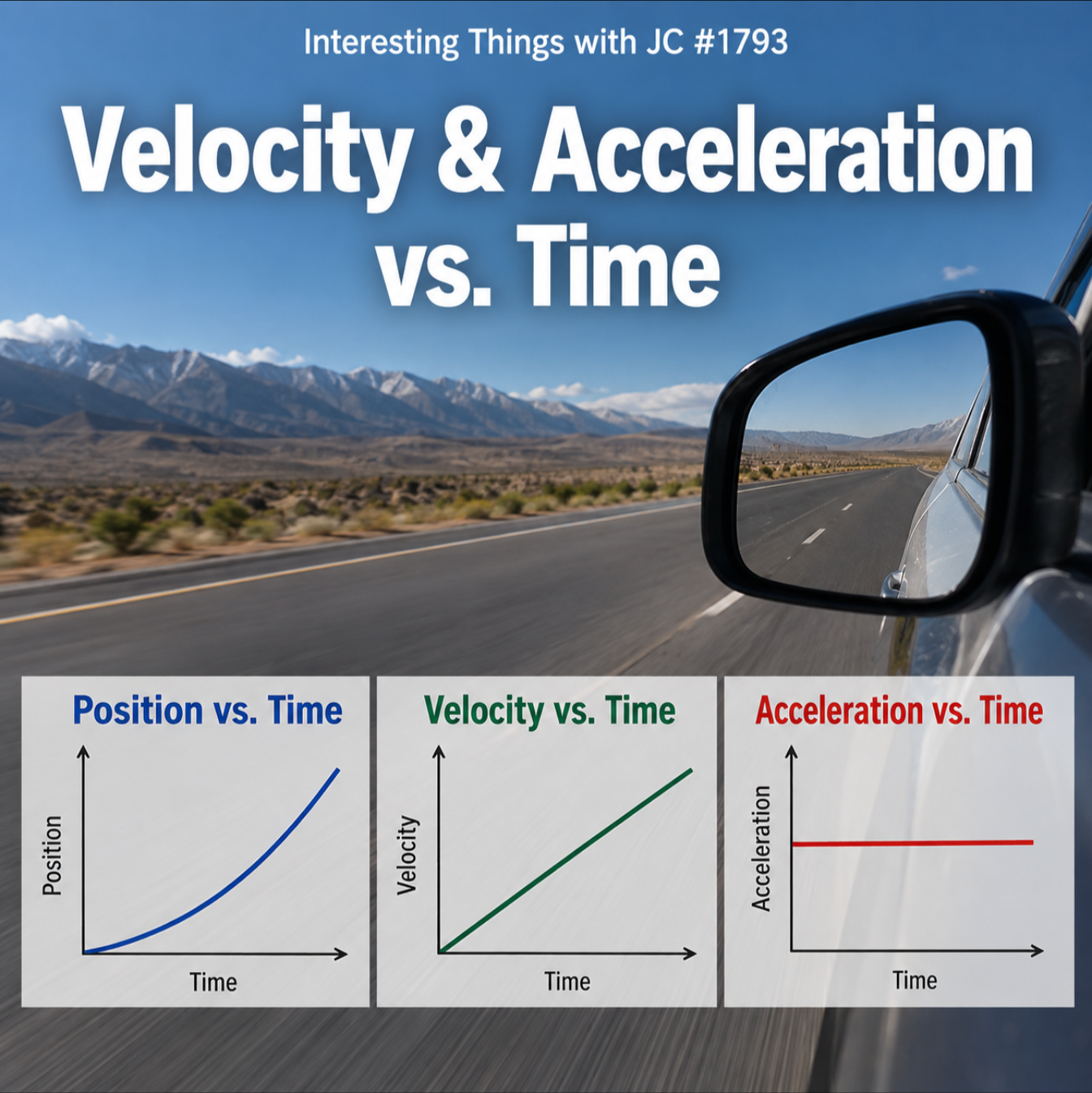
Interesting Things with JC #1793: "Velocity & Acceleration vs. Time" — A car can be moving fast with zero acceleration, while negative acceleration can actually make something speed up. Velocity and acceleration graphs reveal what an object is doing through their slopes, areas, and direction.
Get every episode summarized
Each time Interesting Things with JC publishes, we email you a written briefing from the transcript — the topics, who appeared, and any specific claims, with the ad reads skipped.
Email me new episodesFree for 3 shows. No card needed.
Hosts & guests
Transcript ready
33 searchable segments. Every word is indexed and playable.
Full transcript
Interesting Things with JC — 1793: "Velocity & Acceleration vs. Time". Machine-transcribed; use the interactive transcript above to jump the player to any line.
Imagine a car traveling down a straight road at 60 miles an hour. The speedometer barely moves. You're covering distance, but in one important sense, nothing's changing. That's key to understanding velocity and acceleration. Velocity describes how quickly position changes with time, including direction. Travel east at a constant 60 miles an hour, or 97 kilometers per hour, and your velocity it stays constant. On a velocity versus time graph, that appears as a horizontal line. The area underneath that line represents displacement. Travel at 60 miles an hour for a half hour, and you've moved 30 miles or 48 kilometers. Now, press the accelerator. If your velocity increases from 0 to 60 miles per hour in 10 seconds, the graph slopes upward,
and that slope represents acceleration. How quickly velocity changes with time? Acceleration is measured in meters per second squared. An acceleration of 2 meters per second squared means velocity increased by 2 meters per second. Every second. But acceleration doesn't necessarily mean speeding up, and negative acceleration doesn't necessarily mean slowing down. If velocity and acceleration point in opposite directions, the object slows down. If they point in the same direction, even if both are negative, it speeds up. An acceleration versus time graph takes this one step further. A line above 0 means positive acceleration. A line at 0 means velocity is not changing, and a line below 0 means negative acceleration.
And the area under an acceleration graph gives you the change in velocity. That connects the three graphs. The slope of the position versus time gives velocity. The slope of velocity versus time gives you acceleration. The areas work backward. Acceleration gives a change in velocity while velocity gives a change in position. Position tells you where you are. Velocity tells you how your position is changing. Position tells how that change itself is changing. These are interesting things with JC.
More episodes
More from Interesting Things with JC

1792: "The Compact Disc Era"
Interesting Things with JC

1791: "The Night Lake Erie Rose”
Interesting Things with JC

1790: "Physics: Position vs. Time"
Interesting Things with JC

1789: "The Lake Michigan Circle"
Interesting Things with JC