Get every episode summarized
Each time Catholic Answers Live publishes, we email you a written briefing from the transcript — the topics, who appeared, and any specific claims, with the ad reads skipped.
Email me new episodesFree for 3 shows. No card needed.
About this episode
Catholic Answers Live is made possible by:
“Buying or selling your home, real estate for life can connect you with a pro-life real estate agent. When real estate for life receives a referral fee, they donate 65% to Catholic answers. Very, very happy to be here with you on this Thursday.”From the transcript
This episode delves into the significance of the Eucharist in Catholic faith, addressing questions about its role in adoration and the nature of belief. Additional topics include the importance of faith in daily life and how to approach doubts regarding the sacraments, providing a comprehensive view of these essential aspects of Catholicism.
Join the Catholic Answers Live Club Newsletter
Invite our apologists to speak at your parish! Visit Catholicanswersspeakers.com
Get every episode summarized
Each time Catholic Answers Live publishes, we email you a written briefing from the transcript — the topics, who appeared, and any specific claims, with the ad reads skipped.
Email me new episodesFree for 3 shows. No card needed.
Hosts & guests

Transcript ready
550 searchable segments. Every word is indexed and playable.
Full transcript
Catholic Answers Live — #12917 Eucharistic Adoration w/Don Johnson - Don Johnson. Machine-transcribed; use the interactive transcript above to jump the player to any line.
Buying or selling your home, real estate for life can connect you with a pro-life real estate agent. When real estate for life receives a referral fee, they donate 65% to Catholic answers. Learn more at realestateforlife.org. Hello and welcome to Catholic Dance was live. I'm Psy Kill at your host. Very, very happy to be here with you on this Thursday. Afternoon. Hey, mark your calendars. October 4 through 8. Get over to your local theater for the National release of a beautiful new movie called Adore Him. He is here. And what do you think it's about? Yes, it's a movie and a real movie about eucharistic adoration. The he in that title, of course, is God who loves the doile with his people. And the heir is any Catholic church where there is eucharistic adoration.
And our guest is the maker of that film, the writer and director of that film, Don Johnson. He did not star in Miami Vice. He's the other Don Johnson, the Catholic evangelist, author, filmmaker, father. And the only person I know, maybe the only person there is. I don't know who has a master's degree from Biola University. And one from Franciscan University, which suggests a conversion at some point and you would be right. If you guessed he was a very serious Protestant who became a very serious Catholic, Don Johnson. Thank you for being here. Hey, Psy. Great to be here. And congratulations. I really like the film. Thank you, sir. Adore Him. He is here. A film on you. You've done a lot of great films. Let me give you some of them because people probably have seen some of these convinced was the first big one. Which was on coming into the Catholic church and the guy on the cover is you getting baptized. That's true. I even though I'm not really in the movie, but I put you know I'm on the cover. Yeah. That's right. Unprotected, which is I thought that was one of the most important movies. I just think it's on the sexual revolution, basically.
Disconnected. All of your movies ended in ED until now. I may not have picked the title for this one. I'm Cache. You're wondering. And now Adore Him. By the way, I didn't say this, but Don and I are all friends. We used to do radio together. As a matter of fact, I think both of us are somewhat nostalgic for when we get to. Oh man. It was. I loved that when we got to know that. Nothing against Catholic ancestors live, but it may have been the best Catholic radio show in the history. You always say that just to try to get me a couple, but it was definitely better than this. That's what I was saying. We had a great time. It was fun. All right. So this is I go to see Tom Nash and I went up to the to the premiere of this movie. Adore Him. And you did it in Orange County at the at a magnificent theater on the diocesan property there. And I saw you before the film and you said, because I think I was teasing you. I think I said, Don, you made a movie about Eucharistic adoration.
It's just people sitting quietly looking at Jesus. Like how did you make a movie? And you said to me, well, we had to make it a story. And I was like, how did he do that? And then at the end, I don't know if you remember. I said to you as I was walking out, you did it. You made it into a story. So congratulations. Well, thank you. Yeah. I mean, that is sort of key as a filmmaker, isn't it? Well, although maybe maybe people don't know that. I don't know. It's possible that people don't know that you wonder like, why aren't our Christian movies or our Catholic movies sometimes as interesting as they should be? Where's the story? Yeah, maybe we want less people as speech, you know, speaking at us, lecturing us or preaching or whatever and more storytelling. And yeah, that was sort of my philosophy going in. I, you know, the people were very gracious when I explained to them really on them like, well, if we're going to do this, we need to tell a story. So it was sort of trying to figure out, well, yeah, what is the story of Eucharistic adoration? Obviously people, well, you started the exact spot. I thought this makes perfect sense.
Actually, this is the opposite of what I was watching it go, what is Don doing? There's this mysterious people in the desert who see these other people crossing the desert and saying that their God is with them. And I'm like, what, why? Why do you start with the arc of the covenant crossing the desert? Yeah, this is, I'm very happy to put my philosophy and explain what happened. Yeah, because this, I wanted to, I had this vision early on, I'm like, well, we want to, why do, first of all, why do you go to Eucharistic adoration? I mean, there's many reasons, but to be in the presence of God, right? And what's the benefit of that? So I wanted to connect it historically, but also emotionally. So we start in the wilderness with this family who are moving across the wilderness in order to start a new life at a new place in a new business. And if you remember, Si, the couple's a little bit at odds because really,
why are we, what are we doing here? Is money really going to make us happy? Is this new business venture going to make us happy? And the idea there is to connect with people who are wandering across the wilderness of life, a couple of things, right? Wondering across the wilderness of life, we started the new business, we're moving again, like, at what, at some point, we're like, what are we doing out here? Right. And that's what I wanted to connect emotionally with is people who are striving, we're trying to get through life, but then, theologically, they run into the arc of the covenant and to put yourself in that person, like, I often ask my students, I work with high schoolers quite a bit, and I ask them, hey, if you were alive, you know, 2,500 years ago, and you wanted to get as close as you could to God, where would you go? Oh, what a great question. Yeah. Right, like, say, you were, maybe we're in North or South America at the time, right? Yeah. You wouldn't be called that at the time, but, you know, maybe you're living here, but you want to get as close as possible to God, where would you go? And after some thought, I mean, the obvious
answer is, well, God's everywhere, right? We can pray to Him everywhere. Aren't we all equally close to God? But actually, no, I mean, Scripture's pretty clear, we're not all equally close to God historically. Right. If you really wanted to be close to Him, depending what time period you were in, you would find the Israelites, if you were at the time when they're wandering across the desert with the arc of the covenant and the tabernacle, you go there. That's right. And you are actually, physically, closer to the presence of God than everybody else on the planet. Right. And this always fascinated me, this was actually a pretty big part of my conversion story, frankly, is connecting, I was a big old testament guy when I converted, right? And saying, I always loved that idea of God comes near to us. He wants to dwell with His people and how does He do that? And I love the fulfillment of the arc of the covenant, Mary, as the new arc of the covenant, you know, carrying Jesus in her womb and Jesus walking around as the new tabernacle, you know, in His body, you'd even call it like
Paul tells us, we live in a tabernacle. And so putting all of those connections like God comes near to us. God comes close to us physically. And did He just stop doing that? Right. Did He just stop doing that? Yes. So I wanted to start people along that path, intellectually, they can emotionally get into the story. We're all wanderers. We all need something more. And then to connect that historically with, well, what is the arc of the covenant? Why did God put himself in a box then? Yeah. Right. And sort of builds from there. So obviously the story continues in Canoes. But that's where I wanted to connect people. I think people sort of understand that a little bit better. I mean, I'll be on a side as a, even today, as a 11 year convert. A lot of the Catholic world still looks weird. I still very much, I feel for them. Wonder why that is, John. I feel for the outside perspective. And I mean, part of it is I just,
I work with a lot of non-Catholic world, not inside the bubble. And you look at, you know, like a eucharistic procession. And I mean, beautiful. But let's be honest, that's a bit weird. Yeah. To somebody who sees that. Who's never seen it. What is this? What's going on here? Right. What's happening? You're saying God is there. Yeah. But, but at the same time, I was perfectly happy as a Protestant saying, well, what if you ran into the arc of the covenant? Oh, that's God there. Yeah. Right. That's right. It was no problem for me. Yeah. And having seen the movie, that is connected. The person of Mary is connected in a way that I, that, that, if I had to say, okay, so Don said to me before I saw the movie, we needed to make it a story. And I'm like, how are you going to make the eucharistic adoration story? If I had to say, this is the story Don told. It's the story of God who wants to dwell with his people. And that, and that, and that, that
starts with Abraham certainly. But there's this, the arc of the covenant traveling across is a procession. It's a, it's, and it is analogous to a eucharistic procession that we would have today. Yeah. We, and then we then we explicitly make the connection. So I'll give you a little, for those of you going to see the movie, say, I don't know if you caught this, but I'll, I'll share it for you. I'm gonna say I did. Even if I didn't, I'm gonna say I did. The movie is built. It's, it's a bunch of amazing contemporary interviews, right, with priests and young people and layman and all over the world, got a lot of great people. But the spine of the movie, the narrative arc is for narrative pieces shot in the style of like the chosen or whatever. Like that, that's what it's. So there's four of those pieces. There's four stories. And we start with a story in the Sinai wilderness in the time of the Exodus and some non just random people, if you will, some Persian peoples, I'll run into the arc of the covenant, right? And so they have an encounter with the arc. And then the second story
takes place the night of the Nativity. Yeah. Where you have Mary and Joseph on the way to Bethlehem, and they run into, well, actually we start with the main characters are not Mary and Joseph, but they run into Mary and Joseph. Right. And then run into the shepherds. And if you remember, Sy, we have, it's a very similar scene where the characters look up at the arc of the covenant, and then the main character and the Nativity scene looks up at Mary and has this like something is something is special here. Right. Right. There's, there's an encounter. There's something mystical, something special. I'm changed from my encounter with Mary. And so then I love that scene where they meet the shepherds later at night. And it's the actors were amazing. It's very powerful scene. The third narrative scene then takes place with Jesus as an adult. And in that scene we have a woman who's obviously been through some hard times, enters into the marketplace at Bethany. The night, the day of, but that night, Mary of Bethany, annoys Jesus' feet. This would be the night
or the week of the Passion, right? And she, I won't give away the whole plot, but various things, but then she runs into Jesus himself. And if you remember, it's a same scene, right? She looks up. That's right. It's the same connection, arc of the covenant, Mary, and she sees we have Jesus coming out of an upper room and she looks up and everything has changed. It's an encounter with God's Himself. And you've come into the presence of God, things are different. And then the final scene, to put it all together, takes place in the Reformation era, Bavaria, you know, mid 1500s, where a group of, I mean, just because it's my family, I have a midnight heritage. I made the midnight. It's no offense. But a small group of midnight runs into the Compton Village and they run into a Eucharist of Percession. And one of the characters, same thing, right? He sees the Eucharist. That's right. He looks up, sees the Eucharist, and it's the same encounter. And so I'm trying to, so though for all of you who are going to go see the room, now you know what to look for,
it's those, it's four exact same stories. Right. Connecting like, that's God. Yes. Yeah. And that's what, if somebody said to me, why do you have, why do you Catholics have Eucharist to catarachian? I think before this movie, my answer might have been different, but I would be very tempted to say to the person because God has chosen to dwell with His people. Like he has chosen a place for you to have not a mediated encounter, a direct encounter with Him. And it's still going on. And so you, you interspers then with these scenes, conversations with people who have looked up at that monster and just like that. And they have seen G's and some of them really what they have, like it's amazing what some of these people told you about their own experiences at inauguration. Look, please look for it. You can go to phatham events and look for adore him. He is here, October 4th through
eight in a theater near you. It'll be in a thousand theaters across the country. Adore him. He is here. When we come back, would you get into a little bit of the theology with him? Because I want to, I know we have many, many Protestant skeptic, all kinds of listeners. Why do you Catholics put Jesus in a monstrance and sit there and look at Him? We'll talk about that when we come back. I'm going to fill maker Don Johnson our guest right back with more on Catholic Dancer's Live. We're here for you. Call now. Catholic answers live. Support for Catholic Dancer's Live comes from Catholic chemistry, a dating app for Catholics founded by a long time member of the Catholic Dancer's team, Catholicchemistry.com. Proclaiming the faith, changing lives. The year was 1981. The FCC licensed to operate a satellite earth station. The first ever given to an order of nuns was granted to our Lady of the Angels monastery. Mother Angelica flips the switch and EWTN begins transmitting from Irondale, Alabama. To learn more about Mother Angelica's
life in the history of EWTN, visit ewtn.com slash Mother Angelica. Welcome back, Catholic Dancer's Live. Some of you are thinking, doesn't Don Johnson have a book with Catholic Dancer's Press? Yes, he does. Twisted unto destruction. I have my copy here. I told Don before. I read it and then I put it back in the shrink wrap. I don't want anyone to pay. It's very special. It's such a great book that I shrunk wrap it back. Twisted unto destruction. How Bible-alone theology made the world a worse place? Some stuff in here. Well, it's very different from the usual Catholic and Protestant debate. It's about what were the consequences of saying a soul descriptor or a Bible alone. The social consequences of that and others. So, Twisted unto destruction is the book Don Johnson, our guest filmmaker, author,
evangelist, and all of that. Now has a new film that he has written and directed and made in association with a bunch of folks up in Orange County or in the Orange Diocese. Spirit-filled hearts. A bunch of great people up there. Yeah. The Orange Diocese, man, a lot of great stuff comes out of that diocese. Another thing has come out of that diocese. Now adore him. He is here a book, excuse me, a movie about Eucharistic adoration. October 4th through 8th. You can see it all over the country. Look for it. Fathom events. It'll tell you the time it's playing at your local theater. Do go and support the film early and often. And Don, I said I was going to ask you theological questions. You got the two masters degrees. So, I'm going to ask you a theological question. So, we get this call a lot. So, I'm going to ask you. Jesus said, eat his body and drink his blood. I get that. And even our Orthodox brothers and sisters to say to us, he didn't say put him in a gold and glass monstrance and have hundreds of people come into the church and
kneel down or sit down and just talk to him for an hour. So, why do we do this? Why do we do this adoration thing that Catholics do? It is a question I asked myself as a convert. And it's a question we put directly into the movie, by the way. I have one of our, one of the beautiful things just to explain again the film about having the narrative pieces in the film is that you can put the objections into the mouth of a fictional character. So, we didn't have to, we're not battling anybody. But I know people have these questions. So, we do have a character in the movie who asks that very question like, I get the maybe we, he said, take and eat. But we don't walk him through the streets. And so, we do answer that. For me, it's a couple of, it comes down to the incarnation. And I think the whole thing comes down to the incarnation and the logical consequences of the incarnation. And this is another reason I wrote the movie the way I did. Let me just flip the question a little bit. Was it okay the night
of the Nativity to go where baby Jesus was born and kneel down with the shepherds and the wise man who me, you know, probably weren't there yet, but whatever. And worship. They are in my manger. They're my manger. Don't mess up my manger. We didn't have enough money for the wise man in our particular scene. Poor men and nights. The answer is yes. Of course. Of course. We kneel down in the presence of the Lord. If that is God, regardless of whether it's a baby or a grown man, right? So, if you were there in Nazareth or Bethany in 30 AD, is it proper to kneel down and worship before the Lord? And yeah, I mean, I think we get that. Like if you met Jesus, would you not take Mary's example and worship? That's the question. Well, then logically, if
what the Catholic Church says is true, that he continues this pattern of being incarnate at a particular place at a particular time, even putting himself again in a tabernacle or in a monstrance is not the proper response to worship. And the church, right? I mean, the church has, so even just like logically, like if that's God, then we worship. I mean, we and we kneel at mass. Like, there's adoration in mass, by the way, right? Like, they hold up the don. Yeah. They hold up the host. They hold up the Eucharist. Everybody kneels. Rightly so. Yes. Right. Well, if we teach and we do, not we, I didn't make it up, but the church teaches that it remains the Eucharist. Right? Nothing changes about the host after. So if it is still the body, blood, soul, and divinity of Christ, if it is still God, whether it's in the tabernacle or in the monstrance, then what's the difference?
I mean, should we not worship? And so historically, that's what has happened. There has been up in Ducca. I studied the history a little bit too, just to, because I'll be honest, this, it wasn't like high on my radar before I went into this project. Right. The whole subject of adoration. And I do think that's, you know, for a lot of us, it's like, well, that's for super Catholics. It's a private, it's like a devotional thing like some people do it, some people don't. You know, you go to adoration, but realistically, we all live our lives as if God's with us all the time. But ready? Think about that a little bit like, well, we go to church though. Why do we go to church? It's the sacraments. Is it not? I mean, bottom line. Yes. It's the sacraments. That's other reasons, of course, but if the sacraments aren't there, the law less reason to go to church. Right. Well, if that's God, and if he's available in the Tabernacle, the Chapel, and the
monstrance, is there not benefits? Indeed, do we not need to go and spend some time in his presence? And so, theologically, that was my, I even have a character actually played by my son as it turns out. I didn't know that. I did not know if you knew this, but my son's acting main. Was he the guy that left the process on between the... Yeah, that guy was your son. Good job. He did a good job. He did, dude. Everybody did a great job. There's some some really fantastic performances. But he even says at some point, his line is, Isnet thought, is that not the mystery of the incarnation itself? Like, because there's this dispute about, well, should we really worship? Well, if we should worship Jesus, and if that's Jesus, then yes, we should definitely come in the presence of the Blessed Sacrament and worship. Indeed, it's probably what we're made for. Yeah. Yeah. And so then you did all, you did the written scenes. There's that narrative arc that
the whole thing has. And I was excited after the movie to get to say to you, you did it, don't I? I don't want to say I doubt it you, but I was like, there's a story to tell here. Like, what's the story? It's one of the reasons we come on these radio shows, you know, to tell people like, no, it's not as boring as it sounds. No, it's not boring at all. Yeah, yeah. No, the topic is, yeah. But then you go to the interview part where your modern day talking with people in their experiences, what did you, like some of them are astonishing. Some of them are are just filled with, you just go, you still with wonder when you hear people say you talk to so many amazing people. And not just like scholars, you know, some amazing people who sort of filled in some of that knowledge. But it's all in the form of narrative, even when they're teaching, by the way, it's all in the form of their personal experience. But some of the stories of encounters, which really encouraged me about the whole project, like, no, people do run into the presence of the Lord in the Blessed Sacrament and their lives are forever changed, like from that moment. So we've got everything from
like, you know, I was 13 years old and depressed and my mom had passed. And Jesus just transformed me. A lot of young people, there's a real strong emphasis in the film on what Jesus is doing among the young people, especially through the Eucharist. We talked to some great people at Damascus camps, life team, a lot of people at life team shared with us all over America. We went over to Europe, talked to people in Spain. And it's again and again, like, oh, I was walking by the church and something drew me in. I don't know what it was. I know. I know what it was, you know. I didn't even know what to call it. We talked to some folks who, you know, strong evangelicals, upbringing, like myself, you know, and they're like, I like to worship Jesus. I was meeting all of these Catholics and it seemed like they might be Christian, which I mean, showed up at a church. And the, I didn't even know what to call it. One of the interviewers said, but they were walking down.
And all I knew is that Jesus was in front of me. Yeah. And I just fell. Like, you again and again, we talked to Father Chris Alar. I love his story because he's driving down the street. I know. That's funny. That actually got a laugh at the theater. He's driving down the street and his power steering goes out and it turned into, and he like turned directly into the parking lot of the local Catholic church. And at the time when they, the only door opened, like, there's actually much more to his story. It's fantastic. But there was like four doors and the only one open was to the adoration chapel. And he knew from that point. Like now he's a person. I was impressed with with some of the priests who I think young priests and they're early in their priesthood, they didn't get it. That adoration was part of their, they were trying to do it all themselves and then learned, no, it's the Lord doing this work. Make the Lord available to people. We heard that story again and again. Father John Ricardo plays a beautiful major on the film. I love that guy. And yeah, he tells a great story about early on. He's doing his best to pray for
people and have, you know, devotional, prayerful type masses and prayer times. And then God just spoke to him. Like, just put me out. Yeah, just put me out. You're killing yourself. I'm here. I'm here. Like that's what I got on. I was like, just put me out there. I'll talk to the people. I know how to do this. It was a beautiful, beautiful hour. We'll continue the conversation. I do want to remind people that this is October 4 through 8. It'll be in the theater near you because it's in the thousand theaters around the country. Adore him. He is here. Checked Fathom events right back with more with the filmmaker Don Johnson on Catholic Dance's Live. Want to be a more powerful witness for Christ? One of the most powerful evangelization tools you can acquire is, in fact, courtesy. The apostolate of courtesy is just the message the church needs in this time of diminished social grace. Inspired by Saint Francis' decales, author Robert Grieving shows how everyday manners, whether in conversation or emails, can make us powerful
witnesses for Christ. Get the apostolate of courtesy today at shop.caflat.com. Why do Catholics pray to dead people, bow to statues, venerate relics, and where do we find any of this stuff in the Bible? In the delightful book, The Saints Pray For You, Dr. Carla Rousard, convincingly defends the ancient Christian belief rooted in Scripture that The Saints care for us, that there are allies. Order your copy of The Saints Pray For You today at shop.caflat.com or ask for it at a good Catholic bookstore near you. Your favorite Catholic answers books are now available, unottable, whether you're commuting, taking a nice walk or relaxing at home. You can deepen your faith with audiobooks that will make a real difference in your life. No matter where life takes you, listen to trusted Catholic answers authors explain the faith clearly, answer important questions, and help you grow in confidence as a Catholic. Visit audible.com today, search for Catholic answers, and let the learning begin.
Feeling stuck? Feeling like you are not sure what's next? Well, you can be sure of this. God is not finished with you yet. In his new book, Not Finished Yet, Dr. Marcus Peter shares a powerful message of hope, healing, and transformation in Jesus Christ. Read it to discover how to overcome struggles, embrace grace, and step into the life God is calling you to. Get Not Finished Yet today at shop.caflat.com or at a good Catholic bookstore near you. Welcome back. Catholic Dance was live. Don Johnson has made some wonderful films over the years. Unprotected, man, that thing hit me hard. I remember watching that one in the theater. I think with one of the early groups that saw it. That hit hard, but convinced was the first one. This was when you were doing all movies that end in EDWords. Convince, unprotected, disconnected,
but now Don has a film called Adore Him. He is here. You do get to the end of this arc feeling he is here. I think that you did that. That is what you accomplished in this movie is a sense of he is here. How do you deal with not creating an expectation, a cinematic expectation? Because not every eucharistic encounter with Jesus is a cinematic encounter. Do you see what I'm saying? How do you feel about that as a filmmaker? Adoration, a lot of times it's just sit there, don't do it. I know some people dealt with that in the movie. As a movie maker, you want to this is a special occasion. You're showing up, you're paying your money. It should be a good experience. We try to provide that for you. There's rules to it. We do address that.
Christopher Fanick does a fantastic job in the film. I think of trying to actually several. He explains it. I think he's your strong explainer in the movie. He keeps giving it into putting it into a context where you go, I get it. He talks about looking for his kid. Oh, that's a weird. I can't give that one away. No, I won't give it away. No, that's right. What does it say? Spoiler alert. No spoiler alert. No, he does a fantastic job. He's just so good. But at one point, he's like, yeah, sometimes he just show up and we did have a people, in fact, a young lady I remember. She's like, I just show up. I'm a mess. I know I'm full of sin. There's no magic experience. You're just there. And God's just there. That's what you get. And sometimes it's like, yeah, you're not going expecting that miraculous. No, that's not true. There's always a miracle, I think. In the sense that God's, we address that in the film too. The radiation of God's presence will have an effect whether you feel it or not at that time.
That's right. Yeah. So we talk in that they do it in several priests and some other great people in the film talk about just sitting in the presence. You get a suntan, regardless of what happens. It's transformational just being there, just being in the presence. So you don't necessarily go looking for that emotional high every time. Sometimes you're going to get that. And we try to, again, as a filmmaker, you're trying to just emphasize this. And I'm not just writing stories here. These are real people within the last few years that have absolutely had their life transformed by being in the presence of the Eucharist where they were at their end. And God came and said, I am here. I love you. We have whole ministries based on that premise. I've talked about Damascus. I talked about life team. They're based on the premise that we just give them the Lord. We put them in the presence of the Lord. Obviously we have a lot of fun and stuff too. But you put them in the presence of the Lord and good things happen. I talked to Father Ilo in San Francisco. We have
several places where we tried to go to places where you wouldn't necessarily expect that God's doing great things in the population. We went to San Francisco. We went to... You don't think if San Francisco is like a holy place. Well, what's fantastic about... What are you saying, Don? What's fantastic about Father Ilo in San Francisco? We didn't even get this whole story in the movie because we had... I literally talked like 90 people. He had the same thing. He's gone to several parishes and he's like, you get adoration. Put the Eucharist out. Open up the doors. Open up the doors. Put Jesus out. Good things happen. And that's the basis of what we're doing with the Chicago great story out of Vienna, Austria, which has like a less than 1% church going. Like the Christianity has just pummeled. That's the one where they made the like the church... Yeah, it's a church. It's a father George in Vienna. We had just a fantastic time with that guy. And his story is he wanted some place in Vienna where he could have the blessed sacrament exposed
to the street. Right? So if you walk by, you can see it. And this was very difficult. And so we really emphasized the story. And you go there now. His ministry is thriving. It's as you're right downtown Vienna. And it's like this old hotel that he's transformed into a new hotel slash church. And you look at who's coming. Who's coming to adoration. He's got 24-7 adoration now, by the way, which he didn't have at the time that we interviewed. And it's just fully young people. They're coming. Right. The young European youth are coming in in Spain. 300 parishes are now doing life-teen and it's transforming the youth of Spain. I mean, you don't necessarily hear that. But what we just saw, we were talking about before the show, the Pope in France, like people are pouring out. So God is on the move and it is at its root, I think, his presence is going to be driving this thing. It's interesting for us. And maybe it is for you too, because you're, but here, you know, we're like an intellectual apostolate, which is not a brag. It's just what we do
is talk and write and try to convince people or help people over obstacles. So that's an intellectual apostolate. And then there's charitable apostolates and then artistic apostolates, like yours. But the truth is, we all are, we're like weak-sauce compared to Christ in the Eucharist. We really are. And so what we're trying, and I do appreciate this very much about this movie, is get people to Jesus, let Jesus work. That doesn't mean that it's magical. And we don't want to, we don't want to act like it's magic. But, but, but if we, he really is there, he really does love every soul that comes to him. We need to help souls get in front of him. Yeah. And listen, the intellectual part, and why I don't know what we'd call that, the experiential part, or more of an emotional, but they're not mutually exclusive, right? Like you look what I tried to do in the film was, in fact, I read a review just yesterday. They're like, hey, enjoy the movie immensely.
If you're not Catholic, realize that not only is it a presentation of Catholic beliefs, but it is a defense. It is an explanation. Oh, somebody wrote that interview. Yeah, it a review. They're not just saying this is what we believe, but it's why we believe it. Which is what we do at Catholic Asters, right? This is why we believe this stuff. It is an intellectual, it depends. And I think that just gives the emotional part, the experiential part, so much more weight when you walk out of the theater, like I really feel something, but you know what? I think maybe I learned something too. Well, that's true. I did. Yeah, especially the way you connected the presence of God. It made me think the whole salvation history is all comes down to God wants to dwell with his people. That's what that's kind of how I came out of there feeling like this. I have this like this like organizing principle now to look at the whole arc of salvation. And adoration then is not some extra thing we do that it's about that God dwells with his people.
He's here available to us. Yeah, I tried to. I don't remember if I got this explicitly said, but hopefully it's implied. This was God's plan from the beginning. It's not like a devotional practice that's come lately. We've just made that up. We've just added it now. No, from the beginning, God has wanted to dwell with his people not in a far like a mystical sands, but walk with him in the garden. Yeah, right. Be with them in the tabernacle. Be with them in the temple as they're walking across the wilderness and have at the same tent of their body as they do. Jesus walks with us. Again, they didn't stop that. Chris does a nice job in the movie. Like we did not stop. We didn't become nostick after God did not become nostick. Right. After the incarnation when Jesus came, he still dwells with us in time and space in a particular spot at your church in the chapel in the Eucharist. So this has always been the plan. And if I do think that just adds so much to
the call, like please come to Adoration. Yeah, like, no, because that's the point of life. It does seem to me we're hearing like you talked about some of the evidence we see for a kind of resurgence. One of the places you really see it is weirdly at places like you know, I can't remember I think it's Texas Tech or Texas A&M or Ohio State or you know these big secular universities. And a lot of what's going on is it is all around the Eucharist. It's these priests and the and the other campus ministers who work with these priests in these places, they draw people to the Eucharist. They're not just trying to kind of abstractly evangelize. They're drawing people to the Eucharist and it does seem to me that there's something kind of modern about this. Like I don't know how much you did the history of of Adoration, but it feels to me like modern people need this more than medieval people needed it or like we have a special need
for this. Yeah, well, you look at the culture that we've become. Yeah, I guess. And it is very disconnected from the material. Right. We have become pretty nostic. I talk about this in the film about, well, both, but in the last film I did about transgenderism, we got into a little history and philosophy about how is it that you would ever possibly say, I don't belong in my body. I know. Well, there's a philosophy there about reality and the nature of reality and that my identity comes from something else other than this. What is the technical term for what we are? We're high-lamorphic beings, I think is what it is, right? Like we're a body and soul today. I say it all the time. Yeah, right. I'm feeling high-lamorphic today. Yeah, we are body and soul together. We're not just soul, we're not just body. And to find our identity on screens or just whatever we call ourselves, I'm going to reinvent myself today. Like people are getting real
tired of that because it's very empty. Yeah. And the Catholic Church comes in, I think most strongly among any institution on earth is that's not what you are. That's not what you are. That's not what you are. Yeah. Okay. Your identity is not this ethereal thing. It's not whatever you want it to be. Yeah. Okay. You are created and loved by God himself. And you were meant to spend time in his presence. That's the whole point of life. Like the meaning of life is love and love is all about two people being together in the same time and space. Like it can't happen. It can't happen without that. And guess what? We have that here. Like this is what we're, this is what, and we didn't make it up. Right? This has been 2000 years. It's a very appealing message to young people. I work with a lot of young people and it is tough out there side. It is hard, hard time to be a young person. And when they are told, no, it's not up to you to be dependent on how many likes you
have or to change your looks or put on the filter like that. No, just come and be loved by Jesus. Dan DiMate, the head of Damascus camps and some of the people at Damascus. I mean, a life too. And also they shared with us again and again. Like the kids come and they're, they just tell them like, listen, just, just sit, you know, just, just be here and listen. And what do the kids say? I heard God tell me I am loved. Like I love you. I was stunned by that. Yeah. Again and again. I love you. You were made for me. Well, yeah, that's appealing. That's a great point on. Yeah, of course, that's appealing. Yeah. We talk to some kids from A&M. Like, yeah, the young people, we have a tremendous opportunity for, and sometimes, I mean, again, we, I've got another project in the works kind of overlapping with this one where we talked to leaders, you know, what's working, what's not, all these people coming in. And it is, listen, high view of the Eucharist,
high view, like put at a rate, like an iteration, iteration implies a high view of the Eucharist, right? Like this is not right. That's right. Yeah. Right. This is not just a symbol. This is God himself. Of course, better not a Doris symbol. Yeah. Exactly. Right. That's idolatry. So we're not, we can't be kneeling before a symbol. Right. Has to be God. So it implies a high view of the Eucharist. Well, those, those are the groups that are growing. It's not like, oh, we're going to, you know, appeal to the culture and have more fun and games and listen, hey, I have your fun games and stuff at youth group or whatever, but bottom line, I mean, these kids are going to Damascus Camp and at the end of the camp or at the end of a focus conference, right, at the end of Seek, they have, they do surveys, like what was the best part of camp? What was the best part of this conference? And it's not the speakers. It's not the zip line or whatever. It's the Eucharist. Isn't that wonderful? And these are little kids. Little kids. Yeah. We talked to some young kids. Yeah. So, yeah, that's, that's where, you know, the future is, I think. Well, you know,
what you made me think of while you were saying that, Don, is that we can tell people that they're loved, but that's not the same as hearing from the Lord himself. I love you. Like, that's the life transforming. And so we do have to tell people, God loves you, God loves you, God loves you, but what makes the Christian hope come alive in us is when in whatever way it happens, because, you know, it's sometimes extremely subtle. Sometimes it's like literally, I heard the voice of God, but, but the Christian must know themselves to be the beloved of God. You can't just know it in theory or your Christianity is not going to last. It's not going to, it's, it's not full. It's a kind of empty. And that's, I think, what I, what struck me about the movie is how many people said, maybe it's the first time they went to Adoration, maybe it's the day they walked in, or maybe it's, I went to Adoration for 10 years, you know, and I was telling God, I'm tired of this. And then, you know, so I'm not going to promise that the first day you walk in, it's not about,
you know, your timing, it's about God's timing, but what it is about is, God wants everybody to hear, I love you. Not, not you are in some abstract way loved, but I, God, your God, I love you. And, and you think about what happens experientially when they, they enter the presence of Jesus in the Blessed Sacrament. And that's when it happens, right? Like, listen, we, I'm sure, I've hope we've all had experiences outside where we, where things we feel the love of God, but there's something special and just verifying about, no, it was when I went in front of Jesus. We, you know, we talked to the couple of the young girls who were giving testimony, they were in, they were in a really tough spot. Like, I, I hate God right now. I don't want this. I'm closing my eyes, the one girl, Sienna, love her story. She's like, I absolutely refused. I won't even look up. I won't even look up. I won't look up. I don't want to do this. And she just heard a voice,
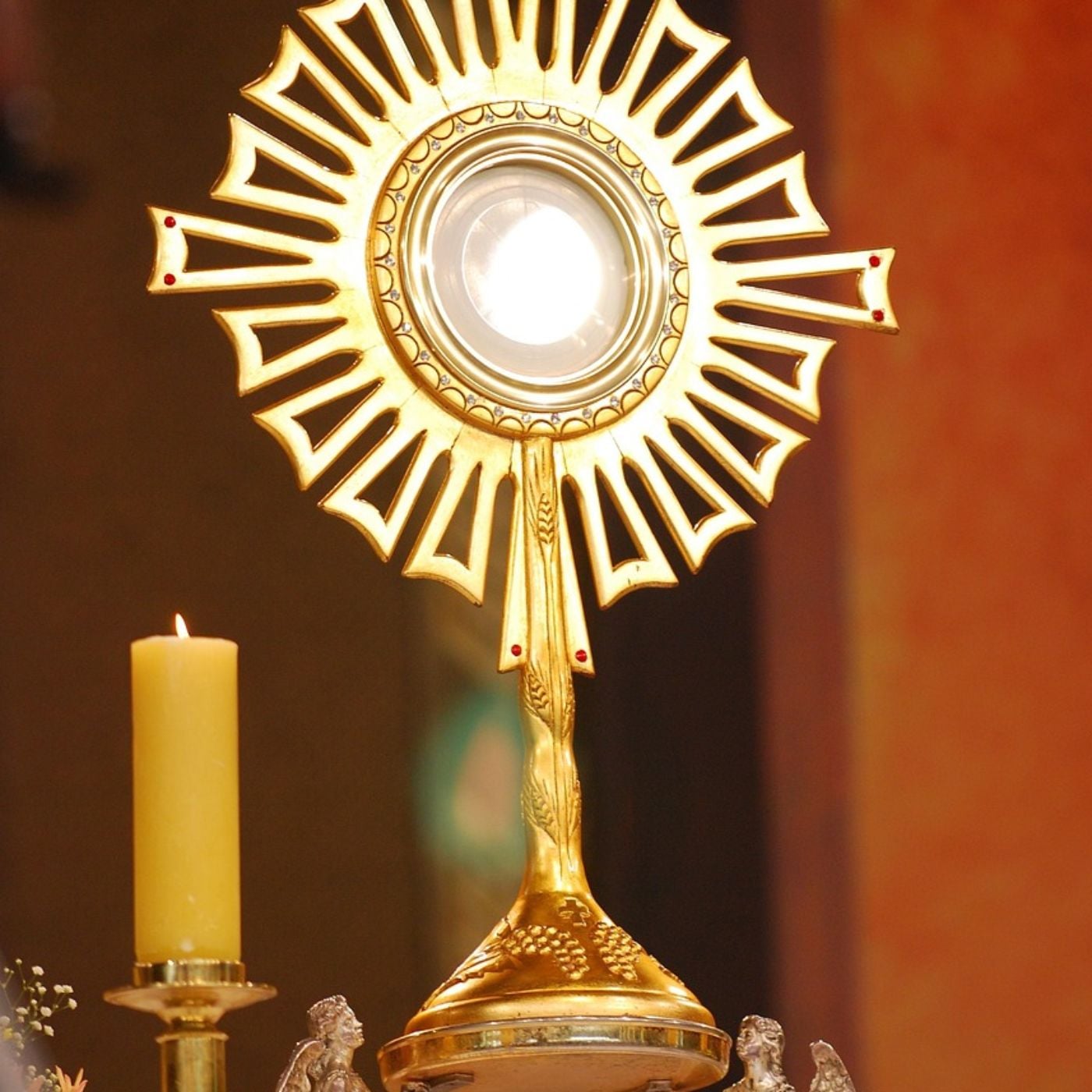
just so gentle and authoritative. She said that she just had to, it was so kind and yet so authoritative, she had to look up and she looked up and they were, the, they were holding, they do this at camp sometimes, uh, personal veneration, they call it. And there was the priest, like right in front of her and she's, we actually got a picture of holding the monster, holding the monster right there. And she was overwhelmed at every bit of depression and anxiety and suicidal ideation. She says, like, flew out of her, like, uh, like those old cartoons when they get hit by the train. That's what she described in the, in the bonus content. Yeah, she's like, it just flew out of me. And she even explains it, like very intellectually, which is nice. She's like, well, what am I supposed to conclude about that? Like that had to be God. Yep. Right. Right. Like, and that's the sacrament. So that had to be God. Yep. And it's, you know, it's amazing. And that's a wonderful thing in this film is to just the, the, the kind of mass of testimony makes you think, this is happening every day now. And though this is not a story about what happened to Saint Teresa of Avila or Saint Norbert or even
Mary the mother of Jesus or Moses, this is every day this is happening now. I want to, I really do want people to go see the movie. I hope you will go see it, enjoy it. I loved it. It's called Adore Him. He is here. October 4th through 8th. It'll be in a thousand theaters around the country. Adore Him. He is here. Look for it at Fathom events. We'll come right back. I got some more questions for the filmmaker, Don Johnson, right after this on Counting Handsome's Line. Hello, this is Archbishop Salvador Cordelloni of San Francisco. Keep your dial to Catholic Answers live. Alexian Brothers is a proud sponsor of Catholic Answers live. For 800 years, these Catholic brothers have offered a prophetic and daring response to the gospel. Serving Christ in the sick, the poor, and the dying is God calling you to be a courageous disciple. If you feel called to total self-giving as a religious brother in the mission of Jesus, call our vocations office at 847-264-8703. That's 847-264-8703. AlexianBrothers.org.
In Worskode, the sequence SOS is a distress call. It's been said that it stands for Save Our Souls. Well, right now our world is in big trouble. And we're putting out an SOS call for help. Will you answer that call? St. Paul Street Evangelization. A Catholic non-profit has hundreds of teams who share the good news with souls who don't know Jesus. Catholic Answers is supported in part by St. Paul Street Evangelization. Visit streetevangelization.com to get involved. The most original Catholic content is on EWTN radio. Now some people, they seem to be born angry. I mean, they're kicking and screaming from day one. And if you say something to them, they say, well, that's the way I would make applesauce. Nobody was made angry. Mother Angelica Live Classics. Every morning, two Eastern on EWTN Radio.
Welcome back. Catholic Gants is live. There's a new movie coming out. Just a day from now, October 4th through 8th. I hope you will get out to see it. If you're in Southern California, there's an extra reason to go see it. They have Eric conditioning in these theaters. It's going to be hard. It's going to be so hot. It's going to be a hundred near my house. And I live near the beach. That's crazy. It's going to be hot here. So go see a door him. An hour and 58 minutes of Eric conditioning. And Jesus, adore him. He is here. Fathom events is where you go. It's in a thousand theaters all around the country. So you can find one near you. And we're speaking with the man who wrote and directed the film. Did a beautiful job on it. I got to see it. You didn't know I was coming. I didn't know. It wasn't done. You didn't look like it was you had to look on your face like, Oh, I cannot lose this guy. You know, I read around the quarter. I saw you. Oh, great. You're here. I'm so happy you came to my movie. But what a beautiful
movie it is. And I was just telling you during the break. After I saw the movie, I kept thinking about Father John Ricardo, the story that he told about how hard he was working. And in a great way, he was being a good priest. Like I was hearing him and I was thinking, this guy's a really good priest. Like he's been a great priest from day one. His priority was to pray with the people and for the people. And so he's spending hours after mass praying with people, praying for people. And then at some point, they they decide, well, let's do some adoration. And he has really a mystical experience of the Lord, like John, just put me out there. I'll all this stuff that you're doing. All this work you're doing, I can get this work done better than you can. Yeah. And it's not, I resonate with Father John and with several of the people in the movie because I myself am pretty task oriented. I'm not a guy who likes to. I mean, I too live fairly close to the beach. And
I don't go down there and just sit very often. I'll be honest. It's hard for me to, like, I enjoy I need to pick up some trash while I'm down here. I can't just sit. I like to get work done. I do. It's relaxing for me to get stuff done off my. But what we see in the Gospels, and this is something else I tried to, a little stuff I tried to sneak in that when you think about the story later, you think, why was it in there? So for example, we have this marketplace in Bethany scene, where the young lady who just sort of is representative of people who are hurting comes in and has an encounter. We want you a lot to watch, maybe to see it, but she runs into Mary of Bethany, right? The worshipper. Yeah. And Mary's there, but Mary is there with a cousin of hers, a fictional cousin who's Benjamin, who's Debbie Downer this guy. Well, but he's kind of me, honestly, well, not necessarily me, but that's funny because that's how I think of you.
Debbie Downer got. Yeah. And she runs into, well, you know, what I want to tell, there's another guy there who watched the movie. There's a couple of the characters that show up. Anyway, the one guy, though, he's like, because she runs into Jesus, has this encounter asks Mary of Bethany, who is he? She's like the Messiah. And then the fictional character, our boy Benjamin is like, no, that's not the Messiah. And here's how I know it's not the Messiah, because he's not overthrowing the Romans. He's not like, we need to get to work. Okay. We need to change this culture. We need to do some stuff here that actually is productive. And that guy just wants worship. It looks like I get that he's doing miracles, doing magic tricks or whatever, but I need the Romans off. I need to be, she asks him to come. She's like, well, he's coming over to my house tonight. You're going to come. He's like, no, I got stuff to do. Okay. And I do think in the culture, whether it's politics or programs or whatever it is, like we really want to get stuff done. We need a program. We need a system. We
need some bullet points. And I'm there with you. Like, yes, I have my checklist. I have my strategy. We're going to do this. And it's going to accomplish this. And I love that stuff. But at some point, Jesus says, just be still and know that I am God. Right. Just just still. And that was the whole like Mary and Martha, right? That's the whole thing. Like Martha's busy. Nothing wrong with being busy. Nothing wrong with serving Jesus. No. Right. But the better part at some time, the better part is to sit and just just chill, just be still. Yeah. And know that I'm God. And so that was what I was trying to bring. Like in the same ways, I hope people resonate with the young lady at the beginning who is wondering why are we still chasing money out here? We're going to die in the desert out here chasing money. You know, like at the same time, they may be resonating with Benjamin. Like, I've been out here working my butt off trying to get something done to change this culture because we all know it needs changed. Like at some point, and this is where Father John, Father Ilo, Father, all of the rest of them, and they come in and say, you know what? If we focus on worship first, the rest falls
into place. Like stuff gets done. You know, whether Chicago, Vienna, Mexico, we're down in Mexico. If we were like, if we focus on worship, then the stuff will get done. In fact, Mark Hart gives us an example of what happens at life team. They have a holy hour. Like their staff has to take a holy hour. And he's like, you know, when they sign up voluntarily for an extra holy hour, he's like, extra stuff gets done. It's not like it's not like you're to do this goes away. God makes the time. And so it is an important point. Father John Ricardo, yeah, he really made that well. Like just put me out. And it's not like Father John's not working either. Like he's got an amazing ministry. Right. But it starts with worship. And it does give you a sense of that there is a kind of a trap in the modern world of busyness. And we're invited out of that trap by the Lord.
Don Johnson's been our guest. Go see his movie. Will you? It's a really fine movie. It's called adore him. He his e. He is here. And it's in a thousand theaters starting in just a few days here on October 4 through 8. It'll be out there. Get your tickets. Go see it. Support these good Catholic movies. And we'll get more good Catholic movies. That's how that works. At least I think that's how that works. That's how it works. That's how it works. And this is number four for you. Number four movie and number five in the works. I haven't been in any of them. But whatever, Don, you know what? Keep going. You're doing great, Don. They've been fine. That's so far. They're so good. That's why they're so good. Adore him. He is here. Check it out at Fathom Events. We'll be right back with more of Catholic Answers Live.
More episodes
More from Catholic Answers Live

#12920 What Is Clerical Celibacy? Conscientious Objectors and War - Jimmy Akin
Catholic Answers Live

#12919 Can We Pray to Saints? Sola Scriptura and the Incarnation - Jimmy Akin
Catholic Answers Live

#12918 Why God is Against Abortion. Suffering and State Votes - Emily Dinneny
Catholic Answers Live
#12916 Why Not Call on Jesus Directly for Miracles? Fulton Sheen and Church Dogm...
Catholic Answers Live