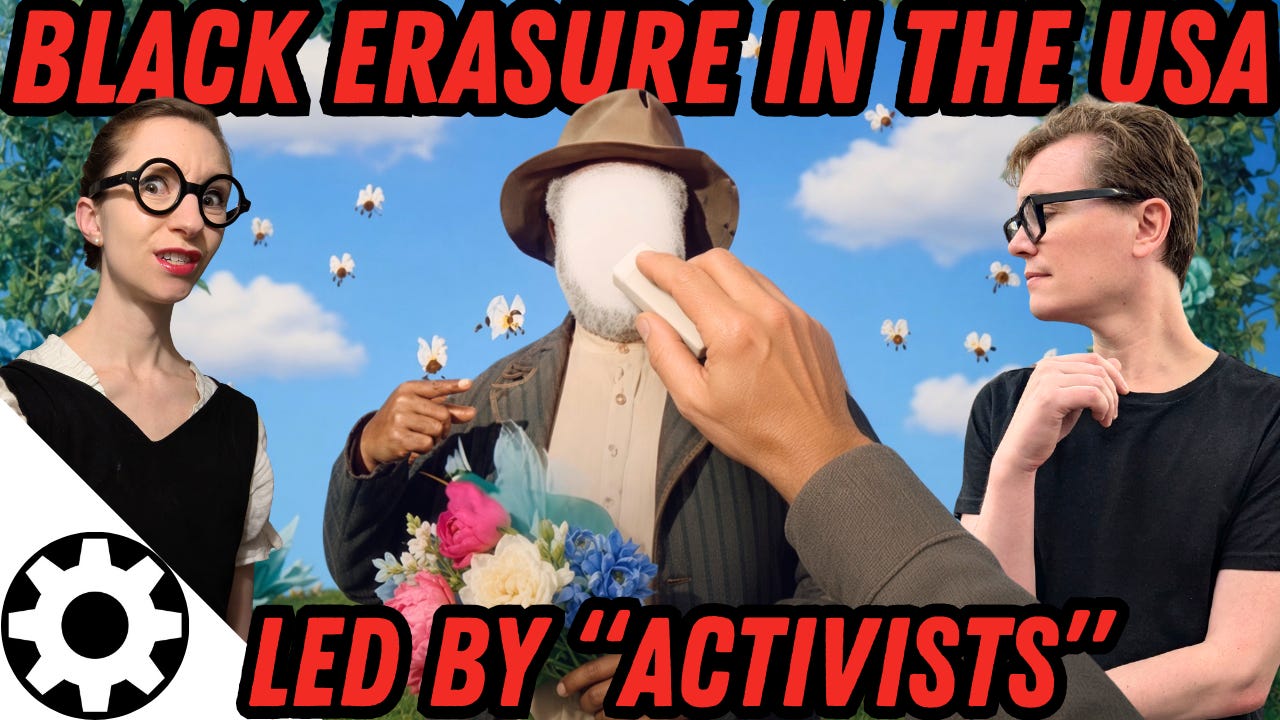
How Erasing Blackface Erased Black Culture: The Uncle Tom Effect
About this episode
Target pulled a kids’ Halloween costume after people said it looked like blackface. Malcolm and Simone use that controversy as a jumping-off point for a much larger argument: that systematically scrubbing minstrel shows, cakewalks, Uncle Tom’s Cabin, Song of the South, Splash Mountain, Aunt Jemima, and similar “tainted” material didn’t just remove racism — it severed Black Americans from large parts of their own cultural history and from the credit for innovations that built American popular music, comedy, and theater.
They walk through:
* What Uncle Tom actually does in Harriet Beecher Stowe’s novel vs. what “Uncle Tom” means now
* Cakewalk as plantation satire of white ballroom dance — and the line from that rhythm into ragtime, jazz, R&B, and rock
* Minstrel structure as the ancestor of standup, the sitcom, and a lot of classic American slapstick
* Brer Rabbit / Uncle Remus as West African trickster tradition (Anansi/hare) fused with Jack tales — and why replacing Splash Mountain with The Princess and the Frog trades one set of problems for another
* Banjo origins, tap’s African + Irish fusion, “tar baby,” family-barbecue “caricatures,” and how labeling ordinary Black life as a racist stereotype pushed later generations toward the opposite
* Why they think groups that treated every racially adjacent artifact as radioactive helped create a cultural vacuum later filled by gangster/rap identity
Provocative, heavily historical, and not YouTube-algorithm-friendly. Watch at your own risk.
RFab (editing, research, companions): https://rfab.ai/
Episode Transcript
Malcolm Collins [0:00]:Hello, Simone. Recently, Target has been in hot water because they decided to release blackface as a Halloween costume.
Simone Collins [0:08]:Wait. Wait. Wait. Wait.
Malcolm Collins [0:09]:They’d say this was by accident, but it is it’s hilarious. But I wanted to take this opportunity. So we’ll go into this incident. But what’s more interesting is I wanna take this opportunity to explore how erasing blackface and mistrial shows from America’s memory and cultural identity was the tool that was used to erase most of black culture. And when I say this, people will think, oh, he’s exaggerating.
Simone Collins [0:48]:No. They’ll think, oh, he’s speedrunning a YouTube ban, I guess.
Malcolm Collins [0:54]:What are you doing? So I we I guess we’ll call it the uncle Tom effect is what I’ll call this. So when you hear No.
Simone Collins [1:02]:Let’s call it the Aunt Jemima effect. Come on. She was our woman. She was our lady.
Malcolm Collins [1:06]:Uncle Tom’s a much better example. When you hear the term uncle Tom, what do you think? Somebody calls someone an uncle Tom. Okay. What they are saying is that they are not a good black person. They are somebody who kowtows to white people. They are somebody who is obsequious to white people and tries to fit in with white society. Okay?
Simone Collins [1:30]:Okay. I’m looking up uncle Tom’s cat.
Malcolm Collins [1:31]:So uncle Tom in the book is a character who dies protecting black people attempting to escape slavery.
Simone Collins [1:41]:Okay. Great way to go. Yeah. It’s it’s it’s an antislavery Yes. Oh, yeah. The antislavery novel it’s by Harriet Beecher Stowe.
Malcolm Collins [1:47]:She was a But it’s not like the character is poorly written or anything. The book became one of the most popular books in American history. The character is introduced. He saves a white girl from drowning. He is then, sold to a very mean slave driver.
Simone Collins [2:02]:Yeah. Away from his wife and children.
Malcolm Collins [2:04]:So Away from his wife and children. And then he ends up being beaten to death, saving two other black women who were attempting to escape. And his last words are wishing to protect the the for for mercy on the people person who’s beating him to death. And it’s very clearly like a Jesus analogy. Right? Now this is not a figure that should be shamed in black culture. This is not a figure whose name should be associated with shame.
Simone Collins [2:33]:No. I mean, it’s it’s a figure who was clearly mistreated by white slave owners. So
Malcolm Collins [2:38]:He’s one of the most important figures, literary figures in blacks being freed from slavery to begin with. I and so
Simone Collins [2:47]:why would he say why yeah. How?
Malcolm Collins [2:48]:His name becomes synonymous if you talk to a black teen today
Simone Collins [2:53]:Okay.
Malcolm Collins [2:54]:With turning on black people.
Simone Collins [2:56]:Right? Real? Oh, yeah. Know Victor Stowe was white. Okay. Sorry. Anyway, maybe that’s the problem.
Malcolm Collins [3:00]:This is what we are going to continue to see, this particular effect around all of these critical moments of black history, if you remove the minstrel shows, you remove cakewalking. If you remove cakewalking, then you remove the
Simone Collins [3:17]:link. Cakewalking? It’s a cakewalking. Is it is it an expression meaning that it’s easy?
Malcolm Collins [3:24]:No. Cakewalking was a style of dancing that African slaves did. Now today, it’s considered very offensive, and no one does it because the very name of it came from the concept of, we will have the slaves come and dance against each other for a piece of cake that the master would give them.
Simone Collins [3:41]:Oh, yeah. A a cakewalk is a nineteenth century African American partner dance that originated on Southern plantations, which also evolved into a modern idiom and a digital music software name. Okay. I okay. I just didn’t know.
Speaker 3 [3:53]:I’m gonna get fancy now. Keep on swinging.
Simone Collins [4:19]:I just heard cakewalk. Like, oh, it would be so easy.
Malcolm Collins [4:21]:To be a cakewalk. Well, yeah, the the that that also the modern idiom is easy as a cakewalk became, like, what the slave owners said because they they’d looked too derisively at these. They would, you know, it was, like, entertainment for them to have the blacks do the cakewalk. But, anyway, so you Oh, it’s a cute dance. If you remove cakewalking from the cultural history, you remove the descendant forms of music that came from cake walking
Simone Collins [4:46]:Oh.
Malcolm Collins [4:47]:Which include ragtime, jazz Oh, ragtime’s great. Rock and roll. No. Basically, form of American music evolved from the cakewalk dances that were constructed. And so blacks can say, wait. Why did we erase this? It’s like, well, because clearly a racist derogatory thing they were doing. And it’s the same thing that happened with uncle Tom’s Cabin. So with uncle Tom’s Cabin, they began to hold Tom shows. Right? And this was the stage play production of uncle Tom’s cabin.
Simone Collins [5:22]:Oh, okay. In the stage to Broadway. That’s great.
Malcolm Collins [5:25]:Productions of uncle Tom’s cabin, you ended up having the the the characters would begin to act more comedically or more in ways that represented normal black tropes. And so they would act obsequiously. They would act in a way that where the uncle Tom moniker might make sense. And so black culture began to use the evoked set, what they had seen more recently, the stage play, instead of the critical character that sparked a huge part of the abolition movement. Wow. And they then denigrated the entire line because of this one connection to actual racism. Take something like the Mistral Show. If you take people are familiar with the Mistral Show where black people were well, first, it began with whites doing in blackface sort of caricatures that were derogatory of black people on stage. And then these evolved into often not necessarily derogatory, but endearing caricatures and caricatures which were the ancestor of huge amounts of what we today think of as the three stooges, for example. Most comedy of this period was done in the style that was pioneered by the minstrel show.
Simone Collins [6:57]:And hold on. If I I’ll check this, but weren’t minstrel shows originally things that took place in England and Europe that, you know, there would be traveling minstrels, and they would make jokes around prevailing tropes at that time. So it’s kind
Malcolm Collins [7:12]:of equal for the point being is is when you’re like, oh, this is a racist against black thing.
Simone Collins [7:17]:No. No. No. This existed before slavery, like, black slavery in The United States. Right?
Malcolm Collins [7:21]:Yeah. The the the it’s like when you have the NAACCP fighting to take down Andy and Amos, which a third of Americans watched at its height, which had caricatures that at its time were not dissimilar to the caricatures white comedians were playing. For example, the three stooges. For example, I could I’ll go through a list later of numerous white comedians that did similar bits, but it was just normal at the time. And it removed a huge amount of black representation, but then also removed the link in American history where you don’t see that this form of the the minstrel shows that did have racism in them, but it also launched the careers of the first major black actors in America. It also launched the first black theatrical company in America. It also brought black people to Broadway for the first time in America. and it it style that it pioneered later became the American sitcom. It later became the American night show.
Simone Collins [8:32]:And I guess trying to erase that or disassociate them from any form of blackness removes both black credit and black influence, but also very positive connotations and and performances from black artists.
Malcolm Collins [8:46]:Right. And what’s what’s worse is that black history the this is this is the bigger part, is that groups like the NAACP and WHO have been like, we’re gonna erase everything that is tied to racism. And it’s like, bro, black American culture is tied to racism. And when I say it’s tied to racism, it’s tied to racism that flowed both ways. If you wanna get
Simone Collins [9:13]:an understanding what
Malcolm Collins [9:14]:I mean by this, do you know how blacks developed the musical style that went alongside cakewalks and the cakewalk itself?
Simone Collins [9:24]:They
Malcolm Collins [9:26]:saw white people dancing in, like, a ballroom style dances, and they thought it was funny. And so
Simone Collins [9:32]:So it’s them making fun of white people? Because that’s what it kinda looks like.
Malcolm Collins [9:35]:Yes. That’s exactly what it is. The cakewalk is the black version of a mistrial show
Simone Collins [9:41]:Of a known people. That’s It really great.
Malcolm Collins [9:44]:It’s each group iteratively doing a minstrel show of each other.
Simone Collins [9:49]:Yeah. Making fun of each other. Yeah. And let’s just to be clear, renaissance minstrels go back to the twelfth century.
Malcolm Collins [9:57]:Right. But the point being
Simone Collins [9:59]:I just wanna be clear on that.
Malcolm Collins [10:00]:Is to understand and to truly appreciate the way that America was able to develop this huge slew of artistic, thematic, and theatrical styles isn’t that necessarily black people or musical geniuses or something like that. Right? It’s or black culture is uniquely rich in, theatrical or musical tradition. It’s that having two cultures constantly and aggressively riffing off of each other allowed for expansion of musical and theatrical styles. And that is what gave us the diversity that allowed America to culturally conquer the world, and black people’s role in that has been erased by trying to dissociate. Because when you think about it, something like blackface more broadly that allowed for this explosion in black descended cultural groups. It was attached to racism, but it wasn’t attached to the type of aggressive racism that we now associate blackface with. Right? Like, it’s not the same. It doesn’t have the same history as the n word. It doesn’t have the same history as slavery. It was, I guess, closer to the cakewalk, you could say. Right? Like, one group being like, the way this other group is doing things looks ridiculous to me. Let’s re redo it and add a bunch of, like, cultural flares to it. And this is where you get the true horror of this and how it left when when you as a black person couldn’t be proud of all these genuine cultural achievements because those were tied to racism, they had to invent new history. And this is where you see the beginning of the modern black culture that came out of the rap industry in, like, the nineteen eighties and stuff like that because this is when they had finally won all the victories. This is when Andy and Amos is finally off the air. This is when all of their connections to their actual history had been cut down, and they’re like the NAACCP, I imagine, being like the once ler, having cut down the the the Lorax being there, stop. Stop shutting down every part of genuine black history that this country has. and then there’s nothing left. It’s a desert. And look at our video if you wanna see the results of this called the zombification of black culture where we go over how blacks went from having out of children a child out of marriages at a rate half that of rights. It was only at 5% when whites with it 10% to a rate that’s, like, seventy eight percent. Like, in in just a few decades as well. It really happened over a fairly short time period, the destruction of black culture once you erase this history. And, you you see it because, Simone, you may not understand how severe it is or how grotesque it is, but look. It’s happening with Splash Mountain. So Splash Mountain
Simone Collins [12:55]:Oh, it got turned into Tiana’s adventure or whatever, by your adventure.
Malcolm Collins [13:00]:Yeah. Yeah. Yeah. So do you I’m just wondering. Was your, like, brief understanding of history. Do you understand how absolutely grotesque that is?
Simone Collins [13:08]:That they got rid of Splash Mountain?
Malcolm Collins [13:10]:Right. Because Oh my gosh.
Simone Collins [13:12]:I follow all these, like, Disney vloggers and stuff. Yeah. It was seen as a travesty. This was a piece of Disney history.
Malcolm Collins [13:18]:No. No. That’s not why it’s important.
Simone Collins [13:20]:Okay. Why?
Malcolm Collins [13:22]:What is Splash Mountain based on?
Simone Collins [13:24]:Oh, like Appalachian culture and Briar Rabbit.
Malcolm Collins [13:28]:Splash Mountain is based on Briar Rabbit.
Simone Collins [13:31]:Yeah. A Jacktail. Briar Rabbit. I know. I I I just said I just said
Malcolm Collins [13:35]:Well, Briar Rabbit is not from Appalachian culture. Isn’t it? No. It was influenced and twisted a bit by the Jacktails archetypes, but Briar Rabbit was a, ethnologist who went around to enslaved black communities and collected all of their local mythology. Oh. And then he built that mythology into a series of children’s books. Those children’s books are the Briar Rabbit mythology. Briar Rabbit about a Carbaby.
Simone Collins [14:06]:Connections. Why they had to cancel it?
Malcolm Collins [14:09]:No. No. It’s not why they had to connect. Briar Rabbit had direct connections to African genuine African myth. Tales?
Simone Collins [14:18]:Oh my gosh. Wait. Wait. Wait. Wait. Wait. So they they erased a ride that was themed around genuine African folk tales with a ride that was, like, some weirdly I mean, I I like I like Tiana. She’s a good character.
Malcolm Collins [14:34]:But the princess and the toad is a European folktale. Oh my god. You’re right. Oh, that’s bad.
Simone Collins [14:40]:Oh, no. No.
Malcolm Collins [14:42]:It’s worse than you think. Because you know the type of music that they played on the ride before?
Simone Collins [14:49]:Good banjo music.
Malcolm Collins [14:52]:Banjo music. Do you
Simone Collins [14:53]:know what the banjo is? I don’t know. But you’re gonna say it’s black, but
Malcolm Collins [14:58]:I thought it was a African instrument that was brought over by the slaves and placed on plantations. No way.
Simone Collins [15:06]:Hold on. Origins of banjo. The oh my gosh. The modern banjo was created by enslaved Africans and their descendants in the Caribbean and colonial North America drawing on West Africans’ gourd bodied loot traditions. Of course, it’s shaped like a
Malcolm Collins [15:23]:oh my god. The entire ride was one of the most authentic Oh, no. Back to true African. True black history. Oh my god. Would have.
Simone Collins [15:38]:But, like, we’re I didn’t they got they got rid of it because I think people were accusing Disneyland of it it’s racist. They’re like, this ride’s racist. We can’t although there was nothing about it.
Malcolm Collins [15:48]:Said it was racist because of the character that would use as the framing device for the Briar Rabbit stories was an enslaved man telling these stories to a white child.
Simone Collins [16:01]:Oh, for ah, FFS.
Malcolm Collins [16:03]:And they said this is an offensive story.
Simone Collins [16:06]:No. No. No. No. Okay. I remember this. Splash Mountain was changed to remove its association with the controversial 1946 Disney film song of the South. Because don’t forget that at the very end, they played zippity doo dah. But I’m I guess the formerly enslaved man you’re talking about is the character in song of the south, which I remember saying No.
Malcolm Collins [16:25]:I’ll go read this is the character. This is the guy. The guy who has
Simone Collins [16:29]:who is He’s a bit of your doorman.
Malcolm Collins [16:31]:A positive relationship. And note here, I I wanna be very clear about this. Yeah. When you eradicate any view of real black history, real black history involved many, many instances of loving, genuinely paternal relationships between slaves and white children. Okay? There are many instances in which a sweet slave who genuinely had nothing but love for a particular child told them stories that were passed down from parent to child all the way back to Africa. And I think when you look at the popularity of something like Briar Rabbit even among white southern culture, these were stories I was read as a kid. They were stories Totally. I was deeply familiar with as a kid. Yeah. They represent the moment that was captured in that movie. But that
Simone Collins [17:31]:moment just that too. It’s like, I remember from my childhood watching old, like, Shirley Temple movies, and there there were definitely similar characters in some of those movies. Like, just a really nice, both, like, older black men and older black women. And that definitely, for, like, me as a kid, shaped the way that I probably came to subconsciously view black people as, like, oh, these are really nice people. Like, I don’t know the baggage or history, it just a positive.
Malcolm Collins [17:56]:The tropes that were available to black people. When you tell a black person, you can’t when you grow up feeling this way, you can’t have a positive relationship with a white child. That’s racist. Yeah. Then you invent rap culture. Then you invent the anti police culture. Then you invent the crime culture.
Simone Collins [18:16]:These things Yeah. What’s sad is oh, what’s that movie? The the the The Help. There’s the movie The Help that does depict a modern relationship between a black nanny slash housemaid in the nineteen sixties, nineteen fifties South and a white child who’s her charge. And she’s really sweet. They have a really sweet relationship, but the only way that they are able to make that work in the movie is that the mother is dismissive and abusive toward her child. You remember where she’s like, you are kind, you are important, etcetera. Like, keeps saying these sweet affirmations to the child because the child is constantly demeaned by her mother. So the only way they were able to make that relationship look positive is by making the mother an absolute monster, which is that’s really sad. That and, well, and, of course, the whole movie was about racial tensions. I I understand, Saba. But the point here being
Malcolm Collins [19:05]:Oh. The wider point I’m making is this Okay. The song of the South as a movie captured the truth of how black culture ended up influencing what today is American culture, what today is Pan American culture.
Simone Collins [19:21]:Yeah. With with some of Americans America’s culture sorry. American culture’s best features.
Malcolm Collins [19:26]:Right. And some of black culture’s best features. Sure. The character in that was not, like, witless or something like that. He was depicted as wise. He was depicted as caring. He was depicted as loving. But that didn’t fit the narrative the NAACP wanted young black people seeing because they didn’t like the additional context that it evolved from.
Speaker 8 [19:54]:Wonderful feeling feeling this way. You mean you leaving your old briar patch?
Speaker 9 [20:00]:That I is.
Speaker 8 [20:02]:Don’t you know you can’t run away from trouble?
Malcolm Collins [20:05]:But to get to his character, to get to the wise black man trope or whatever that you often have come in and, like, give advice to a character in a movie, you have to go through the minstrel shows. And when you tear all that out, what you get in its place is the the the a completely invented, which is what I love, princess and the frog. And princess and the frog is a European story being redone on what is frankly while it isn’t an offensive racist caricature of this house, it is actually more of a racist caricature of what life was like during that period than uncle Remus was.
Simone Collins [20:55]:But, also, they they have some pretty negative stereotypes around voodoo culture in that movie.
Malcolm Collins [21:01]:Well, voodoo and voodoo culture. Voodoo is when black people practiced it. But yeah. Oh, wait.
Simone Collins [21:05]:So what? Voodoo is only practiced by white
Malcolm Collins [21:07]:people? Well, no. No. Voodoo is the culture from the islands. Voodoo is the culture from it’s the distinction doesn’t really matter, and they treat them as the same thing in the movie. Okay. The point being is that even like, if you look at this doctor Facilier in the in the movie Oh,
Simone Collins [21:21]:is that the same? God. You have a good memory.
Malcolm Collins [21:23]:And you look at things like the, well, there’s a great
Simone Collins [21:26]:song about it. I love his song. It’s great. It’s a it’s a really good he’s a great character. It’s a but He’s not depicted flatteringly.
Malcolm Collins [21:32]:Right. You look at the, you know, pin cushion voodoo dolls and stuff like this that you see. That has nothing to do with voodoo or hoodoo. That’s actually a European tradition.
Simone Collins [21:42]:Oh, good heavens.
Malcolm Collins [21:44]:It only became associated with voodoo and hoodoo during the voodoo scare of the I think it was the nineteen eighties. So
Simone Collins [21:52]:Wait. You mean the same, like, this this this Satan, the
Malcolm Collins [21:56]:the satanic panic? That demonized voodoo and hoodoo. There was a a sister scare to the satanic panic, I think, or it might
Simone Collins [22:02]:have been
Malcolm Collins [22:02]:a bit before. Okay. Okay. It might have been a bit earlier than that when they would did a bunch of, like, exploitation films around it. But the scare that happened around these traditions is what doctor Facilier is based on, not after actual
Simone Collins [22:18]:Oh gosh. Okay. So, yeah, they they both demonize it, but also couch it from a caricature
Malcolm Collins [22:24]:created by people who
Simone Collins [22:25]:made it.
Malcolm Collins [22:25]:Actual racist caricature with bad under both bad understandings and and malicious framing.
Simone Collins [22:34]:Wow. This makes it so much worse. Oh, no.
Malcolm Collins [22:36]:Uncle Remus is not maliciously framed. Right?
Simone Collins [22:39]:No. No. He’s a scribble.
Malcolm Collins [22:40]:Think about the things you can’t talk about. Like, in in American culture, situations in the South began to become known as tar babies. Right? Like, because of the stories of Briar Rabbit. Right? And so these were white people who were using a phrase, like, when you got into a sticky situation, you’re like, oh, that’s a tar baby, right, that I knew from growing up because I remember the story of Briar Rabbit and the tar baby. Mhmm. Right? And then black people said, that’s a racist term. You can’t say it because it was in a minority context used as a racial slur. And now all of a sudden, you can’t use it in its other context as well. And that’s erasing black culture black culture’s effect on American culture. And when people go down this particular rabbit hole, and and and and genuinely think, like, what you see in princess and the frog. You see the caricature of the big fair and everything, like, one with Mardi Gras.
Simone Collins [23:49]:Oh. You know, you see the caricature
Malcolm Collins [23:50]:of and even in princess and the frog, you see a friendship between a wealthy white family and a black girl. And yet it’s not a racist caricature because, oh, well, it doesn’t follow these exact tropes. It doesn’t point out that not every slave white relationship was entirely a negative one and that the situation was actually And
Simone Collins [24:17]:then she they weren’t she wasn’t a slave. Yeah.
Malcolm Collins [24:19]:Well yeah. But the relationship she has with this white family is very paternalistic on the white family’s behalf.
Simone Collins [24:27]:Sure. And there’s an obvious power distance. Yeah.
Malcolm Collins [24:30]:There’s an obvious power distance. Her mom works as a maid for the girl, if I remember correctly. And if I remember correctly, it’s very clear that the white family is I I just I’m gonna go on a side here. The princess and the frog, while I do think it’s a it’s sort of grotesque that they could replace real black culture with it, I do think it’s a genuinely good Disney movie.
Simone Collins [24:54]:I know. I love almost there. It’s that’s a great song too. It teaches good work ethics.
Malcolm Collins [24:58]:Yeah. Almost there, I think it’s great. She’s probably one of my favorite Disney princesses. For sure. Her attitude. Yes. She’d make a great wife. She’s like the one Disney princess where I’m like, yeah. You can really marry this girl.
Simone Collins [25:07]:I’d I’d want my daughters to be into that kind of Disney princess.
Malcolm Collins [25:10]:But not just she would make a good wife. They also did a very, very good job with her white friend in her family.
Simone Collins [25:17]:Oh, yeah.
Malcolm Collins [25:17]:Yeah. Because, typically, you get her character, and she’s b****y or shellfish or unaware of her relative privilege or unaware of how her actions could make the other person feel bad. And it’s told very subtly. An example of this. do you remember at the end, where she needs a gown and the girl is like, well, you can just take one of my gowns. Right? And then she gives her a blue gown. and the the problem is is you’ve seen her closet. She wears nothing but prank frilly outfits. This is clearly a gown that she had bought specifically for her friend knowing she wouldn’t have a gown, done up in her friend’s style, and then pretended it was her own gown to not make her friend
Simone Collins [26:08]:Yeah. Because Tiana would never say yes to having a good look that.
Malcolm Collins [26:10]:It’s shown that Tiana would never say yes or the way that they give Tiana money where they order a bunch of stuff from her as an excuse. Oh, I’ll I’ll I’ll just order a bunch of stuff for you to give you money. It’s it’s shown very sweetly and throughout the entire show. The well, I mean, and this character thought she was gonna marry the prince. The moment she realizes that, oh, no. The real prince is someone who Tiana loves she’s happy for her. She wants Yeah.
Simone Collins [26:34]:Yeah.
Malcolm Collins [26:35]:Yeah. Her to do her thing. Probably good for her too because then she goes after the prince’s younger brother, and that’s a good way to get that. You know, become really good with his sister-in-law. You know? If you’re gonna if you’re gonna go for that, go for it. You know?
Simone Collins [26:51]:I’m gonna You know? Yeah. Get your bag.
Malcolm Collins [26:54]:Yeah. Yeah. Get your bag. But it it’s such a shame that that’s sort of the last of that type of Disney movie that was ever made, like, the last of the good Disney movies.
Simone Collins [27:04]:Yeah.
Malcolm Collins [27:04]:The the villains post doctor Fassalier have sucked.
Simone Collins [27:10]:No. Villains have just been the heroines. I mean, look. Except for Tomatea. Tomatea was pretty good. I don’t remember. Tomatea is
Malcolm Collins [27:18]:the giant crab from one zero one.
Simone Collins [27:20]:Oh, yeah. He’s, yeah, shiny. Very good. Very good. Yes.
Malcolm Collins [27:29]:But, no, this is this is where when you see something like the NAACP, when you burn down we like, I honestly don’t understand how anyone thought black culture was gonna survive this. Ripping out everything that racism had ever touched.
Simone Collins [27:46]:Yeah. Or, I mean, like, just a lot of you know, if, obviously, there’s baggage, but I don’t know. Like, a positive depiction is a positive depiction. Like, the Aunt Jemima restaurant that was super popular for a long period of time. Like, it was a popular family restaurant that people liked, and Jemima’s syrup bottles. Like, I remember having them as a kid, and I always wanted them because it was a nice lady in a dress. It wasn’t like, I’m gonna dehumanize these people. There there were restaurants
Malcolm Collins [28:19]:that were meant to dehumanize black people.
Simone Collins [28:22]:Like Right. And there are restaurants that are meant to dehumanize busty women, but, like, I don’t know. We don’t call those,
Malcolm Collins [28:29]:I guess, is the thing that gets me. Right? Is the one type of restaurant gets removed, the other type of restaurant remains. And in the process of ripping out that restaurant, you end up ripping out a bunch of stuff that actually preserved and glorified black culture.
Simone Collins [28:46]:Yeah. I mean, similar to, like, rainforest cafes to be like, this is, you know, an insult to the concept of rainforests. Well, yeah, it is. But it also, like, gets a lot of young kids into the idea of rainforests and conservation and frogs. And, like, it’s it is it is a piece of ambassadorship, which, though problematic, has its merits.
Malcolm Collins [29:07]:Well, I mean, we’ve seen this in the school system. Even when I was a kid, they’re already beginning to phase out Huckleberry Finn because it used the n word too much. Right?
Simone Collins [29:13]:Like they just, I don’t know, censor just that one word
Malcolm Collins [29:16]:and be like did in some, but I I don’t it’s it’s the character’s name. Wait. Inward Jim?
Simone Collins [29:24]:Oh, I forgot that.
Malcolm Collins [29:26]:When I talk about the restaurants meant to dehumanize people, I’m look I’m talking about stuff like Coon Chicken Inn.
Simone Collins [29:31]:Oh, right.
Malcolm Collins [29:32]:Stuff like aunt Jemima, it clearly wasn’t meant to dehumanize black people.
Simone Collins [29:37]:I didn’t know there was a place called Koon Chicken Inn. Good god.
Malcolm Collins [29:40]:Based on a caricature which people have labeled as racist, like the mammy caricature. That said, it’s important to differentiate caricatures that have racial tones and caricatures that are meant to here’s what I mean. Other groups when I grew up, my school had a picture. This was on all of our gyms. I remember it very clearly. It was a little Irishman with his fists up like this.
Simone Collins [30:10]:Oh, yeah. No. Isn’t that a just a sports team mascot? The fighting Irish. Right. Yeah. Yeah. That’s that’s for the specific sports team, though.
Malcolm Collins [30:18]:I wouldn’t have other sports teams have used it. It’s it’s actually a common sports team mascot, the fighting Irish. A a little fighting Irish like, Irish
Simone Collins [30:26]:We know all know exactly what you mean.
Malcolm Collins [30:28]:But the point I’m making here is that if you go in and you eradicate, you say, we don’t want that anymore, you erase part of what is genuine Irish culture. Right?
Simone Collins [30:41]:When Notre Dame? When you Yeah. Notre Dame.
Malcolm Collins [30:44]:Something that is a caricature. So let let me give you an example of what I mean by when you erase the caricature, you erase the culture.
Simone Collins [30:54]:Oh, no. What? No. They’re trying to erase the fighting Irish. The the old logo was him being like, and the new logo is just him marching forward with a football with a resting b***h face.
Malcolm Collins [31:05]:That’s so annoying. It is really annoying. Everybody knows the Irish are quick to fight. Yeah. Come on, man. These people.
Simone Collins [31:12]:Yeah. Even my favorite Irish comedian on YouTube has confirmed this.
Malcolm Collins [31:18]:What’s Russell Crowe Irish or something just going around the world fighting people? What?
Simone Collins [31:22]:I don’t I don’t know, but that sounds great, so let’s just believe it. So Yeah. Check that.
Speaker 4 [31:27]:He loves to act, but he loves one thing more, fight around the world. He fights his directors and he fights his fans. It’s a problem no one understands. If there’s two things he loves, it’s fighting and Fighting around the world.
Malcolm Collins [31:41]:No. No. The the here’s what I’ll explain. This will immediately make sense to you. You’re be like, oh my god. Yeah. Like, that is actually kind of gruesome. So you go to a black person, and you tell them growing up, you know what’s disgusting? This depiction of black people getting together and doing a barbecue and frying eating fried chicken and eating watermelon and playing music, and and and that’s a disgusting caricature. And then, you know, the the the granddad is there, and they’re like, that’s what we did every week. What what are you talking about? Like, what what of the things you just mentioned is negative?
Simone Collins [32:17]:Well, I know. And you just mentioned a bunch of things that, like, our families have done. And if someone came to us, I’d be like
Malcolm Collins [32:23]:I I have another episode I’ll do eventually on how much black culture took from Scots Irish culture and that they’re very closely cultured.
Simone Collins [32:30]:Versa because I thought banjos were like a Scots Irish thing.
Malcolm Collins [32:33]:Well, no. They they they culturally transmitted a lot. Oh, yeah. What the Scotts Irish were known for doing is they didn’t really care who invented a a culture or technology. It it Yeah. If it
Simone Collins [32:43]:was good, you I’m guessing gonna steal it. I’m gonna tell you. I don’t care
Malcolm Collins [32:46]:if any of American did it. I don’t care if black people did it, but that’s why they had so much more intercultural exchange with black culture than the other American cultural groups. Mhmm. and it’s also when the blacks saw another culture adopting their stuff, they adopted more of that culture stuff, and you had much more cultural interplay, which is how you get stuff like country music adopting so much of earlier black cultural ideas. Blues music, folk music, etcetera, which come out of this particular region. But the point here being is you take a collection of stuff that is not bad. There is nothing negative about eating watermelons. There is nothing negative about liking fried chicken. There’s nothing negative about having regular family get togethers where you talk and eat these things. There’s nothing negative about having the the the the comic jokes about the large black family that would all get together because the the before the the breaking apart of black families, they used to do this. This where the commentary of Well, also generation of black families get together, and they joke, and they have these conversations. And then people saw that, and they a comedian would do it, and they go, that’s a racist caricature. It’s like, no. It’s so screwed
Simone Collins [33:57]:up because you know who else likes watermelon a lot? Who? The Japanese. They [bleep] love watermelon. Suica. They they love it so like, I’ve been when I traveled to Japan, like, you just be let’s let’s all sit down and just eat watermelon together. It was like an event food. It was so popular that at the time and I think this is still the case. Like, the metro card of Tokyo, like, broader area was called Suica. Like, this is a culture that freaking loves watermelon. But if you were like, oh, those Japanese people, they love watermelon. Like, no one’s going to have an aneurysm. So it’s so much so messed up. Like, why why if black people like something and then people talk about it? Like, are we is this a problem? Why why, one, are they not allowed to like it? And two, why is them liking stuff a problem?
Malcolm Collins [34:44]:But the bigger problem is how this affects black youth and the way that they perceive their own identity. When you grow up as the BLM movement did and said that black culture is a culture that is antagonistic to the nuclear family. Mhmm. Right? That that has nothing to do with black culture, that we’re about polyamory. We’re about whatever. And then you look at how could you think that as a black person? That is the least black thing in the world if you’re talking about American black black culture. American black culture, if you put together do you if you remember these old black comedies from, like, the nineties or whatever, and you’d see what the joke version of a black family looks like, it was typically three or sometimes four generations of a family with extended relative networks all sitting down at a long table, joking, making fun of each other, etcetera.
Speaker 5 [35:41]:Oh, this is so fabulous. Ain’t nothing like getting together with family and having a good meal.
Speaker 7 [35:45]:You know, in my day, Sherman, people used to spend time with their family on Sundays and special occasion come around and pay their respects. You messing around and miss all over Ernest Golden years, magic Golden years, you’re gonna be mad at yourself.
Speaker 6 [35:58]:I cooked all this food. Is that all you gonna eat? Hey. Hey. Hey. Hey. What’s wrong with you? Supposed to eat that thing, not scalp it. Well, daddy, all the calories in the chicken are found in the skin and in the fat, so I peel talking about is where all the fat and calories is. You know where that come from? Watching that damn TV.
Malcolm Collins [36:11]:And people said, oh, that’s a
Simone Collins [36:13]:racist caricature. And so then the next generation A cohesive family. Great.
Malcolm Collins [36:18]:Yeah. The the next generation grows up and being like, a large cohesive family is a racist caricature, so I’m gonna do the opposite.
Simone Collins [36:26]:Oh my gosh. The co op is not okay about
Malcolm Collins [36:30]:man who who mentors a child of the racist caricature. So let’s do gangs and drugs and hate the police because that’s the the furthest thing from the racist caricature. This is how black culture got cooked. And you and you see these other things like the black Sambo case where it was a story of humorously originally about an Indian character, but when it’s translated into United States, it became a black character it was about a clever child who would, like, outwist tigers and stuff. Okay. They were beloved children’s books, and then but they looked too much like a racist caricature, so they get rid of it. They get rid of the parts of our culture that that could be attached to anything. By the way, if you’re wondering about my claim, the cakewalk was a dance tied to early syncopatic march music. It syncopas to the two four rhythm that became the foundation of ragtime. Scott Jawful’s maple leaf rag from 1899 is the canonical cakewalk adjacent piece from ragtime in line runs straight into early New Orleans jazz, then swing, then rhythm and blues, and rock and roll. The syncopization that made the cakewalk distinctive is the same rhythmic innovation that became the backbone of nearly all American popular music.
Simone Collins [37:51]:I had no idea.
Malcolm Collins [37:52]:I no idea. Black people don’t grow up learning this. They grow up learning how racist the cakewalk was.
Simone Collins [38:00]:What’s really cool, you go to the Wikipedia page about cakewalks, there’s an animated GIF. I didn’t know that Wikipedia did that. That’s a nice improvement.
Malcolm Collins [38:05]:This is also where you get things like the tap dancing. Black performers develop tap from African rhythmic tradition That was fused with
Simone Collins [38:12]:Irish [bleep]. Bull.
Malcolm Collins [38:14]:And they were the ones who innovated the form. Bill Bojangles Robinson, then Nicholas Burnson, great black tappers of the Vaudeville era. You it’s erased. It’s erased. They this is this is all erased by the NAACP.
Simone Collins [38:34]:That is that is wild. That’s really
Malcolm Collins [38:39]:By the way, the briar rabbit story came directly from the West African trickster traditions. The hare and the spider and zazi were the classic trickster
Simone Collins [38:48]:Or or anansi. Anansi.
Malcolm Collins [38:50]:The enslaved black Africans adopted them, and briar rabbit became the central underdog archetype. The small, weak creature that outwits through wit and deception, which adapted heavily from when I say it adapted heavily from Jack Tails, because you can see this cultural transmission had already happened. In Africa, this character is magical, and uses magic to perform its tricks. Whereas if you look at the Jacktail traditions, it’s also about a small underdog character, but he never uses magic. and that’s a very distinctive thing about the Jacktail tradition. It’s
Simone Collins [39:26]:always trickery.
Malcolm Collins [39:27]:You also see in the briar rabbit tradition. Never uses magic. because they did already fused enough with the Protestant tradition where we saw that as, you don’t wanna be teaching kids that magic is a good thing or a cool thing or anything like that. It’s better to use pure wit.
Simone Collins [39:45]:Wow. There’s this really interesting pattern with all of our episodes about something related to black people, which is, oh my gosh. Why have they been so screwed over, but not in any of the ways that anyone says? Yeah. So And the very people who pretend to defend them, which is They
Malcolm Collins [40:02]:well, that’s because they let the fox in the henhouse. The NACP is the biggest threat and has been the biggest deteriorator of black culture. now fun, by the way. So remember I said that it was common in this era when everyone’s like, menstruals, menstruals, menstruals are so bad. They make themselves look like idiots. the stooges predicted themselves as lazy, stupid buffoons. So were the Marx brothers. So were Laurel and Hardy. So were Abbott and Costello. Almost all of the most famous comedic performers of this era did this routine.
Simone Collins [40:35]:Oh, yeah. No. Even in, the the the Christmas classic, White Christmas, they do a a menstrual bit. A minstrel. Sorry. A minstrel bit.
Malcolm Collins [40:44]:Yeah. And and they’re like, well, when it’s black people doing them, it’s about all of black culture. That’s what they’re making fun of. And it’s like, no. You chose to make it that. It might have been about that at the very beginning of the tradition, but the tradition had evolved into a position where it didn’t need to mean that anymore. It even became
Simone Collins [41:05]:yeah. I mean, I I
Malcolm Collins [41:06]:think became it uncle Remus. It didn’t need to be malicious. You guys decided to make it universally malicious.
Simone Collins [41:14]:It started in the twelfth century as a form of entertainment. It remained a form of entertainment. I I feel like nothing changed. It’s just that, like, one one group was like, oh, this one this one subset of people who engaged in this form of entertainment were were horrible and, like, doing committing atrocities. I don’t know.
Malcolm Collins [41:35]:So so for for more context here, the minstrel show had a structure. The end men, mister Tombow or mister Bones, at either end of the stage trading jokes with the interlocutor in the middle. The end men were the comics, and the interlocutor played the straight man. That’s the ancestor of the modern comedy set, the comic on stage, the rapid fire joke delivery, callbacks, and the comic persona. The structure of American stand up, the opening bit, the rhythm of the setup, the punchline, the character the comedian plays was developed in the minstrel format. The the shave and haircut rhythm, the two bits ending, and the call and response of American joke structures all come from this.
Simone Collins [42:15]:Well, this explains that white Christmas song because they kept saying things like, oh, mister Bones, you’re terrible. And that explains mister Bones. Oh my gosh. Wow. So, yeah, is a formalized format here.
Malcolm Collins [42:26]:Well, this is the funniest thing. This is where you hear the mister you just realized, oh, this is part of black American cultural history.
Simone Collins [42:33]:God forbid, I know that. Yeah.
Malcolm Collins [42:36]:But you can’t know this today. We can’t
Simone Collins [42:38]:talk about this today. Yes. Yes.
Malcolm Collins [42:40]:Yes. The sitcom is also of direct descent. The mistrial shows stable cast of comic archetypes and recurring characters at the end minutes of comic foils. That structure had become the sitcom with Amos and Andy being a direct descendant of mistrial shows.
Simone Collins [42:58]:Right. So crazy. That is so crazy.
Malcolm Collins [43:00]:Later evolved into things like I love Lucy and the honeymooners.
Simone Collins [43:04]:Yeah. Which is so slapstick and funny and delightful.
Malcolm Collins [43:08]:Yeah. And nobody’s like, oh, you can’t have the the reason why Lucy like, let’s take something like Lucy or the honeymooners. Like, straight to the moon. you know? Or I love Lucy. Like, oh, I’m such an idiot. Right? Like, we watch these shows, and you could say, well, she’s not depicting every American housewife. And it’s like, I would beg to disagree. Lucy absolutely represented an arch type of all American women.
Simone Collins [43:37]:Yeah. Lucy Lucy is the black face of of American housewives. And it wasn’t necessarily a positive stereotype. No. Not at all. No. Mean, also delightful and funny. So I don’t know. You know, it’s again, is it problematic? Yes. Is it funny and and delightful in a an institution culturally? Yes. Like, come on.
Malcolm Collins [43:56]:The the mini characters, you could look at the Simpsons. Is the Simpsons supposed to depict all white American culture and families? Well, I mean, yeah, kinda. That was kinda the point. And you have a dad who strangles his child every time he gets mad and is an idiot. And who is it
Simone Collins [44:14]:Honey, you have an Indian, like, seven eleven. I mean Yeah.
Malcolm Collins [44:17]:Who isn’t properly trained? No. But the the the reason
Simone Collins [44:19]:You have a Scottish grounds people Yes. Mean, it’s not the way. Reason I’m focused, Simone.
Malcolm Collins [44:24]:The reason I’m focused on the family Yes. Is I’m not talking about every racial stereotype in the show.
Simone Collins [44:28]:Okay.
Malcolm Collins [44:29]:The point I’m making is you can have a negative stereotype still be a positive cultural force. The family of Homer, how how how did much did that impact American culture? If we went back and we erased because it would check every box the minstrel does, is Homer a a negative stereotype of a bumbling worse than minstrels because he’s also aggressive and abusive idiot character, right, who’s bad at his job as a risk to all of society. Truly. About to blow up a nuclear plant constantly. Yeah. Is he a depiction of the average white family and what that very clearly meant to be understood of your average middle class white family in America or lower middle class? Absolutely. Was he a stereotype being drawn by, let’s be honest, mostly upper class people in Hollywood who genuinely looked down on middle class Americans? Yes. He was a stereotype being drawn from people in another cultural group who looked down upon people of that stereotype and meant to this in a derogatory fashion. Yet if we went through and we scrubbed American culture of the Simpsons, how much of Americana would we lose? Now imagine we apply the same rules to everything. We apply the same rules to the three Stooges. We apply the see the same rules to all all the other comedians I went through. And we apply the same rules to you just lose it. You lose American history. And yet this is what was done to black American history.
Simone Collins [46:15]:That’s really messed up. It’s super messed up.
Malcolm Collins [46:18]:and this is why it is incredibly racist in terms of the downstream effects to stigmatize blackface. Yeah.
Simone Collins [46:30]:There’s so many things in here, but I I think the saddest thing is you just pointed out a whole bunch of things that came from black culture that I didn’t even know came from black culture largely as a product of all of this erasure and and refusal to include certain bits of media in our, you know, accepted set, which is messed up. Like, shouldn’t black culture get credit for that? You know?
Malcolm Collins [46:54]:No. But I think the how much content have you watched about the taking down of the the the Disney attraction thing?
Simone Collins [47:05]:Oh, so much. Like, hours worth.
Malcolm Collins [47:06]:Okay. Okay. Had you once heard that the primary music type was invented in Africa or that the ride was
Simone Collins [47:13]:based on traditional like in fact, it’s almost not mentioned at all. It’s like song of the South. It just like, all they had to do was say, well, it was associated with song of the South, which we all know is horribly racist and, like, this, like, scourge on Disney’s history that we must never mention. It was like the Voldemort of Disney’s history. We must not mention it at all. And and so it really wasn’t mentioned at all. Like, in fact, I didn’t know any of this stuff about, you know, the the actual history. I mean, I remember watching some of the South as a kid and, like, enjoying it, but that was it. That’s Yeah. Wild. So crazy.
Malcolm Collins [47:51]:I I appreciate that I was able to educate you. Hopefully, I was able to educate our audience. And, we can realize that just because a portion of something’s history was racist in nature or especially because if if you say we are going to rip out everything that was racist or derogatory derogatory against black, you rip out black culture, and then you rip out the point. You rip out the way that American culturally works, which is two groups making fun of each other. You don’t get the cakewalk without this the black version of the Mistral Show. And you don’t get all American music without the cakewalk. It invented the and and by the way, I think ragtime is the first form of music that I think is good. I do not like classical music. I don’t like anything like that. So every form of music that I personally like is downstream of the innovation that came from the cakewalk.
Simone Collins [48:46]:I can vouch for this. Malcolm is not just making this up.
Malcolm Collins [48:48]:He really likes ragtime music.
Simone Collins [48:51]:Like, it doesn’t make I I can’t say I guess I I thought you you took some, like, course on music history through the great courses and were like, and ragtime is the best. I that’s all I kinda remember. Well, that’s why I learned
Malcolm Collins [49:03]:about this. I learned about the development of the American theatrical tradition and the influence that black Americans had on that, but that influence was through the minstrel shows. Mhmm. During a time of racism, that’s how they were able to have influence. And and when the minstrel shows get erased, when the minstrel shows get to said they were nothing but bad, they were nothing but racist, we miss this cultural conversation that led to current American culture. And it’s it’s wild to me as well that the form of if you ask blacks today, what is black American culture? They’d likely say like, the first thing it it walked on their mind is gonna be rap music. It’s gonna be gangster culture. It’s gonna be gangster dress. It’s not gonna be jazz. It’s not gonna be rag time
Simone Collins [50:00]:Hip hop. I don’t know.
Malcolm Collins [50:02]:Yeah. It’s even hip hop. Hip hop is associated with crime. Hip hop is associated with degeneracy. Mhmm. It’s not going to be the parts of black culture that genuinely uplifted or had a cultural path to uplift the American black community. Right? Because those are the parts that were developed, oh, no, during this this pre time before they had to start from scratch, before they had to say, oh, we won’t look to these old forms of music and how we develop going forward, which is really sad.
Simone Collins [50:38]:It’s really sad.
Malcolm Collins [50:39]:but I’m glad I was able to blow your mind about this because the moment I told you I’m gonna do an episode on the history of blackface and why condemning it so aggressively rather than saying, yes. It was used in a racial context in the past and in a racist context in the past, but it’s not the same as the n word or slavery or something like that. And that once it’s removed, it’s sort of like the Jenga piece that knocks over the rest of the the the Jenga tower that is black history. It’s the one block you can’t remove.
Simone Collins [51:14]:Well, I will see if YouTube’s algorithm can fathom that level of nuance, which I don’t think is that hard to fathom. But, look, they couldn’t figure out when we are trying to say that hipster is a bad sorry, that Hitler is a bad person.
Malcolm Collins [51:29]:Yeah. They’re like, what? Hitler is a bad person because his ideas were as often as progressive as they were conservative and that he fits into modern progressive archetypes much more than conservative ones. How dare you? So that that hit hit that hit us with a channel strike.
Simone Collins [51:44]:So I don’t know if you’re gonna be able to make it through this one, but that for that reason, thank you to everyone who subscribes to us on Substack and Patreon.
Malcolm Collins [51:51]:Thank you guys so much. It means so much to us. And then
Simone Collins [51:55]:we can a a backup because Malcolm’s he’s he’d be speedrunning it. And I I just outlined another episode about Indian culture that might also not help us. So great.
Malcolm Collins [52:07]:Restrude. I think that this is where the real cultural conversation happens. This is where racism actually ends. It’s having the real conversation.
Simone Collins [52:15]:Yes. Shutting it down is how you make it a problem instead of just having discourse.
Malcolm Collins [52:20]:The light of truth burns away evil. Right? You know? That that that is the the end state of this, and this is why progressives the algorithm can’t let us talk about that for like this because it it would have the races be like, oh, okay. Yeah. That makes sense. You’re clearly not coming at this from a Pearl clutching perspective. So I’ll I’ll take you seriously. But and and I will mitigate my views based on this. And we have a lot of you who have been like, yeah. I’m significantly less racist because of your show. But we’d also really encourage you if you if you like our stuff, rfab.ai. This episode was entirely filmed and edited on rfab. We have moved to those features being mostly stable at this point, and that’s really exciting for us, because that means we’re able to move away from some other editing software. And I’m able to try some fun editing tricks that only our fab can do, like the bleeps that you have had around stuff that might make YouTube mad in this. Like the I’ll show off a little feature I’ve been working on right now.
Speaker 11 [53:28]:This is my first time testing this feature, so let’s see if it works.
Malcolm Collins [53:31]:The we got the looping video feature that I built. I thought that was pretty fun for, like, monetizing things.
Simone Collins [53:37]:Sleek. Yeah.
Malcolm Collins [53:40]:And yeah. Even if you’re like, I don’t like playing the AI adventure story that you have on our FAB, fine. There’s there’s probably something on it that is something you’d like to do. Right?
Simone Collins [53:50]:No. Actually, I don’t use them at all except that Yes. We have a lot. I use the image generation. I use the fact checking. I use the based AI. I used I I use oh my gosh. Oh, yeah. You were saying
Malcolm Collins [54:03]:this video also had to be entirely researched with the based AI feature on our FAB because Yeah. Grock wouldn’t give me serious answers to these questions. Yeah. it just kept hedging everything, and I just couldn’t get any information out of it.
Simone Collins [54:14]:Yeah. Even though Grok is the de facto, like, based LLM that people turn to, no. You need to use Rhodes, and you can get it super easy at our FAB. Yeah. That that it’s actually based. Because I also found that I couldn’t use Grok, to do my episode research. Oh, so you used Rhodes as well. Mhmm.
Malcolm Collins [54:31]:So we’re moving more towards an all our fab ecosystem.
Simone Collins [54:34]:I mean, the recipe generation system on Oh my gosh. Yeah.
Malcolm Collins [54:37]:If you’re just a housewife, check
Simone Collins [54:38]:it out. You can lock the site in a safe harbor. A housewife, yeah, you can also use our devices, which are not our devices. You just buy them separately. We don’t make any money from that. But, like, you can make companion devices that are tutors for your kids. For the girls, I made an animated tutor named Thetis, who is a mermaid woman. And then I made Cudish, a chick that our boys like the a chicken a baby chicken.
Malcolm Collins [55:00]:And these work in a few modes. They can work with regular companions, or they can work with, like, living avatars that are, like, fully animated characters based on the leaflet system. Yeah. I mean, I think that’s a little much to put together for It’s
Simone Collins [55:11]:a little much. You can do it.
Malcolm Collins [55:12]:You know? The other But I I
Simone Collins [55:14]:can I can pretend to be cutish, can’t I? Let’s see. We’re still working on this one, but, look, I can be cutish too.
Malcolm Collins [55:19]:Oh, yeah. That’s that’s one of
Simone Collins [55:21]:the features that I have.
Malcolm Collins [55:22]:What’s what’s another feature that I’ve been working
Simone Collins [55:24]:a lot on? This is Thetis as proof. She’s loading. She’s Better better storytelling.
Malcolm Collins [55:30]:Oh, yes. The one thing I’d say, probably the the single most useful feature that Artfab has that isn’t even that obvious if you’re milling around our fab right now. and this feature is sort of a core part of my daily life is the API. If you do vibe coding and you’re not using the our fab API, you are at a massive disadvantage.
Simone Collins [55:49]:Yeah. It creates, really cool animations. It’s very efficient.
Malcolm Collins [55:52]:Yeah. Yeah. If you if you explore the site or use the site, you’ll notice animations of a cat girl. You can easily create that and just put it animations, put images all throughout your website with the RFAB API, and make it so that your own AI can call you while it’s working. So if you’re using, like, Claude Fable or something like that and you wanna go on a walk, you can set it up with the Artfab API just in its background memory doc so that it calls you when it reaches a stopping point and asks for what to do next.
Simone Collins [56:19]:And it it actually does this. It’s kind of weird because Malcolm will just pick up a call at dinner or, like, while we’re on a shopping trip, and he’ll be like, okay. Like, do this. Don’t do this. Call me back when you’re done. And I’m like, who is that? And and it’s like, you know, it’s just our Survive coding agent.
Malcolm Collins [56:35]:Oh oh, and by the way, for people who’ve been using the site for a while and you haven’t gone back to these features, one of the things we added recently that I’m very excited about is the brainstorming features that brainstorm the beginnings of adventures for you and and companions, and we have, like, a lot of these. Now you can fully customize the prompt and the prompt structure on those. So, you control and and control what AI runs in them. So you control those completely now. Those are those are completely user controllable now. We also the narrative engine is way stronger than it used to be because now it builds memory and lore books to better remember facts and and and drift less. So lots of fun things for you to play around with. We also got audio to audio feature now if it’s been a while since you didn’t know that, you can do it from
Simone Collins [57:18]:your phone. I need to use that more because I can’t read anything.
Malcolm Collins [57:21]:I also recently added a feature, hide covers, where if you’re using on a bus or something, but you wanna do not save for work stuff, it hides the cover images.
Simone Collins [57:29]:I didn’t know you did that.
Malcolm Collins [57:31]:Yeah. Yeah. Yeah.
Simone Collins [57:32]:Dude. Okay. Well I
Malcolm Collins [57:37]:love you.
Simone Collins [57:37]:I love you too. Gee whiz.
Malcolm Collins [57:42]:You are amazing, and thank you for your time.
Simone Collins [57:46]:Thank you for your time.
Malcolm Collins [57:47]:No. It’s just the mic was far away.
Simone Collins [57:48]:Okay. You fixed it. Thank you. Thank you very, very much.
Malcolm Collins [57:53]:I love you very, very much, Simone. You’re a great wife. I love you so forward to a fried rice dinner with fancy hibachi steak, but, obviously, cut the steak smaller.
Simone Collins [58:04]:Oh, is there steak in the fried rice? Yes. Okay. So I pick it up, and I it, and then I
Malcolm Collins [58:12]:Shut up. You’re so mean.
Simone Collins [58:15]:You you said you’ve said in the past that you wanted to julienned. You julienned carrots. No one I guess people julienned meat. Clearly, now I do. I love you.
Malcolm Collins [58:27]:And and cut the vegetable smaller too. I noticed you didn’t for Octavians.
Simone Collins [58:31]:Yeah. Because humans eat vegetables that are this big. It’s I do you is it a swallowing thing, actually? Because you don’t like swallowing pills.
Malcolm Collins [58:44]:Yeah. I don’t like swallowing big pieces of meat. That was one of the reasons I didn’t eat a lot at the restaurant. The the chunks they gave were just way too big.
Simone Collins [58:50]:You chew them with your teeth. I don’t like chewing things.
Malcolm Collins [59:01]:Do I know you so much?
Simone Collins [59:04]:Don’t make me chew my food.
Malcolm Collins [59:08]:You have to spend your life with me.
Simone Collins [59:11]:You know what’s so funny though? It’s one of the most endearing things you do that I just love so much, and it’s so stupid, but it’s the sound of you chewing. I really like the sound of you chewing. It’s so cute. It’s like a little guinea pig and some celery, and I just love it. And you don’t even wanna do it. You don’t even wanna chew your food when it’s so cute. I think it goes to show too how, like, when people are actually in love, all this stuff that people cite as annoying them if you hate someone is the same stuff that is, like, the cutest and most wonderful thing in the world if you love them, and that’s so weird.
Malcolm Collins [59:53]:Oh my gosh.
Simone Collins [59:54]:Okay. Don’t love your chewing. I love you, but that means that your chewing is
Malcolm Collins [59:59]:the best kind everyone said they get sick of. It’s like chewing or whatever. Yeah.
Simone Collins [60:03]:They’re disgusting chewing. No. It’s so cute. Oh gosh. It it it it it hurts my heart to hear that you have this strong distaste for chewing your own food. And what how how many years have I known you? And I didn’t know that you disliked chewing and you what you’re saying.
Malcolm Collins [60:23]:Chewing until I thought about it, and I was like, yeah. I guess my favorite dishes don’t involve lots of chewing.
Simone Collins [60:27]:You know what? Chewing is fake and gay. I’m never doing it again.
Malcolm Collins [60:33]:Okay.
Simone Collins [60:34]:Maybe once we make the big bucks and give everyone vampire canines, we’ll, we’ll like chewing again. What do
Malcolm Collins [60:42]:you think? You are I you are so fun. You are beyond fun. That’s just her plan, by the way. She wants vampire canines.
Simone Collins [60:54]:Yeah. For me and her. You’ll you’ll know we’ve actually made money where I’m not, like, worried about food and heat security and everything else when, like, we suddenly show up with vampire teeth. And it’s like, oh, okay. They feel comfortable with their finances. They have so much excess. You’re so weird. Not as weird as you. Not as weird as you.
Malcolm Collins [61:20]:So I’ll get started here.
Speaker 10 [61:21]:That’s correct. 123. Go. What’s stuck in our garden? I was telling you that it’s too small. Okay.
This is a public episode. If you'd like to discuss this with other subscribers or get access to bonus episodes, visit basedcamppodcast.substack.com/subscribe
Get every episode summarized
Each time Based Camp | Simone & Malcolm Collins publishes, we email you a written briefing from the transcript — the topics, who appeared, and any specific claims, with the ad reads skipped.
Email me new episodesFree for 3 shows. No card needed.
Hosts & guests
No transcript yet
This episode has not been transcribed. Request it and it moves to the front of the queue.
More episodes
More from Based Camp | Simone & Malcolm Collins

Aztecs Worshiped Cosmic Horror (Make HP Lovecraft Look Like Dr. Suess)
Based Camp | Simone & Malcolm Collins

Youth Flee Burning Man: "A Retirement Home in the Desert"
Based Camp | Simone & Malcolm Collins

Why Do 10/10 Top VTubers Look Like Children?
Based Camp | Simone & Malcolm Collins
Why Actors Were Social Outcasts Until Recently
Based Camp | Simone & Malcolm Collins