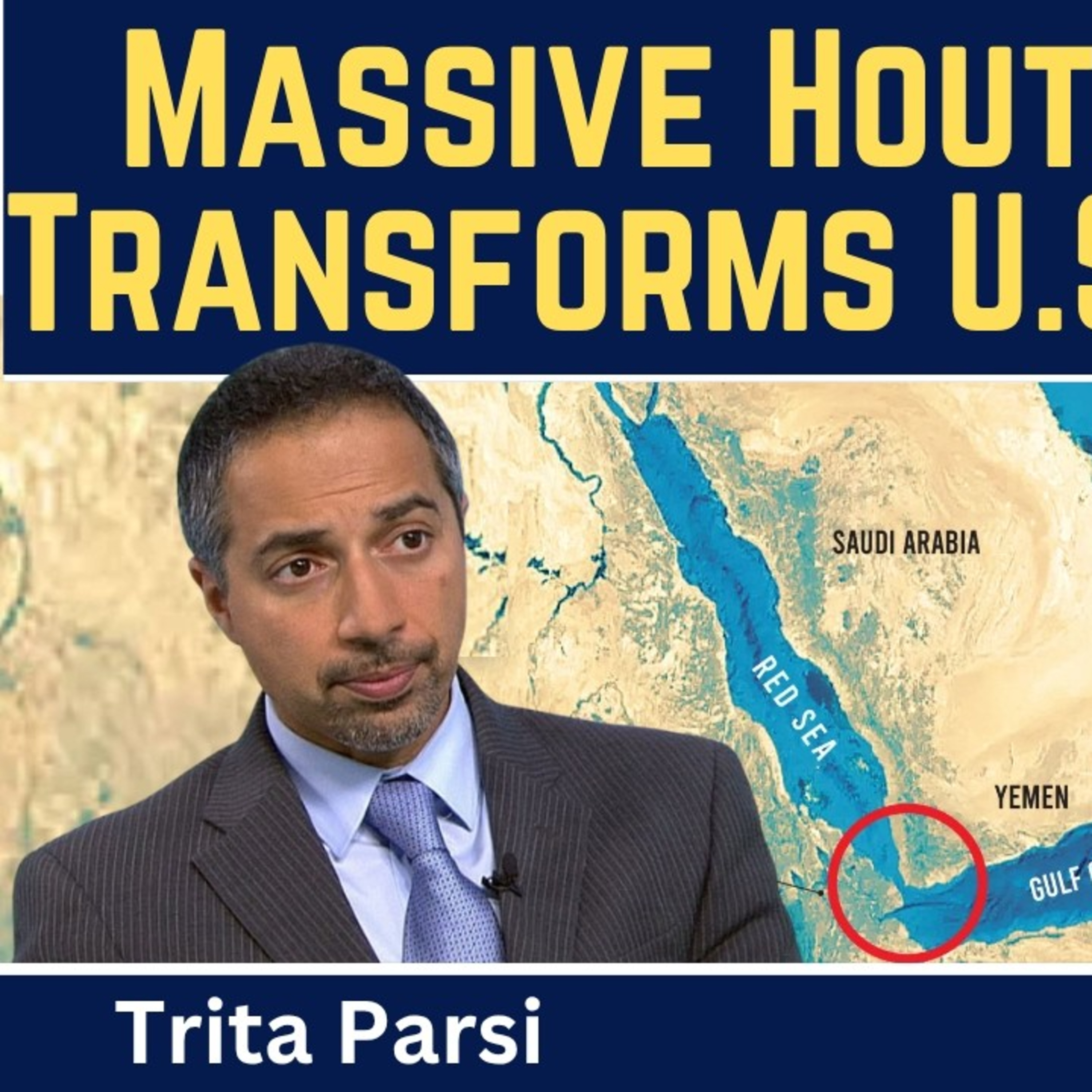
Trita Parsi: Massive Houthi Victory Transforms U.S.-Iran War
About this episode
Trita Parsi is the co-founder and Executive Vice President of the Quincy Institute for Responsible Statecraft. Follow the Substack of Trita Parsi: https://tritaparsi.substack.com/Follow Prof. Glenn Diesen: Substack: https://glenndiesen.substack.com/ X/Twitter: https://x.com/Glenn_DiesenPatreon: https://www.patreon.com/glenndiesen Support the research by Prof. Glenn Diesen: PayPal: https://www.paypal.com/paypalme/glenndiesenBuy me a Coffee: buymeacoffee.com/gdiesengGo Fund Me: https://gofund.me/09ea012fBuy Diesen merchandise: https://diesen-shop.fourthwall.com/en-nokBooks by Prof. Glenn Diesen: https://www.amazon.com/stores/author/B09FPQ4MDL
Get every episode summarized
Each time Glenn Diesen - Greater Eurasia Podcast publishes, we email you a written briefing from the transcript — the topics, who appeared, and any specific claims, with the ad reads skipped.
Email me new episodesFree for 3 shows. No card needed.
Hosts & guests

Transcript ready
462 searchable segments. Every word is indexed and playable.
Full transcript
Glenn Diesen - Greater Eurasia Podcast — Trita Parsi: Massive Houthi Victory Transforms U.S.-Iran War. Machine-transcribed; use the interactive transcript above to jump the player to any line.
Welcome back. Today is September 11th, 2026 and we have the great privilege of being joined by Treeta Parse, the Executive Vice President of the Quincy Institute for Responsible Statecraft, also a prolific writer on his substack and make sure to check out the link in his description. So it's great to see again. How have you been? Thank you so much. Wow. Surviving I guess. Yeah, well, this day's, and that's probably good enough. Well, good as it gets. We were just saying the situation keeps going from bad to worse, so there doesn't seem to be any peak in terms of escalation here. And well, I guess the whole world's been focusing now on the straight-of-ermus as the US and Iran are rapidly going up the escalation ladder and, you know, deepening, widening the war. But while all our eyes are on the straight-of-ermus, we see now big things happening in Yemen, on Saralaw or as we refer to them in the west, the Houthis
have conquered a very large territory along the Red Sea coast and also from what I understand, Perim Island and both of which would be north of the Bob El Mandeb straits. Can you explain the significance of this because this changes the Iran War as well? Well, actually, it's more than anything else perhaps. It changes the Iran War. This is obviously tremendously, a tremendous development that I would say is far more of strategic importance than what you have seen happening in the straight-of-ermus for the last couple of weeks, which in the Western media has been presented as a strategic shift. In the Western media, it's been a presentation that because the Trump administration has been able to get more oil out of the straight-of-ermus, that this has led to a scenario which the tables are turned, time is on Trump side, not only on the Iran side, and that strategically things have shifted. In reality, that was a tactical shift. It had not translated into a strategic shift.
It would have been potentially a strategic shift if it occurred in the scenario in which Iran did not have any further escalatory auctions, but it clearly did. As a result, the Western media once again confused a tactical step forward for the US with a magnificent decisive strategic victory, and clearly it was not. What you're seeing happening in the straight is an indication that part of what the Iranians were going to do as a way of counter-escalating towards the US now having gained that additional leverage. It was not just striking at ships, it was not just striking at Jordan or other places, but also activating together with the Houthis, of course, who are driving this in many different ways. The Babelman that caught, because now the Houthis are in control as you pointed out, a significant area, significant island, they may be able to close the straight not just with missiles, but actually with even shorter
artillery. As a result, all of this praise that the Iranians have lost control of the straight and more oil is flowing may now be reversed because about five to seven million barrels were being pumped by the Saudis through a pipeline to the Red Sea and then shipped out of the Red Sea instead of the straighter pormos. But that now is in jeopardy. That pipeline, if I'm not mistaken, is also on fire right now. CNN just reported that about 40 minutes ago or so. So we're seeing clearly that there has been a counter-escalation, and as a result, this idea at the time was on the USS side, I think was a very short-sighted assessment. We saw the 10-year yield reach 495. Yesterday, diesel is at six dollars nationally, more than seven in California. The rent reached 110. Yesterday,
I think it might be slightly lower today, but nevertheless, a lot of things are shifting in a manner that was supposed to happen in the opposite direction, given the narrative that we were hearing just a week ago or so. Yeah, well, this was Bessens talk that soon the straighter pormos will be insignificant and also, yeah, oil would go back to 40 dollars. Again, all of this wishful thinking or to call it lies. I mean, I get what I have to do to talk down the oil price, but the same time. I mean, it just comes off as delusional after a while, but the the the eminence. I could say something. Yes, you know, governments do this all the time, and as you said, you can understand that it lies in the interest of the administration to try to talk down oil prices. It does not lie in the interest of Western media to believe it. It lies in the interest of Western media to scrutinize what all governments are saying in order to be able to
get closer to the truth rather than paritwing it, paritizing it as if it is the gospel. I agree. No, that's one of the things. Well, in all our current wars, where this conformity to the narrative, the media doesn't do its job very well, I think, but back to the Yemen issue, though, that is Yemen is also in a strong position now to strike Saudi energy assets. The Yemen is also the Houthis that is taking larger territories across Yemen, and also, yes, you said the Arab Peninsula, you know, the first day blocked the straight-room moose on the eastern side, and now they're red-sea on the western side. What do you think this would mean for not just the Saudis, but why their energy markets in that region? I mean, how long can they hold on essentially? Well, prior to the war, about 12% of global oil flow went through the red-sea and another 21 or so
from the straight-of-hormose. So we're talking about up to a third of global oil flow that is now at risk if both of these waterways are closed. And I find it very difficult to see the US successfully opening, or it's not really fully opening, but partially opening both the straight-of-hormose and Balmandat at the same time. We're already seeing how overstretched the US military is and how difficult this has been, particularly mindful of the fact that the entire logistical infrastructure for the American Navy in the Middle East has by and large been destroyed by the Iranians. What has happened in Bahrain, which now an American senior official has admitted, I think, to a newspaper saying something along the lines that the Iranians just blew the whole thing up, has real repercussions. So I think it's going to be very difficult for the US to be able to do so. The Saudis could still pump oil unless those pipelines are also further targeted, but just imagine the cost this will add to
that oil going towards China, mindful of the fact that most of this oil was moving east. If you can't go through the straight, you can't go through the Balmandat, then you have to go north to the Suarez all the way around Africa to be able to reach the Asian market. So that's going to be a tremendously, tremendously costly thing. So this is going to add a lot to oil prices in a way that probably will go beyond what we saw earlier. I think we should also keep on the in mind. The big swing consumer now is of course China, and China has suddenly started to buy much more oil. Part of the reason why oil prices never went up as much as it could have had done early on was because the Chinese cut their demand. Now they're reestablishing that demand, and they're doing so just a couple of days before she is coming to Washington. So I don't know how much of that oil prices actually because of the Chinese. I suspect quite a lot. And how much of that is the Chinese doing it right before they're coming to Washington to just add or a reminder to Trump,
the degree to which the Chinese have tremendous amount of leverage over the US right now, as a result to a very large part of this idiotic decision by Trump to go along with Israeli recommendations and starting this war in the first place. That's a great point. People often neglect, I guess, how much influence the Chinese market has on all essentially stabilizing oil prices because when the oil is cheap, the Chinese fill up their storages, so it puts us a floor below, and when it's very expensive, then they start to reduce it. So yeah, this has the tremendous effect. But with the Saudis though, they're in a very tough spot now, and from what I read, they pleaded with Trump to help them by bombing Yemen, and well, reportedly Trump declined. Why did Trump want to go down this road? But also what's the significance
because the US is the main security provider? Supposedly. Supposedly. I think this is quite significant. I think it's important to understand the US has already been sending military advisors more than 100 to the Saudis to help them. The Saudis are already operating American weaponry, American airplanes, they're dropping American bombs. As I understand it, what the President said to the Saudis is that he's already provided a lot of support, and the Saudis already have a lot of American weapons. There are no restrictions put by the US on the Saudis on what they want to bomb and how much they want to bomb. So the message from Trump, as I understand it, was go ahead, bomb, but the US is not going to get involved, but it's not going to stand in the way of the Saudis. But it just tells you how much the Saudis are in such a desperate position of dependents on the US, in which even when they have all the bombs, they have all the airplanes, they have all the green lights, which they didn't necessarily have before. They still insist on the US doing the
job for them. And having two calls in one day certainly does seem to send a signal of a degree of desperation at least on behalf of MBS. I think the Saudis up until this point had fared quite well in this war. They were capable of selling more of their oil through the Red Sea. They were not in the same tough spot as the Kuwaitis or the Bahrainis or the Qataris. They had also largely avoided getting attacked by the Iranians because they had largely avoided allowing the US to use their territory, unlike Kuwait and Bahrain. But now by taking those military actions against the Houthis when the Iranians were flying planes to Sana'i Airport, this whole thing got restarted. And now I think the Saudis are in a very tough spot with no clear way out of this. Because even if things are resolved with the Iranians, it does not necessarily mean that the situation with the Houthis are resolved. The Houthis are not his bola. They're not some of these other groups that
the Iranians have a degree of a larger degree of influence over. It's very clear that the Houthis of their own mind doesn't mean that they don't coordinate with the Iranians at times, but it does certainly not mean that if the Iranians tell them to do something or not do something that they wouldn't necessarily always abide by it. If I could add one more coin on it. You know, when the MOU was being negotiated, one of the demands the Iranians insisted on that many, again, kind of left that and they thought that this is not possible or this is just one of these unrealistic Iranian demands was a regional ceasefire. And the regional ceasefire, to a very large extent, was about the Houthis and it was about Lebanon and Israel. And the Trump administration, in my view, visibly accepted it. They even spoke about it as their own demand or their own interest, recognizing that if they really wanted to end the war with Iran, they couldn't allow for other fires to continue in the region because those fires could spit over into getting Iran
dragged in and once the Iranians were dragged in, the US would get dragged in as well. So they accepted it at least for a moment. They seemed to have put pressure on these railings to abide by it. The MOU collapsed and now that demand is long gone and look what we're seeing. We're seeing Lebanon getting blown up. We're seeing the geographical spread of the war with the Houthis and the Saudis, the advances, the Houthis have made. And I think now it's more clear than ever why they're needed to be a regional ceasefire and why any deal cannot just limit itself to the straight-of-hormos, to the nuclear issue but has to have that company. It has to be embedded in a larger framework for a regional ceasefire. But if there's a push towards the ceasefire or the Saudis want to walk this whole thing back and establish some peace with Yemen, what exactly does Yemen want here? What do they demand? What would the peace between Saudi Arabia and Yemen look like?
I think that one thing I think that the Ansar al-Alaw will insist upon this time around that they did not get as part of the Saudi Iranian normalization in which the Iranians put some pressure on the Saudis on the Houthis and the Saudis of course also stopped bombing but the blockade was still in effect. And it's that blockade that the Saudis points at do when they objected to the Iranian airplanes flying in Salah. The Saudis are said don't want to see the Iranian relationship on a technological and military level be able to flourish between the Houthis and the Iranians and that's part of the reason why they're insisting on this blockade. But I would suspect that in order for there to be a ceasefire this time around at a minimum Ansar al-Alaw will try to insist on the lifting of the blockade as part of such a deal. And it's going to be very interesting because the Iranians are going to be insisting on there the blockade on Iran to be lifted as well. There's not going to be any deal or an opening of the straight-of-war moves or a nuclear component or lebanon unless the United States also lifts the blockade on Iran.
Well that has served us over the last few days been the main achievement by the Houthis store in Yemen that is they retaliate against the Saudi blockade by putting a blockade on the Saudis. But what would be the consideration stuff for the Saudis? Why would they not want to lift this blockade on Yemen? What would be the cost to Saudi Arabia? The blockade from the Saudi perspective is what contains the Houthis and prevents them from taking full control of Yemen. It's what prevents them from being able to get more military technology and military means from the Iranian side. So from the Saudi perspective this is important in order to make sure that the Houthi problem does not grow. And this is part of reason why when as part of the funeral of the previous Supreme Leader of Iran, Al-Qa'al-i Khomeini, the Iranian sent a Mahan airline airplane to Sana'at to pick up the Houthi officials to fly them to Tehran. The Saudis try to
prevent it. They couldn't but then on the return they did strike at the airport which is you know the initial phases of this new round between the Houthis and the Saudis. And it was essentially them believing that the Iranians and the Houthis were using the current conflict and at the time the MOU was still in effect and the funeral to push the limits and essentially slowly but surely put holes in that blockade and they reacted against it. And here we are, it seems like it's backfiring on the Saudis. I'm just thinking if I was advising the Saudis what I would recommend because this is a you know all-or-nothing situation or that is if they attack the Houthis to try to weaken them. They're going to have a more sustained or intensified blockade and the Houthis can begin to burn down a lot of the energy infrastructure in Saudi Arabia. On the other hand if they make a piece then the Houthis will not be contained, they will grow much much more
strong. So yeah again what the reaction to take. I mean it's a it's a well the fact that they had this blockade but they hadn't escalated it. That looked like the sweet spot that were in though which I take your point and it was quite foolish I guess to intercept that one plane which was you know linked to the funeral. Of course it could have been a way of opening up the blockade but yes nonetheless. I think yeah I think the Saudi perception was not necessarily wrong that they saw this as a way of starting to carve out some holes in that blockade but the action that they took ultimately has led to this scenario. I mean again if we just take a look at how much worse and complex the situation is now not just compared to February but just a month ago. We did not have the Saudi Poo-Ti scenario as it is right now. We did not have a situation with the Israelis doing
what they have done just in the last week in Lebanon and we did not have a scenario in which the US was trying to essentially target Iran's oil infrastructure but without targeting the oil infrastructure instead targeting the tankers and blowing up the tankers in response to the Iranian striking attackers going through the southern corridor but that then led to escalation by the Iranians they have now taken out several bases or or at least struck several bases in Jordan and then also shown their capability of striking and potentially sinking in American naval vessel perhaps a destroyer perhaps something even bigger in the Persian Gulf using these missiles that the US knew that the Iranians had but the Iranians had not demonstrated it's clearly and what seems to have happened about a week or so ago was essentially a warning in which they shot the missiles above it the ship had exploded above the ship did some damage the ships
vacated the area and it seems to have been a warning by the Iranians to show what they can do but they're choosing right now not to do it I spoke to a former US official senior official who said that the only reason why the Iranians had not sunk an American ship so far is simply because they have chosen not to do so it has nothing to do with what they have they capability or not and I'm worried that once again Trump has pushed himself into this information vacuum in which he is drinking his own cool aid he kept on tweeting things that suggested that the Iranians are about to cave whereas reality is not at all pointing in that direction yes the US may have gained some leverage by opening the strait somewhat but has it changed the strategic picture and again I think the the assessment at this point has to clearly be no it has not I think Trump maybe makes a mistake assuming that his entire staff works for him that is I think there's a lot of competing interests there who try to influence him in a in a big way but but as you say all of this has to be connected
to the Iran war and you we see their attacks now intensifying the Iranians as you said they also announced this or will announce this restrictive zone they show that they have the capabilities to strike the US warships I guess that's an indication that they're prepared to take that one step up the escalation ladder if the US chooses so and but also the missile attacks on Jordan I mean you saw the sky being lit up with all these intercepted missiles which the US are in short supply and the need also needs to fight the war against Russia so it's you really this just goes from bad to worse very very quickly but how do you see the Iranians or how might the Iranians now take advantage of this new strategic situation because suddenly the everything very quickly turned to their to their to their strength and again the ones Iranians I spoke to they were making the point that we have the ability to sink this US warships you will want to but but we we we saved
it for later up the escalation ladder you never know if this is just the you know big big talk or you know prepare for trading oneself to have greater capability than one actually has but it appears to be true certainly I would say and I think I think I mentioned on your show as well that conversations I've had with the Iranians I throughout all of this as this narrative invested media was there's starting to reach some sort of hysterical level of you know Trump almost has won the war that I did not detect the slightest sense of panic on the Iranian side not even a significant sign of worry which I found interesting because I have spoken to them in moments and it was very clear that they were worried you know in specific moments of this war or the previous war in which was not entirely clear where things would go you could sense it I did not sense any of that I said something interesting earlier today in conversation was actually very interesting you mentioned something that echoed it you echoed that we have not reached it I think you said something the
the climax of escalation and it was the same point I was made by someone on the Iranian side earlier today that I spoke to who referenced this in a worry some way saying that on the one hand yes many of these developments are benefiting Iranian leverage but there is at the same time a larger worry which is this situation can get entirely out of control that earlier on there was measured escalation it was not necessarily good or bad but nevertheless there seemed to have been an escalation with a degree of control whereas now the escalation is reaching a point in which the degree of control may be lost or weakened significantly and that is ultimately bad for the Iranians even if the developments at the last 24 or 48 hours could arguably be said to be to their benefit and I got a very strong sense that there is still a search for some sort of a diplomatic
exit out of this but that there is deep frustration on the Iranian side that Trump increasingly is showing either no interest in diplomacy because he has made it very clear publicly he doesn't want to talk to them he doesn't want his team to talk to them or alternatively a perception on the Iranian side that Trump frankly has lost his mind and that he is incapable of making a deal and as a result this investment in diplomacy is somewhat of a waste of time and energy because the capacity on the other side just does not exist doesn't mean it doesn't have anything to do whether you can trust a one artist the capacity to make a deal and stick to a deal that has taken a huge blow at least a perception of it that's a very bad situation for the viewers ultimately to be but it's also a very bad situation for the Iranians because the Iranians at the end of the day are going to be they don't have the option of just leaving Trump ultimately does have that he clearly
doesn't seem to like it and the more he invests in this conflict that more difficult it will be for him to just leave but that option does not even exist for the Iranians at the end of the day. Well the as the well the battlefield favors now the Iranians they're showing that the willing to go up the escalation ladder they are they have the capabilities to strike these ships and again everything seems to change but at the same time one here is also some noise from Iran that they are prepared to shift strategy a bit that is to go on the offensive that is why should be the prerogative of the US and Israel went to strike so essentially Iran if they see something happening go for that preemptive strike instead and now you see some reports that they may have this hypersonic missiles long range as well I mean wow if you were you know sitting in Washington all you are sitting in Washington but you know if you're advising depending on or you know
whomever how would this change matter like how because so far it looks like this has been a bit of a luxury for the US if it decides when to go up and down the escalation ladder is one thing but now if it parks too many refuelers or plane or ships something that we're calls concerning in Iran they might actually strike that before the United States gets to you know play its card so how does this shift the strategic thinking or tactical thinking in the US so let's take a step back and look at how this whole thing has evolved from day one in my view the United States lost control of this war on day one they had the plan that this would be overweight within four days they would knock out the leadership the system would collapse but already on day one Iran counter escalated and defined the geography of this war in a manner that took the American side by surprise so the definition the contours of this war how far they would escalate etc the escalation
dominance the Iranians gained already very early on and they don't think the US really had much control over it up until the moment in which they started to feel at least that they had regained control as a result of opening up this rate and feeling that some momentum had shifted even though as I mentioned earlier on they confused the tactical development with the strategic one but now I think you're also seeing that the Iranians have already shown that not only will they define the geography of the war and they will go far beyond what they've done before as we've seen also Egypt has been struck now we're seeing what's happening in Yemen but also the timing of the war that it will not necessarily be that the US decides when the next round begins and the Iranians are just playing their reactionary game the war is not over so any attack by the Iranians at this point is an attack within a war that the US still started and did not end it and I think we saw some of the strikes against Jordan signifying this but I think the bigger one will come
if the Iranians conclude and their conclusion at this point seems to be in this direction and very little has changed including the some of the diplomacy that is taking place right now by some of the Arab states that Trump is inclined to escalate this war dramatically after the midterms the Israelis will be part of that war again because now when Trump wants to go much further it's okay for him to have the Israelis involved he didn't want to have them involved in the the round two for 13 days because the Israelis were not trusted they would go much further than Trump was comfortable with at the time but if he has no limits for round three then he's aligned with the Israelis and this of course will be better off timing-wise for the US after the midterms and after the Israeli elections which may be precisely why the Iranians made themselves initiate round three a week perhaps two weeks before the midterms in order to make sure that the timing of the war is also not decided by the US and England. Yeah well I take a point on the concept of
preemptive strike this is often this concept is often linked to discussing the legality of wars and of course given that the fact that the war never ended that's not really a topic at all it's probably better defined as a Iran rejecting US escalation control but the US partners in the region so because a lot of them has been hit pretty hard and now we're going into yet another round how do you see well they're the willingness to be hit but also the energy exports they are you know a lot of these countries are now being they're economy are being suffocated do you see anyone prepared to try to just pull out of the whole of the whole thing by well essentially yeah now no more using our territory something I know I haven't seen anything of the likes but do you see someone ready to cry uncle and you know tap out of this whole thing from the GCC states yeah
well I think the Saudis and the Qataris already have done so the Ammanis from the outset were not in it's whether the Bahrainis and the Kuwaitis would do so and the Amorades and Bahrain and Kuwait are not countries with a significant amount of leverage it would be very risky for them so I think you know in the case of Kuwait I don't think they were happily going along with this at all I think this they simply didn't have much of a choice and of course Bahrain is not seen as as an independent country by most analysts in the region anyways so I don't see anything happening on that front because it's not that these countries necessarily want this this is that these countries don't have the capacity of being able to push back against the US in a forceful way I but it touches on a more or a different point which is that most of the diplomacy so far has been conducted by countries in the region who have a stake instability who have a stake in preventing this going too far have a stake in preventing it altogether of course
and who have actually really stepped up they've been very creative they've been very energetic on the diverse circumstances they've still tried they've not given up and I think we should give them a lot of credit and that includes Pakistan of course but reality is that none of these states had much leverage over Iran and certainly not much leverage at all over the United States and I think that creates a significant drawback for their capabilities in a sense that they can mediate but they can't pressure the one country that could they may not be as experienced in the mediation front but they have leverage is actually China China has leverage over the US China has leverage over Iran for sure and China may end up developing the interest to actually step in I'm not saying that they're having it right now their approach is to stay out of these things it's paid off extremely well for them they have safeguarded global energy market stability by as you pointed out early on adjusting their demand and purchases of oil in order to make
sure that it didn't go too far above 120 but if we're looking at around three with almost unlimited escalation from both sides the US side will strike energy pipelines and infrastructure in Iran critical infrastructure desalination plants the Iranians will retaliate they will do so against GCC states they will do so against Israel some of the groups aligned with Iran will enter the war much more actively than them we've seen before then that is going to create a massive problem for China as well given what it will do to energy markets and that may actually push them in the direction of contemplating at a minimum stepping in and trying to do something and I think the leverage that China has over the two is crucial not just in order to get a deal but to sustain a deal so it doesn't end up becoming like the MOU it lasts five six weeks and then it collapses that's what the Chinese did between Iran and Saudi Arabia and it wasn't really just getting the deal it's the fact
neither side wanted to violate the deal because of their fear of what that would do to their relationship with China and both sides were aware of the other countries reluctance to have tensions with China and as a result the Chinese role helped sustain the deal and has been sustained for several years now and I'm not hearing any voices on either side questioning the deal or saying we should get out of this deal so if you want to not just get to the MOU and make sure that the MOU actually survives both sides may come to the conclusion the China is necessary I'm not saying either one of them is thinking along these lines right now nor am I saying the China is but when you take a look at the landscape and ask yourself who could step in and put an end to this madness there's few other names except China that comes up yeah no no that's fair I'm just thinking for the for the Chinese it depends what kind of peace it is though because if they are if the Iranians are in a position where they can finally push the US out of the region
versus Iran being defeated by the United States and I guess any and any deal that allows you as to go back to the old status quo would in the long run possibly be not in the interest of China but of course if this continues to go up the escalation ladder I think and the Chinese would well they would also be affected quite unfavorably but the elephant in the room though we haven't really discussed this Israel that is how long will it sit on the what is not really sitting on the sidelines is quite active in you know in thoroughly enjoying this situation how was that in Lebanon Syria but but did you see them getting directly involved now against Yemen or Iran I think that in a third round if it does occur which I unfortunately think at least has an 80% chance unless something happens in the next six seven weeks I find it extremely likely that the Israelis will be involved in this time around these
Israelis will go much further than they did last time remember it was the Israelis that struck the old refineries outside of Tehran that caused people not being able to to greet the air there for two or so days it was the Israelis probably in combination with the Emirates of struck the desalination plant on Kashm Island the Israelis have always wanted to go much much further than the US did and again this part of reason why they were not involved at all in round two the US wouldn't allow them to but if Trump is under the false impression that he has tried everything he's tried diplomacy in his mind he's tried sanctions he's tried what within this context would be more limited war but the one thing he hasn't tried is the full scale war the Israeli option of war to just go all out if that's where he ends up his thinking ends up after the midterms then I think these radies will be on board and they will be very active and again this is part of the reason why the Iranians are striking Jordan right now those bases are needed to protect Israel in a third
round of war in terms of shooting down Iranian missiles so taking them out right now is paving the way for the Iranians to be able to be more affected in their strikes against Israel if these radies decide to enter the war well it would make also sense as a sort of deterrence against Israel because obviously they're watching this knowing that they would be very vulnerable if if Iran is already softened the targets in Jordan but if the US unleashes the Israelis on Iran and we go towards this all-out war where the salination plants all energy fields cargiral and I mean everything is now is being attacked how do you expect the Iranians to respond because then restraint would no longer have any purpose on their side I mean why not strike a US warship why not aircraft carry your salination plants in the Gulf states I mean what do you see the Iranians
going after this let me just say one thing on these radies I don't think these radies can be deterred as long as the US is willing to go back into a third round and escalate it further then the Israelis at least as long as Netanyahu is prime minister which he may very well be after the October elections is willing to accept those costs as long as they have the US fully engaged in war because they know very well that they will likely never get a chance again to have an American president willing to go in an all-out war with with Iran so on the those circumstances the what the Iranians are doing in Jordan will not be a deterrent for the Israelis they will happily risk all of that in as long as they know that the US is fully in on the war when it comes to what the Iranians may do next I think it's very important to know the Iranians could up on after ships perhaps even sunk one and instead chose to do something else I mean they're slicing this
alarming here in terms of being very calculated and careful how they choose to counter escalate and the Houthi option may actually have ended up working better than they expected because it is counter escalating it is putting pressure on the US but it is not providing Trump with some sort of a pretext or a massive amount of pressure from places that may not be pressuring right now to escalate the war with Iran but for instance if if the Iranian strike and sink an American destroyer kill or aim or wound hundreds of American soldiers right a week before the elections I think the overwhelming amount of pressure will be for Trump to do something very very dramatic against Iran but the Iranians may be able to achieve the same amount of damage onto Trump through what the Houthis are doing now without any of the risks that they would be faced with
if they struck an American ship so I think the Iranians are looking at those options and will exercise them only once the situation is much worse which again may be the case once we get closer to the Maytars but we're not there yet thankfully we will not be there at all hopefully we will not be there at all well it's with Israel I mean they are I can imagine they're in difficult position though because they've now had you know decades of rejecting any concessions because they've always had this partnership with the United States which allowed them to use overwhelming force to impose their will so again why do any concessions at all but now that the US is weakening you know I would assume that the sentiment is that this is the last chance to transform the region knockout really wrong as they see us the head of the snake and then now for the first time in decades they have Trump in the White House was willing to put to US military force towards this and then you know so they're in this all or nothing position so that's not a great position do you want
to have your position but it's also a position which again I don't think the Iranians think that they can deter the Israelis precisely for what you said and just add one thing I posted it on sub-stack a little bit early today recent poll that was being summarized by CNN that show that in the last eight or so years Israel's standing in the American public writ large it's dropped 67 percentage points in every demographic it is now negative and that this undoubtedly will impact the politics the trend line is so clear and if you're sitting in Israel right now you're going to draw exactly the conclusion that you said this is probably the last chance future American presidents are not going to be of this orientation on the left or on the right we're already seeing how things are shifting very fast in terms of not just being a negative sentiment towards Israel but also translating into specific measures introduced by Democrats on Capitol Hill and supported by
central publicists we're going to see much much more of this going forward because it's going to not only be good policies going to be good politics so if you're sitting in Israel you're going to try to get as much as you can before the shift in the American public translates into a shift in American politics when it comes to which yeah I'm amazed by how quickly that sentiment shifted I mean Israel was the of all issues this was really the sacred cow you couldn't really touch the US Israeli partnership without you know fairing for your real professional career at least but yeah just one one one last question that is you know I spoke here before about the possibility of the US doing a ground-on nation of Iran that doesn't seem to be in the cards at the moment but with this new front opening up in Yemen and the huge pressure this puts on the US by shutting down the Red Sea do you see the possibility of the US using ground forces against Yemen instead because
I'm not sure if they would be an easier target but it's better than Iran by or there's no such chatter you think in Washington at the moment I've not heard any of that chatter and remember Trump did start a war against the duties on the day advisement of Mike Walts and Pete Hague set and it was a disaster and after eight or so weeks he just ended it never spoken about Yemen again except on the day afterwards he said that the duties are a tough bunch of nuts the Saudis have tried others have tried very few people successfully intervene in Yemen by air or by land and and the reason why the Obama administration just kept on bombing through drones etc by air was precisely because they didn't want to put troops on the ground in any significant number I find it very hard to believe that Trump would go in that direction would take the risk of ground troops but in a manner that would not deal directly with the key issue he has
which is with Iran but on a more peripheral issue because the risks are almost greater and the benefits dramatically lower now having said that who knows I mean it's still the Trump administration and a Trump that loses is perhaps humiliated after midterm elections perhaps loses both chambers maybe an even more desperate and far more reckless Trump than we have seen so far yeah now I remember that there was some when the US began to lose their their their their planes and at the end of it Trump had to declare victory in Polhata I was actually in Tehran when they when he announced this and I thought it was quite quite remarkable but it is an indication though that he didn't want it doesn't want to go down this route once again but I don't know I find this all the times concerning though just this normalization of war I mean remember when the US started
in February how everyone was glued to the screen how shocking this was you know it could be the end of the world not just the war with Iran but also with Russia how how this has become normalized how yeah what kept people up at night a few months ago is now just a daily occurrence and we casually refer to the possibility of using nuclear weapons and nuclear strikes I mean it's it's it's not healthy the longer this goes on I think the more we're using in that direction absolutely so have any final thoughts before we wrap up no thank you so much I only mentioned perhaps one more thing which is there was a lot of talk about the mecca agreement early wrong and I think you and I had a conversation about it's both what it could be and what it could not become and some potential promises some concerns but I think we all concluded at this point it's too early to tell and at the end of the day these things only go as far as their credibility allows them to and now we're seeing Saudi Arabia in this very tough spot and we're not seeing the Turks intervening we're not seeing
the Pakistanis intervening and and I think again it shows that those kind of immediate measures may not have been fully thought through and ultimately any effort here that does not lead us to some sort of inclusive indivisible security and it just ends up becoming some sort of a block formation in the region at the end of the day is not going to prove itself to be a solution for the region and even if it has credibility in the sense that the size actually honor their defense commitments it does not in and of itself mean that there actually will be peace on the country I think a block formation will only make long-term insecurity more like you but sorry for adding another question there but with the mecca defense pact I think many assumed that it would be aimed at deterring either Iran or Yemen but other suggested that it could be to fill the vacuum as the United States leaves the region that it could devolve into an
inclusive security architecture or even that it could be used to deter Israel have you have you seen anything in the language that's suggesting what the purpose of this was to begin with? I do think that it was more looking towards Israel and have some sort of a balance with Iranians the Pakistanis were very adamant about getting the Iranians included because they clearly don't want to have any conflict with Iraners nor do I think the Turks want to at least out of direct one but in my view would have been better if they from the outset had done something that was more explicitly open and from the outset had tried to bring the Iranians on board I understand that that's very difficult to do right now because you can't create a defense pact or some arrangement of that kind with the country that currently is at one but nevertheless the manner that it was presented created expectations that Pakistan and Turkey now has to
intervene against Yemen and I just find it very unlikely that they would do anything against Iran and it seems to me increasingly unlikely that they will do anything meaningful against the willties at this point. Well thanks here again and yeah always a great pleasure and yeah I did read that article you referred to about the Israel standing in the US so make sure to check out Treetoparsis sub-stuck as I do and thanks again. Thank you so much really appreciate it.
More episodes
More from Glenn Diesen - Greater Eurasia Podcast

Steve Jermy: End of U.S. Military Primacy - New Strategic Thinking Requried
Glenn Diesen - Greater Eurasia Podcast

Peter Schiff: Economic Armageddon - Bonds & Dollar in Crisis
Glenn Diesen - Greater Eurasia Podcast

Sean Foo: U.S. Allies Dumping Bonds - Is the Dollar Next?
Glenn Diesen - Greater Eurasia Podcast

Douglas Macgregor: U.S. Defeated in Iran & Israel Will Not Survive
Glenn Diesen - Greater Eurasia Podcast