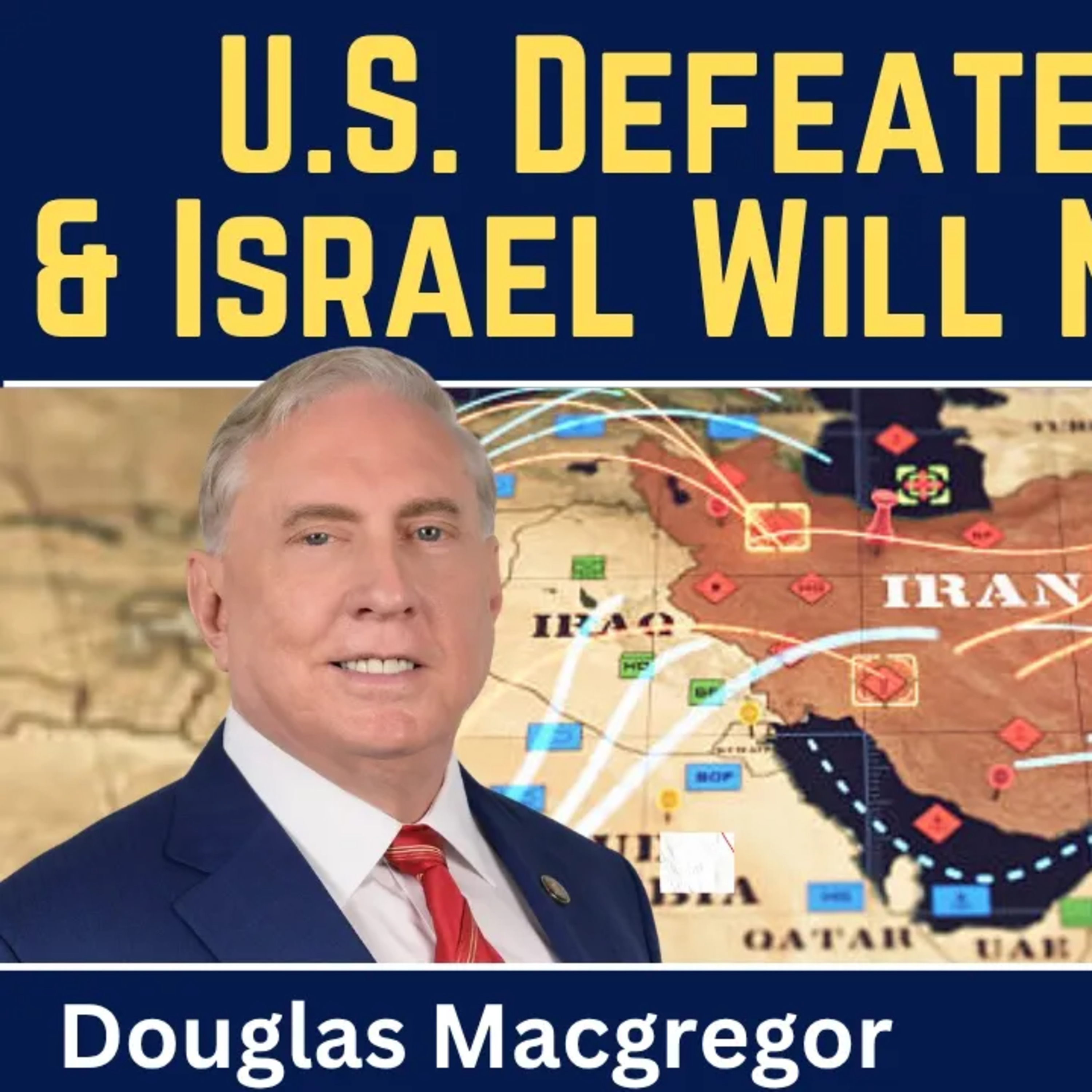
Douglas Macgregor: U.S. Defeated in Iran & Israel Will Not Survive
About this episode
Douglas Macgregor is a retired Colonel, combat veteran, and former senior advisor to the U.S. Secretary of Defense. Please like, subscribe & share!Colonel Macgregor's substack - Trump is not in Hell, Yet: https://substack.com/home/post/p-214040833Follow Prof. Glenn Diesen: Substack: https://glenndiesen.substack.com/ X/Twitter: https://x.com/Glenn_DiesenPatreon: https://www.patreon.com/glenndiesen Support the research by Prof. Glenn Diesen: PayPal: https://www.paypal.com/paypalme/glenndiesenBuy me a Coffee: buymeacoffee.com/gdiesengGo Fund Me: https://gofund.me/09ea012fBuy Diesen merchandise: https://diesen-shop.fourthwall.com/en-nokBooks by Prof. Glenn Diesen: https://www.amazon.com/stores/author/B09FPQ4MDL
Get every episode summarized
Each time Glenn Diesen - Greater Eurasia Podcast publishes, we email you a written briefing from the transcript — the topics, who appeared, and any specific claims, with the ad reads skipped.
Email me new episodesFree for 3 shows. No card needed.
Hosts & guests

Transcript ready
216 searchable segments. Every word is indexed and playable.
Full transcript
Glenn Diesen - Greater Eurasia Podcast — Douglas Macgregor: U.S. Defeated in Iran & Israel Will Not Survive. Machine-transcribed; use the interactive transcript above to jump the player to any line.
Welcome back. Today is September 9th, 2026 and we're joined by none other than Colonel Douglas McGregor, decorated combat veteran, author and also the former advisor to the US Secretary of Defense. So it's great to see you again, my friend. It's been a few weeks. Yeah, absolutely. I took a break, needed one badly. Well, the world didn't take a break, unfortunately. Well, there's a lot we could discuss, but one thing which is of great interest now is this war between the US and Iran. It's escalating quite fast again. The US appears to, well, yet again attempt to use overwhelming force to compare Iran and the Iranians will are responding, not only hitting US bases in the region, but also firing on tankers and also threatening US warships. And they've announced this exclusion or restricted zone. So they also see an necessity to escalate and I guess with the purpose of breaking the US blockade.
I was wondering though, how do you assess the situation now? I guess this is this a new face of the war? Well, I think the Iranians have reached some conclusions that perhaps it's taken them longer to reach than I thought they would need. They clearly understand that they have an interest in breaking the blockade. And I think that's what you're seeing undertaken and they're going to break the blockade now. How important or how effective is our naval blockade? That's open to debate. We know that most of the President Trump's claims of weak control, the strait and oil is slowing so forth are just nonsense. That's not true. You know, the American Navy has been unable to him in really shape events at all. An example of just how utterly ridiculous we look is that now in response to a couple of hypersonic missiles that were deliberately flown over an aircraft carrier battle group.
And I say deliberately because that appears to be what they did they could have hit the carrier, I think. And instead they essentially sent it as a warning. And of course the warning had the desired impact because the carrier battle group is now moved further away from the Gulf. But I think the bottom line is that we don't know what else to do and we don't know what to hit. And so we're striking tankers, which is not particularly intelligent thing to do tankers of the last things that we need to sink at this point. The world needs them. We need them. Everybody needs them. But we decided to do that ostensibly because we can't reach other targets for greater importance to our bombings and missile attacks have simply had no effect. Now we can certainly hit some civilian infrastructure, but that's not going to win any wars for you. So at the end of the day, it looks to me is so you're on once again as the initiative we're reacting.
And there is an attempt, I think, on a part of the president right now to wait for decisive action until after the election in November. So I think the interim period is being utilized to try and replenish our stocks of missiles and precision got immunitions. I don't think it's a good idea. I think it's a very dangerous position to take, but I think that's what we're doing. So the war is definitely not over. Well, what is he being, well, the US risking here though, because the US seems eager to go at least back to the old status quo while Iran seems determined to push the US out of the region. And again, this isn't only a conflict of way between the US and Iran anymore. This isn't only about the regional and line system. Indeed, it becomes the entire political economy of the United States and the US position in the entire Middle East.
So how do you see this ending? Or I guess it has been written yet, but how are you seeing the situation at least? Well, in this latest essay on my sub-stack, I tried to make the point that President Trump is in the uncomfortable position that frankly Abraham Lincoln found himself in after a battle at Fredericksburg in November, December 1862. And it was a terrible loss. And he was under tremendous pressure to show progress and putting an end to the Southern rebellion. He failed and he said, well, if there is a place called hell, I'm in it because he couldn't pass any legislation. He couldn't mobilize support. He was really in very bad shape. I think President Trump is as well. President Trump's approval ratings have now hit a new low of roughly 33% and falling. I would add, these are extraordinarily low approval ratings that I don't see those recovering anytime soon.
The US economy is officially not in recession, but the Trump administration really faces a sovereign debt crisis that makes deficit reduction mathematically unattainable without triggering a real depression. Luke Groman, I don't know if you've interviewed him or not, but he's someone who is well known for his acumen in the bond market. And the problem with the government is that the government is making enormous corporations are making enormous quantities of money. But the problem for them is that their operations are constrained by infrastructure damage and shipping blockades.
And the company's inability to export crude oil from the Gulf. So the oil industry's vulnerability to supply shocks of the Middle East continues to reduce the incentive for any of the oil companies to return to the Persian Gulf and rebuild. The Israel project, which is sort of like a cancerous tumor that no one can get rid of that just continues to metastasize and it ensures that because of our unconditional support for the greater Israel project, we are seeing everywhere in the Middle East is more than just the aggressor now. We're seeing as a terrorist as subsidizing supporting unconditionally Israeli terrorism in places like Lebanon or anywhere else in the region they choose to attack. So there's not much good news here and I don't see anything good happening in the near term. And again, I don't see any evidence that President Trump is willing to say that's enough. It is in the interest of the world that this war end. And even though we have not achieved all of our aims, we see the criticality of ending it.
And we will pursue negotiations with the Iranians on a different level in a different place at a different time. He could do that in theory. Well, I think he can because I don't think he's really in charge. I think the Zionist billionaires that financed his election that put him into office who also incidentally controlled the legislature because they've poured hundreds of millions of dollars into the pockets of various legislators, legislators are really in control. And they said, no, this war must continue. So I, you know, I don't know where we hid from here except downward. And I don't see anything magically changing such that after the elections in November, he can suddenly pull a rabbit out of his hat and call it victory. Don't see that happening. The other thing and you know this better than any of us, much of the world, I mean, just look at the Shanghai cooperation organization conference. Much of the world has said they don't want to see Iran lose.
Because the Turks, the Russians, the Chinese, the Pakistanis, any number of people, even the Indians, I think have all looked at this. And to some extent, they realize that they are more or less on the menu if Iran does lose. So I don't see any good, good news for the United States or President Trump right now. Well, that's a good point that is even adversaries of Iran, with Saudi Arabia, and lesser extent Turkey. I mean, if Iran falls, Israel's guns could be pointed at them. But how do you see that though, when that's this new mecca, joint defense agreement was signed between the Saudis, the Turks and the Pakistanis. A lot of people who thought it was going to be an instrument against the Iranians, but it looks increasingly like the Israelis could be well defense against Israel is could be the purpose here or a restructuring if they think the US might not be there tomorrow or the US might not be on their side.
Well, first of all, the United States is not going to take a side against Israel, forget it. The government is not in the hands of the American people, the government belongs to the Zionist billionaires, they made that very clear. So when you look at the mecca agreement, which is something akin to a mutual defense pact, frankly, but it hasn't become that yet, but it looks like that's where it's headed. Right now, I think it's jazz Freeman talked about it as being a kind of on taught comparing it to what the British, the French and the Russians had before World War One, and we all know where that went. So I think we have to look at the mecca agreement as essentially potentially becoming that kind of military organization or military coalition. But in the short run, there are two things happening. One is the Saudis are trying to persuade the Pakistanis to defend them. Now, I don't know how many people in your audience have spent any time in the Arabian Peninsula, but the Saudis are singently incapable of defending themselves.
If you go to Saudi Arabia and you look at the magnificent structures that exist there, the buildings, the cities and so forth, they are not a product of Saudi Arabian engineering expertise or architecture. These places are built by foreigners, everything in Saudi Arabia was built by foreigners. And they can't defend themselves whenever they've tried they failed miserably. I can talk about why that's a whole different can of worms. My point is, I think the Saudis would very much like the Pakistanis to take on the hoodies for them, and at least try to bomb the hoodies into submission. I don't think that's likely to have much success if we couldn't do it. I don't think the Pakistanis could do it. But that's a short term interest. And of course, if you're sitting in Israel or Washington right now, then that's good news because anything that you think may contribute to the Sunnisia conflict in some fashion isn't inherently good for Israel. Therefore, if you're in Washington or you're in Jerusalem, you say great, bring in the Pakistanis, let them attack the hoodies.
I don't think it'll work out that way. I'm just saying that's the way people in Washington think. Otherwise, I think you're talking about the greater Israel project. And remember that if you look at the greater Israel project, it's not just all of the occupied the Palestinian territories, whether it's Gaza or the West Bank, it's all of Lebanon, Jordan, most of Syria, parts of Egypt, Saudi Arabia about a third of it, Kuwait, and essentially roughly 25% of the entire region, along with parts of Iraq. So, that's what we in the United States are supporting. That's where we're stand where we stand right now, which I think is a catastrophic. Now, the thing that's interesting is remember most of these places with the exception, of course, of Turkey. And obviously, Egypt does not get part of the pact, but there's a lot of evidence the Egyptians may yet join it. These are not real states. These are accidents of history that emerged in the aftermath of World War I.
So, whether they survive or not, that's another matter entirely. I mean, you cannot superimpose Western governmental structures or at least Western borders of nations and the Westphalian model on top of tribal societies. And frankly, that's what we did. I think again, as I've said before, when all is said and done, whenever that happens, it will be Iran and Turkey, the two leading powers in the region that will decide the feud of the rear. And this is the future of the region, not us and certainly not the Israelis. But right now, I think we have to understand that this defense pact, it's a trilateral mutual defense pact in some ways, Saudi Arabia, Turkey and Pakistan, is really a direct response to the Greater Israel project. And even though there may, there's always friction between the Sunni and the Shia. Nobody in Turkey wants Iran to be destroyed. Nobody in Turkey wants it to lose, neither to the Pakistanis. The Saudis may have mixed feelings, but at this point, they're beginning to understand something that the United States has really lost its war with Iran.
You know, we fall and back. We have no way to go forward. We have no answer to the Iranian missile complex and its ISR strike capabilities. Everybody knows that. We don't want to admit it. The last person on Earth that wants to admit it is Donald Trump. Well, if now the Iranians are winning and their objective is to push the US out of the region, either by, well, not either, but by destroying the US bases in the region, but also denying, well, controlling the Strait of Hormuz. And we now see, as you said, the allies of the US beginning to discuss these things, they're realizing what's happening. What does this mean for Israel, though? Because Israel has played a very oversized role in the region. It's been throwing its weight around to an extent which are country with only a few million. Probably wouldn't have done without the United States standing behind it. So, what does this mean for the, I mean, the US defeat against Iran? What does this mean for the future of Israel?
Well, the Israelis have been successful at bullying their neighbors, who were never very strong militarily, weren't very strong societies to begin with. But without the United States and its armed forces, Israel has no chance of survival. It has no chance of overpowering and dominating anybody. If you put that Israel, the greater Israel project up on the screen, if you add a map of that, think the notion that any of that could be achieved by the Israelis without us is absurd. The question that nobody wants to answer in Washington is what interest do we have in the greater Israel project? The answer is none. There's no interest in that at all. That's crazy. But who controls the financial situation in New York City and Washington? Who controls it in London? Well, you answer those questions and it's only you see us committed to this crazy idea in the Middle East on behalf of Israel. So, I think the handwriting is so to say on the wall, long term, I find it hard to believe that Israel will survive as a nation stayed in the region. It's as artificial as Saudi Arabia.
It's another accidental construct that emerges after two wars and it was brought to life through the down payment of millions of Jewish lives in Europe, which is why I'd enjoyed such success in the United States and Great Britain. And to a larger extent in Europe, that's exhausted now. That good will is no longer what it was due largely to the incredible unanticipated murder and brutality that they've seen in places like Gaza and now increasingly in southern Lebanon. So, the Israelis are in a very difficult position. Now, what some Israelis have now said is, well, fine. The bases are lost that the Americans have had in the region. And I think that's true. I think we are finished in the region. Because we're not going to go back in at great expense to the American people and spend hundreds of billions of dollars to rebuild bases that can so easily be attacked and destroyed.
So, where do we go? Well, we go to Israel. You heard American forces into Israel and that becomes a sort of permanent garrison state, manned largely but not exclusively by American military power at the command and control of the Israeli state and its Zionist billionaires in the United States. Well, that work. I don't know. I don't think so. I think it's short term it might have some impact but long term it's going to be very hard to justify. I think we in the West are on, we're at a, what you would call a strategic inflection point. Everything is about to change really dramatically. And I think we've seen that the beginnings of it in Germany. We've seen the beginnings of it in a place like Great Britain. Everyone is beginning to figure out that Russia is not coming. Russia is not going to march into Eastern Europe. It will, you know, restoration of the Soviet Empire. The Russians have no interest in that. Ukraine is probably one of the most corrupt places on the planet. Anything you send there is wasted.
But the global elites that rule in Europe have a permanent interest in keeping these things going because they're afraid that when they end or if they don't succeed in sustaining them, they'll be removed from power. Well, they're right. They're going to be removed from power. People in Washington are very similar. They're not as aware of it because Americans don't appear to be at this stage as alert as Europeans. But Americans are beginning to figure things out. You cannot, a friend of mine sent me a note yesterday. He has a truck, a Chevy truck. And he spent $212 to fill the gas tank. And he's serious. Well, you begin to get a lot of this. And we haven't even talked about the problems with food because of the absence of fertilizer. The fertilizer is heavily dependent now. The fertilizer availability is heavily dependent not only about what we can make ourselves, but also on fertilizer from Russia.
And Russia is trying to provide that to India and China and other places. So we're looking at famine at the worst in many parts of the world. But here at home, we're looking at very, very rapidly rising prices of food. Well, you put that together with the cost of energy and you realize, you know, you no longer have cheap energy. That means you also no longer have cheap credit. We look at the bond market and we see that the bond yields are rising very, very consistently. So the whole petro dollar system is falling apart because people are now selling oil back and forth in currencies other than the dollar. And remember, all of this goes back to the end of the gold standard and Nixon's agreement with the Saudis to protect them in perpetuity in return for which they would do business in oil exclusively in dollars. And they would drag everybody else and OPEC with them. Well, that worked very, very well, but we can't defend them. That's patently obvious. So that means the Saudis are the risk going out of existence completely or they have to swallow their pride and recognize that they're no longer the dominant force they once were. We are not the dominant force we once were and they're going to have to do business with Iran.
We haven't even discussed China and right now China is the only real candidate with the money with the financial power that could walk into the region and rebuild much of it, particularly when you talk about oil infrastructure and refineries and desalination plants, things like that. So, we've lost the war. We've lost it not only militarily, we've lost it financially or economically and things are going to get worse here. They're going to get worse in Europe. So I think you're going to see a big turnover. You know, as I think I mentioned the last time we were together, I anticipate something on the scale of the 1848 revolutions across Western Europe. Eventually we'll get around to joining it. There are a lot of problems that we've ignored and sort of shoved under the rug for a long time that we're now going to have to face or that we like it or not. Well, besides this defeat or against Iran, you know, take a step back, it looks like a lot of the foundations of geopolitics over the past centuries is unraveling a bit.
Yes, the US is maritime power, but before that it was the British, but the dominance at sea it was also a source for technological and industrial dominance. It also gave a lot of advantages for financial power given that they could facilitate the trade. But now with this new technologies and this increasing cooperation between the Eurasian powers and primarily China, Russia, but you can put India in there as well. It seems like a lot of the structures of the US is undermined in terms of the US ability, I guess, to take a well forms of governance that the states would otherwise do themselves. That is the US manages security of other states through military alliances. It's economic dominance allows it to write trade rules, organize financial institutions, banks, you know, the swift payment system, which dollar which currency to use. And of course, it's a dominant multinational corporation, technological standards. And I will make the point even civil society by using all this government financed NGOs which organizes civil society of other states.
All of this has been built up over the decades. And now we see it unraveled a bit. And you mentioned that Chinese, their key talk now is that other one civilization shouldn't tell another one how to develop. It just seems like the Iran war is like one component of a larger picture of a need, I guess, to have a new model for how to develop, how to live with other states. Well, do you see it in a similar way or do you see the Western political elites prepared for such a massive readjustment? No, they're not prepared for any readjustment and they don't want to readjust their reactionary. The United States today is as reactionary regarding the kinds of adaptations that you're discussing as Austria Hungary was after 1848 and after 1815. There are some very uncomfortable similarities there.
But I think what we're looking at is something even larger. If you go back to the early 1600s from the early 1600s until 1945, it was the British Empire. Because of its control of the sea, seaways and maritime commerce which was tied to great wealth, ultimately Britain became the richest power in the world and as the richest power to control most of the gold. And if you control most of the gold, you control what happens in the world. We inherited that in 1945. We did everything we could to bankrupt and undermine and ultimately bring down the British Empire. Then we stepped into it, took it over. We moved in where the British had been. And both we in the British since were external forces, not native to any of the places where we go. We distort the natural dynamics of the various regions. We've done that in the Middle East. The British did it before we did. Remember the British were heavily engaged there and that's one of the reasons you had the 1956 Suez crisis.
And what did the 1956 Suez crisis do? Well, on the one hand, the Arab world in particular thought it was wonderful that Eisenhower pulled the rug out from under the British and the French. Through our control with the financial system and Britain's heavy debt. And essentially, as Emily said, you know, if you're not even clear this with me, you didn't agree to discuss this with me. So either you get out or I'll collapse your economy and the Arabs all cheered and said, oh, this is great. Americans are supporting Arab nationalism. Not really. We were placed in British. So we just went in where they left. Whether it's the Persian Gulf or anywhere else in the region and Israel became our sort of forward operating base in many respects. Well, we did not realize obviously at the time was that we would be turned into the servant of Israel. We thought we were in charge, but financially, Israel ultimately gained control.
But we did the same things the British did. We distorted all these regional dynamics. We're leaving now. We don't have any choice. This balance of power, if you will, between continental states and maritime powers is shifted decisively. And I don't see that changing anytime soon. So I guess you could say that McKendr's notion of Eurasian heartland states being the dominant force in the world has now come to fruition. There's no question about it. And we're forced to withdraw. What's forced us to withdraw, however, more than anything else is really on the one hand, the military reality that we cannot cope with this revolution in missile and space-based surveillance capability. We don't add a fight it. We don't add a defeated. I don't see that changing in the short run. I mean, eventually we'll come up with things. But for the moment, the defense as it was in World War One for different reasons is come back as the stronger form of capability.
And remember, the maritime states, Great Britain and the United States depend very heavily on offensive postures to do what they do. In other words, you have to have an offensively structured naval and air force if you're going to intervene in other people's affairs. And that's all we do. We do it for largely for financial benefit. Now that's the first part. I think the second part is that there is a growing fatigue here in the United States. Here in the United States with all these overseas interventions, there is a recognition that we have lost trillions of dollars. See, the British at least had the good sense to make money. Their empire was profitable. Their estimates that they took 40 trillion and wealth out of India. What have we taken in terms of wealth out of anybody? Well, whatever we did take as a result of the petrodollar, we've squandered. We've squandered on unnecessary conflicts, wars, military interventions. We've wasted it.
Someone was telling me the other day that we've spent at least 6.4 to 6.9 trillion in the Middle East on these various interventions, not including Iran. This is before Iran. How many hospitals could we have built? How much infrastructure repair could have been achieved? All of these things were sort of ignored. I think they're all going to come back into the fore. They're roaring back and we'll roar back into the political forum. But for the moment right now, as you point out, we're reactionaries, the people in Washington are reactors. They want to cling to anachiously to whenever it's out there. They've convinced themselves. And this is not an overstatement. There may really believe this. When the world is either occupied or controlled for the most part by American military power, they're safe. And if we allow the world to reassert itself and the world is no longer dominated by American military and financial power, the world as we know it will end.
No, it's not going to end. The world that we think we built and the British built, that's ending. But the world's not going to end this result. And we're going to have to adjust, as you say, and live in a different place. Live in a place where we're not the center of the universe. You know how difficult that is. Well, maybe you don't, but it is the Americans. It's been a while since we had our great power period for the Scandinavians. But I, but the world of the Fito in, in, in Ukraine, of course, contributes to this. And well, I have to add, I think, you know, this old Mac Inderview of the world and the, you know, land, the maritime powers versus the Eurasian land powers for this is something that preoccupied the Henry Kissinger a lot. And for him, I mean, that's why he wanted the Soviets in the Chinese apart. For him to see how the Chinese Russians and Iranians have all been pushed together in this way where otherwise a natural balance of power would exist. I mean, I think it would be horrified.
But the utilize, of course, that's not a Henry Kissinger creation. That's very British. What was the British permanent aim in Europe, which is one of the reasons people all over Europe, he Britain is to keep Europe divided. The various European powers at each other's throats. And so there was never any sense of what was or not, what was good or bad, it was always what's in the interest of the British Empire. Well, the interest of the British Empire is to ensure that all the people in the continent are killing each other. Well, that's a catastrophe. So Britain is out. It's in very bad shape now. It's exhausted everything. It has nothing. It's entirely dependent upon us as is Israel. Not a good position to be in since we're sinking right now financially. And militarily, we've demonstrated that we are not deleting edge by any stretch of imagination. So anyway, I think it's important that people understand that whether we like it or not, we're on the receiving end now. That's some bad things that we sent out.
Somebody said, you know, cast your bread upon the waters. And in a few days, it will return under you. I think the bridge coming back to Honus. I think the Brits were always a bit frightened by them. The Polo-Nic continental system. That's why they tried to keep the Germans and the Russians apart at least. Well, those devski once wrote that the goal of the British is to make the Slavs hate Russians as much as they do. So I think that they kind of summarized the divide and rule. But on the topic of Russia, though, because this could be a, well, looks like it will be another corridor damaging defeat for the political West. Well, lately we see the situation appears to go from bad to worse for Ukraine. And it looks so bad now that Washington started talking about peace again. And the Europeans seem to be building the case for war. What is happening on that front? This is a very important question because I don't think people really struggle with it enough. Ukraine is finished. It's on its last legs.
Somebody will say, well, they've been on their last legs for a while. This is true. But I think when the secret police and the various other appendages of the corrupts, the Lensky government begin to shoot at each other in the streets, you know you're nearing the end of this particular regime. And I think that's where we're headed. The second part is that you're not only run out of manpower. Now you want to send women onto the battlefield. So if your goal, and this may be true, I don't know if your goal is Salensky is to annihilate Ukrainians, he's successful. He's doing an excellent job of it. And it's kind of interesting because you know as well as I do that that was never the goal in Moscow, quite the contrary. So I think Ukraine is definitely on the losing side. I think that's the fear that Salensky has right now after his discussions with Trump in the past. The Trump has essentially said, look, it's over. You know, you've got to you've got to negotiate. But Trump doesn't again seem to have the executive authority to do much.
Again, those who are controlling him will not permit him to de facto end the war in Ukraine. So he sends over these two people again, Whitkopf and Kushner, who are not even professional diplomats have no no, you know accreditationist diplomats, no experience, no nothing about 400 offense policy. They show up in Moscow again, pleading, I think, for some sort of ceasefire is what I'm being told behind the scenes. The discussion lasts what five hours, three hours, it's over. They're back on the plane and Lavrov is laughing at them. I think Mr. Putin is too much of a gentleman to do that, but Lavrov is about to have it. So I think he's probably having a good laugh. This war in Ukraine is going to end on Russian terms. Then you look at Western Europe and the West European globalists that have driven the train behind this war. They're afraid this is going to end. And so now you have desperate attempts to create false slacks.
I think we saw that recently in Germany, where was it an airfield at Dresden or something trying to argue that the Russians were attacking sure it's but for nonsense, it's crap. Now the AFD seems to be winning some victories. That's a nice nice development, positive poor angle, a miracle who did so much to open the borders of Germany and bring in millions of foreigners in tears. All of her efforts to destroy the German nation have now failed because the German nation shows some life in it. God bless them. I hope the French do the same thing. And now Britain, we had what a several hundred or almost a thousand Englishmen that went down to the beaches and Kent to stop the boats from arriving with migrants that no one in England once. And the police got out of the way and let them do whatever they wanted. I think we're at the beginning of something in Europe. This is this 1848 environment. We've seen things like this in Ireland. And you know, the diagnosis is as follows. The governments in Western Europe and the populations are very much apart.
The people that live in Western Europe see their globalist leaders as contemptuous of their interests. Their job is to shut up to be sheeple, to march in whatever direction the globalists tell them, and to accept the destruction of their culture, their national identity, their language, everything. In favor of becoming some sort of amorphous mass, that the globalists can manipulate. So what's going to happen? Well, that depends on the third leg of a three-legged stool, leg one government, leg two or state, and leg two people, leg three, the army, and the police. Now in 1848, what saved the regimes was the third leg. The army, the police was strong enough in support of the state that the population had no chance. Right now, the states are very weak. They have failed miserably to protect shelter and feed their own populations. The situation grows worth with each passing day.
So the divide is huge. Where does the army come down? What's the French army going to do? What is the British army going to do? We don't know. We'll have to wait and see. Maybe they'll crumble. Maybe they'll disintegrate. Which case they'll be replaced by something else. My point is we're in this very strange environment now that we have not seen in Europe for a long, long time. Some are another, and all of these European countries say, have to bring that together. You have to have the three army people in state together. Where do you see army state and people together today? Russia. There is no divide. The Russian people, the Russian state are one. The Russian army is one with the Russian people and the Russian state. They're healthy. That's a healthy society. Our situation in the United States is questionable. We see things breaking down. Every day you pick up another newspaper report or you see something online that talks about American soldier sailors, airmen and Marines who are either saying we want to go home.
We don't understand what we're doing. We don't see the mission or they commit suicide. And they say, this is not what I signed up for. I signed up to protect the United States of America. What am I doing here? This has been a long time coming. Now, because large numbers of us swallowed for a long time, the argument that marching around the Middle East for some are another in defense of American interest. I think that's gone now. So if you can't get these three together, you're going to have massive social political economic upheaval. That's going to happen in Europe first. It's already begun. It's going to reach us as well. All of this is going to put an end to our overseas adventurism. Before you mentioned that, it looked like a Ukraine has been on this last leg for quite some time. It seems to me that the ability to prolong this has been impressive as perhaps the wrong word.
Linsley Graham, he once made a speech where he said that we're on a great path here. We've got a good deal with Slensky. If we send the weapons, he will fight to the last man. And they know that have been able to keep this going for four and a half years. Every time it looks as if a loss is around the corner, NATO finds a way of escalating with more powerful weapons and Slensky goes more aggressively into the conscription. But now we see, again, NATO looking for how to escalate. You see especially rhetoric coming out of Europe. But also they want to deport refugees and general Keith Kellogg went to Kiev arguing that why don't you conscript to women? They're just as good fighters. If there is this effort to escalate now in a big way and force all this men and women to go die on the front lines, when do you think the Russian patience is over? What lies between Ukraine and Western Europe?
Poland? Yes, Poland. And what has the Polish president said? We will not fight in Ukraine. He's made that abundantly clear, the Polish population, which you know from your own experience is almost incurably anti-Russian. Doesn't want to go to war with Russia. There's no support for that. The Polish military leadership, unlike Harris, has had the backbone and the courage to tell the government, forget it. We can't do it. And if you want to prepare to do something like this, it'll take 10 years. And then we may not be able to do it. So if you can't use Poland as your logistical hub, you can't use Poland as the launching pad for the great campaign against Russia. What are you going to do? You're going to launch missiles. Good luck. Now the Russians may tolerate the British. You send advanced missile technology to the Ukrainians. Well, I don't want to say Ukrainians to those Zelensky regime. And the Zelensky regime in turn fires them at Russia.
But how much longer can that go on? I listened to some very stupid former member of parliament, a conservative or self-described as one, talk about the criticality of stopping Russia and punishing them for their aggression and on and on. It was just absurd nonsense. Spilling it out as we've listened to this now for years. As you prepared to commit suicide, because he's on a suicidal path for his country. Great Britain will not be allowed to sit this out and splendid isolation. The Russians will respond if they need to. That's why they haven't felt that they needed to do that. I'm not sure they need to do it. Do it at all at this point, because of what I've said. I think Ukraine's really are at the point of no return. They're not going to. I don't know that Ukraine will survive on the map. That's how bad it is. But I think there is a failure in Great Britain in particular to understand the seriousness of the Russian position. Because the British, the British leadership, not its people, but its leadership is irrational. And you know, the notion that Keith Kellogg would tell somebody else to put their women on the front lines is absurd.
I mean, stop and think about it. All of Hitler would not permit that. Because he said when this war is over, regardless of what happens, these women will be vital and essential to reproduce Germans. The German nation must survive. Noble thought these days. Colonel, it's always a pleasure. And for the audience, I wanted to say that a lot of the things we discussed today is also included in your recent Sumstack article. That is Trump is not in hell yet. Great, great title. And I will leave a link to that article in the description. So thank you very much for taking the time. Okay, Glenn, thank you. Bye-bye.
More episodes
More from Glenn Diesen - Greater Eurasia Podcast

Peter Schiff: Economic Armageddon - Bonds & Dollar in Crisis
Glenn Diesen - Greater Eurasia Podcast

Sean Foo: U.S. Allies Dumping Bonds - Is the Dollar Next?
Glenn Diesen - Greater Eurasia Podcast

Scott Ritter: US-Russia Negotiations Are Dead & the Leipzig Drone Attack was a F...
Glenn Diesen - Greater Eurasia Podcast

Paul Craig Roberts: Putin's Mistake - Letting the West Attack Russia
Glenn Diesen - Greater Eurasia Podcast