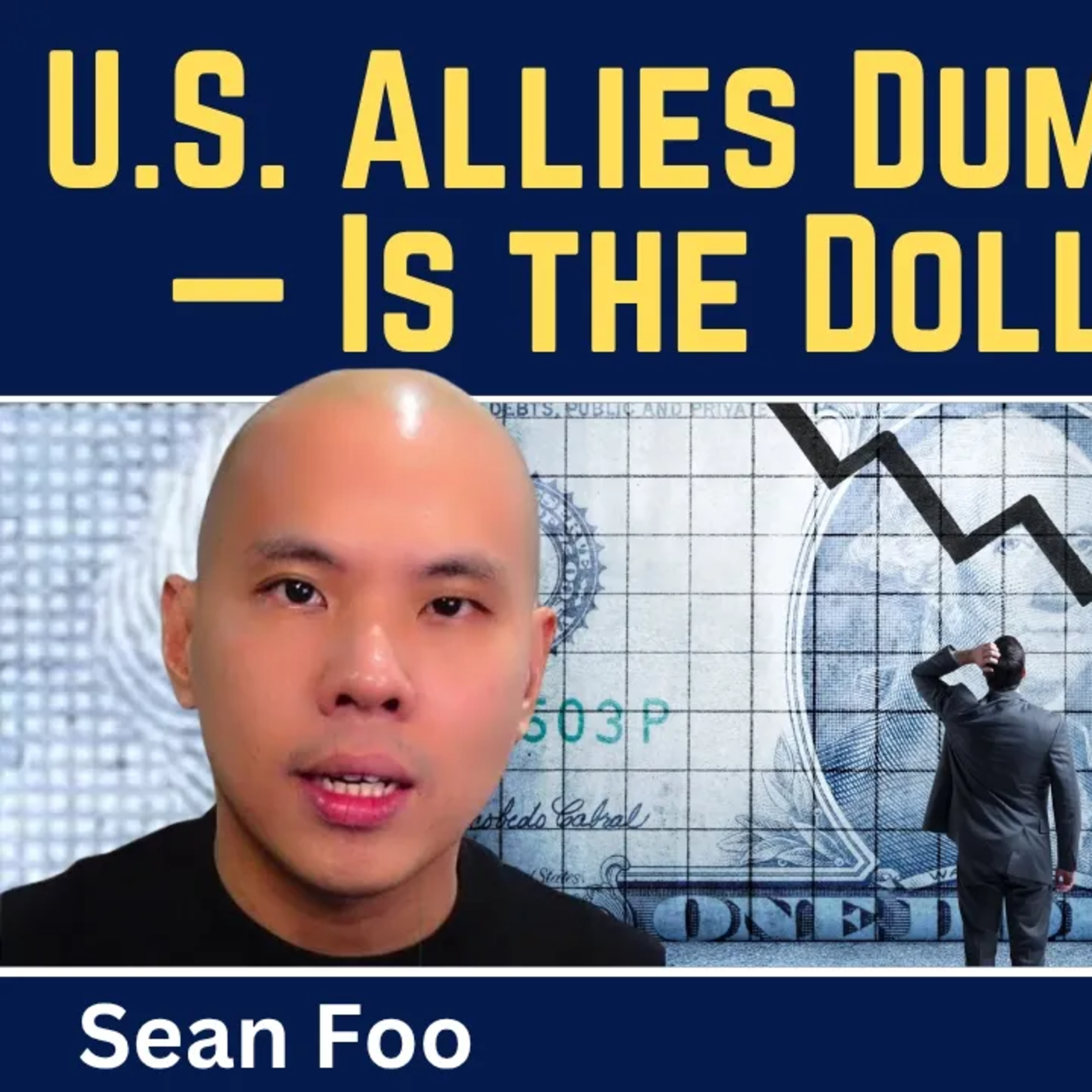
Sean Foo: U.S. Allies Dumping Bonds - Is the Dollar Next?
About this episode
Sean Foo is a financial analyst and a China expert. Foo discusses the intensifying crisis in the US bond market.Follow the excellent work of Sean Foo: https://m.youtube.com/@SeanFooGoldBuy Diesen merchandise: https://diesen-shop.fourthwall.com/en-nokFollow Prof. Glenn Diesen: Substack: https://glenndiesen.substack.com/ X/Twitter: https://x.com/Glenn_DiesenPatreon: https://www.patreon.com/glenndiesen Support the research by Prof. Glenn Diesen: PayPal: https://www.paypal.com/paypalme/glenndiesenBuy me a Coffee: buymeacoffee.com/gdiesengGo Fund Me: https://gofund.me/09ea012fBooks by Prof. Glenn Diesen: https://www.amazon.com/stores/author/B09FPQ4MDL
Get every episode summarized
Each time Glenn Diesen - Greater Eurasia Podcast publishes, we email you a written briefing from the transcript — the topics, who appeared, and any specific claims, with the ad reads skipped.
Email me new episodesFree for 3 shows. No card needed.
Hosts & guests

Transcript ready
630 searchable segments. Every word is indexed and playable.
Full transcript
Glenn Diesen - Greater Eurasia Podcast — Sean Foo: U.S. Allies Dumping Bonds - Is the Dollar Next?. Machine-transcribed; use the interactive transcript above to jump the player to any line.
Welcome back Sean Foujans is today a market analyst China expert and also an important go-to contact for gold I've left a link in the description so thank you for coming back on the program. Hey Glenn, great to be here again. Well I think it's well not an exaggeration to say that the US treasure bonds are the ones that are keeping the US economy alive. However, with forty trillion dollars in debt I think two big concerns emerge for the rest of the world. The first concern being that this debt is not sustainable, the US will not pay back this in full. I mean it will either default on its debt or just print the money and devalue the real value of it. The second concern which is growing now as well is that the declining US weaponizes
its debt that is the dollar and all other economic dependence becomes weaponized and initially I think this was primarily a concern for rival powers if you're Iran, Russia, China or others but now it seems to be coming a growing problem for allies as well as the US keeps talking about being taken advantage of by its allies but also has to uphold this secondary sanctions. We even see them sanctioning our Turkish banks or its economic ties with Iran. I was wondering what are you seeing in the bond market these days? What is the main source of instability? Sure. I think we should take a overarching view of this entire bond market debacle. Right now the US is trying to accomplish too much in too much too soon. We know that they are fighting a war in Iran. We know that they are trying to build back the economy, the industries by getting other
countries to be sure to the United States. At the same time they are trying to drive AI haphazard to keep doing more data centers. Scott Besson himself famously said if China were to win the AI race, it's a game over for the United States. So there's always a lingering fear of China catching up. Now all these activities by self is really quite damaging to the US bond market. It involves a lot of spending. It involves a lot of government deficits. But when you combine these three together, you get a tsunami, a perfect storm of spending. Now there's one commonality that actually underpins the US economy. A lot of people have said it and it's quite true. The bond market leads the markets, it leads the economy as well. Because at the end of the day, the US, they have to spend over $1.8 to $1.9 trillion in deficits. That's how much money they have to borrow. At the same time they are spending like 1.2 trillion, 1.3 trillion a year to service the
debt. Now they have to keep the big tech company spending in order to build all those data centers. The only way to do it is if the bond market is actually kept stable, the bond market is kept happy. But we are seeing use, rise, everywhere from 4% all the way to 4.8% within this six-month range. It's only going to get worse. It's only going to get more horrible. So at this point of time, we are seeing a lot of weird things coming out from the US. Now you see it perfectly right? They are shooting their food, right? They are sanctioning Turkish banks. The God Besson just came out with economic isolation, the big, new global sanctioned blackhead or Iran. But that also once again reminds the whole world of what happened to Russia in 332. We are going to tell the whole world not to trade with you. That if you do, we are going to start cutting you away from the US dollar system. But right now it's called Besson sticking a little further because he is now targeting
more banks. He is targeting bigger institutions as well as subtly hinting that one day Chinese banks will get implicated. So when we look at this whole situation, there's a lot of fear and mistrust in the US bond market and this is only going to escalate more and more, especially when the war in Iran keeps dragging on. But the Japan though, this is a key bond holder and we see the Japanese selling their treasuries from what I understand to defend their struggle and currency for one. But is there anything else behind this? How is this relationship shifting because this has kind of been a pillar of stability for the US economy? Right. Now true that Japan has been a constant buy of US treasuries, I think even today after the dump, they easily hold more than $1 trillion.
But things have really shifted. Over the past two months or one month, we can see the treasury actually telling Japan to do quite a few things. Besson himself, he dumped quite a bit of euros, I think 10 billion euros or so. The euros to buy yen to help Japan. At the same time, I'm sure Washington green-litered Japan to save their own currency by dumping their own dollars. Now the main idea of this once again is to protect the US bond market. We are now at the point that we see China that is rising. They are going to get rid of their bonds every single month. A lot of allies right now, they are a bit on their edges, they are considering, should we just stay with our US bond holdings or should we start to liquidate? We are seeing a lot of threats being thrown around. And most recently we see the Norwegian well-fun, they are considering divesting their US bond holdings. And this is a trillion more than two or three trillion dollar fund and they are looking to sell up to 60 to 80 billion dollars if it really goes through.
So what's got Besson trying to do is to get Japan to say alright, you dumped your dollars right now but you hang on to the treasuries. And we will open this very weird window called the female window where you take your treasuries, you pledge it to us, we will give you cash in response. So the bonds doesn't really enter the open market. The enters are kind of prison, a kind of limbo where it just sits inside the US treasury. And if everything goes well, Japan will swap back the cash. The US treasury will swap back the bonds and no one's the wiser right, it doesn't hit the market. But the issue right now is Japan is also facing a bit of a liquidation problem. We know the one in one is going to last much longer. I think just a few hours ago, most of the day ago, Trump made a joke that the one in one bill will be done by the end of the big thumbs, which is somewhere in November, December. Now the thing is that we have four, five months to go from now to then. We don't know how bad the inflation crisis will be.
The food has obviously rebounded from 80 bucks all the way to 95. I think we are flooding the triple decade oil. Now all this is very damaging for the entire Asian economies, especially Japan, when they are fighting everyone from the Koreans to the Chinese when it comes to manufacturing. Now the issue of Japan's $1 trillion stash is that every time you go up, the value of the bonds go down. So right now, they are in a very weird currency crisis where they need to spend, however the value of the bonds is slowly depreciating. So they are kind of caught in a, between a rock and a half place. So I believe there are some people maybe in Japan, the bank of Japan or the government is taking letters just released some of our bonds right now before it votes value to protect our currency. They end. I think the US right now, they don't really have much say of it because your Japan itself is trying to protect their own industrial survival and I think there's nothing wrong with
that. Yeah, but also if the Japanese economy if they wouldn't do so and something would really crack in the Japanese economy, it's very hard to see this not impacting the United States though. So again, even if you're in Washington, you only have self interest. What do you do at this point? Because, well, the Ducis isn't a similar development with the Gulf States because they're also running out of money. They can't export because of the war that is, they can't get the oil in out on the markets. So wouldn't they also have to sell their bonds and well, what else can the US do here to intervene? Sure. I think just recently, at least three to four months ago, I think there was this idea of Qatar, I was in the UAE, I think was the UAE, asking, called Besson, asking the US Treasury for swap line. So this is something that I could constantly see the US actually do in order to stop some
of the Gulf allies from dumping their treasuries. Now, swap line is quite simple, right? You swap 10 billion derams and the US Treasury will just give you the equivalent in dollars. Maybe that's 20 billion. Now, the thing about that is it just floods more money to the economy. It just drives inflation even higher. It makes the money supply grow. And we are seeing this happen not only through the Gulf States, it's happening. They're trying to help Japan. They're trying to flood money to the system with all their bond buybacks. I think most recently, the US just announced they're not only going to double the bond buyback, they're going to triple it. Right? And just the idea of it itself is booking everyone out. So a bond buyback is basically just a Treasury buying back the existing bonds in the market, especially the longer term bonds, right? The 10 year, the 30 year end of the bite longer dated bonds in order to prevent any commit crash because everything in our lives or our interest rates, our mortgage rates,
our credit cards, they're all packed through the 10, 20, 30 year bond. But this is, this brings us to a even bigger quandary. Now, where are they going to get the money to buy all these 10, 20, 30, 30 year bonds? The United States still needs to borrow it. At this moment, they just can't print the money, right? If they print the money, the dollar would just tank all the way to oblivion. So they're going to borrow it. And they need to borrow it from short term bonds, right? So you're borrowing a bond that's going to mature in one month, one year in order to VD of bond that's going to mature in 10 years, but controls the whole economy. Now, this is where the big Iran question comes into our play as well. You know, yes, maybe the bombings, the big strikes have stopped, but almost is still shut down. Maybe you're seeing Iran hammering some facilities of the Gulf. I think most recently we heard that Saudi Arabian refinery has been targeted. So the oil price of oil goes up. Now inflation in the United States in the world is going to stay sticky and that's prompting
the Federal Reserve to consider rate hikes. And rate hikes affect shorter term bonds. So throughout the yield curve, wherever Scott Bessel wants to borrow, whether he wants to borrow a medium term bonds, whether he wants to borrow it in a short term, or whether he wants to risk at a common implosion and borrow on it on the long end of the curve, he's completely trapped. So right now we are seeing a big scramble for some sanity, but this is just not coming. Well, well, I suggested that Iran war is obviously driving a lot of these problems as well, at least intensifying it. And despite the basins and trampry assuring us that all peace is breaking out and the oil prices will drop, we're winning, we're winning. We see that war against Iran is escalating without any real possible settlement or any path to victory here. And with escalating, we'll also see now recently this attacks on oil mutual attacks on oil
tankers. And this also can escalate now further into attack on the more permanent structures, that is the energy facilities, refineries, and Iran warrants essentially that it can destroy everything in the neighborhood if U.S. attacks its energy facilities. And as you said, Yemen launched now the largest attack they were done on Saudi Arabia. So yeah, we'll add one more. Iran has announced that we'll say they will soon announce a restricted zone which pushes the U.S. further out. I mean, these are a lot of developments, all of which kind of huge economic consequences. And indeed, this is where openly Iran's calculation, they make it clear, they can't defeat the U.S. army, but their strength is being able to put pressure on the U.S. economy, which they are. So how do you assess this development, though, this escalation?
Well, I think it's obviously working. We are seeing it in the numbers, right? We just need to look at inflation numbers. We just need to look at the bond yields. I think Gali Bav came up with a social media post talking about the lost decade of the U.S. economy. No, I don't know whether it's going to be a lost decade, but then there's a lot of points of weakness, right? We are seeing stocks and the markets starting to correct down because valuations are just so high. A lot of AI stocks themselves, they're all getting wobbly. A lot of companies and employment numbers are so getting quite wonky. So I think what Iran is actually doing is it is perhaps the only car and the best car they're playing with. Now, wouldn't really work. I don't know, but it looks that it's going to force the U.S. to a really big decision, at least in the midterms, right? Where the Trumps, party wins, where the somehow there's a very big rebuff on the one Iran,
but I think it's going to force a reaction sooner or later, especially in the midterms, if this economic trajectory continues. Well, while they run in strength, it's to put the pain on the U.S. economy, the U.S. strength is overwhelming military force. So that seems to be the go-to answer for the Trump administration, just bomb. But it's not going anywhere. So I don't know. I just feel this is spreading more and more in the region and economic consequences are just growing exponentially. But again, going back to the, let's call it bullying of allies, at least Japan is getting some proper treatment from the United States. Closer to home though is Canada, which the U.S. continues to threaten, not just in terms of security, but economy. And I find it noteworthy that the Canadian Prime Minister now refers to the U.S. not
just as a challenge, but as a threat. Again, they are increasing their tariffs on the U.S. The President is very dismissive. He refers to this little poodle which can't affect us. I mean, what is the situation really like to? Because this is an important partner of the United States. Right. Well, I think this standoff is not going to end well for the U.S. Now, firstly, Trump has promised Brimstone and Fire on Canada, right? A 50% tariff. But if you look at the details behind it, it's only going to take effect after the midterms. Right? On 1st January, 2037. So Trump himself knows of the impact of imposing a 50% tariff on one of your biggest trading partners up north. The U.S. imports a lot of things that they need for their economy, especially when you're building all those data centers. Now, what are data centers made of?
This is made of aluminum. It's made of steel. And a lot of this raw inputs comes from Canada. So just imagine you importing all those from Canada. Prices goes up by 30 or 50%. This is just going to or price out the imports from Canada. So your own local producers, they're going to charge more obviously. So right now, the prices all goes up. Spending goes even higher. What happens? The AI companies themselves, they are forced to borrow even more. So you have more bonds completing with the treasury. Now, that isn't good for for anything. And another big import that the U.S. buys from Canada is oil and gas. Right? It's quite surprising, but the U.S. actually imports a ton of their supply from the Canadians. And for over one to two decades, at least 10 to 20 years. Canada has been selling them enormous volumes at great discounts. The discounts can be anywhere from 10 to 30% depending on the location.
So if that happens because of that, we are seeing a lot of subsidized oil, gasoline, diesel, that the U.S. refineries are turning out using Canadian oil. And a lot of this Canadian oil, a lot of this refineries are specifically engineered for heavy Canadian oil. It's not like you can just get a shipment from the Middle East, which is very doubtful at current points in order to get all these heavy refineries to crack them into lighter materials like gasoline and diesel, unique Canadian oil. And Trump is also caught in his own web of lies or maybe web of delusion. Now I think we all remember the big Venezuelan deal that Trump just closed or just imposed on Venezuelan depending on how you want to see it. And on the details, it's great, right? It's like 50 or 80 billion barrels under the ground.
The U.S. is going to create a joint venture that gives them 51 or 55% of control. Effectively, Venezuelan must sell them 20% of the crude at cost price, which is $19 or $20 a barrel. And at the same time, the U.S. has the first bite of refusal for the remaining 80%. Now that's great. However, Venezuela only produces like 1 to 1.5 million dollars a day. And in order for that to ramp up, you need to spend hundreds of billions into the industry at the ramp up. It's going to take years. So for heavy Venezuelan crude to replace heavy Canadian crude, it's going to take some time. So I think right now, Canada also sees the right thing in the world. Now let's wonder if I think Kanye is also taking to himself with his oil minister or energy people. What if the U.S. actually poses off? Let's say what if the U.S. really manages to get Venezuelans production up to 3 million to 5 million to 8 million or whatever? Maybe they managed to create it into a mini, mini Russia that exports a lot of oil to the U.S.
So Canada right now, I think they understand that this is perhaps the break off point that we need. We need to start signing deals with Asia. We need to export more oil to China. I think just recently they announced like a strategic partnership with the EU, with Europe. So I think Canada is firing on all cylinders because there's really no hope of a steady trade policy. At least we did the next 2 years. And if you don't do something now, after the 2 years, Venezuela might be fully operational as part of the U.S. Empire. I mean, U.S. economy, obviously empire here. So I guess Canada right now they're playing the cards quite smartly. Well, on Venezuela though, how, I mean, the U.S. spent so many years trying to sanction its energy in the street down to the ground. And now of course they have to build it.
But all of this is premised on, I mean, the willingness to invest would be the assumption that this will be stable in the future as well, which is a bit, I guess, uncertain if you're essentially kidnapped or president and holding their country hostage. So it's, I don't know, it doesn't wreak of confidence. But nonetheless, the U.S. seems quite determined to develop Venezuela as a key exclusive supplier. But what is the extent of this U.S. control over the Venezuela market and how, I mean, do we have any numbers on how much they actually get from Venezuela at the moment? Because Trump keeps on one hand bragging about how they're getting all of Venezuela's oil now. But at the same time, he calls it, you know, it's well dirty. It takes a, it's quite expensive to, yeah, to process. Right. Well, I think they are getting some volumes for Venezuela, obviously.
We do not know, we also do not know the full numbers. I mean, exports from Venezuela to China has dropped dramatically. So the Chinese aren't very happy about it. Will this, will this oil deal with Venezuela really, continue materialize? I think it's all based on whether the U.S. can actually sustain their economy for the next one to two years. I think you have to remember that all the oil companies they have, they are going to pledge a lot of money, a lot of it is going to be borrow money as well to develop Venezuela. Now, even if the government, Venezuela doesn't change or they are very compliant, I think the U.S. economy itself is going to be the big factor of whether this deal continues. We are getting a lot of mixed messaging for the administration right now. Trump, the person, they are all calling for 30 to $40 oil after the Iran crisis ends. Now, will that happen? I'm highly doubtful, but if it does happen, 30 to $40 oil is going to destroy U.S. oil producers themselves.
And if that happens, where are they going to come out of the money to fund Venezuela that which is right now at best a crap shoot? So I think this deal is very questionable at best. And in my estimation, I thought things were going to end well. Well, again, pivoting back to allies. Another country which seems to be cutting the bonds would be Norway. Now, this is a very small country. You wouldn't think it had that much relevance, but Norway also has the world's largest sovereign well fund. And they are also planning now drastic cuts in U.S. bonds. I guess for many of the same reasons. But like this, as in all the others cutting, where is the new money going? I mean, they have to redirect this somehow. Sure. If we look at the numbers from the Norwegian cut from the well fund cutting,
I think they've identified two places that they're going to put it in. Now, the first place which is quite funny, but understandable is they're going to dump U.S. Treasuries. Or they plan to dump U.S. Treasuries to put it into U.S. dollar corporate bonds. So basically that means you sell treasuries and maybe you put it into the bonds of, for example, Microsoft, you put it into the bonds of Google that's going to use the money to build data centers. Now, why are they doing that? It's because they use are simply higher. There are a lot of well funds today. They're all thinking right now we are in a rush for you. Yes, the U.S. Treasury is yielding 4 to 5%. We're slowly moving up to 6%. But we still need more yield because our countries are getting hammered by higher inflation. All the prices are up by 20%, 30%, and the rest of the constituents like diesel, gasoline, they are all up by 40% to 50%. It's actually much worse here in Asia as well.
So I think a lot of these well funds, they're going to move their money to places where there's a higher yield, places where the counties are also going to appreciate. Now, it's quite interesting to see the Norwegian fund. They are also going to double or maybe increase their Japan bond holdings by 50%. Now, why are they doing that? And I think it's for two reasons. Now, the first reason is that own goal by Scott Batson himself. I think two weeks, three weeks ago he was demanding Japan increase their interest rates. Increased interest rates not because he loves Japan, not because he feels they're equal, save the yen. Partially because he would save the yen, because if he saves the yen, he would prevent Japan from dumping treasuries. So everything just filters back that. Now, the big issue with that is as the yen, as the Japanese bonds goes up in yields, it makes the yen more attractive. And just recently we saw the yen appreciate quite a bit against the dollar as well.
So I think the Norwegian fund is saying, okay, why should I hold dollars which is going to depreciate? Maybe the use goes up, but the value of the dollar is still going to go down in order to protect the US bond market. But in Japan, at least for now, I see the currency going up. I see bond use going up. So I get a double tailwind. So I think this is what the Norwegian fund is actually taking off. Now, of course, there are some places in the rest of the world like China, they are diversifying elsewhere, they are buying record volumes of gold. That's the game they are playing. But I think the Norwegian fund, they have their own considerations. So I think they're just hunting for stable currency, they're hunting for more yield. Yeah, it's still an interesting sign when they are dumping US bonds in huge numbers, because it's not just an economic decision. One, it's also having their security tied to the United States. Once they decide to make this, it means that things must be really serious,
because they have other considerations if they would have reasons for not doing this. But as you suggest, the big elephant in the room though remains China. And how do you say China fitting into all of this? Because from what I understand, it demands for oil is growing again. Also, we don't hear much about the economic war with the US. Well, that's not really true. The US keeps making it clear that one of the big benefits of the war on Iran is that the Chinese are getting less oil. So they're not shying away from pointing out this target. How does China fit into this? It's economy, it hasn't stopped. I think China right now, as you clearly pointed out, they are buying more oil from the economy, because I think they've figured out a few things. The US has more control than Venezuela. The US is also maintaining their blockade on Iran.
We do not know how long this crisis will go. And China, although they are powered, I've specified, that we feel the stockpiles right now before prices go much higher. I think China's looking at it from a much strategic view. I think they can also clearly see that the US SPR, the strategic petroleum reserve, is also draining much lower. So we could come to a point where there could be a squeeze on oil prices that actually sends it up much higher if the US gets forced to buy back. Because obviously you can't let the SPR drop so low beyond a certain point as well. So I think this is one reason why China, they're trying to frontrun the markets right now. Let's buy as much oil as possible. Let's ramp up our volumes. We don't really care if prices goes up because we need to secure our own economy. Now recent data from China just came out and it showed that their exports are back up. China recently enjoyed a trade surplus of $800 billion, which is a lot of money.
And as we all know, a lot of this money is not going to go to the US to actually bonds. If any, it's going to go into their own AI sector, it's going to go to the BRICS countries, it's going to go into coal, of course. And this is one reason why the US keeps all they are doing right now. It's just shooting themselves in a foot. The war of Iran is making every country poorer. The trade war with Canada and the 10%, which still exists to the rest of the world, is also making everyone poorer. So in this instance, everyone needs to lower their cost of living. That's for the common, that's for people, people like you and me need to reduce our cost of living. And for the factories, they need cheap inputs. And it's very, very hard to get anything in this too, if it's not coming from China. That's why China is just benefiting from this war. It's quite weird in a sense that the US has lost all the traditional tools of economic competition against China.
The biggest, I think me and you, we had this conversation a year or two years ago, talking about how the US can always endlessly borrow money to find the AI wall with China, while China, you know, they can stretch their dollar further. I think they had this conversation before. Well, the US has effectively lost that tool. How is the US going to come out and say, we are going to borrow $1 trillion in order to fight with China? Use was shot up to 7%, everything was just collapsed, and the S&P would be down by 30% in half a day. So it's not going to happen. And I think because of this, the US is really losing the grand competition with China, thanks to a confluence of the trade war and more importantly, the war in Iran. Well, with this, the failure to compete now with China, that kind of spreads the problem more expensive even further, one of the key objectives of the United States has been to get its industrial might back,
that is, disreshoring the re-industrialization of the United States. This is, yeah, this is essentially how Trump would measure his success, and he hasn't really been able to do this, but also the technological leadership, as you said before. This is, if they can't win the tech competition with China, then it's game over, I think that was your word. So, but the AI sector is now wobbly, when energy prices goes up, it makes it much more difficult to expand these data centers, and then don't have the cheap energy as the Chinese have. But also, yeah, as you said, the AI bubble is getting expensive, and it's not going to sustain itself necessarily. So, how serious is this, though? Because, again, the AI bubble, if something goes wrong there, that's the entire stock market in the US getting wiped out. So, I don't know, I assume that panic must be setting in in Washington at the moment.
Sure, I think we can both analyze this from both the US and China's perspective, because both of them have extreme vested interests, and neither of them is going to stop spending, neither of them is going to stop competing in this. Now, for the US perspective, I think a lot of people don't realize that the rate of the US debt borrowing is rising much faster than US GDP. So, let's say the US GDP rises at 2 to 3%, the debt is rising at maybe double that speed. Now, that's very horrifying, and it shows that sooner or later, the United States, they're going to reach a point where they are either going to default on a debt, remember what Trump said, we are going to use military intervention to secure our bond market. Now, whatever that means, I have my own thoughts, how are that means? We can score quite obvious, but they could come to a point where the US just points a mini finger to bondholders. Now, we're not going to pay you back what you're going to do, you and reach army, right?
So, that could be one way, or the more likely way, like 9%, I would say, they're going to um-twist the Federal Reserve to do debt monetization, to slap my new fighter on it, or I don't know, Trump easing, and then they're going to print trillions of dollars to fulfill bondholders payments. Now, what that does is just going to destroy the bond market, it's going to value the dollar. So, what the US right now is trying to do is they are trying to run at top speed in order to achieve, I think what Jensen Huang just claimed that they have achieved AGI, artificial general intelligence, and that's where intelligence just trades itself, it's on itself, and becomes a whole overwhelming monster. Now, the problem, I think the US really wants the rise of the machines in order to drive productivity so higher, so much that it creates so much growth, of the overwhelms, how much debt they are growing. Now, I'm not saying that is not going to happen,
but the US is putting themselves in an extremely vulnerable position. And while they are trying to achieve AGI that actually works, they are destroying the dollar, they're pushing the bond market direct streams, and because of that, everyone speculating in the US stock market as well, because, well, if AGI works then stock should go up 100%, right? 50%, so everyone's putting their money there. So, that is the US vested interest, but that interest is also being counted by China. Now, China can clearly see that their life line, their sanctions shield is to become, to retain the spot of being the biggest exporter to the world. So, the Chinese engineers to keep exporting more and more and more, that's why no amount of cable banging from the Europeans or from the Americans telling China to stop exporting is going to work. It's not going to work. China is going to keep exporting until the Kingdom comes. This is just the name of the game. Now, why China wants to do it is because if China's the top exporter to 120 countries,
how are you going to sanction China without sanctioning the world? And if China manages to reach a point in AGI, that they can supercharge their factory, they're going to export more obviously, but at the same time, they are going to create an enormous demand for their own chips. No Huawei chips, there may be a generation behind, have a generation behind, but then they're slowly catching up fast. And once they reach a tipping point, they'll be able to surpass US chips when it comes to the power of the chips as well as the pricing power of the chips. And once that happens, China is going to do what China does, they're going to flood the world with chips, especially the emerging markets first. They are not going to tell the countries to pay in dollars. They'll take the Chinese yuan. And just by that alone, it's going to cost a lot of chaos in the US, because that's going to drop dollar demand. So I think both sides have enormous vested interests on this to work.
Well, that's been an ambitious comment, though, that is when I asked about how we're going to repay $40 trillion, he's answered us, well, we'll grow our way out of this. It's not a plan which gives you a lot of confidence, but of course, on the other hand, one should be on the set, we're living in a very unique time in terms of technological development. If all this automation really starts to develop in a massive way, we could see unprecedented growth, but still this 40 trillion hanging over the United States. This is very problematic, because it's not just a problem in the future. If they want to borrow more money now to ramp up production deal with the energy issues, they can't borrow money cheaply anymore, because well, you can't do when you have this much debt. But also on another area, though, is that reducing trust in the US
is not just manifesting itself in selling bonds, but we also see even allies pulling gold out of the United States with the subtext being, we don't really trust Americans holding our gold anymore. So meanwhile, the Chinese, I think, are still stacking up reserves. Why is this important? This is one of your key areas, the golden silver. As I said before, people should check out your page on this. But why is the golden silver so important? Well, I think it boils down to what everyone, every gold stacker knows. For the last 20 or 30 years, if you don't hold it, you don't own it, gold has zero counter-party risk. I'm preaching to the choir, gold has a limited amount, so they can't be inflated away, and no central bank can print it. Now, all these basics, but the basics still apply. The basics are still paramount.
The problem with the US is that they can just print as much money as they want. Chances are they will be forced to do it down the road. Now, in 2008, the US printed at least a trillion dollars in order to save the housing market. The US printed at $3 trillion in 2020 within half a year in order to prevent the pandemic collapse, the lockdown collapse, and after that, they printed more. So a lot of countries are realizing, okay, at the end of the day, a true hedge against what the US might be thinking of doing is to hold our gold. It is to buy gold. That's why we are seeing a lot of moves from the Europeans, from France selling their gold in the New York Fad, and we buying it back in Europe. From, as you see, the Dutch central bank, they sold, not so, I think they moved their gold from the US all the way to the UK, because at least it's closer to your jurisdiction. Now, of course, the Dutch central bank say UK is a gold trading hub,
but I think the main reason is to get themselves closer to the gold. Because you do not know really what's going on in the US. There's a lot of speculation that the gold in Fad Knox might be unaccounted for, although people have said they have gone to see audits, so we don't really know. And what's to say in a time of crisis, the US might not start to monetize all the gold in the country, including those of the allies, they might do the same gold window shenanigans again. Okay, we're going to buy all the gold right now at a market price of, say, $5,000 in ounce. And once they buy all the gold, the US might say, hey, we're going to reprise gold up to $20,000 in ounce to wipe out our debt. Now, of course, that is going to benefit countries like China that owns a lot, but the US is essentially sitting on supposedly 8,000 tons or more, plus allies may be 10,000 tons, so they're going to benefit from it as well.
So I think a lot of allies, even Europe, they're beginning to see this risk. It is a tail risk, but we are living in the era of Trump, right? There's no such thing as tail risk, it's just a risk. So it's time to just protect yourself. So I see this why we are seeing these big exodus of funds, exodus of gold all the way from the United States to Europe. So you see our gold prices potentially exploding up to $5,000 in ounce. I think the trajectory of what we're beyond that, what's going to say? Yeah, they are definitely beyond that given the amount of spending, competition. I mean, if the whole stock market collapses, if we enter a depression or recession, then of course, the gold is going to collapse as well, right? It is a reserve asset, countries will liquidate gold to get cash to buy what they need. But bombing debt, I don't really see a scenario where gold will just collapse on its own.
I think it's going higher. Yeah, and the world is my last question. I mean, the big thing is, of course, the US dollar. And if the US goes into a massive economic crisis now, over its bond, over the AI market, beginning to falter, this stock market, whatever it is, the ability to simply print your way out of this trouble, as you suggested. They're not really there anymore, as there would be too much pressure on the US dollar. How do you see the stability of it moving forward? Could you see a gradually weakening over time, or could we actually see a massive drop in terms of collapsing the value of the currency? Right. I think a massive drop really is contingent on the strength of the US economy, strength of the bond market.
I think gone are the days where people would just run to the dollar as a safe haven. Because if the bond market collapses, if the stock market collapses, if the economy enters the recession, we kind of know what the playbook is going to be. Interest rates will be slammed to zero no matter what. Eflation might be allowed to run hot and trillions could be spent. So that itself could create a collapse in the dollar strength. But I think going forward is more likely we're going to see a gradual reduction in the dollar going forward, maybe losing 2% this year, losing another 3%, 5% and next year. I think everything points to the US spending more. The US trying to flood the market with more dollars in order to get people to buy treasuries. The US simply trying to keep the AI data set up build out stable. And the only way you can do it is unfortunately for Americans, a bigger dollar. I don't really see how the dollar can go stronger unless some kind of pretty bad happens.
Actually, let me squeeze in one last last question. Europe. I should have asked earlier that is for all the problems of the United States, it seems to have some resilience at least. It has financial power, it has technology, the digital platforms. I mean, it does have a foundation in Europe, it appears that the entire economic model they've had at least since the Second World War, it's all, well, its foundations are melting away. But I'm not sure if you see any possibility for revival. I guess for a long time, Germany was the economic powerhouse driving Europe forward. Now it's the industrializing, again, it would have to reinvent itself in somehow. So far, it seems to only plan in Germany is to, you know, let's build tanks instead of cars. But that's not really a great long-term option. So how do you assess the economic health of Europe?
Sure. I think you're right. Germany building tanks, that's just a stock get measure, right? How many weapons can can Ryan Mateo make in order to stabilize the European economy? I think there's a big reason why Trump and Besson, they so angry with Canada, especially after Canada started saying that, oh, we're going to work together with Europeans. Now, last year, I think there was an article saying, or Trump making a statement saying that if the EU were to work together with Canada, we're going to tear off them all the way to oblivion. So I think there's already an underlying fear that if Canada gets their act together, they will be able to help revive the EU to a certain degree. I think right now, we have already given up hope that the EU is going to buy Russian oil. I think he would have happened. It would happen by now. Maybe it will. I don't know whether the rise of other parties in Germany could change things.
But I think as of now, it's off the table. However, if the connection between Canada and Europe really goes through, if somehow, I don't know, Canada invests in their own oil export or Europe invests in them, and there's some kind of long term deal where Canadian could go mainly to Europe. I think we could perhaps see a stabilization of EU industries. Just to be realistic, I think EU is still behind a lot when it comes to AI is still behind a lot when it comes to innovation. They're still facing export giant China, but I think they would be able to. It will give them a much better breeding room and longer runway to figure the next step out. Well, I've heard of the terrifying news these days that it's something possible positive, so I'll take that. Well, it's a great pleasure, as always. Thank you so much for taking the time.
Thanks, Glenn. Good to be here. You
More episodes
More from Glenn Diesen - Greater Eurasia Podcast

Peter Schiff: Economic Armageddon - Bonds & Dollar in Crisis
Glenn Diesen - Greater Eurasia Podcast

Douglas Macgregor: U.S. Defeated in Iran & Israel Will Not Survive
Glenn Diesen - Greater Eurasia Podcast

Scott Ritter: US-Russia Negotiations Are Dead & the Leipzig Drone Attack was a F...
Glenn Diesen - Greater Eurasia Podcast

Paul Craig Roberts: Putin's Mistake - Letting the West Attack Russia
Glenn Diesen - Greater Eurasia Podcast