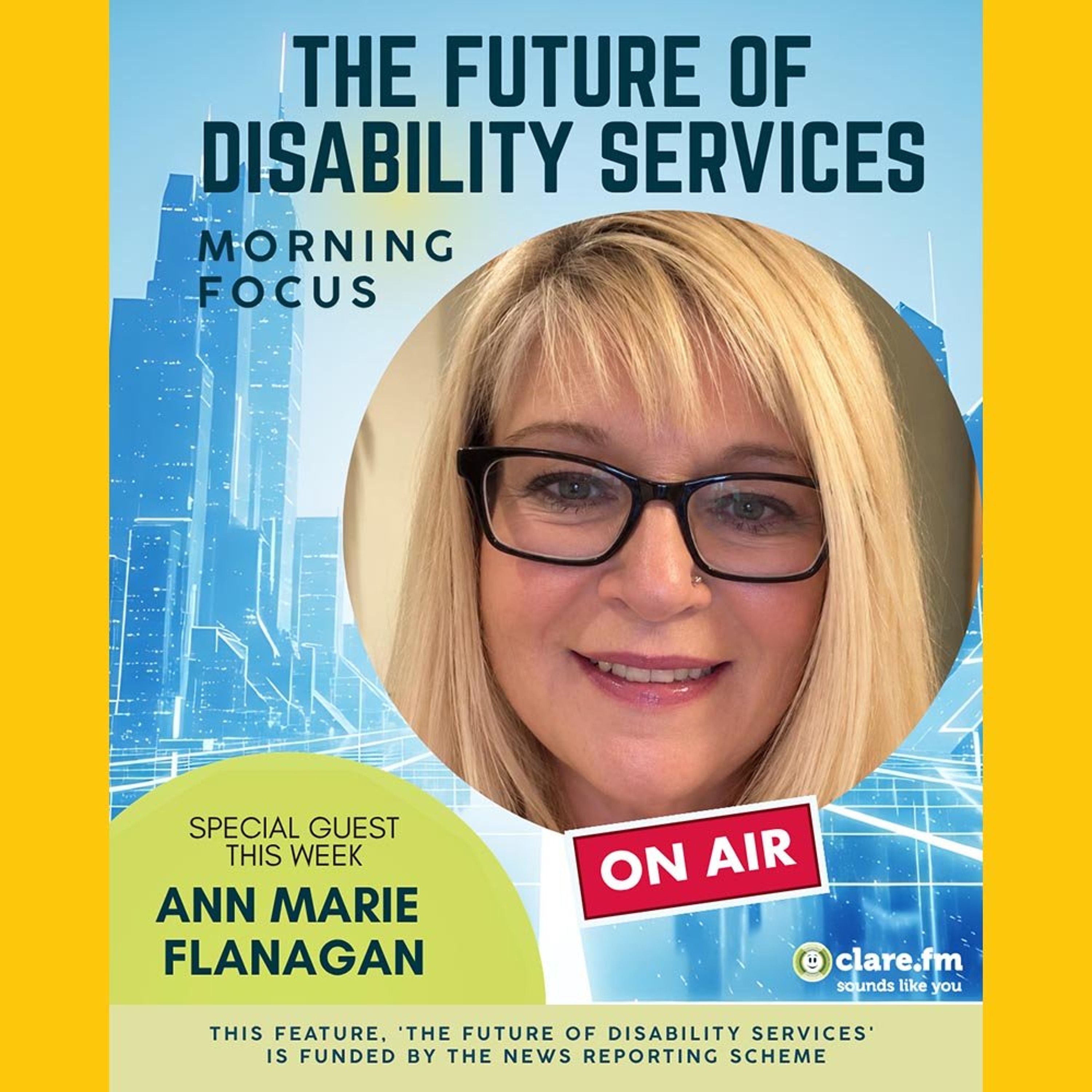
The Future of Disability Services - Week 1 - Disability in Clare – An Overview
About this episode
Get every episode summarized
Each time Clare FM publishes, we email you a written briefing from the transcript — the topics, who appeared, and any specific claims, with the ad reads skipped.
Email me new episodesFree for 3 shows. No card needed.
Hosts & guests

Transcript ready
109 searchable segments. Every word is indexed and playable.
Full transcript
Clare FM — The Future of Disability Services - Week 1 - Disability in Clare – An Overview. Machine-transcribed; use the interactive transcript above to jump the player to any line.
This feature, the future of disability services, is funded by the news reporting scheme. Welcome to this week's episode of the Future of Disability Services on ClareFM. The Disability Act 2005 refers to disability in relation to a person as a substantial restriction in the capacity of the person to carry on a profession Business or Occupation Investate are to participate in social or cultural life in the state by reason of an enduring physical sensory mental health or intellectual impairment. Across Ireland, a large number of organisations, both statutory and voluntary, provide a range of services to assist persons with a disability. A lot has been done over the years to improve these services, but accessibility continues to be a serious issue and further significant efforts are needed.
Ann Marie Flanagan is a disabled woman, activist and co-founder of disabled people of Clare and the Clare leader forum. Originally from Cardiffin, she was born with her impairment and uses a motorised wheelchair to get around while she also has a personal assistant to enable her live her life. Ann Marie campaigns strongly on human rights with a particular focus on the rights of disabled people not only because of her own living experience, but also after witnessing the discrimination and ableism that she and others have to live through even after all the years of campaigning. My first realisation came in two ways, one with puberty because as we know young people start to see the difference in themselves and I did, but profoundly on my very first day in secondary school. Right up until that moment I lived in a lovely work and class health and a state in Coruffin.
I was surrounded by the most incredible family, both my immediate family and my extended family and all my lovely friends and neighbours. I can't speak highly enough of Declan Keller, who was a brand new principal in Coruffin when I was in junior infants right through to sixth class. And again I speak all the time publicly around he and my family enabled me to live a life equal to everybody else, but the shock and the horror and the realisation of societal attitude, of how disabled children and adults even back then, I'm 53 now, or treated so differently in such a minimalistic way I felt now when I look back I'm able to see it as quite a humanised I'll be honest with you. I had unfortunately, I had five years that I used the word hell regularly when I reflect on it and I was excluded from everything. And in 2017 I was asked to be a keynote speaker at a feminist conference and it happened to be in Donland on Chlor.
And I was quite moved because it was the first time that I was in the Donland as somebody participating in an event as people might know I come from a singing family background. I don't think I ever sang a note when I went to the class there. I didn't participate in debates. What I did do was to join the Senfins and Nepal Society which was part of the class there. And I used to do the Hormer Club with Traver Children and that felt as people will know me now I was at home there connected with others I suppose were marginalised. But again of course not being seen myself as that in the time I didn't have the analysis I was just going through it if you know what I mean. Quite a resilient human being from the day it was born. So the harm that was done to me became clear probably later on if you know what I mean. So things like my academic studies were absolutely impacted. I remember my mother going to a parent's teacher made my think it was in first or second year.
And because just of the ignorance of the teacher not to do with my poor results or anything but one of the teachers pointed out to my mother that there was an ink warts special school. Over the road and why wasn't I going there. Now when I look back even how disrespectful it is to people who do go to schools you know what was that statement what did it mean even if I needed to go there you know what I mean and why. And one can say that was a long time ago it wasn't really that long ago but. Was all that thought I'm renowned to ignorance? Oh no totally different. Different time of course but still there should have been some sort of understanding there of what you were going through and maybe others like you. And listen I never like representing the victim side of it of course that's not what it is but it's being able to see it and to look at the journey of where I was then as a 13 14 15 year old. I repeat my leave and search in the Christian brothers in in a stymon and it was I always say it was the recovery I needed.
I mean the principal brother Hayden and all the teachers Jerry Sexton who in all the world non DJ and all the others and the students my brother my cousin and all my lifelong friends those lads were just fantastic. So I can look back and go yeah there are cultures in certain schools even at the time and that school to be part of a small rural school stood out to me at the time or remember brother Hayden every Tuesday and Thursday when the creamer heaps on he really acknowledged he was. Teaching a lot of lads that actually their parents had responsibilities with farming and if they weren't at school on those days he never humiliated me and I remember him sitting down when we were filling up the CEO firms call and a cup of the lads that we're going back to farming but he set with them filled up those CEO firms on an equal basis with everybody else. I just remember that feeling of respect and to be 18 and to have that respect after what I would call quite a traumatic experience previous was actually it was just a moment and time was perfect because it gave me back those feelings I had when I was in primary school and when I was in my community when who we all were was neither here nor there.
I mean when I look back I've met incredible humans that have enabled me to move on from maybe some of the challenges that I faced as a young person and I'm always grateful for them. Are you anybody angry though and worried that you were treated differently or do you appreciate now but it was a different time. Both I'll be honest with you I was at the clear disability pride workshop the other day and Magicala and was leading the workshop and a lot of these themes came up when we were saying how these feelings run concurrent you know and and so I have of course an understanding because again in my own work over the years my career has led me into working with people who experience mental difficulties women who experience domestic violence etc and now we understand drama so somebody could meet Anne Marie Flanagan and I'd be having the chats and the crack and you'd never know and then I might come up against a service that I believe should be accessible and I can go from not to very frustrated and angry and I don't like that it happens of course I'm more aware of it the older I get that's drama you know that can get triggered at any moment in time and so having an understanding of that is really important
and even looking at the disabled people's movement or any marginalized movement where people are carrying our own living experience activists within it. There isn't actually a lot of time to attend to the individual or the collective trauma and so that sometimes we can come across quite robust or almost people describe it as aggressive when it probably is in the middle of just frustration and the human condition and the right to expect to be treated equally. Were there any other in your environment growing up who may have been in a similar or the same situation as you in terms of being impaired? So in terms of physical impairment would you believe it in a school of 900 girls I couldn't see anybody but yes of course there were girls with probably learning difficulties or emotional difficulties or probably artistic who needed support and I suppose one jumps out at me and I was quite bullied by her and I look back now and actually I meet with old school pals
and we bring up that person's name regularly with a lot of compassion in our hearts and almost outbreak that their needs weren't to tend to tell in a way that would have helped them. And what's ironic is after a day of being exposed to her abuse something happened to her and I always waited for a lift to my aunt because I didn't have access to school transport and she came to me and I remember when I could see her coming in the gate freezing but she knew I was the person who would listen so she sat with me and talked to me about stuff that was gone out. I was very emotional to realize that she was gone through that and I was just the easy character at the time. Again it's really interesting I've got a 15 year old son. Now we're really lucky because he's academically able to manage. He gets on great and everything but because of my own experience I watch out for the kids that are more vulnerable and we talk about that a lot at home and to have a sense of empathy and understanding.
And if I saw an injustice in school even if I'm not the parent I would actually bring it to their attention. I've rarely spoken to the primary and post primary schools that I would be connected to and just always reminds even teachers. There's a lot going on. Be careful how we communicate with children because mental health is such an important thing to talk about. And often we wait until someone's in crisis before we respond but maybe we all have responsibility to train children with respect and hope that they can respond back. It is reciprocal. So I'm glad that I have that compassion for the person because it enables me to not carry the added one of I was bullied because I know what was going on. I can see the bigger picture so I don't know pain around that at all other than wondering how she is today. When it comes to the whole issue and Maria back accessibility in terms of being able to go where you want to go. Going back maybe 30-35 years ago when you were finishing school.
What accessibility then an issue? It was a huge issue. Again for me looking back youth was on my side and also my attitude to life was on my side as well as wonderful people around me. So bring those three things together and I got over every hurdle, every barrier. Going to Brandon's upstairs the leds carried me up. Going to college I remember I had no beer, I had no motorized wheelchair and it was just the CIA buses but by goodness I just worked around it and find solutions. For example I was in digs we had these rooms and the wonderful woman on the house said to me on my first speech I was going to be asking people to push up and down to the college. You won't make many friends that way. Because of course for me I was after coming from home and that was the norm. So she quietly went to the college to the chaplain who was also in responsible for putting a few bob for the benevolent fund.
So rather than turning it a charity event for me to buy a motorized wheelchair, would you use one? I mean I'm pretty thought about it because again that's another point. Like ableism and the idea years ago that we had to do stuff for ourselves rather than adjust society. That's the social model of disability. So of course I grew up with I had to try and push myself or do everything no matter how long it took. So anyway the fund raised and they earned a lot of money which was sufficient for my first motorized wheelchair plus the benevolent buncher I was very popular in college for that year but I remember that feeling that of somebody for the first time in my whole life walking beside me and me independently moving. So getting over the hurdles in the barriers so there was no such thing as ramps and lifts and everything was stairs. There was no such thing as sign language interpreting for deaf and deaf hearing. A lot of people are visually impaired and blind who had a relationship to a couple of organizations. But that everything was barrier barrier barriers. But I do think there was a bit of resilience for some people and for others there was a lot of harm.
When then did it become clear that the whole issue of disability had to be taken seriously? Well I suppose I'm very very proud to have been part of founding disabled people's movement here in Ireland and in clear indeed. So I think there was an Irish awakening anyway around social issues for women and then I suppose many of us disabled people. We were seeing what was going on across other parts of the world and the American Disability at the Independent Living Movement Personal Assistance. And so there were incredible people like Martin Nuckton and Donald Hulland and our Geryling Dermott here who passed and I was very young, I was just finishing college. And so here in clear we set up the disabled people of Claire and nationally was the form of people with disabilities and the centre of the individual living. And we were the first three DPO's as they're called nationally and then more flourished. And of course the stronger we got to campaigning, we were able to highlight the issues.
We now know the expression nothing about us without us. And so through that great work we were able to highlight what was going on internationally, what needed to be done. And we're campaigning and so it was affecting change. And so we are 21 years into the Disability Act which is a terrible act. But in it it did put the responsibility on local authorities or the state as part of the building regulations. So if I was to choose one outcome from that piece of legislation it would be the physical infrastructure is significantly improving. And there is a recognition of Irish Sign Language for Deaf people as well. But I suppose we recognise state agencies as having responsibility. But then is there sufficient funding and support and resources for community groups? Like I think you're losing to here locally to have the resources so that every public space, no matter whether it's sports, whether it's arts, whether it's work or services, whether we're in a shop or in a cafe, that my euro has the same value as yours.
And the right to participate and our cultural rights or economic rights and the state has a responsibility to support small businesses and services and community organisations to ensure that we're all compliant with equality legislation. That was Anne Marie Flanagan, activist and co-founder of disabled people of Claire and the Claire Leader Forum. We'll be back next week with another episode of the Future of Disability Services. This feature, the Future of Disability Services, is funded by the News Reporting School.
More episodes
More from Clare FM

Sunday Prayer - Sunday 13th September 2026
Clare FM
Sunday Prayer - Sunday 13th September 2026
Clare FM

Ennis MD To Explore Potential Sites For Dog Park In County Town
Clare FM

Clare FM Sideline View Friday September 11th
Clare FM