About this episode
Daniel Immerwahr, historian, contributing writer at The New Yorker, the Bergen Evans Professor in the Humanities at Northwestern University and the author of How to Hide an Empire (Farrar, Straus and Giroux, 2019) offers historical context on the war in Iran and Trump's overall foreign policy.
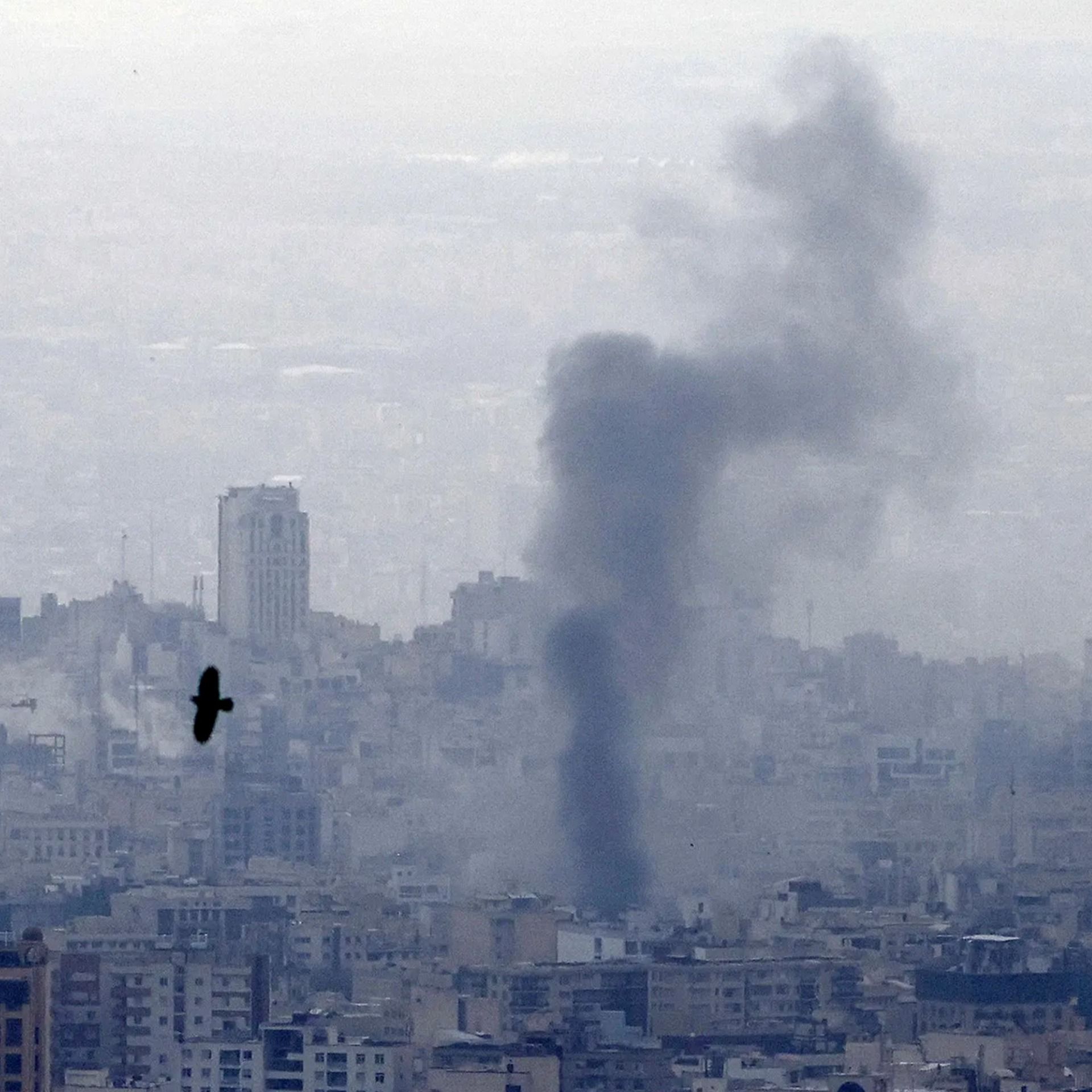
Photo: The aftermath of a US-Israeli strike on Tehran, Iran on March 3, 2026. Credit: محمدعلی برنو/Avash Media via Wikimedia Commons/CC 4.0
Hosted by Simplecast, an AdsWizz company. See pcm.adswizz.com for information about our collection and use of personal data for advertising.
Get every episode summarized
Each time The Brian Lehrer Show publishes, we email you a written briefing from the transcript — the topics, who appeared, and any specific claims, with the ad reads skipped.
Email me new episodesFree for 3 shows. No card needed.
Hosts & guests
Transcript ready
326 searchable segments. Every word is indexed and playable.
Full transcript
The Brian Lehrer Show — The Big Picture on the US and Iran. Machine-transcribed; use the interactive transcript above to jump the player to any line.
It's the Brian Larosho on WNYC Good Morning again, everyone. On Monday, President Trump claimed that a former U.S. president praised his aggressive actions regarding the conflict in Iran. Listen. I spoke to one of the former presidents, so I actually like, actually speak to some, I do like some people be shocking, and he said, I wish I did what you did. There aren't that many living former presidents, and guess what? All have denied having such a conversation. But our next guest argues that the United States could have long ago toppled the Islamic Republic of Iran with its military might alone. In fact, the U.S. has been involved in a standoff with Iran that by one measure has outlasted the Cold War in terms of number of years from 1979 to the present.
Our guest writes, whatever has held back the dogs of war, it hasn't been a lack of American ability. So, the current war with Iran proves, he says, that with the U.S. dropping $3 billion in bombs and missiles within the first 100 hours, it's time to look at some of the history. The historian Daniel Emmervar is a contributing writer at the New Yorker, the Bergen Evans professor in the humanities at Northwestern University, and author of the book How to Hide an Empire. His latest piece in the New Yorker doesn't just ask, why is the war in Iran happening, but why is it happening now? Professor Emmervar, welcome to WNYC. Thanks for having me on. You're interested in that clip of the president citing some unnamed former president supporting this war, and none of them owned up to that. Why? I'd like to imagine it was Obama. No, I mean, it's interesting because there is a truth to it, which is that past presidents
have regarded Iran as not just a problem, but in some cases an existential foe. And so that question, could we not just bomb Iran, that has lingered in the presidential and the national subconscious for decades, although it's never quite spilled over until now. Your book is How to Hide an Empire, but you argue in your New Yorker article that this is not imperialism, Trump's foreign policy is not imperialism. So how do you mean the word, and why do you say this is not that? Yeah, so I think it's tempting to see what Trump is doing as imperialism because this is a strong country lashing out to get its will, and so in that sense it bears some resemblance to imperialism, but classically imperialism seeks empire, it seeks control, it seeks to administer to govern in some sense. And what is so distinctive about Trump is his seeming indifference to that part of it.
And my sense is that that's not just changing sort of how Trump thinks about follow-up. It also is changing about what he thinks is possible. My sense is that the reason that past presidents haven't given into the temptation to bomb Iran is that they've been worried about its effect on the chessboard. Trump doesn't seem to have that worry, and he seems to have entered this war almost politely. But if he's not interested in imperialism the way you just described it, then why is he launching this war here, doing what he's doing in Venezuela, talking about Cuba's next, going after Greenland, that'll sound like imperialism to a lot of people. I think the part that sounds like imperialism, and I would fully endorse this, is Trump's acting like a bully. And this is a form of power exertion, so that's absolutely true. What is interesting to me is that it doesn't seem to be, like, past presidents have invaded other countries, invaded Iraq, for example, with visions of transformation, with visions
of imposing a U.S. order on a region or on the globe. And that's the part that Trump has both explicitly disavowed. I'm not interested in doing that kind of thing. He said in so many ways. And that seems to be informing his actions to he has kind of shrugging indifference to overseas outcomes, even as he delights in, you know, throwing power around. One could argue, though, I think, that Trump is looking for a U.S.-based world order. It's just not the democratic order that past presidents have said they were after, and it may not have been that simple in their cases either, but that's at least what they would say, right? The Iraq war, according to George Bush, was, what, Operation Iraqi Freedom. This war is just Operation Epic Fury, so it's being hung right out there on Trump and I guess Pete Hegseth's, you know, notion of anger and vengeance, guiding their foreign
policy. There is a Trump coalition, even as he's sort of firing our NATO allies and things like that. There's the, you know, arguably anti-democratic, strong man coalition that Trump is putting together with Putin, with Orban and Hungary. One could argue with Modi and India to some degree, with Bukhaly and El Salvador, you could go on from there. So maybe it's imperialism, but a different kind. Yeah, I'm open to that. The thing about Trump though, what's, is he seems to be not just allergic to longstanding allies of the United States, but the way he often talks about alliances is they are short-term situationships. They benefit in a moment, and then they can be discarded the next. And a lot of that legitimation of U.S. power, you know, we're pursuing freedom, you know, its formation, that kind of thing.
A lot of that was about a search for allies and a search for a story that you could tell about the United States that some other country might be able to sign on to. Trump is shocking in how little interest he seems to have in legitimation and how quickly he will go from, you know, in the Venezuelan action from saying, well, we're doing this for liberty of Venezuelans. And then like in the next sense, he's just salivating over oil, our oil, he says. So like all the pretense seems to have dropped. So why do you think this is the $64 billion question these days, right? Why do you think he really got involved in the Iran War? It's really hard to tell. I mean, there's a lot we don't know. It seems quite obvious that Iran has, excuse me, it seems quite obvious that Israel has sought some version of this for a while, but Trump is the U.S. president who's been up for it. Because I think a lot of that has to do with his lack of concern for the downstream consequences.
Because past presidents have game this out time and time again, could we, should we? We seem to have the military to do this. But we, in the accounts that we have from inside the White House, there's always a discussion and that discussion is always hinges around other U.S. interests in the region. We could do this, but that would be bad for Iraq, that would be bad for allies in the Gulf. There's a whole story about other things that might happen as a result that would be connected to U.S. interests. And I think Trump is just so kind of uninterested in a lot of that that he's willing to lash out on a whim in a way that past presidents have been prevented from doing. So just not thinking it through is what you're saying to demonstrate his dominance like he likes to do in domestic policy. Yeah, that seems to be his strategy. When he first became president, there was a national security council meeting and they were talking about this kind of thing, right? How, you know, the shin bone is connected to the knee bone, et cetera. And they asked him, we need to know, what is your tolerance for risk in foreign relations?
And he said, I have an enormous capacity for risk. Risk is good. And that is how he operates, right? Rather than kind of gaming everything out, he's improvisational. What if we do this thing? Especially the thing that you told me I wasn't supposed to do. What if I stiff his contractor? What if I declare that this election was stolen? Let's see what happens. Let's negotiate from that point. Your historian, so let's spend some time ticking through some of the history of how we got here, which is what you do in your New Yorker article to a large degree. You write, although enmity between Washington and Tehran sprang up in 1979, the seeds were planted in the 1950s, unquote. And this, as many of our listeners know, was when Iran's then elected Prime Minister, Muhammad Mosadek, nationalized Iran's oil. And you note that in 1952, time magazine, named Mosadek, it's man of the year. But this went against the interest of more England than the United States.
That's right. Yeah. So the oil in Iran that was nationalized, all of the profits from that have been flowing to Britain. So the British were very animated about this. And meanwhile, the President at the time, Dwight Eisenhower, initially looked at Mosadek and said, great, he's a liberal, he's popular, he's favorable to the United States, he wants to sell oil to the United States and not to the Soviet Union. This guy is wonderful. But then the British managed to convince him that even though Mosadek himself was friendly to the United States and not a communist, that he might be unstable and his attempts to democratize Iran might not work. And then that would destabilize Iran and then that would let the Soviets get a leg in. And all of that kind of larger calculation convinced Eisenhower to greenlight a coup attempt, which was shockingly successful. And so Mosadek was ousted and arrested. And then the constitutional monarch, the Shah of Iran, sort of reclaimed a lot of his power and became something more than constitutional and became the dictator of Iran.
But tell us more, how was Eisenhower's way to intervene in that way? If there wasn't a direct U.S. interest, you know the debate that's taking place over the last day since the resignation of Trump's counterterrorism chief, Joe Kent, over how much control Israel had over Trump's decision in this historical case. It's how much control England had over President Eisenhower's decision. I'm curious if you see any parallels and you can weigh in on this, the whole Joe Kent business if you want, but also in historical context, the Eisenhower one. Yeah, there's a wonderful book that I'd recommend on U.S. Iranian relations, just called America and Iran by John Guzmanian. And he makes the case that Britain did a lot to sort of lead the United States into the war. The difference is that Britain did a lot by appealing to a larger systematic sense that Eisenhower had. They said, okay, don't think about Mossadek particularly.
Just think about where Iran fits in this larger Cold War that you are committed to fighting and think about what happens if Mossadek falls or something like that. And that was enough to get Eisenhower to reorient his thinking because he was thinking about his interest really broadly rather than just narrowly in the sense of Iran. And staying with that history, right, this was the CIA's breakout performance. The United States had just fought a bloody, expensive and inconclusive war to beat back communism in Korea, ousting Mossadek by contrast was a crisp victory for just a few sacks of cash. But I guess notably different from this Iran war, that was done in secrecy, right? Yeah, that's right. And so I mean two things to say, first of all, the CIA just went on a spree after that. We think during the Cold War, it either tried to oust a government or tilt an election covertly 64 times, more than two thirds in support of authoritarians. But the other thing to say is what you just said, that this was done secretly.
And it was explicitly done secretly because Eisenhower acknowledged we can't be open about this kind of thing. We have a larger attempt to legitimize and when allies to our principles. And if this kind of thing becomes known, we're going to lose all our influence in the region. Yeah. There's a popular meme going around. I wonder if you've seen it. And it's a photo of Israel's iron dome that's its air defense system responding to missiles from Iran. And the Israeli missiles are labeled American tax dollars with the Iran missiles labeled somehow also American tax dollars. So leaving the Israel part aside for the moment, the idea that American taxpayers funded Iran's military build up, I think comes from two places. The original Iran nuclear deal that was signed under President Obama and also the Reagan era Iran Contra scandal. So can you riff on that?
There's a lot in there. Yeah. I mean, I would push it back further than that. It was under the shot of Iran before the revolution in 1979 that Iran assembled one of the world's largest militaries and all of that was U.S. military hardware being sold to the shot. It was basically oils for arms, oil for arms. And then when Iran had its revolution, it had an awkward position of it had a lot of hardware, but it was all U.S. hardware. And you think of that stuff as sort of on the ownership model, you own it and you can use it. But you should also think of it as somewhat existing on the subscription model, which is that if you, you know, something breaks, you need to spare part, you need the person who manufactures that spare part. And so there's the famous Iran Contra scandal in the 80s. What that was was the revelation that in order to achieve other things in Lebanon, the United States under Reagan had given Iran the spare parts it needed to keep its military running. And so there's, I mean, the basic fact is that the United States is the largest arms provider
on the planet. And so even, and it often finds itself in this weird position, where even militaries that it's ostensibly fighting have hardware that is genealogically traced to the United States. Listeners, we can take a couple of calls or texts as questions for our guest historian, Daniel Emmervar from Northwestern University, also a writer at the New Yorker and author of the latest piece. Maybe you saw it if you read the New Yorker that asks why the Iran War is happening now. And it's got all this history in it. Two, one, two, four, three, three, WNYC, two, one, two, four, three, three, nine, six, nine, two. Next in your piece that President Bush's actions in the Iraq War were viewed as lawless at the time, how do you think they seem in retrospect given the Trump administration's actions? What is surprising is when you think back to the lead up in the Iraq War, was how much
energy and attention went into the appearance of lawfulness, how much care went into process, critics of the Bush administration and I'd count myself among them often point out that the members of the administration lied. But in some ways to lie is to respect a process. It is to agree that there have to be reasons, there has to be evidence. The difference is that Trump seems completely uninterested in producing a coherent story about why the United States is attacking Iran, why Iran poses an existential threat. He feels very comfortable just switching his story a minute by minute. And on to the Obama administration, which took a different tone, you write the needle up here to move. And of course, Obama negotiated with Iran's Supreme Leader, who just got killed in this war, Hamanay. And if Obama was hoping for a Nixon in China moment, he'd have to fight the U.S. political
establishment. It's funny that this comes up because we're going to be talking about the opera Nixon in China and our next segment. So to Nixon in China related segments in a row, but why do you bring that up with respect to Obama and the controversial Iran nuclear deal that Trump scrapped? So there was so much entrenched hostility toward Iran and so much political gain to be had from insisting that Iran was an implacable foe and one couldn't negotiate with Iran at all, that when Obama just feeling like he wanted to do the opposite of what George W. Bush had done with his sort of crusading attempt to remake the Middle East, when Obama sought a cooler strategy, like a calmer strategy, in the sense of, well, maybe we can just deal with Iran and we can get them to sort of put some caps on their nuclear development. He met with a lot of political backlash, but not only from Republicans, he met it from Democrats, and he met it from members of his own administration, so notably Hillary Clinton
who's then a Secretary of State went to Congress and said, look, we're not really, or I'm not really expecting that this Iran deal will work. It is just a pretext so that when the talks fall through, we can hit them with crippling sanctions, which is indeed what happened. The talks initially fell through, and the Obama administration applied really aggressive sanctions to Iran, which Joe Biden described as the most crippling sanctions in the history of sanctions period. So do you have your own take on whether the Obama nuclear deal with Iran would have presented it from developing nuclear weapons, or maybe that wasn't even Trump's and a lot of the other opponents' main objection, maybe it was that it allowed Iran to have the money to afford so many conventional weapons, which were being used all over the region. Yeah, so I mean, there is a sort of aggravating aspect to this, which is that one of the pretext
that Trump has given for war with Iran is that this is needed to prevent Iran from imminently developing nuclear weapons. Now, that's a little confusing because Trump also said in June that he had obliterated Iran's capacity to develop nuclear weapons, but the bottom of all this is that Trump campaigned on tearing up the deal that was seemingly effective in placing a tap on how quickly Iran could get to the sort of point of nuclear viability. It seemed like the deal was working, and one objection that people had that Netanyahu influentially presented in Congress was that you couldn't trust Iran's adherence to the deal, so secretly they must have been advancing their nuclear program, and more over to lift any sanctions on Iran would just be to encourage the Islamic Republic to make things easier for Iran. You made a article, this New Yorker article we've been talking about, asks, what's behind Trump's new world disorder?
So looking through the long lens of history, as we've been doing a little short version of here, did you find an answer? Yeah, I mean, people often say that Trump is capricious, and he does one thing and he does another, and he's just rolling the dice every day. I don't think that's right. I think Trump has a career-long hostility to US hegemony, to the idea that the United States, excuse me, would somehow superintendents global affairs. He's been really explicit about this for decades, and I think now we're seeing the effects of it as Trump is doing one aspect of global hegemony, which is making war, but shrugging off all of the other aspects of it, which are a sense of responsibility for what follows war. Listener asks a straightforward question that's certainly coming from the news of the last day, and the resignation of Joe Kent. Listener writes, do you think Netanyahu manipulated Trump to go to war?
I don't know about manipulation, I mean, in some ways Trump is always kind of constantly being manipulated because he acts on his instincts and other people know that. It is absolutely true that Netanyahu pushed for this, and other presidents have resisted in Trump hasn't, although it's also the case that Trump has wanted this for decades. I mean, we have Trump on record since the 80s, talking about how great it would be to invade Iran and how weak other presidents have been for failing to do that. Well, then maybe the basic premise of this war, as Pete Hexath, especially has been explaining it, is accurate that Iran has been out to do as much harm to the United States into Americans as it could for 47 years in addition to whatever else Iran does, and that's the main reason to weaken it militarily as much as possible, and Trump says other presidents were too weak or too afraid to do it, I'm finally going to try to do it.
I mean, that's what they say, right? That is absolutely what they say, and it's a very paranoid view of the world, right? It's to view the world at any country that is hostile to the United States that might be building up nuclear capacity. I mean, Iran is clearly seeking to be on the cusp of developing nuclear weapons, understandably, as a form of defense, but the line that usually here from the administration is a nuclear Iran is intolerable because it will swiftly mean the nuclear bombardment of the United States and its allies. You know, that's an unanswered question, but it is certainly the case that the administration has fed on the fear that a militarily capable Iran is just unthinkable, and cannot cohabit with the United States on this earth. Historian, Daniel Emmervara, contributing writer at the New Yorker, where he has that new
piece called What's Behind Trump's New World Disorder, he's the Bergen Evans Professor in the Humanities at Northwestern University and author of the book How to Hide and Empire. Thanks so much for coming on today. Absolutely, thanks for having me on. Since WNYC's first broadcast in 1924, we've been dedicated to creating the kind of content we know the world needs. Since then, New York Public Radio's rigorous journalism has gone on to win a Peabody Award and a Dupont Columbia Award, among others. In addition to this award-winning reporting, your sponsorship also supports inspiring storytelling and extraordinary music that is free and accessible to all. To get in touch and find out more, visit sponsorship.wnyc.org.
More episodes
More from The Brian Lehrer Show

Tuesday Morning Politics: State of Iran War; Home Stretch to Midterms
The Brian Lehrer Show

The CDC and Measles Deaths
The Brian Lehrer Show

History of the War on Terror
The Brian Lehrer Show

Labor Day: Working Class; White Collar Unions; Supermarkets; Summer Songs
The Brian Lehrer Show