About this episode
As we approach the 25th anniversary of the 9/11 attacks, Peter Bergen, national security analyst for CNN, a vice president at the New America Foundation and the author of All the Presidents' Wars: Twenty-Five Years of America's War on Terror (WW Norton, 2026), reviews the history of the U.S. War on Terror.
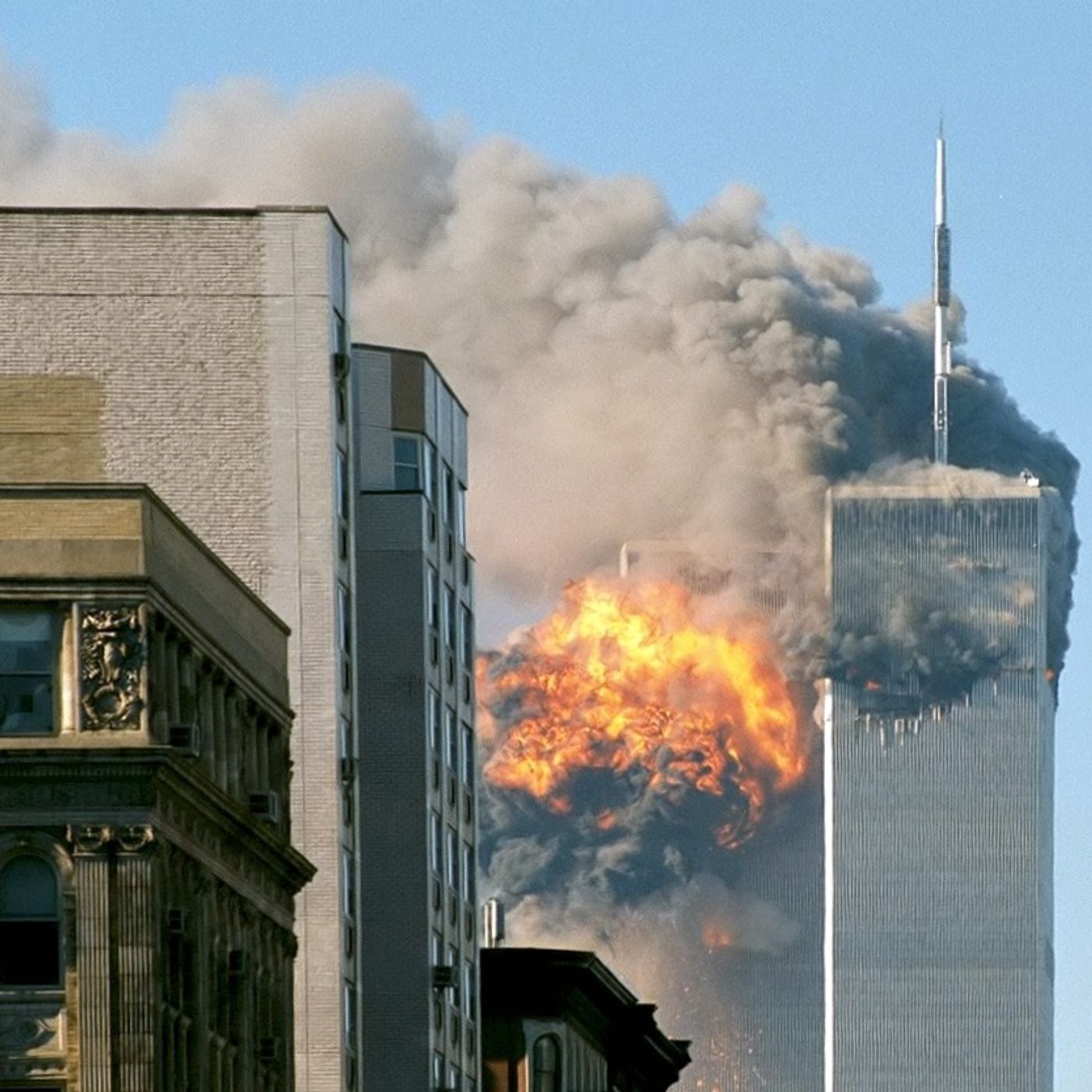
Photo: UAF 175 crashes into the south tower of the World Trade Center complex in New York City during the September 11 attacks. Photo by: Flickr user TheMachineStops (Robert J. Fisch) via Wikimedia Commons.
Hosted by Simplecast, an AdsWizz company. See pcm.adswizz.com for information about our collection and use of personal data for advertising.
Get every episode summarized
Each time The Brian Lehrer Show publishes, we email you a written briefing from the transcript — the topics, who appeared, and any specific claims, with the ad reads skipped.
Email me new episodesFree for 3 shows. No card needed.
Hosts & guests

Transcript ready
530 searchable segments. Every word is indexed and playable.
Full transcript
The Brian Lehrer Show — History of the War on Terror. Machine-transcribed; use the interactive transcript above to jump the player to any line.
It's the Brian Larosho on WNYC, good morning and good everyone. Well this week does mark the 25th anniversary of the 9-11 attacks on the United States. We'll be doing segments every day, today through Friday, acknowledging the solemn occasion for the family's most directly affected. And also the very complicated history of the response to it, as well as the lead up to it over the last quarter century and more. Maybe you've heard the headlines in just the last few days, like around former New York Governor George Pataki, who spent a lot of time at the World Trade Center site in the aftermath of the attack. He was governor at the time, announcing that he believes he has a related respiratory condition now. And the Mamdani administration announcing the release of more air quality records from those months after building the buildings collapsed and burned.
They are going to be adding to the ceremony at ground zero on Friday, something that I believe they haven't done in the past. We'll be covering that Friday morning, which is a moment of silence, not just for the individuals who are killed in the attack, but one for all the many, many people who worked on the pile, as they called it, first responders and many, many, many others, and who have gotten 9-11 related illnesses and many have died since. So George Pataki just perhaps the latest example of that and a headline example, which draws more attention to it, and still apparently some records about the air quality. What did Christine Todd Whitman, who was the EPA administrator at the time, really know and she said it was safe to go back downtown so quickly after the attacks, apparently there are records that the city of New York is now going to release.
But in any case, immediately following the attacks, the country seemed more united than it ever had around the common goal of preventing another attack and catching the people responsible. But that common goal, as you know doubt now, quickly became something much broader and more porous. The post-9-11 response came to define American foreign policy ever since through wars in Afghanistan and Iraq, most centrally, the rise of ISIS in the 2010s, and we can see its reverberation still with the war in Iran, I think it's accurate enough to say. Many more people died, not just Americans who weren't hit by the attacks, as I was just referring to, but also how many Iraqis, hundreds of thousands, maybe over a million Afghans, others in the conflicts that followed 9-11, then in the attacks themselves on the World Trade Center, the Pentagon, and on the airplane that crashed in Changsville, Pennsylvania.
Peter Bergen is a journalist and CNN National Security analyst who's been covering the war on terror for decades. His new book is called All the Presidents Wars, 25 years of America's war on terror, and traces the major decisions made by the four presidents we've had since 9-11 and how they've shaped our country and the world. He's also uniquely qualified to tell the story, as I mentioned before the news, in 1997 he was part of a CNN team that interviewed Osama Bin Laden in Afghanistan before Al Qaeda was a household name in this country, four years before 9-11. His book comes out today, and again it's called All the Presidents Wars, 25 years of America's war on terror. I should also mention the book went to print only a few weeks after Trump launched the ongoing war in Iran, so that's not the focus of the book per se, but he does provide some pretty critical context for understanding it. Peter, thanks so much for coming back on our show. It's been a while.
Welcome back to WNYC. Thank you for having me back, Brian. So before we get into some of the bigger themes of your new book, can you tell everyone who may not know your work a little bit about your background as a journalist covering the war on terror and what came before? Like how did you come to interview Osama Bin Laden in 1997? Well, your studio is not very far from the Trade Center where I'm sitting. On February 26, 1993, a group of men drove a bomb-laden van into the basement of the Trade Center and blew it up hoping to bring down both towers. You probably recall this, Brian. Six people died, luckily they didn't bring down the towers. But these guys had something in common. Some of them had trained in Afghanistan. Some of them had supported the Afghan war effort against the communists. And I went to my bosses at CNN and asked and said, hey, we try and investigate this phenomenon. Last time to Afghanistan was in 93 during the Civil War. I went with Peter Arnet, who was at the time the world's most famous foreign correspondent
arguably. And we spent a few weeks in Afghanistan. The time it was being racked by a very violent civil war. But the bottom line was we concluded that Afghanistan would be the source of future terrorism going forward, anti-Western terrorism. Those were a group of militants who were training there. And they attacked the Trade Center already in 93. In 96, I heard Ben Laden's name for the first time. The State Department released a very useful kind of two-pager about him describing him as a financier of Islamic extremism. I went back to my bosses at CNN and said, maybe this guy, I saw him, Ben Laden is responsible for the Trade Center attack in 93. Since it was well organized and organizations have leaders. It turned out that wasn't quite the case, but he was certainly he and his guys were sort of on the fringes of it. And Ramsey Yusuf, the leader of the First Trade Center attack, was the nephew of Hullach Sheikh Mohammed, who's the leader of 9-11.
So there was a kind of familial connection, monetary connection. And we interviewed Ben Laden in 97. It was his first television interview. He declared war on the United States. It all seemed somewhat improbable. We were sitting in a mud hut in the middle of the night in Afghanistan, where there's no phone system. The only way you can communicate is with very early generation and very expensive satellite phones. And how do you implement a campaign against the United States, was kind of at the back of my mind after he delivered this diatribe against American foreign policy in the Middle East? How did he characterize his grievances to you at that time? There was basically a catalog of American foreign policy grievances. American support for Israel, American support for Saudi Arabia, he believes that there was thousands of American troops that were still posted in Saudi Arabia. He saw the most quote unquote infadels trespassing on the holy land. So these were his principal rights. And they were there from the so-called first Gulf War, right after a rock invaded Kuwait
in 1990 and George H.W. Bush went in and did not overthrow Saddam Hussein, the leader of Iraq, but did militarily reverse the invasion of Kuwait. But then the U.S. left many troops in place in the region, largely in Saudi Arabia. Is that inaccurate enough summary? Yeah. I mean, I don't. It wasn't like, you know, it wasn't the hundreds of thousands of American troops that expelled Saddam from Kuwait, but it was several thousand, including women, which a song had been loud and found very objectionable. Women troops. All right. So now the new book, which looks at key moments in each presidency since 9-11, but obviously you spend a lot of time laying out the decisions made early on in the Bush administration, including the decision to go to war with Iraq, which is widely considered a mistake at this point,
by Democrats and Republicans alike. It's really stunning to see all of the mental gymnastics that went into that decision laid out in one place as you do in the book, especially for people who may not have lived through it, or followed every jot and tiddle of it, as journalists would have at that time. So how do you begin to describe the Bush administration's decision to go to war with Iraq, which did not launch 9-11? I think it was one of those sort of fixed ideas they had going back some period of time. I mean, bear in mind that the kind of Bush's war cabinet on 9-11, Condoleezza Rice was a sociologist, Donald Rumsfeld, that worked as Chief of Staff at General Ford and Secretary of Defense. Vice President Cheney also worked as Chief of Staff at General Ford. So these were kind of the creatures of the Cold War, and they were very focused on state-based threats, which they considered to be Iraq and Russia. And they really didn't, they were totally surprised by the al-Qaeda attacks, even though
they shouldn't have been, because they were receiving a set of pretty strident warnings in the spring and summer of 2001 by the CIA, that al-Qaeda was planning something most famously, the presidential debut brief on August 6, 2001, that was briefed to George W. Bush at his vacation ranch in Crawford, Texas, which was entitled, Ben Laden determined to strike in the U.S. And I'd already mentioned, the groups of these guys had tried to bring down the Trade Center in 93. There have been other, uh, relevace serious efforts to blow up Los Angeles airport by folks trained in Afghanistan in 1999. So it wasn't sort of an abstract concern, but they just couldn't really process the idea that al-Qaeda, a non-state group led by this mysterious and elusive Saudi multi-millionaire might really be a problem, which is strange. They'd also blown up two U.S. embassies, almost simultaneously in Africa in August of 1998, and it's hard to blow up one U.S. embassies, very hard to blow up two simultaneously. They'd also blown up giant hole in the size of a house in the U.S.
S. Col, the most advanced U.S. destroyer at the time in Yemen in 2000. So, you know, they just, there's a lot, you know, I'll give you an historical sort of analogy, by the way, not maybe in exact, but Stalin had a huge amount of information that Hitler was planning to invade the Soviet Union in 1941. And he just chose to just, he just didn't believe it. And I think the Bush administration officials had, you know, they had all they needed to know, and what they didn't do, which I think is a dereliction of duty. And you know, he saw from the said that 9-11 was an intelligence failure. This is a very convenient dodge, because intelligence folks work for policy makers, and they also can't defend their classified work in the public realm. So it's a very easy thing to say. It was really a policy failure. There were, you know, there was some intelligence failures, I think of a tactical nature before 9-11 by the CIA. But they're big, what's the role of the CIA? It's to provide strategic warning to policy makers so they can do smart policy.
And you know, Bush didn't interrupt what was then the longest vacation in presidential history for in three decades when he got this warning on August the 6th, 2001. And his team didn't pulse the national security apparatus to say, hey, are there all kind of people living here? That's really kind of get our informants that go out and sort of shake the trees and see who's out there, because those 19 hijackers were living in the United States under their true name. Some of them got arrested for traffic offenses. I mean, they were here and no one was really looking for them. That August 6th, that you refer to, that was the date of that memo. I'll kind of determine to attack in the United States. And the context for that in your book is that before 9-11, Bush had really underestimated threats from Al Qaeda because it wasn't backed by a nation state. Is that right? That is correct.
And then after 9-11, the admit, well, before we even go to that, you mentioned the USS Cole, the bombing of that worship, the USS Cole in Yemen in 1998. Do you hold the Clinton administration responsible at all, as I know Republicans did after 9-11, for not having responded adequately, whether that be a military campaign against Al Qaeda in Afghanistan at that time or something else, I don't know. But for not having responded adequately to that as kind of a warning shot from Al Qaeda during the Clinton administration in 98. So just to correct you, the attack happened on October 7th, 2000 against the USS Cole. Oh 2000. The embassy attacks happened in 98. The embassy attacks went, okay, so either one. Okay, so the Clinton administration did respond after the embassy attacks with ineffectual cruise missile attacks at Al Qaeda training camps in Afghanistan which didn't really achieve nothing except turning bin Laden into something of a global celebrity.
So I think the USS Cole attack was really a really missed opportunity by the Clinton administration which in their defense was only an office for four months before it turned over to the Bush administration which was in office for seven months. So if that attack on the Cole was in October 2000, well, the presidential election was happening just days or weeks later in the first days of November, that's how close Clinton was to leaving office. That is correct. Then, you know, there were multiple national security council meetings about this supposedly pressing problem with Iraq in the George W. Bush administration first term. And the first meeting about Al Qaeda was on September 4th, 2001. So that sort of speaks for itself. It shows you where the heads were at. Here's a Osama bin Laden related question kind of a prehistory question I think from a 9-11 standpoint, from Nick in Great Nick. Thank you. I'm WNYC with Peter Bergen. Hi. Hi, Mr. Bergen.
Can you describe bin Laden's relationship with Mullah Omar, the leader of the Taliban? And how likely is it that bin Laden would have told Omar about the 9-11 attacks before they were carried out? Good question. I think the likelihood of bin Laden told Mullah Omar about the attacks in any detail or any specificity, speficicity is close to zero because Mullah Omar and the people in the Taliban were actually kind of getting pissed off at Osama bin Laden because he was making all these threatening statements. And they were only recognized by three countries at the time and they wanted more international recognition. So, you know, bin Laden as a sort of pro forma matter had sworn allegiance to Mullah Omar as a leader of the Taliban, a sort of religious oath of obedience. But he didn't really observe the letter of the law exactly. He continued giving interviews. He continued with his plans to attack. And I was going in on the day of 9-11, I was going in to CNN to talk about Akman Sharma
sued who was the leader of the anti-Taliban alliance fighting Mullah Omar. He had just been assassinated. We did know by members of Al Qaeda. And you know, the reason that bin Laden did that, he knew that 9-11 was going to cause a problem for the Taliban. He totally underestimated the likely American response. But he knew it was going to be something problematic for the Taliban. So, when he ordered the assassination of Masood, it was really an effort to curry favor with the Taliban because that Masood was the one person standing between the Taliban and total victory in Afghanistan before 9-11. Peter Bergen is my guest, journalist, and CNN national security analyst who's been covering the war on terror since before 9-11. His new book is all the president's wars, 25 years of America's war on terror, as of course the 25th anniversary of the 9-11 attacks. Comes Friday in listeners. Our phones and text thread are open. What do you want to say or ask Peter Bergen about the years after 9-11, primarily, the
wars in Afghanistan and Iraq, the war on terror beyond those. And the way those decisions have shaped American life and foreign policy and affected people around the world. Some of you listening weren't even born yet and might have a different relationship to this history than people who lived through it. So, Gen Z listeners or anyone else, 212-433, WNIC, give us a call or the comment or a question or send a text to 212-433-9692 for Peter Bergen. You describe the, I'm looking for the exact quote I have it here. They run up to the Iraq war by the Bush administration, the campaign to convince Americans to support that war. And I guess the rest of the world to support that war was one of the greatest propaganda
campaigns in history. There it is. One of the most successful propaganda campaigns ever waged on the American public. I can't stand on that. Waged by the U.S. government. I mean, even two years after 9-11, 70% of Americans thought the Saddam Hussein, the Iraqi dictated, was involved in 9-11. That's an extraordinary polling number because the largest criminal investigation in history, the 9-11 investigation involved interviewing 165,000 people chasing down 150,000 leads. And there was no evidence that Saddam Hussein or anybody from his regime was involved in 9-11. And yet, Americans came to believe that he was, which is why the Iraq war was quite popular at the beginning because the Bush administration had done a brilliant job of snowing the American public with the idea that somehow Saddam was responsible, even though there's no evidence for that. Was part of their argument that Saddam Hussein was kind of the most dangerous anti-U.S.
head of state in the world. And he was developing what they called weapons of mass destruction, which is nuclear weapons, biological weapons, chemical weapons. And that he might share them with a non-state group like Al Qaeda that would actually do something, you know, as they did on 9-11, that could infiltrate the United States in a way that maybe Iraq itself couldn't. And so it was that threat. They saw a kind of pyramid or a domino effect or a hierarchy where Hussein, Saddam Hussein, would be the likely ones to develop, likely one, to develop a weapons of mass destruction, but then might share them with Al Qaeda to use in the United States. Obviously, it turns out that Saddam Hussein didn't have the capability that the arguments claimed. But how central was that to not only the propaganda campaign, but what Bush actually thought?
Oh, yeah. I mean, that was the argument. That was Colin Powell went to the United Nations and made that argument. President Bush and Vice President Cheney made versions of that argument repeatedly in public speeches. And the only, you know, I wrote a piece in the Guardian, a few before the war began, saying, I didn't have an view on the weapons of mass destruction issue because I just didn't know. And you know, Saddam had lied about his weapons of mass destruction program dream in 1990. So was he still lying? It was a question, a reasonable question. It turns out that he got rid of them. But the reason he got rid of them and wasn't advertising it, he just fought an eight-year war with Iran. And he wanted to retain the idea that he had weapons of mass destruction. It turned out to be two clever by half. But the argument needed to be not just that he had weapons of mass destruction, but also that he was in co-host with Al Qaeda. And I just spent years investigating this question. And in fact, met with Ben Laden in 1997 and after the interview, you know, Ben Laden said
that Saddam was a bad Muslim. We were making sort of post-interview discussion. And you know, for Ben Laden, saying somebody's a bad Muslim, is a bad as bad as it gets. And now we know it also from George Pira, who was the FBI interrogator Arabic speaking, who spent six or seven months with Saddam for eight hours a day. Talking to him and interrogating him, but you know, Saddam himself was, I thought that Ben Laden was an unguided missile and was very suspicious of him. So there was no link. And you didn't really need access to classified information to make that assumption because I was able to write about it in the Guardian before the war began. And then, you know, the CIA did try and push back on this particular issue. Unfortunately, there was a, somebody who was rendered by the United States to Egypt called Anas al-Libbi, who was tortured. And he gave up a bunch of BS about this question to his interrogators in order to be stopped being tortured, saying that Russian organized crime and smuggled weapons of mass destruction
from Saddam into New York City. And Saddam was training, training members of Al Qaeda. All that nonsensical stuff got into the Bush administration, senior officials, speeches and arguments for the war. When this guy was released from Egyptian custody, he recanted the whole thing that I made it all up in order to stop being tortured. I want to start talking about, um, after the launch of the Iraq War, we spent so much time and, you know, your book is so sweeping on so much history and we could talk to you every day this week for half the show and not cover everything. And they run up to 9-11 and the decisions of presidents since 9-11, which is the focus of your book. And we've only talked about one president so far. Obviously, George W. Bush. Let me ask you this more sort of general question that pertains to all the presidents since. One of the big legacies of post 9-11 foreign policy, I think it's fair to say, is the expansion of presidential power when it comes to waging war.
That the president can use force without the explicit approval of Congress. We've seen this discussed obviously this year in connection with the war in Iran, but this legacy isn't confined to Trump. You have it in the book as evident under Obama, too, the president who succeeded George W. Bush. Can you talk about that? Yeah. Well, thank you Brian for pointing out. I mean, one of the big themes of the book is the growth of what I call the imperial commander-in-chief, which is he or she now has powers that have been accreted steadily. That really, I don't think the founders of the Republic intended a king-like person to kind of declare war without much consultation with anybody. George W. Bush never had a discussion with his war cabinet on a simple question. Is the Iraq war going to be a good idea? A debate in the cabinet would have been helpful on that, particularly since Colin Powell was in the cabinet and had done this first successful Gulf War as the chairman of the joint chiefs.
So Obama also expanded the war in ways, obviously Bush had the preventative war against Iraq, but Obama expanded the drone war into countries we weren't formally at war with, countries like Pakistan, Yemen, Somalia. He really, he became the drone president. I quote him in the book. He said, Riley, I didn't know that killing people was going to be one of my strong suits, but it turned out to be the case, and that's Obama himself on this issue. And then also Obama overthrew Mohmogat Daffy in Libya without congressional authorization. He did have a NATO, he did have NATO allies, and he did have a UN resolution in favor. But if there's been this gradual erosion of the idea that you really need accountability, and when you have an all-volunteer force in a way that makes the commander-in-chief less accountable, when you have a lot of American contractors, I point out in the book that 8,000 American contractors died in Afghanistan in Iraq, which is more than the 7,000 American service members.
And those Daffs didn't attract the same amount of media attention, but those contractors were doing a lot of war-like activities, whether it was protecting VIPs or protecting bases or providing intelligence support. And that also makes the commander-in-chief less accountable. And then you come to the Iran War. I mean, if you think about a checklist of going to war, what you'd kind of want in an ideal sense, you'd want a congressional authorization, you'd want NATO allies, you want a UN resolution in your favor, you'd want a real imminent threat, you'd want public buy-in, a real plan for the day after, and some kind of basic strategy. Well, none of those things happened with the Iran War, which is kind of a summation of many of the things we got wrong in other wars. The only thing that the United States hasn't done so far, which would be, hopefully, won't happen, would be putting in some kind of sizable number of ground troops into Iran, which I think would not go well. Right. You do write about the Obama administration's expansion of drone warfare.
What did the use of drones change about the way the United States fought and still fights? Even though they don't use the term anymore, right? The war on terror. They retired that term, but obviously drones are still front and center. US troops and US allies in the Middle East are being victimized by a run stock of drones. Yeah. Well, shortly after 9-11, the United States had a monopoly on armed drones. Obviously, it's not the case anymore. But on Christmas Day 2009, I think President Obama realized he had an existential problem, which is if you recall Northwest flight 253, there was an underwear bomber on the plane flying over Detroit. He detonated his underwear bomb. Luckily, it didn't go off as the plane was coming into land. If it had, President Obama would have been building his presidential library a lot quicker, because you can imagine if 200 people were blown out of the sky coming into land and Detroit more people were getting killed as the debris came in.
That would have been politically unsustainable for any president. And Janet Napolitano, who was the very capable Department of Homeland Security Secretary, said something in public, which was not very smart. She said the system worked. I'm not quite sure to hear what she meant by that. But President Obama summoned his war cabinet together and said the system didn't work, and we dodged a bullet and I'm quoting him directly. And the armed drone allowed him to do something that previous presidents had. By then, the drone had really become more accurate intelligence surrounding drone strikes or more accurate. It could linger over targets for longer. And so there was one drone strike in Yemen under George W. Bush. There were 165 under President Obama. There were maybe two or three dozen strikes in Pakistan, drone strikes by President George W. Bush. By 2010 in Obama, there were 122 drone strikes in Pakistan along the border with Afghanistan. So the advantage, but also the new moral question being you could kill members of the enemy
without putting US troops at risk. You could, but there's another moral question, which is, you know, is a drone preferable to a jet dropping a 500 pound bomb. A jet, you know, 500 bomb, how bomb I'm looking at your studio here. That would demolish several blocks around here. And it by its nature is very indiscriminate. So drones are more discriminatory. They can land. They can linger over targets. They can attempt to distinguish between civilians and non-servilians. So there is an argument to be made a moral argument. But on the other hand, of course, it makes the borders between war and peace a lot more fuzzy because it's a lot easier to mount a drone campaign as you've indicated because of zero risk that the people involved who are guiding these drone flights from the comfortable air conditioned office in Nevada. We'll continue and finish up with Peter Bergen after the break whose new book is all the presidents.
Wars, 25 years of America's war on terror. Peter and Manhattan, you're going to be the next caller. Oh, Peter just hung up. Well, we have many other callers who want to talk to you. We almost had a confluence of Peters there, but we continue with Peter Bergen right after this. Brian Lair on WNYC, our last few minutes still with Peter Bergen and Peter and Manhattan is back with his very big picture question, I think. Hi, Peter, you're on WNYC. Oh, my God. I had a call back because you said there was a confluence of Peters. In many cases, I'd like to thank you for this historian, journalist. I think he hit spot on, but I'd like to know what he thinks in terms of this history of the century, Western dominance of the Middle East. And we know why because of the commodity. And this goes back to the Brits going back to after the First World War in Balfour. But this is part of I think what Ben Laden's grievance was.
And combined with, as we, I'm sure some of us remember projects for the New American Century, which by the way included Wolfwoods, Pearl, Rumshell, Cheney, this confluence has continued even to today in terms of dominating that region. In fact, that project said after Iraq, they were going to go on and take Iran, which, oh, by the way, here we are. So I'm just wondering if he has any, by the way, the against this whole notion of pan-Arabism that went back to Nasser, Saddam, and even Qaddafi, although he was in North Africa, we've always been against any kind of that situation. We saw Western dominance in the Middle East. Well, Peter, what do you say about that very big question? Could you question, to your name, Sikh?
Ben Laden would often rail against the Americans and Westerners stealing their oil. I mean, that is a cartoonish version of what happened. In 1934, Stanford Oil signed the first oil deal with King Fard of Saudi Arabia, which was the beginning of a longstanding alliance. And obviously, that alliance has tremendously benefited economically the Saudi Arabia as much as it has the United States. And so, I think obviously, the United States has interests in the region. It was Jimmy Carter, by the way, who made it American foreign policy that for free navigation in the Persian Gulf, and obviously we're at a very different spot today, where there is almost no navigation going on in the Persian Gulf because the Straits of O'muz are largely closed, and the Red Sea has also been getting increasingly closed by the Houthi rebels. So it's in the world's interest to have freedom of navigation from the place that produces a good, so 20% of the world's oil and gas.
And we didn't, the British did occupy, and the French did occupy, good chunks of the Middle East after World War I, the United States, I think is founded as an anti-Ampire project. So we tend not to do the things the British and the French did, which is actually learned the language, understand the environment. And I'm not advocating what the British and the French did was the right thing. But in Iraq, when we invaded, we misunderstood very basic things about the country, unfortunately, for instance, that by overthrowing Sudan, we inverted the power pyramid in Iraq, so that this year was suddenly on top, who'd always been the majority population, but they'd always been sort of on the bottom. That helped precipitate a civil war. So we go into these things thinking they're going to be quick, they aren't. We go in having very little knowledge of the environment, writing history of which I've just done, all the President's Wars. In some ways, it's depressing exercise because we won't even learn from our recent history, let alone.
Because I mean in Iran, we're replicating many of our mistakes. I don't see any immediate resolution because the people in charge of Iran today are kind of formative teenage and adult experience was fighting in the Iran-Arap War, which went for on for eight years and a million people died and ended in a bloody cell, so they can sustain a fair amount of pain, which they are. They're also, they're in bad shape, their currency is at all time low against the dollar. They're exporting very little oil. Who will cry Uncle first is the interesting question. Are you ready for a complex, hot button question for our last two minutes with you? Listener writes, political commentator Hassan Pikers remarked that the US deserved 9-11, which he has since said he regrets, has been the subject of many political ads being aired across the US ahead of the midterms. For some people like myself, right, so listener, the controversy is confusing.
The idea that 9-11 was at least in part the US chickens coming home to roost after centuries of political and military involvement in the Middle East seems obvious, if not unavoidable. What do you make about this controversy? Why is the idea that the US government's actions contributed to the motivations behind the 9-11 attack? So anathema to the American public. Can you do that in about a minute, Peter? I'll try. I don't accept the idea that the United States was in some way sort of guilty years charged and therefore 3,000 Americans, civilians going to work on a Tuesday morning in September deserved to die. There are plenty of other ways that bin Laden could have engaged in normal politics. Al Qaeda doesn't engage, didn't engage in normal politics and a lot of these jihadist terrorist groups don't engage in normal politics if you want to change things. In political movements that might have a chance to success as we saw in the Arab Spring where there was a lot of hope at least in some countries that authoritarian and dictatorial
regimes, some of which were alive with the United States were actually swept away. The Sisi regime in Egypt, these kinds of regimes, they're not there forever. And even Assad, he's been replaced by a former leader of Al Qaeda in Syria and Syria is far from perfect but at least the war is finishing. So anyway, all by long way of saying it's like, I just don't really accept that narrative at all. Well, there's so much more that we could discuss from the 4-9-11, from the day of, from the 25-year since, with Peter Bergen, CNN, National Security Analyst who's been covering the war on terror this whole time. And he's got a brand new book called All the Presidents Wars 25 Years of America's War on Terror. Thank you, Peter, for sharing it with us. Thank you, Brian, for reading the book. Brian Lera on WNYC, Stay tuned for Allison.
More episodes
More from The Brian Lehrer Show

Tuesday Morning Politics: State of Iran War; Home Stretch to Midterms
The Brian Lehrer Show

The CDC and Measles Deaths
The Brian Lehrer Show

Labor Day: Working Class; White Collar Unions; Supermarkets; Summer Songs
The Brian Lehrer Show

Brian Lehrer Weekend: El Niño; NYC Schools & AI; Jeff Spurgeon
The Brian Lehrer Show