About this episode
Get every episode summarized
Each time Offbeat Oregon History podcast publishes, we email you a written briefing from the transcript — the topics, who appeared, and any specific claims, with the ad reads skipped.
Email me new episodesFree for 3 shows. No card needed.
Hosts & guests

Transcript ready
105 searchable segments. Every word is indexed and playable.
Full transcript
Offbeat Oregon History podcast — Steamer wrecked by future Costa Rica admiral. Machine-transcribed; use the interactive transcript above to jump the player to any line.
Good morning, Oregon. I'm Finn J.D. John, FJ at OffbeatOrgan.com, and this is the daily Offbeat Oregon History Podcast. Thanks for downloading, and I sure hope you enjoy the show today. This story was first published on August 17th of 2014 under the headline, Massive Steamer Wrecked by Future Costa Rica Navy Admiral. Here we go. If you had been an ex-paid triad in America in the South American nation of Costa Rica in the early 1880s, you might have run across a fellow American named Thomas Doig. Perhaps you might have met him at a saloon, or maybe at a dinner party someplace. You'd soon
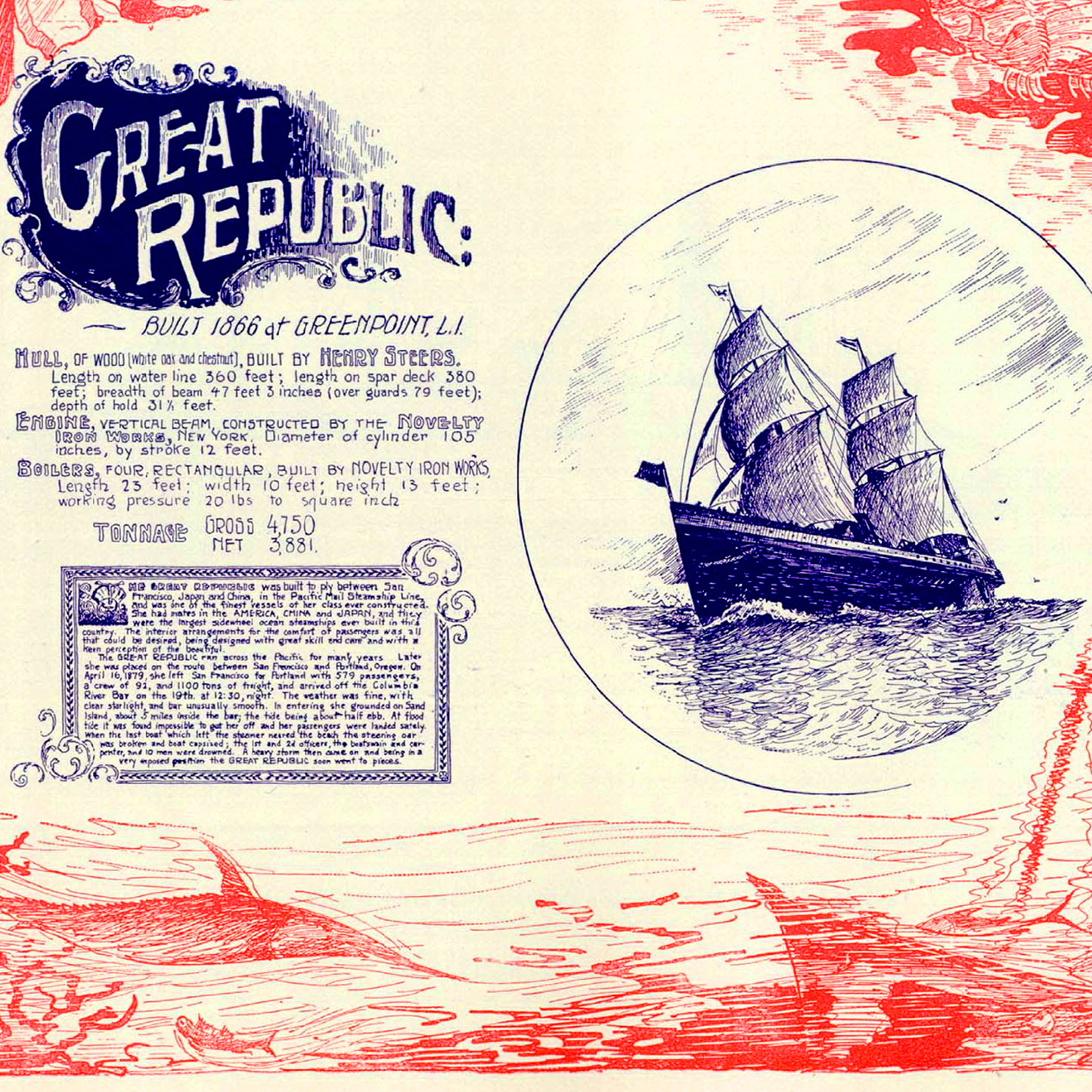
learn that your new friend was a bit of a VIP. In fact, he was the top admiral of the Costa Rican Navy, but he'd probably hastened to add that that was not as big a deal as it sounded. In fact, the Costa Rican Navy had just one ship, a converted commercial vessel formerly known as the Pelican. If you subsequently got to know Admiral Doig well enough, though, you might one day get him to tell you the story of how he ended up here, far away from home in a place that didn't speak his native language. But you'd have to know him pretty well. It was a rather embarrassing story. You see, Admiral Doig had once been a bar pilot on the Columbia River way up in Oregon, and on one clear, starlit night on calm seas he had driven the biggest passenger liner on the west coast onto Sand Island for a total loss. A loss that pretty much everyone agreed was due to his incompetence. The ship was the Great Republic, a massive 378-foot side-wheel monster with four boilers and a reputation for astonishing speed. It had
been built in New York in 1866 to work the China trade, but it quickly became obvious that the ship was a bad fit for long blue-water journeys. As we're most paddle-wheel steamers, it just cost too much money to keep the boilers fed, and the steamers' complement of sales, three gaff rigged mains and some square tops were just too small to be of much use. If you look at a picture of this ship, you'll see exactly what I'm talking about there. After a few money-losing runs, the big ship was laid up in San Francisco while its owner wondered what to do. Enter PB Cornwall, a promoter and adventurer, and something of a sharp-eyed mask. Cornwall figured out that he could get his hands on this odd duck of a steam ship for pennies on the dollar, and if he could figure out a way to put it to making money, he could make a killing with it. Soon he had a plan hatched. Rather a skirless one, it must be added. Cornwall's plan was to take the ship, outfit it as cheaply as possible, and start publicizing plans to go into the coast-wise passenger business, hauling people in freight
back and forth from Portland to San Francisco. He didn't want to actually go into the business you understand, naturally, especially not with a big coal-hungry monster like the Great Republic. No, rather, his goal was to get the other shipping companies worried enough that when he approached them to suggest that they might wish to buy him out for a healthy profit, they'd do it to get rid of him as competition. It was essentially the same scam that the promoters of Lo DeSyle in Portland would run and attempting to shake down the owners of Janssen Beach 50 years later, and it worked out in almost exactly the same way. The other ship owners called Cornwall's bluff and sent him packing, and he was forced to go through with his plan to launch passenger service, and he found, to his utter astonishment, that his new enterprise was a big success. It turned out that even though the Great Republic's ticket prices were higher than the competitions, they had to be because of how expensive the thing was to run, passengers were willing to pay the premium to take passage on a bigger and theoretically therefore safer ship.
Cornwall found that he had swindled his way into an honest line of work, and a profitable one at that. But it wouldn't stay that way for long, and that brings us back to the story of Admiral Thomas Doig. The night that ended both Cornwall's career as a shipping magnate and Doig's career as a bar pilot was a clear and beautiful one. The Great Republic was stuffed to the gills with people in cargo, including 896 passengers. A true worst-case scenario with the Great Republic that night, down with all hands, would have entailed the loss of more than 1,000 people, a little less than 1% of the entire population of Oregon at that time. Luckily, the worst-case scenario is not what happened. And luckily, the best-case scenario isn't either. What happened is this. After Captain James Carroll handed the helm off to pilot Doig, the great ship set off into the channel under a slow bell headed for Portland. Now getting into the Columbia River has always been a tough project, and before the advent of jetties and dredges it was even tougher. The channel curved sharply between clats of spit and a
big barren island of silty sand called Sand Island, which had formed right at the mouth of the river. The channel turned sharply southward around Sand Island, but the current didn't, and if you weren't paying attention, it would carry your boat into the shallow water around the island or onto the island itself. Doig that day made one critical error. He failed to account for how much faster the water would be moving when the tide was ebbing. So thinking he was well clear of danger, he put the helm over a little too soon when the big ship was too close to Sand Island. The eb current caught the big vessel and gently deposited it on the sandy floor just off the upstream end of Sand Island. Initially, Doig and Carroll figured that the returning tide would reflow the ship, but the problem was the tide had only just started ebbing when they hit. High tide when it returned would not be high enough to reflow the ship, and in the meantime the hull left high and dry across a sort of whale back of sand had started to flex and crack. Holes open to admit the water, and the bilge pumps all fouled with
silt were out of operation. It soon became clear that the case was hopeless, and Captain Carroll's inevitable decision, hastened by word that the barometer was falling rapidly and a storm coming in, was to evacuate. Soon a number of tugboats and other small steam ships were coming nearby, taking the hundreds of worried passengers off to safety, leaving just the crew behind. The crew then followed, taking the ship's lifeboats and heading for Sand Island where they could wait safely if rather uncomfortably for rescue. All went well except for the last boat which broke an ore at the wrong moment and was swamped by a broadside wave. Only three of the 14 sailors in that boat made it to the beach alive. After the boats were away, the stranded ship started breaking up in earnest. Quote, a heavy sea boarded the ship and carried away the state rooms on the starboard side, gutted the dining room, broke up the floor of the social hall, and carried away the piano, recounted Captain Carroll. Several seas afterward boarded or forward and carried away the starboard guard officer's room and stearage deck. I remained aboard until 5 p.m. when the
pilot and I lowered a lifeboat and came ashore. In the ensuing investigation, Carroll was roundly praised for his competent handling of the emergency, and Doyle's name was worse than mud. Doyle ashamed to show his face around Astoria, took passage to Costa Rica immediately thereafter and was soon launched upon a new military career. As for the wreckage of the Great Republic, well as much as could be salvaged was salvaged, and the sea soon broke the wooden halt of pieces, leaving the four massive boilers and walking arms sticking up out of the sand. For years afterward, soldiers at Fort Canby used the wreckage for target practice. The resources in this story included works by James A. Gibbs and Don Marshall. Well, that's our show for today. Thanks again for listening. This podcast is part of Offbeat Oregon History, a public history resource for the state we love. What you've been listening to is one of more than 700 stories originally created and published as newspaper comms
in First Runs Indication, between 2008 and today. You can read them all at Offbeat Oregon dot com. Other Offbeat Oregon goodies include an active Facebook page, a ton of historic photos, and a bunch more stuff, including visuals for today's show, and full citations to sources, all accessible through our hub page at Offbeat Oregon dot com. My theme music is by the Atlas String Band and was written by Carmen Ficarra. Listen and learn more at Atlas String Band dot com. This episodes of Offbeat Oregon History are uploaded around 6 a.m. every weekday, so the next one will be on your device and ready to go before you know it. Until then, go out and fill up the rest of the day with good stuff. Bye now.
More episodes
More from Offbeat Oregon History podcast
Luther Cressman was Oregon’s real-life Indiana Jones (Part 1 of 2)
Offbeat Oregon History podcast

Radical Wobblies found support among loggers
Offbeat Oregon History podcast

Shipwrecked fur traders walked from Oregon Coast to Louisiana
Offbeat Oregon History podcast

P-town ‘jitney wars’ were monopoly vs. small-biz
Offbeat Oregon History podcast