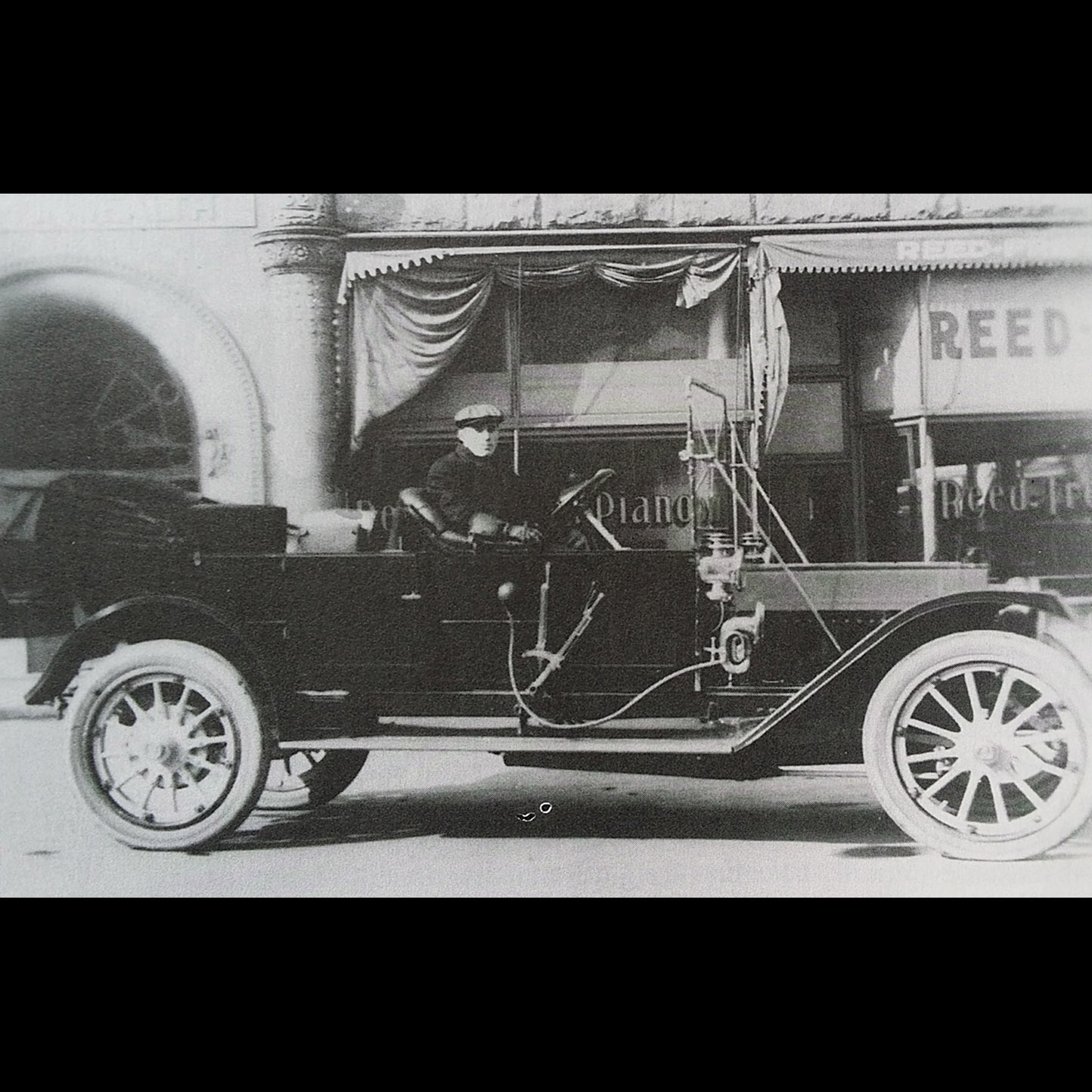
P-town ‘jitney wars’ were monopoly vs. small-biz
About this episode
Get every episode summarized
Each time Offbeat Oregon History podcast publishes, we email you a written briefing from the transcript — the topics, who appeared, and any specific claims, with the ad reads skipped.
Email me new episodesFree for 3 shows. No card needed.
Hosts & guests
Transcript ready
147 searchable segments. Every word is indexed and playable.
Full transcript
Offbeat Oregon History podcast — P-town ‘jitney wars’ were monopoly vs. small-biz. Machine-transcribed; use the interactive transcript above to jump the player to any line.
Good morning Oregon and happy Friday. I'm Finn JD-John, if J. Ed Offbeat Oregon.com and this is the daily Offbeat Oregon history podcast. Thanks for joining me and I hope you enjoy the show today. This story was first published on January 10th of 2016 under the headline Portland's Jitney Wars, Pitted Entrepreneurs Against Monopoly. Here we go. The working stiffs, lunchpales in hand, shiver in the chill of an early January working morning. The street car is late again and when it arrives they'll pack a board to be taken slowly and uncomfortably to work.
When they get there they'll still have to walk a half a mile from the nearest station. They're not complaining, a working man with a job in the slow 1915 economy isn't in the habit of griping about stuff. But still, all of them will admit, if you ask them, that it would be nice if the streetcar company, the Portland railway light and power company, were a little more responsive to its customers' needs. PRL and P is a pondrous, well-protected monopoly and to paraphrase a comedian from a later age they don't have to care. Then the sound of a crude four-cylinder automobile engine breaks the morning stillness. It's a man in a red driving cap behind the wheel of a shiny new Ford Model T. Say, brothers, it calls out, any of you gents care to ride with me this morning? Five cents gets you there quicker and I'll drop you off at your factory gate. Soon he's puttering off with four grateful pipe fitters crammed into his car and another two standing on the running boards.
Ten minutes and 25 cents later he's coming back for another load. He passes a couple of other horseless carriages on the way. All of them are loaded with workers grateful to skip the long lines, slow travel and inconvenient routes of the monopoly street car operators. He exchanges cheerful waves with each. As he passes the street car itself, only half full of passengers the street car's engineer has face a mask of fury shakes his fist. Damn you useless socialist, jitney cream skimmers! He shouts as they pass. It's just another morning in the front lines of Portland's jitney wars. Jitney is a term most Oregonians know today as a vague slang term for a piece of logging equipment if they know it at all. But in the years just before the First World War the term was familiar and as controversial as the name Uber is today. And indeed there are some striking similarities between the modern phenomenon of ride sharing services like lift and Uber and the pre-First World War phenomenon of jitneys.
There are some significant differences too. Differences that have been overlooked by most of the authors of recent newspaper features about them. But we'll get to that in a minute. Jitney phenomenon got started in 1914. At that time most major cities had a street car service. Many of them were still horse drawn but some had fancy new electric drives. Now a street car service is something of a natural monopoly. It's hard to have competing light rail systems. So a city typically gave a franchise to one private operator. The operator was protected from competition and exchange it agreed to have its rates and service regulated by the city in the interests of the public. Of course that regulation typically started outlax and got more so as the big shot businessmen in charge of the street car companies got progressively chummy or with local political elites. Certainly that was the case in Portland. So protected from either competition or serious pressure from the city the street cars in stomp town delivered increasingly desultry service even as the city's growing population
tax their capacity to the limit and occasionally beyond. Meanwhile the Ford Model T had a few years earlier made private automobiles easy to afford and it wasn't long before one of the new car owners tumbled to a great scheme to make a little extra money. Troll the street car lines offering customers personal service for the same nickel they paid to pack aboard a slow smelly inconvenient street car. Now the fact that a private motorist could make a worthwhile profit selling individual car rides for the same price as street car fair clearly says something about the state of the street car industry at the time. Profit margins for street car companies were enormous and in Portland there was not much love lost between street car riders in the Portland railway light and power company, which as most of them knew was backed largely by out of town capital and had been created through merger and consolidation specifically to eliminate competition. When street car monopolies in Portland and other cities around the nation found themselves
competing with hundreds of private motorists picking up a little extra drinking money at their expense they naturally turned to their local city governments with demands that this behavior be stopped. Their case was a textbook argument from a licensed monopoly and it went a little like this. Their deal with the city required them to run many different lines some of which lost money and some of which made money the winners offset the losers. Now they cried came these jitney driving jackals to quote skim the cream of the lucrative routes leaving them with nothing but the losers. It wasn't fair it was unfair competition and if it were allowed to stand they claim they'd have to cut back service. Now another cities around the west this claim resonated strongly. Cities like San Francisco and Los Angeles laid down expensive licensing laws and species requirements. Then they put their police forces on the job performing sting operations and writing fat tickets to unlicensed jitney drivers. In Portland though the jitney drivers who had wisely formed an AFL affiliated labor union
just as soon as they realized which way the wind was blowing much to the dismay and consternation of the street car company's friends at the morning Oregonian had a key friend in counselor will daily. Daily was unusually a union officer who had gone into business successfully for himself so he was both a union man and an enlightened employer and he made the jitney drivers case in terms that were hard for an honest conservative to argue with. How he asked was it appropriate for the city to take action to squelch a cadre of entrepreneurial small business man in favor of a bloated centrally controlled government sponsored monopoly that could simply raise its rates if the jitney drivers took away too much of its business. As a result Portland's jitney drivers got to stay on the road much longer than others and their licensing requirements were much less onerous. But the Portland Morning Oregonian motivated both by publisher Henry Pidock's personal hatred for daily and his sympathy for the high rolling capitalists whose pocketbooks were being impacted by what they saw as illegitimate competition from cream skimming peons never
stopped culminating against the jitneys relentlessly calling them and daily socialists in blive defiance of the dictionary definition of the term and decrying their businesses unfair. As proclaimed that jitneys represented unfair competition, daily's response was equally brilliant. Of course it was unfair he said quote, Where has there ever been competition that is fair? He added, competition means survival of the fittest there is nothing fair about it. Left unspoken but surely understood was a follow-up question. Whose position here is really a socialistic one? The backers of a government sponsored transportation monopoly are the backers of a diversity of individual small businessmen operating in an open marketplace. That difference is also why the comparison with Uber and Lyft doesn't quite work. Uber and Lyft are centrally controlled systems more like a distributed version of the street car company than like the jitneys that once so vexed them. And the taxi companies, although few of them are one car operations owned by the drivers,
are locally owned businesses like the jitney drivers were. And like the jitney drivers, it seems pretty likely that they will lose their fight with the smooth well financed ride sharing services. In the case of the jitneys, the coup de gross that took them out was the outbreak of the first world war. In the years leading up to it, competition from the jitneys inspired the street car company to upgrade its service substantially. When the war broke out, most jitney drivers found that they could make a lot more money helping build ships and tents and cots and other supplies for the war effort. Their jitneys fell into disuse and they joined the throngs aboard the street cars. By the end of the war, stiff regulations had been put into place. The city's nascent taxi services were able to roll with the regulatory punches, but most jitney drivers found that they could no longer make a living collecting nickels and shut down for good. Key sources in this story have included works by Robert D. Johnson, Steve Law, and a 1918 issue of the Electric Railway Journal.
Well, that's our show for today. Thanks again for listening. And by the way, if you haven't yet, check out our off-beat Oregon books. There are a lot like these columns only expanded and updated to take advantage of a less restrictive format. We've got heroes and rascals of Old Oregon, love sex and murder in Old Oregon, bad ideas and horrible people in Old Oregon, and eventually the plan is for eight of them to be out. Although, how many there are out right now depends on when you hear this. There are a lot of fun and would look great on your bookshelf. This podcast is part of off-beat Oregon History, a public history resource for the state we love. Check out our hub page at off-beat Oregon dot com to explore all the other things we do or to find the full citations and visuals that go with today's show. Our theme music is by the Atlas String Band and was written by Carmen Ficara. Listen and download more at AtlasStringBand.com. Off-beat Oregon History episodes are uploaded every weekday morning and around 6 a.m., so it'll be a couple of days before you get your next fix. But of course, Monday morning will be
here before we know it. And that's the latest news from here in off-beat Oregon's Sulphur Spring Studio. So now it's time for you and me both to go out there and fill up the rest of the day and the weekend with good stuff. Bye now!
More episodes
More from Offbeat Oregon History podcast
Luther Cressman was Oregon’s real-life Indiana Jones (Part 1 of 2)
Offbeat Oregon History podcast

Radical Wobblies found support among loggers
Offbeat Oregon History podcast

Shipwrecked fur traders walked from Oregon Coast to Louisiana
Offbeat Oregon History podcast

Dog's 2,500-mile walk home made Silverton famous
Offbeat Oregon History podcast