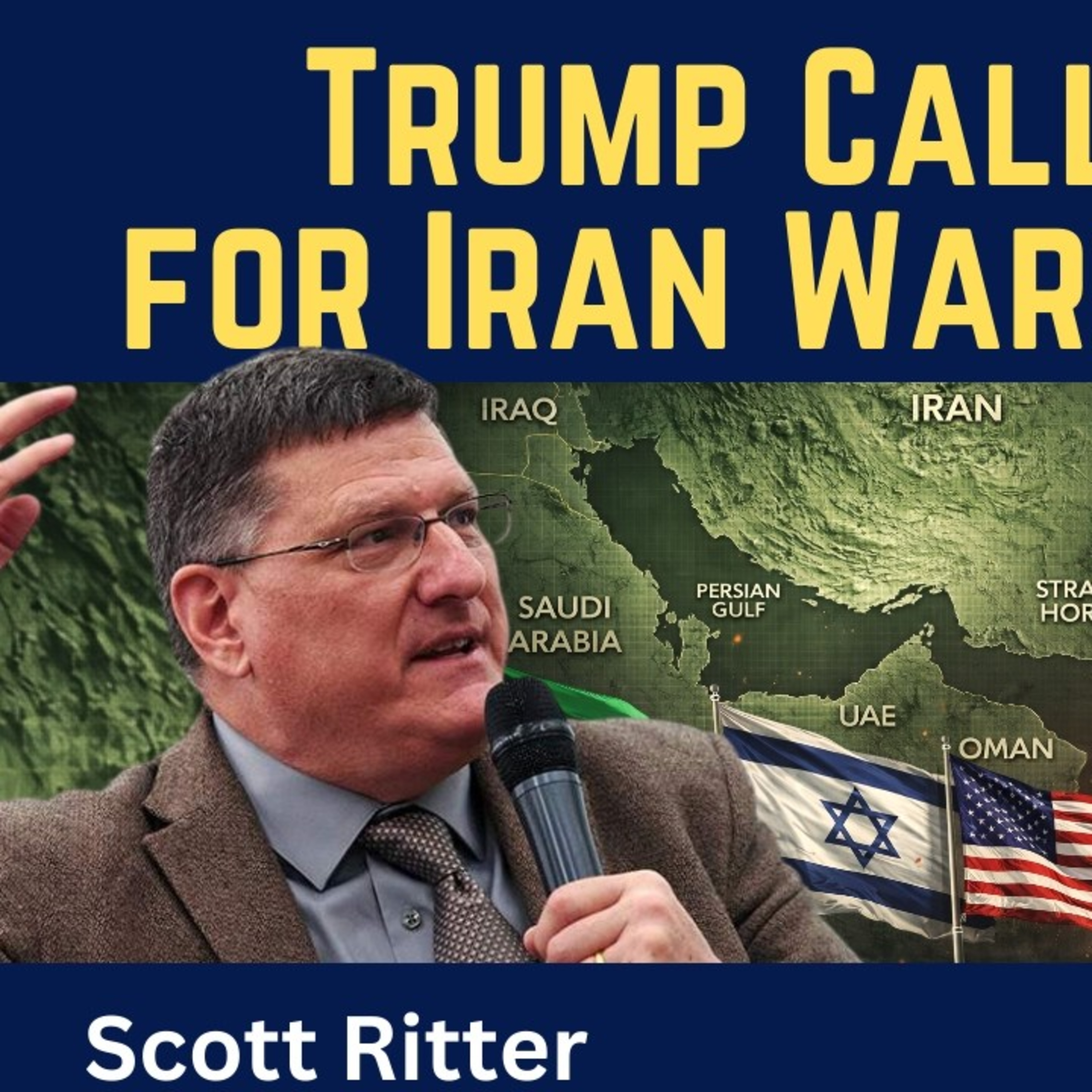
Scott Ritter: Trump Calls Putin for Iran War Off-Ramp
About this episode
Scott Ritter is a former Major, Intelligence Officer, US Marine, and UN Weapons Inspector. Ritter discusses the Trump-Putin phone call as the US needs an off-ramp in its war against Iran.Follow Prof. Glenn Diesen: Substack: https://glenndiesen.substack.com/ X/Twitter: https://x.com/Glenn_DiesenPatreon: https://www.patreon.com/glenndiesen Support the research by Prof. Glenn Diesen: PayPal: https://www.paypal.com/paypalme/glenndiesenBuy me a Coffee: buymeacoffee.com/gdiesengGo Fund Me: https://gofund.me/09ea012fBooks by Prof. Glenn Diesen: https://www.amazon.com/stores/author/B09FPQ4MDL
Get every episode summarized
Each time Glenn Diesen - Greater Eurasia Podcast publishes, we email you a written briefing from the transcript — the topics, who appeared, and any specific claims, with the ad reads skipped.
Email me new episodesFree for 3 shows. No card needed.
Hosts & guests

Transcript ready
390 searchable segments. Every word is indexed and playable.
Full transcript
Glenn Diesen - Greater Eurasia Podcast — Scott Ritter: Trump Calls Putin for Iran War Off-Ramp. Machine-transcribed; use the interactive transcript above to jump the player to any line.
Welcome back. We are joined today by Scott Ritter, a former UN weapons inspector, a US Marine Corps intelligence officer, and also an author. So thank you for coming on. Trump has called Putin. They had this conversation. I assume about ending the Iran war and also the Ukraine war, although I suspect the emphasis was on the former. The Russians refer to this call as Frank. They did not use the word friendly. So I was wondering, what do you read in all of this? What do you suspect they discussed? Well, I speculation thrown into that one. I think we do know that it was Trump who initiated this call. So this is an American initiated call. We also know that Russia has to the dismay of some surprise of others kept the door open for diplomacy with the United States, despite the United States being
less than a perfect diplomatic partner. In particular, they've kept the invitation out for Steve Woodcoff and Jared Kushner to continue to participate and even take a lead on diplomacy. And again, given their track record with Iran, one would think that that would have been a disqualifying factor. But the reason why I bring this up is that Russia is not doing anything precipitously to close down the diplomat door. And you have to ask yourself, why would they? I mean, there are some purists out there. I count myself amongst them who in times of passion sometimes forget that there is an art of diplomacy in such wars and extensive politics, but other means diplomacy is sometimes the more sound path to take than confrontation. But we're dealing with this time when when Vladimir Putin was an assassination of temples against his life using 91 drones
targeted by CIA intelligence while the president was engaged in the conversation. That was December 28th. Great Britain has attacked, without the Kinsk using a British-made storm shot, I'm sorry, flamingo missile using Ukraine as a proxy, but it was targeted built and targeted by Great Britain. And now seven storm shadow missiles that hit a strategic industrial facility in the city of Breon's. Normally, these are red lines and yet the Russians leave the door of diplomacy open. And the question is why? And I think the answer is that Russia is playing a very strategic game on a multiple fronts and that they've avoided successfully following into the military trap to give you an example. Why would you respond to, because logic dictates and Sergei Karaganov has has articulated this, that if England strikes Russia, Russia strikes England.
And we know that there's a there's a facility in a British town in the UK that produces storm shadows and it has literally become a legally justifiable target. Russia would have every right under international law to put an arrest on that facility and cease his existence. Same thing with flamingo. We know flamingo is a British design. The British all but admitted that when they unveiled it at their Abu Dhabi arms expo under the flag of a British company. You know, Russia would have every right to take out that headquarters and any facilities associated with it. So why haven't they? Kierstarmer is in the process of political freefall. If you attack the UK, you've suddenly made Kierstarmer a wartime leader and you create the potential of his political revival. So, you know, Russia has taken seven storm shadows in a flamingo. Some damage has been done,
but the strategic picture is collapsing the British government, which Russia only has to wait to do nothing. So sometimes military action isn't the wise thing with the United States. You know, one of Russia's strategic goals and objections to the lifting of economic sanctions. And here by doing nothing, Russia had all the oil sanctions lifted. I mean, I'm not an economist, but I could imagine that if you were selling Euro, Eurograde crude at $23 a barrel discounted and you're now able to sell it at $80 on the market, open market, that $53 barrel profit is that helps balance a budget, helps pay for a war. It helps any number of things cash shortages, the whole thing. This is good, and Russia didn't have to do anything except keep the door of diplomacy open to pick up a phone call, answer the phone call. You have a frank discussion. I think the Russians had a very frank discussion about world energy. The President has become suddenly very
well informed about the potential of Russia to deliver oil and gas into a market that now faces a critical shortage because of the closure of the straight or moose. The President has been educated about what will happen to the American economy if a balance isn't found in the energy supply market globally. Russia doesn't need to tell the President about the political consequences of a failed economy. The President understands that. I think the Russians have kept the door open because it plays to their advantage. A Russian overreaction, for instance, assassinating Zelensky, which would be a very crowd-pleasing thing to do in Russia. The man is a dog. He's a criminal. He's a Nazi. He's committed horrific crimes. He's now attacking Russian civilians and has been. It would be a very pleasing thing to do, but strategically your
job is to remove Ukraine from the side of Europe and the United States to eliminate the Ukrainian nationalism to make Ukraine a neutral party. Do you do this by carrying out actions that would inflame Ukrainian nationalism? Zelensky right now is identified as one of the worst leaders possible for Ukraine. The longer Zelensky rules Ukraine, the better off it is for Russia. They gain everything, the collapse of confidence in the Ukrainian government, etc. We now see a political three-way death match between Zelensky, Zeluzhny, and Budanov. A Russian targeting of Bangkok would literally turn Zelensky into that, which Russia doesn't want him to be. A wartime leader with credibility. Give him justification for everything he's done. So for the Russians to do nothing is actually the best course of action, to let Ukraine devolve, to let the United Kingdom devolve. Now in the context of Iran, for Russia not to take that phone call, removes them from the
distancing-making cycle in the United States, but by taking that phone call, Russia is able to make its voice heard, and the president is desperate. By taking this phone call, Russia has set up the potential for an additional phone call, an additional phone call, in a face-to-face meeting, maybe with Kirchner and Whitkopf. But that face-to-face meeting will be done on terms that are far more influenced by Russian goals and objectives, because it's the United States that now desperately needs Russian assistance to achieve an outcome that's politically useful to the American president. I think you might see Russia being willing to put pressure on Iran to bring conflict termination or not to do certain things in exchange for the United States, removing some of their demands when it comes to Ukraine. I think that you see the United States is literally running away from Ukraine as fast as possible. Russia wants to encourage that, which is why Russia does nothing, except leave the door open for it. So I think what you saw is a very frank conversation,
not one that put Trump on the defensive, but one that educated Trump about the reality that he's facing, and the role Russia could play. But letting the president know that there are conditions that have to be met, Russia's saying, we want to negotiate it into this war, but that they're not going to accept Ukrainian terms, and the United States needs to stop backing Ukrainian terms. And I think you can see Russia and the United States come to an agreement that more closely resembles Alaska, but we'll call it Alaska modified, because now, since the United States re-nigged on Alaska, they can't just throw it back on the table. When you throw it back on the table, it now has strings attached to it, and the Russians should start calling in those strings, for instance, the idea of freezing the line of contact, and the carestone of this upper region might be the longer, valuable, the Ukrainians might be called upon to give up those territories as well. We get into buffer zones. Again, I don't know the details of the Russian position.
You haven't been made public, but I think Russia is in a better position to admit, to force the compelling United States to stick to Alaska plus, meaning the Alaska plus, the current reality, to bring about an end to this conflict, and I think the United States isn't in much of a negotiating position. Time is not on their side, because this conflict with Iran is going south quickly, and they need Russia, they need Russia to get involved in the energy market, and they need Russia's help with bringing it into this conflict. And again, Russia can help provide some political cover for the President. Imagine if the President said that he was able to get a Ukrainian peace deal, and an Iranian peace deal in the same day, and that Nobel Peace Prize looking pretty good around his neck. I mean, he's the man, because he is the peace president. And Russia is more than happy to play that game. Trust me, the Russians know better than anybody. The President Trump is the least qualified
person in the world for Nobel Peace Prize, but since the Nobel Peace Prize has already been politically compromised, why not just give it to a politically compromised person? So I think the Russians, they know how to play Trump, and I think this phone call is all about playing Trump. But at the same time though, it seems that the cost of doing nothing is that Russia's deterrence keeps weakening. The fact that the British would dare to do this kind of thing, strike inside Russia, the fact that there are people like Chancellor Merz can sit in Munich at a security conference, and brag about how he has imposed all these casualties on Russia. I got the impression from the decapitation strike against Iran that this had brought back, well, made the Russian rethink about what was done in December against Russia in Moldeye. Do you see this pressure on putting to do what Iran has done?
That is to tell anyone who attacks Iran, assists in any way, allows us to use bases, its airspace, everyone will be struck. I mean, I would expect in the future that a lot of the Gulf nations will be very cautious, allowing their territories to be used again if again this is the consequence. Well, again, only Russia can make that call, but I would say that if I were Neurushkin advising the President, I would say that Starmur is history. Here Starmur is toast, and the continued devolution of the British political system is to the benefit of Russia, that when Starmur goes, there will be a political vacuum infighting, and you're going to see Britain continue to collapse of its own volition. You know, the case can be made for patience. You know, what has Britain done, I mean,
you know, giving European politicians bragging rights is meaningless. Mertz bragging about what he did to Russia doesn't change the strategic equation that the German economy is trash and is going to get trashed even further now because of a looming economic crisis brought on by an energy shortage. You know, so Mertz's domestic political status, let him brag, who cares, it's words, it's nothing. And Starmur, if he wants to sit there and you know, talk behind the scenes about how, you know, England is, you know, enabling Ukraine to strike strategic targets. And in the short term, yes, it would be pleasing. I mean, I think I could say that I speak for a lot of Russians who would love to see British factories go up in smokes and love to see a Russian agreeing down on German factories and, you know, and it would feel good for a moment. But is the goal to end this war or is the goal to expand this war? Because right now the European
Union is in trouble. They don't know how they're going to fund the continuation of this conflict. You know, Germany, again, is a collapse in economy with the, and Mertz's political fortunes are collapsing. Starmurs on the way out, Macron's in crisis. You know, sometimes when the enemy is doing what you want him to do, just let him keep doing it and take the peripheral hits. You know, there will have to be a balancing act because, you know, this is not sustainable. But I think there's ways that the Russians would be able to strike targets inside Ukraine. Without empowering Zelensky, you know, to focus more on the bases in Western Ukraine, where these missiles came from, I think you might be seeing a Russian accused more liberally to take out these air bases, where the aircraft that fired the storm shadows are located, the strike targets that, you know, we know that the British have built certain
refurbishment facilities. I believe there's some flamingo assembly facilities. Again, in Western, Ukraine, maybe close, precipitously close to the Polish border. These are targets that need to be taken out and taken out decisively. And it has been some political risk associated with taking out these targets. And I think it's time you eliminate that political risk. So that's where I would think the Russians could, you know, could go to flex their muscle. But let Europe continue to commit suicide. I mean, you know, they're weaving the rope. They've put it around their neck. My God, don't stop them getting on the stool and kicking it out from underneath themselves. That would be my advice to the Russian president is, you know, we're winning. So let's keep on track. Don't allow ourselves to be deflected off course because, you know, the British landed a punch. I mean, you're in a 15-round boxing match, you know, around nine. The British hit you, you know, got a nice kidney shot. Okay? Don't change your plan. Get back to the game. You're wearing them down
and you're going to knock them out in around 14 or 15. But if you change not because you got mad and start, you know, aggressively punching, you might be playing into their game plan. So I think Russia stays to the script. This oil, the lifting of oil sanctions, I think this is to get from God. I think I'm not an economist, but I can't imagine that this, does it solve a lot of pressing economic problems for Vladimir Putin? No budget issues. You keep making $57 profit margin over what you were making. You know, and who knows how high this goes if this war, you know, Russia right now has the ability to influence, you know, how long the trade war move stays shut. So Russia, you know, Russia's in the driver's seat. The United States went to Russia for a solution. I mean, that's the thing. Russia didn't go to the United States for a solution. The United States went to Russia for a solution. And so the United States is looking for Russia to do something. So Russia is doing the driver's seat here. I think this isn't a
sign of weakness on the part of Russia. It's actually a sign of their diplomatic strength. Well, I assume that in these talks, Trump was looking to what extent Putin could help to put it into this war. In other words, offer some kind of an off ramp, even if it could be concessions from the Iranians, which probably isn't forthcoming. But we also see in this reports coming out of, well, at least in Washington Post suggesting that Trump's advisor argues we have to put an end to this because we're not winning. And also in the Israeli media, there's suggestions now that many Israeli leaders are also worried that the Iran is not collapsing, and it's not kind of capitulate. So where is this all going? Now, I guess my question is twofold. Is there an off ramp to this? And in Iran, that is. And if not, what will Trump do? Just inflict destruction or what is the war plan? Now that regime change isn't happening.
The only off ramp is one that Iran agrees to. The United States and Israel have no vote on this. They started something. They're no longer in control. This is going to go as long as Iran wants it to go. That's just the reality. What can Trump do? I mean, we had General King come out and outline his plan. Basically, he said we're having great success against the Iranian missiles. Last night, proved that to be this straight-up lie. We've sunk the Iranian Navy, who cares, the straight-arm moves continues to be closed, and you're not going to open it up because it was never about the Iranian Navy. And now you're going to expand your target set to strike strategic industrial targets inside Iran. They're all empty. If you think a day 12 Iran continues to have high-value industrial equipment stored in known strategic industrial facilities, please pass that marijuana cigarette because it's pretty damn good. And I want some of it, even though I don't smoke marijuana. I might, if it's that good, if it allows you to hallucinate that well, I'll do it because those sites are empty. There's no strategic strategically important equipment in any known facility anymore. It's
all been moved. It's all been evacuated. So we'll just be bombing empty buildings. So all Trump has is an expansion of the empty building bombing campaign, which makes us feel good because we get a lot of war porn. We get to watch things blow up and go in the mouth breathers, get to breathe heavily and post stupid stuff on X and other social media outlets. But Iran just continues winning. At some point in time, it's going to become clear to the United States that it doesn't dictate the end of this war. Iran does. And they need, therefore, to talk to people who have connectivity to Iran. The United States has no connectivity or actually will not pick up the phone and talk to Woodcoff. It means that Russia now becomes the intellectual. And now Russia gets to talk to the Iranians and gets to play a role as mediator. And that's where the value of Russia comes into play. Yeah, so Trump put up a tweet, something along the lines that we hit 5,500 targets, which isn't much of a strategy just to blow things up. As we said, it begins
to look childish. One would want to see what objective is and how these targets achieve that objective. But you mentioned the inability to open Hormuz. Trump has argued this is an objective to open the street Hormuz. I guess it's necessary to get energy flowing again. And also he argued if the Iranians dare to close it, keep it closed at least. He will hit them 20 times as hard. And Macron has also now suggested that the French will also, you know, he said, have a defensive mission in the street Hormuz to open it up. To what extent is such a military option actually possible, though? Oh, la la, the French didn't involve it. That's a game changer. I mean, my god, Macron are the military genius that he is. And I can't imagine, you know, the French that that changes everything. I think Iran is going to surrender tomorrow. This stupidity. Look,
there's a way to get the straight Hormuz open, brute force. You come in and you seize a car island. You seize all islands, you cushion island and you project power ashore. You seize the shoreline on the on the Iranian side of the straight Hormuz. You go in with, you know, 80,000 marines and you seize and you hold that territory and you can extend an air bridge over it and the Iranians couldn't touch it. You can do that. It'll cost you. It'll be very heavy. And we don't have the resources available right now. You know, so that's a time, time intensive thing. And still, once you get there, you'll be vulnerable to Iranian ballistic missiles. You may not get, you know, Iranians able to push you with troops because with your air supremacy, you'll be able to hold back any concerted ground efforts and you should be able to push back against most, you know, local
threats. But we don't have a solution to to ballistic missiles and we don't have a solution to drones. And so we would just now be parking ourselves on Iranian territory trying to, you know, force ships through. The Iranians will still on occasion target of ship. And those to start pounding, you know, our forces logistics becomes a problem. You put 80,000 guys at shore in Iran. You got to support them. You got to sustain them in your poor facilities. Those poor facilities will be under, you know, under duress. You know, so and again, we just don't have the marines to do that. You know, we would have to redirect a lot of marine manpower and bring an amphibious shipping that would be vulnerable. And it would take months to do this. And meanwhile, the international economy is going to collapse well before that. So this is this fancivil thinking on the part of the United States and on the part of France that they they have about. The US has always bragged that they could open up the straight arm moves anytime they wanted to. And the Iranians have always said that that's a pipe dream. And so far it appears that it's a pipe dream that Iran can
shut this thing down. There's not a damn thing the United States can do to open it up in the inclusion of France into the war mix. I think only weekends the the case for for military, his France has zero military capacity. It's that's that's meaningful. And French involvement with the United States was complicate planning. So again, games that match Iran, they've planned this thing out better than than we have. The fact that we're sitting here talking about this at day 12 means we didn't consider it on day one. Which means we're making it up as we go along. We're we're we're the Iranians are on their war plan. They are constrained to their war plan. They've got this thing through John Boyd, famous colonel, you know, talks about getting inside the enemy's decision-making cycle. He talks about the Udalupe. I'm sure you're familiar with the Udalupe Observatory and decide act. Well, the Iranians are inside the American decision-making cycle. We've changed our war plan five, six times. They, on the other hand, haven't changed theirs at all. They're sticking to it.
We are reacting to them. They are driving. They are in the driver's seat. They're the ones, you know, initiating the action we're reacting. When you're reacting, you're losing. You need to be in charge. You need to be the one precipitating action, getting the enemy to react. The Iranians are in charge. We are reacting to them. We are going to lose. If we're talking about putting ground troops into the theater to open up the street or remove, it means we hadn't considered that as an option earlier, which means we've done zero logistical planning for this. So, no, it's just not going to happen any time soon. So what are the war plans going from here? What are the cards that the U.S. can play? Because it looked as if in absence of its own ground troops, it could get cards. Armed them, there were some reports to see. I had already done this, but now reports comes from the cards suggesting that they're not going to do this. Azerbaijan looked like it was going to be pulled in, but instead of retaliating against what was allegedly an Iranian drone, they now sending humanitarian aid instead. And, you know, Lince Graham, he threatened Saudi Arabia with
consequences unless they would, you know, join in on the fight because they don't want to fight Iran directly either. I guess a lot of their infrastructure is quite vulnerable. So, well, what does this, I guess, what cards are there to play? How short is the U.S. on ammunition here? I mean, we have plenty of dumb bombs. We have some kits that can be attached to them. So, we could drop laser-gotten munitions, but we've been supplying Israel. How do you think Israel leveled Gaza? So, there's a finite level of these, you know, number of these sets. We're running out of standoff precision missiles, which means a future strikes would require. Aircraft actually penetrate the Iranian airspace. Iran has held back on its air defense. They've retained a significant
portion of it. And if we start penetrating the air defense, I think you're going to start seeing air defense ambushes. And we'll start losing aircraft, which is going to be problematic, because then we have to rescue pilots, which they could go down. We get a black hawk down, Persian style. It's just a bad, it's a bad, it's a bad look all around. We are running out of precision standoff weapons, they're very expensive. And again, anybody knowing anything would have said we just, it's, we don't have enough. We're going to run out of cruise missiles. We, you know, we've fired enough to kill a bunch of children, but we haven't retained enough to sustain this, this conflict. So, you know, the next steps are just to blow up more things. I mean, that's where General Cain said that's the only option we have is to blow up more things. That's all President Trump could threaten to do to blow up more things. We don't even know what they're blowing up though. Again, if we've shown so much confusion in our initial wave of our attack, where we should have had the best intelligence possible, and yet we put out of four places
targeted in the Minab, a naval facility, two, where we're empty warehouses. One was a hospital, one was a school. Fifty percent of our targets were illegal under a law of war. Make sure, wonder what the percentages that we're striking today that are illegal. We will never know, because Pete Hegseth closed down the units responsible for screening targets to make sure that they were not civilian in nature. But now as we become more and more desperate, we're just going to start expanding the target deck. And, you know, if we've bombed 5,000 targets, and that Trump says we're going to bomb more, where are they going to come from? What targets are they? Who's making these targets? Making decisions. This is AI-driven. How many homes are we going to strike? How many schools are we going to strike? How many hospitals are we going to strike? How many mosques are we going to strike? And the answer is a lot, because this now has become literally a war, you know, a cultural genocide. You know, and that's what the United States will be. We're not going to win. The Iranians are not going to blink. I mean, I'm sure you have studied, at least peripherally, the Strategic Air Campaign during the Second World
War against Germany and your cognizant of the reality that it didn't achieve the strategic results they wanted to achieve. The German production actually went up, became more efficient, and the will of the German people to resist was not broken by the Strategic Air Campaign. So what we're proposing is basically to, you know, increase the scope and scale of a Strategic Air Campaign that history shows doesn't work, doesn't achieve the outcomes you want. You know, there's a reason why Azerbaijan backed off. This war was sold as a regime change war, even though now Trump says it's not, well, it's not because we can't, but we tried. And, you know, the idea was, you know, if you kill Ali Hamane and you have people in the street shouting death to the, to the Ayatollahs, the Kurds might be more inclined to say, okay, we're in. The Azaris might say, yeah, Zangus and our quarter is looking pretty good right now. Let's, let's jump in on this one. But when you kill the Supreme Leader and the end result is a Unified Iran screaming for revenge, the last thing you want to do is get your list on that revenge list.
In the Kurds or suddenly, they woke up and they went, well, we're not doing that. And the Azaris went, yeah, we're not doing it either. The Saudis, they're not doing it. Lindsey Graham can take talk till he's pink in the face. But, you know, he may look cute to his, never mind, I'm not going here. You know, I don't like Lindsey Graham, but no reason to get ad hominem on him. You know, but he, he, this is a man who talks tough, but there's nothing tough about him. He's a pancake. He's a perfume princess. He's nothing. He's a senator who, you know, for whatever reason, people listen to, but hopefully he's being disgraced right now. And I think he's embarrassed. I think he's embarrassed by the fact that he's sold a war to Trump and that war's going bad. And his political capital is going out the window and he's coming up on a contentious election that he may very well lose, which would be the greatest thing South Carolina has ever done. So he, he become more desperate threatening Saudi Arabia. Saudi Arabia isn't care about his threats. The biggest consequences to Saudi Arabia would be the destruction of their energy
production capability, which is a guarantee if they jump in two feet into this war against Iran. The United States has proven that it can't defeat Iran. Iran has proven that it can continue to inflict destruction beyond its borders, even after absorbing 5,000, you know, the bombs dropped on its territory. So it doesn't matter what Lindsey Graham says. He's irrelevant. He's simply fodder for the mainstream media to, to sell a war that is increasingly becoming impossible to sell. You know, it does look like strategically, they got a bit lost after the original regime change operation failed. And of course, the whole premise that Trump would be allowed to choose the next leader, it's, it does show a certain amount of the attachment where they think what they think Iran is and they're Iranian people. Just as a last question, what do you think are the wider implications of this? Because this is of course not just a war between Israel and the US on one
side and Iran on the other. This will have wider, I guess, global ramifications. What does this mean for? I guess the future of Israel, nuclear proliferation, the Abraham Accords, I guess the partnership between Russia and Iran. Sorry, a lot of questions packed in there, but more generic. What do you think is the wider consequences of this war, not just the war happening, but it's going south as well? I think this will be a huge strategic defeat for the United States. Trump will try to mitigate that by creating political cover at home, but globally, I mean, look what's already happened. We've stripped air defense out of South Korea. We've proven that our ballistic missile defense shield over Asia doesn't work. If we were trying to intimidate the Chinese, and remember the National Security Strategy Document of the Trump Administration speaks of conventional military overmatch against China and the Pacific, which is proven that we are
woefully inadequate. If you want to see a nation that has more missiles than Iran, look at China. Iwan has to be looking at this saying, we're screwed. It's over. If China ever decided to unleash their ballistic missile fury on us, so we know that the ballistic missile defense won't work, we know that they'll destroy everything. We know the United States can't come to our assistance, so it's over. South Korea and Japan have to reconsider their tri-partite nuclear deal with the United States, because United States has been exposed as a toothless tiger. Not only that, we're stripping away their defenses. This is bad for the United States all around strategically. We're not going to recover militarily from this. You know, we're not suffering significant material loss in terms of aircraft munitions. What this is going to do to American defense priorities in terms of rebuilding the ammunition, because once you have no ammunition, you're military useless. Who's going to step in and take advantage of this? I think that
we're going to have to leverage Ukraine away, meaning that Russia is going to get what it wants to Ukraine. I think China is going to get what it wants in Taiwan. I think China is going to get what it wants in the South China Sea. I think India is going to realize the United States is not the partner it should be in India. We'll jump in even further with bricks. And I think that Iran will emerge as a regional hour. The United States will be evicted from the Middle East. Israel. This is the one place where I think Putin's intervention could come into play, because Putin has said straight up that Israel, because of its heavy Russian Ukrainian population, is an extension of Russia. So Putin's not going to let Iran sit there and continue this war to the point where they depopulate Israel. I'm not talking about killing Israelis. I'm talking about making Israel unlivable, and people start to flee. So I think that Israel will be retained,
but now pressure can be brought to Israel on their nuclear program. I don't think Israel gets to stand around as a unilateral defiler of nuclear and non-proliferation. Either the entire world goes nuclear or Israel is going to have to be compelled to talk about this. And maybe that's the leverage Russia could use to for the Iranian program, meaning to finally dispose of this 450 kilograms of 60% enriched uranium. Iran is not going to give up that for free now. The United States has lost all negotiating posture. Can't be trusted, but Russia might be able to get Iran to put that on the table and get the deal that closes the door to any breakout potential in exchange for Israel putting its nuclear program on the table as well. So, you know, there's a lot of possibilities here, but in order to do that, this war is going to have to continue for a little bit more time. You're going to need the United States to feel real economic pain. That's the only way you're going
to get the United States to make some of the decisions that need to be made. And then, you know, they're the president. Again, I think the president, you know, being the con artist is that he can sell that I'm the man who brought peace to the Middle East and peace to the peace to the Ukrainian Russia. I'm the guy who did it. Me, Donald Trump, I'm the best thing in the world. This never would have happened if I hadn't gone to war with Iran. This war with Iran, you know, we achieved the lasting peace lift. We brought stability to the Middle East. There's no need for American troops in the Middle East anymore. We brought peace. We can bring him home. I told you, I'd bring my troops home. This is a great victory. And I think he'll try to sell it that way. And he may succeed because the American public has shown himself to be very ignorant and vulnerable to this kind of nonsense coming from Washington DC. Sorry, just last question. Did it surprise you that Lavrov was essentially scolding the Gulf nations because many had assumed after Syria that
the Russians would try to do a more balanced approach to the Middle East. That is, you know, its engagement in Syria alienated many of the Gulf states. But so here we see Russia, well, this Lavrov making it very clear is not a neutral actor in this conflict. And such a, you know, he is scolding the Gulf states for participating in the attack on Iran and then coming to Russia trying to make them put pressure off Iran. Did this come as a surprise? No, because as a long time student of Russia, Russia acts upon the diplomatic foundation that exists. It parsed away Russia's involvement in Syria and see what Russia's obligations were. It wasn't black and white. Russia was not obligated to get involved. Russia was there to achieve stability. Russia made recommendations to the Assad
regime that were ignored. A situation occurred and Russia did not have the authority to expand that conflict, especially once Assad started to weaken. So people, I think, throw a lot of weight on it. But Russia is an actor, a global actor that requires the diplomatic foundation to be in place. They believe it or not. They actually adhere to the rule of law far better than anybody in the West does. They have domestic issues, you know, things that we've done legally. And they also have relationships with nations that are defined by agreements. This is why the 12-day conflict was so frustrating because everybody's saying where's Russia? Where's Russia? But it was Iran that didn't ratify the strategic framework agreement. So there could be no Russia because there was no agreement. Now they have an agreement. Now they have a strategic framework agreement. This gives Russia a tremendous amount of political legitimacy and viability. There's a foundation now of diplomacy upon which they can act aggressively against a Gulf region that has behaved
egregiously because they are empowered to do so because of their agreement with Iran. And so that's why I think you see Lavrov doing what he's doing because Russia's firmly in a legally sound position, a legally secure position for them to be lecturing people about their behavior. Thank you for sharing your insights and yeah, taking the time. Okay, thanks. Sorry about the internet, but hey, you lose what it is. It happens. Okay, bye bye.
More episodes
More from Glenn Diesen - Greater Eurasia Podcast

Steve Jermy: End of U.S. Military Primacy - New Strategic Thinking Requried
Glenn Diesen - Greater Eurasia Podcast

Trita Parsi: Massive Houthi Victory Transforms U.S.-Iran War
Glenn Diesen - Greater Eurasia Podcast

Peter Schiff: Economic Armageddon - Bonds & Dollar in Crisis
Glenn Diesen - Greater Eurasia Podcast

Sean Foo: U.S. Allies Dumping Bonds - Is the Dollar Next?
Glenn Diesen - Greater Eurasia Podcast