About this episode
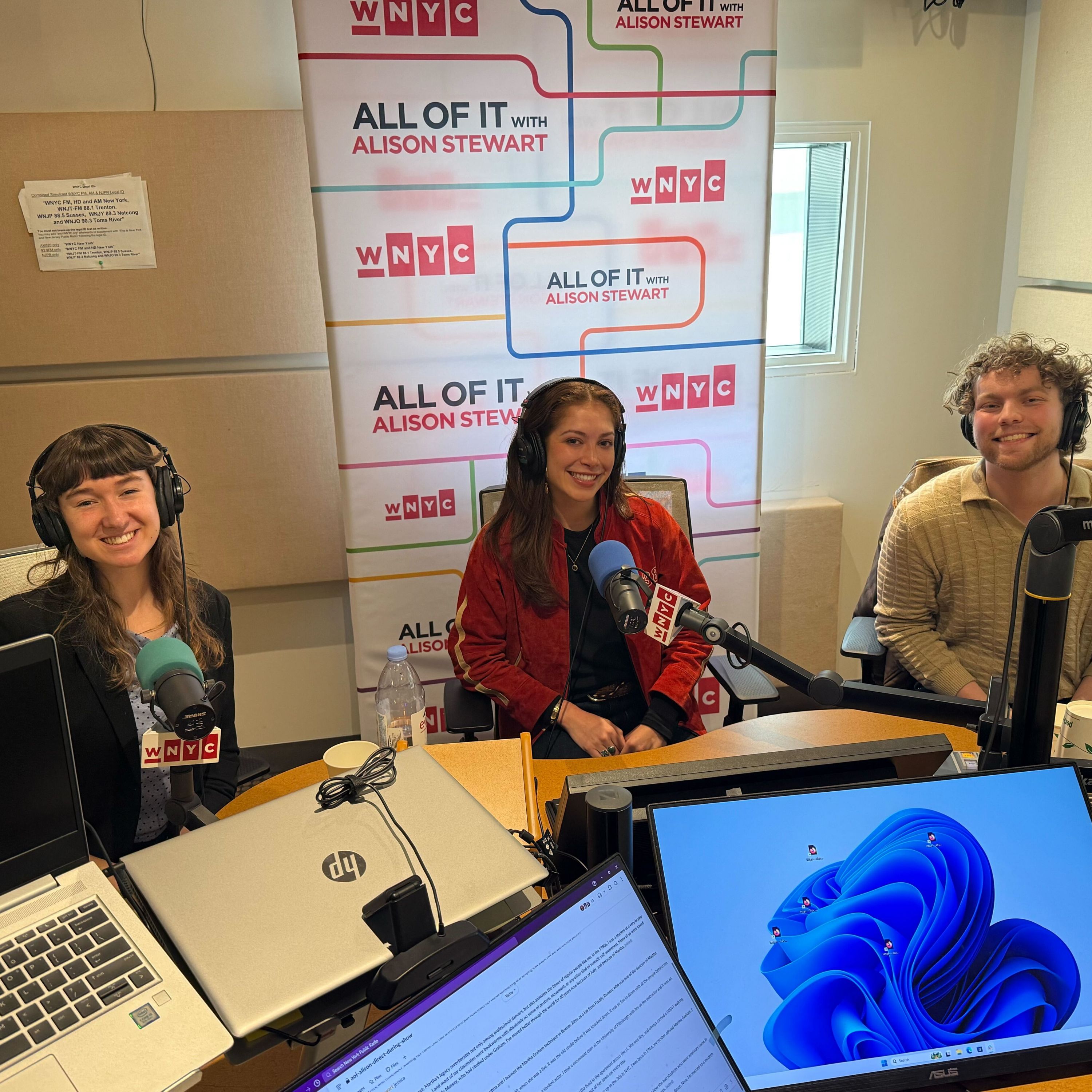
It's March (Audio) Madness time. NPR's Student Podcast Challenge has released the names of its finalists. Undergrads Syd Walter from Sarah Lawrence College, Luisa Sukkar from Barnard College, and Colby McCaskill from Fordham University discuss their contributions to the challenge, and share selections of their work, which include the sounds of a New York City neighborhood, the imaginary country created by someone's brother, and a love letter to aging grandparents.
Photo by L. Malik Anderson/WNYC
Hosted by Simplecast, an AdsWizz company. See pcm.adswizz.com for information about our collection and use of personal data for advertising.
Get every episode summarized
Each time All Of It publishes, we email you a written briefing from the transcript — the topics, who appeared, and any specific claims, with the ad reads skipped.
Email me new episodesFree for 3 shows. No card needed.
Hosts & guests
Transcript ready
260 searchable segments. Every word is indexed and playable.
Full transcript
All Of It — NPR's Student Podcast Challenge 2026. Machine-transcribed; use the interactive transcript above to jump the player to any line.
discover heirloom quality at Paragold, the destination for luxury home. From furniture to decor, our pieces are meticulously made by design's best brands to be lived in and loved for a lifetime. Shop with us and enjoy extraordinary customer service and free, fast, full service delivery on most items in store and online at Paragold.com. Few things are as uplifting as the greatest moments in sports and nothing brings us together quite like Team USA at the Olympic Winter Games. From NBC Universal's iconic storytelling to the innovative technology across Xfinity and Peacock, Comcast brings the Olympic Games home to America, sharing every moment with millions. When Team USA steps onto the world stage, we're not just watching. We're cheering together. This winter, we're all on the same team. Comcast Proud Partner of Team USA.
This is all of it on WNYC. I'm Allison Stewart. If you missed our recent Broadway on the radio event in the WNYC green space and you want to experience all of it on the weekend, you have another opportunity. The stars and creative team of chess joined us for our conversation and a live performance. I'm talking about Leah Michelle, Erin Teveit, and Nicholas Christopher. They talked about their roles. They sang. We talked to the director and LeBretis. It was a great hour. WNYC will air at this Sunday night at 8 p.m. And if you want to get tickets to our next Broadway on the radio event, it's ragtime. You can see the full lineup head to wnyc.org slash events. That's wnyc.org slash events. On the way, the stars of Paradise, Juliana Nicholson, and Thomas Darity. But first, let's start with some folks who are being recognized for their work.
It's March Audio Madness, which means it's the NPR College podcast challenge. It is back. Out of hundreds of submissions from across 35 states, just 10 finalists made the cut. And three of them are right here in New York. One stand out is a deeply personal piece, a letter to grandparents grappling with aging, memory loss, and what it means to hold on. Another takes us into a fantasy world where a sister connects with her twin brother who has autism. And then there's a podcast that walks the upper west side to the ears of pioneering recording artist Tony Schwartz, a named WNYC listeners will know well. Each finalist gets $500 and the grand prize winner gets $5,000 plus a spot on NPR's morning edition and all things considered. But today, we are keeping it local. Kobe McCaskill is a senior at Ford University. His podcast is called Dear Papa High Colby. Hello. We're also joined by Luis Sarama Sukar, a senior at Barnard College whose podcast is Joe's world. Hi, Luisa. Hi. And finally, Sid Walter is a senior at Sarah Lawrence College.
Her piece is called New York 10019. Hi, Sid. Hello. All right. This is for all of you. It's the fifth year of NPR's podcast challenge, Kobe. What made you decide to apply? Oh, man. So I go to Ford him. I have a bunch of journalism classes and one of them, it's specifically about audio reporting. And my professor kind of made it an assignment. She was like, okay, we want you to do just whatever story you want. And with the idea that you would be so proud of it, you could give it to NPR. And so that's kind of where it started. It was just like, you know, take it and fly with it. And then after after that class ended, she like followed up with all of us and was like, okay, so yeah, we're going to follow through. Give it to NPR. Tell them that you want. You want this to be part of the challenge. So yeah. How about for you, Luisa? Yeah. Um, I love audio storytelling. And recently, most of the stories I've told have been breaking news. So whether that's reporting on news at Columbia as a student journalist or an internship at CNN breaking news run down.
But this was a time to really tell a human story and talk about something that is omnipresent. A narrative urgency isn't just, you know, in my life, because my twin is Joe, it's everywhere. So it was a really fun time to talk about something that wasn't necessarily breaking news. How about for you, Sid? Well, I've been applying for the NPR student podcast challenge since I was 14. So this is my fourth year applying. And I just thought to myself, they can't stop me. All I can do is just keep applying every single year and tell eventually something happens or I just keep getting better. And so this year, my like, my main goal was to make a piece that I felt really proud of and was connected with and something that I felt like was deep work. Work that I'd been working on for a long time, something that I was putting a lot of intention into. And so that's kind of where this piece came from. It's come from a long, substantiated, you know, work to get to where I am now. And I feel really proud of the piece that I have and very excited about being here in studio with all of you. Like you said, you've been at this since you were 14. You had a podcast called Teeny. Tell us a little bit about Teeny. My, you know, my idea was to make a podcast about the not-so-teeny
problems of being a teenager. And I felt that teenagers didn't really get a lot of space to explain there, explain themselves and also to tell their own stories. And so that's really where I started with the podcast. And ever since then, it's just grown and grown and grown into this love for using the audio medium as a way of connecting with people and making space for people to feel seen and see others. Colby's sort of simultaneously. You had your audio sort of archive in a group called miscellaneous on SoundCloud. It's radio story, short fiction, it's poetry. When did you have the idea to start archiving your work this way? Well, so yeah, this kind of started, I guess, in the summer of 2024. I was coming off of my, no, sophomore year as a student journalist at Fordham University, I was working for the newspaper. And I just started doing more and more radio stories and like podcast and audio reporting. So it kind of just started out of like, I have all this tape. I want to put it together. So I kind of just started freelancing and I was never good at it. I did not get picked up. No one wanted my stories. But I thought, you know, these are good. I'm proud of them. So let's just start putting them out. So I would, I would freelance,
I would put it on like my website and then I would just see I put it on Spotify. How does audio help you express yourself in a way that posting on TikTok or Instagram might not? Yeah, I guess, man, that's a, that's a good question. I think like what podcasts do that, that regular journalism that's just print doesn't do is it like puts you in someone's head like you're in their years. And so you can be very, very honest. You're speaking like directly to them. Print articles that I like typically did in my early years. You know, you're speaking, it almost feels like a letter to the public. But I think podcasts and audio reporting and radio is like a direct to one person. That's kind of what I see it as. It's like, I'm talking directly to you right now. And so I just, I think it's a, you know, when you're having a one-on-one conversation, that's when you're most vulnerable. You know, when you're not thinking about everyone else, when you're just trying to connect with one person, that actually is, that's when I want to, you know, speak my mind the most. Luisa, you worked as the audio editor for the Columbia Daily Spectator.
What did you learn from that position that helped you put together this piece? Although, that's probably a breaking news situation these days. Yeah. So when I started, I got to do pieces that were a lot more, you know, person-forward. I spent six hours in a dining hall one night and just caught people's stories. But as the news changed at Columbia, so did the stories that we were making. I think that what I learned is like, it is such an opportunity to get to sit with somebody for a long time. And I got to interview my brothers. So we talked for like four hours and to really cherish that time if you get it. Because when we're doing breaking reporting and, you know, I was suspended last year for my reporting. There's a timeline and there's like a, you got to get out. But when you have the opportunity to sit somebody and get their story, like I really cherish those moments now. Can you tell us why you were suspended? Again, I was actually in the library,
writing a paper on the first amendment, ironically. And a protest that I wasn't aware of began the security closed the doors around us within at least two minutes. And I was the only reporter from Columbia Spectator there. And my background- I don't know if we talked about this. My background was not, I was doing live television as an intern at the time, but not really breaking. And my editors really can you stay. To me, yes, because I think that it's really important to have somebody telling these stories, you know, to my best capacity. So I was feeding information the whole time. And at Columbia, you tap your ID no matter where you go. And in order to leave the library, when I was told that arrest was, you know, something that was on the table on my editors, we agreed it was time to go for safety. My ID and like name was recorded. So the next day I received a notice of an
intern suspension without recognition of the bylines that had been posted of my reporting. And my clear identification to security that I was there in a reporting capacity. The suspension was overturned, but I think that what that suspension represents is not erased. We're talking with a few of the finalists of a fifth annual MPR college podcast challenge out of hundreds of entries that received this year. New York college students Colby Cascale, Louisa Ramos-Sucar and Sid Walter made it to the top 10. All right, Sid, your podcast, New York 1009 is about Tony Schwartz, who recorded sounds around New York City. He was a regular here at WNYC Law before you were born. When did you first hear about his work? I heard about his work from my friend and she was like, have you ever heard of Tony Schwartz? And I was like, I have no clue who Tony Schwartz is. And she was like, have you ever listened to Death of a Turtle? Which is a fantastic story anyone who's listening should take a listen to it. It's about this little boy and his turtle that passes away. And it's a five-minute story about this turtle's funeral. And it's like this sweetest,
you know, most beautiful story. And I was telling her about, you know, this is my final year that I can apply to this MPR college podcast challenge. You know, I really want to make a piece that I feel proud of. And I was like, but telling a story in 12 minutes, eight minutes is a really hard thing to do. And she was like, well, Tony Schwartz was able to do it in five. So, you know, take a listen so there. Right. So I took a listen to his work and I was like, oh my gosh, this is amazing. And I kind of just went down this deep dive of his work. And as I was walking through New York, I was I was thinking to myself, there's so many sounds that are so similar to the ones that he was creating. And there's so many new ones, just like daily things you would never think of. Like the walk sign beeping that you, you know, that didn't exist when Tony was around. Or, you know, other sign, other like little sounds that are just kind of minute daily aspects of life. Or like the whisper of like, you know, an electric car down, you know, down the road. So that kind of was how it all sparked. And I thought, well, you know, I can map out where he walked, walk those same footsteps, and then, you know, record those sounds. And that's how it all started. And then it kind of took me down this, this long winding path where I got to meet his son, Anton Schwartz,
who's a jazz musician, who so generously let me use his music for the piece. And I got to actually meet Darryl, who is the kid at the center of the story, death of a turtle. I got to talk to him. And it's like, there was just this nexus in this world that was unraveling when I got to, like got into Tony's work. And I just felt so held by his sounds. And I wanted to help, or I guess I wanted to extend that to other people too, and remind people, you know, to listen to the world. Let's listen to a little bit of your podcast. This is Tony's son, Anton, talking about his dad in Sid Walter's podcast, New York 10019. And why he was fascinated with that part of New York City. On the one hand, he was, he was just like a teddy bear. Everything all out at the surface, very loving. He was very eccentric. He was agrophobic, so he didn't travel far away. The whole New York 19 album was chosen, you know, what did he call it, a sono documentary of his postal zone. But it was out of local interest,
but also because he didn't really travel much further, at least not without, you know, special to do. And a postal zone may be miles, miles, miles in some states, but it's quite small in an end. So yeah, that was where he, you know, spent his entire adult life within that postal zone. Colby, your podcast dear Papa is in the form of a letter. How did you decide to land on a letter? Yeah, I think the, I just decided that I wanted something to remember my grandparents. I think that was the idea for the interviews and going into it. I just, I wanted something that kind of could help me remember them and bring me closer to them. So I didn't actually, I think, go into the interviews thinking, hey, can I write a letter to you? But when, you know, when I got home, I visited them for spring break last year. So when I got home and I was looking at all this tape, I was trying to decide, you know, what kind of, what kind of story do I want to tell? What kind of format does I,
do I want to take? And I think I just wanted to talk with, I think I just want to kind of bear my heart and tell them, like, this is how I'm feeling. I want you to know this. And, you know, as a journalist, like the way that I express myself is, is through writing and through publishing. And so yeah, I wrote kind of it as, as really for them. I kind of, yeah, maybe take issue with the idea that it's formatted as a letter. It is a letter. I was, I was telling these guys, like the first person that I sent the link to once I published it was my grandpa. That was how I delivered the letter was texting in this link. So yeah, it was a letter because that's what I wanted to do. I just wanted to kind of tell them how I was feeling and, and have a conversation with, with them. Really? Lesson to a section of Dear Papa. It feels rude to say you both look older. I don't mean it in a bad way. Your walk, just a little bit stiffer. Grammy's hair, just a little bit wider. I'm sure you know out of everyone how her dementia has been progressing. How she can't remember
my name or her age. I am at sea. I'm like, I am, I'm over, I think right now. I'm like 47 years. That's how we know. But to be dealing with cancer on top of dementia, that's a whole another fight. That day in the airport, I was just reminded how as the days in the months march on, we're quickly losing Grammy and I'm slowly losing you. I don't really know what to do about it other than make time to be with you and write you this letter. I don't know if there is more to do. What am I supposed to do? Colby, what did you want to communicate to your listener about living with someone who has dementia? Yeah, I think the thing that I often just don't recognize when I'm
going to school and I have something every day, but it's, it's that time changes things. Time changes how our bodies operate, time changes the relationships we have. And I really, I was really feeling that when I saw my grandparents, it had been a little bit of time since I saw them and I saw that they had changed. Yeah, as you heard me say, they're, they looked a little, you know, their walk was a little stiffer. Time had had changed them and time had changed me too. And so I think, yeah, I think I even say it there. It's like, I don't know what to do about that. I can't change time. I can't move time. I can't, you know, rewind time. And so, yeah, it was, it was kind of like a, I had a lot of thinking to do. It was like, time has changed. Time has changed you. Time has changed me. What are we going to do about that? And I do think that like as I kind of came to the understanding that like, I think the only thing I can do is talk about it. I think we can recognize it and we can try to deal with it and feel it out and share about it.
So, yeah, I think my grandma is not 47 years old. She's way older than that. But just having a conversation with her about how time feels different to her and feels different to me is, I think that's the best thing that can come out of time changing. It's just you, you recognize it and you talk about it with the people that you love. Louisa, tell us about where you're, the imaginary country where you're, your twin brother sometimes. Imagine himself to be. Yeah. It's called Daspia. Joe's been, we've always had, there was Kalmworthika when we were five, I think, this is Daspia now. We're 22 years old. Yes. And to be so honest with you, I didn't know a lot about Daspia before I went or break when we had this conversation. And Joe, something that is really central to his identity is he paces a lot and he thinks a lot about these worlds that he's imagining. And so it feels like, you know, he can be right next to you. He's my twin. He's the closest person to me. But it can feel like we live worlds apart literally. And so when I got to sit
down and really ask him about it, it was like a portal into, you know, who Joe is and who Joe is is somebody who really, you know, he's acutely aware of this world. But he also has a really strong understanding of justice and he wants it to be better. So he's always dreaming about things that are very similar to here, but just a little bit different. A little bit more just, a little bit more, like be careful of that rattlesnake over there where from South Texas or family. Or he's so smart, be sure to fall into a bush instead of the cactus because it has bacteria. It was something he told me. And what we learned too is that like that specifically was advice that our dad gave him years ago when we were like at the ranch in South Texas. And so sometimes when it feels like he's going somewhere else, he's really resonating with a connection that we have with each other. And that was a lovely thing to learn. Yeah. Well, let's hear Joe talk about what you just mentioned. This is from Joe, Joe's world. It's Luis Arama Sukar's podcast. So now we are in the desert. It's still pretty
hot. Not too much else happening here either. Oh, yeah. And if you hear a sound, do not go near it. It's probably a rattlesnake. Just leave them alone. Joe and I are close. The kind of close where, according to our parents, one twin used to wake up with the other's foot in their mouth like a pacifier back when we shared a crib. And as close as we are for a lot of our lives, we've lived in different places. Joe's thoughts are his own. And even though there's such a big part of him, sometimes it feels like we lose him there. Just enjoy the view. Just enjoy the peace and quiet. All these the birds chirping. Just out in nature. We're one with nature. As you think about that, Luis, how do you hope people understand your relationship with Joe, autism, and the lived experience of people who are on the spectrum? Yeah. So it's funny. I originally wanted to start this story very focused on what RFK had to say about autism at the time.
Interesting. Yeah. And to connect it to that and having conversations with my parents with Joe, it didn't feel right simply because it's a spectrum. And I think that the message I would take away from this is to get to know every person very individually. Everybody experiences autism, neurodivergence very differently. And that's a beautiful thing that you can literally see a different world if you take the time to have those conversations. It's interesting hearing you all talk about what inspires you and what inspires you to make audio. Now that you've finished this challenge, what's next for you, Sid? That's the golden ticket question. I was talking with Luis said before this and I was like, you know, but people always ask me what's next. That's kind of the classic question when you're a senior. And I don't take any issue with that question. I just think we should all be asking you of ourselves all the time because what's next is just simply that it's the next thing that I'm going to do after college, just like college was the next thing that I did
after high school. And I think that, you know, when you're asking that question you're reckoning with who do I want to be in the world and who would I want to be for the world. And those are questions I think we should be asking ourselves all the time and reevaluating like, what's next for me? Who do I want to be in this moment to this moment? And so I think when thinking about that, I want to continue to tell stories and I want to push the boundaries of my storytelling and I want to make sure that I am doing that in community with people. However that looks, you know, I think, you know, there's always this joke when people ask me that question and Luis said this joke earlier and I'm stealing it from her. I got a question for you. It's okay. The joke which she said, which is, you know, so true is people asking, you know, oh, what's next? It's like, well, do you have a job to give me like, I'd be happy. I'd be happy to take a job if you have one. So, you know, I think that those are the guiding principles. And then of course, it's like, you know, I'm just trying lots of things. The applications are being sent out into the universe and we'll just see kind of what finds my way. But I think, yeah, like asking that question of yourself too, like no matter where you are in the world because it's always an apt question to ask. Where do you hope podcast is heading, Luis? Where do you hope podcasting is heading? Where do I hope it's heading? I hope I see
sorry, I see a lot of an integration of video right now in podcasting and I hope that with that, we just hold on to the humanity and what you were talking about the intimacy of audio storytelling. I'm not opposed. I'm a full major. I love video. I think that there's an opportunity to really get to know people through it. But just holding on to that unique opportunity to get to know people through audio. Colby, what did you learn from this challenge? I was looking back at the script before on the train up here or down here, I guess. And I was looking at the way that at the end of my piece, I kind of like, you know, you hear my grandpa talk and then you hear me talking and my grandma talk. But at the end of the piece, I try to bring them together and they almost have a conversation. I think the question I ask is like, how much do you love Grammy or how much do you love Papa? And I like through my editing and through my skills, I can almost put them in
conversation. And I think that was the most fun is not just interviewing them and not just telling them about how I'm feeling but kind of like helping us have a really honest conversation together. And so that's what I learned is that audio isn't just about reporting. This is what happened, but it's about asking questions and having everyone weigh in on it and you can put it all together. And you can have a conversation that you can't otherwise have with this world that's so disjointed. Colby McCasco, Luis Arama Sukar and Sid Walter all made it to the top 10 of NPR's college podcast challenge. Congratulations to all of you and thank you for coming to the studio. Thank you so much. Congratulations. Thank you. WNYC Studios is supported by Odoo. When you buy business software from lots of vendors, the costs add up and it gets complicated and confusing. Odoo solves this. It's a single company that sells a suite of enterprise apps that handles everything from accounting to inventory to sales. Odoo is all connected on a single platform in a simple
and affordable way. You can save money without missing out on the features you need. Check out Odoo at ODOO.com. That's ODOO.com. Few things are as uplifting as the greatest moments in sports. And nothing brings us together quite like Team USA at the Olympic Winter Games. From NBC Universal's iconic storytelling to the innovative technology across Xfinity and Peacock, Comcast brings the Olympic Games home to America, sharing every moment with millions. When Team USA steps onto the world stage, we're not just watching. We're cheering together. This winter, we're all on the same team. Comcast, proud partner of Team USA.
More episodes
More from All Of It

The Cast and Creative Team of 'The Outsiders'
All Of It

Full Bio: Malcolm X
All Of It

Braille Readers Hold the Camera in New Documentary
All Of It

Ashe Performs From Her Forthcoming Album, 'The Girl of Your Dreams'
All Of It