About this episode
All Of It is made possible by:
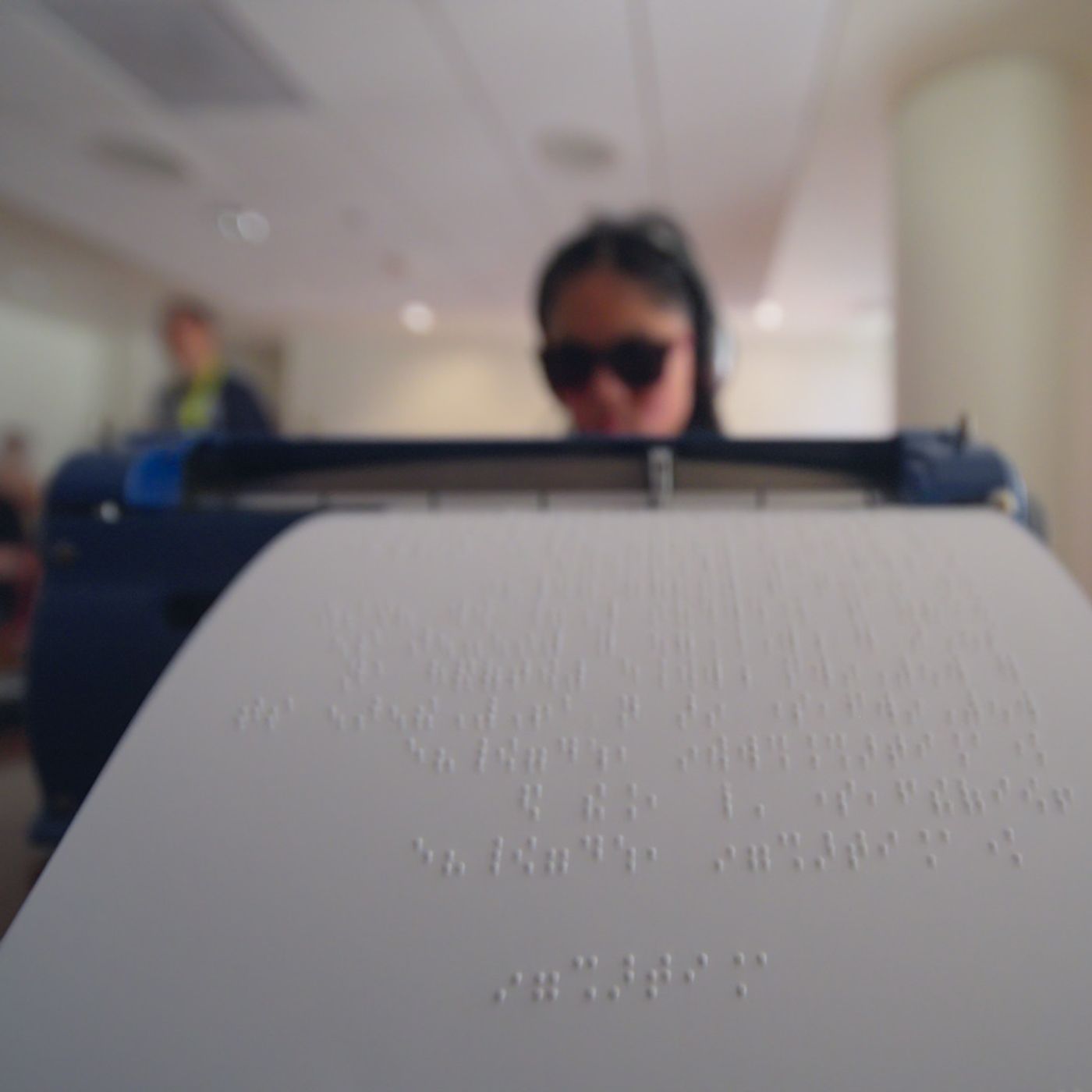
The new documentary "Brailled It" follows a group of blind and low-vision kids as they compete in the Braille Challenge against the country's top readers. The documentary has five directors, three of which are the blind and low-vision children themselves. One of those kids, Christopher Morgan, joins us alongside the film's two adult co-directors, David Grabias and Brendon Shulze. "Brailled It" opens at Quad Cinema tomorrow.
Photo courtesy of Artifact Studios
Hosted by Simplecast, an AdsWizz company. See pcm.adswizz.com for information about our collection and use of personal data for advertising.
Get every episode summarized
Each time All Of It publishes, we email you a written briefing from the transcript — the topics, who appeared, and any specific claims, with the ad reads skipped.
Email me new episodesFree for 3 shows. No card needed.
Hosts & guests
Transcript ready
315 searchable segments. Every word is indexed and playable.
Full transcript
All Of It — Braille Readers Hold the Camera in New Documentary. Machine-transcribed; use the interactive transcript above to jump the player to any line.
WNYC Studios is supported by progressive insurance. Did you ever think about switching insurance companies to see if you could save some cash? Progressive makes it easy to see if you could save when you bundle your home and auto policies. Try it at Progressive.com. Progressive casualty insurance company and affiliates, potential savings will vary, not available in all states. Anybody can make jeans, but you can't dop true religions. That famous thing pockets you recognize instantly stand out stitching. They try to get the full package, but only we have the legacy. Shop the iconography capsule now at True Religion. This is all of it. I'm Allison Stewart live from the WNYC Studios and Soho. Thank you for spending part of your day with us. I'm really grateful that you're here on today's show. Singer, songwriter, Ash is sound checking right now in Studio 5 in about 25-30 minutes. I'll run over there and talk to her about her upcoming solo album
and she's going to perform live. But we wanted to take a moment to remember two women who recently passed away. Grammy Award winner Cassandra Wilson, the amazing jazz vocalist, died. She was once called America's Best Singer by Time magazine. And in 2022, she was named a national endowment for the arts jazz master. Wilson was 70 years old. And Gloria Steinemann died at the age of 92. Her work as an advocate for human rights and her feminism changed our culture. We've done stories about Gloria Steinem's life. We talked about an off-bread way. Show about her, a fictionalized version of her, but for TV. But if you want to know more about Gloria Steinem's mission, you should listen to our conversation about deer miz, a revolution in print. It's a documentary about her founding of Miz Magazine. We'll link to that on our Instagram stories at all of it W and O I C. And with that, let's get things started with another documentary.
The Braille Challenge brings together students who are the fastest English language Braille readers and typists in their class. Every year, they compete for top prizes. A new documentary falls three blind and low vision students, but with a twist. The students are the filmmakers with a camera strapped their chest as they go about the competition. The documentary is called Braille Det. It uses the footage from students captured and made a film design for everyone on the cited spectrum. Braille det premieres at the Quad Cinema tomorrow with me now or co-directors David Grievous. Nice talking to you. Hello. As well as Brenn Schultz. Hello. Nice to speak to you. And we also have director Christopher Morgan, a student featured in the documentary who is one of the top Braille readers. Hey, Chris. Hi. How are you doing? I am doing well. David, what? Why did you decide to give the students cameras to the documentary? Sure. I mean, I think it was pretty obvious from the get-go that the students needed to make the film. I mean, if we were going to try and capture experiences of blind and low vision youth
in the context of this competition, then they needed to have agency and they needed to tell us themselves what those stories were. And so Brenn and I sat down and we experimented with different kinds of camera technology and different ways to approach it and came up with these little kind of action cameras that are fully tactile, voice activated. We gave the kids training both in terms of like what is a film kind of conceptually giving them some ideas and thoughts that way. What does it mean to be a filmmaker? What does it mean to be in a film? And then gave them the technical training and just unleashed them. And they had full agency. They were the ones who decided when to turn the cameras on and off, what to film, who to film, all that kind of stuff. Brenn, why were you interested in Christopher having a camera? Yeah, I mean, the process of selecting the kids was really fantastic and interesting because you know, it's not just about selecting a subject. This is about finding collaborators, true collaborators, right?
And so we had contacted the Braille Institute and got a list of folks that could potentially be interested. And we just started emailing everything out and sort of having these calls with parents and kids alike. And you know, we were selecting kids based on a number of factors, the sort of general enthusiasm and interest as well as age range, things like that because the Braille challenge that's broken up by classes. And so we wanted to have good representation for all the different ages. And Chris just immediately, I mean, you'll see, he's a star. And he was one of the kids that was extremely receptive and seemed to really understand what we were doing. Hey Chris, what was your reaction when you were first asked to wear a camera for this film? Well, I would say that it was just really cool.
It was a really exciting and great opportunity. You know, a lot of times you tell people about Braille challenge and they're like, oh, that's cool. People are just brailingly fast, you know. But it's a lot more than that. You know, it involves comprehension and it involves being able to do things accurately. It involves interpreting charts and graphs. It involves all those different aspects of Braille literacy that a lot of people just forget about when they think of Braille's think of okay, we're just running really fast. But just to be able to capture that and just to capture the experience as a whole was just a super rewarding experience. Christopher, did you ever forget that you had a camera attached to you? All the time. I would say that since the cameras were so low profile, it was really easy to forget. You just like turn it on and forget about it and just start doing your thing pretty much. So there were times where I'd be hanging out with people just, you know, just chopping it up and then suddenly they come over and they're like,
hey, we need to check the batteries in your camera. I'm like, wait, the camera? Oh, yeah, the camera. Okay. And that just really speaks to how low profile those cameras were and how really low stakes it felt to do it. The Braille Challenge is put on by the Braille Institute. David, as filmmakers, why do you see the Braille Challenge as something that would make an interesting documentary? Sure. I mean, I think first and foremost, you know, having the opportunity to be in a room with all these kids who like Christopher, I mean, he can speak to this. I mean, he's the only kid in his school who's blind when he was in high school and younger. And so for these kids, so many of them, it's their one opportunity once a year where they can be in a room with hundreds of other blind low vision kids where their blindness is not the first and foremost, you know, aspect of their personality of who they are, where they can be in community. And the joy and just the life, the energy that comes out of that was just so compelling.
You know, and then I think also just the notion of literacy. I mean, especially in today's world, you know, why are we reading books? Why are books important? And I think the very, the notion of just literacy, fundamentally, and how important that is for blind and low vision youth, especially as they get older and start thinking about careers, jobs, employment, all that kind of stuff, it was just such an important thing. And so it was kind of a no brainer quite frankly. Brendan, what surprised you about the Braille Challenge? I think the intensity of it, because you know, it is, like David said, something where it's very much a space that allows these kids to not be defined exclusively by their blindness. And the competition really is, you know, it's pretty like a techno-presenter is in terms of the difficulty and the intensity of the students. And they all take it very seriously.
So I mean, very quickly when you're there, the idea that, you know, ideas behind disabilities kind of fade in the background. And then it just becomes about, you know, being the best and and really like trying to do the best you can with this very, very difficult, very difficult thing. I mean, what these kids can do truly is like a superpower. It's so impressive and so amazing. Chris, for you won multiple Braille challenges competitions in high school. You started to touch on it a little bit earlier. Can you explain what's expected of you in this competition? So essentially Braille Challenge is a full Braille literacy competition. You have four, well, okay, so you have five different categories of age. So you have apprentices, which is kindergarten through second grade. Freshman is third and fourth. Sophomore is fifth and sixth, JV, seven, eight, ninth, and varsity, tenth, eleventh, twelve. So the younger kids do spelling, which is basically
your normal spelling test. And then they do everyone does reading comprehension, which is to read a passage and be able to correctly answer comprehension questions about it. And then everyone also does proofreading, which is to be able to identify errors in a written text. And then the older kids, so of fifth grade and up, so sophomore and up, we do not do spelling. Instead of spelling, we do test called speed and accuracy, which is those things we recorded audio tape with not only the actual words, but also all the punctuation and everything we need to know. And you have to Braille as quickly and as accurately accuracy is the most important as possible. Full points. So there's more points taken away for incorrectly, Braille symbols or words, then there are for points given when you Braille something correctly. So it's really important. So just go for accuracy, because you can
Braille as fast as you want, but then have all the whole bunch of errors and get much fewer points than someone that didn't Braille as much, but didn't make any errors. So then the other one that the older groups do is called charts and graphs. It's essentially the reading comprehension, as I explained before, the only difference is that instead of reading a passage, you're looking at a tactile graph. So the graph is felt by your fingers. And you have to answer the same, you know, comprehension questions about it. So that's kind of what the Braille challenge entails. Why do you like to compete in this? Hey, I've heard it really compared to like a standardized test like an SAT or something, but really the biggest reward I've gotten out of it is yes, I've been able to sharpen my Braille literacy skills and I've had a motivation to sharpen those skills in order to compete at Braille challenge. But also I just made so many connections, so many friends. I have so many friends that I've made and that I made the first time I went in 2017 that I'm still friends with to this day,
or just over the times that I've been, I've just made these friends that have continued for so long. You know, we still check out by each other, we still are there for each other, support each other. And that was just something that we always looked forward to every year, making a Braille challenge so we could just hang out with our friends because as David mentioned, a lot of us, including myself, were the only or one of the only blind students in schools with thousands of students. So it was really cool to be able to be in a place where the blindness wasn't the main thing that defined you. Braille did is a documentary that follows a group of students, Braille readers, as they compete in the Braille challenge against the country's other top blind or low vision readers. My guests are co-directors David Grabius and Brennan Schultz, as long as Christopher Morgan, one of the three student directors who competed in the Braille challenge. The film opens at the Quad Cinema tomorrow. So the film opens with your narrator, Meredith. She introduces herself, her voice is there to provide
visual information for audiences across the site spectrum. She speaks throughout the film. David, how did you decide when Meredith should come in and speak? Sure. And I would argue Meredith is actually, she's not a narrator really, she's audio description. There's a little bit of semantics there, but audio description typically is something that audiences who are blind or low vision can turn on when they're watching a television show or film so that they can get visual information about what's happening in a scene. So like, oh geez, Allison's in a room. She has a microphone and she's talking to Brendan and David. Anything that an audience might not be able to discern or interpret from just the dialogue or the sound effects you can hear. And we very, you know, from the get-go, obviously we wanted to make this film something that was accessible to audiences across the site spectrum so that Christopher and obviously the kids who made the film could watch it and have
just as rich an experience as anyone else. And so we worked with Meredith, who was our, the actual voice talent, and then a number of different audio describers around the country, who helped us come up with just a basic kind of audio description script. And then we took that and tried to finesse it, make it just a little bit more impressionistic, poetic, so that it didn't feel so sterile, so just purely expository. And it's there, obviously, to help blind and low vision audiences understand what's happening, but we found that actually also helps cited audiences kind of track the cameras, track the characters, and follow some of the events of the film. Well, let's listen to an example of how the film sounds. This is when we first meet Chris, as he tries to find his hotel room in the film, first you'll hear Chris, and then you'll hear Meredith's audio description.
No, no, let me, let me find him. What do you think? He slides his cane along doorways on the left. Oh, usually hotels are even an odd size of this one. This one's different. This one is, yep, uh, 4-1-1, here we go. He takes his key and touches it to the door lock. As he enters the room, he pulls his suitcase past his mother, his reflection in the mirror. A teenage boy wearing glasses who's tall and has short dark hair. That is from the documentary Braildit. When the, when the film starts, we have one student who's heading out of the hotel room and walking down the hallway and waiting for the elevator, and Meredith describes what's happening. Now under an unfold over a few minutes, Brendan, why did you want to start the film that way? It was a really interesting scene.
Yeah, I think that, you know, because of how the film was captured and how it's put together, it does not necessarily align with a lot of sighted conventions when it comes to films, right? So we, in challenging that, we understood that there needed to be, I think, a moment of attunement. In the film where people can get their bearings, sighted or blind and low vision alike. So that was a great scene just to sort of introduce the concept, I think, in the approach, and allows people before things get too frantic, too intense, to understand what they're watching, and to understand, you know, the perspective that they were seeing. And there was something about it as well that I think, like I said, it's before things really get too intense, but there's really something beautiful and quiet about the audio description, what Salome is doing, that not only
allows people to, I think, get that moment of attunement, but also soak in that reality and and perspective, and it just really stuck. I don't, you know, it's funny. It just was one of those things where it kind of actualized itself in a way where we saw it, and like, oh yeah, that's, that's perfect to open. We're talking about the documentary Braild It, we'll have more after a quick break. This is all of it. You're listening to All of it on WNYC. I'm Alison Stewart. Braild It is a documentary that follows a group of student readers as they compete in the Braild Challenge against the country's other top blinder-loving readers. My guests are co-directors David Grabius and Brendan Schultz, as well as Christopher Morgan, one of the three student directors who competed in the Braild Challenge. The film opens at the Quad Cinema tomorrow. David, each student is, they have a camera
strap to their chests, and as a result, we don't see their faces. What effect did this POV have on the story? Yeah, no, and I don't think we realized how powerful that was going to be until we started to look at the material and edit it. I mean, it's, I think, first and foremost, it really creates a sense of intimacy because you are physically with these kids. I mean, you know, again, all of them, Chris, the other two primary filmmakers and the other kids who also had cameras, they chose whether they wanted to wear that on their chest or they could hold the camera or they could just carry it around and place it on a table. Most of them ended up wearing on their chest, I think partially so that they could use their arms for other stuff, right? Like their cane or reading braille. But there is this sense of intimacy. You're literally on their body, you're with them as they go through and navigate this experience physically and emotionally. And there's something very beautiful about that. I think the other really interesting thing, which takes us
back to that audio description point, is that as, because the scenes you're always looking forward from the kids perspective, you don't know whose camera it is when the shot cuts to a new filmmaker, right? Goes from Chris's camera to Salamay's camera. You don't know initially whose camera it is or what world you're in. And the audio description thus serves a vital role in literally just saying Christopher Salamay just identifies who the camera is, which helps you to kind of understand who you're with and connect more deeply and more intimately with their stories. Christopher is listed as one of the directors of the film, Brendan. Why was it important for you to list him as a director? I mean, we truly think of the kids as the directors with this. They are the ones telling the story. They're the ones with the agency, right? Deciding what and how they film everything. Because of our experience, we're able to help put together the process
a little bit more. But it's really about them and it's about their experience. And you know, there's a bigger story to the film also in the idea that this, our hope is that this really can challenge what film is and can be and who can make films and the idea of blind cinema. And that, you know, it's our hope that it opens some amount of doors. If it's a little cliché, but if it's a fire, it's just one person. But you know, it's true where it's like, you know, just challenging those conventions, really opening up those possibilities of telling those types of stories in different ways. And so to that end, which the kids did, I mean, they earned that credit through and through, they did the hard work really. So, so yeah, I mean, there really wasn't a question for us. Christopher, as a director, what was your hope for how this film would turn out?
I was really hoping and I really think it did a great job of this to really just capture the whole Braille challenge experience. Like I said before, it's an event that we look forward to. And I really wanted people to see just why we look forward to it. I mean, it's not just a competition. I mean, honestly, sometimes I forget about the competition. It's like just being able to see everyone again and just to feel in a place where you belong. Like I mentioned before, a lot of times for blind students that go to these big mainstream public schools, especially, feeling like you belong can sometimes be next to impossible, especially. It also depends on your geographic location because there's a lot of different opinions on blindness depending on where you go in the country. So, that's why I think it was really important to just show the camaraderie that we have as a group of students. Not only are we competitors, but we're just good friends. Like we pick each other up, we encourage each other even though we're competing against each other. And I think that was really
important to show. Let's listen to another clip from Braille Dip. This is when the challenge begins, and we hear how nervous you can be Chris. I'm so nervous. I'm so nervous. Look at this over. All right, any more questions? All right, I have 45 minutes on my timer. And you, okay, you can't. We see hands on a brailler. Today, you'll take a series of Braille skills tests. Okay, guys, first up, speed and accuracy. Please transcribe the audio passage. You will be judged on how much you finish and how accurate your transcription is. In two side-by-side images, competitors type on their braillers. How do you handle your nerves, Chris?
That is a great question. Quite frankly, I don't even know. It's just sometimes a miracle. I mean, sometimes I kind of just be like, well, I've made it this far. I worked this hard. So at this point, there's nothing I can really do about it at this point. But that doesn't really take the nerves away completely. Sometimes you kind of just have to deal with it. And you just have to learn to breathe really best, the biggest thing to breathe. And just to be like, okay, it's okay. You know, whatever happens happens, I don't have control anymore. I can just let the... But if I continue to have nerves, then it's just going to make me do bad. David, now that you have made this film braille, what lessons have you learned from the process if you were to make another film that is designed for both sighted and blind or low-vision audiences? Yeah. Well, I think, I mean, first off, as Brendan mentioned, I think there is just something so powerful and important about the question,
what does it mean when a blind person makes a film? I mean, I just think asking that question and exploring what the answers could be and what that has to say about the very medium of cinema is incredibly exciting. I mean, for someone like myself who's done this for a long time, it just opens up so many different ways of thinking and approaching the medium. So I think, that's super important. And then I think also just the power of collaboration, as artists so often, it becomes, it's about me, and I'm controlling this, and it's my vision. And I think there ironically is such power and beauty in being able to hand that agency over to your collaborators and to really empower them to tell the story with you or on their own for that matter. And that is just, I mean, again, it's just a testament to the power of collaboration, the power of generosity, the power of sharing in that creative moment. And I, Brendan, I want to give the other people in the film their shout-outs, who are the other
filmmakers? So we actually wound up giving cameras to nine kids total, and we focused on the three based on the narratives throughout the weekend, and as well as the age group. But we also have Salome, who is in the film, and Isaiah, those are the other two primary focuses for the film. But then we used footage from everyone else who filmed, and as supplemental material. But of course we have Meredith. We had a lovely editor, Edgar Sardarian, excuse me, who had the uninviable task of watching nine kids' cameras were the weekends. Oh my gosh. I mean, it was the highs and the lows are in the film too. Yeah, yeah, all of it. So I mean, it was a group effort for our audio engineer, Brian Kessler,
you know, like everybody really poured together and got on the same page for what is I think a an unconventional project, David, am I missing anyone? No, that's it. Yeah, Salome, Cummins, and Isaiah Goetheier are the other filmmakers, along with Chris, Chris for Morgan, and then, yes, cinematography by an additional six individuals. Chris, what do you hope people get out of this film? If you brailed it. Well, I really hope that people can just, like I mentioned before, I mean, see the importance of brailed challenge to students who are blind. But also another thing is a lot of times people see us and a huge misconception is, I don't know, we're just not like normal kids. But the, this film just shows, I mean, we're just normal kids, normal teenagers just trying to hang out, have fun. And I think that's really another big takeaway that people can get from it.
Our site is gone, but we want the same thing as any other child, as any other teenager we want. We just want to have friends. We want to make, we want to have fun. You know, we want to be competitive. And all those things are really, really highlighted in the brailed it film. My guests have been David Grievous, Brennan Shultz, and Christopher Morgan. The film's brailed it opens tomorrow at the Quad Cinema. Thank you so much for joining us. Yay, thank you so much for having us. Thank you for having us. You brailed it, Alison.
More episodes
More from All Of It

The Cast and Creative Team of 'The Outsiders'
All Of It

Full Bio: Malcolm X
All Of It

Ashe Performs From Her Forthcoming Album, 'The Girl of Your Dreams'
All Of It

Michelle Buteau on the Final Season of 'Survival of the Thickest'
All Of It