About this episode
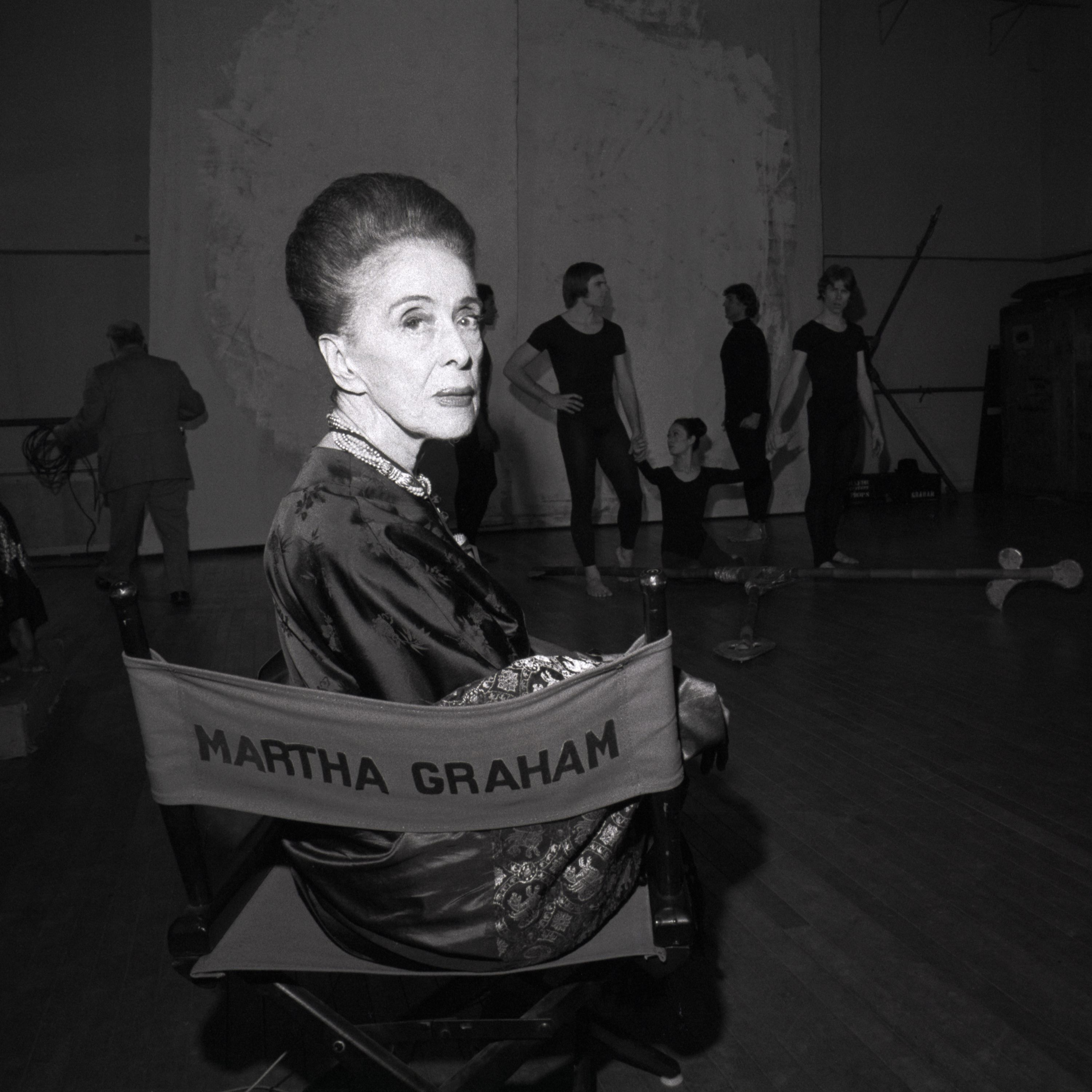
A new PBS docuseries called "We Are Our Time" explores the life of the legendary dancer and choreographer Martha Graham. Co-directors and co-producers Peter Schnall and Cyndee Readdean talk about the seiries, and Graham's impact on the world of dance, today. Martha Graham Dance Company will be performing at New York City Center April 8 through 12.
Photo via Bettmann/Getty Images
Hosted by Simplecast, an AdsWizz company. See pcm.adswizz.com for information about our collection and use of personal data for advertising.
Get every episode summarized
Each time All Of It publishes, we email you a written briefing from the transcript — the topics, who appeared, and any specific claims, with the ad reads skipped.
Email me new episodesFree for 3 shows. No card needed.
Hosts & guests
Transcript ready
753 searchable segments. Every word is indexed and playable.
Full transcript
All Of It — New Doc About Dance Legend Martha Graham. Machine-transcribed; use the interactive transcript above to jump the player to any line.
WNYC Studios is supported by Odoo. When you buy business software from lots of vendors, the cost's at up and it gets complicated and confusing. Odoo solves this. It's a single company that sells a suite of enterprise apps that handles everything from accounting to inventory to sales. Odoo is all connected on a single platform in a simple and affordable way. You can save money without missing out on the features you need. Check out Odoo at odo.com. This is all of it. I'm Allison Stewart live from the WNYC Studios in Soho. Thank you for sharing part of your day with us. I'm really grateful that you're here on today's show to the stars of Paradise, Julianne, Nicholson, and Tom Astarty will be here. We'll also speak with three local finalists for MPR Student Podcast Challenge and we'll play some of their work.
And we'll learn what it's like to be a subway musician. We'll speak with a trumpet player who plays at Grand Central and will also perform live in studio. That's the plan, so let's get this started with the new documentary we are our time. The oldest dance company in the United States is right here in New York. This year, the Martha Graham Dance Company is celebrating its 100th birthday first founded in 1926. Martha Graham innovated what we now consider to be modern American dance, although she preferred the word contemporary. She had different ideas of movement. What is now celebrated as the Martha Graham technique exhuming ballet shoes for bare feet. A new documentary goes behind the scenes at Martha Graham to capture dancers and choreographers as they rehearse, perform and tour. We also see archival performances of Martha Graham herself
and hear from her collaborators about what made Graham's ideas special. The film is called We Are Our Time. The first part airs tomorrow night on PBS, part two airs on April 3rd. My guest now, our director's Peter Schnall, hi, Peter. And Cindy Radine. Hi, Cindy. And if you're interested, the Martha Graham Dance Company is performing at New York City Center, April 8th through the 12th, as part of the centennial celebration as April 8th through the 12th. Peter, what interested you about the Martha Graham Company? Well, as a New Yorker, we've all heard about the Martha Graham Dance Company. And our executive producer, David Kenner, knew the company had been talking to them about their upcoming 100th anniversary and they wanted to do something special. So the idea of doing a documentary popped up right away. And Cindy and I had this idea of not just capturing their performances and what's about to happen
in the 100th anniversary celebration, but to go behind the scenes, to really get a sense of what it's like to be a dancer today in America. And we had unbelievable access over the course of over two years where we filed a company both all across America, Europe and China. Why did you want to film with the contemporary company and before, as well as the archival footage use, Cindy? Really early on, Peter and I made the decision to ground the story in the current company. You know, I think our idea was that Martha Graham's work lives within her dances themselves and within the dancers themselves. Early on, we made the decision that we weren't going to interview historians because the dancers themselves are the historians of Graham's work. They've read her work. They've read her biographies. They know her in and out. They can quote her. So, you know, she's alive and living in the studio and the West Village with them.
Listeners, we'd like to hear from you. Have you ever seen a show by the Martha Graham Dance Company over the years? What was it like? Give us a call and text us now at 2-1-2-4-3-3-9-6-9-2, 2-1-2-4-3-3-WNYC. Or maybe you're out there and you danced with Martha Graham or you've taken a class there. Let us know your story. 2-1-2-4-3-3-9-6-9-2, 2-1-2-4-3-3-WNYC. Peter, you include archives of Martha dancing in the film, but you also bring her life towards in the words of Meryl Streep reading Martha Graham. How did you get Meryl Streep involved with this project? You just asked very nicely. Again, we had a connection to her through our executive producer. In some ways it was actually a personal request. This Streep had actually read from Martha Graham's autobiography quite a few years back with Yo-Yo Ma playing the cello behind her. So clearly she had some sense
of this incredible genius, this revolutionary modern dance creator. Again, Cindy and I had decided that there would be no narration in these two episodes that we wanted the dancers and we wanted former Graham dancers to tell us about their life and their world and about Martha Graham. So what we decided to do was to have an actress read from Martha's writings, from her essays, from her autobiography, from she was volumes and volumes of absolutely incredible writings that she had done over her 90 years. Very philosophical, very Haiti, very thoughtful about life, love, and the pursuit of dance. So that's what we did. Cindy, what did you learn from reading Martha Graham's words? I learned that she was very focused on becoming the artist that she became and from a very young age. And I really, I love that that she was singular in her pursuit
and that she didn't care what others thought. It was, you know, I don't care what they think. I'm just going to do what I'm going to do. And that's what happened. She did what she was going to do and then people came along and saw what a brilliant artist that she is. You hear this reference quite a bit in the film, The Graham Technique. What are the important elements of the Graham Technique Peter? Contraction and release, meaning it's all within, well, for a dancer, of course, is all within the body. It's all within understanding. But for Martha, I believe that that what she wanted to have her dancers do was not only to bring their own sense of how a dance should be performed, but also to understand the power of the human body. And what it means to take it from within and then present it to the audience. What do you take from the Graham Technique? What the dancers always spoke about
is how powerful they feel. So the female dancers, how powerful they feel dancing Martha's work. Many of the dancers have backgrounds in ballet. They've danced until they were six years old. But they talk about the moment that they danced Graham that for some reason it felt right to them. And it felt powerful for them. It was interesting that she danced barefoot. How was that first received when she started dancing? My understanding is that Martha Graham wanted to sort of challenge the whole notion of dancing in a point to choose, dancing in ballet, sort of to throw those off. And again, sort of let the body feel, not only to the dance floor, but present itself in its most sort of bearway to put it bluntly. And I think that that's what is so extraordinary about her dances today. And a lot of the young modern dance choreographers
who now create dances for Martha Graham, understand that and see that. And you can see that in the shows that in the dances that we covered from the new choreographers. For them it's like they love it that Martha's dances are barefoot and out there sort of being very, very sort of real with what's happening. Very grounded. Very grounded, exactly. We're reflecting on the 100th birthday of the Martha Graham Dance Company, the oldest dance company in the US, a new two-part documentary. We are our time, goes behind the scenes with the company, part one airs on PBS tomorrow at nine, part two on April 3rd. My guests are director Peter Schnal and Cindy Radine. We're also hearing from you. Have you seen Martha Graham show before? What was it like? Maybe you've danced with Martha Graham company. Our number is 2-1-2-4-3-3-9-6-9-2, 2-1-2-4-3-3-W-N-Y-C. Let's talk to Carrie, who's calling in from Crockennon Hudson.
Hi, Carrie, thank you for making the time to call all of it. Yes, thank you for taking my call. When I first came to New York in the early 70s, I was at a theater company. I guess it was a joycer. It might have been a good sort of, but there was that, a month ago, dancers were, they did a show, and then, at the end, she came out, and I'll just never forget the vision of her. She had this, this gown in which she held it up and bowed, and it was just fantastic. She had this regal and tall and gorgeous, and it was just fantastic. I'll never forget it. Thanks for calling, Kathy. I just talked to Bill, who's calling from Larchmont, New York. Hi, Bill, thank you so much for taking the time to call all of it. Oh, thank you. I just thought, my experience was a little, I think worthy of a documentary, really. But I was a Smith College graduate
in 1969, Martha Graham spoke at my graduation. What happened was, I had an MFA in acting from 67 to 69, and I studied the Graham technique as part of my course of study. I studied with a dancer, by the name of Deborah Zoll. I believe she was a student of protege, maybe a Martha's, way back when. So I celebrated my 80th birthday recently, and I heard you guys talking to Martha Graham, and it took me way back to 67 to 69, and I was quite honored for her to speak at my graduation in 1969. The Graham technique, of course, was amazing. I was very proud of my physical life, and how it changed me. I studied ballet there as well, but I studied ballet with Agnus Demille, and, like I said, Deborah Zoll was her protege, and I found those classes to be so, like, amazing every morning,
it was like a very early Martha Graham technique study, about probably about 830 in the morning every day. Thank you so much for calling, Bill. So, it's interesting what the gentleman just said. Use the Martha Graham technique in terms of breathing, and understanding the power of their own body, in some very famous actors, and I believe Merle Street also, when she was studying, found the Martha Graham technique to help her really, bring out the power and beauty of what's inside us. Cindy, it's interesting. It's mentioned in the documentary that sometimes her choreography or the way her dancers presented themselves was, quote, erotic. First of all, what did Martha Graham have to say about that? She says that, you know, she embraced sexuality and sex, and that felt that hidden things. Oh, how did she say it?
Hidden? Peter, help me out. Hidden things are... that one should never be... that eroticism, should never be felt, you know, to be something to be ashamed of. Shameful, yeah. Let's talk to Jessica, who is calling in from Montclair. Hi, Jessica. Thank you for making the time to call all of it. Thank you. So, in 1975, I was a senior at the high school of performing arts in New York City, and Martha Graham spoke at the National Honor Society conduct ceremony. And it's funny, one of the other callers should talk about how tall and regal she was. I remember her being so tiny, but very commanding, like such a huge presence for a tiny person. And I also have such a memory of shaking her hand. And her hands,
she had arthritis, I think, and her hands were kind of in that contracting, you know, when she would teach her contractions, then you would sort of cup your hands, and they seemed to be like that now in perpetuity. So, I'll take that off the air, but it was very inspiring. That was so interesting that one caller described her as being very tall, and this caller described her as being a tiny little person. How tall was she? Do we know? Not very. But she had a tall presence? Very much so. We're talking about the documentary. We are our time and celebration of the 100th birthday of the Martha Graham Dance Company will have more after a quick break. This is all of it. You were listening to all of it on WNYC.
I'm Alison Stewart reflecting on the 100th birthday of the Martha Graham Dance Company, the oldest dance company in the US. A new two-part documentary called We Are Our Time goes behind the scenes with the company Part One airs on PBS tomorrow at nine, Part Two on April 3rd. My guest, our director's Peter Schnell and Cindy Radine. We also want to hear from you. Have you ever been into a Martha Graham concert? What was it like? Maybe you've danced with Martha Graham, or you've taken a class there. We want to know your story. Two on two, four, three, three, nine, six, nine, two. Two on two, four, three, three, W and Y, C. Cindy, we see a lot of scenes of rehearsals, the dancers, the choreographers. At times, they're having fun. At times, they're laughing. But they're really going through an intense practice. What was most interesting to you as a filmmaker watching those dancers work? I think I personally didn't realize
the amount of work that they have to do in their lives. We capture definitely them in rehearsal, which is a long day for them. And they will train in a number of different dances. So they might do a Graham work in the morning, and then work on a work with a new choreographer in the afternoon. But even before they get to work, they usually take dance class. They go to the gym. They do Pilates. I gained a lot of respect for the work that they do. Yeah, they're kind of serious athletes here. And they all experience pain. They experience injury. How did the dancers talk to you about the physical toll? It's so interesting, because one of the dancers who's been with the company for over 20 years, Lloyd Knight, did a one-person piece where he kind of helped the audience understand
what it's like to be the life of a dancer. You get up, you have your breakfast, you rehearse, you go to the studio and perform. And the next day, you get up and rehearse and go to the studio and perform. And it's over and over and over again. And the beauty and power of what it takes to be these incredible artists. It is quite astounding on so many levels. And it's trying. And nothing more than a simple ankle injury or a back injury or a shoulder injury can take you out immediately. And like most artists, there is that concern that will I be able to return to the dance floor? Will somebody else take over for me? And that is one of their concerns and they speak about it very much in the program. Let's talk to Michael who's from Brooklyn. Hi, Michael. Thanks for calling. All of it. You're on the air. Yes. Hi there. Hello. Yeah, you're on the air. Yeah.
Hi. I love this show. And I was right with you, Allison, through your tough times. Thank you. I'm here. I just talked to you about a crazy thing to have to me. In early 70s, I was this young student actor and I was at the University of Pittsburgh. And Martha Graham was apparently touring around. Not sure why. But we had this movement class. And I was told, oh, you're going to have a famous person teaching you today. And I said, who's that? Martha Graham. I said, who's that? And they told me, she's a famous choreographer. You're very lucky. And I said, I'm not a dancer. She said, she's going to help you move. So that's what happens. She took our barefoot. We were barefoot, as you said. And she seemed very tiny, by the way. Not big. I'm a short guy. So we kind of related. And she told us how to move. And it was really a wonderful moment in my acting career. I left Pittsburgh and came to New York and went to the American Academy of Germanic Arts. She became an old Broadway actor. But at that time, it was really exciting to have this famous person
drop in on us. Sounds like it was quite an experience. This says, I'm from Buenos Aires, Argentina. And I learned the Martha Graham technique in Buenos Aires as a kid from Freddie Romero, who was one of the dancers of Martha Graham. She's very popular and loved in Buenos Aires. Let's talk to, I think, it's Gwen. Hi, Gwen. Thanks for calling all of it. Yeah, hi. Thank you so much. I trained there in the late 80s up until, for six years. When Martha was alive, it was quite extraordinary. We were in the old school that was given to her. It was, a wonderful space. Martha used to come in and watch classes often when she heard there was a good dancer in the taking class. And she was short. And I also had the lovely opportunity in 1984 to see at the state theater. Brigina Cove, Nuriyev
and Theresa Capacelli do right of spring. It was powerful. It was amazing. And I will never forget it. And Martha was alive at the time. It was quite an extraordinary experience. Martha always said, you want the audience to feel. And she also was quoted as saying her father was a psychiatrist or psychologist. And he said, movement never lies. And I will never forget that. It was a wonderful time in my life. Thank you so much for calling in. You have Brigina Cove in the film. Yes, we do. Which was a real get for us on so many levels. He took time off from his work. And we went up to his studio in Manhattan. And he spoke so openly and kindly about his first meeting with Martha Graham and what it meant to him as a young dancer here in New York. And then the power of who she what she represented to the dance world
and what it meant to him, especially. It's so interesting, Cindy. As you're hearing people call in all these different experiences, are you surprised there are that many people who have been touched by Martha Graham? I'm not surprised. Especially, you know, we were touring with the company in Europe and in China. You know, we acted performance. The dancers sometimes would be in the lobby. And people would flock to them and wanted to speak to them. And often it was, you know, we took a class and we saw Martha Graham. You know, a lot of people have very personal memories of either experiencing the going to class and having it affect their body and their lives through that or having seen the company dance themselves. Let's talk to Gretchen from Bronxville. Hi, Gretchen. Thank you so much for calling all of it. Hi there. I'm happy to be on. Yes, I'm calling because as a young woman, I've gotten a job working at set of bees and I was young. And the studio, that fantastic house in the 60s,
was still there. And so I would go every evening after work and take a class. And I danced all my life, but I was not professional. And it was so extraordinary to be in this building surrounded by incredible props in the corner, built by the likes of Isomo no Gucci and various other modernist sculptures. Just kind of stuck in the corner as part of this incredible artistic collaboration that she was kind of clean up. And as a non-professional, having her come in and sit and watch our class, gave such a sense of importance and value to her creativity. And I remember seeing her hands. This has been mentioned a lot. And I remember noticing that her knuckles seemed to me to be the size of golf balls and feeling so sorry for her. And also thinking to myself, wow, should I continue this technique?
Is this going to, you know, and the last thing I will say is there was always a young man, a young musician playing fondos. And that's what we danced to in those classes. And I loved it. Gretchen, thank you so much for calling in. My guests are directors Peter Schnoll and Cindy Radine. We're talking about their new documentary. We are our time. It's about the Martha Graham Dance Company. You get into some of the thornier issues around being in a dance company. It's not full-time work for the dancers who are part of your company. And it's unpaid when they're not working. And you have a dancer who has a really hard time committing. You don't want to get into it too much. But to what extent are dancers able to make a decent living? That's something that was very interesting for us to learn in our journey with the company that these great young artists
are basically freelancers in a sense. They are not working full-time. And in the off season, with the Graham Company, they have to do go out and find other work, mostly with other dance companies, or they actually create their own dances. But I think that speaks to so much of sort of the arts and culture in America where it can be a struggle for so many. And it's such a commitment for so many. And yet, if you think about the fact that this company has endured for 100 years, that in itself is quite extraordinary. And speaks so powerfully to Martha Graham and to the people that have created the work for with her and for her. And I think that, again, the dancers today understand that and are committed to that. And yeah, it's tough. It's tough to pay your rent. It's tough to be an artist today in this country. Yeah, the Artistic Director says in the documentary how difficult it is for a non-profit.
In the world today, how difficult is it for the Martha Graham Company? A company has been around 100 years. I think they're constantly fundraising. We make the connection in the film. One of the quotes that we use from Graham, she also had struggles funding her company when she was running it. So I think it's just a reality, as Peter said in our country today, non-profit struggle and rely on foundation funding, philanthropy. But the Graham Company is still going. So they've got something right. Let's talk to Linda. Hi, Linda. Thank you so much for calling all of it. Thanks for taking my call. In the early 80s, I moved to New York City, and my residence was at 63rd Street, New York, which was across the street from where Martha Graham lived. And also just a few blocks from her studio.
And walking up 63rd Street, I would often see her coming out of her building and getting into her town car or whatever car that would take her wherever she was going. And she was tiny, but she was so regal. And so she had such a presence. And if you said hello to her, I would say, good morning, Ms. Graham, and she would look up, and she would have this very slight smile. And just sort of nod, like the queen of England would. She was just such a presence. And I never got to take a class with her, but I did have a young cousin come visit from Victoria, British Columbia, who did take a class, and Ms. Graham was sitting in the room. And my cousin was just so excited she couldn't believe that she got to be in the same space. So she was really what New York embodied for me at that time, the culture, and everybody says the early 80s in New York were so horrible with Bernie Gets, but I loved New York. And I reluctantly lived here. I moved kicking and screaming to Oregon. We were calling us from, we love it. It was in a WNYC, by the way. Thank you so much for calling.
And let's get Michael one more call in. Hi, Michael, you're our last caller. So excited to be on. Can you hear me? Yeah, you're on the air. Okay, great. Yeah, I saw Martha Graham company as a high school student back in the 70s, and it was really inspiring. I was, I ended up taking modern dance classes in high school, not being much of a dancer, but you know, developed an incredible affinity for dance. Flash forward to today. I'm married to a modern dancer, Ivy Baldwin, who is appearing at Skurball Center in a couple of weekends. And you know, I'm witness to the incredible work, the incredible difficulty of fundraising, the, you know, just constant punishing of one's body, and the wonderful people who are part of the modern dance world. And Martha Graham is just such an icon to all those people.
My wife was, you know, she took Martha Graham all through college, and it's, you know, I'm really looking forward to this documentary. It's pretty good, I have to tell you. Thank you so much for calling in. As we start to finish, for each of you, how is your understanding or appreciation of dance changed since you've made the documentary? Well, I love saying this was my first dance. So of all the documentaries I've been honored to have been working on and produced. This really was the first time I had a chance, both as a director and a cinematographer, to capture the extraordinary and the beauty and the power of dance, both through the lens, and understanding what it meant to be a dancer today in this country. And I think that what Cindy and I and what PBS allowed us to do, to really journey into a world that few know so much about behind the scenes, the effort, the energy, and just what it means to take this
and bring it to audiences as never seen before. Cindy? For me, I feel like, you know, I just, for me, just spending all the time with these amazing dancers and getting to understand their lives and how they're so committed to the creativity and to Graham and to modern dance and continuing her legacy and pushing, to continuing to push dance forward and having it evolve and being part of it. I love their passion and I definitely see more modern dance now having worked on this documentary than I did in the past. My guests have been directors, co-directors Peter Schnell and Cindy Radine. We're talking about their documentary. We are our time. It goes behind the scenes, the Martha Graham Dance Company, Part 1 airs tomorrow night at 9 on PBS, Part 2 airs on April 3rd
and you can catch the Martha Graham Dance Company performing at New York City Center, April 8th through the 12th as part of it's Centennial Celebration. Thanks for joining us and thanks for taking listeners' calls. Oh, thanks. Thank you. Mmm. One iced coffee. 99 cents, please. For real? No way. Mmm. What a deal. Your new morning groove. Ice coffee from McDonald's. Any size for just 99 cents to 11 a.m. Pricing participation may vary. Cannot be combined with any other offer. Bada bada bada bada bada. A cancer diagnosis changes everything. If you or a loved one drank alcohol and was later diagnosed with cancer, you may be eligible for compensation. Go to cancerclaims.info. Again, that's cancerclaims.info. Attorney advertising.
More episodes
More from All Of It

The Cast and Creative Team of 'The Outsiders'
All Of It

Full Bio: Malcolm X
All Of It

Braille Readers Hold the Camera in New Documentary
All Of It

Ashe Performs From Her Forthcoming Album, 'The Girl of Your Dreams'
All Of It