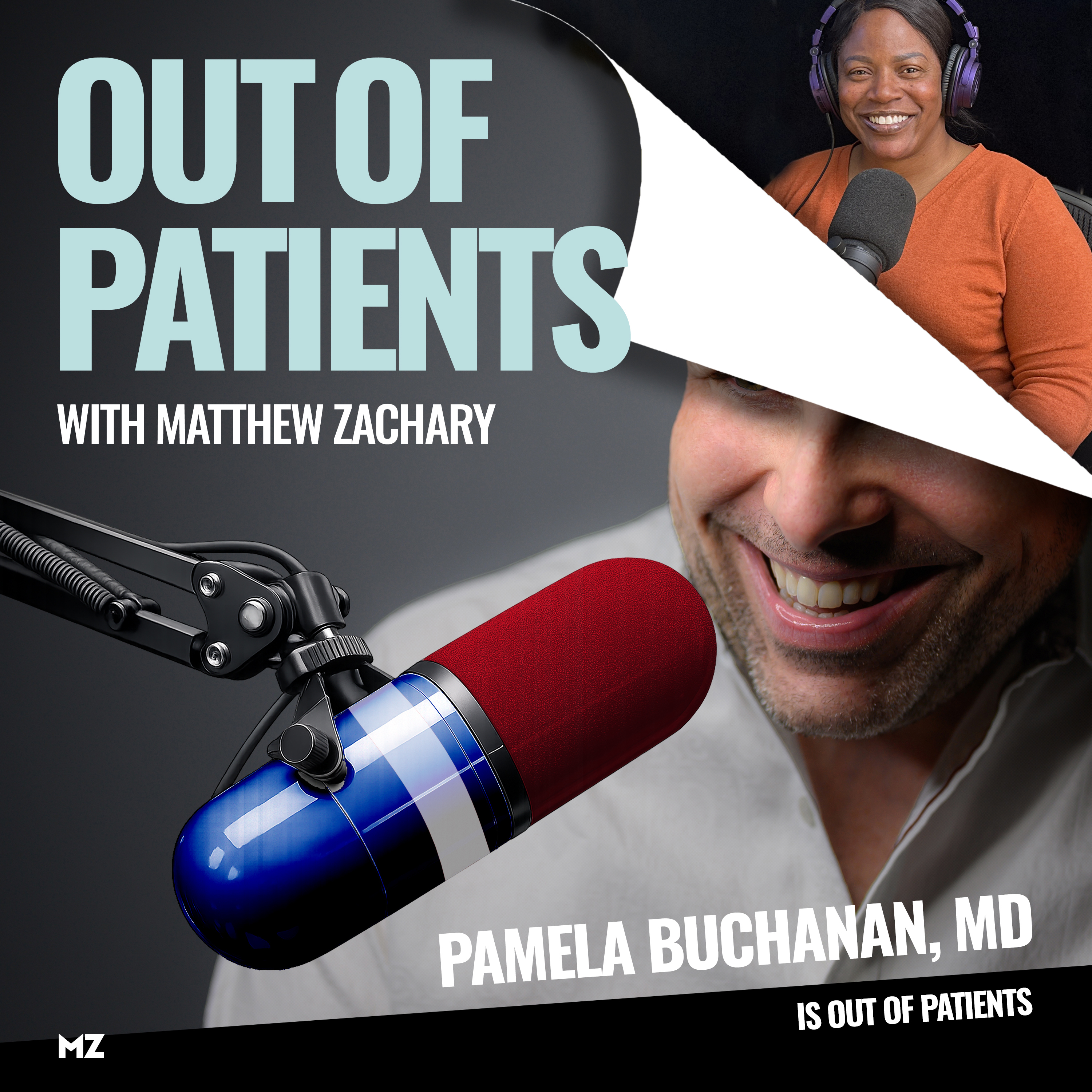
Neuro Spicy on the Front Line: Dr Pamela Buchanan
About this episode
Today’s episode of Out of Patients welcomes Dr Pamela Buchanan, an emergency room physician with over 20 years inside American medicine who refuses to sugarcoat what the job demands and what it destroys. She worked straight through COVID as protocols changed by the day and deaths arrived faster than anyone could process. She logged 80 to 100 hour weeks. She isolated from her family to avoid bringing the virus home. Over time, survival began to feel negotiable.
Dr Buchanan speaks openly about burnout as emotional flatline and about physician suicide as a predictable outcome that leadership prefers to ignore. She describes the ER as the catch all for a broken system and explains why chronic care collapses there by design. She shares the reality of trying to access mental health care while still practicing medicine, calling dozens of therapists, getting nowhere, and spending $10,000 to $15,000 out of pocket just to stay alive and functional.
Listeners will hear how neurodivergence shaped her career in emergency medicine, how race and trust intersect inside hospital walls, and why doctors are leaving in waves. This conversation carries clarity, anger, humor, and hard earned truth from someone who stayed long enough to name the damage.
RELATED LINKS
Dr Pamela Buchanan on LinkedIn
Dr Pamela Buchanan on Instagram
KevinMD essay by Dr Pamela Buchanan
FEEDBACK
Like this episode? Rate and review Out of Patients on your favorite podcast platform. For guest suggestions or sponsorship email [email protected]
See Privacy Policy at https://art19.com/privacy and California Privacy Notice at https://art19.com/privacy#do-not-sell-my-info.
Get every episode summarized
Each time Out of Patients with Matthew Zachary publishes, we email you a written briefing from the transcript — the topics, who appeared, and any specific claims, with the ad reads skipped.
Email me new episodesFree for 3 shows. No card needed.
Hosts & guests
Transcript ready
931 searchable segments. Every word is indexed and playable.
Full transcript
Out of Patients with Matthew Zachary — Neuro Spicy on the Front Line: Dr Pamela Buchanan. Machine-transcribed; use the interactive transcript above to jump the player to any line.
Hello friends, welcome back to the show. My guest today is Dr. Pamela Buchanan. She's an ER physician with over 20 years inside American medicine. The horrible underbelly, you know, she works straight through COVID, all sorts of fun there while the rules changed by the hour and the deaths kept stacking up. She logged 80 to 100 hours a week back then, sometimes even more, and she isolated from her family so she wouldn't bring the virus home and wipe out the people that she loved. Pam speaks very openly about burnout, depression, and physician suicide because she lived it on the edge and she walked back from it. She does not dress it up, she does not sell tickets to the WoW's me theater.
She talks about emotional flat lining, about what happens when hospitals treat doctors like shit and why wellness emails never save anyone. You're going to learn more about what frontline medicine actually did to the people trying to hold it together, why so many doctors are quitting their profession and what it takes to tell the truth when the system would rather have you disappear quietly. Let's get started. I feel like in watching your TED talk, I was waiting for you to drop some F-bombs. You can't, they wouldn't let you, right? You do not do that. I know. I want to know about your training for TED, your TEDx talk. Okay. Have that happen. How are you just being you and amazing? It was accidental. Someone, my marketing person who I contracted out to, I was running a mental health practice.
I bought it as a franchise. We were doing some videos and marketing and she's like, you are the brand. You are dragging people along with you and she was like, you should do speaking. You know, after I did a spot on a local radio, local TV, and I was like, I never really thought about that. She was like, there's a TEDx coming up, I'm going to recommend you. Go ahead and do it. Do in three days, and I didn't even know him think about TED like that. I didn't know if it was a big deal. And so I submitted the application, March 27th had to be in about a 31st. Did it write itself though? It was not hard for me. And they approved it in person and I got to be in the TEDx. But what was crazy was after the initial round, what happens is you get accepted to a TED and it organizes a sign you a coach and this coach helps you craft your message because TED is all about what's your big idea.
And my big idea was, nobody talks about the fact that one physician per day dies by suicide. The fact that how fast physicians are burning out and that we're headed for a complete collapse in crisis, who's going to take care of me when I'm old, because I'm 50 now. I turn 50 this year and you know, out of your 50 stop stars breaking down and you need more and more stuff fixed on you and you got to know that doctor's going to be there. I'm nodding my head on the radio for the list. I'm totally just nodding my head. And it just pisses me off. I'm just like this is just like fucking nuts. Nobody's doing anything about this. And when you work in medicine, the people who run the hospitals, they don't give it down. They just want somebody to be there in the hole. And then I think they think that nurse practitioners are the answer. And that's not the answer. But like flies, doctors are dropping.
I have like doctors have doctors as friends. And of my friends, lots have gone to other things. You can easily get a job and tech. You can go and consult with the EMRs. You can get into informatics. You can get an MBA. Hell, I know a lot of people got an MBA and start selling real estate. That's a big thing in doctors now. So you think about it, you can work a couple of heart years as a doctor, get some money by a few doors and by the way, you got a business, you don't have to be a doctor anymore. That's what people are doing. It's this mass exodus. There is a mass exodus. The diaspora, causal to diaspora, like we're doing it to ourselves as a country. We are doing it to ourselves. And it was already bad before COVID. Then after COVID, there are some statistics that say like 40% have left the healthcare field. I'm like, really, I can feel it as a person still works in it because you can tell that the ER is full of people that should be seen by their primary care. And that's always been the case, my whole 20 year career, but not like it is now.
I have so much, not dirt. It's good dirt on you because I did almost be lucky. But I love that you were labeled a gifted child. That was the term we used to use in the 80s, which now doesn't, has an age well. I was a gifted child as well. But it's not like neurodivergent like today. It's like, you know what? It's okay to be smarter than other kids without being a douche about it. But how did that make, you know the child's way of the chance? I'm the youngest of seven. Okay. I said, oh, only child, but did you feel as the last as an old child? I was because I was an oops baby. My parents, my parents had me six years out there. They thought they were done. So you were raised by, I raised my, my, my, my sister, I was going to say like, who amongst the gaggle were your, served as your elders? It took me a while to figure out that my sister wasn't my mother and didn't have control in dominion over my goodness, because you know, she, she would punish me. You would tell me where to go and what to do is she's seven, she's 15 years older than me. Oh, wow. Okay.
Yeah. That's going to be, make for an interesting diagram. We are all the, and we are all born of our condition. Yep. That's exactly that. What is one memory as a kid that you have? Because I have ones that you think, if we go around the room like tell us something about yourself that we would never know about, I'll tell you my story if you tell me yours. As a kid. Okay. I always felt weird and I got picked on a lot. I got picked on and people would ask, if I was slow, that's the term they would use, I was just different. Now, you know, there's more grace for that because I know that because two out of three of my children are similar. And one of the memories I remember is I did very well in school. I got great grades. I always did. I always loved reading and learning. And my parents, my mom didn't allow much TV. You had to choose an hour you would watch her day. And after that, you have to read black and lighter color. It was still color. It was the 80s.
Yeah. And I had a black and white TV in my bedroom in the 80s, so. You know what? I did have a black and white until 30th grade. Yeah. All right. So one hour TV per day. And I'm glad she did that. I think that helped academically. I do that to my children now. I live at the screen time now. And as an American Academy of Pediatrics says, that's what you should be doing. No one should. Yeah. I see. I see people just a baby's two years old and just got them in front of the iPad. I'm like, no, it's going to be stupid. Yeah. I can already see the don't going to be stupid if you met our society. I know. I'm trying to be kind. I can already see the dumbing down of America, like just in basic stuff, like the Darwin award started like 20 years ago, you know? Oh, okay. So I started my medical career 20 years ago and people don't have a basic understanding of anything, like you have a cold. But my memory from childhood, I digress, I have ADHD. So if you let me, I will go 10 gentle, okay?
So I'm going to, what am I on one of those holiday days? I'm not full of Adderall today. So but you look great. Okay. I just didn't want to be a hopped up. I just wanted to be normal or whatever normal is. You can't even say normal anymore, nothing is PC anymore. I feel like at any moment, I could say a thing that would cancel me. All right. The entire rest of the show is Gen X bitching. Go. I'm totally kidding. Continue. Yep. I could do it all day. But that was my memory being called slow and I remember specifically this one thing. When I was in third grade, oh no, it's a sixth grade. I skipped bully by these three girls. Rosalind Renee and I can't remember the other one, but they would bully me in every morning. Everybody got dropped off my brother. He'd walk me to school. They would fight with me and take my homework so they could copy it. And one day, I was, you know, tussling around with them and I just gave them my homework and the sixth grade teacher was a family friend.
And he told my parents what was going on. And I grew up in the church. When you church all the time in Sunday school and they said that you're supposed to turn the other cheek. So I didn't think you should fight. And so my mom found out and she's mad at me and she's like, what are you doing letting these people beat you up? I said, well, the Bible said, and in Sunday school, he's supposed to turn the other cheek. And she says, not when you get in your ass beat. That's some ground truth right there. And so the next time I went back to school, I was mad like that TV show, The Christmas Story. When he finally got mad. Oh, yeah. Oh, and I went crazy. I went ham. Hard as a motherfucker on them. And I mean, I just lit them up. I mean, they were beat. And they left you alone from then on. It carried all the way to high school that I was crazy. Joe, that's what matters. He's crazy. And I recently saw all of these people just at Starbucks as we're as adults. No, really? Yeah. In our forties. And they're like, hey, how you doing? I'm like, why are you being nice? You used to beat me up. Yeah. Until I kicked your ass.
I figured like a savvy or like the modern version of this story because you really can't hit people anymore is just fake your homework. So they get bad grades and keep your own homework to yourself. I think that's just a shame because my son had a similar situation where he thought he was going to be in trouble with me. And this was when he was in fifth grade. So he's now 17. But there was a girl who was his friend and these guys were messing with her. And I think they pushed her down. And then he went over and he hit the guy. And he was like, I'm sorry, mama, I hit somebody today and I was like, well, what happened? What were the circumstances? And he told me the circumstances. And I was like, hi, five. Let's go get some ice cream. Yeah. But I'm trying to figure out why can't you find anybody because the president right now is aggressive towards Venezuela. And I don't want a society of people coming up after me who don't know how to defend themselves.
Right. I don't get that. We've moved into such a litigious society that if you even touch me, I'll sue you. And I can be a jerk to you because of freedom of speech. I get it. Yeah. Although a little bullying kind of helped me out back in the 80s too. I can't deny it. Bullying definitely helped me out. Yeah. We shouldn't have to whisper that. I feel like I'm going to get canceled. Why? I mean, I'm going to say why medicine, but why emergency medicine? What is the deep end of the pool? You know, emergency medicine is what happens to those with ADHD. It was a lot of people with ADHD already on the spectrum or ER doctors because, you know, you're therefore, you know, a good time, not a long time. It's like the mistress of doctors. It's perfect because I don't own you. You know, on me, I see you for five to ten minutes. Leave me alone. No relationships. No relationships. It's like you're the whore. I was going to go with speed dating, but okay.
Well, the primary care, that's a marriage. Yeah. That's a relationship. That's true. That's you could call me anytime, all hours of the night and tell me your running nose is going on. If you see me in the ER, I'd be like, yeah, yeah, it's running nose. Okay. Goodbye. Wham, bam. Hope you're alive. Yes. Yeah. I can see now why that the, the, the ADHD and you would sync up with that freneticness of the ER was like, did you watch ER and we watch ER? Did that inform you? Or like scare you? No. Okay. I mean, what I, when I saw Carter and, and who are, whatever George Clooney's now, that guy and Eric LaSalle, I thought, that's what I want to do. And by the time I was in medical school, it was grazing anatomy. And so, yeah, I definitely want to be like ER. What is true about ER, I'm, I'm thinking back and those who are in ER, those people didn't have any relationships. And that's really true. Because you become so jaded. Right. So it takes a special person to be with a person who works ER medicine.
Well, this, this show might air next year and hopefully the pit season two or three. Two? Yep. Yeah. We're praying for Wiley. Yes. Season two is a very, pit is the only show, the only medical drama that is so very accurate. Mm-hmm. Yeah, I tell you when I watch that show, I have to be careful. I have friends who watch it who say they can't watch it because it's very traumatic, triggering. And for me, sometimes when I watch it, I am transported back to the COVID era. It's that real. It's that real. And I feel like I need to book a therapy session. It is that real. At what point, and this is a loaded question, but at what point did you realize, or how quickly, within one second or three seconds, did you realize that being a doctor in ER is representative of how fucked up American healthcare is? Man, it took me a minute. Probably though, when I was a resident, I realized this is what, this is how fucked up it is because what happens is, it's the waist back, it's the waist back, it's the catch-all,
it's the safety net. And it's really not a safety net because the ER is the worst place to go for care, the absolute worst. You can spend like 17 hours waiting for like anything. And people come for their chronic care stuff. You are going to get the most pissed poor care in the ER when you come for your chronic care stuff. Number one, chances are that the doctor is on the spectrum and doesn't care about those types of things. So he's not good at longitudinal type of medicine. And secondarily, you lost his interest a minute, you weren't dying. Because that's what excites an ER doctor. Is it a death? Is it something I need to save? Is there a procedure to do if it's you needing refills on your blood pressure medicine? Wait, so the more you're closer to dying, the more exciting it is to be a doctor there. Yeah. Is that you or is that everyone? A lot of people. That's some secret sauce right there. Proceed is the emergency room where you want emergencies. I should cut myself up a little more when I go there. Yeah, make it bigger. That's more exciting.
This is a rip some things out and save it. I'm going to sing an arm and let everything else do. Yeah. Come in with your thumb on backwards. I had that a little while ago and that was fine. How many women of color were in your medical school? Actually, how many women were in it and how many women of color were in it? Well, you know, I don't remember, but I know we were all friends and so when I think about it and I was president of the black student union, so. But of course you were. Yeah. So probably like 30 out of hundreds. Okay. It's small. It's still a small percentage, isn't it? Yeah. I can't remember how many women, but I just remember all of the black people. Well, yes. Because what happens is you look across the room when you first start and you're like, where are they? Where are my people? Right. So you have somebody connect to? Is this, I'm going to make a white guy observation. African American people go to the ER, trust African American doctors more. True. True. Absolutely true.
That's my question. So here's why. So tell me a story about that. Here's why it's true. I can tell you a bunch of stories because what happens is, especially where I work, I'm from the Midwest and I've worked in the city and I work in rural areas and especially when I work in a rural hospital and you see a black person, they go, they light up like they saw Santa Claus and they go, and you can see it and you're like, yeah, and then we do this thing. We go like this where you just give them the back of your hand and you stroke it. Okay. Because that means skin folk. Wow. And then they relax because they don't want to come because they feel like the way doctor may mistreat them and they're not wrong. Right. And so in particular, it probably was a few months ago, this black family came in, lady had back pain and you know, she seemed to have real legit back pain. She was coming in for that. I took care of them and I took my time. I listened, got some films, treated her. She felt better and they didn't want to leave.
They didn't want to leave. I was finished. I'm going to the next patient and the nurse is like, they want to talk to you. And I was like, I don't have time. I got to get from room to room. Did I do everything? And I say, well, tell them everything is fine. Here are the instructions. And I was like, no, they have to talk to you. And they just really waiting in that room until I had time. And I said, we just want to say, we appreciate you listening to us and appreciate you not dismissing us. And we want to know what days you normally work. So that if we have an immerse, I said, you can't. Time your immerseys will be. Only almost time on Thursdays. I work Wednesdays sometimes. Now it's down to Tuesdays every now and again. And I feel bad because they won't look for me. It's like a burdensome privilege, I suppose. It is a burden. Yeah. It is a burden. And it is a privilege. I get it to whom much is given, much is required, right? So, you know, I'm happy to be there for them. But it sucks that we're doing things like backpedaling and we're no longer doing diversity
training. We used to have, they used to be standard now as it should be. Right. Because even me, everybody, like for instance, I didn't know about Asians and increased amount of gastric cancers, but the diet is different, the types of spices. And you know, learning that from my Asian colleagues helps. You know, you learn about patients who are in LGBTQ community from your colleagues who have experience because those lived experiences kind of staying in your mind. The fact that, I mean, we can lurch into all the Trump fuckery we want at this point. But the fact that DEI, fine, if you want to believe it's like in the workforce, fine. You go believe that bullshit. But in science, you can't ignore diversity in academia and science and medicine. How are you compensating for that or how is it being compensated for that now? It's been ignored. Okay. Well, that's the opposite.
Yeah. It's been ignored. And you know, medicine still is, you know, only five percent, five point six percent are black doctors. You need to have lots of other races. And you have a good amount of Caucasian doctors and they're like, good, we don't have to deal with this anymore. Right. But it's like, yes, every medical professional should be aware that the Asian American diet, the Asian diet produces a different set of, I don't know, what's the word, physiological. Risk factors. So different groups have higher risk factors for a multitude of different things. And a lot of it has to do culturally variable. Right. It's culture. You should know that. Right. Yeah, that's medicine and opportunities and make sure about our doctor. Yes. And so that is one of the things that drives me nuts. I'm like, why are we going backwards when not trying to take care of everyone? We need to take care of everyone. So let's take a break. I want to talk about your TED Talk in more depth because it really, it spoke to me. I think it'll help the listeners really appreciate who you are as like a spirit.
So we're right back. You know, I've only known you a little while. You are a bulletproof. That's true. I can tell you are just a bulletproof human and a bulletproof woman. Enter a lot. Yeah. Is it all the Gen X piled up to eating dirt and on Rossi slides in the 80s? Yes. We're not co-bullying for the record, but bullying has this merits. Don't cancel me. I raise my kids like Gen Xers and people like they're so well behaved. They raise like, they were born in the 80s. And so I ain't no bitch at my kids. No, I'm on the same page with you. My kids are 80s kids too. They learn failure, they learn dirt, they learn like third place is not tolerable.
They learn disappointment, knowing it gets a prize for like just walking up and breathing on a mirror. I'm just nodding my head. I was like, you can't say this in the streets anymore. You can't talk. You can't talk like this. So to your TED talk, and we'll put links to it in the episode notes because I want everyone's up to watch this. It was really brilliant. And for your first time out, seriously, like you hit a home run on day one, it's great. I like the, you mentioned this quote, you said, Neuro Spicy. And I, that like, A, I didn't even pull that out. I was like, what the hell is this? I get it. You tell us what it means to you. My daughter gave that to me. Okay. So I didn't remember forced gum when he had, he found out he had a son. Yeah. Oh, that was a scene. And he said, is he stupid? Yes. And so I remember when I came home from work, I was a resident. I didn't want any of my children to be like me.
I didn't want any of them to be neurodiverse. I didn't want them to have to go through that. I didn't want them being bullied, being weird. It was so, it was just, it was a lot. And I didn't want it for them. And so I, I thought that they would just be normal like their dad. And we could, I thought, look, you like that. When I came home and I saw my daughter, you know, one of the hallmarks of autism is like during repetitive things, she loved to watch the ceiling fan and watch it go around, around and around. And I was like, damn. Oh, boy. Damn, she's on the spectrum. And I just didn't want to think that, you know, got, got, got a, you know, made sure she had surfaces and early education and, and just really didn't want it to be true. And the way she just didn't socialize and just hard making friends I knew as she was going through school that it was true. And one, and then at one you, she got to be in college. She was in college, I think it was, or about to go to college.
She was going, she had to go to therapy and so hard to find the right therapist and she ended up landing on, play therapy, helped her. And I was like, I'm so sorry. You have to go through all this. I'm so sorry. You take after me. And she's like, what? Mom. She's like, I love my Neuro Spicy family. And that really freed me because she was like, no, it's genius. She's like, different. It's cool. And then she's like, no, it's not really like that like it was when you were kids. And then my other children told me that, too, it's like, no, like, that's like old people stuff. People are not mean like you guys were. So Neuro Spicy is a term that like the Gen Zs are using. I think that's going to be the name of the episode. What's that? Neuro Spicy. All right. Yeah. With Pam Buchanan. And you know what, too? I was like Neuro Spicy. Like I said in my TED Talk, it makes, you know, being on the spectrum sound cool. Yeah. Like it's either a delicious dip or either it's a dance, you know? I like it.
Yeah. And now for the, you know, for the fun part, suicide and depression and medicine, it's going right down the hill. Yeah. What point did you realize that this was taking a toll on you that you didn't sign up for? It snuck up on me because I pride myself. You know, you grew up in an African American community, African American community barely believes in mental health, anything, right? Talk it out, walk it off. There you go. You too blessed to be stressed and if you are having an issue, maybe you're not praying enough, you need to go seek Jesus. And that's kind of how you deal with mental health, right? That's how I was, you know, raised, we didn't talk about that kind of stuff. So I really never, yeah, turning the other cheek, considered it. Even when my mom got me help when I was in your divergent, we didn't tell that. We just kind of snuck off to see this white guy in a cardigan who would talk to me and show me ink blocks. So you just did it like that. And so physician suicide, it's very prevalent.
One doctor per day dies by suicide, right? And they don't tell you this. I had no idea. Nobody told me about it in medical school, like, watch out. This may be you. Would that have diverted the course of the river for you? It would have. I would have taken better care of myself. No, would you have still gone into medicine? I still would have gone into medicine. But I would, because I just feel like it's a calling for me. And I definitely know we need more people of color. I feel blessed and honored to do it. I don't think it just needs, I don't think it needs to be done full time. I think there's a better way. I think the way we do it is, it's messed up. So what happened for me is, I worked my tail off. I always worked hard and I worked a lot because I was poor. And so as soon as you gave me that medical degree, I was off to the races. I'm working all I can. I would work days and sometimes I'd moonlight in the ER at night. I'd work weekends until I, you know, trying to get out the whole. And just never any issue felt fine. It is pandemic because pandemic hit differently.
During the pandemic, there was a combination of extreme work. And you're working in an impossible situation. And so, and think about the ego of a doctor too. Because on a normal day in the ER, most of it you can kind of control and predict. You kind of know who you can and cannot save. And it doesn't affect you as much. But these people were having what seemed like some little virus and they were just dying, dying, dying, dying. Right. And then on one day, Dr. Fauci would say, I remember particularly, they said, I be profan, don't give I be profan to COVID patients. And you're like, I'd be profan. It's bad. We don't know what it does for the inflammatory response. So you have people who have an allergy to Tylenol and we have no way to treat the fever. Because they can't have incest per, you know, the government at that time. And treatments are changing. Seems like every other day. Yeah, every other day was something else. Every other day was like, do this, not that. Give this, don't give that.
It was hard to keep up with. And so when you lose a patient, you wonder, did I follow the protocol of the day? Did I do all I was supposed to do? And you went from, say, maybe a patient of yours dies once every few months, maybe in the whole year, you lose a few patients until the same amount of patients you lost last year happens in one day. Oh, my okay. And so your process and the whole process, did I do? Was it my fault that I do the right thing? Did I intervene quickly enough? That on top of, I hated playing God. I hated having three people crash at the same time. I have to decide who has the best chance of survival. And go into a room, offer them to die. And wonder if I would have gone to them to the other room, like pick a door with that person, have lived. Does that speak to the primary source of the stressors during COVID? Is the rampant deaths of more people in quantity? It was that, I'm trying to frame it up. So it was that for me. And then also the extreme work, okay?
And the fear, because I didn't know if I was going to die saving people I didn't know. And then the isolation, because I wasn't around my family. I stayed above the garage and they put my food outside the door. And I came into the house, everybody went into their room. And I didn't touch anything. We were just like trying it. And I came into the house, I took my clothes off, shoes off, everything in a garage. And they knew not to touch my car, it was the COVID car. And then I had friends who bought campers and put and lived in the camper in the backyard. Or that kind of thing. Or when they stayed at a hotel and didn't come home. Because we didn't know if I breathed on my kid, am I going to kill him? Right. Remember the early days we didn't know. We were like sanitizing a Amazon box. We were sanitizing a Amazon box. But think about me, I'm going into it. And so I'm covered in COVID as I come home. Well, no, I wasn't the black community, even more susceptible to illness. It wasn't that. And here's what it was. It was like if you were baseline unhealthy.
And so black people are baseline unhealthy for a multitude of reasons. From structural racism, from not taking care of your chronic care conditions, unmanaged hypertension, unmanaged diabetes, and obesity because your community is not walkable. And so it's not just genetic. I think it's structural. Yeah. Wow. When did you say I'm done? Well, so I never really thought I would be done. I thought I'd be working completely full-time as a doctor until I got to being old lady. I had a lot of admiration for my pediatrician. And she was a pillar in the community and worked until she was an elder person as a doctor. And I thought that would be me. But after COVID, it was like living 10 years and one. And also, it looked like the apocalypse. So while you guys got to sleep in and be locked down, I had to get up early and be locked in. I didn't be locked in on how am I going to manage this patient
low today? As I'm driving in the work, I'm thinking, what is it going to be today? And you hit that parking lot in its full. And then you hit the, you go into the hospital and you walk through and people are every cheer in the lobby is full, people on the floor. And it sounded like what you thought, revelation, sounded like weeping in the nation of the teeth, just moans and groans. It was just horrible. And all the beeping and the sounds of the machines and the yelling of the staff, this room, that one, we need a crash and it was, and plus, think about it. I'm on the spectrum. It was way overstimulating. Even though even when I hyper focus and get things and focus on one thing, it's like, what do you focus on? So the isolation plus the deep work and the fact that I never got covered. So I'm covering for my colleagues working sometimes a hundred hours a week. And I, one day driving the work, the bridge always seemed cloudy.
There was never anybody on it. Well, you mentioned the bridge in your tent, too. That bridge is a part of my talk a lot of times when I give talks, but voices would tell me to jump in. And I would visually see myself jumping in. And I really wanted to jump in. And I would say, what is going on with me? So you think that you would slow down and get some help. Because if that happened to you, I'd take you by the hand, I'd get you some help. I might hospitalize you, put a mandatory hold on you because you were danger to yourself and others. But for me, what I do, I picked up more shifts. I said, no, I just need to work more. And then I was like, well, maybe I need to pray more because I was raised. I was like, I'm not praying enough. So I started to go to church more because virtual church. So I'm like watching one virtual service at the other. And then I was like, well, maybe I'm not taking better care of myself. So I got a pellet time. So I tried to work it away. I tried to pray it away. I tried to spin it away. It wasn't until I found out that one of our colleagues in the community, another ER doctor, one who had helped train me, he died by suicide. That's when I knew I better do so.
Because it, it's easy, like he had a perfect life. And nobody has a perfect life. He was very handsome guy with a beautiful wife, tall, handsome, active in his church, on some businesses. He was like, if he could do it. And a few days before that, he texted, not texted, but he put a post up that we were all going to get through this together. And so I was like, this is real. I better get some help. And what really sucked is it was so hard to get help. You know, you call the EAP and they didn't call me back. The employee assistance, whatever that is. They didn't call me back. They didn't call me back. And then I called probably about 30 therapists. Nobody was taking insurance. And a lot of therapists were like, I'm not seeing patients. I'm not coming in doing COVID. And they didn't even want to do it virtual. And then my insurance, at the time I had Anthem, it didn't cover anybody. If I finally found somebody, I didn't take my insurance. So I was just like, screw it. My best friend is, one of my best friends is a doctor and our husband's a psychiatrist. So he gave me information about a therapist I could go to.
And we thought she'd take my insurance. I get there. Yeah, no, we don't take your insurance. So I just put on my credit card. I'm privileged that I could just pay for it in cash, but I spent at least $10,000 to $15,000 in therapy. Damn. And just so you could still practice the properties and save people. Just so I could live. Yeah. Because I know that I would have done it because the way I was planning, that's the hallmark of somebody who's serious about doing suicide. I got a will and I figured out who the kids would go to. And I increased my insurance policies. I'm doing this. Yeah, this is pretty real. Yeah. But now you're on the other side. Right. And you were here to help other people who are going through this. You coaching and with strong medicine. Tell us about, like, let's go back up the hill. Yeah, we're going back up the hill because what I did when I saw a therapist, she helped me realize that it was okay to feel what you feel. She kind of gave me permission. And then I started to know that a lot of doctors and nurses go through this.
A lot more than you know. And that being said, going through therapy helped me. And that helped me be just okay. But what helped me thrive was when I met a physician coach because it really takes one to know one because physicians are a special kind of breed. It kind of takes a special kind of crazy to go into that. It's such a self-sacrifice. What you give up to do it. And just, and what's going on right now kind of slap in the face. And COVID was a slap in the face. And that, you know, I'm giving up so much of myself to do this for you. Meanwhile, in the Midwest, you get cussed out. You get into all of it. There's no effing COVID. People are saying that's what's right. The Florida beaches were full of people. Yeah, with their last breath, they used it to curse you. Yeah. And so that was like, why am I saying, risking my life for these people? But now after getting through it, I realize, you know, I got through it.
I help other people get through it. I help people be okay with feeling what they feel. Give them permission. I think a lot of doctors, a lot of nurses need permission. Like, it is okay that you're not okay. And really just think about what you do and what you've given. No wonder you're not okay. And give them frameworks and ways to work through it. I love to go to, like, I have some, I have a lot of things lined up this year where I'm teaching the whole hospital teams because hospitals are the last adopters. I make most of my money from corporations. Right. You know, they would write, they pay for this kind of stuff. Take care of their teams. Well, hospitals like, you know, doctors and nurses, they're fine. Really? Yeah. Until, until they have nobody working it and they're doing stupid stuff, like paying travelers to come from 10 bucks to, and even the Philippines, because they got nobody to work, because everybody's quitting. It's just so antithetical. It's like if you don't take care of yourself, can't take care of others, like put your seatbelt on first before you can get them.
They don't do that. That's insane. Seatbelt, oxygen mask, whatever metaphor you can think of. And I just, for the life of me, can't understand why hospitals are the last adopters. And the way we're going right now, I don't know who's going to be there by the time we're old people. Well, on that note, you and Climber are already old people in our early 50s. I would say we got another 50 to go. No, I went out. Oh, yeah. I think we had an adjard. I'd be happy having an adjard at this point. You could have the damn adjard. Let me go. Where can people learn more about what you can offer in your services? All right. You can go to drbstrong.com. That's my page where you can learn about speaking and coaching, and strongmdstl.com. We'll put links in the episode. So you've heard my show. You probably know at the end of every episode, I basically endowed people with my own chat GBT version of who Netflix things would play you in your own series. Now, you don't have to guess because I have the answer. Says my chat GBT and says me. So if Dr. Pamela Buchanan
were in the Netflix series, her character would be represented by what three pop culture soulmates, okay? You are Woopy Goldberg and Jumpin' Jack Flash. Explanation. A woman who operates outside the traditional boundaries combines intelligence with the reverence and challenges systems that underestimate her. You are Sigordi Weaver in Working Girl. The good part of her, I had to qualify that. A professional navigating male dominant environments, managing ambition, identity, and expectations with precision and Pam Greer and coffee. Oh, okay. A figure known for strength, complexity, and uncompromising self-definition. She moves through systems that fail to protect her yet she retains control over her story and her mission. I think it did a good job. Oh, right, all right, all right. Yeah, yeah. Is that acceptable? It is acceptable. It is a robot. No, it's definitely a robot.
Yeah, but still, I think you are worshipable in the decisions you've made what you've had to endure on behalf of helping so many people. Thank you. I don't see it like that, but I appreciate that. Take the compliment. Thank you. I'll also just put this by saying that for the listeners, Pam reached out to me on LinkedIn and just like, I love to come on your show and it's like, well, I only tape in New York, but next time you're in the Big Apple, she's like, I'm booking a flight today. And here you are. Yeah. I really appreciate that. It's such a passion. I'm so appreciative of what you're doing who you are. So thank you for coming on the show. Likewise, I think you're doing good work. Thank you. Thank you. Thank you. Thank you. Thank you. Out of patience with Matthew Zachary is the production of Matthew Zachary Worldwide. The executive producer is Matthew Zachary. It is mixed and edited by Kyle Moore. If you like the show, ratings and reviews are always welcome wherever you get your podcasts. If you have guest suggestions
or would like to learn more about sponsorship opportunities, email podcast at Matthews Zachary.com. For more information about Matthews Zachary and Matthews Zachary Worldwide, visit Matthews Zachary.com.
More episodes
More from Out of Patients with Matthew Zachary

Not Today, Life: Teresa Baglietto
Out of Patients with Matthew Zachary

Standard Deviation S2 EP1: Gatekeepers of the Ivory Tower
Out of Patients with Matthew Zachary

[BONUS] Eczema, Exit, Repeat: Dr. Barbara Paldus
Out of Patients with Matthew Zachary

STEMM Cells and Broken Bones
Out of Patients with Matthew Zachary