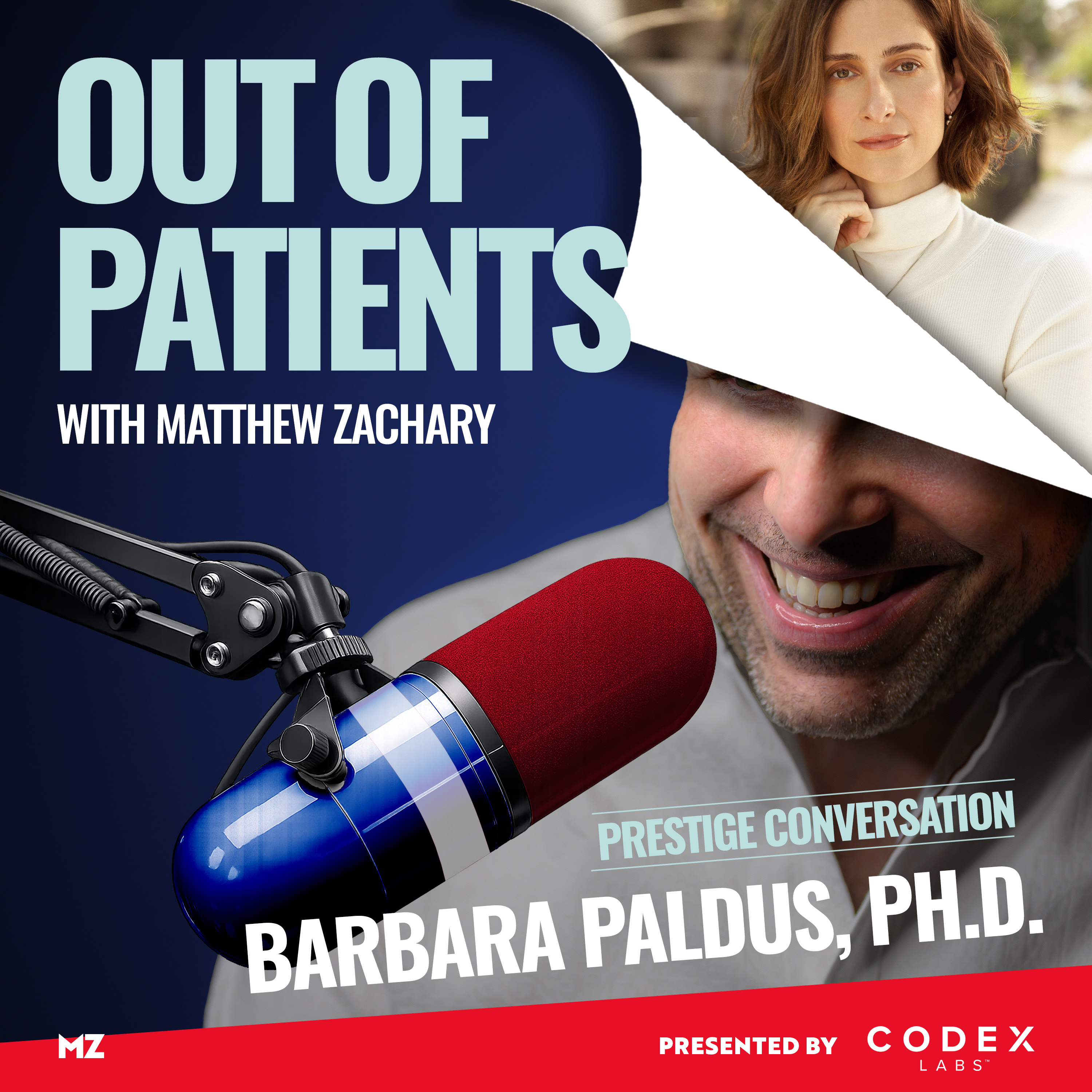
[BONUS] Eczema, Exit, Repeat: Dr. Barbara Paldus
About this episode
Dr. Barbara Paldus is the Founder and CEO of CODEX Labs, the sponsor of this episode.
She grew up around Nobel Prize winners, built biotech manufacturing equipment for vaccines and cancer therapeutics, and then sold her company after an 8 year old threatened suicide.
Her son’s severe eczema pushed her into an unregulated $100,000,000,000 skincare market where parents are told to trust labels that nobody verifies. She explains how corticosteroid ladders leave patients with years long withdrawal, why U.S. ingredient oversight lags Europe, and how chemotherapy destroys the same skin and gut barriers seen in inflammatory disease.
The conversation tracks the real stakes behind “clean” marketing: a child’s immune system, hospital infections like MRSA, and patients trying to survive treatment without new damage. She also details the research path from Irish medical manuscripts to microbiome science and why sick populations become the only reliable regulators when policy fails.
RELATED LINKS
Explore Codex Labs with Matthew Zachary | Use code ZACHARY for 15% off
FEEDBACK
Like this episode? Rate and review Out of Patients on your favorite podcast platform. For guest suggestions or sponsorship email [email protected]
See Privacy Policy at https://art19.com/privacy and California Privacy Notice at https://art19.com/privacy#do-not-sell-my-info.
Get every episode summarized
Each time Out of Patients with Matthew Zachary publishes, we email you a written briefing from the transcript — the topics, who appeared, and any specific claims, with the ad reads skipped.
Email me new episodesFree for 3 shows. No card needed.
Hosts & guests
Transcript ready
1,347 searchable segments. Every word is indexed and playable.
Full transcript
Out of Patients with Matthew Zachary — [BONUS] Eczema, Exit, Repeat: Dr. Barbara Paldus. Machine-transcribed; use the interactive transcript above to jump the player to any line.
This episode of Out of Patients with Matthew Zachary was made possible in part by Codex Labs. For more information, visit mathusacary.com slash Codex Labs. That's mathusacary.com slash Codex Labs. Hello friends, welcome back to the show. My guest today is Dr. Barbara Paldis. And the first thing she tells me when I met her before the show with prep is that she burdened down her parents' kitchen with a blowtorch in the 80s at the age of 11. I was hooked, saying no more, everything else is just gravy. So just let that set the tone. She's a scientist who like never waited for permission. She's a daughter raised by a father who worked for a Nobel laureates as one does.
And kept the bar so high that she had a climate. She's a mother who threw out $120 of tubes of steroid cream because she refused to let her son's immune system get rewritten by convenient medicine. This is the person you're going to hear today for an extended episode of Out of Patients. The gist of the show to make this quick is that, you know, I came into this conversation as a kid who was basically put in the easy bake oven and burned her a crisp in the 1990s and no one really cared what you put in your body to heal yourself. Maybe just go take a bath and Vaseline was therapy back then. But my how things have changed. So Barb decided to start Codex Labs, which is why I wanted to have them on the show. Basically, they make things that you put on your body that don't give you cancer. That's a nice thing. You don't want to be shopping for soft and like, oh my God, this smells great, feels great. What are those ingredients? Why are there so many syllables?
Anyway, that is what Codex Labs is not. So this conversation carries like every nerve I've ever had since 1995's easy bake oven. I was a frickin' pop tart back then. The sick will save us because we have no choice. We have to learn fast or get steamrolled. Barbara learned fast. She built something real. She's here today. She's hysterical. She totally burned down her parents' kitchen when she was 11. Without further ado, here it is, your episode with Barb Paldas. You have to tell me about your burning down your kitchen as a kid. We're starting here. Deep end of the pool. Go. Okay, well, I was in my teens. I'd failed home economics class. So as punishment, I had to take a cooking class over the summer. So my parents would drive me to this like French cookery. And they didn't realize you learn how to sharpen knives.
You also learn how to make everything with basically propane torches. So like crème caramel or crème plombé. And so I decided to surprise my parents who were at a party. And I had everything ready. Everything was ready to caramelize. And it just went poof and everything was great. When my parents came home, I'm like, hey, I made you dessert. My mom's like, where are the damn curtains? I made vaporizer like nylon or one of those, you know, artificial synthetic fabrics. They had just literally vaporized. And I didn't even notice. I was so focused on cooking that I had no idea they were like bare kitchen windows. Now I want like a plushie of you as a 10 year old girl with a torch. Yeah, exactly. Now I used to be head Barbies. I was, I was pretty bad. Was this in Europe? No, this is actually in Canada, but I did spend a lot of time in Europe. Where were you born? As born in Waterloo, well, Kitchener Waterloo, Canada. And then we basically spent a year in Strasbourg, France. And another year in Strasbourg, France, you're in Berlin, you're in Naimeakin, Holland. We were kind of all over the place. And then also some summers like in Barcelona and whatever.
Was it like a military Brad or just your folks get moving around? No, I was a science brat. My dad used to use super computers. So we went wherever they had the hottest, coolest supercomputer with the most memory. So he could do his calculations. Your dad is all over your content. I want you to just tell us your dad's story. Well, he was a huge influence in my life. My dad grew up in a village. And well, what used to be kind of, it was called Zudatin Lanzo. It was Germany. And most of the village died. It was Sudatinland. I just went back there like European history in high school. Yeah, it was basically the German occupied part of the Czech Republic. And so he was, you know, his family was God knows, you know, part Lithuanian, part German, part Czech, you know, everything in their mix, you know, kind of hides 57. And so he was the first person in his family to get a college education and then go on to get a PhD. And then he worked for a Nobel Prize winner in the Czech Republic, Hiroski and Kudetski, and then he immigrated to the US where he worked for another Nobel Prize winner Herzberg, basically at the National Research Council in Ottawa and basically in 1968, they left.
And my dad was my hero. You know, he was an amazing scientist, but he was also one of these people like you would never know, because he was so humble. I didn't realize to later on in life like that, all these weird and amazing people we met were either Nobel Prize winner as a Richard Feynman, whom he called Dick affectionately. Oh, boy. Yeah. Yeah, surely you're joking, Mr. Feynman. I just didn't realize he had known all these people. And so to me, it was just after he got older and it started sinking in, it was like, holy shit, I missed out on all these opportunities, because I didn't really realize that, for example, the old man I was chasing down the corridor, he was wearing a mask, was Herzberg and the Nobel Prize winner. And then I tried to shave his head, you know, you don't quite realize that when you're four or five years old. And then you met people whose IQ is less than 350. And what happened? Then I became human. I don't know. Humbling this. Oh, my God. That's okay. You're pretty smart, but hey, Herzberg. But I work hard. My dad always told me you're not that smart. Don't get ahead of yourself. Work your ass off. That's the only way I'll get ahead. So I mean, and the best part, and I told this on another podcast in the Czech Republic,
and they're kind of like, what the fuck? But it's very typical for Czech parents to be this way. I won, you know, one of the, you know, alumni awards. And so we went to see the president of the university, and I happened to go to the university where my dad was a professor because it was cheap. You know, and it's not exactly like... Burn the curtains down there, too? No. Okay. Got to make sure. No, but it's Stanford. No, it's Stanford. I actually was doing an experiment. I had pop-tarts, because I was really into pop-tarts back then, and I forgot the pop-tart in the toaster oven in the kitchenette. And I'm doing my experiment, and all of a sudden I see all these fire people, and they're like, you need to evacuate the building. It was my pop-tart. All right. You have to leave. We need like some kind of like waiver to keep going on the show here. But again, I hear how your dad raised you. My parents are very much... I think it's very generational. Each European, Soviet block. I'm Polish, Prussian, Austrian. I think Lithuanian, second generation. My mom spoke English, right?
Community edition English. Yes, she couldn't like German and English. I mean, the woman came over in 39, and before the... Germany started killing everybody, and never lost her accent died at 96 saying, what is going on with me? Well, in Israel, they joke that Hebrew is the only language parents learn from their children. I like that. I like that. I like the phrase, like, you're born of your condition. And I read that your son happened to have something going on, and they're like, oh, here's a timeline shift for me. Yep. Let's discuss that. Yep, so he had eczema. So actually, he started with contact dermatitis. And the contact dermatitis evolved into atopic dermatitis or eczema. I'll never know why. I mean, I suspect it was phenoxyethanol, because he had an allergy to it. Wait, wait, that's a lot of syllables. Say that again. Oh, phenoxyethanol. It's a common preservative and a lot of... Right. My IQ just dropped by 10 points. Okay, keep going. Phenoxyethanol. Phenoxyethanol. Okay. Anyway, so I mean, it could have been something else.
The problem is, it's an unregulated industry. They say there's less than 1% in it, whether or not the product of the baby products I was using had less than 1% in it. I'll never know. You know, it's not exactly like I sent them off to a lab and tested them, because I didn't figure this out for four or five years. I just figured out he was allergic to a certain, you know, I basically did a process of elimination by writing ingredients list. But we pretty much managed the eczema, like my mom came over when he was born. And typical old East European doctor was like, no, no, no, no, no, no, throughout all the products, put coconut oil on his butt. And I'm like, what the hell are you doing? She goes, it's an anti-bacterial. It'll be fine, you know. So he lived basically with kitchen products. And then my mom would be grinding up vitamin B12 and making it into these like reddish creams. It's like, what the hell are you doing mom? She goes, no, no, no, we fine. She pretty much helped me get them through the eczema with minimal, minimal uses of corticosteroids, because that was something she was like, no, it's like, what do you mean no? She goes, and they gave you three tubes. It's like, what do you mean mom? It's like, are they, is the pediatrician insane? It's like, well, mom, that's what they're telling me to do.
She goes, no. So she goes, we're going to use it for two days. We're going to cut down the flare and she goes, and that's it. And then I'm taking it. And then she threw them out. And it was like, mom, that was just like 120 bucks of stuff. She goes, no. She goes, I'm protecting his immune system. So my mom basically started me on this path of just wondering, because she's now 85. And like, what was it that they did differently than what we do now? And we just take a lot of things for granted medically. And we take a lot of drug products kind of for granted medically. Like, they're safe. They work. They're fine. And if we're told to use them. And now, you know, I see so many people with topical steroid withdrawal syndrome, that I can't thank my mother. So these are people with eczema who were given steroids. And there's such a thing called the steroid ladder. And they're basically steroids that are more and more potent. So for example, you start with like hydrochordazone that you can buy as an over-the-counter product of the pharmacy. And then you step up the concentration of the hydrochordazone. Then you can go to something like triumphant alone. Then you go to bedamethasone, et cetera, et cetera. And there's like a seven-step ladder. And so as your body gets used to it, you need a, you know, it still flares.
It still has a immune reaction for maxima. So they just prescribe the next thing up. And it calms the flare, but eventually it stops working. So then you kind of go up and up and up. And then at some point your immune system says, I'm done. And then these people, I don't know if you've ever seen anybody on social media or met anybody with topical steroid. Basically, their skin peels. It bubbles. It blisters. They're bleeding. They're oozing. They're in terrible pain. It can be their entire body. And it can take years and years and years to recover. And today it's, I mean, hopefully there will be a paper soon that's published by one of the guys on our medical advisory board, Dr. Peter Leo. That basically shows the different conditions, like how a doctor can figure it out. Like what the, you know, what the signs are, what the symptoms are, that are different from maxima. But it's still not a recognized disease. And these people can't get, you know, a disease code and therefore reimbursement. It's still treated as a maxima. But it's pretty much a long-term care. I mean, it opens up another Pandora's box. I mean, yes, working on ecology and rare disease my whole life, because I was, hey, look, I've born in my condition. It just speaks to how, well, maybe the ancients really had it right,
like with castor oil and honey. I mean, have we reached the point where we're coming full circle and the awareness of like, I'm going to say, I'm going to say, I'm going to say, I'm going to say, I'm going to say, I'm going to say, I'm going to say, I'm going to say, I'm going to say, I'm going to say, I'm going to say, I'm coming full circle and the awareness of like, that shit works. Well, what's interesting is that we're finding the... the ingredient.. are the active. So, we now kind of science, like, called biotechnology, that we can now break the stuff apart and figure out, okay, this is the active thing, that's actually giving this plant its potency and then, we can go to amplify that thing through, again, plant biology and biotech, we just take the right plant cell, and we amplify it. And we basically get the plant action on steroids. on steroids, which is really that's a bad pun because we're just talking about steroids, but yeah. And that's basically how we started developing stuff is we went back to 13th century and 14th century manuscripts in Ireland. So there was one, so as my son had eczema
and I was traveling the world and I was basically making biotech equipment for making everything from vaccines to model clone antibody cancer therapeutics, I was looking for products that my son would tolerate because he was so hyper, hyper sensitive. And so in Ireland I found a company so after I sold my company and that's a whole another story because he was diagnosed with ADHD and became suicidal. And so pretty much as psychiatrists. Wait, wait, wait, wait, you can't just speed through that. Let's take a moment here because that's another narrative today. Just kids being under so much stress and pressure. We grew up when mental health was just fucking walk it off. Yep. Can we just pause for a sec? Because like you're brilliantly speeding through this with the intellectualism of Wiley Coyote, but we have to just stop and focus on that for a sec. So when I was growing up, my mom had, I had a migraine headache. My mom would be like children don't have migraines. As you said, go outside and go walk it off. So my son always had trouble like in kindergarten and grade one, like we put him in a private school
and basically he was told no. Basically he needs a different kind of school, not Montessori because he couldn't handle Montessori. So then we went to kind of a blue ribbon local school that was literally like 200 feet from our house. And the teachers kept saying he's not paying attention. He's disruptive. He can't sit still. He's not learning. He can't remember what he's being told. And so by the time he was in grade three, the teacher was super, super nice. And she took me aside and she goes, I think you might want to have him tested for ADHD. So we had him tested and pretty much nine out of 10 criteria. So pretty much pegbed plus high anxiety. So the reactions he used to have were actually, I started feeling really bad. And on top of that, because I was a little bit of dragon mom and when my parents were there, they're like, write this and do this, edition and do this. And he was always struggling. Turns out he was diagnosed with dysgraphia. So I- Which is what? So you know how there's dyslexia where people invert letters. So it's the opposite where they can't write. There's the translation from the brain to the hand
as opposed to from the eye to the brain. They just can't write properly. They can't form letters. They have a lot of trouble. So that's when we put him on a computer and he learned to touch type. And he could actually start communicating and writing in a much more fluent way. So because for whatever reason, that physical act of holding that pencil or that pen and forming, whether they were letters or cursive, just that connection, that neuronal connection did not happen and wasn't there. And now he can write, but it looks, you know, it kind of looks like most of my friends when I was growing up in middle school, it looks like shit. But I mean, at least he can now write, but he prefers to type. And today, you know, in today's age, I remember I was like, oh, you've got to write because you're going to have to sign checks and he looks at me and goes, mom, we're going to be paying with Apple Pay in my generation. So like stuff that idea and it was like, damn, you know, he outsmarted by like, you know, an eight year old. I feel like you should know how to write your name as a signature, no matter what age and time and space you are. My kids don't know how to sign,
they don't teach cursive anymore. No, but his point was, mom, it'll be an ocular, you know, recognition or fingerprinting is going to be obsolete or there'll be a DNA, you know, fingerprint or something like that. And so he was like, we're not going to need to do that anymore. And everything will be kind of like in an Iron Man where there's Jarvis and you talk at it and it basically does a calculation and you're pointing on a screen. So I mean, he had a point that didn't mean I didn't still want him to be able to write, but the bottom line was, so he was diagnosed pretty much with this condition and the high anxiety and I was traveling a lot because at the time my company was growing a lot. So I was literally like home on weekends, I'd fly to China, come back, fly to Europe, come back, fly to... Who watches him or he comes to me? He had two nannies. Okay. He had a day nanny and a night nanny at one point. And he just started feeling like mom didn't love him because mom wasn't home. Which again, it's logical for a child and that mom preferred her company and her work over him. And... Which was not true.
No, of course it wasn't true, but, you know, I just wanted, I wanted to make sure that no matter what happened to me in the future, he'd be financially secure, right? So I was pretty much killing myself to scale this company and to eventually, you know, have an exit. And so the problem was that he started getting more and more depressed and one day I got a call from his psychiatrist and she pretty much said, I think he's been talking about committing suicide. He's been talking about jumping off the balcony of his room. How old is he at this time? He was about eight. Wow. And she said, and I'm giving you three months to figure this out or you might not have a child and you may not have a choice. So that was probably, you know, having been trained by my parents that career is everything, successes everything, you know, you can balance it, you can make it work. It was like, well, clearly not. So that was some pretty dark deep soul searching and that was it. I sold the company pretty much three months later. I sold the company and then the company that bought it
you know, was supposed to cut my travel but they figured out I was pretty good at solving problems so they started still sending me everywhere and so after about 15 months of that I told myself, look, I'm gonna quit and I quit. And I just left. That's a good note to take a quick break because we'd like to end on a high end. We'll be right back after these messages from CardEx Labs. Hey guys, Matt here with the sentence, I never thought I'd say on this show. This episode is sponsored by something I actually use. So if you've ever been through chemo or radiation you already know that your skin just stops cooperating. Back in 1996, my skin went from human to overcooked rotisserie in about a week and the official treatment back then was petroleum jelly and good luck. I started using CardEx Labs recently because they build products around the skin barrier
and the microbiome instead of fragrance and vibes. No mystery ingredients, no 11 syllable crap inside and no stinging when your body already has enough problems. I use the wash at night and the moisturizer in the morning. Simple routine, skin behaves better, I sleep better. So yeah, this is my first real endorsement because it cleared the one rule I have. If I would not hand it to another patient, I don't talk about it. CardEx Labs, link in the show notes and at codexlabs.com. I want to go back to this idea that maybe humanity, at least in the Western hemisphere, especially in this fucked up country, are finally catching on to the fact that ingredients in products, whether it's beauty care or food, are vastly different in other countries. Absolutely true. Why did it take so long for our country to realize this?
Because our country is driven by marketing and our country is driven by sensationalism and I think a lot of it, simply if I look at the questions we get from customers in Eastern Europe versus the United States, is our educational system. And lately, it's far more, everybody wants to be an influencer, nobody wants to be an astronaut, nobody wants to go into science, nobody wants to do math. Well, only fans pays really well. Oh, it does. I know, like why on earth would you want to go and get a degree or try to get into MIT and get an engineering degree if you can get on to only fans that make 50 million years? You mean steers and civics? Yeah. Yeah. So I think it's just the values in this country have changed dramatically from the 50s versus Europe has evolved far more slowly because also it's regulated things like social media far more, but it's also regulated its industries. If you look at the number of ingredients in Europe that people are not allowed to put into food or not allowed to put into cosmetics or personal care products,
that's a very, very different range and the list is much more extensive like to give you an example of retinal, right? In the US now, there's this trend of half a percent, 0.8 percent, 1 percent, we might even go to 2 percent and none of that is regulated. In Europe, they just announced that as of November 1st, 0.3 percent retinal on a leave on product and companies have two years to basically. But that's based on science and data and correct. I would always imagine like a consumer protection model. Correct, correct. And there's a committee of scientists and there's a committee of toxicologists and they do the calculations and they do the analysis and even in Europe, they still fight, right? Like about this preservative for phenoxyethanol. The French scientist raised the issue that they wanted it lowered for kids products because they had concerns about the impact on neural development and brain development. So then there was a big fight, they ended up not passing it. So it's still at 1 percent,
but the point was at least they have the discussion and they'll probably have the discussion again and they revisit this every year. Well, you don't have the same lobbyists from the chemical industry in Europe as we do here. Absolutely not. And that's entirely the rationale. Absolutely not. And you have far fewer lawyers running these countries than you do in the United States because if you look at, I mean, what is the percentage of lawyers in Congress versus, for example, Germany? Probably pretty high. Yeah. So it's all about what laws we can create and they call them lawmakers, right? They don't even call them politician anymore. They're lawmakers. And so what laws can we do? And also how many lawyers does this country produce versus, for example, Europe or doctors? I mean, there's so much malpractice insurance now that our medical costs keep rising. You look at, for example, managed care, you look at hospital bills and insurance, you know? And everything there is about profit versus Europe is far more based on standard of care and accessibility of care. And I mean, if you have an accident in Spain,
I mean, chances are you'll be taken into the hospital into the ICU and you'll come out paying a couple thousand dollars. That would never happen in the United States. No. A couple of thousand for your aspirin in the United States. Exactly. So again, I want to trace the core back to the world because I think we mentioned this on our first date. Back at Stupid Cancer, we had interacted with an organization that I think they're a different name now called Safer Chemicals Healthy Families. And they were one of the only lobby groups, the good lobby groups that were trying to take on the American Chemistry Council. Because at that time, there was something Frank Lottonberg, former Jersey Senator, passed something called Tosca. I'm sure you've heard of this. Toxic, something, chemical safety, something. And Tosca was up for renewal. So they were on Capitol Hill fighting for X1Z and we learned that something like only 2% of chemicals and beauty products and cosmetics were regulated,
which is really terrible. But they needed like angry genxures who were using shit off the shelves to make a stink that we vote to. And we do not want this. And of course it failed. Because ACC has lots of lawyers and lots of lobbyists. And here we are today. We even put up a whole campaign called Stupid Chemicals. For like three years, we must think I'm 40 or 50,000 people sign of the Stupid Chemicals petition. It just didn't help. So I come from it and then of course, Walgreens, hey, we care about this and I'm not throwing Walgreens under the bus. But there's a lot of like, like savior complex in corporate America. We'll come to the rescue with this and this and this. I mean, I give credit what credit does do that. I think there's more from awareness now that shit's in your shit. That shouldn't be there. But you can still buy stuff with Mercury in it on Amazon. Because you can buy anything you want. Made in Mexico, made in Thailand, made in China. It doesn't matter.
I mean, there's no regulation on that. There's no regulation on paint on children's toys. There's no regulation on general paint going into the house. You know, you have activists like. There's still lead in our apartments. Well, that's the thing. You have like, let's say, if mama on Instagram and she's going through like, I love scrolling through her stuff and I know her. But like, she measures stuff. Like, she does go fund me's to go measure what's in baby food or what's in baby supplements. And it's just to me, it is just mind boggling because they wouldn't do this in Europe. No. No. So why are we doing it to ourselves here? Like, are we stupid? I think it makes shareholders wealthier. But those shareholders are still making baby food for their kids. I don't get it. It's like a circle of dumb fuckery. Well, their kids probably don't eat that baby food because they have a nanny and a cook who makes everything organic. Yeah, I'm going to go with that. And they're on garden, right? Have you heard of the app think dirty? Yeah. I know the founder. I remember when it launched, we like tried to make that another thing in our trade show. It was like, oh my god, you can,
now there's all these cottage industry apps like Scanger Barcode. And it tells you the death, the deathometer risk of the shit you're buying. But there's really been no mass adoption of that stuff. No, because I mean, to be honest, I think the American consumer at the end of the day doesn't care. They still go to Sephora. They still buy whatever they want to buy. And they don't, I mean, clean beauty's dead. When we started Codex, clean beauty was like the up and coming movement. And we thought, oh, this is going to be great. There's going to be real science. And there was a lot of talk and back and forth about what's clean, what's not clean, cosmetic chemists were becoming Instagram stars. And today that whole clean beauty movement is dead. And now people are talking about science beauty. And I'm like, oh great. So now you're going to start science washing instead of greenwashing and clean washing. So it's kind of like it's all about marketing. So what I figure is like, I still believe most people are not stupid. And most people, if they want to. And so this is... That's boring, Mackie Valley interview, by the way. No, but most people, it's a choice, right? Everything we do, how we spend our time,
how we spend our money, what we choose is our choice. We still are at least for now in this country able to exert free will. And so our consumer choices, yeah. Are what basically can drive the industry. And it's going to be not through legal battles or people declaring, oh my God, this sunscreen produces benzene and again, doing sensationalism because then that sensationalism takes away from the science that may or may not have been correct. And so the problem is you never really know was the experiment produced this result was it done right or was it the lawyers or was it their financial motivation to take down this product or this company. So my point is consumers are kind of on their own. And because there is no regulation and the FDA says, well, it's self-regulated. Well, what the hell does that mean, right? Like I mean, does that mean you can shoplift if nobody catches you because it never happened. So since this country so commercially driven and so profit driven, people are going to have to educate themselves. And it's hard. Record scratch.
Is that a reasonable thing to keep considering that people will educate themselves? Don't you think that would have been done already? Well, let me put it this way. The average person who's healthy is probably not going to bother. But the person who gets diagnosed with cancer, oh, they're going to give a shit. Well, now you're going niche though. No, niche is a super conversation. And that's what I'm saying is what I think is mass market. That's just going to stay the way it is. It's going to be chaotic. It's going to be profit driven. It'll be, you know, whatever's, I don't know. I'm thinking in my head like bum bum cream. You know, it's like whatever is the thing of the day. Boudreau's butt paste. Exactly, you know, that lived in my house. I think that's pretty clean though. Yeah. I want mercury in my Boudreau's butt paste. Not a sponsor, but hey, props to Boudreau's butt paste. They saved my first three months of being a dad. But yeah, so I think, you know, the mainstream, no, forget it. And it's also too big a market, right? Like it's a hundred billion dollar market. So how do you control a hundred billion dollar market? You can't. And so ultimately, I think the niche markets
are where we're going to get movement because those are big life changes. You know, if you're pregnant, if you have a baby, if you're diagnosed with, you know, a terminal disease, those are the times when you kind of perk up in your life and go, oh, shit, I should probably pay attention to what I'm eating, what I'm putting on myself, what household cleaners I'm using, what kind of clothes I'm wearing. And so I think as we expand from those markets and the volumes come up and the prices go down because of the volume, because it's one thing, you know, if you're one of the major suppliers, you know, not to name names and you're making 10 million, 50 million bottles filled with goop every day and you're a small company doing 10,000, right? That volume scaling just doesn't allow you to be in the CVS or Walgreens if you want to make a quality product that you can stand behind, right? So. But the internet made bespoke products pretty trendy these days. Not really. I think Instagram, what was Instagram store? What's that? I can't wait to add for the Instagram shop or whatever. There were some decent things in there that don't belong on shelves. Well, let's see, but see, they scale and then they drop. They're kind of like, I don't know
if you remember the Chiapets from the 80s, right? I have a so-finger trillion. Or Rubik's Cube, right? Or Rubik's Cube, just, you know, pick your trend, right? And we have those today. So, I mean, they might take a little longer than one year and some cases maybe two or three, but look at like Kylie Cosmetics. It came and it went. She got minted. She sold it at the right time. You know, it was like Mr. Beastburger. Yeah, exactly. Exactly. I have kids. I know what that is. So I think it's in those niches that people are going to actually nurture the real technology, stuff that works, stuff that truly, you know, doesn't hurt the skin microbiome or the gut microbiome. And I think with education, again, you know, right now the big trend is longevity. Everybody wants to live forever. We all know that, you know, the human lifespan kind of ends around 125 years or 126 maybe, you know, because we don't have any recorded people who've lived longer than that. And so, okay, you know, and then if you start looking at human lifespans, they're starting to reverse. So, what was it, for example, that our parents generation did? Or was it just because they were in love?
They ate dirt. True. But they also had the World War where a lot of people were starving. So they were on a starvation diet, which turns out to be really good for you, which is just so bloody ironic, right? Because they were starving. I just cried that and I just got like nauseous headaches after a day and a half and my wife was like, get out of my house or have a twinkie. That was it. That was it ended. But I believe, yes, starvation, not starvation, but like, what do they call that like? Restricted calorie diet. Thank you, thank you. Yes, that's a real thing. Yes, yeah. But, I mean, I'm just saying, so I'm still trying to figure out why that generation or was it just that they grew up before the pesticides, before GMO, before all the- I'm going to go across this food, right? I'm going to go across this food, right? Exactly, exactly. So if you start looking at that, and then you start looking at all these longevity trends and, you know, NAD plus and NAD plus patches and injections that people are doing and all that stuff to try to stay young, to me, it's kind of like, well, we learn a lot of science out of it. I don't think anyone's going to live past 130.
I think that would be amazing, but- Then you're like a future on a head and a jar. Yeah, exactly. My work. Yeah, and then you go into cryopreservation, right? In the hope that may be in 200 years. Exactly. Yeah, get all Disney. Exactly. So are you trying to indicate I've heard this phrase before I like this phrase, the sick shall save us? Yes, absolutely. I truly believe that because the sick get themselves educated because they don't want to be sick. They are highly motivated to get educated, to help themselves and to be around for their families. So yes, and like, I wouldn't have never gotten into this industry had my son up in sick. And then I learned way more about cardiology than I ever wanted about cardiology drugs. When my dad who basically had a heart conditioning had three heart attacks, but at the end of his life, he basically had congenital heart failure. And I was trying to figure out how to buy him another year so he could actually spend more time with my son, because as my son was getting older, he would remember more, right? So you want that memory of the grandfather in it. You're a good mom. I try. I try and I often fail.
But yeah, so I learned way more in there. There were, for example, medications that were developed in the U.S., my dad was living in Canada, that I had to basically lobby for him to be on, but they extended his life by six months. My mom was pissed that, of course, they didn't extend his life by another six years, but when she was pissed that he died right before there, I think it was her 62nd wedding anniversary, but it's like, you know, mom, you can't have it all. And for someone who had their first heart attack at 42 living in other 40 years, and who it had polio as a child, was the only child in this village that survived polio? That's a good track record. Uh-huh, exactly. I take that. Yep. So I like to believe that advocacy means, if we do it right, no one knows. Yes. And I say this way because I look at the oncology community. Again, we don't ask to be sick, but most of us, hopefully, don't want to put cancer causing shit on ourselves or in ourselves, and we might be of a higher consciousness of like less shit is better for us to not get cancer again. Yes. But I look at how the oncology community,
almost like the market, with the niche market, we help reduce breast cancer screenings down to 40. Yep. How many women will now hopefully be either early detection or just postpone what we hope is not the inevitable? But are we then helping people stay invisible so they don't care about eating Twinkies? Not necessarily because now that women... Or did the scare... No, no, no, no. So I started getting those when I was 50 because it hadn't been 40 yet or maybe it was 48 or something. All right. And I remember, normally you kind of think about work, you think about family, you think about the cat, you think about putting gas in your car, and then all of a sudden it was like, you're getting your first mammogram. And for the week before it was like, holy shit, holy shit, holy shit. Because my dad's mother had died of breast cancer. Turns out that that was caused by contraceptives that were made in Hungary. That turns out that they were carcinogenic. Oh, lovely. And then that 30 years later they did the analysis
and they found out that maybe one million women in Eastern Europe died from this Hungarian contraceptive because it induced ovarian or breast cancer. Oh, that's true. So you know, of course you have the BRC1 gene analysis down and you're like, okay, few, you know, and then the weeks for you're waiting for that analysis are just, oh my God, oh my God, oh my God, do I have it, do I have it, do I have it? And even though you're healthy, you no longer feel invincible. And then you're waiting for that first mammogram and then you're like, okay, do you have the picture? Do you have a picture? And she's like, I need to go look at it. Like for Christ's sake, you know, wait for the doctor to give you, you know, and she's like, well, you know, you have very dense breast tissues. So, you know, we have to take another piece of picture again because there might, and then you're like freaking out. And she's like, no, I think it's fine, but let's do it again next year. And by that time that cycle comes, you are freaking out. So I think that first screen will break a lot of people's sense of invincibility. I'm not as optimistic as you. I think, because I did, actually, you know what? I want to take a break because I have a great story to tell you about how that definitely doesn't work for men.
Okay. All right, we'll be right back with another ad from Codex, by their shit. Hey guys, Matt here with the sentence, and never thought I'd say on this show, this episode is sponsored by something I actually use. So if you've ever been through chemo or radiation, you already know that your skin just stops cooperating. Back in 1996, my skin went from human to overcooked rotisserie in about a week. And the official treatment back then was petroleum jelly and good luck. I started using Codex Labs recently because they build products around the skin barrier and the microbiome instead of fragrance and vibes. No mystery ingredients, no 11 syllable crap inside, and no stinging when your body already has enough problems. I use the wash at night, and the moisturizer in the morning.
Simple routine, skin behaves better, I sleep better. So yeah, this is my first real endorsement because it cleared the one rule I have. If I would not hand it to another patient, I don't talk about it. Codex Labs, link in the show notes, and at codexlabs.com. I've done some advocacy in the SoftGL cancer. Amazing diagnostics coming to market where they could do biomarkers during endoscopy and pre-cancer during barretts, right? That's nerdy shit guys, but that makes sense. Like, gird, leads to barretts, leads to pre-sophageal, leads to, oh fuck, you're dead. But now they can have tests at some point soon, they'll be in the market soon. Where wouldn't you like to know during your endoscopy at 55 years old, you might be predisposed to pre-cancer, which is extra cool because you're not predisposed to regular cancer. It's like diet cancer.
Now, some of the early market testing on this shows that men, let's say they're eating barbecue shit and they have barretts and they have pre-sophageal cancer. Like, oh, it's not cancer yet. I can keep eating beans, right? Where in the human nature does fear kick in enough for that behavior to truly change? Well, I think with men, it's usually when their dick stops working. Oh, yes. Then it's a disaster. God bless Viagra, not a sponsor. Come on Viagra, hey, I'm 51. So I want to stay on the theme of the six shall save us. I love that expression. I think I should just write it. And I would say the sick and the pregnant. Okay, fair enough. Well, yeah, pregnancy is a real sickness. No, no, no, that's a good problem to have. But again, I look at how cancer has helped create prevention and screening so people don't have to have shit happen to them. But does, and we could debate the philosophy of like, well, that spark of revolution in there. I would eat it, it's a checkle. They were with all of risk and I've got longevity.
But at the same time, I mean, I think what you're working on, we're going to get to the, why you're doing this. Like, yes, let not put cancer causing shit in our bodies. Two quick anecdotes. So, and this one, I don't mind throwing them on the bus publicly at all. In the mid 2000s, Susan G. Coleman with their pink washing bullshit and their blenders and their M&Ms, partner with, I don't know, fragrance company X. I have no idea who it was. So of course, the breast cancer warriors immediately went to like the lab and tested it. And it had carcinogens in it. And like, my God, was that the best blowback ever when like everyone just like the exodus from Coleman that they had the, just the nerve to come out with a pink, the perfume cologne thing and not even know to test it to see if there's carcinogens in it. To me, that's like unthinkable. Like, that's just unethical. That's beyond unethical because this is something people
are putting on their bodies. But then again, I was probably raised with a very, very different set of ethics than a lot of people because everything was centered around the psychotic method. Everything was centered around the ancient Greek philosophies. Everything, you know, my parents kind of went back and made me read, you know, all that literature. And so. So was that word read? Yeah. What is reading? Come on, get with it. My second anecdote, and I'm a Atlantic Notice, like I've looked at the emergence of, I'll just point of phrase, consumer oncology. Yes. Right? We kind of know what that means by inference. But the idea is like, people want to come to market riches and niches, ideally is the, I mean, we want to get back and help because we're born of our condition to come back to that theme. But I've seen so many companies try to penetrate and go to market in consumer oncology. And because there's really no demand market for this, you have to like create the demand market because to your point, we're bombarded
by TikTok shop shit and crap all day. I have the NAD ads on, I don't, what the hell is this? Well, why would you want to trigger your cancer by basically taking NAD? Like that, that would be insane. That's like overdosing on glutamine or some other, you know, basically bodybuilder. Because there's some guy that takes 40 pills and it looks 20 with his 80. Exactly. Or he's been photoshopped, right? Or he's an AI-generated model now. Right, right. He's been Daged by, you know, ILM or whatever. Exactly. But there's no sign of like, so we're gonna, let's get into this now. And so to me, this is a much longer path. It's a much more painful path. It's kind of the almost anti commercial anti marketing path and doing it honestly and doing it right. And educating yourself about the true needs of that customer. And so we spent a ton of time learning about a topic dermatitis and topical steroid withdrawal. We've also spent a ton of time learning about hormonal acne because that's another thing like women in their 20s and 30s and 40s. And we still every month break out in the psychological aspect of that is terrible
and learning how the gut is connected to the skin is connected to your mental health is connected to all the microbiomes, which are like the bacteria that live inside and outside us. And then I started studying cancer because I met you and I thought, gee, I can't show up on this podcast and be a complete dumbass and not know anything about cancer. Because clearly you're not smart enough already. So I ran a couple hundred papers and- Oh, this at home. Impress me. No, but I mean, I'm just starting to scratch the surface when I'm trying to say is I actually don't know very much yet. But what is amazing is you look at basically the effect on the gut, the gut microbiome, the complete loss of the microbiome during chemotherapy or during radiation therapy. You look at then how, because you don't have the beneficial bacteria, you can't produce these things called short-chain fatty acids. Well, then your gut cells have no energy source. So then they start to atrophy. Then you get holes in your gut. Then you get basically immune reactions because now allergen they're penetrating. And I was thinking, holy shit, this is like induced eczema. Like the chemotherapy and the radiation therapy
induces conditions that are genetically present in people with eczema. But these are previously healthy people who now through the treatment to kill the cancer have the same conditions and have the same with leaky skin. Basically, because you're taking something to kill the cancer cells, it will kill cells that are rapidly dividing, which is your skin cells, your hair cells, your nail cells. So all of a sudden, all those cells are collateral damage. And so it was like, wait a second. So in eczema, people can't produce enough of those cells. In cancer therapy, you're killing them off. But the net net is, your barrier goes to hell. You become leaky both in your gut and your skin. You lose all your hydration, so your dry, your itchy, your burning, and you have super sensitive skin. So it was kind of like, wow, I didn't realize how chemo people can benefit from the last five years we've been doing research in eczema. And in fact, everything we've tried to do from preserving the microbiome, not stripping the microbiome,
not dehydrating, hydrating, rebuilding the skin barrier. And now we basically have a recovery gel that in the Czech Republic, we originally developed for psoriasis and for eczema because they get UV treatments. So basically, they get UV radiation to try to reduce the inflammation in the skin. But when you think about radiation therapy, they just dial it up to kill the cancer. It is a big oven, pretty much. Exactly. And then basically, that part that's been irradiated is pretty much killed. And so in the Czech Republic, or we do a lot of our early trials, we started giving these products to women with breast cancer who were getting radiation therapy because they're it's localized. And all of a sudden, we got all this feedback of, oh my god, my skin didn't turn black. Oh my god, I don't have the burning. Oh my god, I don't have the redness. So it was like, surprise, surprise. Yeah, exactly. So it's like, biology is the same. I was when I was burned to a crisp, I was smearing myself with like Vaseline. That's all they had back then. I think there was no butt paste back then. Or aquafore, yeah. Vaseline and aquafore. Before desicin and, and, and, and valveline.
Pretty much. And then because right now, we're launching a product to kill staff, especially MRSA, because we see a lot of kids with eczema, like they go to summer camp. They basically have no hygiene there. They come back, they're full of staff. And then the staff is what causes the. And takes. Yup. Yup. Well, we don't address those, yeah. But basically, you know, helping the mom get rid of the staff because the staff causes flares and they get itchy. Then they basically scratch themselves to the point they're bleeding. And it was kind of like holy shit. That's a same problem also that as you damage the skin barrier during radiation and you kill off the microbiome, then you can get staff colonization. And then people with MRSA, that's even worse because when your skin barrier is basically full of holes that MRSA can get into your bloodstream. And now you have people who are immunocompromised, who are getting MRSA. So it was like, wait a second. I think we can help there too. So you open my eyes to basically, oh my god, all this stuff we've been developing here for eczema and psoriasis. You know, we can actually apply because I guess dermatitis is kind of dermatitis,
you know, whether it's a topic or a radiation. Yeah. And the sad part is, I might not be, it might be less sad than 30 years ago. I don't know if, what do you want to call it? Like beauty therapy or cosmetic therapy, is part of rehab for anyone going through this. Like, well, I was reading that they get donations of makeup for people going through cancer therapy and I'm like, are they insane and are they regulating what makeup they're giving to people because it can have as bestos in it. Yeah. And so it's kind of like, Well, they used to be a part of what look could feel better, but there was never any analysis of what they were actually using to help women look better with the cosmetics. But again, there is, I've been at the precipice of this for 25 years that the cancer community would love to know about things that will A, make them better without toxicity and add things to their routine that won't help make anything worse.
Exactly, the first do no harm principle. Yes. And so that's what we've done with eczema. And now, I mean, we actually have results with our products in small clinical studies, 35 people because we can't afford to do the $100 million, $300 person double blind placebo controlled study. But we have similar now results to biologics. And now I'm really curious. And I want to see if maybe we're going to be launching a health platform for gut and skin analysis. And I was reading some cancer, some chemotherapy studies are doing up in Canada where basically when you wipe out the gut, you're wiping out also the bacteria and the production of things like serotonin and dopamine. And so pretty much these that no wonder these people are depressed, no wonder there's like an anxiety correlated with chemo and depression correlated with chemo. On top of the original existing anxiety, yes. Exactly, and so it's kind of like, wow, I mean, it's like, I think we can start helping these people because we had developed all these tests and like the dermatologists were like, well, what the hell are you going to use
the neurotransmitters for? And it was like, well, for acne because there is a known correlation and acne between hormone levels and depression. And they're like, yeah, but neurotransmitters, you know, like GABA, but now it turns out that for people with cancer, that's actually a very interesting metric or serotonin or epinephrine, you know? So now it's kind of like, oh my God, we've developed these tools. Let's see if we can maybe do some citizen clinical trials and get this research out there. Well, yeah, I just keep wanting to say positive that what is the moral arc bends towards justice metaphorically speaking? The cancer community is so much more savvy because we didn't ask to get sick. You're educated, right? You're educated. Or we want to never get it again because we know how bad it is to get it and we want to help other people try to not get it. But at the end of the day, it's just an emerging market. I'll just, I'll back that up. It is an emerging market of millions
of potential customers who just want to know that the shit they can buy off the shelf that will not do harm for them. Yes. And that's just waiting to be conquered when consumer oncology becomes something that sounds less weird, say. Well, we want to help. I mean, and that's genuine. I mean, we also donate products. We also basically, if somebody can't afford something, for example, they have a child with horrible exema, we will find a way to help them. And because to me, what we're doing here is far bigger than building a business. I mean, obviously, there's a business there. Obviously, the business needs to be profitable. But to me, revolutionizing how people care for inflammatory skin conditions, of which there's 32 million people with exema and counting, that's like an old number, 15 million people with rosacea, but 40 million people with acne are starting to get up to 100 million people. And now 22 million people who have been through cancer.
I mean, the number 35 million people with chronic disease. Yes, exactly. And that's not counting IBS, IBD, exactly, exactly in Crohn's, right? So listeners, this is the first of many conversations we're going to have because I'm hellbent in my further ascension to sort of mainstream healthcare fuckery that if I can help espouse the virtues of shit that you didn't know you needed, of course, you got shit you didn't ask for, this is right up the alley of, you're going to put it on your body anyway, in your body anyway, try to make it not full of shit that'll make you worse. How's that for a summary? I think it's perfect. Yep. All right. Dr. Barbara Paldis, is that different, how's that currently? Oh, yeah. Is the CEO of Codex Labs, and I guess for your second appearance, the managing partner of segment ventures? Yes. Which is just some 30 seconds on segment. So segment was an Egyptian goddess. She was born from the eye of raw to punish humanity. And she pretty much killed most of humanity
until raw looked down and went, oh, shit, maybe I overdid it. So we got her drunk on beer and pomegranate simulating blood. Today to the Egyptians, she was the most feared dread goddess. She protected the pharaohs in battle, but more importantly, she was also the goddess of medicine. And her son, Nefertum, was the god of medicine, one of the gods. And so surgeons, physicians, all her temples had adjacent hospitals. And so for me, she represents, as you put it, kind of that scary female energy, but also the healing female energy. Well done. Well, thanks for coming on the show. I think you're a guest for life, and we'll see you back here next time. Sounds awesome. Thank you. All right, folks. See you back on the show. Take care. All right, folks. Out of patients with Matthew Zachary, is a production of Matthew Zachary worldwide. The executive producer is Matthew Zachary. It is mixed and edited by Kyle Moore. If you like the show, ratings and reviews are always welcome wherever you get your podcasts.
If you have guest suggestions, or would like to learn more about sponsorship opportunities, email podcast at Matthewzackery.com. For more information about Matthew Zachary and Matthew Zachary worldwide, visit Matthewzackery.com.
More episodes
More from Out of Patients with Matthew Zachary

Not Today, Life: Teresa Baglietto
Out of Patients with Matthew Zachary

Standard Deviation S2 EP1: Gatekeepers of the Ivory Tower
Out of Patients with Matthew Zachary

Neuro Spicy on the Front Line: Dr Pamela Buchanan
Out of Patients with Matthew Zachary

STEMM Cells and Broken Bones
Out of Patients with Matthew Zachary