About this episode
Francesca Chambers, White House Correspondent for USA Today who covers foreign policy, talks about the Trump administration and Israel's strikes on Iran and what may come next as the war spills out across the Middle East.
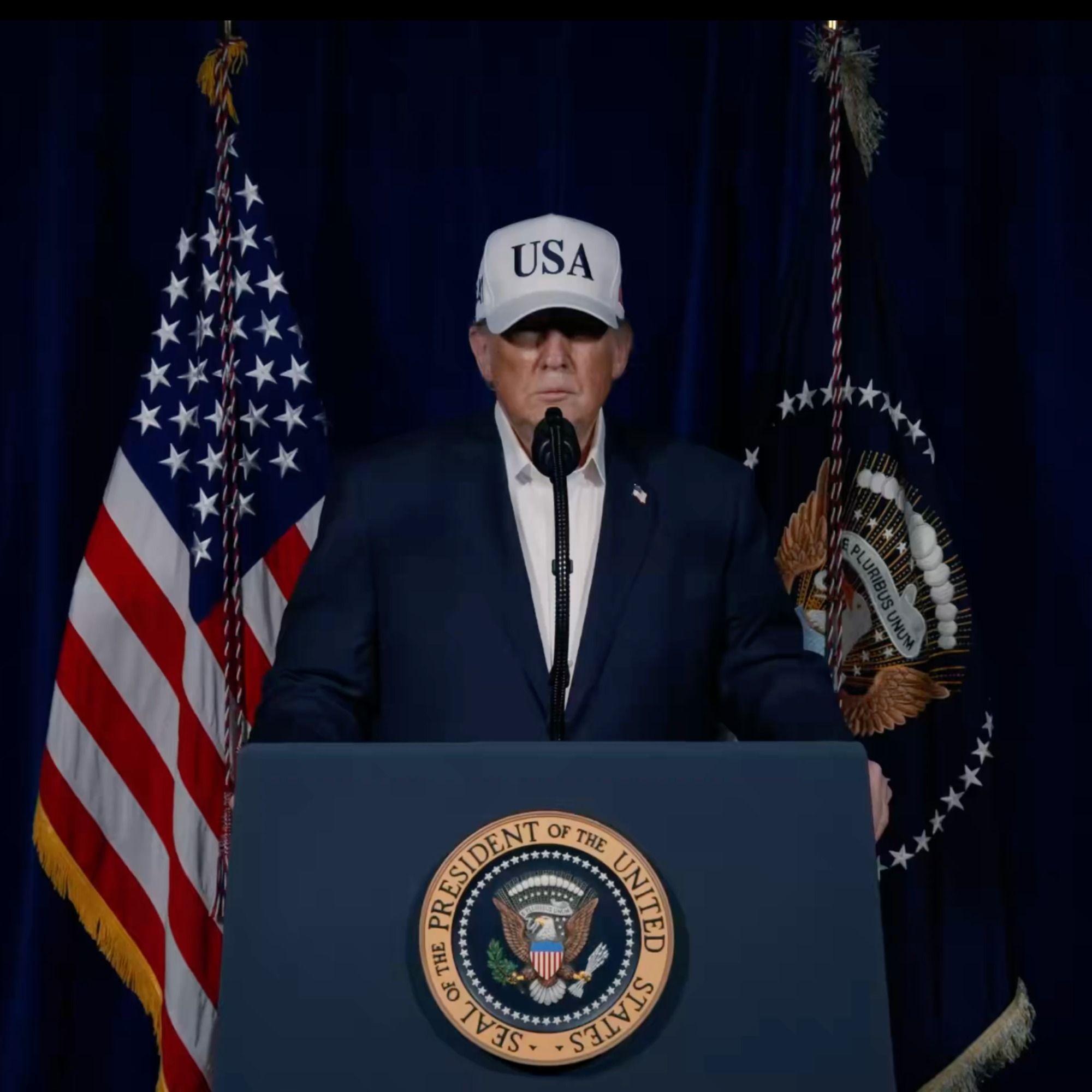
Photo: Trump announcing American-Israeli strikes on Iran on February 28, 2026. Credit: Donald J. Trump on X/Twitter via Wikimedia Commons (Public Domain).
Hosted by Simplecast, an AdsWizz company. See pcm.adswizz.com for information about our collection and use of personal data for advertising.
Get every episode summarized
Each time The Brian Lehrer Show publishes, we email you a written briefing from the transcript — the topics, who appeared, and any specific claims, with the ad reads skipped.
Email me new episodesFree for 3 shows. No card needed.
Hosts & guests
Transcript ready
214 searchable segments. Every word is indexed and playable.
Full transcript
The Brian Lehrer Show — Monday Morning Politics: War in Iran. Machine-transcribed; use the interactive transcript above to jump the player to any line.
It's the Bryan Lair show on WNYC. Good morning everyone. First of all, let me stay right up front and just for 30 seconds. Actually, first of all, let me kill a audio source here that I have. I apologize. But first of all, let me say right up front and just for 30 seconds that we have resumed our winter membership drive today after suspending it over the weekend to bring you NPR special coverage of the start of the war with Iran uninterrupted. If there is more special coverage or if it just seems inappropriate to continue the drive, if events warrant that judgment, we will of course suspend it again. But we also have to pay the bills. And I don't have to tell you, in a time of war, journalism is more important than ever. So please help us achieve full participation of WNYC listeners as WNYC members at 888-376-WNYC or at wnyc.org. And that's
all I'm going to say about it now. But thank you for your new memberships and extra donations at this crucial time for journalism, for our country and for the world. Help us cover what's going on. 888-376-WNYC 888-376-9692 or right from the homepage at wnyc.org. Thank you so much for considering it. Now, we're happy that Francesca Chambers is giving us some time today as she is fully engaged in covering events right now because she covers specifically White House foreign policy, White House foreign policy for USA Today. And I'm wondering how exactly is this different from what George W. Bush did with Iraq in 2003, a preventive war where there was no imminent threat because maybe someday, maybe someday, Saddam Hussein may have eventually developed nuclear weapons and eventually used them against Americans. And then we overthrew Saddam but with no clear plan
for reformulating a government there, right? And we see how that turned out. How exactly is this different? So we will ask that question and others. Francesca, thanks so much for this. I know you're covering events around the clock. Welcome back to wnyc. Thank you so much. And based on those other audio sources, too, I apologize that there are some that are coming from my computer. As you can imagine, there are, you know, there's a lot of updates that are coming in fast and very furious this morning. And thank you so much for having me. That's right. I don't hear anything in the background right now. So that's good. And listen, as we have 20 minutes with Francesca, and we can invite some of your questions and comments. Most of them will hear her analysis. But my question to you is, if you accept the premise that Iran under Ayatollah Hamanay was a horrible, repressive, murderous regime, how much are you for this war and how much are you against it? 212-433-WNYC-212-433-9692. Just like with Saddam Hussein, for those of you who are around,
to remember that, let's assume this is not a war against a good guy regime. But with that as a given, how much are you for this, against this, conflicted about this, is it worth the American, and Iranian, and Israeli, and other blood that is being spilled? 212-433-WNYC, or any question you have for Francesca Chambers who covers White House Foreign Policy for USA Today? 212-433-9692. Francesca, I'll ask my question from the intro. How exactly is this different? If anyone claims it is, from the war of choice against Iraq, with only hypothetical future threats and no plan for how it resolves after killing Hamanay? So this morning we heard from Pete Hagset, the Defense Secretary, as well as General Kain, in a briefing. And this was the first time that we've seen US officials on camera briefing reporters in any way. I would note that US officials
did host a call for reporters over the weekend as well. But that was on not on camera, and that was on background. And of course, we've seen the two videos from President Trump, but he also has not appeared on camera yet to take questions from reporters, although he also fielded a number of calls over the weekend. So I just set that as a level set here. With respect to what we heard from Defense Secretary Hagset this morning, he said that the way that they view this as different than what we've seen in the past is that this isn't going to involve sending 200,000 troops somewhere that this is not something that's going to be 20 years long. We don't yet know how long it will be. President Trump told a reporter yesterday from the Daily Mail in one of those phone calls that he's envisioning something that will take four weeks or less, essentially. But this morning, Secretary Hagset specifically said that it's going to be up
to President Donald Trump and that it could be shorter than that. It could be longer than that. But what something they are saying is that isn't something they envision taking years. And then we did hear from close allies of the administration over the weekend, including Tom Cotton, who cheers the intelligence committee in the Senate, as well as Lindsey Graham, a close ally of the president, saying that they're also, they've been in contact with President Trump, and that he's not envisioning American combat troops on the ground. That's not what the plan is. Right. Well, let me play a clip of Defense Secretary Hagset speaking earlier this morning about the hypothetical goal I mentioned before. Iran was building powerful missiles and drones to create a conventional shield for their nuclear blackmail ambitions. Let me say that again. A conventional shield for their nuclear blackmail ambitions. Our bases, our people, our allies,
all in their crosshairs. Iran had a conventional gun to our head as they tried to lie their way to a nuclear bomb. So how is that different from what we heard from the Bush administration in 2002-2003? The Trump administration's assertions for why they had to do this right now. I will know are coming under scrutiny from experts. Steve Wichoff had said prior to this in an interview with Fox News prior to the strikes that Iran was, as they saw it, very close to being able to have a nuclear weapon. Again, that's not a direct quote, but that's essentially what he was saying. And that came under scrutiny at the time because if the U.S. had obliterated the sites, as President Trump has repeatedly said, the nuclear sites over last summer, how could that essentially be the case? And I will also say that intelligence assessments from the time showed that one of those sites had been destroyed, but the other two sites were badly damaged, but not totally destroyed.
So that's one thing there. But with respect to whether or not Iran was close to having a nuclear weapon or being able to build one, I mean, what we heard from President Trump multiple times over the past week is that they were starting to rebuild their nuclear capabilities or trying to rebuild their nuclear capabilities. Then we heard from U.S. officials, as you're noting here over the weekend, as they just did not think that the talks that Jared Kushner and Steve Wichoff were having were producing what they wanted, both from the sense that they were, that Iran was, as they were saying, continuing to pursue nuclear ambitions. They also said that Iran would not even discuss ballistic missiles, which was something that the U.S. wanted to be part of the discussion. We had heard from President Trump over the past week again that Iran was close to being able to have missiles that could reach the United States. He said that those would be, that they were soon,
that they thought that that would happen soon. That's something else that experts have called into question as how long it would be before Iran could have those kinds of missiles. Although it is clear as we've seen over the weekend that they can reach, the weapons can reach U.S. bases that are in the Middle East, but not the United States. That's a decade out. Roughly is what experts have said. There's a number of things there that we're all still sorting through as we hear these briefings from experts and from the administration officials. Dan in the Bronx, you're on WNYC. Hello, Dan. Hello. Good morning. Thank you for taking my call. I don't know how the President of the United States is conducting a war without Congressional approval. And I wondered if you could speak to that. Thank you very much. And yes, Congress is beginning to debate whether it has a role to play
in authorizing this to continue or not. Or if the war was started legally under U.S. law, here's House Minority Leader Hakim Jeffries over the weekend. The resolution would require that Donald Trump immediately terminate the use of any U.S. armed forces from any hostilities against Iran, unless that is explicitly authorized by a declaration of war. So, Francesco, what's the law as you understand it? What's the resolution? The Jeffries indicated there as being introduced. And what's beginning to happen in Congress now? So, Kana and Masi, Rokana, Democrat and Masi, the Republican, have teamed up in the House, at least, on the bipartisan war powers resolution, essentially, that's expected to be brought to the floor this week. That's what Jeffries referring to. At the same time, there are senators, Democratic senators, and then you've also seen Rand Paul speak out about this consistently,
who were also pushing for some sort of vote in this United States Senate on a war powers resolution. They say that President Trump does need to come to Congress to get this kind of authority. The Trump administration has consistently said, and this goes back to not just those strikes as summer, but as well as the Venezuela operation at the beginning of January, that they don't need to come to Congress to request permission. Now, what we are seeing from the administration post-Venezuela is that they are consulting Congress. So, Secretary Rubio briefed the gang of eight, right, that by puristing group that includes the Senate intel chairs and vice chairs, as well as, you know, House Speaker, the minority leader, packing Jeffries and others, briefed them on the day of the State of the Union. I mean, that was public. They put it on Rubio's public schedule that this was going to take place at the White House. So, that happened
on Tuesday before the strikes. Since then, US officials have said that Rubio did call gang of eight members to give them a heads up on the strikes, and that also after that, armed services members were also called. Rubio himself will be on Capitol Hill today, around 4 p.m. to provide another classified intelligence briefing to gang of eight members, and then we're also expecting him to be on Capitol Hill tomorrow, which is Tuesday, to brief lawmakers again. Let's take another call. Here is Peruz in Yorktown, who says he is originally from Iran. Peruz, you're on WNYC. Thank you so much for calling in. Brian, good morning, and thank you for taking my call. I'm a former member of WNYC's Advisory Board and a University professor for 40 years, born and raised in Iran, arrived here in 1979,
and I'm a Democrat by most my voting. However, on this one, I am making an exception because I thoroughly and deeply understand the ultimate impact and identification of Islamic radicalism, which is going to be widespread worldwide, and that's the domestic, that's the regional and international and national level ramifications, but domestically this regime has been extremely radical and repressive to the nationals of Iran, and they have been caught between Iraq and a hard place. So therefore, I would give the benefit of the doubt to the Trump administration, as we did to Clinton during the Yugoslavian war. There are times that there has to be an exception made. I totally understand the rationale for blanketly claiming that, on principle,
we are anti-war, anti-violence, and there is a lot of merit to that. However, let us bear in mind, for 47 years, this despotic regime has declared war against the US, death to America, has declared war against Israel, death to Israel, has been rather acrimonious, rather acrimonious against its own people, as well as the people in the region who are of funny sex. So what else do we have to wait? For the seven years, they have been spreading hatred. Peruz, I'm so glad you called in. Let me play a clip of Trump from over the weekend and get your take on it. In the context of human rights and political freedoms for Iranians, in what I saw of Hexath this morning, and I acknowledge I didn't see his whole news conference, but it looked to me, from what I did see, like he did not make democracy or human rights for Iranians, an item on his list of reasons for the war, as opposed to what you were just laying out.
47 years of hostility and these longer term American security interests, and he didn't offer Iranians any guidance on how to rise up and take back their government as Trump has argued for them to do. Here's the clip of the president on that, and then I'll get your thoughts. For many years, you have asked for America's help, but you never got it. No president was willing to do what I am willing to do tonight. Now you have a president who is giving you what you want. So let's see how you respond. America is backing you with overwhelming strength and devastating force. Now is the time to seize control of your destiny and to unleash the prosperous and glorious future that is close within your reach. This is the moment for action. Do not let it pass. So Peruz, let me ask you, given what you said, in a divided country, pro and anti the regime,
and with the government's military and revolutionary guard still in place and successors who himself put in place, do you think this can happen? Well, I'm a cautious optimist all my life, in particular, with respect to potential transformation of Iran into a secular democratic country, and I give you the reasoning for that. According to internal domestic by government as well as independent third party surveys of Iranian people, sometimes the surveys have had 200 plus thousand surveys respondents. 80 plus percent of Iranians have not only walked behind the Islamic Republic regime because of its multiple level of failure from domestic to international level, but also believe it or not, 80 percent of the people have also walked, put behind the Islamic
religion, the Shiite or Sunni Islamic religion, as a faith, as a religion, especially when it becomes ideological and it becomes radicalized and it becomes interfering in every aspect of their their life. So your hope is that there's an 80 percent opposition to the theocracy, and that's going to be enough to drive the theocrats from power, the weight of public opinion, and whatever may happen in the streets behind that, am I getting that right, and then I have to move on. Wholeheartedly concurred with your statement as you concluded, Brian. Thank you. Thank you very much for your call. Well, that was really interesting, Francesca, and my guest for another few minutes, Francesca Chambers, who covers White House Foreign Policy for USA today. Is anybody questioning that the president seems to be challenging the Iranian people like, okay, now it's on you, you better rise to your responsibility, don't expect us to try to change your
government. You know, all we did was overthrow the leader. Now you better show up. Is are people questioning him putting it on people who have been killed by this regime, by the thousands in the streets? Well, you played that that first clip, but he did go on to say that this will likely be the best opportunity that the Iranian people have had in a you know, in a generation or rather that it would be the best opportunity. We'll have in generations to be able to do that, but in the second video that he put out over the weekend, he repeated to his message to the people of Iran and protesters. He said, I made a promise to you, and I have fulfilled that promise. The rest will be up to you. And then he said that the US will be there to support them. So he has been clear in his remarks, regardless of whether or not a piquex South and the others, you know, brought it up when they did their briefing today. Yeah, well, we'll see what the United States will
be there for you means, right? We have no idea, do we? We are sorry about that. We are, you know, we're still learning what it is that the United States how long again that they plan to be involved and everything that happens here. And I will say that this morning, you know, when asked questions about how many more troops are the United States, you know, sending to the region as part of this air campaign, there are a lot of details that they didn't want to provide. They said, why would we tell this to you? Why would we project this to the enemy at this point? So we're certainly asking the questions, but they're not always, you know, getting responses right now. So they are saying this is not like Iraq, we're not going to stay. And so he seems to be putting it on the Iranian people. Let me ask you one more thing, back to Congress. How are the Republicans on this? A lot of them got elected on, you know, no more
adventurous US wars in the Middle East based on hypothetical threats for the future. And are they lining up behind Trump? Do they think this is good for the midterms? Well, we talked about Rand Paul before, right, who's libertarian, who has consistently said that you need to come to Congress for authority and also, you know, no more endless wars. With respect to most of the rest of the Republicans and Congress that we've heard from over the weekend, this is mainly come down along party lines, right, with Democrats saying, this is a quote-unquote illegal word. You need to come to us for permission, sort of thing. And Republicans generally supporting the President and saying that, you know, if the US has this intelligence that said he needed to do this now, then, you know, we're backing the President of the United States. But within the Republican Party itself in the MAGA movement, the President is getting pushed back
from those typical types that we, you know, we'd expect in the MAGA movement who were also opposed to both the, you know, the action of Venezuela and also the strikes last summer. We've heard from Tucker Carlson, for instance, who was just at the White House recently, who pushed back on this Marjorie Taylor Green, who resigned from Congress and left Congress really this year, over her disputes with the President over his focus on what she described as a focus on foreign policy, rather than affordability issues, was very, very vocal over the weekend. And you may recall that the reason that she left Congress is because of her break with the President on this, and then he promised directribution and to, you know, find a primary challenger to her. So there are certainly Republicans, conservatives, you know, MAGA types who are pushing back on the President. Francesca Chambers, who covers White House foreign policy for USA Today, and I can tell even from the urgency in your voice that things are continuing to break around you
and you're continuing to, continuing to cover them and keep your eyes going in multiple directions around the clock. So we really appreciate you giving us this time and insight this morning. Thank you so very much. I really appreciate being here. Brian Lara on WNYC, and we've got more war coverage coming up on the show, but we've decided that that's not all we'll do today. Coming up next, as the Jeffrey Epstein revelations continue to emerge, and frankly, as some people involved are clearly relieved that the war is taking that out of the main headlines, we will not. We'll talk to Lisa Miller, who wrote a very trenchant analysis in the New York Times about how people rationalize their ongoing relationships with Epstein, including excerpts that she found from the texts and emails that have now been made public, that are really eye-opening the way she put them together with what people said later. So that's coming up, more war coverage coming up, Brian Lara on WNYC.
More episodes
More from The Brian Lehrer Show

Tuesday Morning Politics: State of Iran War; Home Stretch to Midterms
The Brian Lehrer Show

The CDC and Measles Deaths
The Brian Lehrer Show

History of the War on Terror
The Brian Lehrer Show

Labor Day: Working Class; White Collar Unions; Supermarkets; Summer Songs
The Brian Lehrer Show