About this episode
Eyal Press, contributing writer to The New Yorker, shares his reporting on how disagreements over Israel, Gaza and Zionism itself are dividing synagogues, Jewish families and communities across America.
→ At Synagogues, Tensions Are Boiling Over | The New Yorker
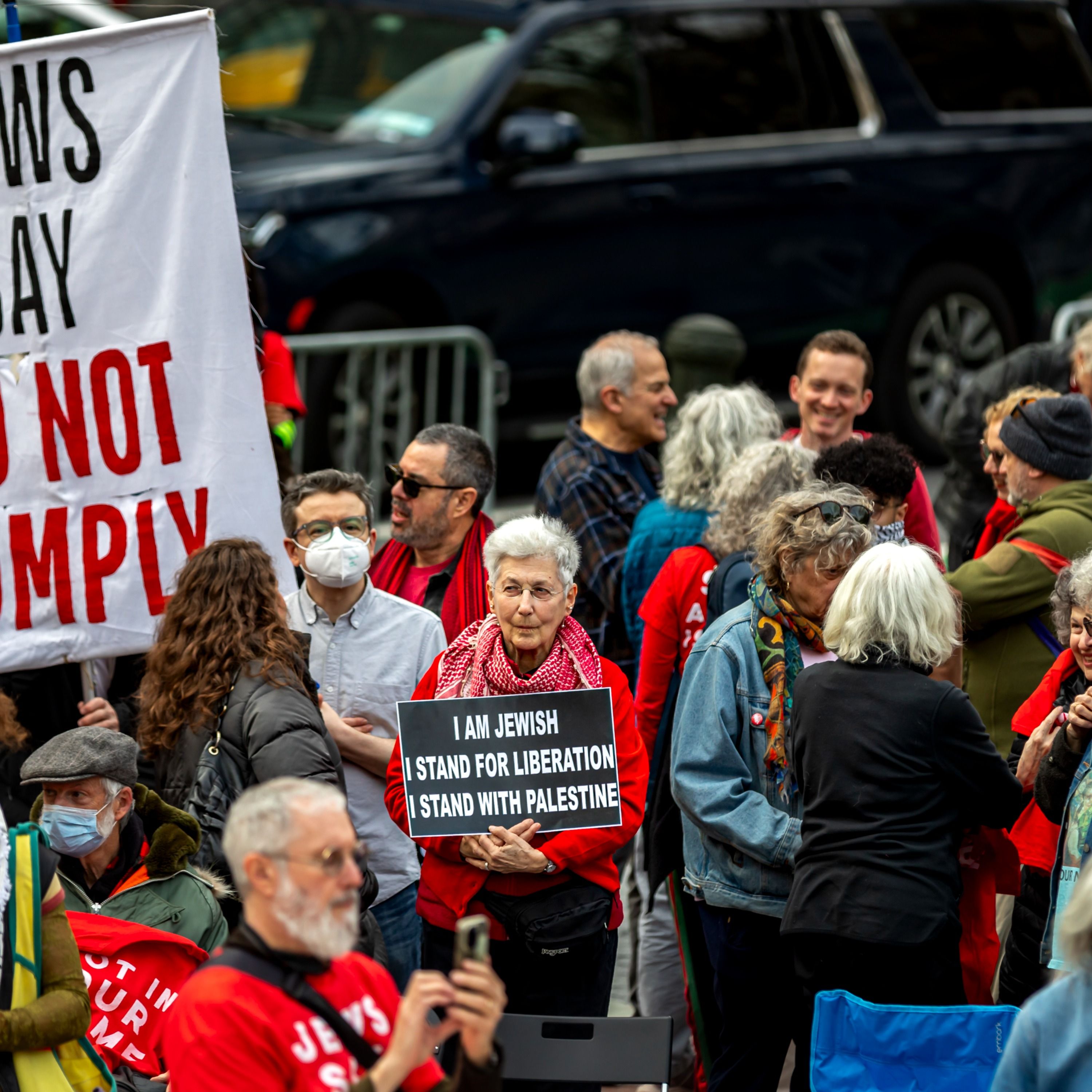
Photo: Jewish activists and allies take part in a Passover Seder outside ICE headquarters in New York City to demand the release of Mahmoud Khalil and an end to the war on Gaza, April 14, 2025. (Photo by Michael Nigro/Pacific Press/LightRocket via Getty Images)
Hosted by Simplecast, an AdsWizz company. See pcm.adswizz.com for information about our collection and use of personal data for advertising.
Get every episode summarized
Each time The Brian Lehrer Show publishes, we email you a written briefing from the transcript — the topics, who appeared, and any specific claims, with the ad reads skipped.
Email me new episodesFree for 3 shows. No card needed.
Hosts & guests
Transcript ready
850 searchable segments. Every word is indexed and playable.
Full transcript
The Brian Lehrer Show — How Gaza and Zionism Are Dividing Synagogues. Machine-transcribed; use the interactive transcript above to jump the player to any line.
WNYC Studios is supported by Odoo. When you buy business software from lots of vendors, the cost's at up and it gets complicated and confusing. Odoo solves this. It's a single company that sells a suite of enterprise apps that handles everything from accounting to inventory to sales. Odoo is all connected on a single platform in a simple and affordable way. You can save money without missing out on the features you need. Check out Odoo at odo.com. That's odo.com. Here's a shift worth noting. Better health care is care that meets patients where they are. United Health Group is bringing it directly to living rooms. This is a win for patients managing chronic conditions. And here's the interesting thing. By closing those care gaps, administering in-home exams and identifying risks earlier, more diseases can be prevented and patient outcomes can improve. In 2025 alone, United Health Group patients received over 19 million home visits. Learn more at UnitedHealthGroup.com slash commitment. So you're saying with Hilton Honors
I can use points for a free night's day, anywhere, anywhere. What about fancy places like the canopy in Paris? Yeah, Hilton Honors, baby. Or relaxing sanctuaries like the Conrad and Tulum. Hilton Honors, baby. What about the five-star Waldorf Astoria in the Maldives? Are you gonna do this for all 9,000 properties? When you want points that can take you anywhere anytime, it matters where you stay. Hilton, for this day. Book your spring break now. It's the Brian Lerishow on WNYC. Good morning, everyone. We'll be doing segments about Passover and Easter and the world situation this week. Passover first today because it comes first. It starts at sundown tomorrow night. Good Friday is this Friday and Easter is this Sunday. We'll address those later in the week.
With respect to Passover, the New Yorker has a very thoughtful article this week about the divides within Jewish congregations, within Jewish families as Passover approaches over the way Israel is fighting its wars in Gaza and now Lebanon. What will the conversations be like around many family satire tables on a holiday that celebrates freedom from oppression, freedom of movement and the founding of Israel, the promised land as a refuge for the Jewish people? The article sites, for example, a Washington Post poll just a few months ago that found 46% of American Jews supporting the war in Gaza and 48% opposing it, basically a 50, 50 split in the American Jewish community. And the article quotes from a sermon back on the Jewish New Year, last fall, by Angela Bookdall, senior Rabbi of the Central Synagogue in Manhattan. Now, I've found a video of it and I'm going to play the quote
to help set this up, play the clip. Then we'll talk to the writer, Al Press from the New Yorker, and take your calls about your families and your congregations. This runs a minute and a half. Again, it's Rabbi Angela Bookdall and her Rosh Hashanah sermon at the Central Synagogue. Listen to both halves of this. As she acknowledges different worshipers within her own congregation who might fire her as they rabbi if she says what she really thinks. I want to tell you about my unconditional love for these really people and our beleaguered homeland, still desperately struggling to bring its hostages home, still trying to eliminate Hamas terrorists that not only refuse to lay down their arms but intentionally trap their own people in a combat zone. But if I tell you these things, all of which I believe, some of you will stop listening and decide that I'm no longer your rabbi.
I also want to tell you how my heart breaks over the civilian deaths and tragic suffering in Gaza, the shattering destruction of Palestinian homes and cities, I want to denounce settler violence in the West Bank and the rhetoric from far-right government ministers who talk about annexation of the West Bank and expulsion of Gazans instead of ending this war and bringing our hostages home. But if I tell you these things, all of which I also believe, some of you will stop listening and decide that I'm no longer your rabbi. This Israel conversation is ripping our community apart, not just here at Central but across the Jewish world, among friends, within families, it's been the most painful experience of my rabbinic life.
Angela Bookdall, seen the rabbi of the Central synagogue in Manhattan in Hirussia, Son of Sermon last fall. And with that, we welcome New Yorker magazine writer, AL Press, who cited that sermon in his article called at synagogues, tensions are boiling over. Disagreements about Gaza and Zionism have divided congregations. AL, thanks for coming on. Welcome to WNYC. Thanks so much, Brian. It's great to be here. And Jewish listeners, you're invited to call in and reflect on the tensions you may be experiencing in your congregations. Rabbis, congregation members, are you experiencing this kind of tension? If so, are you able to have productive conversations about it? Are you able to resolve it in any way? Is anyone changing anyone else's mind? Are any of you literally deciding that your rabbi is no longer your rabbi because of their positions on Israel or Gaza or Zionism today, one way or another? And if so, what then for you and for them? 212-433 WNYC 212-433-9692?
Or maybe this is happening for you outside of a synagogue, elsewhere in your Jewish life, maybe in your family. We know there's a lot of this divide by generation, right? There's been a lot of talk about that, but not just by generation. One woman from congregation Bethel in Maplewood in the article describes herself and her husband in this context. She says, we're in a mixed marriage on Israeli politics. Does that sound like you and your spouse, too? Does that sound like you and your spouse, too? So again, if you're experiencing this kind of tension, are you able to have productive conversations about it within the family, with your husband or wife or parents or kids? Are you able to resolve it in any way? Is anyone changing anyone else's mind? What's the heart of the moral question or moral questions you're grappling with? 212-433 WNYC, any Jewish Americans? Rabbi is anyone else? 212-433-9692, call a text.
So let's start with that clip of Rabbi Angela Bukdal. Did you report it out on Central synagogue enough to know how divided that particular Manhattan congregation is on how Israel is conducting these wars? No, I didn't. I have to say, I did reach out to Rabbi Bukdal and she declined a request for an interview. I think probably because she felt her sermon speaks for itself. But I did focus intensively, as you mentioned, on a synagogue in New Jersey called Congregation Beth L, located in South Orange. And I should say and emphasize that the division I found there is not unique to congregation Beth L by any means. It's playing out across the Jewish community, you know, as Rabbi Bukdal's sermon suggested. And I wrote the article really with two sort of ideas in mind. One is that, you know, so much attention had focused in the media on the protests after the Gaza war,
the pro-Palestinian protests. And one of the striking facts about those protests, which sort of came out, you know, here and there in the news coverage, is that there were Jews on college campuses who were deeply upset and offended by these protests. And there were also Jews on college campuses who were participating in those protests. That's not a secret, but it tells you something about sort of how divided and fractured the Jewish community was getting and has gotten. And the other reason I really wanted to delve into this is, you know, the mistaken perception. And I think the dangerous perception that Jews are a monolith, that they think in one, that they speak in one voice, that they all hold the same views when it comes to subjects like Israel and Zionism. That has never been true historically. It is less true today in the American Jewish community than perhaps ever before. And so we should be talking about it and understanding why.
I did read through your article so much of which is about congregation Bethel in the Maplewood South Orange area. And I will say, it took some time. If one were to print this article, I see it would print at 41 pages. And well, for one thing, Rabbi Bukdal didn't want to comment to you. Rabbi Bukdal, maybe you're listening. And want to call in and describe what the next steps would be after that sermon, right? Can you bring together factions of your congregation? Or maybe you've taken more of a stand on one side or another yourself. Rabbi Bukdal, if you're listening. Or any other Rabbi, any other Jewish American. But on congregation Bethel, the Rabbi there, Jesse Olitsky, I think it's fair to say, based on my reading of your article, clearly took a side. And a congregation member, Nathaniel Felder, who you profile, who was protesting Israel the way it was conducting the war in Gaza,
was very frustrated, even though the leadership was progressive on other things at that congregation, like ICE and immigration. So where would you start to tell the story of congregation Bethel? Yeah, I mean, I think that captures the background well. You know, Rabbi Olitsky, with whom I spoke, is a very progressive guy on a lot of issues. On ICE, on, you know, civil rights. He's participated in an interfaith group in New Jersey that, where folks work together on those issues, on the issue of Israel and Zionism. I think it's fair to say that after October 7, his sense of attachment and feeling of the inclination to defend Israel and to worry about Israel and to highlight the plight of Israel intensified. And he's not alone in that. You know, one of the sort of feces of the article is that
there had been a kind of soft sort of liberal Zionism, a place where people who were slightly more conservative and slightly more liberal could meet and not necessarily argue. But that October 7th and the Gaza War has really shattered that. And you have one group that has felt a heightened attachment to Israel and a heightened sort of fear of anti-Semitism, of belief that it's worse now than it's ever been. And therefore, you know, we need to stand with, you know, quote, unquote, our people. At the same time, you have a lot of Jews and they're not just Jews in their 20s. They're parents, they're Jews in their 40s and 50s. They're people like Natfelder who were at first concerned, initially, both by the, of course, they felt horror at the October 7th attack and sympathy for people in Israel they knew, but immediately felt concern for Israel's response
that it would be brutal, that it would be indiscriminate, that many innocent Palestinians would die and suffer. And those concerns escalated as the course of the war intensified. And Natfelder, I open the piece by describing the point he came to, and this was last spring when reports were surfacing that Israel was blocking humanitarian aid into Gaza. And Nat, who is someone who, you know, has a lot of family in Israel, and his grandfather made Aliya, left his home in Long Island, went to Berceba, lived there for a year himself. All of this is in the piece, but he could not remain quiet when he would pass the sign in front of the synagogue that said we stand with Israel. And meanwhile, what he saw as a policy of starvation was unfolding, because that same grandfather taught him that the most important thing about being Judaism was adhering to certain basic moral concepts.
And the most important of all was protecting human life. So he wrote to the rabbis, and he wrote to them several times, actually, asking that the sign come down, or that some sort of congregation-wide email be sent. And when this didn't happen, he took matters into his own hand. He made a sign of his own. And the sign said starvation is against Jewish values. Our support of Israel cannot be unconditional. And he made the sign, he stood in front of the synagogue, and that's sort of the point of departure for the piece. And what unfolded and how things got to that point. Not only at Bethel, but again, at a lot of other congregations. And we'll come back to congregation Bethel and some of what you describe. They undertook there to try to hear various points of view from within the congregation, but if I'm reading your article correctly,
it wasn't very satisfying to a lot of the people there. Here's an example. This is sort of maybe a meta-example of how deep this divide runs, even the fact by all that we're doing this segment. And I guess by extension that you published this article that the New Yorker published this article right now. Listen a road shortly before we went on the air. The Brian Lershow, how Gaza and Zionism are dividing synagogues. Great story idea, but right at the start of Passover, nasty mistake. And so even raising the topic, and it's relevance to this week, starts to get some people ticked off. Absolutely. It's not surprising at all. But if we've done this in the fall, people would have said on the eve of the high holidays, how can you talk about this? And if it were neither holiday, they might say, how can you talk about this in a moment when anti-Semitism is rising?
And I'd refer them to some of the voices in the piece. I quote Rabbi Elliott Cosgrove at one point, and he's a sort of controversial figure in the piece because he gave a very divisive sermon criticizing Zoran Momdani. But in his quote, I mentioned in the piece, he says his biggest concern right now are the internal divisions within the American Jewish community. And so you can pretend they're not there. You can pretend it's never a good time to talk about them. Or you can talk about why they have formed. And I have to say I was inspired and moved by the stories shared with me by the members of this congregation who as you rightly know, many of them are very frustrated and have been very frustrated because they're at a synagogue where they feel that their sense of belonging is harder to feel
because their perspective on the Warren Gaza and on many of these issues is not represented in the same way that the other side is. And we played that clip of Rabbi Bukdol from central synagogue in Manhattan saying if she expresses one half of what she believes, some of her congregants will say, you're no longer my Rabbi and if she expresses another part of what she believes, other congregants will say, you're no longer my Rabbi. Well, I think we have a call from somebody who literally did fire their Rabbi and change congregations over some of this. Udi and Highland Park, you're on WNMC. Thank you so much for calling in, hi. Hi, thank you. My wife and I were members of a conservative synagogue for 20 years and do we resigned after our Rabbi gave a sermon about the destruction of Sodom and Gomorrah and talking about how the shrieks of the people coming from the destroyed cities were the shrieks of the perpetrators, not the shrieks of victims. And this was early on into the Gaza War
when there were just 15,000 people who had been killed. And I went up to him afterwards and asked, you know, is that what you're, am I in taking away from this what you, what I think I am? And he said, yeah, and he just didn't, he brushed away any concern about the humanity of the other side and we resigned after 20 years of being members. Do I understand correctly from my screener that you and your wife served in the Israeli defense forces? Yes, we both grew up, we grew up in Los Angeles, moved to New Jersey and we both served in the IDF. That's intense. Are you in contact with people back there and having conversations with them? So much of the Israeli public from the polls I've seen of there supports pretty much everything that the Netanyahu government is doing in Gaza and now Lebanon. Do you still have relationships there with people you're in dialogue? Yes, we have family there. But I don't bring up the political situation because even those who oppose Netanyahu,
my cousins in Israel have marched against Netanyahu. But I think they're firmly in favor of what Israel is doing to, you know, against Gaza. And I listen to Israeli radio and I just, you just hear that there's a very biased view. It's all about the hostages and the victims. And there's nothing on Israeli radio on Israeli media about the other side and what they're suffering. Ooty, thank you for your call and your perspective. Let's go right to another caller. Matt in Brooklyn says he's a rabbi and this kind of divide essential to his existence now. Matt, you're on WNYC. Hello. Hi. I told you, I told your screener that the phrase I usually use and people have seemed to come around to it as the definition of politics is that if you disagree with me, it's called politics and if you agree with me, it's called Jewish values. And, you know, I don't only say it actually to be funny, I think it's actually a really valuable
or hopefully meaningful way of looking at the issue because, you know, if as a rabbi, I were to say to my condor that I just got back from the J Street conference then they're going to say, why are you so involved in politics? But if a colleague says, oh, I just got back from the APAC conference, nobody's going to say why are you so involved in politics? They're just... Jay Pag is a progressive group. APAC is APAC. So depends what the reaction will be. And in that case, even further, even people who actually probably do disagree with APAC, for example, will still not even see it as politics because we've come to see it as this kind of, I guess you could say, it's an overt and window type of thing where we've come to see that as just sort of a normal part of Jewish communal life, whereas the other one is quote unquote political because people just because so many people, so vocally disagree with it. Yeah, anyway.
Well, how do you navigate this divide as a rabbi in your congregation? Do you try to move toward some kind of consensus or some kind of, I don't know what the word is, maybe tolerance or respect for those with the other point of view than some of their co-congregants? Well, I'd like to think I act with tolerance in respect toward all of them. And I think to the point of your piece, I mean, I'm in a much more traditional kind of synagogue than rabbi Bukdal. So if I were to, for example, speak about keeping kosher, the importance of keeping kosher, the importance of keeping Shabbat, and then I found out that a congregant doesn't keep kosher or doesn't keep Shabbat. I don't think anyone would think, oh, I bet he doesn't respect them. I bet I'm not gonna feel welcome there. I hate him for saying this thing that disagrees with me, whatever it is.
But when it comes to this issue, people say, well, how come you're saying things that I disagree with? And it really is, not just this issue, I guess politics in general really are this thing where how dare you say this, how dare you have this position that isn't the same as my position, whereas on seemingly all other matters of Jewish life, that's okay. Matt, we really appreciate your call, rabbi. Thank you very much. And as this in Pesach to you, Steven in Westchester I think is calling about a congregation where there's another type of approach to this that actually comes up in Isles, New York, or Article. So Steven, you're on WNYC. Thank you for calling in. Hi, Brian. Thanks for taking the call. I was gonna say that I think some of the, at least my congregation feels a little bit stymied because it's a, I feel like if the rabbi were to bring it up, I think they would sort of lose memberships because I think some of the congregants are so entrenched
in this bit of like a blind faith approach to Israel and what they're doing. And it's very interesting because it's the same people that would criticize what's going on in this country in terms of the government, but they don't really seem to criticize what's going on there. One thing you told our screener, and I wanna see if I got it right, is that your congregation doesn't really talk about Israel because they don't wanna divide themselves among themselves. And the rabbi doesn't wanna lose one group or another. How much are you experiencing that? Is that an accurate characterization? I would say Israel in terms of what's going on there with Gaza and the West Bank and Palestinians. I mean, when I was, when I was going to Hebrew school, it was very much like we can, you know, two-state solution. But I mean, I feel like the two-state solution hasn't been a real concept in like 25 years. So maybe, maybe it should say 20 years, but.
Stephen, thank you very much. Take on it. Stephen, thank you. Well, that kind of touches on something in the article I all that you wrote about, which is that a lot of rabbis, according to your reporting, will just avoid the topic. You know, they'll talk about other Jewish issues, but they'll avoid Gaza now, Lebanon, because they don't wanna divide the congregation. Is that what you found? I think that's definitely one impulse. I think it's a reason that as the Gaza war got, you know, longer and longer and bloodier and bloodier and more and more divisive within the Jewish community, there were a lot of rabbis who just strained to avoid it. But there's another factor at play in that. And that is that saying anything critical or perceived to be critical, you know, by a board member or a donor to the synagogue or a member of the synagogue is dangerous.
You can be branded a traitor if you do that, particularly if you're a younger rabbi. And I heard in my reporting that younger rabbis who are more inclined to have more progressive views on this issue are the ones who are most afraid to speak out. I did speak with Rabbi Sharon Browse, the senior rabbi at a synagogue in Los Angeles, and she talked about the discourse, she called this discourse, defend, deflect, and denounce. So if you dare to say anything about Israel and your rabbi, the folks who attack you will first they'll defend Israel regardless of what it's doing. Then they'll say, why are you talking about Israel? Why aren't you talking about Sudan? And then they'll denounce you as someone who's disloyal to your people and she has been denounced in that way several times. So I think there's a great disincentive to say anything critical. At the same time, and you heard it in these calls,
and I think it's a more general thing. You know, American Jews by and large are liberal. They pray to, you know, what one scholar called, you know, the God of social justice, a God who believes in equality and tolerance. And love for Israel in the United States, which I think eaked in the 1970s and in the decades afterwards, was sort of predicated on this notion that Israel was a country that sought peace with its neighbors, that integrated women into its army, that could sort of be wedded to that progressive ideology. Well, Israel yesterday passed a law, its class passed a law, mandating hanging for West Bank Palestinians who will be tried in military courts. That's not consistent with progressivism. What's happening in the West Bank is not consistent with progressivism. And so the tension that I described in this article
is not going to go away, and in fact will very likely intensify in the years to come, particularly among younger people. Here are two texts that just came in, that kind of reflect pieces of the divide. One says, Passover is when Jews are supposed to reflect on how bitter it is to be oppressed, and how important it is to struggle for freedom. It's the perfect time to talk about the plight of Palestinians and Gaza. People have captive starved many of whom are refugees from their land that they were driven from within living memory. But a very different text says, I am a Jew in my 40s. I used to define myself as a moderate Zionist after the Hamas attack on Israel on October 7, 2023. And during the subsequent war, I have become a more radical Zionist. I am also an advocate of freedom of speech and diversity of opinion. In that sense, I'm willing to tolerate the views and expressions of Jews which are different from mine. What I do not have patience for is when people who have opinions
that are strong but uninformed, the mainstream media is not a good source of information regarding Israel. This person writes, citing New York Times, CNN, etc. People who rely on these sources to inform them about what is going on over there and then think and speak as if they are well informed do so in error. So a couple of texts that came in back to back that exemplifies what's in aisle presses New York or magazine article. After the break, we'll play a clip from a journalist guest who was on the show last week from Lebanon who raised a specific moral issue facing Israel and its supporters and will continue to invite your calls from your point of view maybe specifically on that clip stay with us. Music Brian Lehr on WNYC as we continue with New York or magazine writer
Al Press and his article with Passover beginning tomorrow night and we're going to have a Easter and Good Friday in the world situation segment later in the week. Al's article is called at synagogues, tensions are boiling over and here's one source of those tensions. Last week we had journalist William Christu of the Guardian on from Lebanon where Israel is hitting what are widely considered civilian targets because Hezbollah uses that same infrastructure as civilian non-combatant Lebanese people do as Hezbollah plans and stages attacks on Israel from across the border. The reporter gave this example. We're seeing in those areas there's a widespread targeting of medics including through the double taps, double tap strikes, which is when they strike somewhere, wait for paramedics to come and then they strike the area again hitting the paramedics in the process.
And what we saw in the last war, what we saw in Gaza, is that the point of this is to make it increasingly difficult for people to stay in those areas, to clear those areas out so that Israel can fight their war easier. And human rights groups have warned against this, saying that it amounts to forced displacement. So Jewish listeners on that human rights groups argument as one side of it and Israel's argument on the other side of it that without destroying that much civilian infrastructure, even killing people in the healthcare workforce as we just heard there, without doing that, Hezbollah will be able to keep attacking so it's the right of self-defense. So Jewish listeners as we discuss these divides among American Jews as we head toward Passover tomorrow night, in the context of Jewish community divides like the Washington Post poll that we mentioned at the top that found basically a 50-50 split among American Jews on whether they support the war in Gaza.
What's your own answer to these moral questions? How much killing of civilians is justifiable in the context of trying to protect your community from a military foe that is real and that is attacking you from within that community? And on the Zionism question, which we'll get to in a little more depth with our guest, how much is national self-determination justifiable, even when your group has indigenous roots there and they were persecuted for 2,000 years everywhere else they've been. If you're setting up a country without equal rights or any related question you want to address and that maybe you'll bring up your Passover Seder this week, 2, 1, 2, 4, 3, 3, WNYC call a text, 2, 1, 2, 4, 3, 3, 9, 6, 9, 2, 2, the theme of IELS article. And I all you write that even Zionism is now being perceived differently
in the Jewish community with more of a divide. And so for example, you give us some history citing a broad unity among American Jews about Israel. After the 1973, I'm Kippur War, a surprise attack by Arab countries. Most American Jews weren't Zionists in the sense that they wanted to move to Israel, you say, but they were glad that it existed overwhelmingly. Why do you cite that particular Arab Israeli wars having been so galvanizing and what do you compare it to today? Well, I think it's just such a striking contrast with October 7th. So the Yom Kippur War, the surprise assault launched by Arab forces on the Jewish holiday, the holiest day on the Jewish calendar, stirs this pretty unified response in the American Jewish community that I quote the commentary editor Norman Buthoritz was, didn't need any convincing, but he celebrates the fact that this attack,
as he says, all American Jews have been converted to Zionism, even the skeptical Orthodox Jews who thought that Zionism was a heresy were coming around. He quotes Irving Howe, the editor of dissent, the socialist who expressed his taste for nationalism, but admitted that he felt this astonishingly intense feeling for Israel when the Yom Kippur War broke out. Then you fast forward 50 years to October 7th, and it's another surprise attack that sort of punctures this era of vulnerability, of invulnerability, I should say, in Israel. Would it galvanize the same unity to the contrary? What it has galvanized is what it has done is sharpen the divisions, create deeper polarization, make Israel and Zionism more contentious subjects within the Jewish community. And that's in part because the American Jewish community has changed.
It's also because Israel has changed. And so I think that contrast is really striking. And again, some texts coming in that are on various sides of this. If they don't want to be attacked, they should stop attacking Israel. Very simply stated, we're getting a few like that. I think in contrast to those, Helene and Brooklyn, you're on WNYC. Hello, Helene. Hi. This is just so pressing for me. I am a baby boomer, the essential baby boomer born in 1946, to two parents who escaped from the Holocaust in 1939, from my father from Poland, my mother from Vienna, and leading behind very, very many relatives, tens of which died.
At the same time, I grew up in Brooklyn in a very progressive family, and what Passover Seder means to me right now is taught about how to be a Jew in light of both prevalent anti-Semitism, and what Jews are doing, Israelis are doing in the gods of destroying people. That's not the Jew that I was brought up to be. Humanism was, in fact, the core of our ideals. What I was most proud of is that my parents did not bring us up as Holocaust Jews. They brought us up with optimism in our place in the world, and we worked for all kinds of progressive things. But it's an unmixed feeling. I feel vulnerable as a Jew. I understand that these Israelis feel vulnerable, but at the same time, I don't support what these Israelis have done during this war in Gaza,
and also have been much more informed in my later years about what the Jews did to take over the land of Israel, and how much destruction and death and extrusion occurred. None of this is easy resolution, but certainly I don't take offense that the New Yorker article was written at this time. I can't think of a more important time for Jews and everybody to fit and talk about what is that we want? What can we accomplish? Who are we? Those are the most important questions. Helene, what would you say then if you were in dialogue with the listener who just wrote this text? I found the fact that the majority of Israelis, even those who are previously very sympathetic and supportive
of Palestinians' rights, support the government actions, I find that persuasive in my support of Israel's actions. I don't believe that Israelis are uniquely irrational or immoral, it's easy for us to cut-tut when we sit in our safe bubble, quite different to feel the need to protect those who are brutally mutilated or innocent loved ones. What would you say to that listener? I understand what came to mind as you were saying it, it's like asking the victims or the survivor of an attack. Okay, my child is killed, you're asking me, should I put the perpetrator of that horrendous crime to death? These are not the people. I understand this is a country in fear. They've been attacked many times. They've had thousands of their soldiers die. This is not really where you can draw back and say, okay, who do I want to be in light of this?
What am I willing to do to the end? I understand the fear. That's why I premised my comments that I don't have that absolute solution. There is anti-Semitism. The Arabs have attacked Israel multiple times. But the Jews have done incredible things to take over the land of someone else and to push them out. And they have now conducted a war in a way that's killing many more than the people who are hurting them. So I wish I had a magic answer. I don't think there's a magic answer. But I don't know that the fear of the Israelis is necessarily the answer to what we want to do because it goes beyond the war. What do we do with Israel going forward? A democratic nation. It could never be. Thank you very much for your call. We really appreciate it. As well as to the listener who texted the words
that we contrasted her with and invited her to respond to. A. L. as we head toward the end of the segment, I'm going to read one more text which it appears came from a member of Congregation Bethel at Maplewood, which is where the heart of your article is. Listener writes, I am a white Jewish woman in my late 60s and a member of the Congregation reported on in ALs article, I appreciate that a core aspect of our Jewish tradition is to wrestle and grapple with hard things. We are about the dialogue and the exchange and the learning. And we remain in community with one another even when we don't agree with one another, after all we are all and remain co-congregants. And that's something to be celebrated and amplified. So I guess my closing question to you based on your deeply reported article is where is this headed or might head going forward
or are people like our various callers and textures from various points of view destined to divide into political echo chambers like the country is doing to such a degree within the Jewish community in the United States? Well, you know, it's a great question. I'm going to defer to Liba Byer, one of the people I interviewed in the piece. She grew up in a super Zionist household. She is now openly identified as anti-Zionist. She is also a member of Congregation Bethel. And one thing she mentioned to me, which I later saw was that Congregation Bethel was a big tent synagogue meaning this is a movement that sought to open the doors of synagogues to LGBTQ Jews, to interfaith couples really to broaden who feels accepted. And what she said to me was, you know, for me and for a lot of young people today,
big tent means diversity and tolerance. Tolerance of diverse views on Israel and Zionism. I think that actually pinpoints the challenge or rabbis. Can you be tolerant not just through paying empty lip service or occasionally saying, sure, we'll welcome you in. Just don't expect any of your views to ever be articulated from the BMA or in congregation-wide emails. But can you really be an equal part of this community expressing your beliefs in dialogue with others and not be tagged as disloyal or un-Jewish or somehow hostile to the congregation? I think that's a challenge and the challenge will grow because as younger Jews grow up and become members or look for congregations, they have experienced these events, these formatives deeply, you know, they have watched the Gaza War unfold and they don't remember the Young Kippur War.
They don't remember 1948, as well as they remember 2000, you know, the October 7th attack, 2023 and it's aftermath, the destruction of Gaza. So if there is no big tent in these communities, then it will be polarized and they will split up. I think that's the really hard challenge that faces these institutions. New Yorker writer, AL Press. He's also author of the book, Dirty Work, Essential Jobs and the Hidden Toll of Inequality in America, which came out a few years ago and won some journalism awards. Thanks so much for joining us on your latest article. Thanks so much for having me, Brian, and happy Passover to listeners. And same for me to all our Jewish listeners. And that's our pre-passover segment about difficult discussions taking place within the American Jewish community. Later in the week, as we head toward Easter, we'll talk about American Christians finding different answers to the question, what would Jesus say about immigration in particular
and other Trump policies?
More episodes
More from The Brian Lehrer Show

Tuesday Morning Politics: State of Iran War; Home Stretch to Midterms
The Brian Lehrer Show

The CDC and Measles Deaths
The Brian Lehrer Show

History of the War on Terror
The Brian Lehrer Show

Labor Day: Working Class; White Collar Unions; Supermarkets; Summer Songs
The Brian Lehrer Show