About this episode
Kathryn Jezer-Morton, author of The Cut's Brooding newsletter, talks about her plan to "friction-maxx" this year in life and in parenting—that is, to build tolerance for "inconvenience" despite tech companies' attempts to make our lives smooth and frictionless.
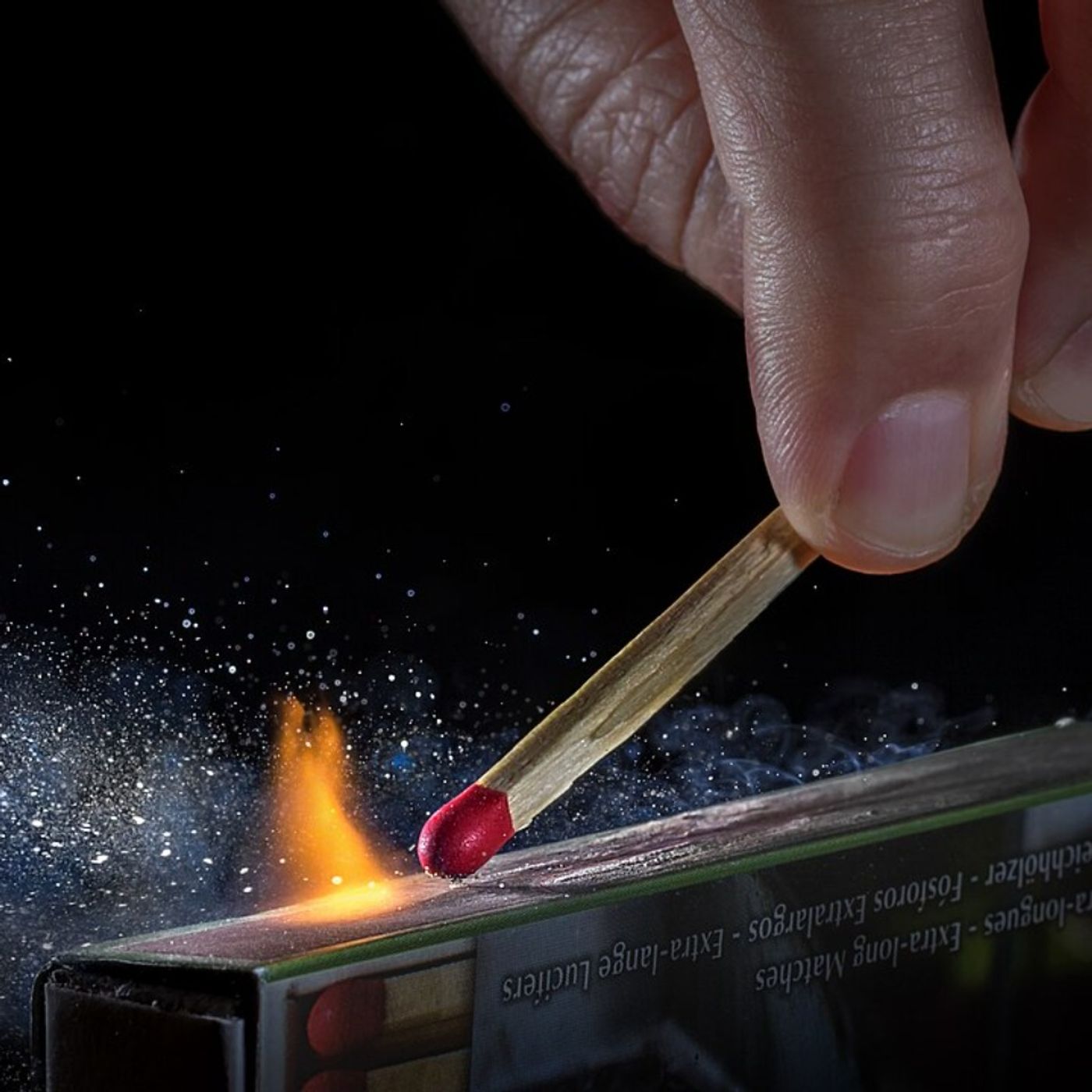
Photo: match, meet matchbox. Credit: Yann Segalen via Wikipedia Commons.
Hosted by Simplecast, an AdsWizz company. See pcm.adswizz.com for information about our collection and use of personal data for advertising.
Get every episode summarized
Each time The Brian Lehrer Show publishes, we email you a written briefing from the transcript — the topics, who appeared, and any specific claims, with the ad reads skipped.
Email me new episodesFree for 3 shows. No card needed.
Hosts & guests
Transcript ready
127 searchable segments. Every word is indexed and playable.
Full transcript
The Brian Lehrer Show — Have You Heard of 'Friction-Maxxing?'. Machine-transcribed; use the interactive transcript above to jump the player to any line.
Few things are as uplifting as the greatest moments in sports, and nothing brings us together quite like Team USA at the Olympic Winter Games. From NBC Universal's iconic storytelling to the innovative technology across Xfinity and Peacock, Comcast brings the Olympic Games home to America, sharing every moment with millions. When Team USA steps onto the world stage, we're not just watching, we're cheering together. This winter, we're all on the same team. Comcast, proud partner of Team USA. It's the Bryan Lair Show on WNYC. I'm Amina Serna filling in for Bryan today, and to end the show, we'll turn to a new trend that emerged earlier this year. Friction Maxing. Have you heard this term? It's a new trend that advocates for deliberately choosing inconvenience, aka friction, over the efficiency that modern technology-driven convenience provides.
The idea is to build back tolerance for inconvenience and strive for maybe a little bit more mindfulness in our daily lives that can look like driving without Google Maps or having difficult conversations in person rather than texting, or even cooking from scratch rather than ordering delivery. Catherine J. Zermorton, author of the Cutts Brooding Newsletter, wrote up her plan to Friction Max this year in life and in parenting, and she joins us now. Catherine, welcome to WNYC. Thank you for having me. And listeners, how are you introducing friction back into your digital forward lives? Maybe you make a point to take public transit instead of hopping into an Uber? Maybe you're off the social media apps and checking in with your friends, IRL now. I know at least one person who uses Instagram on a desktop, but that's a form of friction maxing. Call in and share your stories. 2-1-2-4-3-3-WNYC. That's 2-1-2-4-3-3-9-6-9-2.
And we can take your text as well. Catherine, you've resolved to commit to make 20-26 a year of friction maxing. Did I get that definition right in my intro? And why would anyone want to add more friction to their lives? Yeah, you know, you did. And it's so interesting to be thinking about this in the context of McKay's, you know, what he was just talking about before us, you know, because so much of the tools that we're using today are basically, they're based on predictive models to do with our own behavior. Like, we live within a matrix of prediction models. And a lot of this has made, you know, if you think about like suggested stuff when you open your Netflix app or obviously social media in general, a lot of this feels like it's personalized and it's, you know, making life easier, but it's mostly just based on information about what we've done before and in the hopes of steering us in a particular direction. So that's another aspect of friction maxing that I've been
thinking about, which is just kind of reclaiming your own decision making as something that occurs kind of privately in your own mind, as opposed to in relationship with a tool that is kind of already knows what you might do. You write, once we've adopted a habit of escaping from something, whether it's ubering dinner, five nights a week, or using AI for replying to texts, the act of return, which is how we might describe it no longer using a tool of escape, feels full of irritating friction. You liken us to toddlers whose iPads have been taken away. So talk a little bit more about that feeling. Yeah, I mean, I feel like we've all had that moment where, you know, maybe we forgot our phone and now we're waiting in line somewhere. This is where most of us don't forget our phones even. But you know, for me, I really noticed this when I had become accustomed to Amazon's Buy Now button, which allows you to make a purchase the click of one button as opposed to filling out
anything. And you know, online retailers are becoming better and better at creating a frictionless consumer experience. And then I had to purchase from a small vendor and I had to enter all my information. And I was like suddenly consumed with this like totally irrational frustration, like how dare you ask me to put my address in here. And that was kind of a moment where I realized that maybe I wasn't fully in control. Like I had sort of seated a lot of myself to this idea of convenience that was was becoming infantilizing. Let's go to a call. Here's Ben in Mimernik, Westchester County. Hi, you're in WMIC. Hi, how's it going? I, yeah, I'm just calling. I guess I've always been, what is it? What kind of maxing is it called? Friction maxing. Friction maxing. Yeah, I guess I guess a millennial and I still use a flip phone. I've always cooked for myself. If you want to live in the city, I always run a bike, never use an Uber. We don't give like
iPads and stuff to our kids. And it's pretty easy. I don't understand. I know all these things everyone says it made it convenient. I've always felt it's inconvenient. Like I don't use Google maps. I just kind of look where I'm going and I figure it out and use my head. And I don't know, it seems like my son is last night. He says kid. Anyways, he listens to the radio. We're not streaming either. A young Brian Lear show listener. Ben, thank you so much for your call. Catherine, you actually write parents who themselves are horribly averse to Friction. Can't reasonably expect their kids to tolerate much a little bit opposite of what I guess Ben was saying. But in relationship to your kids, you write that there's a whole parenting component to this. Do you want to tell us more? Yeah, I mean, in my experience, it was really about getting my kids to start enjoying reading. And I really found that when you have iPads and phone games around, it's really hard for reading to compete with the fun and the kind of entertainment that that offers. And so for me, it was just it
was a family road trip that ended up being a little bit, I guess you could say long and eventful in terms of like vehicular issues. Anyway, my kids didn't have iPads and they learned to read in the back of the car because there was nothing else to do for days at a time. And I really don't know if they would have become avid readers without that kind of forced monasticism of no technology. And I honestly don't think that for a lot of parents, they're up against it when it comes to raising people who love to read when you have an iPads sitting on the couch waiting to be played with. Let's go to another call. Steve in Upper Manhattan. Hi, you're on WNYC. Hi, thanks for taking my call. I grew the previous caller, by the way. You have to force it. Other guy was showing off because it's really hard. But my example is an app. It's Substack, which is growing in popularity, but I've been writing a newsletter on it. And I've been tempted to
try to write something on my phone because an idea comes to me and you can't. So you've got to write your newsletter from the desktop and it makes you slow down. And it's not a lot of longer form. I try to write really short stuff, but the point is you're stopping and really thinking and you can't do this stuff on the fly, which is all over social media and just escalates conflict. And I can find an audience of people with kind of a niche thing, educators who care about the school of prison pipeline. So you can write more thoughtful stuff that way. That's really cool. Steve, thank you so much for sharing your story. And let's take one more. Here's Nierage in New Providence, New Jersey. Hi, you're on WNYC. Hi, good morning, Nina. Thank you very much. I wanted to talk about writing. It's funny. I actually have a four-year-old who's learning how to write right now and write well. And I thought about, hey, when do I write anymore? And I think the whole hard process writing cards now has become more automated than I expected. I think whether it's holiday cards or even like a wedding, save the date, it's all, you know, find the service,
load in your addresses. They'll send it out. You don't have to do anything. I still prefer writing cards, whether, you know, I know that creates a lot of ink and paperwork, but still, I mean, just writing something personal, writing a message to let my friends and family know I care, more than just, you know, having to do automated. I understand that, you know, people are busy so they can't always write, but it's still that personal touch I still enjoy adding to them. Nierage, thank you so much for your call. And Catherine, you know, something that I was thinking of hearing Nierage speak was, I saw somebody call somebody out on Reddit for using ChatGPT to write like no of condolence after a loss. And you have a kind of maybe a controversial take for some. You say, um, stop using ChatGPT completely. So tell us more about that. Yeah, I mean, I guess in that regard, I'm like some of the previous colors who are really just never adopted these things. And therefore, there's no, there's no temptation. I just don't,
I don't want to use it. And so I just don't. I mean, I'm a writer, so it's, it's a little bit easier maybe for me to make that commitment. But yeah, I mean, I have a friend recently who attended a funeral and was struggling over what she was going to say and had families say, well, why don't you just use ChatGPT? And, you know, she was really kind of taken aback and felt like, no, this is something that I have to struggle over like articulating how I feel about, you know, a loss is like this is part of what being a person is. It's like one of the challenges of human life. And so I think there are a lot of our experiences that if we sand them away, it becomes a matter of dehumanizing ourselves. And I think that's something worth thinking about. Another example, I shop online, but almost always pick up my purchase at the store unless the store isn't local and related shopping, a listener writes, I use cash, so I have to do just a little bit of math
instead of a credit card. But Catherine, we're getting a few listeners who are text-stagging, calling, asking, is friction maxing just being frugal? That's my motivation to cook from scratch and take public transit. So could you just parse the difference for us? Oh, I mean, there's certainly overlap, but I think that's very convenient. I think it's a little more than that, because a lot of the tools that we use that eliminate friction from our lives are they don't cost us anything, you know, and these are the tools that collect our data obviously, and so they cost us that. But I think that, you know, the idea that even just like leaving voice memos instead of calling people, which is one of my kind of downfalls, like I hate talking on the phone, and so I found voice memos to be this like great workaround where I can talk to people, but not really talk to them. And it's not great, you know, I find myself really relying on that instead of back and forth conversation, and so I'm forcing myself to call people on the phone. I think these are just ways of facing our own kind of discomfort with just regular
everyday human stuff that everyone kind of struggles with a little bit. Rather than letting these struggles be washed away, be kind of, you know, eased away for us. Catherine J. Zer Morton is the author of the Cutts Brooding Newsletter. She wrote a per plan to friction max this year in life and in parenting, and you can catch that in the cut. Catherine, thank you so much for your time today. Oh, thank you so much. Since WNYC's first broadcast in 1924, we've been dedicated to creating the kind of content we know the world needs. Since then, New York Public Radio's rigorous journalism has gone on to win a Peabody Award and a Dupont Columbia Award, among others. In addition to this award-winning reporting, your sponsorship also supports inspiring storytelling and extraordinary music that is free and accessible to all. To get in touch and find out more, visit sponsorship.wnyc.org.
More episodes
More from The Brian Lehrer Show

Tuesday Morning Politics: State of Iran War; Home Stretch to Midterms
The Brian Lehrer Show

The CDC and Measles Deaths
The Brian Lehrer Show

History of the War on Terror
The Brian Lehrer Show

Labor Day: Working Class; White Collar Unions; Supermarkets; Summer Songs
The Brian Lehrer Show